 I was struggling over what to write about in this post, which begins the 10th season of my blogging regularly about my teaching. What angle, what big idea, what topic, should I focus on? What do I have to say that’s new? I couldn’t seem to think of anything. And then I remembered that when I started writing these posts, all I aimed to do was report back from inside my classroom, to counter harmful negative myths and stereotypes about what goes on there. It’s partly because I had been doing that for a long time that I began to take up somewhat more general abstract topics — you can see it happening if you scroll through the archive, not all the time, but more and more as the series putters along. But that wasn’t supposed to become an imperative! So without further ado, I’ll just get back to saying a little bit about what went on in my classes this week.
The short version is: not a whole lot, really. After all, it’s only the first week of the fall term, and it wasn’t even a complete week, at that. The most important thing I did, besides distribute the syllabus and try to sort out logistics like class lists and presentation sign-ups, was probably set the tone for what’s to come. Still, in both classes we did move into some content.
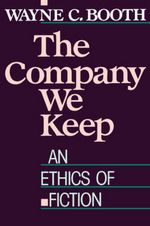 I opened Close Reading on Wednesday with a lecture focused primarily on choices: first ours, in the department, to include the course among our suite of requirements; then theirs to take it, which includes their choice to major in English (not something I’ve ever heard of anyone being pressured into); then, moving into the course materials, the choices writers make, from the biggest (to write anything at all) to the smallest (to use this word or that one). My broader pitch is for the connection between aesthetics and ethics; I quote Wayne Booth, which won’t surprise regular visitors here:
[The writer] has made a vast range of choices, deliberately or unconsciously: these characters and their conflicts rather than a host of tempting other possibilities; just which of their experiences to dramatize fully and which merely to ‘tell’ or narrate; which virtues and vices to grant them; which voice to grant the telling to, which metaphors to heighten and which to delete; where to begin and where to end; when to use style indirect libre and when to use actual quotations; which level of style to employ, and where; when to interrupt with commentary revealing the authors’ judgment of events …; and so on and on. It is that chooser who constitutes the full ethos of any work. It is living with that highly select set of virtues…that constitutes our full experience.
I propose that in our close readings we are trying to understand what that “chooser” is offering us. In the classroom we don’t typically move from understanding and appreciation to judgment, but in our lives, we often do, or should, so I also quote Orwell: “The first thing we demand of a wall is that it shall stand up. If it stands up, it is a good wall, and the question of what purpose it serves is separable from that. And yet even the best wall in the world deserves to be torn down if it surrounds a concentration camp.” It’s harder to know if a work of literature stands up than it is to tell if a wall does, just as it can be much harder to be sure what that literary “wall” surrounds. But I think — I hope — that thinking of their reading as something that at least potentially has ethical implications makes our academic project of becoming good close readers seem more than just an academic exercise.
 In today’s tutorials we looked at one writer’s specific choices, comparing Robert Frost’s “In White” to the later, much more famous version, “Design.” You can see the two poems side by side here, if you’re curious. Looking at different versions of the “same” poem is a nice way to provoke discussion about the difference a specific word makes — consider the difference between “dented” and “dimpled” in the first line. (I actually used a reader for this class once that was all poems in various revisions.) It’s not so much about explaining why the later version is better, though in this case it does seem to me conspicuously so. It’s about seeing the significance of the poet’s choices come into focus when you consider what else he might have said. A lot of the changes in the later version really bring out the problem of agency, for instance: if there are “characters,” who is their author? And so on — from the title to the last line, there are lots of things to consider. It’s a small-scale exercise, but I think it was a good way to get us started.
In The Victorian ‘Woman Question,’ Wednesday was for getting organized and today was for establishing some context, meaning I lectured, for the one and only time I will do that in this seminar class. I have found that with students arriving from many different directions, it is helpful if I give everyone a common framework at the outset so I go over some key terms and concepts — some generalizations about the “separate spheres,” the ideal of “the angel in the house,” that sort of thing .Then I explain a bit about women’s education in the period, and about some of the central legal issues with marriage and property — and I also sketch out some of the special challenges of being a woman writer at this time. I try to emphasize that the “woman question” really was a “question,” and that it was posed as well as answered in many different ways, as our readings will amply illustrate.
For Monday we’re reading Frances Power Cobbe’s terrific essay “Criminals, Idiots, Women, and Minors”:
At the head of this paper I have placed the four categories under which persons are now excluded from many civil, and all political rights in England. They were complacently quoted last year by the Times as every way fit and proper exceptions; but yet it has appeared to not a few, that the place assigned to Women amongst them is hardly any longer suitable. To a woman herself who is aware that she has never committed a crime; who fondly believes that she is not an idiot; and who is alas! only too sure she is no longer a minor,—there naturally appears some incongruity in placing her, for such important purposes, in an association wherein otherwise she would scarcely be likely to find herself. But the question for men to answer is: Ought Englishwomen of full age, in the present state of affairs, to be considered as having legally attained majority? or ought they permanently to be dealt with, for all civil and political purposes, as minors? This, we venture to think, is the real point at issue between the friends and opponents of “women’s rights” . . .
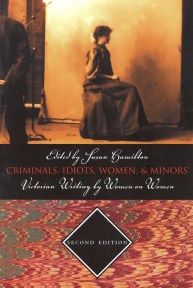 For a somewhat different perspective, we’re also reading Margaret Oliphant’s essay “The Condition of Women.” (Both are in Susan Hamilton’s excellent Broadview collection, which some person named “Maitzen” calls “an indispensable volume” in her sincerely enthusiastic blurb for it.) And we’re reading the first chapter of Mill’s The Subjection of Women, which we’ll finish for Wednesday.
Usually now when I teach a seminar class I have students give group presentations, and one of the requirements is that they have to engage the rest of the class in some kind of activity — they aren’t allowed to hold forth on their own for more than 10-15 minutes of their time. I always look forward to the creative things they come up with. In previous years, for example, I have played “Who Wants to be a Pre-Raphaelite” and done a “Choose Your Own Adventure in Wildfell Hall” in which we tried to extricate Helen from her bad marriage without violating convention, law, or her character as we understood it. But things don’t have to be so elaborate: I have also had really successful presentations that relied on more conventional but very valuable things like break-out discussion groups that reported back on key themes or passages. The first presentation for this term will be next Friday, so that guarantees me one class where I am not in charge. Hooray! Because I was reminded at the end of my third class hour today that running the show — whether lecturing or coordinating discussion — is pretty tiring.
OK, there we go. Nothing fancy, just another report from the field. Yet, having said that, I continue to believe that in addition to helping me be a more self-conscious and accountable teacher, these posts do, in their own small way, serve a larger purpose.
 It happens so gradually at first: there’s a slight chill in the evening air, the sky is a little darker on my morning run, the leaves look just a little less green. Then a faint hum begins on campus: more people are in their offices, the sidewalks are a bit more crowded, signs of arrivals and departures — abandoned sofas and mattresses, extra trash bags, boxes for recycling — appear in the neighborhood. It’s at once depressing and enlivening: summer is over, and soon we’ll be back at school.
 So, what will I be busy with this term? I have just two classes, both ones I usually enjoy teaching very much and both of which I haven’t taught since 2011-12. The first is English 3000, Close Reading, which is part of our suite of required classes for majors and honours students. They don’t have to take English 3000 in particular: they have to chose one of our ‘theory and methods’ courses, which also include The History of Criticism and Contemporary Critical Theory. The first time I taught English 3000, in 2003, that wasn’t the case: then, it was one of two classes we’d introduced that were to be core requirements for every student in our program (the other was a survey, Literary Landmarks). Then, it had an enrollment of 120; this year, it is capped at 60 and right now has 42 students in it — so, quite a different undertaking. Still, my approach to the class was shaped by thinking about it as something that should be as useful and as engaging as possible to every English student — to every reader, in fact. It is actually the most conceptually interesting class I’ve ever developed (for me, at least) because it isn’t organized around content, the way my classes usually are, but around a method, a habit, a practice.
 In addition to working on how to read attentively (including learning precise vocabulary for explaining what we read), I try to focus our attention on why it matters to read carefully, not just for class but for life. In working out my approach, I drew especially on Wayne Booth’s The Company We Keep and on the ways he links aesthetics to ethics. My hope is that this connection motivates students to see our work, not as an intellectual parlor game, but as something with vital implications for living an examined life. We’ll be reading a selection of poetry and short fiction, and then really digging into Middlemarch and The Remains of the Day. The juxtaposition of these two very different novels has proven extremely fruitful in past iterations of the course. There is always some grumbling about Middlemarch (“it’s TOO LONG to read in a one-term course,” a student once exclaimed in her course evaluation — which amuses me because of course I always teach it in one-term courses, which are all we offer now, and usually with four other fairly long books). My justification is that if we’re going to pay really close attention to a novel, it should be a novel that I am confident will reward that attention. And we take five whole weeks to read it, so we don’t exactly rush through it.
 My other fall class is an upper-level seminar, The Victorian ‘Woman Question.’ It has 23 students in it, which is actually pretty big for a seminar — it’s going to be a tight fit, for instance, getting in all the student presentations. But if past years are any indication, the discussion should be fairly robust. I’ve done this class with an exclusive focus on fiction, but this year I’m doing my more standard mix of genres. We’ll start with some non-fiction, including Mill’s The Subjection of Women and essays by Frances Power Cobbe and Margaret Oliphant (included in Susan Hamilton’s excellent Broadview anthology Criminals, Idiots, Women, and Minors), then we’ll read The Tenant of Wildfell Hall, The Mill on the Floss, Aurora Leigh (all of it, hooray!), The Odd Women, and an array of other short poems and stories. From the outset I emphasize that there wasn’t just one ‘question’ about women’s roles, and there certainly, too, wasn’t just one ‘answer.’ I provide some historical context at the outset, including information about women’s legal, economic, political, and educational realities, and then we approach each of our readings to see what terms it sets for the debate: how it poses and answers the ‘woman question.’
 I had hoped that
  I’ve been roughing out schedules for my 2016-17 courses — even the winter term ones, because before I can order books for them I need some idea of how the readings will fit in. As I consider how best to allocate class time, especially for my first-year class, I’ve also been thinking about a very interesting conversation I had recently with a former student who now works in a Dalhousie office concerned, among other things, with understanding student retention.
 Technically, this post should really be called “This Week For My Classes,” since of course I’m not actually teaching any right now. In between other projects, though (mostly finishing a small essayish review of Mary Balogh’s Only Beloved for the next issue of Open Letters — yes, that’s right, I am trying my hand at writing a little bit about romance, thoughtfully, I hope, yet while avoiding the pitfalls of the dreaded “romance think piece”) I am chipping away at preparations for next year’s offerings, particularly the one completely new class, which is
  Following on that simple (if somewhat shoulder-shrugging) conclusion, I have decided not to spend a lot more time shopping for possible main texts to assign but just to call it for the ones that are my top candidates at this point, so that I can think about how to frame and teach them in particular (and what shorter texts to use to supplement them). So that means (I think – I haven’t actually placed the order with the bookstore yet)
  I’ve been looking at the syllabi for two of my colleagues who’ve taught this class recently and one thing that struck me is how many more readings they included. My big three won’t be my entire reading list, of course, but apparently I just take things more slowly than they do — they both typically take one week per novel, for instance (not super-long novels, but including, for example, King Solomon’s Mines, which is 300+ pages in the Penguin edition, or Frankenstein, which is around 200 pages). Looking at their schedules, I wondered if I should try to fit more in, so I did up a version of the timetable with Lady Audley’s Secret added — but unless I sped everything up more than I’m comfortable with, that meant leaving out most of the short fiction I’d included. In the end I think I’d rather allow lots of time to talk about particulars (and also take up class time with writing instruction, editing workshops, and that kind of thing — which I’m sure my colleagues do too, but I’m not sure how they manage to get it all done and still have robust discussions of so many complex readings). Pacing is one of the many mysteries of pedagogy, of course: there is no right rhythm, and what works depends on your own style as well as the purposes of the class. I usually spend three weeks on Middlemarch when I teach it in the 19th-century fiction class, but we take five weeks on it in Close Reading — and it would certainly be possible to take an entire semester for it, if only there were such a course (or, if only I dared to offer such a course and anyone actually took it!). Anyway, I reverted to a schedule with just three full-length novels, with short stories interspersed, and for now I like the looks of it. I can always order a fourth book later on if I change my mind. In the meantime, with the main titles chosen, I can set some parameters for my preparatory research.
 I have done a few more small things for teaching prep too: I began adjusting the plans for my two fall courses — both of which I’ve taught a few times before — to fit the university’s revised fall schedule (which includes a week-long fall reading break for the first time), and I’ve started poking around on our new Learning Management System, Brightspace. So far I don’t like Brightspace at all, mostly because we seem to have chosen the version that doesn’t let us customize any of it, even the colours. That takes a lot of the fun out of it! Obviously the real purpose of these things is utilitarian, but the more you restrict what I can do with it, the more inclined I am to use it as a document dump and nothing else. People who’ve been using Brightspace for a while tell me they like it better than Blackboard, though, so I’m trying to stay optimistic that in ways I haven’t yet discovered, it’s actually an improvement and not just a change.
 Where does the time go? It seems like I only just finished reading
  I have also been reading, in dribs and drabs, the critical books I’ve collected about romance fiction and Westerns, taking some first steps towards prepping for next winter’s ‘Pulp Fiction’ class. I have been enjoying the new ideas and frameworks raised by these materials, and they have started a lot of things turning around in my head. But since I haven’t been working on them in a very concentrated way this week I haven’t felt I had anything in particular to say. I’m sure I will! And I have also been kicking around, in a very preliminary way, how I might organize the course, and especially the readings. I am puzzling, for instance, about whether it would work to assign only full-length novels in a first-year course. I have taught many different incarnations of our introductory classes, but every one has included some blend of short and long readings. Short ones, of course, have many advantages when you’re working with beginning students: they can get the whole thing read reasonably quickly and you can begin to practice the analytical skills you want them to learn with material they can easily manage. Then you can build up to longer texts. In some of the genres we’ll cover (detective fiction, for instance) it is easy enough to find good short options, but this seems harder to do with romance. (I found one that I think might work quite well — Liz Fielding’s “Secret Wedding,” which is cleverly metafictional about romance conventions — but it seems to be available only in a Kindle edition, and I’m currently stumped about whether that rules it out as a required reading.) I’ve also been thinking about starting with some Victorian ‘pulp,’ specifically Lady Audley’s Secret — but I’m worried that they might bog down in it, especially if it’s the first thing we read. You can look forward to (or dread, I guess) many more updates as my thinking about this course develops. And, as always, I will welcome input!
 Classes ended last Wednesday, and I held my first final exam at 8:30 the following Saturday morning. That seemed hasty to me! Students have a lot going on at the end of term, and two days isn’t much time for them finish other assignments, regroup, and rest up a bit. On the bright side (for me, at least) I don’t have another exam until next Tuesday, so this has given me plenty of time to get that first batch graded. Since the only thing I have left to do for my other exam is copy it, I have a nice little window to sort out my own end-of-term mess and start organizing — literally and mentally — for my summer reading and writing projects. I spent some cheerful time this afternoon filing papers, reorganizing my bookshelves, and reflecting on the year that was.
 Often at the end of term I am full of resolutions about things I will do differently next time. One thing I am almost certain I’m going to change is my use of reading journals in the 19thC Fiction course.
  I have been very glad to see eloquent and well-informed responses to Ron Srigley’s screed “Pass, Fail” in The Walrus (which largely reiterates his screed in the Los Angeles Review of Books). I was disappointed in both venues, frankly: it seems to me to show poor editorial judgment to publish rants of this kind without checking their intemperate anecdata and wild generalizations against at least a broader sampling of facts and opinions about the very complex business that is higher education. I would have expected both journals to think better of themselves and their readers. Both
  But then I realized that I have said so, that I have made my argument — over and over, for almost 10 years. Here at Novel Readings I have posted regularly about my teaching, for instance, since 2007, when I began my series on
 Not for them — for me!
 Another reason teaching is a tonic for me, though, is precisely that I am not faking my interest in the course materials, and time spent really focusing on them brings me back in touch with the things that brought me into this profession in the first place. I loved being an English student myself (well, I loved being an undergraduate student – I mostly hated being a graduate student), and it’s in the classroom that the reasons for that are most present to me: the books themselves, of course, but also the open-minded engagement with them — teasing out what is most interesting, looking at the details and trying to put them into patterns that illuminate the whole, thinking and talking about the ideas that animate them, and all this, best of all, in conversation with other keen readers who bring their own questions and ideas to the process. This week’s readings are very purposeful, too, which gives our work on them extra urgency: in Mystery & Detective Fiction, we’ve just wrapped up

