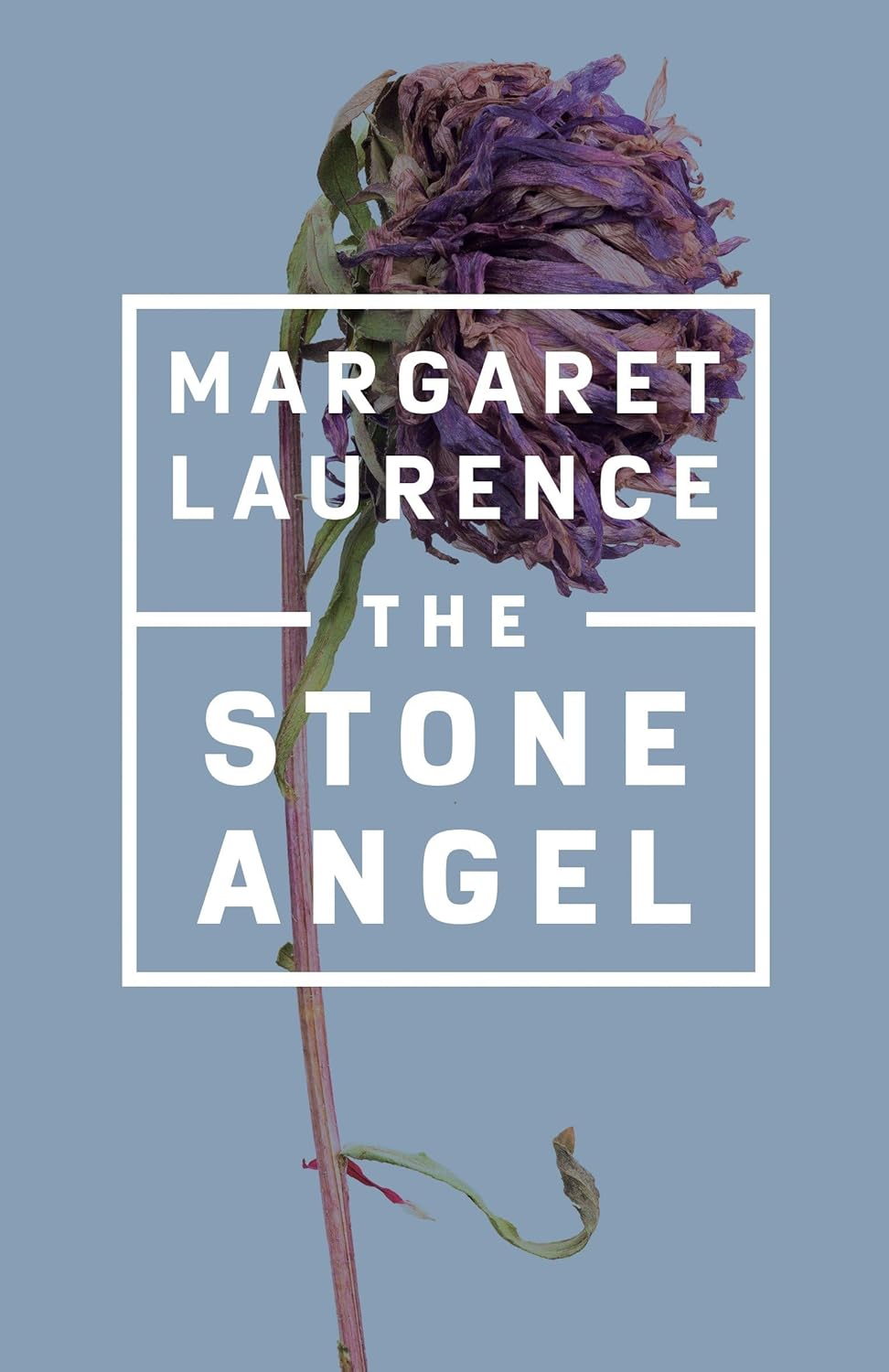

Inspired belatedly by the discussion of Margaret Laurence’s The Stone Angel on the One Bright Book podcast, I replaced my donated copy (see, this does sometimes happen, that I purge a book and then reconsider!) with the nice Penguin Modern Classics edition and reread it after–I don’t even know how many years. I am sure that whenever I last read it, at least 20 years ago, I would felt interest and reluctant sympathy for its protagonist, Hagar Shipley, rightly described by her son Marvin as a “holy Terror,” but my relationship with her would have been based on imagining getting old, not on my own experience of it. This time through, though given average life expectancies these days, at just-turned-59 I don’t really count as “old,” I felt her rage and horror and refusal at the indignities and compromises of old age to my core. Nobody every really knows what lies ahead–except that we all know that it’s coming for us in some form (unless it isn’t, which is no consolation).
There is a lot going on in The Stone Angel, through Hagar’s retrospective account her of childhood, her difficult marriage, her losses, her eventual, still difficult, independence. But this seemed to me where the novel’s fiercest care lies: in Hagar’s fierce, ruthless, but inevitable also both foolish and futile struggle to stay unequivocally herself to the very end. Laurence plays out this losing battle artfully through Hagar’s first-person narration, which gives us the immediacy of her voice and her experiences but also lets slip over and over how Hagar herself is slipping, even as she denies, even to herself, that she is.
“Here I am,” Hagar says at one point,
the same Hagar, in a different establishment once more, and waiting again. I try, a little, to pray, as one’s meant to do at evening, thinking perhaps the knack of it will come to me here. But it works no better than it ever did. I can’t change what’s happened to me in my life, or make what’s not occurred take place. But I can’t say I like it, or accept it, or believe it’s for the best. I don’t and never shall, not even if I’m damned for it. So I merely sit on the bed and look out the window until the dark comes and the trees have gone and the sea itself has been swallowed by the night.
“Even if I”m damned for it”: that’s the spirit of Hagar, and also, that’s the spirit, Hagar! She’s a quintessentially unlikeable character–rude and rough and proud and defiant–and yet there’s something inspiring as well as refreshing in her, and also in Laurence’s, refusal to pander to the notion that an old woman should be a harmless creature, gentle, pliant, no trouble to anyone. It’s not the dying of the light Hagar rages against: it’s life, with its injustices, its griefs, its disappointments. It’s odd that such a negative force should nonetheless be uplifting. Her intransigence is surely not exemplary, but the novel conveys with great power the imperative she fights to live up to: to be herself, Hagar, to the bitter end.
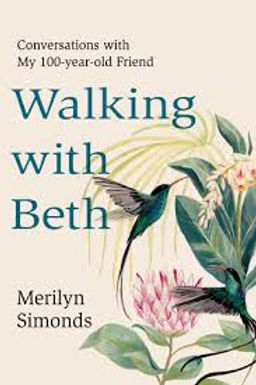
Merilyn Simond’s Walking With Beth could hardly be more different in tone or spirit, even though it too highlights truth to self as essential to aging. Walking With Beth recounts the many conversations Simonds had with her beloved friend Beth, mostly during the pandemic when regular walk-and-talk sessions helped them both cope with the stress and isolation of lockdown. They are 30 years apart: Simonds is in her early 70s when the walks begin and Beth is 101. “Now I am the old lady,” Simonds reflects; “Still, I am not so old that I can’t find a woman older than I am. Beth is my old lady now. My last guide into the future.” What wisdom does Beth have for her, from her position as, not just an elder, but one of the eldest? How can her choices, her way of being so old, help Merilyn imagine herself into an old age that is something other than a fading away?
I liked Walking With Beth but I did not find it a particularly revelatory or inspirational read. Beth is clearly an exceptional woman; like her past, her aged present is rich with creativity and generosity. She has no trouble filling her days, as far as her energy and health allow. “Many people reach retirement,” she tells Merilyn,
never having thought about what has given them pleasure or satisfaction in their life . . . What can take them into the next stage. They don’t realize they have no need of a boss or a job description. Any number of activities are self-initiated. I can’t believe how much has happened between 1988, when I officially retired from teaching art therapy at Concordia, and now–dance, embroidery, my collages–clusters of activity, each one different, yet in a way they are part of one long, continuous journey. Every day, at every age, you wake up, your eyes open, your whole being opens, and off you go!”
Is it because I have in fact been thinking a lot about retirement, and also reading books and listening to podcasts about it, that I found this banal? But Walking With Beth isn’t really a self-help or advice book, so maybe that’s unfair: it’s really a record of a friendship, and considered from that angle it is more satisfying. It is low key, episodic, digressive: sometimes that works (for me), sometimes it feels unfinished (to me). Partly because of Simonds’s own medical problems during this period, it highlights physical decline, often in a dispiriting way. “Younger birds,” Simonds observes,
may be more active and have more vibrant plumage, but birds, at least to the human eye, have been spared the equivalent of the white hair, slack, wrinkled skin, stooped back, clouded vision, and tangled mind that mark advanced age in our species.
“It is the terrors of the mind that frighten me the most,” she adds, but “we cannot avoid the endgame; we can’t even choose which one we’ll be forced to play. All we can do is choose where we cast our eyes,” and she and Beth, and her book, nudge us consistently to look towards the light:
Today, the sky is bright, the Sierra Madre mountains lift the horizon as they have done for thousands of years, the birds in the pepper tree outside my window are singing, and my heart, nudging aside my mind, sings too.
OK, that’s nice, but again, it shades into banality. Nice as the book is, lovely as the friendship it centres on is, deft as some of the writing is, it made little impression on me–much less than, say, Death of an Ordinary Man, which is a lot less nice but somehow a great deal more comforting, or at least more bracing. I actually know someone who walks every week with a friend of hers who is a couple of decades older: they both really look forward to their walks. Maybe as a vicarious experience, it’s bound to be less energizing. Simonds, who has had to clear out the belongings of many of her loved ones after their deaths, comments that photographs are rarely of great interest to those besides the photographers: I had something of the same feeling about this book, that it takes a lot to make a friendship of yours mean much to someone else, and Walking With Beth doesn’t quite deliver.
To be honest, I sometimes have the same feeling about podcasts: it’s a lot less fun listening to someone else’s discussion of a book than it is being in the discussion myself. It can make me feel like Frankenstein’s monster watching a happy family through the window. However! Now that I have finally reread The Stone Angel, I look forward to listening again to the One Bright Book episode. And I’ll be thinking about those walks and those talks. I love walking and talking (or sitting and talking) with my own friends, but it’s such an occasional pleasure, as we all seem to be so busy.

