Is Jane Austen a “Romance Novelist”?

new-austenI feel as if I should begin with a disclaimer: this post is just a preliminary attempt to sort something out for myself that I am sure has been discussed a lot already! I know it’s not a new question, but it is a new one for me to be thinking carefully about — and that’s what my blog is for, not for presenting absolutely finished position papers but for exploration. So don’t jump on me if, for you, this is old news or already a settled question! Instead, tell me what you think, since one thing I’m hoping will come from writing a little about this question here is that I’ll get some leads and ideas for how to think about it better, or where to read more about it.

I’m puzzling over whether Austen is a “romance novelist” (and I’m going to keep the scare quotes, for reasons that I’ll get to in a bit) because I’ve begun doing research in preparation for the romance unit in next year’s Pulp Fiction class (another disclaimer: it’s just a first-year writing class organized around a fairly imprecise definition of “pulp,” so I’m not going to get very ambitious about the theoretical or critical grounding — I just need to sort out some terms and frameworks for talking about our one or two readings in the genre).*

One much-cited scholarly work in this field is Pamela Regis’s A Natural History of the Romance Novel (2003), so that’s one of the first ones I took out of the library to read. It’s generally very helpful, and it’s also thought-provoking, for its tone as much as its argument. It is certainly less rah-rah than some of the more fannish books I’ve peered at about the genre (such as Sarah Wendell’s Everything I Know About Love I Learned From Romance Novels (very ably reviewed at Open Letters by Jessica Miller). It still differs from most academic criticism I’ve read, though, in being very openly a work of advocacy: it includes a chapter called “In Defense of the Romance Novel,” for instance; it declares that its purpose is not just to historicize or analyze the genre but to “refute” negative critical perspectives on it; and it includes many celebratory claims on behalf of romance fiction — just for example, “the romance novel is … about women’s freedom. The genre is popular because it conveys the pain, uplift, and joy that freedom brings.”

RegisNot that there’s anything wrong with that! Lots of (maybe even most) critical work is at least implicitly advocating on behalf of its specific topic — whether for its underestimated importance to literary history or for its political efficacy or for a right understanding of its aesthetic properties. Romance is a special case, too: as pretty much everyone I’ve read who writes about romance says at some point, it seems to call for overt special pleading simply because it is so routinely dismissed and its readers and writers so routinely shamed. If Regis seems at times to protest too much, it’s probably just that she knew her choice of subject would be met with skepticism, if not derision, and not just by her academic colleagues. (I expect that more recent scholarship is less defensive, as genre fiction and popular culture more generally have become increasingly familiar parts of the academic landscape. Eric Selinger and Sarah Frantz’s collection New Approaches to Popular Romance Fiction, which came out in 2012, is also on my reading list; I’ll be curious to see if I’m right that the tone has changed.)

Regis’s book is built on a particular (but also very general) definition of romance novels: “a romance novel is a work of prose fiction that tells the story of the courtship and betrothal of one or more heroines.” She expands on that definition by offering a specific list of structural features — “the eight essential elements of the romance novel” — including “the meeting between heroine and hero,” “the barrier to the union of heroine and hero,” and “the betrothal.” Then, using this definition, she tells a history of the romance novel (as she has defined it) through exemplary texts, starting with Pamela then going through Pride and PrejudiceJane EyreFramley Parsonage, and A Room with a View. It’s not until Chapter 12 that she turns to what she calls “the popular romance novel” — to, that is, all of the books I think most people actually mean when they use the term “romance novel.”

At the end of her discussion of A Room with a View, Regis comments that “it would be [Forster’s] only romance novel.” In a way, then, I could just well have called this post “Is E. M. Forster a ‘Romance Novelist?'” (or Bronte or Trollope or Richardson). As far as I’ve seen, though, it’s really just Austen among these canonical authors who comes up repeatedly in the romance context, and it’s Pride and Prejudice that Regis uses to illustrate her outline of the “eight essential elements.” So I’ll stick with her as a test case for how or whether we want to define “romance novel” as broadly as Regis does.
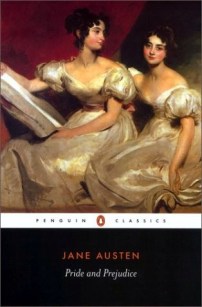
pride-and-prejudice-penguinRegis is completely right that by her definition, Pride and Prejudice is a romance novel. But here’s the thing: to me, that suggests she’s using the wrong definition. First of all, it’s too broad to be interesting (even her list of canonical “romances” hardly seems to hang together in a meaningful way, outside a very bare skeletal similarity). It also seems anachronistic, in the same way that calling The Moonstone a “mystery” does: there wasn’t really such a category at the time (that’s not really the kind of book Collins himself thought he was writing), and applying our current terms so absolutely means losing sight of the genealogy of our modern genres. Books can be closely related in kind (or, as Regis sets it up, in structure) with being the same kind exactly.

These are already debatable objections, of course: labels are always more or less arbitrary, and we redefine and recategorize things all the time based on new theories and approaches. So here’s another reason I don’t think I like Regis’s approach: I think that insisting that Austen writes “romance novels” indistinguishable in kind from today’s “popular” examples has inapt and potentially unwelcome consequences. For one thing, if this means that Austen and, say, Mary Balogh and Loretta Chase are doing the same thing, it seems to me to follow that Austen is doing it better (because much as I like Lord of Scoundrels, if it’s really an apples to apples comparison, I’d certainly consider Pride and Prejudice the better novel). Georgette Heyer? Fun, but not as artful or incisive or thematically rich as Austen. Balogh? Don’t even try. Lump them all in together, that is, and a hierarchy emerges that’s almost inevitably to the disadvantage of all the not-Austens.

Regis herself would disagree, I think — and others no doubt would too — that we can or should differentiate on the basis of literary merit in quite this way. Some would disavow the whole notion of literary merit, in fact, but Regis seems happy enough making evaluative claims. In her chapter on defining the romance novel, she uses Katherine Gilles Seidel’s Again as an exemplary case alongside Pride and Prejudice, claiming that it is a “complex, formally accomplished, vital romance novel” that makes nonsense of the idea that popular romances are just “hack work”:

Seidel incorporates the eight essential elements of romance, and two of the three incidental ones, in a manner so masterful that it leaves no doubt as to the vitality of the form in contemporary hands.

“Masterful,” no less! I’m only a couple of chapters into Again (which I dutifully rushed out to get), so I can’t be sure, but if it’s anywhere near as good a novel (qua novel) as Pride and Prejudice, I haven’t seen the signs, even though I’m enjoying it fine so far — which is exactly why my intuition is that Regis is coming at this question in the wrong way. We have to be able to acknowledge the differences on terms that don’t set contemporary romance novels up for failure.
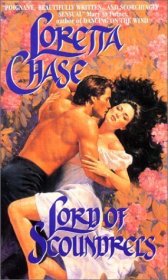
scoundrelsAlternatively, you could argue (as I have seen done) that romance, like all genres, comes in both “high” and “low” — or literary and popular — versions.** There’s still a kind of hierarchy, but now you’re separating out those who “transcend the genre” (to use the phrase Ian Rankin hates when applied to crime fiction) from those who happily take their place within it. No direct comparisons are called for, then, and Heyer or Chase (or choose your preferred exemplars) get considered more or less on their own terms. I still think the larger category (the one being subdivided into high and low forms) conflates too many different kinds of things, and the end result can be condescending — it implies, or could, that the serious stuff is going on in some sense over the heads of both readers and writers of the popular incarnations of the genre, or that those who really take themselves and their work seriously will aim at that transcendent kind. But at least this approach doesn’t pretend all novels organized around love and marriage are the same kind of books.

I can see that, strategically, it serves Regis well to define the “romance novel” so that she can include Austen. That way the aura of Austen’s literary prestige can be shared with the popular writers who are the ones who actually need defending. (There may be some circles in which Austen is still shrugged off as a trivial miniaturist, but her iconic cultural status is surely beyond doubt.) But it could just as well backfire if it sets up the wrong expectations: yes, the plot structure of a contemporary popular romance is likely to resemble that of Pride and Prejudice, but if you expect to be reading the next Jane Austen, aren’t you almost certain to be disappointed? Maybe another way to think about it is that Austen is not celebrated because of how she incorporates the eight essential elements of romance (never mind the many “incidental” ones) but for other reasons, and so what Regis is doing is not thoroughly defining a category but encouraging a vast category error. Instead, wouldn’t her defense be more convincing if her definition were narrower — if it were based, not on 18th- or 19th-century marriage plot novels but on, well, actual “romance novels”?

Ay, there’s the rub, though, right? Because how do you define them? Where do you draw the lines? I sometimes say to students in my mystery class that genres and subgenres are themselves fictions, but useful ones, and that while it’s true you can’t perfectly define them, often enough you know them when you’re reading them. I think, too, that with the popular genres we’re familiar with today, while it may be difficult to pinpoint their exact beginnings, eventually the time comes when it is possible for someone to say “I’m going to write a detective novel” (or, even more specifically, a police procedural, or a feminist revision of hard-boiled detective fiction) because that is now a recognizable literary form, with a tradition and conventions of its own. Similarly, just because the margins around a genre are fuzzy doesn’t mean there’s no center. As Regis points out, “formulaic” is usually a pejorative term but all fiction is in fact driven to some extent by formulas; works that clearly belong to a particular genre just embrace and employ them in a more conspicuous way. Though intention is a tricky business, I might go so far as to say that what we now call “genre fiction” is defined by precisely that kind of knowingness on the author’s part (which is also an invitation to the knowing reader): this is the game I’m playing, I know the rules, I use or subvert them at my will, this game board is where I feel at home, my teachers and role models are the ones who showed me how it’s done so that now I can do it my way.

So by my definition, Jane Austen is not a “romance novelist.” Pride and Prejudice definitely has a crucial place in the history of the romance novel (as The Moonstone does in the history of the detective novel), but it’s part of the genre’s origin story, and that’s not what we’re talking about today when we talk about “romance novels.”

Or at least, that’s what I think so far! Now I feel that I may have taken a long time to say something nobody else will find surprising or controversial at all — but we all have to work through things on our own when we’re learning, right?

*Can you tell from these disclaimers that I have learned just how engaged, informed, and opinionated many romance readers and writers are?

**A belated additional point: Also, one era’s “popular” version may well become a later era’s “classic” or literary version (cue obligatory Shakespeare reference).

Weekend Miscellany: Reading and Watching

SweetDisorderIt’s a busy time at work, with papers and midterms piling up a bit, so it’s still a bit quiet over here at Novel Readings.
I have been doing some extra-curricular reading, but the serious stuff has been for reviews, which I don’t usually anticipate with commentary here. I’ve been filling in the interstices with some light reading, mostly romances. I’ve been trying out some more recent “historicals” to see if I can find more writers among the many, many there are to chose from that I can reliably enjoy. I have had pretty mixed success with historicals up to now: a lot of them seem really thin and formulaic, and only a few authors so far (notably Cecilia Grant and, sometimes, Loretta Chase) have become personal favorites. I read Rose Lerner’s Sweet Disorder and quite liked it (I’d read her In For  a Penny before, and liked it too). Then, encouraged by having mostly liked My American Duchess, I also read another of Eloisa James’s, Any Duchess Will Do, and I enjoyed it as well, enough that I’ll probably keep poking around in her vast back catalog. Both of these books, however, did add to my sense that, for me, the pacing, or maybe the balance, is off in a lot of modern romance novels: when the hero and heroine have sex fairly early on, instead of as the culmination of their developing relationship, the book becomes (again, for me) too much about their lusty goings-on and the romantic tension is lost. Other forms of angst are typically introduced, something to tear them apart before they can finally have it all, but I usually find that angsty part tedious and the final resolution belated. This is one reason I often skim the last third of these books: the fun part seems to be over before then. In contrast, I just reread Heyer’s Venetia and it seemed to me perfectly balanced: just sexy enough, just tense and surprising enough, and just charming enough to be thoroughly satisfying.

longviewThe “literary” book I’ve been reading “for fun” is Elizabeth Jane Howard’s The Long View, which I bought after my book club read and enjoyed The Beautiful Visit and, in the same week, Hilary Mantel coincidentally published a persuasive essay about Howard in which she singled out The Long View as exceptional. It is very good of its kind, I think, and yet I am bogged down about half way through it because right now that “kind” feels claustrophobic. It’s an emotionally intense, scrupulously nuanced examination of an unhappy marriage — well, it’s unhappy when the novel begins, but because of the novel’s ingenious backwards-chronological structure, the relationship is building towards happier beginnings. Howard’s prose is wonderful and the psychological, social, and sexual complications of the couple’s life together are exquisitely, if painfully, drawn, but the novel feels airless to me: it doesn’t seem to be offering me any sense of the broader view of their life — of its impersonal contexts. The novel feels too personal, too minute, and it makes me restless for a narrative, or a narrator, that looks around and draws connections between these small complicated lives and the bigger world they’re set in. I may be missing ways in which Howard’s subtleties do exactly that, and of course since I’m not finished the novel yet, I can’t say whether things change in it, either. But my boredom (shocking! but true) with the novel got me thinking about the books that have really excited me lately and they have tended to be books with wider scope, often (though not always) historical: Dunnett’s King Hereafter, Nicola Griffith’s Hild, Adam Johnson’s The Orphan Master’s Son. Is it because I already live a narrowly personal existence (and spend enough time scrutinizing the complex nuances of marriage on my own behalf) that right now I want fiction that does something, goes somewhere, else? Or maybe it’s just that when I’m busy and distracted, I lack the patience for novels that are all about the finely-wrought sentence and the emotional minutiae of daily life.

happy-valleyAlso, when I’m busy and distracted, the lure of television is very strong! And, conveniently, Netflix recently dropped two tempting series — the fourth season of House of Cards and the second season of Happy Valley — both of which we’ve now seen. In retrospect, I’m actually kind of sorry I watched House of Cards. After the third season, I wasn’t sure I wanted to see any more of it, and this season will almost certainly be my last. The show is just so unpleasant: the people are loathsome; the acting is … well, it has its moments, but mostly it’s uninspiring; the plot is absurd; and the show overall is so cynical, not just about the world it depicts but also, I think, about what its viewers want or will tolerate. I did admire the color palette and cinematography, but otherwise, it’s a show that made me feel bad about myself for wanting to see what would happen next. Happy Valley, in context, though very grim in its own way, is brilliantly acted and tells stories about richly human individuals trying to bring some sense and order into their lives, with a protagonist whose anger and toughness are offset by compassion and a strong, if often thwarted, desire for justice. Even the crimes, horrific as they are, come out of contexts that are believable and morally complicated. It’s also almost absurdly refreshing to see women play prominent roles without having to look like stick insects and wear ridiculous stiletto heels.

OK, that gets me about caught up! Now, back to the next book I’ll be reviewing, if I can just get it all read, and then to Hard Times, which I start with my 19th-century fiction class tomorrow. Now there’s a classic that still has something to say “for these times.”

Recent Reading: Romance, Reykjavik, and Relatives

In among my other recent chores and challenges I’ve read a few things chosen primarily for their likely distraction value. I don’t have a whole post’s worth of comments on any of them but I thought I’d round them up here, just to sort out my impressions of them.

juliejamesFirst, two romance novels: Julie James’s Suddenly One Summer and Meredith Duran’s Fool Me Twice. I really liked Suddenly One Summer. It’s more subdued than her others, but for me that was a plus. I still find it mildly annoying that all of her main characters are so relentlessly gorgeous, but the heroine’s anxiety issues in this one were both realistically and sympathetically conveyed, I thought, and I liked that the story line overall focused less on overcoming cynicism (which is often the core problem in James’s other novels) and more on taking risks and learning to trust. Fool Me Twice, on the other hand, ended up a ‘DNF’ for me. It was my first Meredith Duran, and the problem I had with it is the same I’ve had so far with the Courtney Milan novels I’ve tried: for me (and obviously others respond very differently) there was just too much of it. What I’ve found so far is that the longer and more ostensibly complex a romance novel gets, the more judgmental I get about whether it’s really a very good novel, rather than just an enjoyable read, and in these cases, I started finding the books tedious. With Fool Me Twice, I just couldn’t believe in either main character, and yet the novel went on and on about them. I am going to give Courtney Milan another try: I’ve been on the library waiting list for The Suffragette Scandal for a while and my turn just came up. And maybe there’s a Duran that would suit me better: I’m open to suggestions.

jarcityFollowing up on recommendations from both Miss Bates and Dorian, I’ve just finished my first Arnaldur Indridason mystery, Jar City. (When possible, I always prefer to start at the beginning of a series, even if it might not be the best of the bunch, because that way I’m not missing any pieces.) It took a while to get going, and at first I thought it was a bit too blandly reminiscent of Henning Mankell: is it perhaps an effect of the translations that so many of these northern crime novels sound so much the same? I got drawn in by the case, though, which proved genuinely interesting in ways that seemed quite original to me: I did not expect the story to unfold the way it did, or the motive for the crime to be quite what it was. It provoked some good questions about what counts as justice, but also about families, genealogies, and data — specifically, in this case, data about our genetic inheritance, which is going to be an increasingly pressing ethical issue, I expect. I didn’t get much of a feel for Erlendur himself: he didn’t seem terribly distinctive as a character. But I’ve got Silence of the Grave ready to read next, and maybe as I get to know him I’ll see him more clearly.

trollopeFinally, after being disappointed in Joanna Trollope’s Balancing Act, I decided to reread her earlier novel Marrying the Mistress, which I remembered thinking was excellent (and which I had been thinking of as also fairly recent but which turns out to be from 2000). I can’t quite put my finger on what makes Marrying the Mistress so much better — but it is. It is structurally very similar: it takes a family with a complex and carefully balanced set of relationships and changes the dynamic by introducing a dramatic change, in this case the husband-and-father’s decision to leave his wife of 40 years in order to marry the much younger woman he’s been having an affair with. It’s a cliched scenario but Trollope makes it feel very specific to these people, at this moment in their lives. She also plays in unexpected ways with our sympathies and with her characters’ loyalties; she discovers, for us, ways in which getting what you want, or what you think you want, might be very different than what you expect, as well as ways in which unwanted change, change that’s unkindly forced on you, might be right, and liberating, as well as painful. She’s very savvy about family loyalties and how people push and pull at each other. It’s not a very happy book, but it’s definitely a book about love.

I also read The Girl on the Train last week — but I’m going to be writing about that for an Open Letters feature so I won’t say more about it here.

Georgette Heyer: Romantic but not Sexy?

heyer cotillionI’ve just finished Cotillion, which is one of my favorite Georgette Heyer novels so far. Like The Grand Sophy (which was the one that helped me finally “get” why people enjoy Heyer so much), it’s laugh-out-loud funny, but it’s also very sweet. I was so pleased with the resolution to the romance plot, which turns on its head the expectation that the dashing rake will settle down under the influence of a good woman — or just that the dashing rake is in any way the best marriage prospect. Sure, he’s the sexiest one . But this time sexy just means  trouble — and in fact, so far I haven’t read another Heyer that is as explicit about someone’s rakish behavior, including his intention to make a beautiful young innocent his mistress (or one that is as blunt that this young girl’s mother will happily prostitute her daughter if she can’t score a rich husband for her). In this one respect, Cotillion is not just one of the funniest Heyers I’ve read but also, in the interstices, one of the darkest.

It got me thinking, though, that while Jack’s sexiness is set up as a particular kind of problem in Cotillion, due as much to his particular character as to the behavior itself (he’s quite the smug amoral rascal, is Jack), I have found Heyer’s novels generally much more romantic than sexy: in the ones I’ve read (still a relatively small sample, I realize), there’s been really no perceptible acknowledgement of desire, little of the frisson of physical attraction. And I’m not thinking just in comparison to other more contemporary Regency romance novelists I’ve read (Mary Balogh, for instance, whose books are both much less funny and much more sexually explicit, or Cecilia Grant, whose books conspicuously up-end conventions), but in comparison to 19th-century novelists including Jane Austen (the obvious comparison) or George Eliot.

I’m thinking, for instance, of the intensity of the scenes between Anne and Wentworth in Persuasion. Remember when he helps get her naughty nephew literally off her back?

In another moment, however, she found herself in the state of being released from him; some one was taking him from her, though he had bent down her head so much, that his little sturdy hands were unfastened from around her neck, and he was resolutely borne away, before she knew that Captain Wentworth had done it.

Her sensations on the discovery made her perfectly speechless. She could not even thank him. She could only hang over little Charles, with most disordered feelings. . . .  neither Charles Hayter’s feelings, nor anybody’s feelings, could interest her, till she had a little better arranged her own. She was ashamed of herself, quite ashamed of being so nervous, so overcome by such a trifle; but so it was, and it required a long application of solitude and reflection to recover her.

Persuasion-coverAFOr, a bit later, when he assists her into Admiral Croft’s carriage:

Yes; he had done it. She was in the carriage, and felt that he had placed her there, that his will and his hands had done it, that she owed it to his perception of her fatigue, and his resolution to give her rest. She was very much affected by the view of his disposition towards her, which all these things made apparent. This little circumstance seemed the completion of all that had gone before. She understood him. He could not forgive her, but he could not be unfeeling. Though condemning her for the past, and considering it with high and unjust resentment, though perfectly careless of her, and though becoming attached to another, still he could not see her suffer, without the desire of giving her relief. It was a remainder of former sentiment; it was an impulse of pure, though unacknowledged friendship; it was a proof of his own warm and amiable heart, which she could not contemplate without emotions so compounded of pleasure and pain, that she knew not which prevailed.

She’s so overcome with her feelings that “Her answers to the kindness and the remarks of her companions were at first unconsciously given.”

Or the equally intense encounters between Elizabeth and Mr. Darcy in Pride and Prejudice, when for all their hostility they can hardly take their eyes off each other? Their deliciously awkward encounter at Pemberley is quite erotic enough without a wet shirt: “They were within twenty yards of each other, and so abrupt was his appearance, that it was impossible to avoid his sight. Their eyes instantly met, and the cheeks of each were overspread with the deepest blush.”

And speaking of blushing, what about Dinah, in Adam Bede? She can’t be in a room with Adam without becoming suffused with feeling: “It was as if Dinah had put her hands unawares on a vibrating chord. She was shaken with an intense thrill, and for the instant felt nothing else; then she knew her cheeks were glowing, and dared not look round.” The details of Arthur Donnithorne and Hetty’s affair may have been specified to what some contemporary readers found a shocking degree, but we know what they do (and what consequences it has), not what they feel in the moment.* It’s impossible to miss, though, that Dinah’s attraction  Adam is both physical and nearly irresistible.

millflosspaperbackAnd speaking of physical attraction, what about Stephen and Maggie in The Mill on the Floss?

 Who has not felt the beauty of a woman’s arm? The unspeakable suggestions of tenderness that lie in the dimpled elbow, and all the varied gently lessening curves, down to the delicate wrist, with its tiniest, almost imperceptible nicks in the firm softness. A woman’s arm touched the soul of a great sculptor two thousand years ago, so that he wrought an image of it for the Parthenon which moves us still as it clasps lovingly the timeworn marble of a headless trunk. Maggie’s was such an arm as that, and it had the warm tints of life.

A mad impulse seized on Stephen; he darted toward the arm, and showered kisses on it, clasping the wrist.

Are there “mad impulses” in Heyer? There may be, but so far I have yet to detect any such erotic undercurrents. More, I have sometimes felt mildly uncomfortable at the romantic resolutions precisely because the relationship considered as a sexual relationship seems inappropriate given the heroine’s youth — not just in years, but in outlook and behavior. This was most conspicuous to me in The Corinthian, but I had a similar reaction, if milder, to Sylvester, and even to Cotillion — where things are not improved in that respect by Kitty’s openly thinking of Freddy as a big brother pretty much until they finally kiss. Even Esther squirreling away Alan Woodcourt’s flowers in Bleak House seems more like an adult awareness of sexuality than anything I’ve read in Heyer.

Not that there’s anything wrong with that! I’m not complaining: just observing, and then wondering what, if anything, the novels’ aura of innocent fun might have contributed to their enduring popularity. Unlike the 19th-century novels I’ve quoted, her novels surely would not “bring a blush to the cheek of a young person.”

I’ll be interested to hear from those of you who’ve been reading Heyer longer than I have. Do you think I’m right that her novels give us love but little or no desire? Might it be Heyer, not Austen, who fits G. H. Lewes’s remark that “there are worlds of passionate existence into which she has never set foot”? Or am I missing something (see fn below!), or have I just not read the sexy Heyers yet?


*This is arguably not true. It hadn’t occurred to me until I read the notes to the Broadview edition of Adam Bede, for instance, that in this scene after he kisses Hetty in the woods, we may be meant to understand that Arthur has an erection:

Arthur too was very uneasy, but his feelings were lit up for him by a more distinct consciousness. He hurried to the Hermitage, which stood in the heart of the wood, unlocked the door with a hasty wrench, slammed it after him, pitched Zeluco into the most distant corner, and thrusting his right hand into his pocket, first walked four or five times up and down the scanty length of the little room, and then seated himself on the ottoman in an uncomfortable stiff way, as we often do when we wish not to abandon ourselves to feeling.

I may just be being equally obtuse about the sexiness in Heyer — there may be signifiers I’m just not attuned to.

My First Romance? L. M. Montgomery, The Blue Castle

bluecastle1

Once upon a time I had never read a “romance novel” — or so the story went. There’s a way in which that was absolutely true: I had never read anything marketed or labeled explicitly as a “romance novel” (a Harlequin, say). As with all literary labels, though, “romance” isn’t really that precise:all around the territory of the card-carrying Harlequin-style “romance novel” there’s a vast borderland populated by everything from chick-lit to Victorian marriage-plot novels, all of which have at least some key elements in common with romances, even if it’s only a structural similarity. I had certainly read a lot of books from that more nebulous territory before I ventured into the heartland, but (partly because I didn’t know, or think, much about what made something a “romance novel” instead of some other kind of novel, and partly because I hadn’t read any self-identified “romance novels”) I hadn’t recognized any of them as romances.

I just reread Lucy Maud Montgomery’s The Blue Castle, which is why I’ve been thinking about how (and, a bit, why) we make these distinctions. I haven’t read The Blue Castle in over 30 years; though it was a favorite of mine long ago, our family collection of L. M. Montgomery didn’t move east with me, and the only ones I’ve restocked are the first two in the Anne series. I happened across The Blue Castle at the Women for Music book sale last weekend and grabbed it right up. And as I reread it, what I kept thinking is how similar it is to so many of the romances I’ve read in the last couple of years, particularly Mary Balogh’s: I can totally imagine the entire plot transplanted to one of her Regency settings. In fact, aren’t there one or two that are very similar? But asked about my recollections of it, I would never have said it was a romance: though I remembered the falling-in-love plot, it’s the heroine’s journey of self-discovery that has stayed with me all these years. (Of course the two things frequently go together, as they do here and in many of the romances I’ve read.)

The funny thing was that this time, though the whole of The Blue Castle was intensely familiar to me, and I thoroughly enjoyed revisiting all of its familiar scenes (it’s almost eerie, isn’t it, how you can reread something you used to know well and not even know how much you remember about it, but then at each moment find yourself thinking “oh yes, this is what happens”?), it also struck me as familiar in a different way: as exemplary of a particular formula. “Formulaic,” of course, is the derogatory term other people (who me? never! OK, sometimes…) use for genre fiction. Being formulaic is perhaps the defining quality of “genre fiction,” the way that we know it isn’t “literary fiction.” (Getting past the use of “formulaic” as a judgment is actually one of the key things I work on in my mystery fiction class. First of all, another word for “formula” is “convention,” and all literary works rely to some degree on conventions. And second, once there’s a formula, you can mess with it in interesting ways, and that’s its own kind of challenge, especially because readers get very savvy about formulas — which makes them hard to surprise and impress.) The Blue Castle read like a romance this time — which is not a criticism, but just a recognition that my reading has always been more promiscuous than I thought — or that labels are less useful. It also looked like a romance this time: look at that cover! The one I grew up with is below — quite a contrast.

bluecastle2The Blue Castle is a great example of a book written for the tortoise market, which is probably why I loved it when I was around 13 and moping about being undesirable the same way as Valancy does through the first half of the book. (Count me among those who have no nostalgia for their teen years.) Much older and somewhat less self-critical now, I still enjoyed her Cinderella-style transformation into someone joyful and confident in her own beauty and sure of her own values — and yet what I liked best about it is that unlike Cinderella, Valancy is the agent of her own transformation. I also liked the lyrical nature writing in the novel, which is linked in the plot to the books of Valancy’s favorite author and [spoiler redacted!], so that the descriptions, which are usually filtered through Valancy’s emotions, draw all the elements of the novel together. I’ve never been to the Muskoka region of Ontario, but Montgomery made me wistful for it in a dreamy kind of way, as a place I’ve never seen and yet somehow know intimately:

The stars smouldered in the horizon mists through the old oriel. The haunting, persistent croon of the pine-trees filled the air. The little waves began to make soft, sobbing splashes on the rocks below them in the rising winds . . .

October — with a gorgeous pageant of colour around Mistawis into which Valancy plunged her soul. Never had she imagined anything so splendid. A great tinted peace. Blue, wind-winnowed skies. Sunlight sleeping in the glads of that fairyland. Long dreamy purple days paddling idly in their canoe along shores and up the rivers of crimson and gold. A sleep, red hunter’s moon. Enchanted tempests that stripped the leaves from the trees and heaped them along the shores. flying shadows of clouds. What had all the smug. opulent lands out front to compare with this?

Georgette Heyer, The Grand Sophy

sophyI’ve tried Heyer before but without great success: I found Sylvester stilted and predictable when I read it a year or so ago, and more recently I finished The Convenient Marriage and though its madcap escapades amused me for a while, by the end the fun had gone out of it for me. Undaunted, I moved on to The Grand Sophy — and it completely won me over. I can’t remember another recent read that has made me laugh so often, and in such an uncomplicated way. Sophy herself is enormous fun, and Heyer manages the array of other characters and their mix-and-match relationships so deftly that there’s a wonderful air of inevitability as they arrive one after another for the dénoument. The only one I got a bit tired of was Eugenia (we get it — she’s no fun!), and Goldhanger the moneylender is an unfortunate lapse. But Charlbury and his “ill-judged” mumps (“‘I cannot conceive what can have possessed you, sir, to contract mumps at such a moment!'” “‘It was not done by design,’ said his lordship meekly.”), the hopelessly ineffectual poet Fawnhope (“I have abandoned the notion of hailing you as Vestal virgin: there is something awkward in those syllables”), the languid and well-fed Marquesa, dear sweet Cecilia, and of course, the upright, uptight, and inevitably seduced cousin Charles: it’s an irresistible ensemble.  And as if there’s not enough to enjoy in those last scenes, there are ducklings!

The Grand Sophy is not a particularly romantic romance. I’m starting to wonder if that’s the secret to success where my romance reading life is concerned. The minute things get too sincerely sentimental, I tend to disengage…which means I haven’t really read read the last 15 or so pages of most of the Mary Balogh novels I’ve gone through! I’m not so allergic to sappiness in other kinds of novels (I love Dickens, for crying out loud), so I wonder why the romances I’ve really liked so far have tended to be more comic than serious. Whatever the reason, I’m glad I kept trying with Heyer. I figured if so many smart readers have loved her for so long, there must be a door for me to go through. Now that I’ve found it, the only question is: which one should I read next?

Update: So far, the top recommendations coming through on Twitter are: Black SheepCotillionArabellaFriday’s Child, and Sprig Muslin. That sounds like enough to start with, but if any of your favorites are missing, let me know.

A Year in the Life of a New Romance Reader

While I was sick last weekend I downloaded a few light reads from the library to help cheer me up and pass the time. All of them were romance novels — which (as I emerged from my Neo-Citran haze) struck me as noteworthy and led me to the realization that it has been about a year since I posted “Confessions of a (Former) Non-Romance Reader.”

In that post I admitted that I’d always been casually dismissive of romance novels because I assumed they were “so formulaic as to be essentially interchangeable and so numerous they are clearly also disposable.” The mind-opening discovery (one that, as I said, would not have been such a revelation to me “if I’d been taking the whole genre more seriously from the start”) was that romance is not so much a formula as a form, a genre which, like mystery or science fiction, “can contain multitudes.” The challenge, once I had belatedly grasped this point, was to pick out ones I would enjoy from the overwhelming array of available titles. A year later, this is still the biggest challenge! I’m aware, now, that there are many subgenres of romance, and both within and across them there’s a whole array of ‘tropes’ which can be tweaked, revised, and subverted in unlimited permutations. And then, of course, there are the more individual factors like an author’s voice and style and pet interests (literal as well as metaphorical). Sometimes it seems you should be able to enter your preferences into some kind of recommendation generator and walk away with exactly the book of your dreams. Wanted: one paranormal romance set in 13th-century Spain, told in first person, featuring an alpha male, a prostitute with a sad back story and a heart of gold, a marriage of convenience, and an English bulldog! And in fact you probably could come pretty close to this mix-and-match perfection, if you were really clear on what you wanted and had enough sources to suggest titles.

As a relative newcomer to the world of romance fiction, I have been discovering my own preferences through trial and error. I’ve tried not to think too hard about what they might reveal about me (as a person or a reader), but I still feel that there’s something more intimate about romance fiction than about mystery fiction because “few of us (happily) have personal experience of murder, but most of us (happily or not) have been through our own experiences of relationships”: I still suspect that “the things we find unrealistic, sentimental, naive, or foolish are as potentially revealing as the things we find admirable, desirable, dreamy, or delightful.” I have also still found the romance novels I’ve read to be mostly slight or insubstantial: though I see no reason why they should be considered a guilty pleasure, for me they are definitely diversions, books I don’t feel obliged to read with great care or without interruption or, in general, to take very seriously. I’ve been reading them for fun. Not that there’s anything wrong with that! But it does mean, for instance, that I shrug off bad writing (and bad grammar! get some editors, you supposed professionals, and learn the difference between ‘lay’ and ‘lie’!) and clichés and stereotypes and other signs of intellectual laziness more casually than I do in books for which I have higher expectations. I’m also still not aware of any books explicitly and deliberately within the genre of romance that ‘transcend the genre’ (that problematic phrase!) and take us into the literary realm the way something like The Maltese Falcon has been seen as doing for crime fiction. Maybe when a novel about relationships goes really literary it simply shades into the ‘marriage plot’ novel and thus loses its identification with genre fiction. (An interesting potential case study: Mark Helprin’s new novel In Sunlight and In Shadow sounds pretty romantic in this review, while in this one the same novel is condemned as a bad imitation of Danielle Steele and Nora Roberts, “a bad romance novel, driven by a preposterous, melodramatic plot and filled with some truly cringe-making prose.” The genre affiliation, that is, comes up only as a condemnation–though Kakutani does seem, by implication, to be allowing that there is such a thing as a good romance novel.)

So what do I like in my romance novels, you may be wondering? Well, as it was Jennifer Crusie’s Anyone But You that turned me around the first time, it’s probably no surprise that my favorites are in that vein: sprightly “contemporaries” with mature characters (mature enough, that is, to be established in some kind of self-respecting career and otherwise doing something interesting with their lives besides falling in love) and a sense of humor to leaven the sentimentality of the love plot. I suspect my preference for novels that closely approximate the film genre of romantic comedy comes from my own resistance to taking the whole idea of instant attraction, mutual adoration, and living happily every after very seriously. I didn’t know this before, but apparently I am both a romantic and a cynic, and so the cheerful lack of realism in this particular approach works well. I’ve read a lot of Crusie’s novels, and of them, Anyone But You (which I reread last weekend) remains my favorite (I find the heroine’s inhibitions about her aging body tedious, but that’s really my only grumble), followed by Bet MeWelcome to TemptationFaking It, and (to my own surprise) The Cinderella Deal. These are all ones I’ll happily reread, sick or not. I also really enjoyed Maybe This Time, which is a sly rewriting of The Turn of the Screw.  Second best so far (though with reservations) is Julie James: Practice Makes Perfect is fun and, again, sprightly, and the ones I’ve read in James’s FBI / US Attorney series mostly entertained me without annoying me,  though I find her men a bit too predictably ‘tall, dark, and smoldering’ and her women too physically perfect and too prone to need rescuing at the end. I liked A Lot Like Love best of these ones because I enjoyed all the details about wine: I realize this may be the wrong place to focus in a romance novel, but hey, it’s my fun that this is all about, right? And this turns out to be a trend: I enjoyed Ruthie Knox’s Ride with Me as much for the biking and the scenery as for the witty repartee and the sexual tension, and though I found Nora Roberts’s Bride Quartet too saccharine for my taste overall, I was intrigued by the inside look at the lives of a florist, a baker, and a photographer. While I like the ‘she humanizes him’ trope of The Cinderella Deal, it’s the painting that really engaged me. I like the emphasis to be more on the emotional and intellectual relationship then on the physical — if the relationship or the novel is mostly about sex, rather than about the people having sex, then it’s not for me. I was raised, after all, on Elizabeth and Mr Darcy:  it’s all about the deferred gratification! Victoria Dahl and Jill Shalvis would be more popular with me if it didn’t seem that they invert these priorities too often; Knox’s About Last Night was not a favorite, for the same reason.

I have yet to read a “historical” that I really like or would promptly download to read again. Mostly they seem to take themselves too seriously and thus run up against my cynical streak. I liked the concept and, mostly, the execution of Judith Ivory’s The Proposition, and after I read my first Mary Balogh (The Ideal Wife) I thought I was on to something and borrowed a bunch more, but I got kind of tired of them. The only Heyer I’ve read is Sylvester and I didn’t love it: no doubt something’s wrong with me, given how beloved she is. I haven’t even tried “paranormal” romances, and though I think Julie James’s novels probably border on this category, I also haven’t focused on “romantic suspense” as I’m reading for fun, not anxiety. I’ve downloaded or sampled a lot of other titles from the library, but just taking what’s available turns out (predictably) to be the worst way of finding something that actually suits me or fits my mood. I’ve realized that this is another way in which my romance reading is not like my other reading: I don’t put down a ‘literary’ book because it’s not exactly what I already want (imagine how far I’d have made it in the Patrick Melrose novels with that attitude!). Also, most of the time I figure the onus is on me to read to the end before making up my mind about a book, but I’ve been happily trying but “DNF”-ing all kinds of romances. Not much really seems to be at stake, and that’s only partly because so many that I’ve read (or started to read) have been borrowed from the library.

And that’s where I find myself a year later: not necessarily wiser but more experienced and less judgmental, both of the books and of myself. Now, as then, I’m open to suggestions. Wanted: sassy, literate contemporary featuring mature independent heroine with interesting job, tall, dark, but not necessarily smoldering and definitely not domineering hero (preferably, neither of them will be stinking rich), plenty of witty banter and sexual tension, sophisticated urban setting preferred but not required, cats (for a change) rather than dogs.*

*Update: It sounds like In Bed with the Opposition is a good bet for me! As it happens, too, I’m rewatching The West Wing when I get the chance (so much more relaxing than watching the actual U.S. election coverage, which tends to give me indigestion).

Recent Reading Round-Up: Cohen, Donoghue, Knox

I  have some serious reading to do for my two book clubs this month — Madame Bovary for the local one and The Yacoubian Building for Slaves of Golconda. I’ve actually started both of them, though I started The Yacoubian Building so long ago that I think I’ll just start it over again. But at the same time I’ve been flitting around among a lot of different books for my light reading, so I thought I’d catch up on some of them here.

On the advice of Amateur Reader, I looked up Paula Marantz Cohen’s Jane Austen spin-offs, Jane Austen in Boca and Jane Austen in Scarsdale; or, Love, Death, and the S.A.T.s. Both are intelligent, entertaining, satirical, and romantic without being sentimental. I thought  Jane Austen in Boca was unevenly constructed: the set-up was too long and the resolution too quick. I also thought the introduction of the college film crew was extraneous to the novel’s needs: it wasn’t even used as a device to resolve the romantic conflict. But that was OK: I enjoyed the quirky people and the milieu (both of which I envisioned looking exactly like the retirement community part of In Her Shoes) and the literary chit-chat, and especially the Austen seminar, from which AR has already quoted the best bits. I liked Jane Austen in Scarsdale better overall, and not just because it’s based on Persuasion rather than Pride and Prejudice. I thought the shifting of the Elliots’ class anxiety from Austen’s context to the context of status-obsessed parents angling to get their kids into the “best” colleges was really smart, and though I can imagine Cohen’s extended satire on the whole process seeming too extended to some readers, I found it very funny. Changing the Wentworth figure from a naval hero to a travel writer was also clever: how else could he have travelled the world and come back, not broke, but rich, after all? The bit that didn’t work as well, I thought, was the “giving him up on the advice of family” part, which just seemed really unlikely for modern characters. But maybe I just move in the wrong (or right!) circles.

Following the enthusiastic recommendations of Jessica at Read React Review and Liz at Something More, I picked up Ride with Me (continuing my intrepid explorations of Romance-land!) and, like both of them, quite enjoyed it. I’m not a biker, but I liked the premise because of the excuse it gave for lots of descriptions of the landscape, and also because travel narratives are always effective devices for character development and (in this case at least) relationships. I got a bit tired of the appreciative voyeurism–how interesting can it be for us to be told repeatedly how great someone looks, after all? And the really, really rich guy trope (experts: does this count as a trope?) is a bit annoying because it’s kind of like waving a magic wand over the story: I prefer an HEA that isn’t so imbalanced. I had lunch today with Sycorax Pine and we talked a bit about ideology and contemporary romance, and particularly about whether period romances may sometimes do a better job complicating things like gender roles and economic issues precisely because in looking back, we are able or willing to see more critically. No doubt, as a beginner, I should not generalize, but in this specific case and a couple of other romances I’ve read recently (like Julie James’s About That Night), it has bothered me that part of the happy ending is the implication that “money perfects everything.” But overall Ride with Me was a lot of fun, and even funny (like Jessica, I particularly enjoyed the hot sauce contest).

I guess it isn’t right to include Emma Donoghue’s Room as light reading, though it was certainly a very fast read. I avoided it for a long time: the premise made me uncomfortable, and I didn’t particularly love the other Donoghue novels I read. But it was hard not to be curious, given how much hype and acclaim it got, so when the e-book went on sale for $5 I couldn’t resist. For the first 50 or so pages I was captivated and really impressed: Jack’s voice is pitch-perfect given the concept, and Donoghue very effectively balances us on a knife-edge between innocence and evil because we can’t help but understand everything so very differently from Jack. Though the narrative conceit started to wear on me after a while, I also got very caught up in the suspense of their escape attempts. Unlike litlove, though (whose reading of the novel is wonderful), I tired quickly of the second half. After the initial shock of being introduced to the rest of the world, Jack began to seem to me too much of a device to show us the world as it seems to an outsider. His voice faltered too, I thought: though we were set up for his advanced vocabulary by the ‘parrot’ game he and his mother play and his otherwise hyper-developed skills, still, some of the comments he made seemed artificially pointed while at other times he seemed much more babyish than he ever did while in “Room.” The setting up of his new life felt laborious, too. Clearly, readers differ on this!  I’m very interested in litlove’s proposal that something more generalized comes out of the novel about childhood innocence and the difficulties we all have growing out of it, but I’m not comfortable reading the novel in a way that conflates Jack’s childhood, founded in trauma and built through artifice, with childhood in general–unless we want his mother’s relationship with Old Nick to stand in for marriage generally too, but nothing about Room gave me the sense that Donoghue intended it as an allegory overall. So for me, the novel works best at the more specific level, an experiment in perspective and psychology. I think the strengths of sticking to Jack’s point of view–including that it’s unexpected and often very poignant seeing as he sees–also become the novel’s weakness; I would have liked to switch to his mother’s point of view for the second half, perhaps, because it’s not that hard to get the idea that everything seems very strange to Jack, so instead of giving us a tour of everything as he gets around to it (a coffee shop! a toy store! a playground!) some of the realities of their captivity as well as of their re-adjustment could have been explored from a more sophisticated point of view.

End of Term Decompression

I wrapped up my winter term courses last week. It’s always a bit discombobulating after the final grades are submitted and I look around and realize the pressure is off. It hasn’t been my busiest term ever–fall was much busier, for instance–but even so there’s that constant awareness of something to get done, those weekends with Monday’s 9:30 class looming over the horizon, the steady of hum of guilt in the background when reading ‘for fun’–and all those odds and ends of bureaucratic business: things to post to Blackboard, doctor’s notes to collate with attendance records, reading responses to alphabetize, record, and return… And then there’s not! Hooray! And, now what?

Well, for starters, I usually treat myself to two things at the end of term: some housecleaning in my office, and some guilt-free down time. This time, that included breezing through some books by long-time favorites Dick Francis and Robert B. Parker. My public library has got quite a good selection of both authors now in their e-books, so all I have to do is point and click and I can load them up on my Sony Reader. I finally got God Save the Child, which I haven’t reread in ages–it’s the second one, right after The Godwulf Manuscript. Just one book later, it’s already more like the Spenser series I came to know and love, but most important, it’s where we first meet Susan Silverman. Spenser does a lot of cooking, and everyone wears fab seventies clothes described in tedious and inexplicable detail. I’m glad Parker started paring things down. Now I’m reading Sixkill, the last Spenser novel Parker finished before he died. The Dick Francis novels I read through were Reflex, Banker, and Decider–all good ones, but of these I think I liked Decider the best. Like Parker, Francis has a formula, but another way to think of a formula is as a recipe: if it works, why not make it again? I like the later Dick Francis books better than the earlier ones that were more closely focused on racing. Though horses are still always involved somehow, the protagonist usually has some interesting job that we get to learn all about: he may be a chef (Dead Heat) or a painter (To the Hilt, one of my favorites) or a glass blower (Shattered, another favorite). As a character, he’s pretty much the same every time: an everyday guy of relentless integrity who rises to the occasion and proves himself, not exactly a hero, but certainly heroic. Best of all, he always admires and usually falls in love with strong, intelligent, independent women. It’s true that, as in the Spenser books, it’s a man’s game overall, but that’s OK because if I get tired of looking at the world from that direction I can always skip over to my collection of Sara Paretsky or Sue Grafton mysteries!

I mentioned on Twitter that I enjoyed Francis’s incorporation of various exotic (to me) professions and my Romance-Land buddies suggested I might find something similar in some of Nora Roberts’s novels. So another book I downloaded was Vision in White, featuring a leading lady who’s a wedding photographer (side note: Nora Roberts is sure popular! pretty much all of her many, many books are checked out from the library’s e-book collection, most with multiple holds on them! I had to wait a few days for Vision in White too). I did enjoy the technical stuff, and I confess that though I’ve never been much of a wedding junkie, the wedding planner business was also entertainingly presented, though I don’t think I could stay interested in it for a whole series. My favorite part of Vision in White was definitely the cute English teacher, though as usual when anyone or anything remotely academic is presented I find it equal parts funny and annoying that the details are usually so inaccurate (not only does this guy enjoy marking student papers, but no distinction is drawn between being a literary scholar and being a creative writer–he has a Ph.D. but “of course” has a short story on the go, just for instance). Hmmm. Maybe all the glass blowing and haute cuisine and banking and architecture stuff in Dick Francis looks just as lame to professionals in those fields! No. Impossible–heresy!

I have been doing some work, including working through some of a revised thesis chapter on which I owe comments and also warming up (but definitely not warming up to) our latest installation of Blackboard. And I’ve had several hours of meetings, including a three-hour appeal hearing this morning, and I’ve had some reference letters to do, all for students I think very highly of and all for the same position–that’s a rhetorically tricky situation, I must say. Now it’s time to adjust to the new reality and start making up to-do lists and setting goals for the time between now and when classes start again. I’m not very good at summers, so I’m going to try and set up some structure for myself…starting tomorrow!

Recent Reading Update

Blog evidence to the contrary, I have in fact been doing some reading besides that for my classes. Since The Last Samurai, there hasn’t been anything that really excited me, and between that and the usual late-term mental exhaustion, I just haven’t felt that motivated to write anything up in detail. Here’s a quick run-through of what I’ve been reading.

I did enjoy Jane Gardam’s The Queen of the Tambourine, if “enjoy” is the right word for a book that is really quite sad, as well as occasionally disturbing. It’s the story of Eliza Peabody’s journey through a mental breakdown, told all in her letters to a departed neighbor…sort of. The novel thrives on uncertainty about what is real and what are Eliza’s delusional (or compensatory) imaginings. Even as much of the story proves unreliable, Gardam manages effectively and poignantly to make Eliza’s emotions real and vivid, and to balance the pathos of her situation with comedy.

I had high hopes of Laila Lalami’s Secret Son, because I admired Hope and Other Dangerous Pursuits a lot, but I found it a somewhat disappointing read. It’s a thematically and politically interesting and carefully structured book, but the language felt stilted and often even cliched, and as a result I never became very engaged.

I have been urging Maddie to read From the Mixed-Up Files of Mrs. Basil E. Frankweiler for ages, and one night I decided I should leave her alone (she’s busy enough reading her way through the novels of Jacqueline Wilson) and revisit it myself. The story of the brother and sister hiding out in the Metropolitan Museum is still a delightful fantasy to me (the “period” rooms in the museum are my favorite parts and I love the idea of camping out there!), but this time I was less caught up in those specifics than in the sense that the book is really about a different kind of quest-as the author says in her afterword, “the greatest adventure lies not in running away but in looking inside, and the greatest discovery is not in finding out who made a statue but in finding out what makes you.”  I wonder what it means that I often feel closest to finding this out when I am “away,” including when I’m in New York.

I’ve continued my adventures in contemporary romance with some more Jennifer Crusie titles, including Welcome to Temptation and Bet Me. I found Welcome to Temptation a bit too zany, but I quite enjoyed Bet Me. I don’t mean to condescend to the genre when I say that for me, the appeal I can see is that it doesn’t demand to be taken very seriously, and indeed these titles are quite conspicuously light-hearted. Especially when the books I’m reading for work are not that at all, it’s actually nice to have something to pick up in between that makes me laugh.

Now I’m reading Mr. Golightly’s Holiday for those in-between times, along with Mollie Gloss’s Wild Life, which is this month’s selection for the Slaves of Golconda reading group. I felt bad that I didn’t get through last month’s choice, Anabel Lyon’s The Golden Mean: I just wasn’t interested in it, and it’s hard, with so many books around, to make one a priority that isn’t otherwise a priority for me. I admit I’m feeling the same about Wild Life, that it’s not a book I would otherwise be reading–and I also feel that about The Paris Wife, which my local reading group settled on for this month. I have books stacked up that I’m more interested in! But then, one of the points of belonging to a reading group is that it pushes you outside your usual reading habits, which if unchallenged can actual be limits, and may prevent the discovery of new pleasures. So I will finish these, I swear! One thing I do like about Wild Life so far is its West Coast setting: it reminds me of big trees and blue mountains, and a little bit of one of my favorite meta-historical novels, Daphne Marlatt’s Ana Historic…except that Wild Life, as I understand it, is going to take its fantasy in a different direction, one that I fear is going to involve something like Big Foot…

And in the meantime reading for work continues. This week we begin North and South in my 19th-century fiction class, which I’m looking forward to, and in Mystery and Detective Fiction we are moving on to Sara Paretsky’s Indemnity Only and then our last book of the term, Walter Mosley’s Devil in a Blue Dress, while in the Victorian ‘Woman Question’ we have just The Odd Women left. It’s amazing how fast the term goes by! Reading will actually be the least of my problems this week, as I get in 70 midterms and 20 paper proposals on Monday, followed promptly by 40 essays on Wednesday. Egad! I should really do something frivolous today, as it will be my last chance to play for a while.