Thomas H. Raddall and Stephen Kimber, Halifax: Warden of the North

Canadian history is not boring! Surprise!

As I romped through Thomas Raddall’s lively and very informative history of my adopted city, I found myself wondering why I have never been interested in Canadian history. Whose fault is that? I’d blame boring teachers except that I can’t really remember being taught any Canadian history in school. I started reading historical fiction at the tender age of five–I still have my tattered copies of Jean Plaidy’s The Young Elizabeth and The Young Mary Queen of Scots–so can I blame my total oblivion to Canadian history on the absence of equally romantic and accessible historical novels with Canadian heroines? (There was Anne of Green Gables, of course, but in my childish mind she was eternal, not historical, just like Meg, Jo, Beth, and Amy.) Though in later years I took some detours into American history (via Gone with the Wind, mostly) and occasionally into French or Russian, it was British history that had caught and held my imagination, and it really never occurred to me that I was missing anything by not exploring the history of my own country. That was a failure of patriotism as well as of curiosity, I suppose–but then I’ve never been much moved (in fact, I’m usually annoyed) by pressure to be more nationalistic, especially culturally (and Canadians actually get quite a lot of that kind of pressure, what with the incessant feeling of being encroached upon or drowned out by our noisy neighbours to the south).

Anyway, I remember various class trips to the Museum of Vancouver or the B. C. Provincial Museum, and to Fort Langley (where we’d get the obligatory square nail souvenirs) and I think at some point we made dioramas of scenes from Vancouver’s early years, but none of this competed with the thrilling stories of Lady Jane Grey or Eleanor of Aquitaine or Good Queen Bess. That was the good historical stuff! Later, as a history major in university, I stuck to Britain and America for my coursework, along with the intellectual history and historiography that were my main interests–there must not have been a Canadian history requirement, and of course it didn’t occur to me to take any Canadian history voluntarily!

Well, better late than never, right? I thoroughly enjoyed Halifax: Warden of the North, which I bought in the gift shop at the Halifax Citadel after touring the fort for the first time in my almost 17 years living here. I figured it was time I stopped moping quite so much about not living in Vancouver and tried to learn to love the east coast–and you know, the ironic thing is, Halifax actually has a lot more to offer a British history buff than Vancouver does, because so much of its early history actually is British history–obvious, I know, but reading Warden of the North finally made that sink in. From the earliest days of French and British competition for control over the area, through the drama of the War of 1812 to the nearby chaos of the American Civil War and the heyday of Victorianism–Halifax was a British outpost, for better or for worse, and right in the thick of things, too. Why, the British force that captured Washington and burned the White House was sent from the naval base in Halifax!

Continue reading

From the Archives: In Memoriam–Escallonia Hedge

Samantha Li

Three years ago today, my student Samantha Li died in a terrible car accident. She was a brilliant, original thinker and a warm, gracious, witty person. I was touched and honored to be asked by her family to be one of the speakers at her funeral and also at a concert held in her memory later that summer. I still think about her often. I wrote this post soon after the funeral service.

It seemed fitting to write about her on my blog because she was one of its earliest readers and the first (and still almost the only) one of my students to comment on it.  That engagement, also reflected in the blog she wrote herself, was typical of Samantha: she cared about the books she read and the questions they raised for their own sake, not just as academic assignments. For her, the conversation neither began nor ended during class time; the page limits of an essay did not set the parameters of her inquiry. This could be challenging for her instructors: well after you thought you and she were done with something–after it was submitted or even graded–she might show up to discuss a new idea or example that she thought would make it better. She didn’t expect to get a chance to rewrite it: she was just still thinking about it. This is exactly what you hope for, of course, but it was often humbling to discover myself, amidst the rush of term, unable to sustain my own attention to her project well enough to respond as thoughtfully as she deserved. The best students inevitably show you your own limits. But with Samantha it was never about showing off, only about an utterly sincere desire to figure things out.

The English Department has established the Samantha Li Memorial Award, given annually to the student who in our estimation best reflects the same special qualities of literary passion, intellectual curiosity, and generosity.


July 17, 2009

Gently they go, the beautiful, the tender, the kind;
Quietly they go, the intelligent, the witty, the brave.
I know. But I do not approve. And I am not resigned.

One of my favourite quiet corners around here is a site called Escallonia Hedge. The name, as explained on the site, refers to the hedges surrounding the garden at Talland House, Virginia Woolf’s childhood summer home. Its author describes it as “a space through which things are meant to be discerned,” an opportunity for “trying to get comfortable with talking about texts in a comfortable but nonetheless what is called a ‘productive’ way. Maybe some dawdling along the way.”

I’ve read Escallonia Hedge since its inception. There aren’t many posts there, just over a dozen altogether, but every one showcases the author’s playful intellect and her delight in words and ideas. Here’s an excerpt, for instance, from a post on “Woolf and the Body”:

I have been thinking lately about Woolf and the body. Woolf is always thought of as being incredibly cerebral—which, no doubt, she was—but always to the point that I think there must be a popular misconception that she somehow rejects the body, does not think it important or take it seriously, just as there is the popular conception that she is somehow of a parcel with figures like T. S. Eliot, or how she must always and only be egotistical, when, really, she has one of the most sympathetic eyes ever.

Thinking about this I am of course reminded of a frequently cited passage in On Being Ill, on the body as a pane of glass:

“[L]iterature does its best to maintain that its concern is with the mind; that the body is a sheet of plain glass through which the soul looks straight and clear, and, save for one or two passions such as desire and greed, is null, and negligible and non-existent. On the contrary, the very opposite is true. All day, all night the body intervenes; blunts or sharpens, colours or discolours, turns to wax in the warmth of June, hardens to tallow in the murk of February. The creature within can only gaze through the pane—smudged or rosy; it cannot separate off from the body like the sheath of a knife or the pod of a pea for a single instant; it must go through the whole unending procession of changes, heat and cold, comfort and discomfort, hunger and satisfaction, health and illness, until there comes the inevitable catastrophe; the body smashes itself to smithereens, and the soul (it is said) escapes.”

It just occurred to me as I lay in bed this morning, procrastinating on my papers (actually, not wanting to face the world), that Woolf’s frequent use of metaphors of glass is connected to this. Why is it sometimes that these very obvious things take so long to process or register?

Here’s another excerpt, this one from some commentary on a collection of Woolf’s writings called The Platform of Time:

The satire “JB” I found especially striking: it’s full of very interesting nonsense. It reminds me of how I tried to write at one point because I couldn’t find a sentence or a sense-making group of words that expressed what I thought, only I was writing that way sincerely whereas VW parodies the practice as confusion and excess. The character VW tells the character JB to find a single “image” to express what he means instead of clumping together various descriptors, and then JB tries to figure out what an “image” (simile, metaphor) means! (What is its use; where he can find an example of one; how it’s no good because it’s not GE Moore-ish enough (“how can a thing be like anything else except the thing it is?”).) This in contrast to JB looking at a “male siskin under a microscope” in an effort to compose a poem “in the manner of Gerard Hopkins” (“The siskin’s been dead a week”):

“Seepy, creaking, sweeping, with a creaking kind of beating of the penultimate dorsal jutting out femoral crepitational tail. The siskin whisking round the peeled off mouldy bottle green pear tree rivers. Well, I flatter myself that’s a pretty good poem—all true to an inch.”

Then there’s a big fuss about finding an image for the siskin, which in the end is arrived at by what JB has for lunch: “The siskin lies like—like cold salt roast beef the siskin lies. My word—that does it.” It’s moments like this I feel like saying “Oh Virginia Woolf, you’re the best!” I think the interesting thing about that line “like cold salt roast beef the siskin lies” is that it sounds beautiful but is being a framed in a way that makes it silly, reaching, and untrue. This is always the interesting thing about Woolf’s satirical moments, I think, and why I would say “Oh VW you’re the best”—many of them are a mixture of a form of sympathy and ridicule. Like Samuel Johnson’s satire manqué.

The author, Samantha Li, graduated from Dalhousie in May with first-class Honours in English. She would have begun her M.A. in English at U.B.C. in September. Tragically, she died on July 11, in a terrible car accident. She was 24. Her funeral service was today; I had the honour of being one of those invited by the family to speak at this heartbreaking event. All of us who had the pleasure and the privilege of working with Samantha will always remember her questing intelligence, her self-deprecating grace, her vivacious warmth, and her kindness. She was much loved, and will be greatly missed.

The lines I’ve quoted at the head of this post are from Edna St. Vincent Millay’s “Dirge Without Music.” As Samantha was also an exceptionally talented musician, however, it seems fitting to remember her with music as well, though unfortunately the available samples are not great quality. In this video, she is playing the violin; she is second from the left as we watch.

Molly Peacock, The Paper Garden

peacockI described The Paper Garden as an impulse buy—but there’s always something behind an impulse, some need or desire or curiosity or affinity. As I read through this idiosyncratic, fascinating, beautiful, and occasionally annoying book, I kept wondering what it was that had drawn me to it at this particular moment, especially because it’s not, superficially, “my” kind of book. I don’t read a lot of biography or autobiography, and this book is partly the story of Mary Delany (1700-1788) and partly the story of contemporary poet Molly Peacock. I have never been as interested in the eighteenth century as in other times—never found the art or literature or music of that period as compelling as that of the Victorian period, for instance. This is a generalization that suppresses all kinds of exceptions, of course, but nonetheless, in the choices I made about my professional specialization as well as in the daily choices I make about reading and looking and listening, I don’t tend in an 18th-century direction. And yet not only did I pick up The Paper Garden to take a closer look (a first move that’s understandable when you see how lovely all the various editions are) but almost right away, I wanted it. It seemed to have something to do with me, something to offer me.

Peacock suggests that her own interest in Mary Delany is continuous with her life-long quest for role models (“my blurry radar scanned on, as if I were always looking for something at the back drawers of experience”).  Her strong sense of identification with her subject permeates the story she tells of her and also shapes the way she tells her own story, as she integrates her autobiographical material so as to invite or explicitly draw parallels between the stages of their lives. The similarities are more abstract than specific, unsurprisingly, given the historical distance—and the economic difference (though not, herself, exactly wealthy, Mrs. Delany moved in very aristocratic circles: she was best friends with the Duchess of Portland and eventually intimate with George III and Queen Charlotte). What can two women separated by centuries, living lives unlike in almost every imaginable concrete detail, have in common? What Peacock’s mingled narratives evoke is a sense of the rhythm of lives: growth, survival, flourishing, and then fading. This larger pattern seems more important, ultimately, than the fact that, for instance, both women married twice. This larger pattern is common to all living things, too, and so it unifies not just the two women the book is overtly about but all of us, and then links all of us to the flowers that are the focus of Mrs. Delany’s own art. Peacock chooses one of Mrs. Delany’s flower “mosaicks” (as Mrs. Delany called them) as a motif for each chapter, reading its details as illustrative of each phase. The common Hound’s Tongue, humble, unprepossessing, yet strong, introduces young Mary Granville, nobody of particular notice and yet altogether herself, her strength and possibility nascent rather than displayed; the startlingly aggressive Nodding Thistle evokes the prickly misery of Mary’s first marriage, to the much older, drunken, creepily possessive Alexander Pendarves; much later, the Portlandia Grandiflora (named for her dearest friend) expands luxuriously, as Mrs. Delany did when she emerged from mourning for her second husband to become an artist. “Seventy-two years old,” remarks Peacock. “It gives a person hope.”

1.-Mary-Delany-Rose-short-1960-913x1024

Hope is what The Paper Garden is ultimately about; it’s what Mrs. Delany modeled for Peacock, along with perseverance and resilience. It takes a lot of hope, doesn’t it, to make something new, to believe in yourself enough to do it, to expose it and thus yourself? Can it be too late for that? Learning Mrs. Delany’s story, Peacock is reassured that it does not. “Some things,” she concludes, “take living long enough to do.” The paper collages are the fruition of a lifetime of observing, crafting, and caring very deeply about every detail: as Mrs. Delany says in the book’s first epigraph, “How can people say we grow indifferent as we grow old? It is just the reverse.” Peacock loves the moment in which Mrs. Delany sees how to use her attention, “the spectacular mental leap” from a fallen petal to her long expertise with paper and scissors, “the vital imaginative connection between paper and petal,” a “lifelong habit of simile” galvanized into new form by the “dropped petal of a geranium.” Twice widowed, childless, aging, temporarily immobilized by an injured foot, Mary Delany was finally ready for the work that would immortalize her. ‘I have invented,” she wrote laconically, “a new way of imitating flowers.” In the next 11 years, she completed 985 “mosaicks.”

winter-cherryThe prints of them in The Paper Garden are lovely, but it’s hard to believe they are what you’re told they are, that is, incredibly fine cut and layered pieces of paper glued into place: the reproductions do not convey their three-dimensionality. Nothing can compromise the astonishment, though, of learning that on some of them she integrated leaves or other parts from actual flowers, the most magical of which is surely the “desiccated netting” of the decaying Winter Cherry or Chinese Lantern. Nobody knows, Peacock reports, how Mrs. Delany “managed to glue something so brittle and make it stay.” Peacock reads the Winter Cherry as a metaphor for Mary Delany’s creative life: “Some of us flash into floral peak like prom queens, but others of us have to dry like the Winter Cherry in order to unfold into productivity.” That’s the source of her hope: that we can see time as our friend rather than our enemy. “The flowers are portraits of the possibilities of age.” For women in particular, inundated as we are with signals that aging is to be fought, resisted, feared—that youthful blushing ripeness is all—that’s a powerful, subversive, liberating idea.

Peacock’s very personal ‘readings’ of the flower collages were fascinating and also provoking to me: I turned back again and again trying to look with her eyes at their images. These readings of hers were also what prompted intermittent resistance and annoyance from me. For one thing, to her the flowers are insistently sexual. The further I got in the book the more I found myself prepared to concede her that point, which she justifies early on by the straightforward reminder that “flowers are plants’ sexual organs, after all.” Still, there were moments when I thought “really?” and moments when the connections she wanted felt forced or speculative. For all she knows about Mary Delany, from the more than three thousand pages of her correspondence, there’s still plenty she can’t know, after all. “Did Robert Twyford steal a kiss?” she wonders. “No kiss? No touch?” she queries as Mary’s relationship with Lord Baltimore founders; “No disordered dress or wrenching away from an embrace?” Not in her sources, anyway, and so who can be sure what feelings pulsed through the lived experience. “It seems impossible,” Peacock writes about Mary’s second marriage, to Dean Patrick Delaney,

that the woman who ate with the gusto, who wrote with the vigor, who danced with the elan, who walked with the heartiness, who consoled a friend with the vitality, who drew with the energy, who gardened with the spirit, who chattered with the vim that Mary displayed moment to moment in all her eighty-eight years did not have a little sexy affection for the man who called her his bliss.

Fair enough: the life force she sums up here is amply conveyed in the excerpts from Mrs Delany’s letters, and why not assume the rest? But (and perhaps this is just an imaginative or aesthetic failure of my own) I had a harder time accepting moments like this one, comparing Mrs Delany’s magnolia to two contemporary renderings of that flower by male artists:

 Mrs. D’s magnolia lolls at the bottom of the page. It almost looks up from the bed linen-like disarray of its petals. The two men style the magnolia at the top of the missionary position, but hers waits below for a partner to lower onto it.
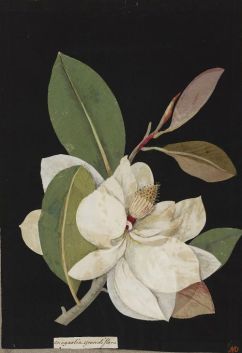
magnolia“It’s just a flower!” I mentally protested as I read that the first time. And yet the more times I look at the picture—now, inevitably, with that description in my mind—the more I see at least the possibility of its eroticism. As Peacock points out, “Anyone who has ever read a seventeenth-century metaphysical poet knows that the sacred and the sexual are never very far apart. Nor are the botanical and the anatomical.” Mrs. Delany’s flowers look, superficially, very pretty: simple, safe, and feminine. When Peacock herself first saw them, she was disappointed in her own reaction: “I felt nearly ashamed about how deeply I swooned over her work, because the botanicals seemed almost fuddy-duddy.” They belong to “the tiny, boundaried world that has its sources in handiwork,” the kinds of crafts her grandmother did. That’s not the artistic heritage she seeks for herself (“Georges Braque or Pablo Picasso probably would have hated them”) but she is “hooked,” “sunk.” At first, though, she didn’t see the collages quite as she would later come to, and as she would like us to: “They all come out of the darkness, intense and vaginal, bright on their black backgrounds as if, had she possessed one, she had shined a flashlight on nine hundred and eight-five flowers’ cunts.”  Is seeing (showing) the flowers this way a means of exorcising the fuddy-duddy from them, or from herself?

Perhaps one reason I was drawn to The Paper Garden is that as my birthday came around this year, for the first time I began to feel haunted by my own aging. I turned 45—which is not, I know, really old, though it was startling to read Peacock’s remarks on Mary’s second marriage, at age 43, at “what she thought was her old age, but what turned out to be her middle period.” I too am in, I suppose, my “middle period.” I didn’t approach my 40s with the trepidation that seems to be the clichéd expectation for women. (To a large extent, I thank my grandmother for this, as she always told me the good years began at 40, and she launched her own career as a writer and editor in her 40s. Like Mary Delany, she worked into her 80s, too, full of vitality and loving life, never indifferent. ) So it was unexpected that 45 felt like a tipping point. Was it the subtitle that caught my eye, then? It promises what The Paper Garden in fact delivers, a subversive, celebratory view of growing older as a woman. The book is also, crucially, about becoming an artist—I would say, “belatedly,” but the whole impulse of The Paper Garden goes against that word, insisting instead on the necessity of long preparation (“Her whole life flowed to the place where she plucked that moment”). I’m not (as Peacock is) a creative artist, so there’s an even fainter resemblance between my own story and Mrs. Delany’s in these specifics. But in the last couple of years I have been doing some different work that I’m really just starting to believe might be my real work, if I can see how to do it right, the way Mrs. Delany figured out how to replicate the fallen petal. Five years ago, though I had done a lot of writing, I would never have called myself a writer. Now, that identity lives for me as a possibility.

delaney

Mrs. Delany’s possibilities come to fruition not just through her own creativity and ability but, Peacock emphasizes, through the encouragement of her friends, especially Margaret, the Duchess of Portland: “the idea of the solitary artist is undercut at every turn by Mrs. D.” When Mary makes her first “mosaick,” her “friend of more than forty years supplied exactly what was necessary: applause.” Her applause continued “non-stop for ten years,” spurring Mary to continue and also drawing the attention of “the botanical, artistic, and aristocratic worlds.” Peacock’s many returns to this issue made me wonder why today we are so furtive about wanting applause. I often make self-deprecating remarks about my own anxiety about how my writing will be judged: “I’m a recovering A student,” I say, “still worrying about getting my teacher’s approval.” But is this anxiety really nothing more than refracted vanity, no better than the chafing of needy egotism? Isn’t it instead (or also) a kind of hope? And is it so shameful to bask in the occasional praise that comes our way? “Compliments,” Peacock points out, “aren’t superficial … They are the foundation of recognition of who we are in life.” Compliments about my writing help me believe in myself as a writer. They encourage me to write more, as “the recognition and praise of the Duchess for Mrs. Delany’s imaginative act triggered more acts.” Peacock tells us also of Mary’s young classmate Lady Jane Douglas, at Mlle Puelle’s school for girls, who cherished Mary’s paper cut-outs of flowers and birds, “preserving them,” Mrs. Delany recalled, “many years after.” “It was as if Mrs. Delany had pinned her friend Lady Jane’s admiration to some emotional equivalent of a ‘gown or apron,'” Peacock reflects, “and in private moments, decade after decade, dressed herself in its esteem.”

It seems apt that Mrs. Delany’s creations should, in their turn, have given other women confidence. The very idiosyncrasy of her project is its most inspirational aspect. She succeeded by being completely herself. “What is your own form among the endless varieties of life on earth?” Peacock asks meditatively, near the end of the book. We’re all, in our own way, just trying to figure that out. It’s an effort that “requires creativity till the day a person dies.” That’s the effort, the quality, that Mrs. Delany exemplifies. It does, indeed, give a person hope.

Bits and Pieces, and a Break

I’m heading to Boston tomorrow–again! I had a great time there last year (touristy post, bookish post) and expect to have just as much fun this time. Once again a primary reason for going  is to meet up with some of my Open Letters Monthly colleagues: we work well together in our various virtual spaces, but it’s definitely a good thing to cultivate face-to-face relationships too, not least because in email and other online correspondence there’s always that pesky issue of tone, which is much less difficult to interpret the better you know somebody. (As an aside, I think tone is also easier to interpret if an online relationship goes back a ways, even if you haven’t met in person: you get a sense of someone across a range of moods and modes that makes a difference, as I realized when my book club discussed the discussion between Amateur Reader and Litlove on my Madame Bovary posts. They found the exchange more ornery than I did, and I think that’s because they had no previous experience of either voice. This is not by any means a criticism, direct or indirect, of the tone of any of those comments, which I found  fascinating, respectful, and also very mentally stimulating. It was just interesting to reflect on the kind of familiarity you can feel with someone even if you know them only ethereally.)

Another happy feature of this trip to Boston is that I’m meeting up with my mother there. She’s a born and bred New Englander, though long transplanted to Canada’s west coast (by way of Berkeley), so she has many associations with Boston and the surrounding area; she’s also a Smith College alum, so we’re including a nostalgic stay in Northampton along with our bookstores-and-museums-and-libraries tour of Boston. Doesn’t that sound like a lovely time?

I had hoped to write up a proper post about my book club session on Madame Bovary but got caught up in the miscellaneous errands and obligations involved in traveling.( What an unpleasant chore it has become, from the early check-ins and security hassles to the cramped quarters of the planes themselves–and I hate flying, too. When I went to London last summer, the London Review Bookshop was my ‘happy place’: en route to Boston it will be the Public Garden, I think, and the placid swans–and the statue of Mrs Mallard and her ducklings.) The discussion at the book club was energetic: the book clearly provoked most of us, though reactions varied. Probably the most controversial subject was whether we felt (or Flaubert encouraged) any sympathy for Emma. One proposal was that, in seeking to be unlike the rest of the dreary people around her, she is like Dorothea Brooke. This is not one of the parallels I made in my post comparing Madame Bovary and Middlemarch, and ultimately I didn’t find it a persuasive suggestion, beyond a kind of structural similarity. Dorothea’s aspirations are certainly misguided, but her aim is to have a spiritually significant life. She begins imagining how to do this in fairly egotistical terms, but she learns from her experience–and from the start, she has an instinctive generosity, even in error. We didn’t get a chance to pursue this topic at the time, and in fact one thing I find difficult about these sessions is precisely that we move on (and around) so fast. I find it mentally exhausting! I enjoy the occasion, and it’s good to hear a range of ideas and views from so many smart opinionated people, but it also sometimes feels frustratingly chaotic. Well, it’s not meant to be a seminar, and heaven forbid one of us should assert herself as group leader! At the same time, it does give me renewed appreciation for the challenge of seminar discussions, which need to combine direction and focus with organic development and spontaneity. And it helps me see why I enjoyed the comment thread so much: writing things out forces a certain slowing down, and then reading and replying allows also for some reflection and cogitation.

The other book club discussion I was involved in last week was of The Yacoubian Building, with the other Slaves of Golconda. The novel didn’t seem to excite a great deal of enthusiasm, though I think most of us found it quite interesting. The forum where discussion usually breaks out has certainly been very quiet! Perhaps the next selection will work better.

I don’t expect to be posting again until I get back, as not only will I be busy frolicking but I’m taking only my iPad, which as far as I’m concerned is no good for producing content. See you then!

May Day!

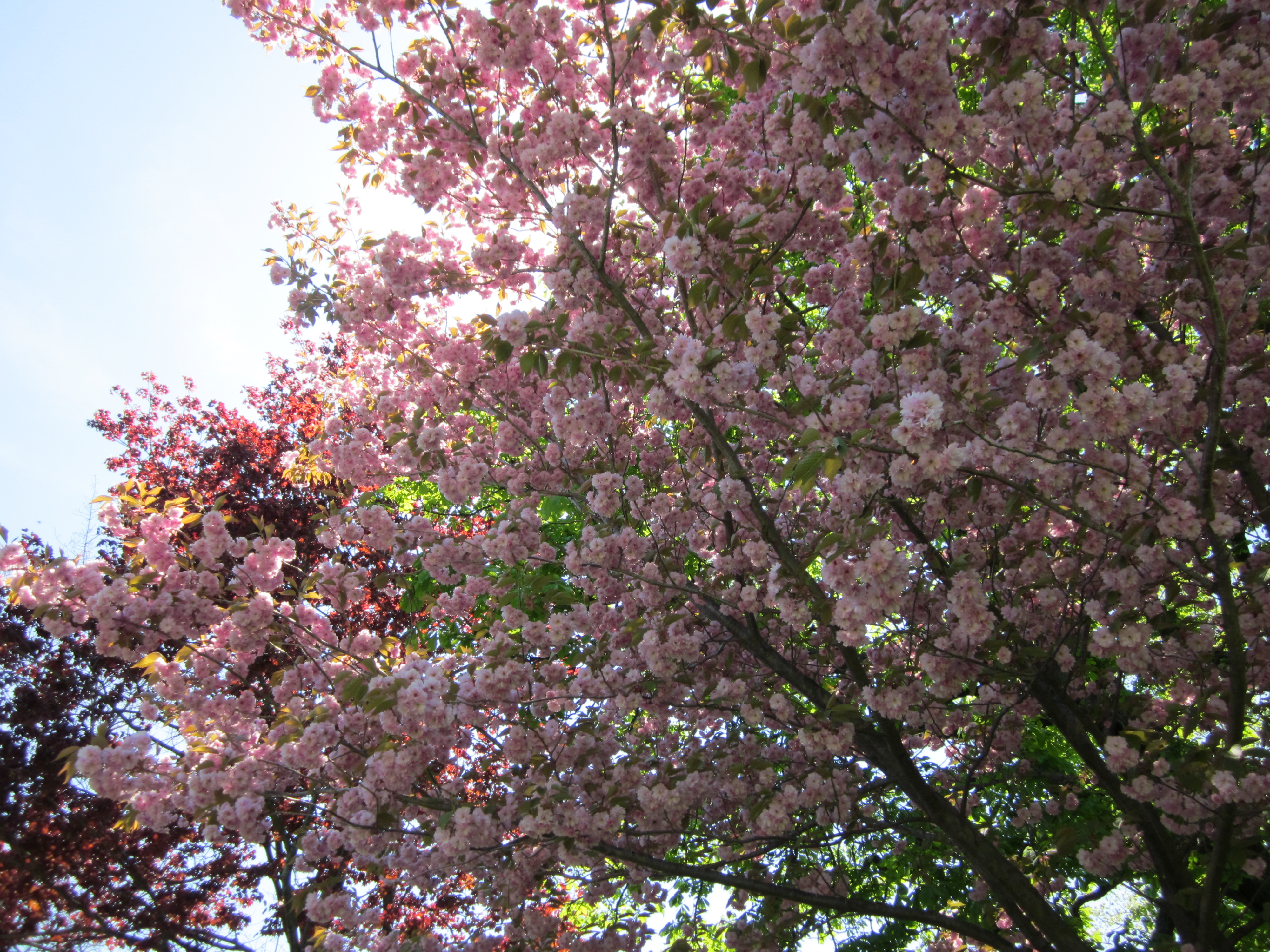
It’s a spectacular May day here in Halifax, perfect for the Bluenose Marathon (no, I didn’t participate, but we cheered on a lot of the runners and walkers as they came down our street towards the 38K marker). It’s supposed to be nice again tomorrow, which is lovely as this is the Victoria Day long weekend so we can all enjoy the sunshine. Winters in Halifax, though not as cold or as snowy as winters in many other parts of Canada, are plenty long and dreary, and for someone raised on the more temperate west coast, they can be hard to take. Harder still is the late arrival of spring. As of today, though, there’s no doubt that spring has sprung here, and I have a few photos to prove it from a beautiful walk Maddie and I took in the Public Gardens, my favorite spot in the city (as documented in some detail in this earlier post). I am thinking lots of serious thoughts about Madame Bovary for my next post, and I have also begun a little construction work on the “Middlemarch for Book Clubs” I so boldly promised in my previous post, about which more later too, but for now, here are a few pictures of beautiful trees and flowers. Grim thoughts of adultery and arsenic can wait!


(The photos open up bigger if you click on them.)

Sandra Beasley, Don’t Kill the Birthday Girl

My daughter has a severe peanut and tree nut allergy and a fairly serious egg allergy. I’m a worry-wart by nature (just ask my kids!) but worrying about her allergies has added a whole different dimension to worry-warting. I am working hard, though, to be realistic and constructive, and to train her to navigate as safely as possible in a world that is not and should not be nut and egg free. The biggest challenge is finding the right line between taking precautions and being prepared–and figuring out what’s reasonable to hope for or expect in terms of accommodation. I have never seen a topic attract as much vitriol as this one on comment threads: I get really depressed about the people who feel there’s no sacrifice to their convenience worth making to help protect someone vulnerable in this way. I can understanding wanting to balance everyone’s rights and interests, and to decide based on fact rather than paranoia, but people are both callous and self-righteous about it, which is painful when it’s your beautiful child they are talking about. Happily, in real life I have found pretty much everybody would rather be helpful than not. We don’t try to create a safe bubble for our daughter, but it sure makes her life more fun and ours more relaxing if, just for instance, the cake at a birthday party is not laced with peanut butter. We always send along safe alternatives for her, though, and she brings benadryl and her epipen along at all times. Now that she’s older, she takes more responsibility herself, including reading lists of ingredients and declining food if someone can’t show her that list. “Don’t assume,” is our number one safely rule, and “no epi-pen, no food” is the other.

But it’s one thing to convince yourself (and her) that she’ll be OK if she’s sensible and prepared, and another to control the anxiety. So there’s lots to appreciate about this memoir, including the author’s frank descriptions of how difficult her allergies made her life, and her parents’. She has a much wider range of allergies than my daughter, and reading her story I felt selfishly grateful that my daughter’s are fewer and more or less easier to control for. The technical stuff about allergies was not that interesting because we’re reasonably familiar with it. The author is rightly emphatic that people who claim to have allergies but don’t aren’t helping people with life-threatening ones get taken seriously. At the same time, she makes some good arguments about problems with attempts to create allergen-free zones–she is, or at least positions herself as, an advocate for good information and sensible policies, a moderate (despite the severity of her own allergies) amidst extremists on both sides.

This all seems like a good way to go forward, except that I felt, reading along, that her repeated insistence that she knows the world does not revolve around her allergies (e.g. she can’t and shouldn’t try to control other people’s choices, homes, air plane snacks, lunch boxes, etc.) is undermined by her many, many stories of derailing outings, vacations, parties, and so on by having reactions severe enough to require trips to the hospital. Her determination to get out there and live with everybody else has clearly had consequences for everybody else and I wondered if eating out a lot (she spends a lot of time talking about restaurant food) and either having reactions or sending plates back that weren’t prepared quite as specified is really as non-confrontational as all that. Is it really better to end up curled on the floor ill and needing rescue from parties than to negotiate safer food choices with your friends? In her case, given the range of her allergies, maybe there’s just no degree of compromise possible and I can see resolving that it’s worth some risks not to live like a hermit. But couldn’t you ask your boyfriend to give up milk if the option is not kissing you? Which would he really prefer? Live and let live sounds like a good policy but it doesn’t really operate as ‘let live’ in practice. But these are really tough choices and negotiations.

Black Moods and Grey Memories: My Own Balkan Journeys

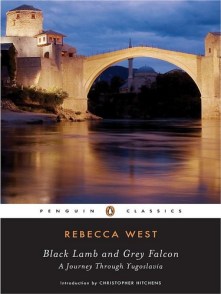
westThere are lots of impersonal reasons that I’m interested in Rebecca West’s Black Lamb and Grey Falcon. Most obviously, it is a widely celebrated literary and intellectual achievement. Here’s what Steve Donoghue says in his write-up on it for his list of 20th-Century Non-Fiction Greats:

All the dark heartaches of the newborn century are shaped into the dark corridors and musty train compartments that make up West’s masterpiece – readers will come out of it knowing quite a bit about Yugoslavia (and the entirety of Eastern Europe), yes, but their hearts will have been harrowed too.

In his introduction to the Penguin Classics edition, Christopher Hitchens calls it a “signal polymathic achievement.” It’s also written by a woman who is herself fascinating, intimidating, original (take a look at this Paris Review interview and tell me you don’t come away from it captivated, impressed, and  thoroughly provoked).

These are the best reasons to read Black Lamb and Grey Falcon, and these are mostly the reasons motivating me to read it now, but I’ve also had it on my TBR list for many years for more idiosyncratic personal reasons. As it happens, my family has a longstanding interest in the Balkans–not because our roots are there, but because many years ago my parents took up international folk dancing as a hobby and became particularly keen on the music and dance of eastern Europe. For many years some combination of us went every week to meetings of the Vancouver International Folk Dancers. From September to June the club met in school gymnasiums; in the summers they set up on a blacktop in Stanley Park. Another club we went to for years met at International House at U.B.C. In addition we attended dance camps, with classes led by specialists from all over. One we went to regularly was a Balkan dance camp held at Fort Worden, near Port Townsend in Washington: this event included, along with days of teaching and nightly dance parties, a fabulous outdoor finale dinner including whole pigs roasted over giant spits. At one point VIFD organized a camp in Vancouver, the “Big Bulgarian Bash” or “BBB,” which ran for several years. My father and sister belonged to the VIFD performing group that used to dance at various local folk festivals and other occasions. My family used to hold Friday night sessions in our basement for the ‘hard core’ dance enthusiasts, and also for many years my mother hosted a weekly Balkan singing group that met Sunday afternoons around our dining room table.

So I grew up with a somewhat unusual awareness of the Balkans, for an otherwise blandly Anglo-Yankee Canadian kid. We had a lot of friends and visitors who were from the Balkans, particularly from what we then still called Yugoslavia–tensions sometimes ran high between the Serbians and the Croatians, but by and large (at least as I remember it) the dance community was not a place for politics but an opportunity to learn and share enthusiasms about music and dance from all over the world, from Quebec to Israel to Louisiana to Romania.

Although I went along pretty regularly to the weekly club meetings for a while and tagged along on many trips to different camps, I wasn’t as involved at VIFD as others in my family. Friday “hard core” nights, when my parents were otherwise occupied, were perfect opportunities to tie up the phone for hours talking to my best friend (remember when there was no such thing as ‘call waiting’?), and I mostly stayed out of the way of the Sunday singing, though I liked to join in for the tea and goodies after. My father and I also took up Greek dancing as “our” thing: we joined the Philhellenic Dancers and eventually were regulars in their performing group–oh, the memories, of late nights full of smoke and retsina as we danced in restaurants in exchange for dinner and drinks. We danced at Greek Day, too, and sometimes were even flown out of town by restauranteurs who thought we’d liven up their weekend business. One day maybe, if I’m  posting late at night and feeling nostalgic, I’ll tell the story of the pentozalis performance that ended with someone’s teeth in a water glass, or of the patrons who didn’t quite understand that you aren’t supposed to throw the plates at the dancers.

Corfu

Anyway, this is all just background to explain why, when my sister and I planned a six-month backpacking trip in Europe for 1986, the year after my high school graduation, it was inevitable that we would head into the Balkans. In particular, we set our sights on Koprivshtitsa, Bulgaria, where that year a folklore festival was to be held that happened only once every seven years. Whatever else we did, whatever other turns we took along the way, we aimed to get to Sofia in August in time to go into the mountains to the festival. And we did get there. We left for London on March 1 and flew into Sofia from Belgrade on August 4 (on what I described in my journal as “a rickety creaking old BalkanAir plane”). Along the way we had been to England, Scotland, France, Spain, Portugal, Italy, Greece, and Yugoslavia.

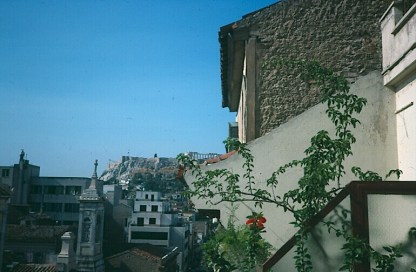
Athens Hotel

I wish I could say that my record of my trip across the Balkans is full of insight. I wish that my youthful experience of singing and dancing had made me enough of an expert on the history and politics and culture of the places we visited to make me an observer or commentator even one tenth as interesting and engaged as West is in her drabbest moments. Unfortunately, my journal for that period–though it does include odds and ends of scenic description and some passing reflections on what we were seeing–is relentlessly personal, a record of my own tumultuous emotional state, with the changing landscape little more than a backdrop. In my defense, I was barely 19, and despite having read Middlemarch for the first time (between Paris and Barcelona), I had not yet learned to decenter my own experiences. Also, again in my defense, I had just been through what to me seemed like an extraordinary crisis: during our stay on Crete, I had fallen passionately in love and, believing myself to be passionately loved in return, had declared my intention to stay there forever, only to find that an impossible promise to keep. It was, actually, kind of a Middlemarch moment, in that I was ultimately moved to leave by reflecting that the situation as a whole was not my event only. It was also, though I only really figured this out very recently, a Mill on the Floss moment: to stay would have been to attempt to create a new life–very nearly a new identity–as if my life were not intimately bound up with everyone and everything I had left behind. It’s amazing to me now, really, that I thought I had a genuine choice to make, but there’s no doubt that in the moment it was all very real and overwhelming for me. I think now that the reason I was so emotionally distraught when we left Hania for Athens is that despite my insistence that I was going to be back the following summer, I knew I was saying my final goodbye to everything I thought I had found there.

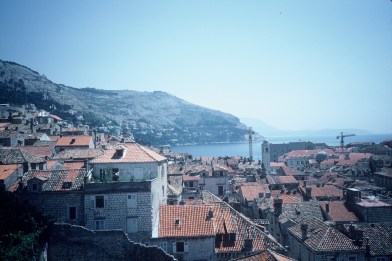
The grief I felt (and the gardenia pressed between the pages of my journal brings it back with surprising sharpness) cast a cloud over the remaining weeks of our trip. Athens, to me, was little more than a place I didn’t want to be, though even in my self-absorbed state it was thrilling to see the Acropolis from the balcony of our cheap hotel. We took the night train from Athens to Skopje, then went to Belgrade and then to Zagreb, then to the Plitvice Lakes National Park, where we tried and failed (because it rained the whole time) to take a holiday from our travels, which were wearing us both out pretty much by this point. From Zagreb again, we went to the town of Varazdin, where we had arranged to meet a Serbian friend we knew from back home (I think he must have been an exchange student, though I can’t now recall exactly) who was at that point serving in the army. Then we finally did get that holiday, by flying to Dubrovnik,where we spent a couple of wonderful lazy days in a city I remember as being, with Venice, the most beautiful city we visited.

000033

Then it was back to Belgrade to catch our flight to Sofia, where we spent two slightly surreal days navigating as solo tourists in a city still emphatically behind the iron curtain.

We did go to the Koprivshtitsa festival, and by that time–and thanks to the distractions it offered–the cloud was lifting. I was also, oddly, though further from home in almost every respect than I had been at any other point on the tour (it doesn’t get much more foreign for European travel, perhaps, than being in rural Bulgaria) back in more familiar territory: we saw more people we knew at the festival than we had seen for almost six months. So the world I had chosen over the fantasy life I had imagined was already becoming, as it inevitably would, my reality once again.

What possible relevance can this personal history have to Rebecca West’s masterpiece? None, really, of course–except that we bring our whole selves to anything we read, and when I read the last line of her Prologue — “In a panic I said, ‘I must go back to Yugoslavia…'” — it echoed in my mind like the opening line of Rebecca, pointing me back towards a part of my own story that has never been completely resolved. I have no desire to go back to Yugoslavia, but every time I have thought about both reading West’s book and writing about it, every time I have looked at her subtitle (“A Journey Through Yugoslavia”) as the book sits by me on my desk, I have been distracted by thinking about my own journey there, which was a grey interlude between two parts of my life. I’ve sometimes thought I left something behind in Crete–not (or not just) a little piece of my heart, but my youthful romanticism. I’m not, now, the kind of person who gets swept up in the moment. Maybe I never really was, but I was then, for a little while. Then I came home, started university, and the rest is history–or, more accurately, it would have been history, if I hadn’t changed my major to English…

Still, all this reminiscing (out of place, perhaps, on this blog that’s supposed to be about literature and criticism) feels like an unfortunate extension of the solipsism that characterizes my journal entries from that part of that long-ago trip. Or, it did feel that way, until I came to this passage in Black Lamb and Grey Falcon tonight:

Art is not a plaything, but a necessity, and its essence, form, is not a decorative adjustment, but a cup into which life can be poured and lifted to the lips and be tasted. If one’s own existence has no form, if its events do not come handily to mind and disclose their significance, we feel about ourselves as if we were reading a bad book.

I don’t pretend there’s any particular art in this post, but I think she hits on why I have wanted for so long to write at least something about this part of my past. I’ve been thinking off and on about its significance for more than half my life. I don’t much like critical writing that subordinates the books to the writer. I’m not going to talk about myself when I start writing properly about Black Lamb and Grey Falcon. But I’m actually glad that this great book finally prompted me to give a little form to my own existence. If I keep working on it, maybe it won’t be such a bad book, by the end.

To close, here’s some Balkan music for you from Balkan Cabaret, a group well known to my family; the lead singer, Mary Sherhart, gave many workshops at camps and festivals, and also at my mother’s Sunday singing group. The song, “Jovano, Jovanke,”  is Macedonian, and is one I heard many, many times, either being sung or being danced to.

In the Penny Press: My Fantasy Life

I love Steve’s series on his readings in the “Penny Press.” He engages with such gusto with all kinds of periodicals, from highbrow literary journals to lad mags to Dogfancy and National Geographic–and he’s so delighted when he finds good stuff, and so disheartened when his favorites let him down.

Reading Steve’s posts always makes me think about the magazines I read. It’s a small number: I do most of my more miscellaneous reading online, and the only print periodical I actually have a current subscription to is the New York Review of Books (some years it’s the TLS instead, but next year I think it will be the NYRB again, and/or the London Review of Books). I do pick up individual issues of magazines sometimes–but they are almost never literary, culture, or news magazines. Usually, they are quilting magazines, with the occasional foray into Canadian Living (which I did subscribe to for many years–for the recipes!) and a dip into the Running Room’s freebie whenever I pass by the store. Once in a while I pick out something else for variety: I bought Granta‘s spring feminism issue, for instance, but I’m at least as likely to bring home something like the issue of Piecework shown in the photo.

I’ve been wondering why it is that these are the choices I make from the magazine rack and not, say, Harper’s or the New Yorker (or The Walrus, for that matter). What is the lure of these publications dedicated to food, fabrics, and healthy living? These are hardly the central concerns of my days, or at least, not so much that you’d think I would want pages and pages of articles about and glossy colour photographs of them. That said, I do dabble in all of these things: by and large I’m the family chef, and I appreciate getting new menu ideas; I do a little quilting and needlework; and I’ve been a slow, intermittent, but fairlypersistent runner since my “Learn to Run” clinic several years ago. Do you suppose that I buy these magazines because I wish these activities were a bigger part of my life? Do I buy them because doing so gives me the illusion that I do more of this stuff than I actually do–is browsing their pages a way of pretending I’m the sort of person who might run a marathon some day and distributes full-sized quilts to friends and family that have all the points of their triangle patches all neatly in position?

I do think that is part of why I buy them: to bolster my sense of commitment to things that are actually (partly by choice, partly by pragmatic necessity) peripheral to my main priorities. But why would I wish I were living the life that these magazines collectively illustrate, rather than the life I do in fact live? Why is my magazine pile not all book reviews–not to mention academic journals (which I read only under duress now)? Thinking about what the magazines I like have in common, I noticed that they all emphasize two things: the individual satisfaction of tangible achievements (something rare in academic work), and a strong sense of community created by a shared passion. The Running Room magazine and the quilting ones I like are especially conspicuous for their stories of people helping each other to realize their dreams: the Running Room has tributes to clinic leaders and coaches who inspired runners to do more than they thought possible, of people who began just as members of the same running groups and became fast friends. I love the “shop hop” issues of Quilt Sampler, which feature different shops around the country (sometimes in Canada, too) with stories of how they were founded, often by a couple or a pair or group of friends who just really wanted to shape their lives around something they loved and, happily, found a community of like-minded customers and became a supportive, creative community. I think I pore over these stories because academic work is only intermittently like that: the work itself, in fact, often seems to pull us (or at least me) away from the kind of creative fulfilment and warm-heartedness the quilt shop owners seem to enjoy in their work lives. Also, on a more personal level, I’m often a bit lonely in my day-to-day life: my extended family is all far away, my local friends are as busy and stressed out as I am, if not more; a lot of my work is done in solitude, and its group aspects are far from warm-hearted and creative (committee meetings, anyone?)–it’s easy to feel isolated, and the world these magazines conjure (and this is true of Canadian Living as well) is not like that. So, they represent a kind of fantasy life for me, in a few variations, one that if I had more time and energy and guts I might be able to pursue here (I could take a quilting class, maybe–but the nearest quilting store is quite far away, and winter is coming, with its icy roads… I could take another Running Room clinic–but they are often in the evenings, and I’m just so tired and swamped…and again, winter’s coming). Also, in my fantasy life I really love to cook, and nobody in the house has food allergies or any other dietary complications…

There’s one other thing I know I buy the quilting and needlework magazines for: often, their pages are just beautiful! And though I don’t have (or make, I guess) a lot of time for quilting, I do get some done now and then, and it’s inspiring to look at the colours and patterns and spend a little time indulging in the sensual pleasures they offer: they are treats for the eye, just as the fabrics are when you’re actually quilting (when they are a tactile pleasure as well–I bet all quilters sort their stash once in a while really for no purpose than to fondle the fabrics and look at them some more).

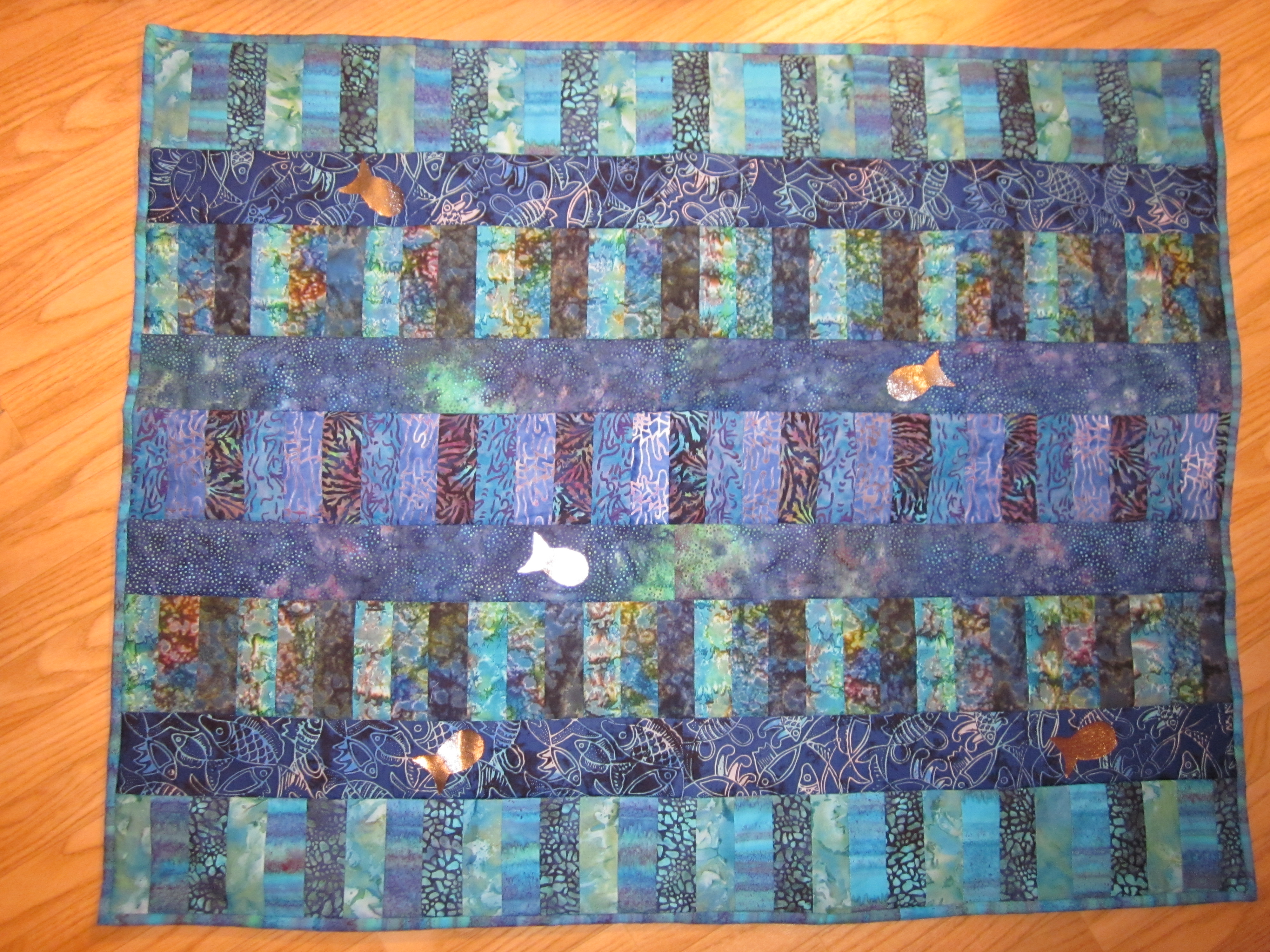
(A couple of my more recent quilting efforts: “Overall Bodie” and “Blue Ocean”)

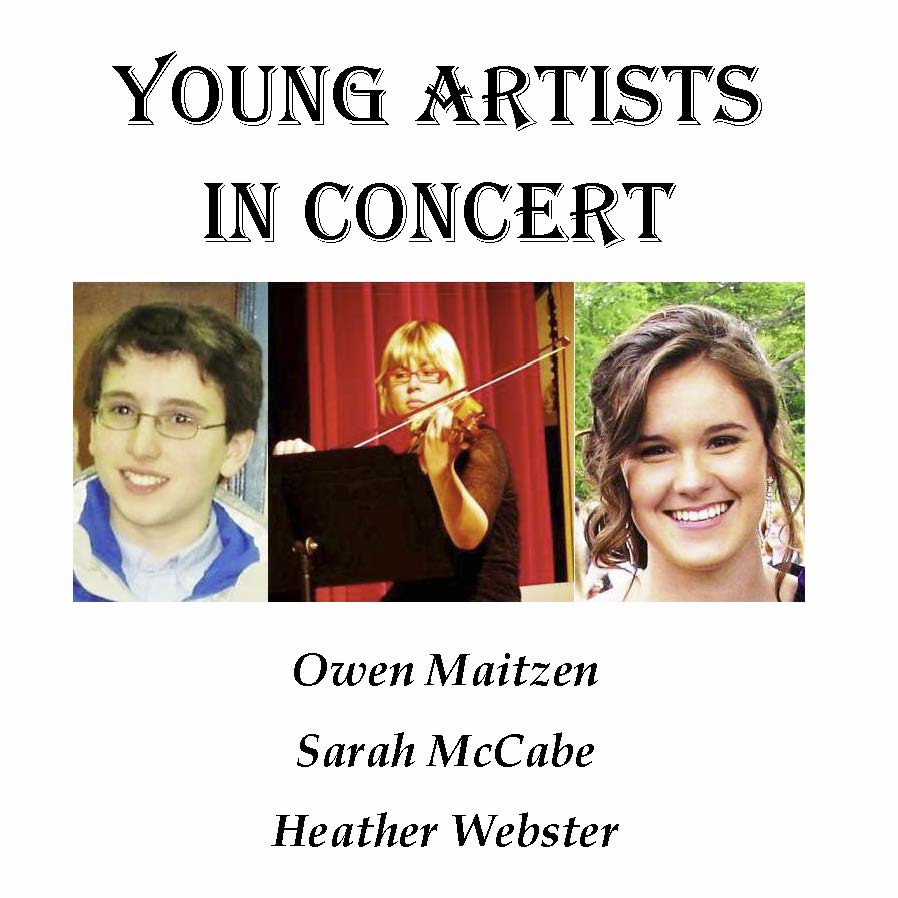
Musical Interlude: Young Artists in Concert

I’ve posted a couple of times before about my son’s compositions. Last week he and two other talented young musicians performed in a concert that included a number of his original pieces (a Sonatina for piano and violin, two solo piano pieces, and a setting for voice and piano of Poe’s “Romance”) along with pieces by Ravel, Fauré, and Wieniawski–and, in an unusual twist, some piano-violin improvisations prompted by audience suggestions. It was a big event that took a lot of preparation, especially by Owen (who played in every piece on the program) and my husband, who handled most of the logistics. The evening was a treat: not only was the music delightful but it was wonderful to watch the three young performers working together for the love of it. The audience was very appreciative, and we have been been beaming with pride (and basking in reflected glory) ever since! Audio tracks of the entire concert are now available here, for anyone who would like a listen.

Infected!

In my all happy anticipation about getting back into a regular routine for the fall, including getting back into the classroom, I did not imagine finding myself the victim of a truly evil computer virus that somehow (despite my anti-virus software)  got so deeply into my little netbook that after four days of intensive care with our tech people, it has proved impossible to clean out. Today they are wiping the hard drive, and I hope to have the computer back by tomorrow. Thankfully, it seems that they will be able to preserve a backup of most of my files, but there will still be a lot of reinstalling and reorganizing to do before I’m back in business. As a result, I haven’t been able to do either much work or any blogging in the evenings–hence the sudden silence over here. It has been interesting realizing how much I depend on being properly equipped, not just for my own interests and personal activities, but for getting done the array of work tasks, from e-mail to class prep, that can almost never be completed during regular work hours. As a result, I feel particular strain on my regular work hours right now, which is why this post will be short! As if heading into a three-course term and picking up all the other regular duties of the term wouldn’t be stressful enough without this added complication… and as if dealing with losing what feels like my life-support system doesn’t induce enough frustration without people commenting, “well, you do spend a lot of time online,” as if I somehow had this coming to me for my risky behavior. Anyway, here’s hoping that my next post will be about books or teaching and this will all be behind me.