Two Women Writing: Ditlevsen and Toews

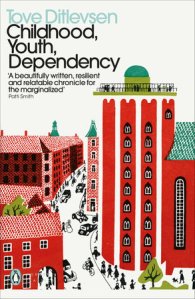
I made my way to the end of Tove Ditlevsen’s Copenhagen Trilogy without ever deciding if I was enjoying it or not. Enjoying might be the wrong word in any case: it’s not really a fun or pleasant story, and Ditlevsen herself does not come across as likeable, so what’s to enjoy? The better question is whether I was appreciating or admiring it, or interested in it. I am undecided on these questions as well. And yet her account of her childhood, youth, and “dependency” (meaning addiction) did exert a kind of pull on me, enough that I persisted to the end. One of the rewards, as I mentioned before, is coming across passages that hit hard. Some samples:

I look up at [my mother] and understand many things at once. She is smaller than other adult women, younger than other mothers, and there’s a world outside my street that she fears. And whenever we both fear it together, she will stab me in the back. As we stand there in front of the witch, I also notice that my mother’s hands smell of dish soap. I despise that smell, and as we leave the school again in utter silence, my heart fills with the chaos of anger, sorrow, and compassion that my mother will always awaken in my from that moment on, throughout my life.

Or,

Wherever you turn, you run up against your childhood and hurt yourself because it’s sharp-edged and hard, and stops only when it has torn you completely apart. It seems that everyone has their own and each is totally different. My brother’s childhood is very noisy, for example, while mine is quiet and furtive and watchful. No one likes it and no one has any use for it.

Or this, which is such an uncomfortable kind of yearning, perhaps not completely unfamiliar to anyone who was a precocious girl in a world where that quality was not always welcome:

I desire with all my heart to make contact with a world that seems to consist entirely of sick old men who might keel over at any moment, before I myself have grown old enough to be taken seriously.

Or this, once she has grown into a writer:

I realize more and more that the only thing I’m good for, the only thing that truly captivates me, is forming sentences and word combinations, or writing simple four-line poetry. And in order to do this I have to be able to observe people in a certain way, almost as if I needed to store them in a file somewhere for later use. And to be able to do this I have to be able to read in a certain way too, so I can absorb through all my pores everything I need, if not for now, then for later use. That’s why I can’t interact with too many people . . . and since I’m always forming sentences in my head, I’m often distant and distracted.

As these samples show, there’s a hardness, a flatness, to the narrating voice: as often before, I wondered if that affect was intrinsic to the original or an effect of the translation. There’s also an intensity, and a ruthlessness, towards herself as much as towards others. It is a strong voice, but it does not inspire me to look up any of Ditlevsen’s fiction.

I also finished Miriam Toews’s A Truce That Is Not Peace, which is not really a memoir, I suppose, but I’m not sure what else to call it. It is about her life and about writing and about the death by suicide of her father and her sister—which is to say, it is about the same subjects as most of her other books, which is sort of the point, as it is written in response to a question she cannot clearly answer: “Why do you write?”

I did not like this book much as a book, though I admire and sympathize with Toews’s wrestling with questions about how or whether or why to keep returning to these deaths. It’s odd to think that long before I knew that her main subject would become, in a way, my own, I puzzled over my dissatisfaction with her highly autobiographical novel All My Puny Sorrows. One of my thoughts at that time was that she had stuck so closely to the personal that her novel had not offered something more philosophical, something more meaningful. That’s not an obligation for art or artists, of course, but reading AMPS that’s the dimension I felt was missing. In a way, I feel the same about A Truce That Is Not Peace, even as I understand better now how inappropriate it might be, or feel, to move from the personal to the abstract based on one’s own individual experience of this kind of grief or trauma. Certainly that would have meant writing a very different kind of book, and my sense from Truce is that it is not the kind of book Toews would want to write.

What this book communicated to me is a kind of stuckness, a kind of stasis, in her grieving and her thinking about her grieving. I am not complaining that she hasn’t “gotten over” these deaths: that (as I well understand) is not how this works. As she herself is clearly aware, she keeps writing because she isn’t over them, because they aren’t, in that sense, over themselves. Her loss is ongoing. That is a reason, not an explanation, for her writing—if that makes sense as a distinction. It would be nice if writing led to meaning. Sometimes it does, but not always. “Narrative as something dirty, to be avoided,” she says at one point,

I understand this. I understand narrative as failure. Failure is the story, but the story itself is also failure. On its own it will always fail to do the thing it sets out to do—which is to tell the truth.

I sympathize with her grief and anger and frustration, and also with her wish, which I think is implicit in her bothering to write this book at all, that maybe, possibly, hopefully, she can say something truthful if she just keeps at it. I was outraged on her behalf, too, when I read this part:

Is silence the disciplined alternative to writing?

A student of English literature, whose class I recently visited, has suggested that now is the time for me to stand back and listen. I’ve had a “platform” long enough.

But what then—if I stop writing? I don’t want a platform. I am listening. What an awful word! Platform.

I didn’t much like this particular book. I found it too fragmented, too random; I wanted Toews to actually write the whole book, not to give us what felt (to me) like scraps of it, a draft of it. I understand that its form reflects a refusal to impose order and meaning where she does not find them, but at the same time I am not sure that if anyone but Miriam Toews had written exactly this, it would have found a publisher. But never mind my personal taste, or what I personally go to memoirs about suicide hoping to find (words in the shape of my wound, to paraphrase a poem that still echoes in my mind). We (generally) want to read it because she wrote it and we believe she is worth listening to. Imagine telling the author of Women Talking that she should shut up now.

Here’s something true in it, something that I think Yiyun Li would appreciate for its bluntness, something Denise Riley also talks about. Toews recounts a conversation with a friend whose child died of cancer:

She hated some of the things people said to her afterwards.

I can’t imagine your sorrow. I can’t imagine your pain.

Yeah, you fucking can! You can fucking imagine it. Go ahead and fucking try.

My friend told me she’d never felt more alone and sealed off in her coffin of grief than when people told her, even lovingly, even with tender hugs, that they couldn’t imagine her sadness.

Try! Stay! Stay with me.

“What will happen if I stop writing, I want to ask the student of English literature,” Toews says, right after this anecdote. Maybe the answer to the question that launches this book is here: she writes so that we will stay with her. 

No Good Way: Yiyun Li, Things In Nature Merely Grow

There is no good way to say this—when the police arrive, they inevitably preface the bad news with that sentence, as though their presence had not been ominous enough . . .
There is no good way to state these facts, which must be acknowledged before I go on with this book. My husband and I had two children and lost them both . . .

I wrote a little bit about Yiyun Li’s Where Reasons End, first in 2019, when I could only imagine, and again in 2022, when I no longer had to. I didn’t actually say much myself either time. “Some books,” I said in 2019, “are hard to write about. Imagine how hard this one was to write.”

When I reread it, it was because I was still looking for and sometimes finding comfort in what seemed like the right words. I didn’t bring my critical self to the book, and I can’t bring it to Things In Nature Merely Grow either. Well, I probably could, but I don’t want to: sometimes, what I want from words is to let them do to the work. I appreciate the work Li has done with her words here, again. Her experience is not exactly my own: she is herself; her sons are themselves; she has lost them both. Loss may be universal but every loss is intensely specific. There are also ways in which I don’t actually find Li that congenial a writer, or a thinker. We are not the same person, the same kind of person, at all, I don’t think.

Still, she says things in this hard, painful, honest book that I completely understood and was glad to have articulated. Some of them are things that, for various reasons, I have not been able to say, or not wanted to say, myself. It turns out that there are good ways to say them: unadorned, unapologetic.

As before, then, excerpts.

1.

I did not feel any anger when Vincent died—not at him, not at life either. But I did feel baffled and wounded by life. That a mother could do all things humanly possible and sensible for a child but still could not keep him alive—this was the fact that I would have to live with, I thought, every single day, for the rest of my life. It was Vincent’s death that made me begin to use that phrase, “every single day, for the rest of my life.”

2.

I don’t want an end point to my sorrow. The death of a child is not a heat wave or a snowstorm, nor an obstacle race to rush through and win, nor an acute or chronic illness to recover from. What is grief but a word, a shortcut, a simplification of something much larger than that word?

Thinking about my children is like air, like time. Thinking about them will only end when I reach the end of my life.

The only passage in which grief appears in its truest meaning is from King John, when Constance speaks eloquently of a grief that is called madness by others in the play.

Grief fills the room up of my absent child,
Lies in his bed, walks up and down with me,
Puts on his pretty looks, repeats his words,
Remembers of all his gracious parts,
Stuffs out his vacant garments with his form:
Then, I have I reason to be fond of grief?

3.

That a mother can do all things humanly possible for a child, and yet she can never understand the incommunicable vastness and strangeness of the world felt by that child; that a mother cannot make the world just a little more welcoming so the child feels less alone; that a mother cannot keep that child alive—these are facts I have to live with now, every single day, for the rest of my life.

4.

We like to set our hearts on a finish line, hoping to take the right actions so that we can reach that finish line fast and with the least hassle and pain. Perhaps this urge reflects a desire to mark time in a different way: to harness time for gain. And yet in life, time cannot be harnessed.

Marking time after a child’s death is not about overcoming grief or coming out of a dark tunnel—all those bad words sound to me as though bereaved parents are expected to put in a period of hard mental work and then clap their hands and say, I’m no longer heartbroken for my dead child, and I’m one of you normal people again, so now we can go on living as though nothing had happened and you don’t have to feel awkward around me.

How often we return to the problem of time, as we go on living, eventually learning—at whatever cost—to seem “normal” again. (“Children die,” Li repeats throughout the book, “and parents go on living—this too is a fact that defies all adjectives.”) “Until the end of time” is also what A. S. Byatt said about her son: “He is dead . . . that will go on and on till the end of time.”

Three Years After

TWO YEARS AND TEN MONTHS LATER:

No time at all. No Time.

THREE YEARS AFTER:

And by now I’ve stopped making these notes.

– Denise Riley, Time Lived, Without Its Flow

Content warning: depression and suicide.


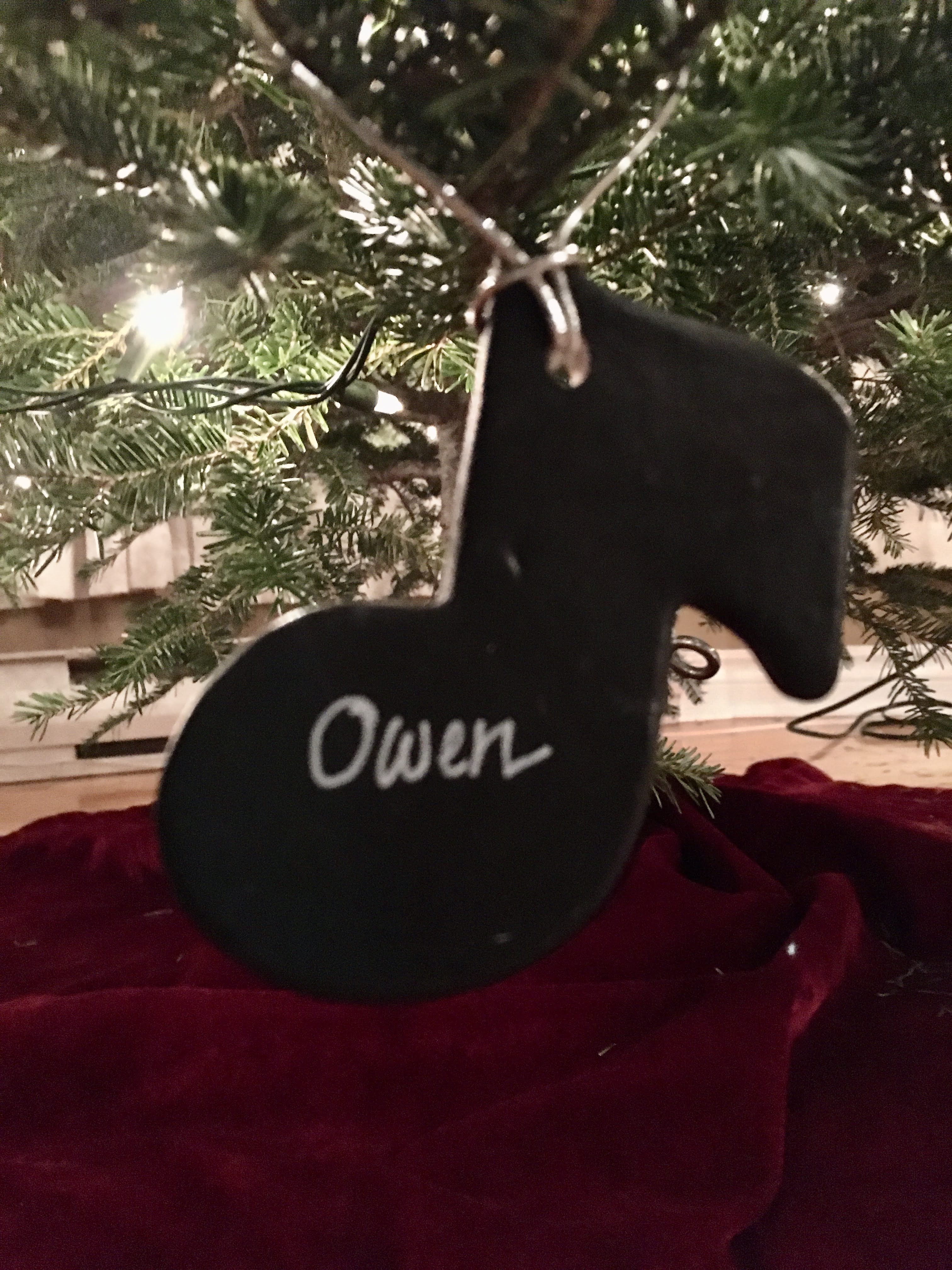
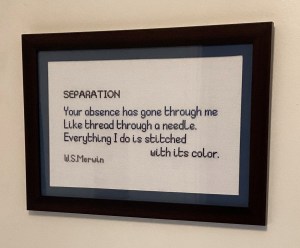
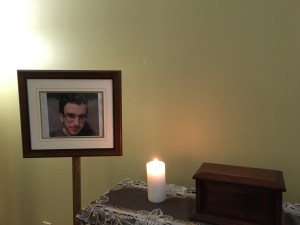
Owen died three years ago today. I wrote about his death a lot in the first year: I felt a strong urge to write about it. I needed to gather up my pain and shock and confusion and shape them into something that made some kind of sense—to bring the chaotic, unbearable feelings under some kind of control. (“In words, like weeds, I’ll wrap me o’er,” Tennyson says on In Memoriam, a poem I have returned to over and over since that first day.) I also wanted to reach out to my community of friends and readers, who showed me so much kindness, and still do. I also see now that this writing was a way of holding on to Owen by showing what I could of who he was and what he meant to me, what his loss meant. There’s a lot I don’t remember very clearly about the first few months after his death, but I do remember the way sentences would rise up in my mind and nudge at me until I used them—and the way lines of poetry would surface (as they still do), haunting me until I figured out where to put them, whether in my journal or in a sampler or in a post.

I also remember how angry it made me, in what I now know to call the “acute” phase of grief, to be told “it takes time.” Time for what? What could possibly change, with any amount of time? “My son is in a box!” I raged at the nice woman on the other end of the help line I called, before I had the right kind of person to talk to. “What difference is time going to make to that?” Seeking my own way to understand that, however I felt, time was going to keep passing, I thought about Woolf’s idea of To the Lighthouse as two blocks joined by a corridor:

One way I suppose I could think about where I am right now is precisely in a corridor between two blocks, one of them my previous life, which included Owen, and the other my future life, which will go on without him.

I have thought about that model a lot, as time has passed—time in which I have learned that both things are true, that it does take time, and that the passage of time doesn’t change how much it hurts that Owen’s life ended the way it did (or that Owen’s life itself was, to him, so painful that he ended it the way he did).  When people said, kindly, helpfully, “it takes time,” I resented the implication that I would one day stop grieving, even though the prospect of feeling the way I did indefinitely was also terrible. What I think they actually meant, or should have meant, is rather that over time you learn to live with those feelings: that they do not destroy you. The grief does not end—how could it? It does not get any less—why would it? A. S. Byatt said of the death of her young son that she was haunted by the thought “He is dead . . . that will go on and on till the end of time.” People say, she said in an interview, that “after a time, you get to want to celebrate somebody’s life. All I can say is no, you don’t. It’s just terrible. It stays like that.”

The model of grief that makes sense to me now is that, as time passes, you build new layers around it: it is a lasting part of you, a big part, but it is not all of you any more. So I’m not sure that a corridor was the right metaphor. I like these lines from Julia Copus’s poem “The Grievers” a lot:

What we can’t absorb we carry in us,
a lumpish residue. It’s truly a wonder
we manage to move at all; let alone
as freely as this, with the ease at times
of our old and lighter selves.

Her emphasis on the heaviness of grief matches my own experience of it as weighty, hard to carry. I still carry it with me, but I do also sometimes move now with ease, with lightness. I am doing much better. I am stronger. I have worked hard at this: therapy is hard. The work is not done, but I am better at it too.

Like Riley, whose meditations on grief have been interwoven with my own since almost the beginning, after three years I have nearly stopped writing about it, at least publicly. As I realized long ago, there is a terrible sameness to grief: it is repetitive, including for me. I don’t talk about it much any more either, and sometimes that’s tough, because it means I’m not always honest. How are you? Oh, fine. I’m fine. For other people, time has passed; they have moved on, and probably it seems as if I have too. I have, of course, in a way, because time does pass – for me, just not for Owen. “The dead slip away,” Riley says, “as we realize we have unwillingly left them behind in their timelessness.” 
It’s a grey, foggy day here today; the lines that are pressing on my mind on this sad anniversary are Tennyson’s again, the starkest lines in In Memoriam:

He is not here; but far away
    The noise of life begins again,
    And ghastly thro’ the drizzling rain,
On the bald street breaks the blank day.

He is not here: after three years, what else is there really to say? But it has helped me, as always, to put some of what I’ve been feeling and thinking into words.

“Doneness”: Joan Barfoot, Exit Lines

barfootRuth sighs. It takes a great deal of energy, week after week, pressing her one remaining desire. “Try thinking of doneness as an awful illness then, and bound to be terminal. If you can’t even imagine feeling finished, you must think it’s a pretty terrible state to be in. So it’s about accepting what a person—me—regards as the end of the line. My definition of a fatal disease, which isn’t necessarily yours.”

A cautionary note about the rest of this post. Joan Barfoot’s Exit Lines is about someone planning to end their life. That is a tough topic for most people, I expect; it is certainly a tough one for me, and the novel brought up a lot of painful thoughts about Owen’s death in ways that I talk a bit about here. If you find discussions of suicide distressing, you should probably not read on. Canada now has a Suicide crisis helpline: call 9-8-8 if you need support. The same number also works in the United States and the United Kingdom.

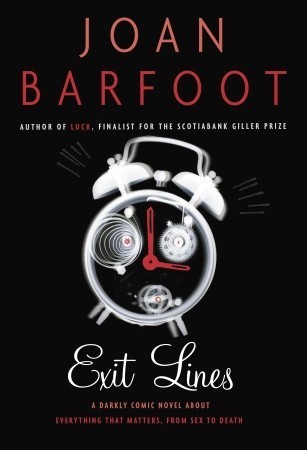
Exit Lines is a brisk, smart, darkly comic novel about four people who move into a retirement community named—in typically euphemistic style for such places—the Idyll Inn. When the novel opens, our protagonists are creeping through the residence’s darkened corridors at 3 am. on a secret mission, the full details—and the outcome—of which we only gradually discover. In the meantime, Barfoot deftly recounts the story of their settling in and making what accommodations they can to their new circumstances—including the loss of autonomy and privacy, the depressingly bland dietary options, the relentless parade of activities that, though well-intentioned, inevitably come across as infantilizing, and the knowledge that the Idyll Inn will be the last place any of them call home.

The novel cuts back and forth between chapters taking us, bit by bit, further down those scary hallways (“Three busy hearts leap and bang. Legs are wobbly, hands a bit shaky, flesh feels fragile. These pajamas, nightgowns, slippers and robes are warm, but the skin beneath is unfairly goosebumpy, shivery”)  and chapters that tell us more about Sylvia, Greta, George, and Ruth—including what their lives and families were like before they ended up at the Idyll Inn. They were not all strangers to each other before, but the bond they form at the Inn is a pleasantly bracing surprise. It is particularly important to Ruth, who has determined to control her eventual exit from the Idyll Inn by ending her own life, on her own timeline and in the way that she has figured out will be quickest, least painful, and easiest for those assisting her to cover up. In her new friends she finds (she hopes) allies and co-conspirators, though she waits until she is fairly sure of their loyalty before asking for what she admits is an “enormous” favour, “to be with me come the time. And . . . to help me.”

Ruth’s request understandably shocks the other three:

Friendship is supposed to be companionability, compatibility, trust, empathy, challenge, warmth, goodwill, consolation, and sustenance. Not this. What she’s asking has to be—or is not?—beyond all possible bounds.

What follows is a lot of arguing and and soul searching as each of the characters confronts questions from the pragmatic to the profound:

What do they believe? What are their values, and if any, their faiths? How do these apply to the small figure of Ruth sitting here?

What is compassion, how important is trust? . . . 

What exactly is so exceptional about human beings? A single human being? Besides the fact that only human beings can even contemplate such a question.

The single most important question is “Who gets to decide?” Ruth says she does, but Ruth’s friends aren’t so sure, or at least (especially if they are going to help her) they need a better reason than because it’s what she wants (“What Ruth wants: ‘My time, my place, my way'”). “I’m sure I’d have an easier time,” Sylvia finally says, “if you had an awful illness that was going to be fatal.” Ruth’s reasons are not as straightforward as that, and perhaps they are not as good as that—but whose business is that but hers?

barfoot2The others’ counterarguments are also not that robust. “God crops up,” but none of them is religious, or at least doctrinally secure, enough to insist that her plan is wrong or sinful. They are all in varying stages of physical decline, and the one certainty they share is that they will  eventually leave the Idyll Inn the same way other residents have, their bodies whisked away as quickly and quietly as possible so as not to discourage the rest. Still, it’s one thing to die and another to kill yourself, or so they try to convince Ruth (“Those people who struggle to be alive. When we are safe and comfortable here—they feel their lives are precious even when they are so very difficult, but you do not feel your life is?” challenges Greta). Ruth is resolute, however, and finally, one by one, they come around. As Sylvia puts it after her own change of heart, “Whatever anyone says—lawyers, doctors, governments, religions, all those nincompoop moral busybodies that float around like weed seeds—we should be in charge of our own selves.”
It sounds so simple, even inarguable, put like that, but the long journey our characters take to get there reminds us that it isn’t, as does the lived experience of anyone with direct experience of suicide. Details matter, of course.  What Ruth is seeking is closest to what here in Canada we have termed “MAiD,” medical assistance in dying, although the help she asks for isn’t strictly speaking medical—but that is precisely because she does not have the kind of “awful illness” Sylvia initially thinks would be the only justification for death on her own terms. Sylvia is thinking of a physical illness, and that generally seems to be the easiest scenario for people to accept. The availability of MAiD to those with illnesses other people can’t so easily see for themselves, specifically mental illnesses, is more controversial. I’ve had several painfully searching conversations about this issue since Owen died: I am fortunate to have people in my life who are deeply thoughtful as well as remarkably kind, and I have been truly grateful to be able to talk with them about what having this option might have meant to Owen, as well as how I expect I would have felt about it as his mother. If I have reached any conclusions, they rest, as Sylvia’s does, on the primacy of autonomy as a right and a value. But there is nothing simple about any of it—the hypotheticals are as terrible for me to contemplate as the reality, if in different ways. 

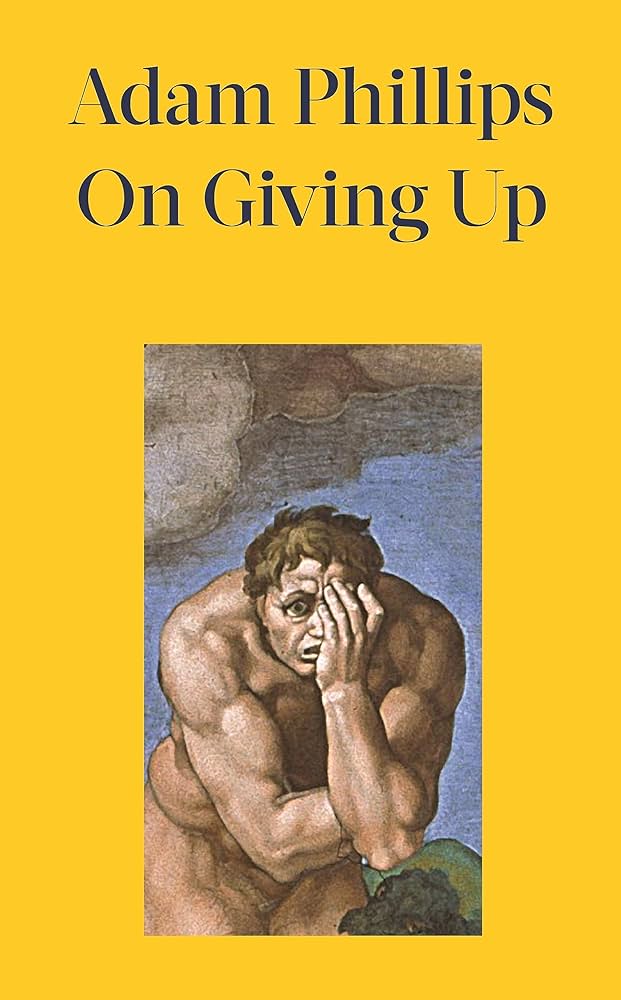
phillipsBarfoot simplifies things for her characters by emphasizing Ruth’s clarity of mind and purpose: whether you find her desire to die more or less acceptable as a result is going to depend on your values, but it does, I think, help answer the question “who decides” in her favour. Illnesses like depression affect, perhaps distort, people’s perception of reality: it is harder to defer to their autonomy, then, although perhaps it shouldn’t be, as what makes the most difference to someone’s quality of life is how they experience the world, how they experience life, not what other people insist it is actually like. Of course, we want to believe things will change for them, that they will get better, and most depressed people will. What does that mean about their right to say, as Ruth does, “my time, my place, my way,” or our right to intervene? One of the most insightful discussions I’ve heard about suicide since Owen’s death is an interview Hermione Lee did with Adam Phillips about his book On Giving Up. Phillips argues that we should be “able to acknowledge, not happily, that for some people, their lives are actually unbearable,” that the dogmatic insistence on life as the ultimate unassailable intrinsic good (what he calls “the ‘life is sacred’ line”) “means you are absolutely compelled to suffer whatever it is that’s inflicted on you,” which he rejects as an “intolerable position.” I agree, while recognizing as he does that this does not make any part of such a scenario anything other than heartbreaking, tragic. Phillips notes that the famous psychoanalyst Donald Winnicott never tried to dissuade anyone from suicide: “I just try to make sure they do it for the right reasons,” Winnicott said. I find that a defensible and principled position—but this is a case in which my head and my heart are in profound and perhaps intractable conflict.*
Is Ruth seeking death for the “right reasons”? I think Exit Lines ultimately answers this question in the negative, although I won’t go into spoilers about what exactly happens. I found the novel’s ending disappointing in some ways, because it seemed to falter from its own hard won and, to my mind, justifiable position. On the other hand, Barfoot’s characters do find comfort in the choice Ruth has fought for, in knowing that they do not have to “be helpless,” that “this could be a strong thing, although [they] did not dream of it before.” They feel better knowing that they do not have to drift passively into that good night but can stay in control, so that each day is really their own unless or until they choose otherwise. Planning for this eventuality gives them a long-term project “more riveting than playing bridge, watching TV or turning needles and wool, click, click click.” The tone of the ending, which is uplifting without being saccharine, is well suited to the book as a whole, which I have probably made sound much heavier going than it actually is. I began by describing it as “darkly comic” and it really is quite funny, and exceptionally clear-eyed about people’s weaknesses and hypocrisies and moral compromises. I really appreciated Barfoot’s ability to combine a brisk, entertaining story with such important questions about life and death. The book I read right after it, Elizabeth Berg’s Never Change, tries to do something similar—it is about someone with terminal cancer making decisions about the end of his life—but by comparison it seemed pat, simplistic, and emotionally manipulative.barfoot3

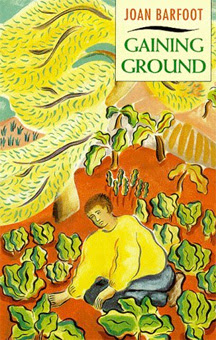
It was Backlisted that made me go looking for something by Barfoot to read: their conversation about her earlier novel Gaining Ground (aka Abra) was completely convincing about the quality of the novel. Exit Lines is the only one of Barfoot’s novels held at the Halifax Public Libraries, which is why I got to it first, but it turns out the Dalhousie library has a lot of them, several of which I checked out on my last visit to the stacks. I don’t know why I hadn’t already read more of Barfoot’s fiction: I had certainly heard of her, and I think I actually read Dancing in the Dark many years ago, but somehow I had never gotten any further. I plan to make up for that in the next few weeks.


*I am not interested in debating the ethics of suicide here, or in defending either Owen’s choice or our understanding of it. I was recently reminded that this is a subject on which some people feel free to judge and criticize both the person who died and those who grieve them. Comments along those lines will be deleted.

“What Can’t Be Said”: Concita De Gregorio, The Missing Word

Missing WordHelp me say what can’t be said, you ask me.

This would be the most extraordinary outcome. Managing to say out loud, dry-eyed, the things that can’t be said because no one knows where to put them, no one wants to hold them, because they burn. And you—when people ask about you—feel guilty because you are a red-hot ember that scorches anyone that touches it.

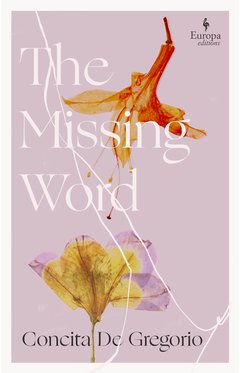
Concita De Gregorio’s The Missing Word is just barely fiction, by which I mean both that it tells a true story and that it tells its true story with exceptional lightness, almost delicacy, not of tone but of touch or glance, as if to help her readers hold Irina’s story in their minds without scorching.

What happened to Irina is this: she married Mathias; they had twins; she and her husband eventually separated but made amicable arrangements to share time with their daughters; one day he picked them up and they were never seen again. Mathias took his own life, leaving no traces or clues of the girls’ fate. Irina lives on, because “that’s what nature has decided: pain on its own doesn’t kill you.” Eventually she meets another man, Luis, and is happy with him, though she is also, always, grieving: “It’s a never-ending occupation. A constant battle. A siege, as you call it The presence of those who are absent besieges you.

Some of the chapters of The Missing Word are told by the narrator (Concita, as I understand both the novel’s conceit and its fictionalized truth) addressing Irina with questions or observations about Irina’s story, or Irina’s desire to tell her about it:

You want to talk about you. About what you’re like now. You want to say, eyes wide with surprise, that it can happen, something that you never imagined possible has happened to you. Love is back, it never really left: it was hidden in a corner, crouching in fear with its hands over its head, but it was there  . . . You talk and talk. You talk about changes. Memories. You wonder.

Other chapters are in Irina’s voice. She talks about about her family history, her marriage, her children, their disappearance, her memories, her mourning:

No. I don’t have a single picture with me. I don’t have one in my wallet. I don’t need to see them captured and immobilized in the past. I see them alive in the present, I don’t even need to close my eyes. I see them and hear them . . . There isn’t one image in particular that comes to mind. Every single one. All my memories are here: it’s not that they return, they never left. They haven’t been dislodged since the second they came into the world. Sometimes you’re surprised by the moment when they manifest themselves to you.

Other chapters are letters and documents: Irina writing to her friends, to her Nonna, to the girls’ teacher (begging, poignantly, for the school to release their stories and pictures to her), to judges or investigators (pressing for the investigationwhich was inept, half-hearted, inconclusiveto continue). A couple of the chapters are lists: things Irina is angry about, things that make her happy, things she “mustn’t forget”I made a list with that heading too, after Owen died.

riley-time-2It must be said,” Irina says to Concita, “that losing a child is the touchstone of grief, the gold standard of pain. The benchmark.” This is uncomfortable territory: it doesn’t seem right to weigh one grief against another. “Never would I compare my state with that of, say, a widow’s,” Denise Riley says in Time Lived, Without Its Flow”; “never would I lay claim to ‘the worst grief of all.'” Yet Riley, whose adult son died suddenly of a previously undetected heart defect, goes on to make other comparisons:
And, among my own kind, never would I compare my own infinitely lighter lot with that of the parent of a murdered or tortured child, or a suicidal child, or one killed in a stupid accident, or one very young, dying painfully slowly.

Irina does not know how or even whether Livia and Alessia died. She feels the impossibility of their survival, because surely there would have been some sign after so much time:

They’re very sensitive, Alessia and Livia. Highly intelligent. They understand, they hear everything. They would have found a way, in these years of absence, to let me know: we’re here. One person, a trick. Even if someone had said Mamma’s dead, or Mamma doesn’t want you anymore, she left. They would have come across something or someone, I think, able to capture a signal and transmit it. To be suspicious, feel sorry, understand.

But against the ninety-nine percent probability of their death, she sets the one percent chance that they are “somewhere in the world”: “all I can do is squeeze every fiber of my being into that infinitesimal space.” Maybe that would be worse, the not knowing for sure, the persistence of that tiny hope, although my mother’s heart says it might be better than what I know.

“There’s no specific noun for the parent of a dead child,” Riley remarks. That is the “missing word” of De Gregorio’s title. Maybe, both writers imply, there is no ready vocabulary because this is the loss (worst or not) that people, or parents anyway, least want to contemplate. It frustrates Riley when people say (as they have said to me too) “I can’t imagine what you are feeling”: “I’d like them to try to imagine,” she says, “it’s not so difficult.” I have thought the same, but I also understand the refusal; Riley calls it “a disavowal of the possibility of empathy,” but surely it is only self-preservation. Concita reflects on Irina’s reluctance to tell people the truth about her daughters:

People ask: Do you have children? You say nothing. Yes, two, you’d like to say. Because it’s true, you have two. They’re there all the time. You can’t free yourself of their absence . . . Then you should add: but they’re dead. Presumed dead, if you really want to be precise. But you don’t say it. You don’t say it spontaneously and then it’s too late, and you can’t find the courage to say it. Courage, yes, that’s the word. Because you’re ashamed to embarrass people . . . They truly didn’t want to know: they didn’t want to hear it.

“Well, do you know what would be amazing?” she goes on; “If people you speak to about yourself had the capacity to hold their peace, listen, and not feel duty-bound to put their two cents of horrified clichés in. To accept, and find a place for what you are saying.” That is what The Missing Word offers its readers as well as Irina: a place to listen, a story of love and loss to make up for the word we don’t have to give our grief a placea story, too, of movement, which for Irina makes a new story and a new love possible, not replacing the old story or the old love but continuing them:

Searching, traveling, seeing, trying to understand what the bigger picture is. This is the only thing we can do. Not stopping ourselves, not suppressing our desire, ever. Another step. One meter further. Forgetting and remembering. Letting things out and then bringing them back into your heart.

I read The Missing Word on what would have been Owen’s 26th birthday. Another step.

Corridor

Heart Rock November 22It has been quiet around here. I’m not really sure why that is. I’ve been busy at work, but that has never stopped me before. When this term began, I intended to make posting about my teaching routine again. When I kept that up, in the old days, it didn’t matter if I felt I had something in particular to say when I started: eventually I would discover what I had to say, because (as I’ve been trying to convince my first-year students) that’s how writing works. My reading hasn’t been going very well, but I used to write about it anyway.
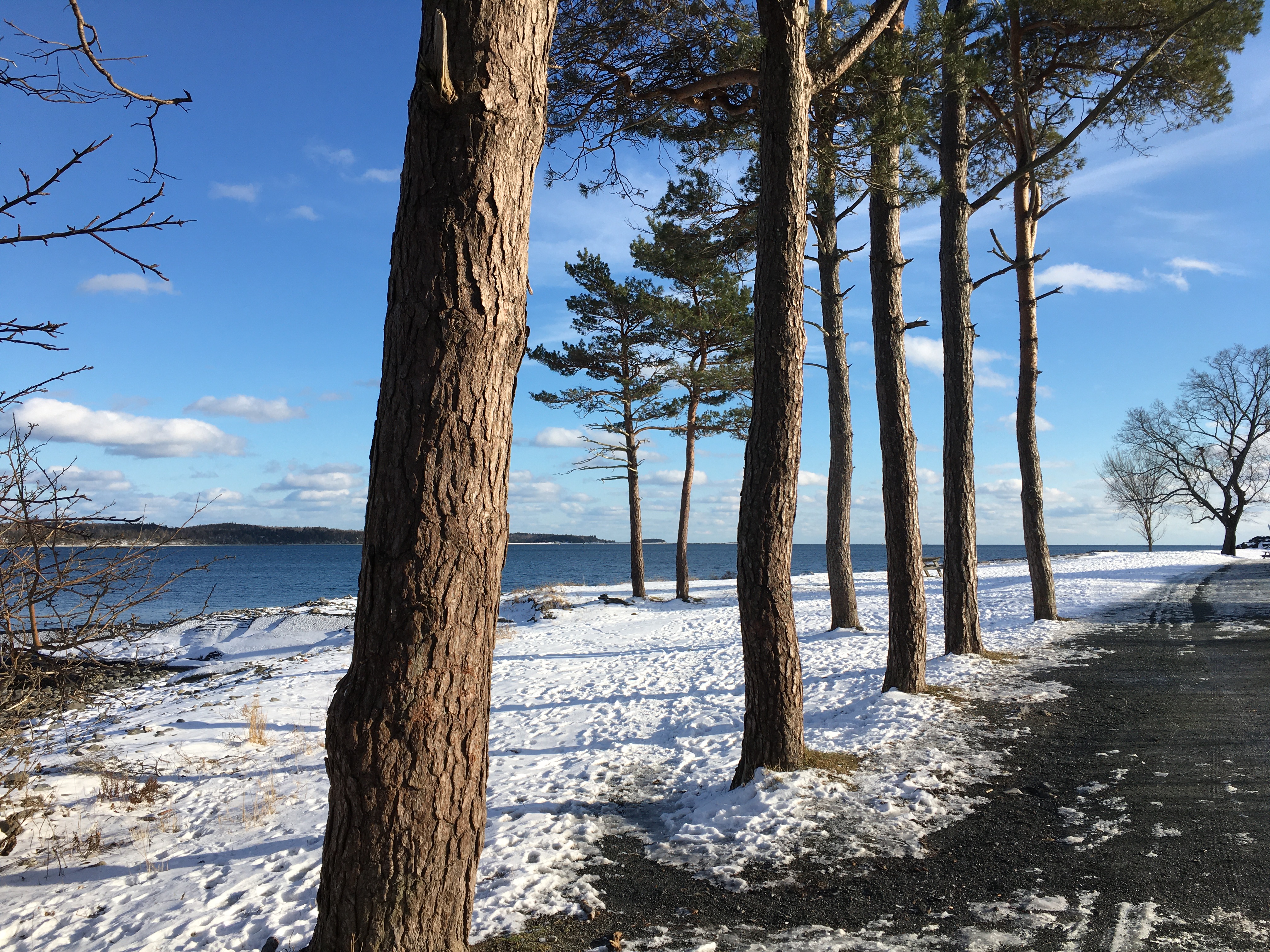
One challenge for me right now, something not directly related to my blogging or teaching or reading and yet maybe essential to them, or to me, to what I can do, is that I am still in what I imagined a year ago (a whole year ago!) as the corridor:

One way I suppose I could think about where I am right now is precisely in a corridor between two blocks, one of them my previous life, which included Owen, and the other my future life, which will go on without him. In a literal sense, of course, I am already in that new life, but it doesn’t feel that way yet: I feel disoriented, adrift, unsettled.

Then, when I was still (to an extent that I didn’t really understand) in the first shock of my loss, I felt the passing of time, and especially the coming of spring, as an offense against my grief. Spring is here again, officially anyway, and though on the surface my life appears much as it did before Owen died, I still have not figured out “how to incorporate his death into my understanding of my life”; although my life continues, I cannot understand or experience it yet as continuous. “Superficially ‘fine,'” as Denise Riley puts it, sixteen months after her own son’s death,

as my daily air of cheerfulness carries me around with an unseen crater blown into my head, the truth is that my thoughts are turned constantly to life and to death; all that I can attentively hold.

Two years after, two and a half years after, three years after, she is still writing her shock: “The severance of a child’s life makes a cut through your own”; “No time at all. No time.” The corridor, it turns out, is long, longer than I could have known, or was willing to know (she tried to tell me) — and now that so much actual time has passed I feel self-conscious, even a bit defensive, that I haven’t emerged from it yet.

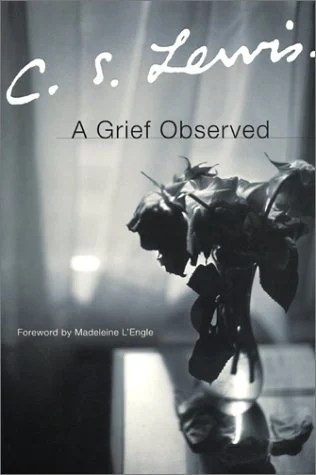
It’s not that anybody has said or even implied that I should be “over it” by now, but — rightly, understandably — for most people the urgency of my loss is over, the tide of sympathy and care has receded, new demands and crises and losses have come up. Life goes on, and “how are you doing,” while still a kind question, and sincere, becomes perfunctory, a question I answer in the same spirit, superficially, because what else, really, can I do? If sometimes I’m just going through the motions, well, at least that means I’m moving, and how else can I get to the other end of this corridor, whatever it means, wherever it leads? If I look straight ahead, it’s not so bad, either, although sometimes that’s actually the worst. “There’s no denying,” C. S. Lewis comments in A Grief Observed, “that in some sense ‘I feel better,’ and with that comes at once a sort of shame, and a feeling that one is under a sort of obligation to cherish and foment and prolong one’s unhappiness.” He’s wise about the complexity of that reaction:

We don’t really want grief, in its first agonies, to be prolonged: nobody could. But we want something else of which grief is a frequent symptom, and then we confuse the symptom with the thing itself.

Lewis talks of recurrences and cycles, like Riley seeking to articulate the temporal disruption and disorientation of grief. “Am I going in circles,” he asks, “or dare I hope I am on a spiral?”

But if a spiral, am I going up or down it?

How often  — will it be for always? — how often will the vast emptiness astonish me like a complete novelty and make me say, ‘I never realized my loss until this moment’? The same leg is cut off time after time. The first plunge of the knife into the flesh is felt again and again. a_grief_observed

When people say “it takes time,” they aren’t thinking about the knife, about the craters. “What a different result one gets by changing the metaphor,” George Eliot says in The Mill on the Floss. At least a corridor connects, rather than severs. Maybe it also shelters, protects, directs.

One book I did finish recently is Stephen Marche’s On Writing and Failure. If it sounds like a discouraging read, well, it is, but it also isn’t, because amidst the real talk and the cynicism there is also sincerity, even conviction. I loved this little passage, which helped me understand why I keep this up (why I want to keep this up):

I do not know who I am writing for, or for what time, or to what purpose. But there is a deep longing in me — and that’s not a lie, not a fraud — to make these words for you. These ephemeral connections are the substance of victory, to belong to a constellation of meanings, to alleviate a specific, miniscule cosmic loneliness. It seems like such a small satisfaction to expend your life on. It isn’t. “You ask, why send my scribbles,” Ovid, in his exile, asked. “Because I want to be with you somehow.” Somehow, anyhow.

I also read a book of poems by Linda Pastan. I especially loved “The Bookstall” (“For life is continuous / as long as they wait / to be read”). Her poem “Yahrzeit Candle” begins “On the second birthday / of your death / nothing / much / has changed.” I’m not there yet. I don’t want to be there. It seems impossibly far off, which is both good and bad, but time passes.

Cold Trees Feb 2 23

Still the World: This Term In My Classes:

I’ve been reading through my archive of posts about “This Week In My Classes,” which goes back to September 2007, nearly the very beginning of Novel Readings itself. There are some (possibly) practical reasons for doing this, including considering what to say in my contribution for a forum on teaching Victorian literature today that my colleague Tom Ue is organizing for the Victorian Review.

I’ve also been thinking more generally about the unbearable lightness of blogging—the flip side of the immediacy that is such a big part of its appeal as a form is its ephemerality. I have put so much effort, and so much of myself, into writing here at Novel Readings; as it becomes increasingly evident that, however persistently some of us keep up the habit, the ‘Golden Age of Blogging’ is past (something that is clearer to me than ever as I review the vigorous discussions that once happened in my comments sections), I find myself wondering if any of this archive is worth revisiting, revising, repurposing in some way that might be—I don’t want to say “more substantial,” because I fondly believe it is already substantial, if in a diffuse way—so let’s say a bit stickier.

The exercise so far has been at once invigorating and strangely mournful, or maybe not so strangely, given the context. For one thing, it’s not just blogging as a phenomenon that is past its prime but also, perhaps, my teaching career, although in my brighter moments I hope that there is time, and that I will have the energy, to make its last decade meaningful to both me and my students. Another context, of course, is Owen’s death and my continuing sense of disorientation in my own life, a feeling that is somehow harder, more confusing, to deal with when I am in the midst of what used to be normalcy, including especially, this term, on campus. So much is the same, including the work I am doing and (more or less) the person that I am while I’m doing it: how can that be? The discrepancy between my two realities continues to give me emotional vertigo, and rereading my old posts intensifies the effect, because they immerse me, in the moment, in the world before everything split apart. They are full, too, of casual references to my children—to sick days and holidays, to March break camps and Christmas shopping. Many of those years were actually hard times in many ways, both personally and professionally; frank as I have been about some aspects of my life, there’s a lot I’ve never talked about here. Now, though, they seem like such innocent times. Whatever my struggles, whatever I imagined or dreaded about the future, it was never this.

One question in the back of my mind throughout this term was: should I say anything to my classes about Owen’s death? Was there any way in which that recent experience of mine was relevant, not just to me personally but to what we were doing there together? Most of the time the answer pretty clearly seemed to be “no.” I did say, once or twice, that for personal reasons I wasn’t necessarily at my best and they should feel free to remind me or correct me about things if I got muddled. But in general I like fairly clear boundaries with my students (“be friendly, but not their friend” is the advice I got early on, and I still consider it sound); of course I’m always communicating my enthusiasms, interests, and values, just through what I teach and how I teach it, but I’m not a fan of oversharing, on either side. Suicide is also a fraught topic, and it is impossible for me to know how bringing up my own trauma might affect other people in the room. I think some of my students did know—and in fact one or two kindly extended their sympathies to me outside of class, which I appreciated.

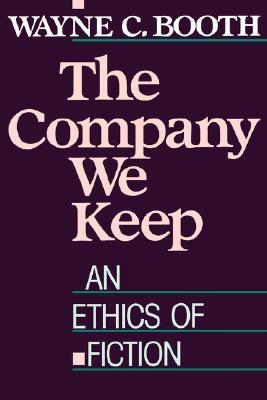
I did finally bring it up, though, on the last day of class in 19th-Century Fiction. I usually end that class with a peroration about why I think our work is worthwhile, on what I hope they have learned from our readings and discussions, and, most important, on what I hope they will take away from it all. For many years (and my review of my teaching posts has shown me just how long this has been true) I have thought about my classes as less about conveying specific content than about teaching reading—about training better readers. Always, in these closing remarks,  I note that they will only be assigned “required reading” for a fragment of their reading lives; the rest of the time, what they read and how they read it will be up to them, as will be their relationship with books in other ways, from supporting public libraries to attending book festivals, from joining book clubs to getting involved in debates about the curriculum in the public schools. I do care about their engagement with the particular books I’ve worked on with them; I am always delighted when I hear from a former student who has carried away a love of Victorian novels and continues to seek them out, or who thinks back on our journey through Middlemarch as a highlight of their university years (and some do!). But I also hope that my students carry away a set of habits and skills for reading, and a set of questions to ask of anything they read, questions like the one Booth proposes as fundamental in The Company We Keep:  “Is the pattern of life that this would-be friend offers one that friends might well pursue together?” (The best literary “friends,” he elaborates, are identified by “the irresistible invitation they extend to live during these moments a richer and fuller life than I could manage on my own,” which is as good a definition of literary merit as I know.)

In my closing peroration in 19th-Century Fiction this year, I said a lot of the same things, but I also commented on two specific contexts for our work together that really mattered to me this term, both of which had given new urgency, in my mind, to questions about how we all spend our time, not just but especially in the classroom. The first was my return to in-person teaching after two+ years of teaching online, an experience which has prompted a lot of pedagogical reflection for me. Before COVID, I made a lot of assertions about the importance of teaching in person (some of them prompted by MOOCs, which seem to have fizzled out conspicuously as both promise and threat). I have learned a lot in the past three years about online teachingenough not to dismiss it or recoil from it, but also enough to know that I was right that, for me and the kind of teaching I enjoy and value most, being in the room with my students is preferable. I struggled a lot this year because it wasn’t clear that a number of my students thought the same; I hope that this is a lingering effect of the COVID years (not that they are really over, sadly) and that eventually those meetings will hum with their old energy. I didn’t go on and on about this to my class, not least because the ones who were present were the ones who had pretty much always been present, so they had shown their own commitment to what I strongly believe is, at its best, a collaborative venture.

And the second context I brought up was that this had been my first term back in the classroom since my son died. I did not go into any details about his death, but I told them that, inevitably, it had prompted a lot of questions for me about how I spend (and have spent) my life and my work, about what my priorities have been over the years. I have worked hard, I told them, to recover and sustain my conviction that if  teaching was the kind of thing that had been worth doing before Owen died, it was still worth doing, and doing as well as I could manage, after he died as wella principle I have tried to believe in and live up to in other ways as well, including maintaining this blog.  I got a bit choked up talking about this, which I knew was a risk, and maybe it was too personal a thing to say. Rightly or wrongly, though, it really mattered to me to tell themthis group who had stuck it out with me all term in our grim, windowless room, heads up, masks onthat our time together had really meant something to me, that I wasn’t just going through the motions, that teaching might be “just a job” in some respects, but that it is a lot more than that in others. I guess that’s something I hope they will carry away from my class as well, that (as Aurora Leigh tells us), “the world of books is still the world,” and that how we read, and how we think about reading, is inseparable from how we live.

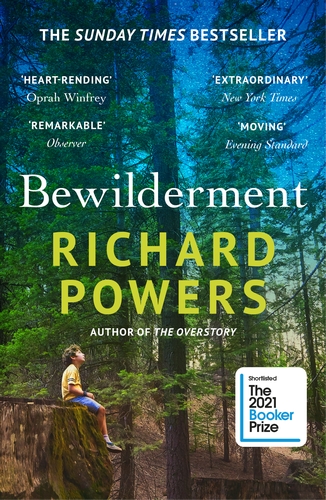
“Otherworldly”: Richard Powers, Bewilderment

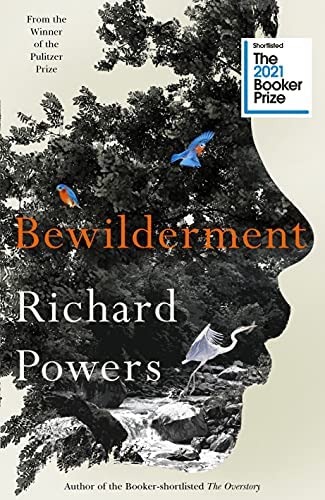
bewildermentI twitched in my sleeping bag trying not to wake Robin. A chorus of invertebrates swelled and ebbed. Two barred owls traded their call-and-response: Who cooks for you? Who cooks for you-all? Who would ever cook for this boy, aside from me? I couldn’t imagine Robin toughening up enough to survive this Ponzi scheme of a planet. Maybe I didn’t want him to. I liked him otherworldly. I liked having a son so ingenuous that it rattled his smug classmates. I enjoyed being the father of a kid whose favorite animal for three straight years had been the nudibranch. Nudibranchs are underappreciated.

Bewilderment is a heart-rending novel. It is about two failures, or two catastrophes. One is the failure of a father, Theo, to save his beloved, brilliant, difficult son Robin; the other is our collective failure to save our planet and the other creatures for whom it is also the only precious, fragile home. These failures are related: one source of Robin’s baffled fury—his terrifying, exhausting, destructive outbursts of rage—is the devastation he sees around him as some species are driven to extinction and others suffer needlessly because of human greed, selfishness, and callousness.

Theo is a single parent; he and Robin are still grieving for the death of his wife, Robin’s mother, Alyssa in an (apparent) accident, and that emotional struggle gives their close but fraught relationship additional pathos. Theo tries everything to help Robin learn to live in the world, to help him find his balance—everything, that is, except the one thing almost every other authority figure or expert involved in Robin’s life wants Theo to do, which is to medicate him. One source of Theo’s resistance is that he doubts their diagnoses:

When a condition gets three different names over as many decades, when it requires two subcategories to account for completely contradictory symptoms, when it goes from nonexistent to the country’s most commonly diagnosed childhood disorder in the course of one generation, when two different physicians want to prescribe three different medications, there’s something wrong.

powers2“So far the votes are two Asperger’s, one probably OCD, and one possible ADHD,” he tells Martin, a neuroscientist friend of Alyssa’s to whom he eventually turns for help. “Most of the common meds are pretty normalized,” Martin comments, but when Theo insists that he wants “some treatment short of drugs,” Martin proposes that Robbie enter his ongoing trial of a therapy called Decoded Neurofeedback, or DecNef, in which “subjects enter emotional states in response to external prompts,” generating scans that are then used to guide another set of subjects to follow in their mental footsteps. (I don’t pretend to grasp either the nuances or the feasibility of this intervention, or to know how realistic Powers’ evocation of it is.) This is Martin’s explanation of the approach they go on to take with Robin:

The scanning AI would compare the patterns of connectivity inside Robin’s brain—his spontaneous brain activity—to a prerecorded template. “Then we’ll shape that spontaneous activity through visual and auditory cues. We’ll start him on the composite patterns of people who have achieved high levels of composure through years of meditation. Then the AI will coax him with feedback—tell him when he’s close and when he’s farther away.

The treatments are successful from the start (“Brain Boy,” the researchers admiringly nickname Robbie) but they become remarkably so once Martin’s team connect Robin specifically with recordings of his mother’s brain activity from an earlier experiment she and Theo both participated in. Is Robin really reconnecting with his dead mother when he follows her thoughts and feelings in this way? It certainly seems like it, to him and to Theo: ‘It was her, Dad, Robin reports after one of the first of these sessions, and then, hauntingly, Your wife loves you. You know that, right?’

Theo’s hope is that the treatment will enable Robin to stay in and survive at school. It doesn’t work out that way, and so Theo begins home schooling him, with some costs to his own career as an academic astrobiologist. Robin flourishes under their new system:

He had no trouble keeping up with the public curriculum. He polished off his online self-exams with glee. We traveled everywhere that reading, math, science, social studies, and health let us travel. We studied at home, in the car, over meals, and on long walks through the woods. Even shooting penalty kicks against each other in the park became a lesson in physics and statistics.

Every success is precarious, though—the gains of the treatment wear off, even as Robbie becomes something of a celebrity as a case study, and the world around them continues to cause him distress Theo is increasingly unable to mitigate. Robbie finds meaning and motivation in activism, only to be crushed at its inefficacy, and at other people’s indifference (one of many ways in which his struggles reminded me of Owen’s). News of a devastating outbreak of bovine encephalitis necessitating mass killing of the “demented cows” causes a meltdown so self-destructive a worried neighbor calls child services.

powersTheo’s tense, beautiful, heartbreaking account of his life with Robin is intercut with their “visits” to other planets: part of Theo’s work is running simulations of what kind of life might emerge under wildly varying conditions which he and Robbie “explore” with exhilarating curiosity and awe. These sections are weird and wonderful, visions of possible worlds completely unlike our own and yet always imagined as possible points of connection. On the planet Pelagos, for instance,
Life spread through its latitudes from steamy to frozen. Hosts of creatures turned the ocean bottoms into underwater forests. Giant blimps migrated from pole to pole, never stopping, each half of their brains taking turns to sleep. Intelligent kelp hundreds of meters long spelled messages in colors that rippled up the length of their stocks. Annelids practiced agriculture and crustaceans built high-rise cities. . . . Dozens of dispersed intelligent species spoke millions of languages.

‘No telescopes, Dad,’ says Robbie; ‘No rocket ships. No computers. No radios.  . . How many planets are like this one?’ “There might be none,” replies Theo; “They might be everywhere.” ‘Well, we’ll never hear from any of them,’ Robbie concludes, not so much regretfully as with wonder. The planetary excursions reflect Theo and Robbie’s moods and needs: when their own world is too inhospitable—especially for Robbie, who is too sensitive to endure its sorrows, and too intelligent to be placated or distracted from them—they leave it behind. There is no escaping reality, however, and the last planet Theo conjures up is one “that couldn’t figure out where everyone was. It died of loneliness. That happened billions of times in our galaxy alone.” His desolation is complete.

powers3I was initially drawn to Bewilderment because of its description as the story of a father and his “rare and troubled boy.” I had a son like that, and while his specific passions and hardships were not the same as Robbie’s, Powers captures a lot of what it was like to try and to fail to know what was right for someone whose gifts and whose difficulties were equally extraordinary, excessive, sometimes exhausting, especially but not only for him. I too liked my son “otherworldly”; his ingenuousness was so precious, even as it made him, sometimes, so vulnerable. “His pronouncements were off-the-wall mysteries to everyone except me,” Theo says of Robin;

He could quote whole scenes from movies, even after a single viewing. He rehearsed memories endlessly, and every repetition of the details made him happier. When he finished a book he liked, he’d start it again immediately, from page one. He melted down and exploded over nothing. But he could just as easily be overcome by joy. . . . Tell me what deficit matched up with that? What disorder explained him?

I think Bewilderment is, in part, about the limits of explanations, which are not, after all, instructions. What lies beyond them, as deep and vast and mysterious as space, is love.

What Am I To Do With These?

‘Jacob! Jacob!’ cried Bonamy, standing by the window. The leaves sank down again.

‘Such confusion everywhere!’ exclaimed Betty Flanders, bursting open the bedroom door.

Bonamy turned away from the window.

‘What am I to do with these, Mr. Bonamy?’

She held out a pair of Jacob’s old shoes.

“To that question,” Winifred Holtby notes in her book on Virginia Woolf, “there is, indeed, no satisfactory answer.” The novel’s final image “leaves an impression of apprehension, of the solicitude of women and of the indifference of fate . . . Its melancholy, its extraordinary desolation, are indefinable.”

The famous six word story (attributed, apocryphally, it seems, to Hemingway) “For sale: baby shoes, never worn” is often cited as one of the saddest stories imaginable. I know that grief is not a competition, that there is no hierarchy of loss, and yet I have sometimes thought, since Owen died, that items often worn—like picture books often read—tell a tale every bit as heartbreaking, if not more, because they represent a love and a loss encompassing years. How well Woolf understood: I see myself in Jacob’s bereft mother, baffled, as I have so often been baffled, by the puzzle that completely ordinary things like shoes and clothes remain, even though the person who gave them meaning is gone. For nearly a year now, I have avoided them, but I have not been able to ignore them. Just by being present, by being what is left of him, they have relentlessly demanded my solicitude. But what am I to do with them?

There is, indeed, no satisfactory answer, but in the last few days, with loving help and support, I have at least (at last) done something. His clothes are cleaned, folded, and sorted, some ready to go to others who need them, some saved for our remembrance. I have never done laundry with so much love before: sad as it was, it also felt right, as if I was taking care of him again, as I did for so long. There is desolation in that, but also some comfort.

As always, a poet has shown the way.

“The Sadness of Clothes” by Emily Fragos

When someone dies, the clothes are so sad. They have outlived
their usefulness and cannot get warm and full.
You talk to the clothes and explain that he is not coming back

as when he showed up immaculately dressed in slacks and plaid jacket
and had that beautiful smile on and you’d talk.
You’d go to get something and come back and he’d be gone.

You explain death to the clothes like that dream.
You tell them how much you miss the spouse
and how much you miss the pet with its little winter sweater.

You tell the worn raincoat that if you talk about it,
you will finally let grief out. The ancients etched the words
for battle and victory onto their shields and then they went out

and fought to the last breath. Words have that kind of power
you remind the clothes that remain in the drawer, arms stubbornly
folded across the chest, or slung across the backs of chairs,

or hanging inside the dark closet. Do with us what you will,
they faintly sigh, as you close the door on them.
He is gone and no one can tell us where.

Reading Week Reflections

Reading

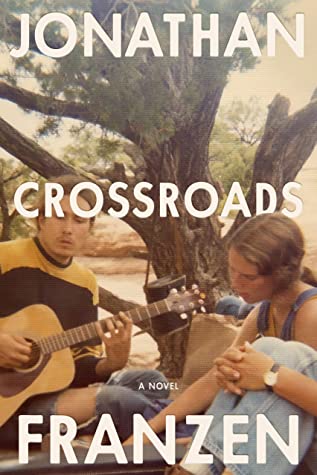
It took some effort and some strategic skimming, but I made it to the end of Jonathan Franzen’s Crossroads. There’s a lot of it – but that wouldn’t have been a problem if I had felt there was more to it. What was all that accumulated information for, in the end? What comes of it? What are we left thinking about, after wading through so much detail about people who are by and large quite unsympathetic and disappointingly static? I was never exactly bored, but I was also completely unable to get my bearings at anything but the most literal level. But a lot of astute critics loved the novel (that’s one reason I bought it, after not having read anything by Franzen since The Corrections) so as always we are left with the great mystery of reading, the inexplicable idiosyncrasy of it all.

Now I’m reading Graeme Macrae Burnet’s Case Study. I think it first caught my eye because it was on the Booker longlist. Then I read something else about it somewhere – now I can’t remember exactly what or where (typical of me these days, I’m sorry to say) that sharpened my interest enough that I went ahead and procured it. I’m engaged but not engrossed so far; we’ll see how it goes. I reviewed Burnet’s earlier novel His Bloody Project for Open Letters Monthly a few years ago and concluded it was “not wholly satisfying.” It too was a compilation of purported source documents; my main complaint (besides the voices being insufficiently distinct and exciting) was that it lacked a unifying idea about its elements. Maybe this should have discouraged me from trying another novel by the same author in so similar a vein, but Case Study seems tauter so far. I’ll see. If I can just concentrate on it long enough to read to the end, that in itself will be a mark in its favor.

Update: I did read Case Study to the end, and stayed interested in it the whole time. Success, then! I am not sure I read it in a suspicious enough way: I found the ending curiously anticlimactic and it was only on peering at some reviews that I started to think about more layers of unreliability and thus interpretation than had occurred to me on my own. Curiosity, too, rather than emotional engagement, was my main feeling as I read: I wanted to see how the elements were going to come together, and what they were going to mean, but I wasn’t particularly invested in the outcome otherwise. It’s a clever book, maybe too clever for a reader like me whose first instinct, at some level, is to give myself over to the fiction, rather than to mistrust every move.*

Also on my TBR pile are Ian McEwan’s Lessons, which my book club is doing next and Anthony Doerr’s Cloud Cuckoo Land, which a member of my book club talked about in such an interesting way at our last meeting that it inspired me to pick it up. I’m stalled about a third of the way into Andrew Greig’s Rose Nicolson, and keep looking at but not actually starting Nicola Griffith’s Spear. I feel as if I keep picking the wrong books, as if my reading radar is malfunctioning. For this reason I am suppressing my urge to rush out and buy Barbara Kingsolver’s Demon Copperhead, even though everything I’ve heard about it so far makes it sound very tempting. Or maybe my “bandwidth,” as we like to call it nowadays, is just overwhelmed by the combination of work (which of course includes a lot of reading) and grief.

Reflections

Today is exactly one year since Owen moved back in with us, for what was meant to be a restorative stop-gap measure while we sorted out his next steps. The onset of fall weather, with its crisp sunshine and bright colours, has intensified the feeling I’ve talked about before of time coming somehow full circle: the intervening months have been so strange, so foggy and disoriented, and the events of this time last year are still so immediate and vivid in my mind, that it is almost easier to believe I am still there, in November 2021, than here, helplessly reaching back to that hopeful reunion across the unfathomable chasm Owen’s death created in my life and my memories. But I’m not there, of course, but here, and soon there will be other, even harder, markers of the relentless way time puts more and more distance between us. I think often of Denise Riley’s comment that “the dead slip away, as we realize that we have unwillingly left them behind in their timelessness.” Current wisdom is that grief is best treated by finding ways to continue our relationships with those we have lost. It is an ongoing struggle, for me, to understand what that means in practice, although I am learning that it includes grief itself, which for now at least is the truest expression of my ongoing love for my son. Its pain is no less fierce now, but it is at least more familiar.

These lines by Philip Larkin capture so well what it feels like to live with sorrow, sometimes sitting quietly with it but sometimes sensing it stir, or stirring it yourself, so that it flares up once more, rending your heart. I know a lot of you live this way too. 

If grief could burn out
Like a sunken coal,
The heart would rest quiet,
The unrent soul
Be still as a veil;
But I have watched all night

The fire grow silent,
The grey ash soft:
And I stir the stubborn flint
The flames have left,
And grief stirs, and the deft
Heart lies impotent.


* One of the challenges of a novel like Case Study for me is that, deliberately, we are discouraged from accepting any of it as sincere. And yet in the midst of it, there was a passage – narrated by a character we can’t trust, about someone who by the end of the novel I’m not 100% sure ever actually existed within its fictional space – that hit very hard:

Then something else occurred. One evening, as we sat at supper, I turned to the place Veronica had lately occupied and was about to say something to her, before I checked myself. For the first time, I keenly felt her absence. From that moment, I saw her death in a different light. There was a Veronica-sized void in the world. As well as her physical presence, the contents of her mind were gone. The question I had been about to ask would never be answered. Everything she had learned, the memories she had accumulated, her future thoughts and actions had all been snuffed out. The world was diminished by her non-existence.

In the novel, this moment is either poignant autobiography or strategically affecting fantasy (or, perhaps, sadly troubling delusion). Whichever of these it is meant as, it’s also, in its own way, truthful, as are many of Burnet’s remarks – off-hand though they seem – about suicide and “dark thoughts.”