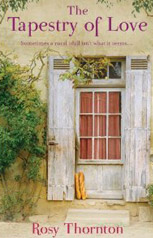
Rosy Thornton, The Tapestry of Love

What’s not to like about The Tapestry of Love? It’s undemanding and charming, while also being thoughtful and literate. Along with Thornton’s Hearts and Minds, it now numbers among the little cluster of books I think of as my ‘comfort reading,’ books that I reread when I want to wander mentally away from home without feeling adrift, to be distracted without being distraught or dismayed–books, too, that always bring me home again, quietly, rather than leaving me staring wistfully over the horizon. I am sure I will reread The Tapestry of Love more than once in the years to come.

Like Anne Tyler (whose Ladder of Years is a longstanding comfort read), Thornton has an astute sense of character–of what makes people distinctly themselves–but also of relationships and how they challenge (or, more rarely, reinforce) that individualism. The story of Tapestry of Love is simple enough, perhaps even clichéd: a divorced Englishwoman pursues her dream by moving to a cottage in the Cévennes and setting up her own business, including making the tapestries that provide the novel’s underlying metaphor (and, obviously, its title). Though she doesn’t go in search of romance, inevitably (by fictional, not real standards) she finds it. But its development is hampered by her own reserve, by her more flamboyant sister, and by the complications of being both grown up and divorced already, and thus under no illusions about fairy-tale endings. Filling in this simple outline are details and anecdotes–sometimes humorous, sometimes poignant–about life in this rural community, told in prose that is precise, evocative, and unsentimental.

I first heard about Rosy Thornton from the review of The Tapestry of Love at Tales from the Reading Room. Litlove speaks so well about the book that I’m going to quote her at some length rather than try to find another way to say something that wouldn’t end up being very different (it’s not lazy, it’s appreciative!):

There are two preoccupations in this delicate novel that stand out in particular. The first is the exquisite nature writing that brings France alive on every page. I don’t recommend you pick up this book if you have a deep hankering to move to the south of France because you’ll find you’ve booked a ticket before the end is reached. Catherine is an observer, a practiced witness to lives that are more vivacious than her own, and her profound attention to the consoling beauty of the world around her is completely convincing. But at the same time, this attentiveness to the natural world has another purpose, in that it emphasizes the cycle of life in which all the characters are trapped. I found this to be the most poignant of Rosy’s books so far, the one most concerned with loss and how it might not perhaps be managed, but eventually accepted, or soothed with other distractions. The cycle of family life, with its need to find partners, to raise children, to let go of the adults they become as well as the parents who raised us in their time, is the underlying trajectory of the plot. Catherine is at the time of her life when there are too many goodbyes, and to add to that, she has chosen to leave her homeland and all its familiarity behind. But Catherine is a sensible, grounded woman, a woman whose work matters to her as much as her romantic life, a woman who knows what needs to be done and will do it, even if it requires unreasonable selflessness. And she is also a hopeful woman, one who believes without needing to say it, that tomorrow will bring fresh opportunities and new chances. Her resolute strength of character and her belief in the process of renewal carry her (and the reader) through adversity and to the optimistic ending you long for her to have.

There’s also a lot of wry humour in the book, about the French bureaucratic system (which deserves to have fun poked at it), and about sibling relationships. It’s a wonderful portrait of two sisters, and it was probably this relationship I appreciated most in the novel. There’s always a great core of strength at the heart of Rosy’s novels and this comes from her celebration of love over the false friends that are need, desire, lust and romance. Unlike other genre writers, who turn love into Sturm und Drang or emotional pyrotechnics, Rosy portrays love more realistically (and therefore surprisingly), as presence, awareness, mindfulness, and also as acceptance of people exactly as they are. This makes her books less outwardly dramatic than some, but reassuringly, resolutely real and immensely comforting. The Tapestry of Love is about the gentle warp and weft of relationships, the tracing of a thousand threads of attachment into patterns that please and console. In this way it’s a novel that leaves the romance genre some way behind, and deserves a categorization all of its own.

You can see from this why I was prompted to look up Rosy Thornton for myself (and why I like Tales from the Reading Room so much, too). I was delighted to learn from Thornton’s author page that her career as a novelist grew out of her enthusiasm for Gaskell’s North and South (and I would just like to say “I hear that!” to her comment about Richard Armitage in the role of John Thornton). I haven’t read her other two novels yet, including the first one in which, she says, the influence of North and South is particularly evident, but I enjoyed Hearts and Minds very much too–also gently humorous and unassumingly astute. This is the point at which easy access to the Book Depository and its free worldwide shipping becomes dangerous…

A trivial question that lingers: There are all kinds of novels about the English abroad, yearning for sunshine, or for a society fondly imagined to be somehow more open, emotional, or authentic–like A Room with a View, to give just one more famous example. Do folks in Italy or the south of France ever dream of (and write novels about) holidays in England? I suppose if they do, it would be out of yearning for something other than the weather.

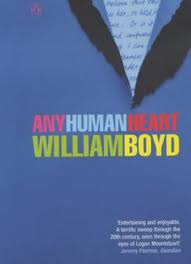
William Boyd, Any Human Heart

From the Novel Readings Archive

I haven’t watched the first instalment of the new BBC adaptation of Any Human Heart yet, but it’s waiting for me on my DVR. In the meantime, it seems like a good time to recall what I thought about the book. As you’ll see, things started out a bit rocky–but I ended up liking it a lot. I’m curious to see how (or if) the adaptation deals with the formal features of the novel, particularly the first-person narration through the diaries. I’m expecting that it doesn’t try to capture Logan’s voice but simply dramatizes his life story. That’s usually the great loss in the shift from written to visual form, no matter how good the adaptation otherwise. The BBC Middlemarch, for instance, though intelligent in many ways, is an incredibly thinned-out experience compared to the novel because (except for a brief voice-over at the end) there’s no narrator.


I almost didn’t finish reading William Boyd’s Any Human Heart. By about 200 pages in, I was tired of Logan Mountstuart, his personality, and his life. He seemed archly insouciant, pretentious, insubstantial–as did the novel’s conceit of following this unappealing person through the 20th century, punctuating his episodic memoir (the novel consists of his journals, ‘edited,’ complete with footnotes, editorial commentary, and an index) with encounters with Woolf and Joyce, Hemingway and the Duke of Windsor and Picasso. Here’s a typical diary entry:

Tuesday, 4 March We dined at Luigi’s and went on to the Cafe Royal. It was busy, full of unfamiliar faces. Spotted and spoke with Cyril [Connolly] and Jean who were with Lyman? Leland? [unidentifed]. They left shorty after. Then Adrian Daintrey[22] came in with a party in evening dress–which included Virginia Woolf[23], smoking a cigar. I let them have our table and during the general milling around that took place I introduced Freya to Woolf. ‘Are you two here alone?’ she said to Freya. ‘What a ghastly crowd. How it’s changed.’

‘We were here with Cyril Connolly, a moment ago,’ Freya said.

‘Was his black baboon with him?’ VW asked.

Freya didn’t know what she was talking about.

‘His little gollywog wife.’

I turned to Freya. ‘Now you understand Mrs Woolf’s reputation for charm.’ Back to VW. ‘You should be ashamed of yourself.’

We strode out and when we reached home had our first serious row. Freya was a little shocked at VW’s spite. I said you would never imagine the person who wrote all that lyrical breathy prose was steeped in such venom. ‘At least she writes,’ Freya said, without thinking. But it cut and so we looked around for something to fight about and duly found it. Now I’m writing this, about to go to sleep on the sofa, and I can hear Freya sobbing next door in the bedroom.

And so it goes, documenting Logan’s haphazard journey across the century. He’s a novelist, a journalist, a sort-of spy, an art dealer, a husband, a philanderer, a father. He meets Joyce in Paris, Hemingway in Spain, Frank O’Hara in New York. He is a kind of picaresque Rosencrantz (or Guildenstern, take your pick), always present, always involved, never really very important or impressive. He spends two years as a prisoner of war–in Switzerland! Somehow, that detail of his WWII escapades seems to me to capture something fundamental about how his life is conceived and presented in this novel, that he should parachute into Europe on a secret mission but to a neutral country, and end up so unheroically, and so diverted from the course of history that he doesn’t even know when the war has ended. It would be a comic incident (even Logan, mystified as he is by his internment, never seems to fear he will meet a terrible fate at the hands of the Swiss), if his return to action weren’t marked by a family tragedy. His story oscillates between such turns of good and bad fortune…and that uneven, unpredictable alternation of good and bad, happiness and grief, begins after a while to reveal itself as the underlying logic of the novel. As Logan reflects, near the end of his life,

That’s all your life amounts to in the end: the aggregate of all the good luck and the bad luck you experience. Everything is explained by that simple formula. Tot it up – look at the respective piles. There’s nothing you can do about it: nobody shares it out, allocates it to this one or that, it just happens. We must quietly suffer the laws of man’s condition, as Montaigne says.

As I realized Any Human Heart was not going to shape its protagonist’s life into something more definite, but would just keep on going with it, right to the end, I began to fall under its spell. I didn’t like Logan much more later in the novel than I had at first, and certainly he never achieved the level of moral self-reflection you might hope for if the novel were of a different kind (a Bildungsroman, for instance). The novel is a bit like David Copperfield, but without the benefit of hindsight in its narration, or of real personal growth in its action. But at the same time, the relentless forward movement of time itself has a kind of narrative to it. At one point Logan heads “to the passport office to collect [his] new passport, valid for another ten years”:

In 1965 I’ll be fifty-nine and the thought makes me feel faint. What’s happened to my life? These ten-year chunks that are doled out to you in passports are a cruel form of memento mori. How many more new passports will I have? One (1965)? Two (1975)? Such a long way off, 1975, yet your passport life seems all too brief. How long did he live? He managed to renew six passports.

I thought that was a beautiful moment; it was certainly the moment at which I began to read without impatience, with a quickened interest in following Logan’s life the rest of the way. He has no great epiphanies. He just keeps on living, one way or another, sometimes better, sometimes worse, in comfort and in poverty, in sickness and in health. He makes and loses friends and lovers; he has good ideas and bad ones, successes and failures. His most lasting relationship is with himself (he dies alone), but he has the great gift of “genuine love” for three other people, a love that brings him to another brief but beautiful insight:

As I write this I feel that draining, hollowing helplessness that genuine love for another person produces in you. It’s at these moments that we know we are going to die. Only with Freya, Stella, and Gail. Only three. Better than none.

I finished the final journal entry, which is touching but unsentimental, very happy to have persisted with the novel. I was with Logan emotionally in a way I never would have predicted from my initial response. I’m not convinced, though, that the set-up, the elaborate pretense of authenticity, was necessary. The apparatus (explanatory prefaces, footnotes, index) seems gratuitously metafictional. We can suspend our disbelief readily enough when reading a novel cast as a diary (or as letters, for that matter); we don’t need to pretend we can read it because it was prepared for publication. I suppose this framing material does enhance the novel’s emphasis on Logan as a witness to history, something he himself becomes more self-conscious about, naturally enough, later in his life when having known Hemingway, or met Woolf, or been sketched by Picasso, confers on him a kind of status, as if he’s a walking relic. But it still felt artificial to me and even, at times, detracted from my unfolding sense of commitment to the individual voice speaking through the journals.

(originally posted October 10, 2009)

February at Open Letters Monthly

Thanks to the insight, creativity, and just plain hard work of editors and contributors alike, the new issue of Open Letters Monthly went live yesterday, and it’s full of the usual fine array of essays and reviews (yes, I’m patting myself on the back along with everyone else!). Here’s a sampling of what you’ll find if you click on over:

  • Anne Fernald (who blogs at Fernham and has published in Open Letters before) offers a thought-provoking reminiscence of her grandmother, an uncommon variety of the ‘common reader.’
  • Victoria Best (better known to some of you as litlove), writes a fascinating account of the troubled but somehow mutually inspiring, or at least enabling, relationship between Margeurite Duras and her young acolyte (lover? muse?) Yann Andréa.
  • My Dalhousie colleague Alice Brittan reviews Michael Cunningham’s By Nightfall and finds it good–but not quite good enough for what she believes Cunningham to be capable of.
  • Joanna Scutts’s excellent commentary on the new BBC series Downton Abbey makes me wish I’d been recording it–I’ll be watching for the reruns.
  • The indefatigable Steve Donoghue (who blogs at stevereads) launches his new series, ‘A Year with the Windsors,’ with a review of Kate Williams’s Becoming Queen Victoria. At my urging, the remainder of the series will include far more references to Walter Bagehot.
  • I pitch in with a review of Sara Paretsky’s most recent V.I. Warshawski novel, Body Work, placing it in the context of some of the issues that come up when I teach my classes on detective fiction.

There’s lots more, too, so I hope you’ll take a look. We’ve also added a couple of sidebar features this month, one linking around to a few highlights elsewhere on the web, the other showcasing some of the great material from the OLM archives, which go back almost four years. The magazine is a labor of love for everyone involved–and I never really guessed just how much labor, or how much love, before I became part of the editorial team!

By the way, if you happen to be in Washington at the AWP Conference, look for our table, chat with our charming representatives, and buy a copy of our anthology!

Sabbatical!

Today is the first day of the rest of my sabbatical! Much as I love being in the classroom (usually, anyway), it’s a good feeling to confront a term in which my time will not be overwhelmed with teaching tasks and I can concentrate on the other parts of my job description–particularly, of course, research and writing–that tend to get crowded out the rest of the time. The sabbatical system is a wonderful and very valuable feature of academic life. It’s impossible to imagine sustaining the commitment, creativity, and intellectual integrity that’s necessary to do this job well without these intermittent opportunities to update my own knowledge and exercise my own skills as a researcher, scholar, and writer. We bring our whole selves to the classroom; the richer, more energetic, and more imaginative our own intellectual lives, the more worthwhile that teaching time will be for everyone involved, but especially for our students.

Not that my teaching life screeches to a halt, of course. For one thing, class descriptions and book orders for the fall term will be due before too long, which means I’ll have to make a number of important decisions about how to approach the three classes I’m slated for. It will be nice to make those decisions a bit more reflectively, and in fact one of my sabbatical projects is to refresh my ideas and knowledge about the course topics by reviewing recent critical work as well as work on effective assignments and teaching strategies. All three are courses I have taught repeatedly in recent years, so it would be easy just to do basically the same readings and course structures as before, and to some extent I am likely to rely on the materials I’ve already developed (it’s not as if I have any reason to think they are no good at all!). But it’s important not to fall into a rut, or to assume I don’t have anything more to learn myself about the texts and topics I teach. Yesterday I began compiling a list of recent books in my field that look interesting, and I even picked up a few of them from the library, so I’m ready to get started on them. Also continuing is my work with four Ph.D. students, all of whom are in the thesis-writing stage of their degrees. At this moment I have about 140 pages of their draft material waiting for my input, and I expect more to come in pretty steadily over the next few months, as at least a couple of them hope to wrap the whole thing up this year. This is another task that will be much more pleasant–not to mention efficient–without the pressing distractions of a regular teaching term, and without competition for my time from M.A. students (my most recent one successfully submitted her thesis just before the break–hooray!). Requests for reference letters continue to come in pretty steadily. Otherwise, however, this term is clear of a number of the usual ongoing chores and commitments. Least missed will be marking undergraduate essays, with attending committee meetings a close second!

So, in addition to refreshing my stock of information and ideas for teaching, what are my sabbatical plans?

First of all, I’m committed to finishing the full version of the essay I’ve been working on for a couple of years on Ahdaf  Souief and George Eliot. I had worked through a lot of what I wanted to do with In the Eye of the Sun, but I want to cover The Map of Love also and have not come to terms yet with how it complements or complicates the arguments I made about the earlier novel. And then I stalled as I tried to figure out how to balance all of the potentially relevant aspects of this project, which include theoretical issues in postcolonial criticism,  postcolonial critiques of Victorian literature including George Eliot’s novels, historical and theoretical questions about Arabic literature and the novel tradition in Egyptian literature, work on neo-Victorian novels and on travel writing and on imperialism and on women travellers, specific interpretive questions about both In the Eye of the Sun and The Map of Love… Well, clearly one essay can’t do everything, and I don’t need to know everything about all of these topics before I can write my essay. But I need to regroup, review the work I’ve already done, and then go back to the novels themselves and focus on explaining what interests me so much about them, how they work both formally and thematically to get us somewhere new in our understanding. In order to write the essay I also need a target publication venue or two in mind; the decisions I make about where, finally, to place the emphasis of the essay (particularly its theoretical framing) will determine (or be determined by) the kind of journal I hope might accept it. I have been thinking about Edebiyat, but the Journal of Postcolonial Writing seems like another possibility. (Other suggestions?)

My second research and writing commitment is to a series of review essays I want to do for Open Letters Monthly on some titles from the Virago Modern Classics back catalogue. Looking at these early 20th-century titles will take me outside my usual Victorian beat, but I’ve spent more time in the modern period since working up my British Literature survey lectures, and I’m very interested in learning more about these texts and writers. I have been dithering about where to start, and yesterday I finally decided that absent any overwhelming reason to do anyone in particular, I’d just have to choose, so I’ve chosen Margaret Kennedy as my first subject, because Together and Apart was the title in the very enticing pile of VMC’s Steve Donoghue recently sent me that for whatever reason piqued my curiosity the most. I don’t intend to do a complete survey of all of her work, but I got The Constant Nymph from the library yesterday (it seems, also, to be the only one still in print at Virago), and I hope to read that, Troy Chimneys, Together and Apart, and The Ladies of Lyndon. My second pick, I think, is Barbara Comyns, for the excellent reason thatI loved the first line of Our Spoons Came from Woolworths. But Antonia White (whose Frost in May was the first VMC published) is another possibility. The key here, though, is committing to whatever I’ve chosen, so Margaret Kennedy it is, a writer I’ve never read and indeed had never heard of until Steve’s parcel arrived in the fall. Though I will do some light research, into both Kennedy and Virago (I’ve already read a very interesting interview with Virago’s founder, Carmen Callil), I want to focus more on the reading experience here than on contextualizing or theorizing–all part of my project to gain confidence in my own critical voice and perspective. Happily, there isn’t nearly the weight of critical opinion on Kennedy as there is on George Eliot or Virginia Woolf anyway, so the whole anxiety of authority is somewhat allayed from the start.

I have a third writing project on the go, of at once narrower scope and grander ambition, based on my years of reading and loving George Eliot’s novels. But at this point I think it’s too soon to make pronouncements or declarations about how or when this will get done. And I’m also wondering if I can or should make anything more solid out of the fairly substantial archives here at Novel Readings. I was struck by the opening line of Zadie Smith’s Changing My Mind–that she didn’t realize she had written a book. Blog posts aren’t ‘literary essays,’ but they can be revised into them. But then, I’m not Zadie Smith (or James Wood or Michael Dirda or whoever) and who would want to read a collection of my reviews and essays? But it’s something to think about, anyway.  I’ve been writing this blog since January 2007: I started it at the outset of my last sabbatical, and in fact my very first post was a short one on none other than Zadie Smith! When I look back at just how much I’ve written, I’m not altogether happy to let it just fade into the distance, as blog posts inevitably do.

In addition to writing projects, I have many reading plans–too many to list, and more flexible, not so much commitments as ambitions and interests. For an English professor, time to read widely and curiously is enormously valuable. You never know what books you read ‘just’ for yourself will end up infiltrating your research and teaching life (many of the books I now teach regularly, such as Atonement or Fingersmith, I first read purely out of interest). But also, the more you read the richer your sense is of what literature can do, of how it can be beautiful or interesting or problematic or mediocre. I am convinced that I talk better about Victorian literature because of the contemporary literature I read, and that I teach with more commitment, and more hope of making connections with my students and their interests, because I read around and talk to them about books as things of pressing and immediate significance. So I’ll read a lot, I hope–and write about it here! Up soon are two books for reading groups: Graham Greene’s The Power and the Glory for the local in-person group, and Tove Jansson’s The Summer Book for the Slaves of Golconda.

And with that, I’d better get going–apparently it’s going to be a very busy term for me!

Why Criticism Matters

Is it just me or do the six “accomplished critics” writing on this topic for the New York Times go on and on without saying much of interest or substance? Most of the offerings exemplify the dangers of generalizing–whether about criticism, about literature, or about good writing. Indeed, some of their generalizations make me worry none of them read much, which surely can’t be true (for instance, “the serious contemporary novel withdraws from linearity”? so much for A. S. Byatt or Hilary Mantel, to name two obvious counter-examples;  but then “its focus [is] distributed across several characters”–which sounds not so much contemporary as Victorian to me). Then there’s the oddly facile pot-shot by Stephen Burn against English professors who abandon literature to become administrators (take note, Craig!): I guess he’d rather universities all be run by business professors? Well, that seems to be what most people want these days. By and large they all conflate criticism with book reviewing, they seem quite preoccupied with evaluation as the critic’s job, and there’s a lot of talk about good writing, but not much about good reading, by which I mean reading that comes from close, patient attention and expertise. The value of academic criticism is hardly acknowledged (the only one who admits it, indirectly at least, is Batuman, and then only through references to books she read in graduate school), and though there’s a nod or two to the possibility that some of the critical writing done by ‘amateurs’ on the internet might not be stupid or strident (they all assume that bloggers are amateurs, which is sort of funny, because there are a lot of bloggers whose professional credentials and accomplishments as critics are surely equal to those of this Big Six, if often in different venues), the general tone seems to be a defensive one, the mission to prove not so much why criticism matters as an activity but why their critical practices and habits matter. Still, there are some pretty good moments. I think Sam Anderson is close to the mark, for instance, when he notes that the “membrane between criticism and art has always been permeable”:

That’s one of the exciting things that books do: they talk to other books. The critic’s job is to help amplify that conversation. We make the whispered parts of it audible; we translate the coded parts into everyday language. But critics also participate actively in that conversation. We put authors who might never have spoken in touch with each other, thereby redefining both. We add our own idiosyncratic life experiences and opinions and modes of expression — and in doing so, fundamentally change the texts themselves.

Nobody asked me why criticism matters, but if they did, I think I would just say that criticism matters because literature matters. If I were then asked to expand on that response, I would say that serious criticism (a label which excludes plenty of what passes for book reviewing on the internet and in print) matters because it takes literature seriously enough to investigate, explain, contextualize, and challenge it. It may do so in myriad ways, from formalist or aesthetic or historical or political or even, per Batuman, Freudian perspectives. Good criticism, I would add, requires expertise as well as beautiful writing–indeed, I would say that the quest for beautiful sentences (though they are certainly requisite for truly great criticism) can also be a dangerous temptation, luring critics away from rigorous analysis. And though I think it’s fair to emphasize the importance of the critic’s voice, I don’t read criticism to learn about the critic but to enrich my understanding of, my thinking about, the work of literature under examination. If criticism accomplishes that, it matters.

Now, let me ask you, accomplished readers, critics, and bloggers: why do you think criticism matters–assuming you do, and it does?

Novel Readings 2010

My turn! Here’s my traditional look back at the highs and lows of my reading and blogging year.

Book of the Year:

Hands down, and entirely to my delighted surprise, since I had no particular expectations going into it, my favourite book of the year was Dear Genius: The Letters of Ursula Nordstrom. I raved about this book in my original post, and I’d like to emphatically repeat what I said there:

If you ever read a book, or were a child, or read a book to a child–if your childhood was shaped in any way by the books you read–then you should buy this book and read it immediately.

I don’t usually do this, but I feel strongly enough to provide a link straight to Amazon so you don’t waste any time getting your own copy. Mine was a gift, and for that, many, many thanks to the amazing Steve Donoghue of stevereads, book-giver extraordinaire.

More books I’m particularly glad I read:

After featuring it three times running on my ‘most looking forward to’ list and making at least one false start, I did finally read Vikram Seth’s A Suitable Boy (it took two posts to cover it, here and here). I enjoyed it thoroughly, proving my long-held theory that sometimes books simply have to ripen a while on the shelf before the reading experience can be perfectly tasty. “Would I read A Suitable Girl?” I asked, rhetorically, I thought; “You bet I would.” Imagine my pleasure in learning that just such a book is forthcoming!

Lynne Sharon Schwartz’sLeaving Brooklyn proved every bit as rich and satisfying a read as my long-time favourite Disturbances in the Field, though in quite a different style and register. It’s a coming-of-age story, “an intensely personal but also profoundly commonplace experience, movingly represented in a book by a woman, about a woman, that [I concluded my original review] I think deserves to be called ‘important.'” It would have been my ‘book of the year’ if it hadn’t been edged out by Dear Genius–but that’s OK, because Dear Genius is a book that advocates for all other books!

Hilary Mantel’s A Place of Greater Safety took longer to grip me than Wolf Hall, but once I was well into it, it really wouldn’t let me go, even though there was absolutely nobody in it to like or even (except sort of theoretically) to root for. A bit like A. S. Byatt, Mantel is resolutely severe, not only towards her characters, but also towards her readers, giving them little comfort or even encouragement as they press on:

if, as I recently suggested, reading Ian McEwan’s prose is like getting acupuncture to your brain, I found reading A Place of Greater Safety akin to walking barefoot across a stretch of gravel towards a graveyard: you aren’t particularly enjoying the experience, but it has its own vividness and particularity, and there’s a morbid fascination in the direction you know you’re headed.

Even at the end–the guillotine for pretty much everyone, as we know it will inevitably be–she avoids what I called “tumbril sentimentality” of the Tale of Two Cities variety (I can’t imagine Oprah ever assigning this novel to her followers). Impressed as I was by Wolf Hall, I read several other novels from Mantel’s back catalogue this year and was repeatedly startled by her range of styles and interests (not one, not even A Place of Greater Safety, really fits the marketing tag ‘by the author of Wolf Hall‘ as they are all simply too dissimilar). The other that resonated most deeply with me was The Giant, O’Brien. Fludd was under the tree for me this year, so there will be at least one more Mantel novel in 2011.

Penelope Fitzgerald, The Bookshop. I found this “a gem of a book: spare but revealing, quirky but unsentimental” (hmm, I’m noticing a trend away from sentimentality this year–even A Suitable Boy, though full of sentiment, does not ultimately cater to our more wistful or wishful emotions).  I’m glad finally to have begun my relationship with Fitzgerald; I’ve been meaning to read The Blue Flower for years and I look forward to doing so in 2011.

Elizabeth Hardwick, A View of My Own. When I grow up, I want to be Elizabeth Hardwick. Well, OK, not exactly, but I envy her the force and confidence of her critical voice. Even when I disagree with her, I really want to talk to her about what she says. I was particularly interested in her essay “George Eliot’s Husband,” which sets a high standard for biographical thinking not met at all by a particular more recent attempt to write about my favourite novelist–Hardwick says more worthwhile things in a few pages than that author comes up with in a couple hundred.

A. S. Byatt, The Children’s Book. Another tough-minded, unsentimental novel, as expansive in its own way as A Suitable Boy or A Place of Greater Safety. I called it “history as information management,” and I meant that as a tribute of a sort. Byatt is an accomplished novelist; while Seth’s abundance (though I loved it) occasionally seemed cluttered, Byatt’s somehow has a tautness to it. If Mantel writes historical fiction that defies conventional expectations of the genre, Byatt does the same with the ‘sweeping family saga.’

Laila Lalami, Hope and Other Dangerous Pursuits. I called this “a quietly harrowing account of hopes turned back and diminished,” and concluded that “hope is a dangerous pursuit, not just because of the risks of the pursuit itself, but because sometimes the chance you take brings you only further away from what you really wanted.”

Morley Callaghan, Such is My Beloved. This book, a classic of Canadian modernism, took me out of my comfort zone as a reader; talking about it with the new book group I belong to took me out of my comfort zone in other ways–but salutary ones! I ended up finding some kinship between Father Dowling and a couple of Victorian protagonists who founder, similarly, on the mismatch between their most strongly felt principles and the pragmatic realities of their world. But Callaghan’s setting, contexts, and language are not Victorian at all.

May Sarton, The Small Room. In the end I didn’t love this novel, but it interested me enormously, as did the conversation it generated on (and around) the Slaves of Golconda reading group. Its central themes certainly struck a chord with my ongoing anxieties about my professional work and the public discourse around higher education:

So much about the discourse of education today seems to disregard the value of that connection to the whole person–it’s all about outcomes and measures and productivity and, of course, jobs after graduation. Is that really what we want? We as teachers? or as parents? as students? If Lucy’s view seems dangerously personal, the current obsession with students as consumers seems dangerously limited and limiting. If we can’t ever hope to teach students as people, or to be people ourselves when we teach, who will ever, in the end, actually learn anything worth knowing?

Daphne du Maurier, Frenchman’s Creek. Dare I say that they don’t write pulp fiction like they used to? Purple prose, absolutely, but as I said in my original post, it’s ‘royal purple, richest velvet.’ I haven’t worked my way through the rest of the du Maurier collection on my shelf, but what’s a sabbatical for, if not to catch up on books you otherwise have no excuse at all for reading?

Books that disappointed, for one reason or another:

Happily, once again there weren’t very many of these. Leading the pack is certainly Brenda Maddox’s George Eliot in Love, which I reviewed for Open Letters Monthly. Here’s the money quote:

I wasn’t just disappointed in George Eliot in Love—by the time I finished it I was equal parts astonished and enraged. The book is not just George Eliot ‘lite’–it is superficial, prurient, and at times simply offensive. Maddox comes across as naively underqualified for her task: her good intentions are as painfully evident as the bad judgment and limited expertise she displays throughout. Focusing persistently on the pettiest details of Eliot’s biography, Maddox strips her of both dignity and intellectual substance and leaves us with an impoverished version that belies Elizabeth Hardwick’s confidence (expressed in her marvelous essay “George Eliot’s Husband”) that it was impossible to make this accomplished woman “look foolish and small.”

I was pleased (though hardly surprised!) that George Eliot in Love also won a spot in the ‘Worst Nonfiction, 2010‘ smackdown at stevereads: “Maddox should chronicle Paris Hilton next and leave the deep end of the pool to the grown-ups.” Ha! Between us we perhaps give the lie to the old saw about the only thing worse than not being talked about.

I was underwhelmed by Louis Menand’s The Marketplace of Ideas:

I really wish that, having grabbed people’s attention, Menand would have seized the opportunity, not to lob another petty grenade at his struggling colleagues but to insist that we not concede too much to either the rhetoric or the pressures of the marketplace. Surely an English professor who is also a public intellectual is uniquely positioned to make the case for, not against, the rest of us.

For quite different reasons, Tracy Chevalier’s Remarkable Creatures was also distinctly unremarkable: “The subject of the book is intrinsically interesting, but if a novelist can’t do any better than this, we might as well read non-fiction, or, better yet, poetry”–the salient example of the latter being, of course, In Memoriam A.H.H.

I think my expectations were just too high for David Mitchell’s Cloud Atlas. I really enjoyed reading some parts of it, but I don’t ordinarily seek out work in some of the genres he plays with (notably, science ficton) and I was frustrated by the way so many different kinds of storytelling were shoehorned into one book–even though Mitchell is dazzlingly smart (too conspicuously so, I sometimes thought) about the unifying threads. My conclusion after reading it was “after a while I found I was more aware of  his virtuosity and the ingenuity of the nesting narratives than I was actually engaged in them.”

The best of the not-entirely-satisfying collection is Ian McEwan’s Solar. I’d rather read an imperfect novel by Ian McEwan than any novel by probably the majority of other contemporary writers. I actually couldn’t quite decide which category to put Solar in, it’s so nearly excellent–but in the end, I decided McEwan set too high a standard for himself with Atonement and (for me, at least) Saturday, so for failing to live up to it, here he is down here.  A bit of my original post:

Of course it is not a universal prescription for excellence that a novel satisfy both heart and head, but that’s what I want, that’s what I think takes a novel from good to great, and Solar seems quite content to leave my heart untouched. I think this is a missed opportunity for a novelist with McEwan’s gifts. Why not set against the shabby opportunism of the protagonist (who is both brilliantly drawn and wholly unsympathetic) either some idealism not undermined by the general attitude of cynicism that permeates the novel–even if only to show it up as ineffectual against the absurd realities of political and scientific institutions–or some unembodied but evocative commitment to the beauties of the planet Michael Beard only pretends to cherish? Bleak House is an unforgettable critique of the stupidities of a system that serves, at most, only those who constitute it, because we see beyond it, unrealized, an idea of human flourishing, of love and justice, worth yearning for. Thus we find the yammering of innumerable lawyers both comic and tragic. Where is Miss Flite, or Lady Dedlock, never mind Jo the crossing sweeper, in McEwan’s universe?

Books I’m most looking forward to reading in 2011:

There are too many to enumerate, really, including all the treasures delivered for Christmas from my lovely family, but here are a few titles, if only to motivate me as the new year gets underway.

  1. Tolstoy, War and Peace. This is the new Suitable Boy: it will be on this TBR list until I get it read! Surely being on sabbatical, if only for half  the year, will remove most of the standard excuses.
  2. Flaubert, Madame Bovary. Yes, the new Lydia Davis translation. I’ve begun this, but it got pushed aside during the Great Cough and Cold of late 2010.
  3. Christina Stead, The Man Who Loved Children. I’ve been curious about this since reading about it in Hardwick’s A View of My Own.
  4. Sigrid Undset, Kristin Lavransdatter. This one is another object lesson in why you should never “purge” your book collection, no matter how often you move or how many times someone close to you mutters baleful warnings about running out of space. I owned this trilogy as a girl, never got around to reading it, purged it, and now–older and wiser–rejoice to have found a nice Penguin edition in a local bookstore.
  5. A delicious stack of old Virago Modern Classics, including novels by Margaret Kennedy, Antonia White, Rebecca West, and many others.
  6. Vikram Chandra’s Sacred Games. I’ve owned this for a couple of years without reading it–I think its time has come.
  7. Helen DeWitt, The Last Samurai. The discussion at Conversational Reading piqued my interest about this novel, which I’ve owned for many years without reading (note again the value of the ‘ripening on the shelf’ theory to justify these habits!).
  8. Graham Greene, The Power and the Glory. This is the next book up for the book group that read Such is My Beloved. I read it many years ago but Greene is an author I haven’t done anything with since turning ‘pro,’ and I’m finally, belatedly, interested.
  9. Colm Toibin, The Master and Brooklyn.
  10. Hermione Lee, Virginia Woolf. I’ve made some progress on this one, helped by an excursion into Woolf’s letters and diaries. I’d like to finish it in 2011!

I observe that not one of these is a work of literary history or criticism! There’s some chance that being on sabbatical will also give me a chance to recover some energy for that kind of reading! Certainly I will be doing some of it, as I am working (still!) on at least one academic paper which I hope to get into publishable form by the end of my leave.

Other Novel Readings highlights:

In 2008 I noted the invitation to contribute to The Valve as an important development in my blogging life. 2010 saw my farewell to The Valve, following on a resolution to “Get On With It!“–whatever, exactly, “it” is. The biggest development in 2010, congruent with this shift in emphasis, was the invitation from the fine folks at Open Letters Monthly, first to move Novel Readings to its new home, and then to join their editorial team. Both steps have been good ones for me, helping to sustain my blogging energy, bringing me into contact with all kinds of interesting writers and readers, even providing an excellent excuse for a trip to New York. Under the influence of these developments I increased my contributions to Open Letters, taking advantage of the flexibility and outstanding editorial input the magazine offers to write some more pieces on Victorian literature (Felix Holt and Vanity Fair), a couple of reviews (in addition to George Eliot in Love, I reviewed Claire Harman’s Jane’s Fame) and an essay on Gone with the Wind that took me a little outside my usual 19th-century ‘beat’ but reflected  my ongoing interest in ethical criticism–and my desire to write in a more personal voice. The Gone with the Wind essay earned me a link from Arts & Letters Daily, which helped me believe that I do have something interesting and even valuable to say as a critic–something that I have rarely felt in my almost 20 years as a practising academic critic. Looking ahead to 2011, I hope I can continue to build my confidence as a writer and critic, keep discovering what I have to say and saying it as well as I possibly can, in my own voice.

To everyone who reads and comments here at Novel Readings, and to all of you who keep up your own wonderfully thoughtful, diverse, and stimulating book blogs, thank you, and Happy New Year.
Read Better!

I admit, I have some sympathy with Hillary Kelly’s lament about the whole Oprah Does Dickens thing. I don’t share, or like, Kelly’s condescending assumption that Oprah’s readers are incapable of appreciating the novels, that they will have to “scramble about to decipher Dickens’s obscure dialectical styling and his long-lost euphemisms” or that “with no real guidance: they will only “mimic their high-school selves with calls of, ‘It’s too hard!'” People have been reading Dickens “with no real guidance” for a pretty long time and lots of them have had great fun with his language, his stories, and, yes, his ideas. Of course, I wouldn’t be in the profession I’m in if I didn’t think “real guidance” could enhance people’s reading experience, especially (though not exclusively) for books that don’t yield as easily as others to the kind of self-revelatory or just lazy reading-for-what’s-relatable that Kelly rightly proposes is one of the main purposes of Oprah’s book club. A case in point actually comes from the putatively ‘high culture’ end of the media spectrum, the New Yorker‘s Book Bench, which this week included in their Year in Reading series the following commentary on George Eliot’s Romola:

Absolutely no one reads “Romola” these days, at least not for fun, and I hate to admit that I can see why: it’s desperately wearying. The heroine is a hopeless prig, unredeemed by anything even slightly compromising in her character, and the villain’s villainy isn’t very interesting: he’s uniformly awful to his father, his wife, and his mistress. Eliot was utterly diligent about ensuring the book was historically accurate: her diaries report that, in preparation for writing, she gathered “particulars, first, about Lorenzo de’Medici’s death; secondly, about the possible retardation of Easter; third, about Corpus Christi Day; fourthly, about Savonarola’s preaching in the Quaresima of 1492.” But as one of Eliot’s early critics, Leslie Stephen, put it: “The question will intrude, What would have become of ‘Ivanhoe’ if Scott had bothered himself about the possible retardation of Easter?”

Actually, this complacently closed-minded and anti-intellectual reading is much more annoying to me than Oprah’s Dickens fest because of its pretense of erudition. Dickens was a great populist, after all; he wrote to reach the hearts of the masses, and there’s a certain logic in an alliance between him and the forces of O. The really annoying thing about Oprah’s announcement, to me, was her gleeful admission that she’d never read any Dickens before  and the sheep-like enthusiasm with which her millions of viewers will now rush out and do what the diva says. (But hey, what corner of the book world is free from fads? It seems just a short while ago nearly every bluidy reviewer and blogger and tweeter I follow was talking about the same book … and wait, so was Oprah!)  The hot cocoa stuff is silly, too, as if every Dickens novel is a cozy holiday classic. Oprah ought to put on a better display of informed reading. It’s not hard to do–and she could just staff it out without losing a day of her royal tour of Australia. But with her resources, she may in fact bring in some really interesting people to talk about Dickens. Maybe, just maybe, some of the issues raised in this old debate about Dickens’s racism will even come up, though I sort of doubt it, since it would undermine the feel-good ethos of both the show and the book choice. For me, the bottom line is, Great Expectations and Tale of Two Cities (though, as Kelly and others have rightly noted, oddly mismatched) are books that are worth reading, whether it’s your mom, your grade 10 teacher, me, or Oprah who motivates you to read them. (I did do a double-take when I got my first look at the Penguin cover, though; I was relieved to learn that the back cover reverses the disproportion. Also, I hope Oprah’s web editors will stop putting a random apostrophe after Dickens; I already get endless assignments in about “Dicken’s” and I don’t need any more confusions introduced…)

But, to come back to Romola, if you’re going to set yourself the excellent project of reading through all of George Eliot’s fiction, and learn enough about Romola to know that it was extensively researched, you might also work on the assumption that novels that don’t immediately gratify your taste may be revealing some of your own limits, not just theirs. Sometimes, you’re asking the wrong questions, for instance. Here’s where ‘real guidance’ might come in handy, at least in training you as a reader to stop and think about why the book is as it is, what purposes its aesthetic and formal choices serve, what ideas shape it. You might not like it any better, but you would understand a lot more about it. These comments give the impression of a reader who really didn’t try very hard–in fact, who did just what Kelly worries Oprah’s readers will do. And seriously: any novel with the line in it “children may be strangled, but deeds never” surely deserves our close attention. Some of my ideas about Romola are here, from when we covered it in my recent graduate seminar; these excellent posts from Bookphilia also show how very far from “desperately wearying” the novel can be to a good reader.

Writing and Life: Influential Critics

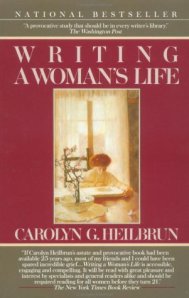
heilbrunSome time ago one of my most thoughtful readers (hi, Tom!) suggested I write about “a teacher/scholar whose work has had a significant influence on you.” I really liked this idea because, as I said in the resulting post, “It is impossible to overestimate the importance the right teacher at the right time can have on a student, though it may be impossible to foresee what will turn out to be ‘right’ ahead of time.” The teachers I wrote on included one from elementary school, one from high school, and one in particular among several who were important to my university years. At the close of the post, though, it occurred to me that the original question “may have been meant to elicit more about scholarly and critical, rather than personal, influences.” “I’m still thinking,” I concluded, “about that dimension of influence. No question, I have learned a lot from many teachers and scholars. But is that the same as having been ‘influenced’ by them? And have any of them actually inspired, moved, or motivated me?”

I’ve been thinking about those questions again recently because as I have tried to figure out what is most important to me to express as a critic (now that my long apprenticeship is over and I’m answerable primarily to myself for the future direction of my research and writing) I have identified two critics whose work indeed does inspire, move, and motivate me. More specifically, I have noticed that two critical books in particular repeatedly help me see and articulate what matters to me, or interests or challenges me, about many of the books I read, teach, and write about. One of these is Wayne Booth’s companionably plump and erudite The Company We Keep: An Ethics of Fiction, and the other is Carolyn Heilbrun’s slim but mighty Writing a Woman’s Life. Oddly, both were originally published in 1988. That means both were quite current when I started my PhD program at Cornell in 1990. But neither work–indeed, neither author, that I recall–was assigned, or even mentioned, in any course I took.

Booth’s book I discovered for myself when, soon after I earned tenure, I allowed myself to reconsider the focus of my scholarship, hoping to capture in my research the same excitement and urgency I felt in my teaching. I was dubious that I would ever feel much exhiliration pursuing increasingly esoteric projects about obscure women historians; I had done what I wanted to in that area with my thesis (which became my book). What I wanted to talk about was how and why novels actually mattered in our lives. I felt (feel!) that they do, profoundly, and I thought (think!) that one important facet of their significance is ethical. But I didn’t know how to talk about this in a rich way that would also be sensitive to fiction’s many other significant facets, including form, aesthetics, and history. The Company We Keep not only talks about exactly this, but it does so in Booth’s wonderfully engaging, unpretentious, open-minded way. It was criticism that talked about how we live in the world, and about literature as part of that living rather than something abstractly theoretical. Booth’s work was part of a wider debate about the ethics of fiction that included, among many others, Richard Posner, Martha Nussbaum, and, eventually, me: I published two academic essays as a result of this turn in my research (here’s one, in PDF; here’s the teaser for the other). The ideas it generated infused my teaching as well, particularly in a course I designed on ‘close reading’ that I will offer again, for the first time in 5 years, next fall. More recently, I wrote an essay on Gone with the Wind that attempted a “Boothian” reading of that problematic novel: an ethical reading that avoids (or so I hope) simplistic finger-pointing while accepting morality as a key aspect of literary evaluation. (Judging by the comments, not everyone was convinced! But I hope, in the spirit of what Booth calls ” coduction” [my favorite neologism!], some readers found themselves thinking about Gone with the Wind differently, even if they didn’t agree with me in all the details of my argument.) Clearly, Booth counts for me as an influential critic; I only wish I had read him earlier and been in a program where he and his interests had been prominent instead of–well, instead of much of what I was assigned.

I have a longer relationship with Heilbrun’s little book, which was given to me by my mother soon after its publication, with a lovely inscription noting that she had found it “interesting and provocative” and hoped we would talk about it “over tea.” It seems appropriate that Writing a Woman’s Life should have come to me in this way, as a gesture of shared interests and an invitation to intimacy and support, because that kind of female community and the strength it generates is one of Heilbrun’s major themes. Written relatively late in Heilbrun’s long career, its brevity is deceptive as it distills the accumulated insights of three decades of academic experience and feminist scholarship (for Heilbrun, often in a vexed relationship with each other). It’s wise, articulate, and insistent. I drew on it in formulating the central argument of my thesis and book, quoting from its first chapter, which is nominally on George Sand but is also on the difficulties and the vital necessity of finding appropriate ways to shape narratives of women’s lives. “Lives do not serve as models,” Heilbrun writes;

only stories do that. And it is a hard thing to make up stories to live by. We can only retell and live by the stories we have read or heard. We live our lives through texts. They may be read, or changed, or experienced electronically, or come to us, like the murmurings of our mothers, telling us what conventions demand. Whatever their form or medium, these stories have formed us all; they are what we must use to make new fictions, new narratives.

She moves immediately on to an example from George Eliot, to the Alcharisi in Daniel Deronda, who vehemently “protests women’s storylessness.” She writes in the book about women who lived lives that chafed against the stories they knew, and about biographies of these women that did, or, more often, did not find a better story to tell their lives in. She writes about anger and courage, about love and compromise, about age and beauty, about Dorothy Sayers and Virginia Woolf and herself. Writing a Woman’s Life is as much polemic (graceful and witty as it is) as theory, and it makes big claims supported by allusion and invocation rather than narrow claims defended by bulwarks of footnotes and metacriticism. It’s not, exactly, scholarly, but then it wasn’t exactly meant to be, because it’s a book that’s about living life as much as it is about writing it. “I risk a great danger,” Heilbrun remarks at the outset: “that I shall bore the theorists and fail to engage the rest, thus losing both audiences.” But Writing a Woman’s Life is never boring because it has all the urgency I wanted criticism to have. Though I didn’t immediately see it as a relevant book when I was reconsidering my own critical path, it’s urgent because it too is ethical criticism, in that broad sense of ethos that drives Booth’s arguments as well, and it’s urgent because it thinks it matters what and how we read: it takes fiction seriously because it sees reading as part of living, as shaping how we think and thus how we live.

I’ve found myself returning again and again to Heilbrun’s ideas about the limits of narrative forms and the problems of conceptualizing new stories (especially love stories) when talking with my students about many different novels, from The Tenant of Wildfell Hall to The Mill on the Floss to Sue Grafton’s ‘A’ is for Alibi. Like Booth’s book, Heilbrun’s has been recurrently useful not so much in the details but in the lens it offers for bringing key problems into focus–or, to try a different metaphor, for the way it illuminates the problems I want to talk about. Reviewing a new biography of George Eliot that frustrated and disappointed me, I turned to Heilbrun for help in explaining why. I just turned to her work again while teaching Death in a Tenured Position, which was written by Heilbrun under her pseudonym, Amanda Cross. (In another odd coincidence, Death in a Tenured Position is dedicated to May Sarton, whose novel The Small Room I just read and wrote up for the Slaves of Golconda.) Looking at it again, and also reading with great interest and pleasure the essays in her collection Hamlet’s Mother and Other Women, I found that after all these years, she more than most critics speaks in a voice I want to listen to. She’s infectiously passionate about the books and writers and issues she addresses, and she explains them sympathetically: her approach is inspiring, even, again, if we might differ on the details. Her  own story, also, with its brave ending, is moving in its effortful integrity. She was a controversial figure, but that in itself is motivating. As she says towards the end of Writing a Woman’s Life, those of us who are very privileged,

not only academics in tenured positions, … but more broadly those with some assured place and pattern in their lives, with some financial security, are in danger of choosing to stay right where we are, to undertake each day’s routine, and to listen to our arteries hardening.

“I do not believe,” she concludes, “that death should be allowed to find us seated comfortably in our tenured positions.” There, she is surely correct.

Recent Reading: Micro Edition

The pile of books I’ve read but not written about is growing. I guess it’s a good sign that, however busy I am, I’m still getting some things read that aren’t strictly for work. But right now it feels like, between teaching and administrative responsibilities (which are heating up, inevitably, as the term moves along) , writing a book review, doing the usual round of editing for Open Letters, and resisting the temptation to get drawn into long debates with commenters on my Gone with the Wind essay (it turns out the down side to getting attention is getting negative attention!), I won’t do any long book posts for a while. But I had an idea: if Bookphilia can do 10 word reviews, surely, so can I–or as close to 10 as is reasonable to expect from a Victorianist!

Anita Brookner, A Start in Life. So depressing it made me want to draw the curtains, turn out the lights, and drink. Or go to Paris–which would probably cheer me up.

Leila Aboulela, The Translator. In the end, it didn’t seem a lot more to me than a love story, and not a very believable one at that. Evocative prose, though.

Robert B. Parker, Pale Kings and Princes. Spenser, Hawk, and lots of Susan–all’s well with the world, or at least it is when this invincible team is done its work.

Elif Batuman, The Possessed. This one I’d quite like to write about at more length. Maybe on the weekend. I had no such adventures as a graduate student, that’s for sure! She went to Uzbekistan, I went to, um, Buffalo. I’ve been out of graduate school longer than she has, also, and I’m still not able to find my experiences there funny. I consider myself still in recovery! If I ever write the story of those days, there’s a ‘townie’ bar that will represent a sanctuary from a world in which I had to keep my head up while someone told me (in front of others) that I was “intellectually calcified,” and another told me (in writing) that because I wanted to argue about concepts of literary merit (I was for them), I needed to prove I wasn’t D’nesh D’Souza. Did I mention I’m still in recovery?

If you’re looking for more substantial blog posts, I recommend Adam Roberts’s review of Room at Punkadiddle (and also see this helpful roundup at The Second Pass). Stefanie at So Many Books makes Rosy Thornton’s The Tapestry of Love sound very appealing (I recently read and enjoyed Hearts and Minds), and Craig Monk weighs in on Freedom at The Classroom Conservative. Stevereads turns to Rosemary Sutcliff, then has a bad day with comics, and at LikeFire Daniel Nocivelli writes about what sounds like a wonderful story in the New Yorker: “a magnificent look, through the eyes of a book, at the many and varied transformations occurring across a half-century of one woman’s life, from her junior year abroad to her deathbed.” Enjoy! And more substance from me soon.

Reading Elizabeth Hardwick

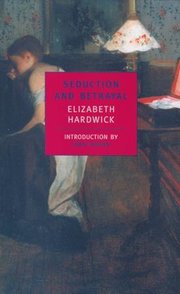
I’ve been really enjoying reading Elizabeth Hardwick’s criticism recently. I have owned Seduction and Betrayal for many years but I hadn’t really looked at it since I turned professional. More recently I picked up A View of My Own: Essays on Literature and Society, along with her novel Sleepless Nights, which I haven’t read yet but look forward to. I’ve been trying to put my finger on just what is so engaging about her essays on books and writers. It’s not their rigor or persuasive power, because they strike me (perhaps because I turned professional) as a bit rambling and digressive, and I don’t always agree with her insights (which are rarely offered as conclusions). I don’t think it’s her prose particularly: at least in the pieces I’ve just been looking at I don’t notice that she is an especially graceful stylist. It’s something more like the impression the essays give of her strong, distinctive, curious personality reacting vigorously–both intellectually and emotionally–to what she’s reading. She seems very interested in what she finds, and she doesn’t feel the need to surround or support her own response with explicit allusions to any theory or scholarship–which is partly a matter of form, of course, as she’s writing essays and not theory or scholarship, but it strikes me as also, somehow, a matter of confidence, in herself as a reader, a thinker, and a writer. Where does someone find that kind of confidence? After a while, of course, you earn it.

Here are a couple of samples. First, from the essay on the Brontes included in Seduction and Betrayal:

Sympathy, pity, intelligence, goodness, genuineness–these are the charms Charlotte Bronte wishes to impose. There is something a little overblown in the heroine’s hope to press virtues upon men who are conventional, and even somewhat corrupt, in their taste in women. The heroine’s moral superiority is accompanied by a superiority of passion, a devotion that is highly sexual, more so we feel than that of the self-centered and worldly girls the men prefer. (This same sense of a passionate nature is found in George Eliot’s writing.) Charlotte Bronte’s heroines have the idea of loving and protecting the best sides of the men they are infatuated with: they feel a sort of demanding reverence for brains, honor, uniqueness. Mr. Rochester, M. Paul, and Dr. John in Villette are superior men and also intensely attractive and masculine. Girls with more fortunate prospects need not value these qualities but instead may look for others, money in particular. That is the way things are set up in the novels.

Here she is on Sylvia Plath, also from Seduction and Betrayal, in an essay I found piercing in its own kind of ruthlessness, its total (and necessary) absence of sentiment about its subject:

Beyond the mesmerizing rhythms and sounds, the flow of brilliant, unforgettable images, the intensity–what does she say to her readers? Is it simple admiration for the daring, for going the whole way? To her fascination with death and pain she brings a sense of combat and brute force new in women writers. She is vulnerable, yes, to father and husband, but that is not the end of it all. I myself do not think her work comes out of the cold war, the extermination camps, or the anxious doldrums of the Eisenhower years. If anything, she seems to have jumped ahead of her dates and to have more in common with the years we have just gone through. Her lack of conventional sentiment, her destructive contempt for her family, the failings in her marriage, the drifting, rootless rage, the peculiar homelessness, the fascination with sensation and the drug of death, the determination to try everything, knowing it would not really stop the suffering–no one went as far as she did in this.

From A View of My Own, here’s a bit of “George Eliot’s Husband,” an essay that embraces the peculiarities of what she calls the “fantastic partnership” of Marian Evans and George Henry Lewes:

She and her husband, Lewes not Cross, are inconceivable as anything except what they were, two writers, brilliant and utterly literary. They led the literary life from morning to midnight, working, reading, correcting proofs, traveling, entertaining, receiving and writing letters, planning literary projects, worrying, doubting their powers, experiencing a delicious hypochondria. . . .

From later in the same essay,

Leslie Stephen thinks George Eliot’s powers were diminished by Lewes’s efforts to shield her from criticism, to keep her in a cozy nest of approval and encouragement. But Stephen’s opinion is based upon his belief that her later novels are inferior to the earlier ones. Stephen didn’t much like Middlemarch, nor did Edmund Gosse–both preferred the early work. It is hard to feel either of these men had anything more than respect for George Eliot.

‘Their mistake,’ she is clearly thinking, though she doesn’t quite say it. What she feels for “the Warwickshire novelist” is something warmer than respect, as we can tell from her remark that “As one grows older this industrious, slowly developing soul becomes dear for a secret reason–for having published her first story at the age of thirty-eight.”

One final excerpt, from her wonderful piece on Jane Carlyle in Seduction and Betrayal:

Jane Carlyle’s letters have something subversive in them; the tone is very far from the reverent modes that came naturally to Dorothy Wordsworth. Both the journals of the poet’s sister and the letters of the wife of the great prophet are ways of preserving and discovering self-identity. It is easy to imagine that the steady literary labors going on around the two women made a kind of demand upon them; a supreme value attached to sitting at the desk with a pen rushing over the pages. Both had gifts of an uncommon nature, but the casual, spontaneous form of their writings is itself the ultimate risk. We are not expected a hundred and fifty years later to have them in our hands, to read them. It is only by the luckiest chance that they survive, and no doubt many letters were lost. Jane’s letters might not have been collected, but The French Revolution would certainly have stepped forth; Recollections of a Tour Made in Scotland might have perished, while The Excursion was not written for obscurity.

Here again her judgment is left implicit, but I think we can tell perfectly well that she sees no reason to value The French Revolution or The Excursion any more highly than the “casual, spontaneous” writings, despite their greater pretensions.

Here are links to a couple of nice pieces I found online once I started poking around to get a better sense of Hardwick’s life and career: there’s Jim Lewis in Slate; Lisa Levy in The Believer; Chrisopher Lehmann-Haupt at the New York Times; and her NYRB page, with links to a lot more reviews and essays I want to read, including “Melville in Love” (June 15, 2000) and “The Genius of Margaret Fuller” (April 10, 1986–which I’ll be able to read as soon as my new NYRB subscription is official!), and to the NYRB editions of Seduction and Betrayal, her New York Stories, and Sleepless Nights.