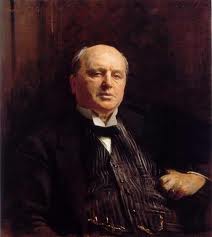
Most Seriously Displeased! Robert Hellenga’s The Sixteen Pleasures

pleasuresI was very restrained in Hager Books on my recent trip to Vancouver: I picked out a modest two books there. One, Gift from the Sea, I chose because I’d heard so much about it. The other, Robert Hellenga’s The Sixteen Pleasures, I chose for the opposite reason: I’d never heard of it at all! That may seem like a risky strategy, and right now, when I reflect on my decision to put Rose Tremain’s Restoration back on the shelf and take The Sixteen Pleasures instead, I feel like an idiot. But I have felt betrayed by buzz often enough not to think that my having heard a lot about a book is any kind of guarantee that I’ll like it (cough cough The Woman Upstairs cough cough), and who doesn’t enjoy discovering a hidden gem? Also, there were four of Hellenga’s novels on the shelf, suggesting that somebody likes them, and not only does The Sixteen Pleasures sound interesting, but one of Hellenga’s other novels is a sequel to it — again, suggesting some kind of success.

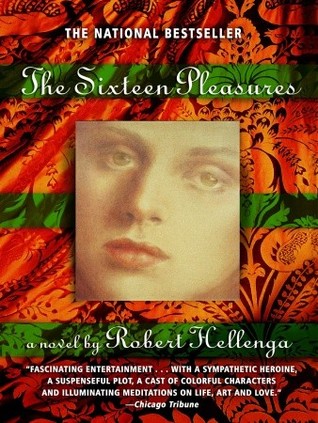
Obviously, I’m leading up to some bad news here. I didn’t hate The Sixteen Pleasures, but it gave me very little pleasure. It was mildly interesting, especially the neepery about book binding and art restoration. But the main character’s story is a hodge-podge, her big romance is almost unbelievably dull, and the “sensual life-altering journey” the cover blurb announces that she’s on? I think I missed it.

There were some bits early on in a convent that seemed promising, and the premise — a quest begun by the discovery of a volume of erotic drawings from the Renaissance — also seems full of potential. But here’s what doesn’t happen: “Inspired to sample each of the ineffable sixteen pleasures, Margot embarks on the intrigue of a lifetime with a forbidden lover and the contraband volume.” Doesn’t that description make it sound like a kind of sexy, cerebral Eat, Pray, Love? But though that is the jacket copy, that does not describe the book at all. Margot does in fact experience some of the “pleasures” shown in the drawings. But there’s nothing like a quest to try them out, and they’re handled pretty perfunctorily. Then, nearly 300 pages into the book, Margot does decide that the book is “my handful of magic beans, it was my magic ring, my talisman” and that somehow it will help her figure out who she is and where she’s going. At that point there are 60 pages left and during them she does finally take charge and, I guess, decide who she is. She even has some kind of epiphany – a “mystical experience” – but it’s in the auction room at Sotheby’s and consists of her taking a big risk in order to drive up the price on the book. This is not the “sensual, life-altering journey of loss and rebirth” I was looking for.

If I sound uninspired about it, I really am, and I’m annoyed at having fallen for an unusual premise and some misleading if obviously effective marketing (who was it in the New Yorker that said “everything about the narrator and heroine of this novel is appealing,” anyway? and how dare Kirkus Reviews declare it “absolutely compelling”!). To think I could have been reading more Barbara Pym or Georgette Heyer instead.

Recent Reading Round-Up

likenessIt’s not that I haven’t read anything except Gift From the Sea recently, though you might think so from the dearth of book blogging going on over here. If you peer at the summer reading tally on the right, you’ll see a few more titles on either side  — but I haven’t written them up! Distraction, laziness, and humidity are to blame, along with Season I of Homeland, which we have just begun watching (so there go the evening hours in which I usually do my book blogging). If any of these books had mattered to me a lot, of course, I would have done better. But that’s not to say they aren’t good books and enjoyable reads, so I thought I could at least review them briefly here.

I finally followed up on recommendations (especially from Dorian) that I give Tana French a try, and I’m definitely glad I did. Without those recommendations, I might have stayed away, because the subgenre she writes in is less police procedural than psychological suspense / thriller, which is not usually my thing. Also, In the Woods begins with terrifying things happening to small children, and even in police procedurals that’s my least favorite trope. It’s hard enough being a parent without stocking my overactive imagination with vanishingly unlikely “what if” scenarios! But In the Woods is smart and well-told as is its sequel, The Likeness (which I wrote up briefly at GoodReads). I enjoyed these two well enough that I picked up Faithful Place and Broken Harbor the last time I was at the public library. I don’t think I’ll be adding French to the syllabus for either of my mystery courses, though: so far, her books are good examples of their kind but don’t strike me as otherwise ground-breaking or thematically resonant in any way that would support class discussion.

blacksheepNow that I’ve made friends with Georgette Heyer, I am gradually working my way through her catalogue. I’m trying not to binge, partly because I don’t think I could take all that much of her at once, but also because one binge per summer seems like quite enough. I read Arabella very happily on the flight home from Vancouver, and picked out Black Sheep as my next one based on the number of people who recommended it here and on Twitter. And it was thoroughly enjoyable! Liz was right about the “great hero.” It was also a bit sexier than the other Heyers I’ve read so far. My only quibble was the way the hero masterminded the “elopement” at the end — I prefer my heroines to make their own decisions more deliberately. But that’s a pretty small quibble, considering that Abby is perfectly happy about it all. Next up will probably be Cotillion, or maybe Sprig Muslin.

I just reread The Big Sleep because I finally swapped out The Maltese Falcon for Mystery & Detective Fiction, and with that behind me I turned my attention to seeking out possible new books for the Women & Detective Fiction seminar in the winter term (I have until October, I think, before I have to order the books). As previously mentioned, one of my goals is diversifying the reading list, which has so far always been pretty much WASP-Anglo-American-straight. One new title already ordered is Katherine V. Forrest’s Murder at the Nightwood Bar: there’s a strong tradition now of lesbian detective fiction and when I read this one a couple of years ago I thought it did a good job making sexual politics a significant part of the story and theme. I’ve been trying now to find a book that will put race on the table — but it’s turning out to be tricky to figure out what’s in print, and then, of what’s available, what will work well in class. As far as I can tell, for instance, none of Barbara Neely’s novels are currently available to order, and the same seems to be true of the early Eleanor Taylor Bland titles. I just took a look at a couple of Paula L. Woods’s Charlotte Justice novels and didn’t much like them — but that may not end up being a good enough argument against them. I As always, suggestions welcome: it’s very time-consuming sifting through bibliographies (on and off line) or lists of recommendations and trying to collate them with ordering information to rule out the unavailable ones. Walter Mosley has been a great addition to the general survey course, bringing into focus a lot of assumptions about justice and law in our other readings — and Devil in a Blue Dress is also sharp and stylistically interesting. I admit that in my frustration about finding something to do the same for the Women & Detective Fiction class, I started wondering about The No. 1 Ladies’ Detective Agency as an option … is that just a terrible idea? There are some pretty interesting critical articles about its (controversial) presentation of Africa in general and African women more particularly. But it does seem a cop-out (pun sort of intended).

I’m about half way through my reread of Adam Bede, which I will be writing about for Open Letters for the September issue. I had some idea of doing that essay for the August issue, but between work things, revisions on the Dick Francis essay, and a delightfully large number of submissions to me for the next OLM, there won’t be anything from me in it. I’m loving Adam Bede, though, and wondering why I haven’t ever assigned it for an undergraduate class. Maybe next year!

pleasuresI’m also about half way through Robert Hellenga’s The Sixteen Pleasures. I’m not in love with it at this point but it has many interesting aspects, not least among them the high degree of neepery about art and book restoration. More about this one when I’ve finished it.

And last but not least, I sent out an S.O.S. to Steve about my shocking lack of John D. MacDonald titles, and thanks to him I’m finally getting acquainted with Travis McGee. We’ll see how I get along with him. In the first book I’m trying, Darker than Amber, I’m a bit put off by his making love to an emotionally distraught friend despite her making sounds of “half sleepy objection.” It’s OK, though, really, because “when the sudden awareness that it was working for her brought her wide awake she was too far along to choke herself off with all those anxieties [her ex] had built” — and the therapeutic sex sends her happily off to sleep. Hmm. But not every friend makes a great first impression, right?

Update: A Twitter call for suggestions for the Women & Detective seminar has yielded some good ideas: Colson Whitehead’s The Intuitionist, Attica Locke’s The Cutting Season, Ivy Pochoda’s Visitation Street, Margaret Millar’s Tom Aragon series, Sara Paretsky’s Hardball … Ideally I’d like a book by a woman author about a woman detective — that helps us keep certain continuities in our class discussions and assignments. But I’d certainly consider other configurations if the book was the right one, so I’m going to follow up on all of these. I’m starting with The Cutting Season, though, as it sounds really interesting and  is by a black woman author and has a female protagonist.

“The value of appreciation” — Harrison Solow, Felicity & Barbara Pym

I missed Barbara Pym Reading Week by just a bit. I have been keen to read more Pym and serendipitously picked up a couple of Pym’s novels at a book sale just in time for it (The Sweet Dove Died and A Few Green Leaves). And I ordered Harrison Solow’s Felicity & Barbara Pym, which arrived on schedule. Then other things got in the way and I missed it.

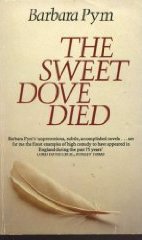
sweet doveI did read The Sweet Dove Died a week or so later, though. It’s a slight little book, yet it wasn’t an easy read for me: I kept picking it up and putting it down and letting myself be diverted to other books. It’s true I’d been on a steady diet of Dick Francis novels and so perhaps my reading senses (they’re like spidey senses only less tingly) were not attuned to Pym’s dry tone and small scale. I was eventually drawn into the pathos (or is it bathos?) of Leonora’s lost loves, and of course I abhorred the loathsome Ned … but I felt as if the larger significance of the subtle nuances were escaping me.

I was afraid that my relative inexperience and lack of success with Pym (I didn’t love Jane and Prudence either, when I read it last year) set me up badly for Felicity & Barbara Pym. It turns out, though, that the opposite was true, as Solow’s charming and slyly provocative book is (in part) a tutorial for someone not altogether unlike me. Not quite or even very much like me, I hope, as the recipient of the letters that compose the novel is a self-absorbed undergraduate who gets a little snippy at blows to her self-esteem. Actually, that last bit sounds kind of familiar … Anyway (as Felicity might say), she’s registered for a seminar on Barbara Pym and Mallory Cooper (whose side of the correspondence is all we see) is called in to provide some advance tutoring.

Felicity initially isn’t much better at appreciating Pym than I was, and Mallory is quick to call her (alright, us) on it:

Your notes aren’t bad. You have touched on a few themes that Pym’s biographers, editors, and critics analyse repeatedly: Silly men. Mousy women. Tea. Religion. Quotations. These are worthy of mention. The fact that you still think nothing happens is not. It merely shows that you do not respond to what does happen in the novel, for whatever reason — innocence, feminism, scepticism, youth, cynicism, thoughtlessness, expectation, or too rapid and therefore too shallow reading of the novel — too light, perhaps, a perception of the economy of expression Miss Pym employs.

OK, OK: I am appropriately shamed and humbled.

solow

Over the rest of the correspondence Mallory — cranky, erudite, witty, persistent — does her best to improve Felicity’s perception, working with her on nuances of dress and class, on historical contexts, on literary relationships (the riff on Religio Medici is particularly memorable), on silly men and, crucially, on the real significance of mousy women:

At best, the cultivation of mousiness is to participate in a distinctive moral past. At worst, it may indeed be a camouflage, brought about by war, under the protective covering of which the wish to inhabit one’s own cosmos peacably can be fulfilled.

“And now,” she continues, “– on to Tea” — and the excursus on tea is a wondrous thing indeed.

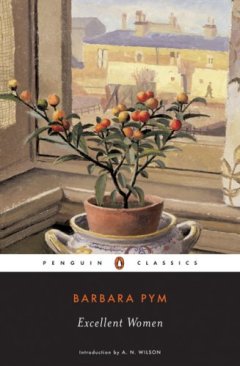
The Pym neophyte will benefit enormously from all of this: I have been moved not only to a greater appreciation of The Sweet Dove Died (“There is even an entire Pym novel devoted to the downfall of elegance, beauty, and taste, personified in the character of the colossally self-preoccupied Leonora”) but to a wish to reread Jane and Prudence and to acquire as soon as possible Excellent Women and Less Than Angels (at a minimum).

But the sneaky thing about Felicity & Barbara Pym is that Pym herself (as Solow acknowledges in her Preface) is not exactly the real subject of the book: instead, she’s a device for allowing Mallory — or  Solow — to critique academic approaches to literature she thinks are limited and limiting. Pym’s lack of academic currency (and really, how likely is it that anyone would offer or take an entire seminar on her novels?) makes her useful for this project: “she is such an antithesis to the prevailing attitude.”

It’s a project that could, like Pym, seem “outmoded.” Mallory speaks with nostalgia of a time when universities “were sacred to the pursuit of education, whereas now, for the most part, they are desultorily engaged in the dispensing of narrow expertise.” Her position is not exactly anti-theory: there’s even a theory primer of sorts near the end, which, though brisk and tendentious, is not inaccurate and includes the full URL of a real website at Brock University for “some rather more practical assistance,” perhaps even enlightenment. I might sum it up as a “pre-theory” position: Mallory feels that the literary conversation, particularly but not exclusively in the academy, needs to start with what Solow calls “the context of the civilisation of literature itself” — not just the big picture but the really big picture. “We do not read, after all, as a species,” Solow says in her Preface,

in order that we may deconstruct and dissect. People buy books and borrow books from libraries because they like them. They read, re-read, recommend, learn from, incorporate values from, live by, study, and take to bed at night, books they like; books they appreciate; books they find meaningful.  Appreciation is not perhaps what the university requests of its students today. But it is what writers … deserve.

As Felicity’s tutor, Mallory keeps broadening, rather than narrowing, the field of inquiry, the scope of questions. The ultimate goal, though, is not to ignore the range of theory, interpretation, and scholarship available but to arrive at it equipped with as rich an “appreciation” as possible, so that you can figure out its worth for your reading (and writing) with some independence. “I hope you will not ignore all of these critics,” exhorts Mallory, “for, among the labyrinths of nonsense, there is great, great worth. But that is for you to discover . . . ”

Excellent Women

To some extent I sympathize  with Mallory’s skepticism and impatience with the “labyrinths of nonsense,” and I certainly embrace the idea of appreciation, which is something I often pitch to my own classes as our goal (as opposed to, say, “liking”). The kind of appreciation Mallory endorses is also, crucially, not an anti-intellectual kind. There’s even a paragraph in the book that is eerily like a speech I have given more than once:

I want you to feel — and feel deeply about literature. But I also want you to know why and how these emotions are engendered by the writer, the text (apart from the writer), the words (apart from the text) as well as the relationship between the reader and all of the above. I also want you to be able to take that emotion out of any equation when it is necessary to do so. Otherwise, we could all take courses in “My Favourite Books” and spend endless and idle time in groups resembling your friend’s therapy session “sharing” our feelings about why we just love Gone with the Wind and how cool Harry Potter is. Not that there is anything wrong with that, intrinsically. But it’s not what we do in academic literary studies. If that’s what you want to do, join a book club.

Yet there are aspects of Mallory’s approach, and even more of her tone, that seemed a bit 1990s-culture-wars-ish to me, and I wondered how important it was that Felicity & Barbara Pym is epistolary fiction, rather than a straightforward first-person treatise or polemic: is Mallory herself being ironized even as she’s the vehicle for Felicity’s (re)education? Is her rather prim tone and affected manner a way of placing her at a safe distance? Are we meant to embrace her nostalgia, or to see her as embodying another among the list of theoretical approaches, one that purports to speak for the universal value of literature but that, in doing so, reveals its own limitations? (The book is actually, Solow says, “both fiction and non-fiction”; there are clear biographical parallels, but it’s also clear that we aren’t meant to assume a direct identification of author with speaker.)

Felicity & Barbara Pym, then, provokes as well as amuses. It had lots of connections, sometimes unexpected, to my own adventures in re-thinking literary criticism (speaking of “why we just love Gone with the Wind!). I would recommend Jane Smiley’s 13 Ways of Looking at the Novel over Francine Prose’s Reading Like A Writer, and I didn’t much care for Elif Batuman’s The Possessed, but these are hardly irreconcilable differences to have with a book  so lively and ingenious.

Full disclosure: Harrison Solow and I follow each other on Twitter and have had more than one friendly exchange. I first learned about Felicity & Barbara Pym as a result of this contact — and I’m glad I did.

New Reviews and “Right” Reviewers

timthumb

Launch day never comes but what I am surprised at what we’ve pulled off, thanks to the talent, perseverance, and generosity of our contributors and the diligence, enthusiasm, and contributions of our editors! Our May issue seems to me to exemplify what we want Open Letters to be. It covers a wide range of material — I think there’s greater variety in the titles we cover than in most other literary magazines, online or otherwise — and in a range of voices. Have you ever looked at our “About” page? Here’s what the wise heads that set up Open Letters in the first place came up with as our “mission statement”:

We’ve all had the experience of reading a review that sparkled—one that combined an informed, accessible examination of its quarry with gamesome, intelligent, and even funny commentary. These are the pieces we tell our friends about and then vigorously debate.

That’s the kind of writing you’ll find in this month’s issue, so hop on over and take a look! Among its goodies you’ll find a thoughtful exploration of Yoko Ogawa’s Revenge by friend-of-Novel-Readings Colleen Shea (a.k.a. the esteemed proprietress of Jam and Idleness); an exuberantly insightful commentary on a new edition of Birds of America by the inimitable Steve Donoghue; a provocative critique of Tea Obreht’s critically-acclaimed The Tiger’s Wife; and much more.

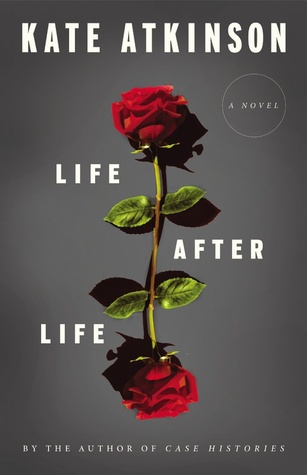
atkinson1My own contribution this month is a review of Kate Atkinson’s Life After Life, which has also been receiving  a fair share of critical acclaim. You’ll have to read my review to find out if I’m joining in the chorus. I will say that the book is extremely readable, and that writing the review was good mental exercise, especially once I decided on how I wanted to structure it.

While I was working on it, a conversation broke out on Twitter about the question of what makes someone a good fit to review a particular book. OK, I started it — well, technically Mark Sarvas started it by noting he thought a particular reviewer was a “terrible choice” for a particular assignment. Happily, I pretty much “assign” my own books to review, but I puzzle over how to make good choices for myself, so I asked what he thought the parameters were. He proposed avoiding cases of “outright conflict,” cases where there’s a specific “axe to grind.” I proposed someone who could be expected to have a good conversation with the book . Gregory Cowles of the NYTBR chimed in (Twitter is fun that way) to suggest “open engagement” as the key.

As I said in that exchange, I seek out books to review that I expect to like, by which I mean books by writers I have some reason to trust, and/or on topics and/or in genres that are within my usual range of interests. This is not to say that my default plan is a good review (in fact, I try not to think in terms of “good” or “bad” reviews). I just figure that way I have the best shot of appreciating what the book does well but also recognizing what, according to my reading experience, it doesn’t do well. To keep going with the conversational metaphor, there’s no point trying to have a lengthy discussion with someone whose language you don’t speak at all. If I were a full-time professional book reviewer, such discrimination would presumably be a luxury. Sometimes when I’m paging through catalogs not finding any “likely candidates” for my next review, I hope I’m not being some kind of prima donna, or  (worse?) that I’m not being intellectually unadventurous. But who would want to read my attempt to review something like Revenge? Or, to go even further outside my normal literary habitat, Richard Hell’s autobiography, reviewed with great panache in this issue by Steve Danziger? Much better to leave these books to readers who get them.

Besides, in a way all contemporary fiction is an adventure for me, since my official expertise is entirely elsewhere. I’ve certainly found plenty to grapple with in the recent books I have reviewed, from The Marriage Plot to Two-Part Inventions. (Whether I’ve acquired expertise, or at least relevant experience, by writing about contemporary fiction on my blog is another question, not entirely unrelated, I suppose!) Mark’s question was timely in part because I was wondering if I was a good choice to review Life After Life. Reviews were coming out all around me as I worked (I managed not to actually read any of them until I had a complete, committed draft of my own!) — Francine Prose’s came out in the New York Times just this past weekend, too. Clearly someone there thought she was a good fit, and I can see why. Every reviewer who acts in “good faith,” though (to call on another of Mark’s Twitter comments) brings something fresh to the conversation. It’s possible, too, especially reading the major literary reviews, to feel as if there’s all too much insider trading (have you heard the joke about the New York Review of Books — that its real name is The New York Review of Each Other’s Books?). I think my review stands up well to Prose’s. (Mind you, she, poor woman, was probably given a word limit.)

What do you think makes someone a good fit for a particular review? Proximity or distance? Expertise or an unexpected angle? Or will you take any of these provided the conversation itself is good enough? These questions are relevant to me not just as a writer but as an editor, after all.

Also, in case you wondered, the next book I’m reviewing is Deirdre David’s biography of Olivia Manning. I think I’m a good fit: I know David’s work as a Victorianist, of course, and I’ve read both trilogies in Manning’s The Fortunes of War, and I know a lot more about early 20th-century women writers than I used to because of my reading in the ‘Somerville’ set. So far it’s entirely fascinating.

Diana Athill, Stet: On Angela Thirkell, Virginia Woolf, and the Embarrassment of Caste

StetThis month’s reading for the Slaves of Golconda group was Diana Athill’s briskly evocative memoir Stet, about her decades-long career in publishing. Other folks have been putting up their smart and detailed posts, and you should hop on over and read them if you haven’t visited already. Partly because I’m tired and busy, and partly because I can’t think of anything substantial to add to their observations, for my contribution I’m just going to quote a passage I particularly enjoyed. It comes almost at the very end, in Athill’s Postscript to the memoir, and it stood out for me because it touches on a number of issues about publishing and taste and literary merit and canonicity that have been coming up a lot in my classes this year — particularly the Somerville Novelists seminar (and as you’ll see, chronologically her remarks are spot on for that one) but also, more recently, in my intro class, where we’ve been talking about feminism and the role of taste-makers and gatekeepers in establishing and policing the literary hierarchy. The ‘crisis in publishing’ and the ‘death of reading’ are also, of course, endlessly reiterated themes in the literary world. I found Athill’s frankness and lack of pretension refreshing, her pragmatism admirable, and her examples thought-provoking.

Having seen Andre Deutsch Limited fade out, why am I not sadder than I am?

I suppose it is because, although I have often shaken my head over symptoms of change in British publishing such as lower standards of copy-preparation and proof-reading, I cannot feel that they are crucial. It is, of course, true that reading is going the same way as eating, the greatest demand being for the quick and easy, and for the simple, instantly recognizable flavours such as sugar and vinegar, or their mental equivalents; but that is not the terminal tragedy which it sometimes seems to the disgruntled old. It is not, after all, a new development: quick and easy has always been what the majority wants. The difference between my early days in publishing and the present is not that this common desire has come into being, but that it is now catered for more lavishly than it used to be. And that is probably because the grip on our trade of a particular caste has begun to relax.

Of that caste I am a member: one of the mostly London-dwelling, university, university-educated, upper-middle-class English people who took over publishing towards the end of the nineteenth century from the booksellers who used to run it. Most of us loved books and genuinely tried to understand the differences between good and bad writing; but I suspect that if we were examined from a god’s-eye viewpoint it would be seen that quite often our ‘good’ was good only according to the notions of the caste. Straining for that god’s-eye view, I sometimes think that not a few of the books I once took pleasure in publishing were pretty futile, and that the same was true of other houses. Two quintessentially ‘caste’ writers, one from the less pretentious end of the scale, the other from its highest reaches, were Angela Thirkell and Virginia Woolf. Thirkell is embarrassing — I always knew that, but would have published her, given the chance, because she was so obviously a seller. And Woolf, whom I revered in my youth, now seems almost more embarrassing because the claims made for her were so high. Not only did she belong to the caste, but she was unable to see beyond its boundaries — and that self-consciously ‘beautiful’ writing, all those adjectives — oh dear! Caste standards — it ought not to need saying — have no right to be considered sacrosanct.

Keeping that in mind is a useful specific against melancholy; and even better is the fact that there are plenty of people about who are making a stand against too much quick-and-easy. The speed with which the corners of supermarkets devoted to organic produce are growing into long shelves is remarkable; and there are still publishers — not many, but some — who are more single-mindedly determined to support serious writing than we ever were.

She’s right about organic produce (around here, anyway), and though I bet a lot of us would like to have it out with her about Woolf, and maybe also Thirkell, there seems a lot right too in her wry admission that there is no incontrovertible standard, and that  it’s all too easy to mystify one’s own preferences.

Latter-Day Dorotheas? Renunciation in Trollope and Tyler

From the Novel Readings archives (originally posted June 15, 2007)

trollopevillageWhen I decided to take a break from more “serious” reading with Joanna Trollope’s A Village Affair, I wasn’t really expecting the novel to reach towards the serious itself. I had read it before, but what I had retained was admiration for the clarity with which Trollope gives us the people she has devised: many (though not all) of her novels that I have read have struck me as achieving an enviable quality in their characters: they are enormously specific and individual and often intensely, even poignantly, believable. Here, Alice’s father-in-law, Richard, seems especially well conceived. Everything he says communicates to us who he is and how he has lived, particularly in his marriage to a woman he persists in loving but who cannot, in her turn, recognize in him someone as complex and fully human as she is. He lives this hampered life in full knowledge of its limits, neither tragic nor stoic. Alice’s discontent is the stuff of cliches; her affair seems contrived (by the author) to break up the seemingly calm surface, the routines and compromises of daily life. In fact, this is how Trollope’s plots generally work: the ordinary people, the change or revelation, the repercussions. For me, it’s the repercussions she does really well. Having set up her experiment in life, she works out plausibly how it will play out, and she does not sentimentalize–as, in this case, Alice’s “coming alive” through a new and different experience of love creates more problems than it solves.

In this case, as in another of her novels that I think is very smart, Marrying the Mistress, Trollope sets her characters up to confront what is a central dilemma in many 19th-century novels as well, namely how to resolve the conflict between, or how to decide between, duty to self and duty to others. That she is aware of her predecessors in this investigation is indicated by the quotation from Adam Bede recited (OK, improbably) by one of the characters in A Village Affair. As that quotation forcefully indicates, George Eliot placed a high value on renunciation and on accepting (as gracefully as possible) the burden of duty: resignation to less than you want, or less than you can imagine, is a constant refrain, and this with no promise of rapturous happiness. Hence the melancholic tinge at the end of Romola, for instance, or Daniel Deronda, or, for all its lightning flashes of romantic fulfilment, Middlemarch. (Of course, famously, it is her heroines who must resign or, like Maggie Tulliver, die.)

Although much has changed socially and politically since George Eliot found it unrealistic to give Romola, Maggie, or Dorothea uncompromised happy endings, the struggle between what we want for ourselves and what is expected or demanded of us by others continues to be a staple of fiction. Though Trollope’s scenario is much more contemporary, she too accepts that one’s individual desire cannot (or not easily, or not ethically) be one’s guiding principle, because of the “visible and invisible relations beyond any of which our present or prospective self is the centre” (Adam Bede). So Trollope, with admirable restraint, refuses a fairy tale ending for her protagonist, though, with a different kind of insistence that perhaps George Eliot would respect, she also pushes her out of the unsatisfactory life that was her reality before, and into what, given this context, seems like a narrative limbo, or a waiting room. This is not to say that Alice’s single life is an incomplete one, but she herself acknowledges that it is not, in fact, what she really wanted–only what she was capable of achieving.

tylerladderI think this novel makes an interesting comparison to another quiet novel about a woman reconsidering her life, Anne Tyler’s Ladder of Years, which I have always admired. But Tyler, though far from offering simplistic fairy tales, offers her own version of the resignation narrative. In Ladder of Years, as in Back When We Were Grownups, it proves mistaken for the heroine to try to start a new life, however much she is, or believes she is, following the promptings of her innermost self. Again, the “visible and invisible relations” exert a powerful pressure, like the entangling webs of family and society in Middlemarch but perceived, overall, as more kindly, less petty and destructive. The plain litte room Delia takes and uses as a staging ground to reinvent her life is a room of her own, but her story is not rightly understood as being just about her own life (“was she alone,” Dorothea asks herself). In these novels Tyler’s women learn to appreciate the value of what they tried to leave, to see their own identities as having become inseparable from those of the others whose demands and complications hamper their desires. The vision seems starker in Trollope’s novel (“Aga saga” though it certainly is).

This Week in My Classes: Feminism and Fatality

richThis week in my section of Intro to Literature we’re starting a unit organized around women writers and feminism. We’re starting this week with some poetry — Adrienne Rich’s “Aunt Jennifer’s Tigers” and “Diving Into the Wreck,” Margaret Atwood’s “You fit into me,” Marge Piercy’s “The Secretary Chant,” and Sylvia Plath’s “Daddy.” Next we’re working through A Room of One’s Own, and then we close out the unit — and the term — with Carol Shields’s Unless.

I decided to lead off yesterday with some introductory comments: a bit about the history of feminism, and a bit more about feminism and literature, with a focus on ways feminist critics have challenged and revised the literary ‘canon’ as well as on some of the ways feminist critics taught us to read differently. Am I alone in feeling an uncomfortable blend of diffidence and defensiveness when introducing these kinds of questions? I have had just enough comments over the years, on course evaluations and in class, from students who are offended by what they feel is an unnecessary or unwelcome emphasis on gender issues that I know there will be some resistance (whether or not it’s spoken aloud) to the idea that this is something we ought to talk about. The attitude I’ve heard expressed most often is that the time for all that is over and so it’s quaint but annoying to read a writer such as, say, Sara Paretsky (whom I teach often in Mystery and Detective Fiction) drawing overt attention to inequality and making openly polemical statements. (A variation of this is approval of Paretsky’s detective, V. I. Warshawski, because she’s a feminist but doesn’t make a really big deal about it — which isn’t true, actually. And there’s always a minority that enjoys V.I.’s outspoken politics and unapologetic attitude.) Once a student complained in an evaluation for a course on the 18th and 19th-century novel that the class was biased towards feminism, a bias clearly revealed by the preponderance of women writers on the syllabus: as it happened, that year the reading list for the course in question was split 50/50 between women and men, so I could only conclude that the bias was perceived because our male writers also raised pressing questions about women’s roles. In Intro a couple of years ago, a student (again, anonymously in his or her evaluation) protested that “the prof was such a feminist” — which struck me as odd because that year I honestly couldn’t think of what would have been the trigger for this complaint. It doesn’t take very many such remarks, however ill-founded or oddly calculated they seem, to make one aware that teaching feminism (or as a feminist) is a tricky business.

I believe (though I may be wrong about this, of course) that I do not approach gender issues or feminist interpretations in an aggressive or polemical way. However, it’s rare for these topics not to come up in my classes because they are so fundamental to my own critical apparatus — and, of course, for courses in Victorian literature, they are central to the material itself. One thing I don’t feel is apologetic, then. My guess is that just talking openly about gender issues and feminism simply comes across as polemical to people who aren’t used to, or are resistant to, having that conversation. (That probably explains the intro student’s comment above, as well as my own obliviousness to what exactly I’d done “wrong.”) Basically, these students just need to get over it!

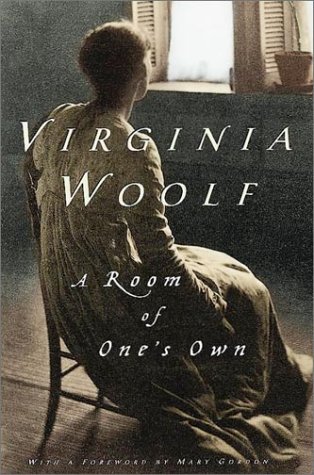
roomHowever, I do want to make our class discussions productive and inclusive, especially for this class of (mostly) first-year students, many of whom may not have had explicit discussions about feminism and literature before, so I fretted quite a bit about exactly what to say and what tone to take on Monday. One thing I pointed out is that politics broadly understood have been part of our discussions all year: we just haven’t identified what we’re doing as political criticism. And I noted that we’ve already talked about the challenge of literary evaluation, and about canonicity. We’ve also already worked on texts that are all about women’s position in society: “The Yellow Wallpaper,” for example, and “A Jury of Her Peers.” So we’re doing more of the same. Now that we’re doing a whole cluster of works with this focus, though, it makes sense to create a more explicit framework, both for what the authors are doing and for what we are doing. I hope I hit the right note in my introductory remarks. We’ll see how it goes. One of the particular challenges (something I’m going to address specifically tomorrow) is that a lot of the works we’ll be reading are angry ones — including A Room of One’s Own, though the anger there is very, very carefully managed (but is it entirely hidden?). I think anger can be off-putting: it makes the reader a bit squirmy, as if they are being blamed or attacked. It’s hard to like an angry person! The tendency (which I have been unable, despite my efforts, to quell completely) to prefer speakers or characters who are “relatable” makes anger a problem for a lot of students. My hope is that we can make it a useful problem — because after all, what does it mean to tell someone not to be angry, or not to listen to someone who is angry — especially if they have good reason for it? Angry women, of course, always get a particularly hard time.

I’d be interested in hearing from other people about their classroom experiences with feminism. Some of you probably teach (or have taken) courses much more completely and explicitly dedicated to the topic: classes on feminist theory, for instance, or feminist philosophy. I expect the population of such classes is more self-selecting so perhaps the awkwardness I sense (or am I just projecting?) does not arise.

In 19th-Century Fiction we are finishing up The Mill on the Floss this week. Tomorrow we’ll discuss the ending. I’ve collected a string of quotations from various critics onto a handout which I hope will provoke plenty of discussion…some of it about feminism! Reading “Diving Into the Wreck” over today for class, I found myself thinking that it resonates uncannily with the ending of The Mill on the Floss — not just in being watery but in being difficult to explain.

“Middlemarch in Six!” Nick Hornby’s The Polysyllabic Spree

This is the first in what I plan as a regular series of re-posts from my archives. It seems appropriate to lead off with a review that was not only one of my earliest posts (it first went up on the blog in January 2007) but one that lays out some of my reasons for blogging in the first place. It is quite interesting (for me, at least) to see how I was thinking about blogging and criticism at the time, and to reflect on how things have changed in my writing life since then. When I wrote this post, I was venturing out of academic writing for the first time and quite uncertain about where my experiment might take me. One of the tasks I set myself, therefore, was to explore “books about books” written for non-academic readers, to find out what they were like and whether I might learn from them about how to write differently, or for a different audience, myself. Hornby’s was one of the first I read, and remains one of the ones I’ve liked the best. I’ve tweaked my review just a little to clarify its timing and reflect changes in the format of Novel Readings.
Another reason I chose to revisit this particular post is that just recently, Litlove at Tales from the Reading Room reviewed The Polysyllabic Spree along with Zadie Smith’s Changing My Mind; you can read her very thoughtful review here. It turns out we liked and noticed (and quoted) some of the same things.

hornbyspreeIn addition to the reasons laid out in the introduction to this blog (see ‘About Me,’ above), I wanted to try writing up informal notes on my reading because of my ever-increasing dissatisfaction with the kind of writing about books I am expected to do professionally, namely academic literary criticism. Although I believe that academic criticism has its own kind of interest and value, as an avid reader I often find it frustrating and bizarre when the conversation about a book becomes remote in both form and feeling from the conversation I think the book itself is supposed to be a part of. My own area of academic expertise, for example, is the Victorian novel, and if any one quality could be said to be typical of so many books so widely varying in subject and style, it would be a sense of engagement with the world–not that they aspire to represent it mimetically (any reader of Victorian fiction knows there is nothing naive about what often gets called its ‘realism’), but that these books challenge their readers to think and care about all aspects of social, political, economic, and romantic life. “Dear reader!” Dickens concludes his polemical anti-Utilitarian novel Hard Times. “It rests with you and me, whether, in our two fields of action, similar things shall be or not. Let them be!” And of course his “Let them be!” is a call to action, not to complacency or passivity: let the world be the way you and I can imagine it to be, better, more just, more loving, more humane. But current literary criticism communicates little of this urgency, and none of Dickens’s humour, or, as he would have it, fancy.

My concern is not so much that literary criticism is often written in difficult, obscure prose (after all, every specialization requires its own jargon)–although I have finally achieved the courage and professional security to adopt Nick Hornby’s poetry-reading philosophy for my own reading of criticism and theory (“If something doesn’t give you even a shot at comprehension in the first couple of readings, then my motto is “F–k it” [p. 91, my polite hyphens]). My objection is more that we have distanced ourselves so completely from ordinary conversation about books that we have become irrelevant to all readers but ourselves. Of course, there are some exceptions, academics who have produced the textual equivalents of cross-over albums. But most of us know that when we write and publish even our most supposedly ground-breaking article, it is destined straight for the dustbin of other scholars’ footnotes. Most of us are presumably OK with this result, or there would be a revolution. Or perhaps the necessity of publishing such material to secure and keep our jobs and our professional credibility drives doubts away. But Dickens, to stick with my example (not least because he is one of Hornby’s favourite examples as well), certainly hoped his words had more life in them than that.

All this is by way of saying that I wanted to experiment a little with writing in a different way about books, a way that would reflect my experience of reading them and thinking about them in a more immediate, personal way than academic writing allows without letting go altogether of the analytic habits built up by years of professional training. Surely there can be an informed, educated conversation about literature that allows, for one thing, for judgment, for values, for affect, for liking and disliking. And, of course, there is such a conversation–indeed, there are many such conversations today, just not in the pages of academic journals. One contribution that I have just finished re-reading is Hornby’s The Polysyllabic Spree.

I first read sections of this book last year, when a graduate student passed it on to me thinking (rightly) that I would enjoy Hornby’s infatuation with David Copperfield (thanks, El!). Since I began thinking about alternatives to academic criticism, partly through my work on 19th-century literary reviewing, I have begun looking for examples of contemporary writing about books that achieves something like the balance I am interested in between analysis and immediacy, and going back to Hornby’s collection this week, I think he gets fairly close. Unlike those in Sara Nelson’s So Many Books, So Little Time, for example, Hornby’s commentaries, though engagingly personal and idiosyncratic, focus primarily on the books and not on himself. He attends to questions of craft, though my academic side wishes he would introduce some technical terms here and there for greater precision, and he thinks about the books in terms of the means they use to their ends while still considering also the value of those goals. For all his breezy style, he has a knack for summary judgments, as when, after recounting a particularly horrific detail from a rape scene in Pete Dexter’s Train, he objects that it seemed to have happened “through a worldview rather than through a narrative inevitability” (97). For me, the great charm of this collection is its combination of these moments of intense literary and moral scrutiny with irreverence and humour. Who says you can’t be both serious and funny? I loved his idea of the “Cultural Fantasy Boxing League” in which, he supposes, “books would win pretty much every time. Go on, try it. ‘The Magic Flute’ v. MiddlemarchMiddlemarch in six…” (58). Of course!

But Hornby really won me over when he articulated what I think book lovers everywhere feel: the extent to which our own libraries are extensions or reflections of our identities. This is why we recoil from well-intentioned and practical advice to ‘clear some space’ on our existing bookshelves to make room for new purchases! “I suddenly had a little epiphany,” he says, as he files away some volumes: “all the books we own, both read and unread, are the fullest expression of self we have at our disposal. . . . with each passing year, and with each whimsical purchase, our libraries become more and more able to articulate who we are, whether we read the books or not” (125).

Margaret Kennedy, The Outlaws on Parnassus

Preparing for reading The Constant Nymph in my Somerville Novelists seminar, I was intrigued to learn that in her Times obituary Margaret Kennedy was accorded little significance as a novelist while her book on the novel, The Outlaws on Parnassus, was considered her greatest literary contribution. I promptly ordered it from interlibrary loan, and it arrived just in time for me to take a look at it before we wrap up our discussions on Friday.

First published in 1958, The Outlaws on Parnassus harks back to works like E. M. Forster’s Aspects of the Novel rather than anticipating the more theoretical wave of criticism to come. It’s an idiosyncratic book, including  taxonomies of forms and styles along with reflections on the role of the novel and of the critic. Kennedy begins from the point that the novel is a “late arrival” and thus does not have a clear, established place among the other older arts. The relatively low and ill-defined status of the novel is one factor, she proposes, for the dearth of serious criticism of the novel; the other is the perceived redundancy of such criticism given the apparent ease of both reading and writing novels: “The other arts strike the average man as being much more mysterious and as making more strenuous demands upon him.” Novelists, too, she thinks, are uneasy about where they fit and what their work is worth.

I enjoyed her analysis of the fundamental problem confronting the would-be critic:

It is a great misfortune for any human activity if the Greeks, as was seldom the case, had no word for it. The chances are that it will stagger through the ages shackled by ambiguities, since it never got itself thoroughly defined at the start. The most useful words in which to discuss it are missing, and there is no original debate to which any dispute can be referred.

In a discussion of the drama, for instance, it is always possible to ask what Aristotle meant by irony, pathos, the unities, and the protagonists. Since he never deliberated upon the novel we do not know what meaning he would have attached to a plot or a story save in relation to tragic drama. If he did not define these things, who can? Who should?

Who should, indeed? The Outlaws of Parnassus is, of course, Kennedy’s own contribution to defining “these things” plot, story, narrative voice all get some attention, with examples drawn from Homer to Austen to Scott to Tolstoy to Joyce. Kennedy’s approach is pluralistic: she focuses on what different strategies enable, or on when and why various trends emerged, rather than declaring any of them preferable. A sample from her chapter “The Language of Thought”:

Scott, when he wrote this passage [from Waverley], would not have maintained that it was an accurate transcription of thought. He had taken some trouble to convey the state of mind. The soliloquy is addressed to the victim, which is obviously right. We are told that the dying man’s whisper rang continually, like a knell: “Ah, Squire! Why did you leave us?” The paternal fields have been identified as a boyhood memory for both of them, and a picture conjured up of a cottage and bereaved friends: “old Job Houghton and his dame” to whom the penitent has promised to be kind if he ever gets home. In 1814 no novelist would have thought it necessary or possible to do more. Few would have done as much.

By 1914 it was felt to be necessary, and possibilities were therefore explored. Writers using an orchestra of minds to tell their story for them were obliged to consider, not only the exact language of the mind, but the variety of language, as used by different minds. A technical device developed which has sometimes been called “interior monologue.” It is a soliloquy purporting to be bounded entirely by the thinker’s character, idiom, vocabulary and range of expression.

As a device it bristles with problems. . . .

After discussion of, among other things, Molly Bloom’s “reverie at the end of Ulysses,” Kennedy returns to Scott to note that when most fully possessed with a character, as she thinks he was with Jeanie Deans, exceeds “the conventions of his age” and “indicates those small, subtle changes of style and vocabulary,dictated by mood, which are the essence of the whole business; he indicates them with a certainty for which many a writer in this century, grinding out interior monologue, might envy him.” That’s the kind of moment that made The Outlaws on Parnassus winning for me–it’s not that Scott is good only insofar as he anticipates later fictional priorities, but that he’s not to be underestimated because these were not routinely his priorities.

Kennedy gets kind of snarky when she gets to the more self-conscious era of the modern novel, especially when talking about novelists who focused making the novel “professional” or “serious.” About James, Moore, and Conrad, she notes,

All three were tremendously interested in the theory of the novel; they believed that a writer ought to be able to determine in advance what a good novel should be, instead of writing one, as their forbears had done, in the hope that it would turn out to be good.

Things only got worse as novelists decided that their watchword, their measure of good, serious art, should be “integrity”: “The fact that bad artists can have it too was not so generally recognized.” Shes impatient with attempts to distinguish on this basis between potboilers and real novels, or between art and non-art, an effort she sees as a diversion from the critic’s real task, which is “to distinguish between bad art and good art, and, above all, to help us to understand why good art is good.” Attempts to delimit the field of art a priori, on the basis of intentions, are fundamentally mistaken; as she says with admirable understatement, “It is not by a yard-stick of intentions that we can measure the distance between East Lynne and Middlemarch.”

However, the twentieth century saw the rise of “dogma” about “the only possible and permissible way” of writing novels. She looks at “naturalism,” for instance, which she sees as having given novelists new tools and ways “to say some things which had not been said before” (a good thing) but which, taken as dogma, could also lead novelists into error: “at length it became clear that there is no intrinsic magic in the formula . . . a formula can beget nothing on the imagination.” The alternative to the dogma of naturalism or realism is what she calls “the novel of egocentric perception.” Here her touchstone text is Woolf’s essay “Modern Fiction,” which she quotes at length, including the “gig lamps symmetrically arranged” bit. Rather than insisting on scrupulous fidelity to external details, the novelist wedded to this dogma “bases all on the writer’s own feeling . . . [and] shuns the external.” This too is an enabling dogma in the right hands (“by its first advocates [the Bloomsbury Group] it was regarded as a formula for the rare, the gifted, the chosen few”). But as with realism, egocentrism — however excellent in theory –could be only as good  in practice as the individual novelist:

Amongst novelists the good news spread that they need no longer provide plot, comedy, tragedy, love interest, nor catastrophe in order to get top marks. Many adopted the new method who had never got nearer to Bloomsbury than Clapham Junction. They did not see why they should not be as rare and gifted and chosen as anybody else.

The failures of “writers who should never have attempted the method” incited a backlash and “the dogma collapsed so suddenly that those who had put their shirts on it had no resource save to declare furiously that the whole art of the novel must be, in such cases, defunct.” Yet Kennedy believes that “frontier land between the novel and poetry” which “the novel of egocentric perception” had explored was worth the risks and rejoices that such experimentation had made it possible for novelists such as Elizabeth Bowen and Eudora Welty to have “a large public.” Pluralistic, as I said, a point that is reinforced by her chapter “The Choice” which surveys formal options available to novelists (with examples from Richardson, Fielding, Homer, Bennett, and Bowen) and concludes:

In making a possible list for the attic these questions can be put: Why was the form chosen? Did it suit the material? Did the author appear to understand it? Had he the gifts required by those who use it? Is any departure from it deliberate, an experiment, or merely an indication that he did not perceive its limitations? Upon the answers will depend the sheer readability of the book in thirty years’ time. Whether, even it is readable, it will be read, is another matter. That depends upon content. He need not sign his own death-warrant in advance. If he does so sign it, however striking the content, to the attic he will go.

One way this commentary seems relevant to the reading I’ve been doing for my Somerville seminar is precisely that point about choosing the form to suit the material: one of the most useful critical pieces I’ve read is an essay on Winifred Holtby and Woolf (previously discussed here) that points out that by the time Holtby wrote her novels, there were clear stylistic and formal alternatives to the social realism she chose.

There’s much more of interest in this little volume, including a chapter on didacticism in fiction (charmingly titled, “Anyway, I think so!”), another on ethics, another  on “Faking” (including a bit on famous writers who produce a “Reputational Novel,” one written only “because he thinks that his reputation demands another addition to literature”). But I’ll take my last excerpts here from her concluding chapter on “The Goosefeather Bed,” in which Kennedy takes up arms against “the appearance of a new critical term: the serious novelist.” In this chapter she laments the tendency of critics to set aside “the labour of identifying and defining the good” in favour of guaranteeing a writer’s seriousness, defined largely in opposition to his commercialism. “Seriousness” used to be a meaningful term, she says, but now is little more than a good conduct prize, indicating “a miserable decline in critical standards.” In fact, Kennedy argues, there ought to be no such distinction between types of novels, all of whom “share the great goosefeather bed of General Fiction.” What seems to bother her most, again, seems to be the idea that you can or should discriminate between kinds of novels or novelists, rather than between good and bad novels. She urges as broadminded a concept of fiction as possible, on the grounds that it is ultimately the freedom from rules, constraints, and categories that

enabled novelists in the past to write as they pleased, under a label which might be inadequate but which never quenched those who had no mind to be quenched. It never fettered or silenced the giants who won for the novel a whom on Parnassus, and to whom it owes liberty and dignity.
Blogging is Detrimental to Literature? Make Him Stop Saying That!

Just when you thought maybe, just maybe, the worst was over when it came to casually dismissive generalizations about blogging–you know, of the kind that used to get us all riled up way back in 2008, and that still irked us in 2010–we get this, from the editor of the TLS:

The rise of blogging has proved particularly worrying, [Stothard] says. “Eventually that will be to the detriment of literature. It will be bad for readers; as much as one would like to think that many bloggers [sic] opinions are as good as others. It just ain’t so. People will be encouraged to buy and read books that are no good, the good will be overwhelmed, and we’ll be worse off. There are some important issues here.”

Yes, that’s right: he’s worried that if readers stop tagging along after the “traditional, confident” critics who occupy the literary high ground, they will end up (lemmings that they are) following bloggers over the cliff into the slough of mediocrity, and then they will be worse off! He’s right: there are some important issues here. They just aren’t quite the ones he’s talking about…

Is there really no way we can put an end to this kind of pompous and insulting pronouncement? Can’t we flood the comments with links to book blogs that inspire and excite us as readers and do more than the TLS ever does to bring us to books we would otherwise not discover? Can’t we explain that the world of  “traditional, confident” criticism often seems hopelessly circular and self-referential–that it can only be good for literature to have a variety of voices and perspectives and tastes in play? Can’t we remind him that people have always bought books that others thought were “no good,” and that the process of sorting and judging is always a fraught one? Can’t we get across the basic point that blogging is a form that can hold as great a variety of content as a newspaper (imagine dismissing the TLS because of the existence of the Sun or the Mirror) and that the problem continues to be one of filtering–a problem the TLS could help with by actually reading a wide range of bloggers and encouraging (maybe even engaging with!) those that offer the most informed and provocative and original commentary? Can’t we … Oh, never mind. It’s hopeless.

But actually, no it’s not. Here’s Daniel Mendelsohn,  in his recent ‘Critic’s Manifesto,’ discussing how the “the advent of the Internet [has] transformed our thinking about reviewing and criticism in particular”: “First, there has been the explosion of criticism and reviews by ordinary readers, in forums ranging from the simple rating (by means of stars, or whatever) of books on sites such as Amazon.com to serious longform review-essays by deeply committed lit bloggers.” It’s true he sees this in terms of “ordinary readers” finally going public, not as his having discovered critical peers online, but he certainly acknowledges that there’s more to blogging than seems to be dreamt of in Stothard’s philosophy: he even gives the impression that he might actually have read some book blogs (and not just those run under the aegis of “traditional, confident” publications). Mind you, Mendelsohn (surely someone whose opinion is worth something even to Stothard) has been making more carefully qualified statements like this for years: apparently Peter Stothard doesn’t listen to him either. So, maybe it is hopeless–for Sir Peter.

And for the rest of us? Well, I’m not worried. We’ll just keep reading and writing, and somehow I’m confident nobody will be worse off because of it.