 From the Novel Readings Archives: I still find myself thinking a lot about the questions raised by Brian McCrea’s book Addison and Steele Are Dead, which I wrote about during my first year of blogging. Apparently I’m in something of a minority, or presumably I’d be able to find the actual cover image online somewhere! But rereading this post nearly a decade later, McCrea’s theory about the relationship between literature, professionalism, and teaching still seems well worth considering.
In parallel to my reading of ‘books about books’ aimed at non-specialist readers, I have been reading scholarly books that treat the development of English studies and/or academic criticism in historical as well as theoretical contexts. (Examples include John Gross’s The Rise and Fall of the Man of Letters, Morris Dickstein’s Double Agent: The Critic and Society, and Geoffrey Hartman’s Minor Prophecies: The Literary Essay in the Culture Wars. My notes on these have been largely maintained off-line, though my post on Denis Donoghue’s The Practice of Reading comes out of the same line of research.) All of these books (and many more like them, of course) make explicit that what now appear to be the “givens” of professional literary criticism and the discipline of English studies are highly contingent and far from exempt from scrutiny, evaluation, or (presumably) further development.
McCrea’s Addison and Steele Are Dead: The English Department, Its Canon, and the Professionalization of Literary Criticism (1990) is certainly among the more lively and provocative books in this collection. As his title suggests, McCrea frames his consideration of English departments as professional and institutional spaces with arguments about what features in the work of Addison and Steele “render it useless to critics housed in English departments”–not, as he is quick to add, that “their works are without value, but rather, that they are not amenable to certain procedures that English professors must perform.” The opening sections of the book look first at the express intentions of Addison and Steele as critics and men of letters, particularly at their desire to be popular, widely read, accessible, un-mysterious. The short version of his story is that professional critics require difficult, complex, ambiguous texts to do their jobs; the “techniques of simplicity” that characterize Addison and Steele propel them, as a result, out of the canon. (McCrea reports that the last PMLA essay on Addison or Steele appeared in 1957, and that Eighteenth-Century Studies, “the publication of choice for the best and brightest in the field,” published only two short pieces on them in 20 years.) (As an aside, I wonder if a similar argument could be made about Trollope, whose novels often seem difficult to handle using our usual critical tools.)
 As he develops his argument, McCrea offers an interesting overview of the 19th-century and then 20th-century critical reception of Addison and Steele. He explains the Victorians’ admiration for these 18th-century predecessors largely in terms of the different understanding that prevailed about the relationship of literature, and thus of the literary critic, to life. Rightly, I’d say (based on my own work on 19th-century literary criticism), he sees as a central Victorian critical premise that literature and criticism are public activities, that their worth is to be discussed in terms of effects on readers; hence the significance attached, he argues, to sincerity as well as affect. Especially key to McCrea’s larger argument is his observation that the 19th-century writers were not “academicians” or “specialists in a field”:
For Thackeray and his contemporaries, literature is a public matter, a matter to be lectured upon before large audiences, a matter to be given importance because of its impact upon morals and emotions. For the present-day academic critic, literature no longer is a public matter but rather is a professional matter, even more narrowly, a departmental matter. The study of literature has become a special and separate discipline–housed in colleges of arts and sciences along with other special and separate disciplines. The public has narrowed to a group of frequently recalcitrant students whose need for instruction in English composition–not in English literature–justifies the existence of the English department.
As McCrea tells the story (which in its basic outlines is pretty similar to that told in other histories of criticism) this decline in the critic’s public role has had both significant costs (among them, the critical ‘death’ of Addison and Steele) and significant benefits. At times the book has a nostalgic, even elegaic sound:
People who want to become English professors do so because, at one point in their lives, they found reading a story, poem, or play to be an emotionally rewarding experience. They somehow, someway were touched by what they read. Yet it is precisely this emotional response that the would-be professor must give up. Of course, the professor can and should have those feelings in private, but publicly, as a teacher or publisher, the professor must talk about the text in nonemotional, largely technical terms. No one ever won a National Endowment for the Humanities grant by weeping copiously for Little Nell, and no one will get tenure in a major department by sharing his powerful feelings about Housman’s Shropshire Lad with the full professors.
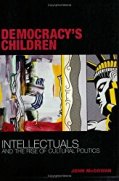 While we can all share a shudder at the very idea, to me one strength of McCrea’s discussion is his admission that marginalizing affect, pleasure, and aesthetic response is, in a way, to be untrue to literature, and that the professional insistence on doing so also, as a result, marginalizes our conversation, alienating us, as McCrea says, “from our students, our counterparts in other academic departments, our families [unless, he allows, they include other professional critics–otherwise, as he points out, even they are unlikely to actually read our books and articles], and, ultimately, any larger public.” (In Democracy’s Children, John McGowan makes a similar point: “There remains a tension between the experience of reading literature and the paths followed in studying. . . . To give one’s allegiance to the academic forms through which literature is discussed and taught is to withdraw [at least partly] allegiance to literature itself”).
But why, McCrea goes on to consider, should we expect such cross-over between our work–our professional lives and discourse–and our personal lives? McCrea’s answer to this question (we shouldn’t) puts the professionalization of English studies into the context of professionalization more generally, which he argues (drawing on sociological studies) was a key feature of American society during the last half of the 20th century. Perhaps the most distinctive feature of McCrea’s book, in fact, seems to me to be his insistence that, in this respect at least, ‘professing English’ is (or has now become) just another job, and indeed that its success at establishing itself professionally at once accounts for and has depended on its investment in theory and metacommentary: “The ultimate step in the aggrandizement of any professional group is for its members to get paid to talk about how they do what they do rather than doing it.” If one result is isolation from and (perceived) irrelevance to the broader public, including the reading public, the gains for criticism and even for literature are also, McCrea argues, substantial:
Rotarians no longer look to us for uplift, future presidents no longer turn to us to increase their ‘stock of ideas,’ nor do ex-presidents attend our funerals, undergraduates no longer found alumni associations around us, family members can no longer read our books, and plain English has disappeared from our journals. But professionalization has liberated us from a cruel Darwinian system in which one white, Anglo-Saxon, Protestant male emerged at the top while others struggled at the bottom, grading papers in impoverished anonymity. It has liberated us from the harsh economic realities of eighteenth-century literature . . . while [today’s critics] might wish to share Steele’s influence, I doubt they would want to share his life. He practiced criticism in a world in which there was no tenure, a world devoid of university presses, National Endowments for the Humanities, and endowed university chairs in literature. . . .
In a society in which no one outside the classroom reads Pope, professors can earn handsome incomes by being Pope experts. The five top Pope experts compete with each other, but probably not with the Tennyson experts, and certainly not with the Chaucer experts. The quest for autonomy has cost us Addison and Steele, has cost us the ability to treat literature as a public, moral, emotional phenomenon. But it has left us with a part of literature, with a canon of works complicated in their technique and tone, and with a classroom in which we have a chance to teach those works, to keep them (and whatever value they hold) alive.
Provocative, as I said, not least in reversing the oft-heard line that (undergraduate) teaching is the price professors pay for the opportunity to do their research and as much as declaring that, to the contrary, academic criticism is the price they pay to preserve literature and its values.
Originally published in Novel Readings August 8, 2007.
 In Close Reading I always start with poetry, partly because it’s just easier to model and practice mining details for meaning when working with shorter, denser texts. Even in Middlemarch (don’t tell anyone I said this!) there are places it’s probably okay not to scrutinize every word, but a sonnet such as Robert Frost’s “Design” demands our unrelenting attention. I reviewed some key terminology on Monday, and then Wednesday and Friday were all about scansion, something I think is not just vital (who can talk well about poetry without considering rhythm?) but kind of fun. However, despite my best efforts, I am almost never able to convince the majority of my students that it is anything but aggravating: the stress was palpable in both tutorials on Friday!
 I almost always end up using lines from Donne’s Holy Sonnet X (“Death, Be Not Proud”) to illustrate just how interesting, important, and even exciting scanning poetry can be. For one thing, it’s a poem that quickly teaches you not to read it in anything like mechanical iambic pentameter: “Death, BE not PROUD, though SOME have CALLed THEE / mighTY and DREADful, FOR thou ART not SO”? You wouldn’t. You mustn’t. And not just because that’s not how you pronounce “mighty.” You’re standing up to Death! At the very least, you have to call him out in that first syllable: “DEATH, BE not PROUD.” You might even do four stresses in a row — “DEATH, BE NOT PROUD” — or maybe that’s too much. I’m tempted to do “for THOU ART NOT SO” as well, but my reading of the poem may be more confrontational than others would like. At any rate, you have to say it as if you mean it, which makes scanning the poem actually quite a profound exercise:
 On university campuses we hear a lot about innovation these days, from hype about the latest ed-tech fad to proclamations by institutions like my own about fostering a “culture of innovation.” This has got me reflecting on how we define or recognize innovation — something that is not as obvious, I think, as its champions, or as those who insist on it as a measure of academic success, typically seem to assume. In some fields, of course, it’s easy enough to tell when something is new, if it shifts or breaks a paradigm. But in others, context makes all the difference, as my own chequered career as a “thought leader” demonstrates.
 Today, of course, an interdisciplinary degree is wholly unremarkable; Dalhousie even has an entire
  But when I got to Cornell, I discovered that far from being a radical, I was actually a conservative! It turned out that there were some kinds of questions you couldn’t safely ask there, arguments you couldn’t seriously entertain, without undermining your feminist credentials. My first big mistake was giving a seminar paper called “The Madwoman in the Closet”: it queried some then-dominant trends in feminist criticism, particularly in 19th-century studies, and tried (perhaps crudely, but I was a beginner at all of this — and frankly, my somewhat old-fashioned training at UBC had not prepared me well for it) to figure out how politics and aesthetics were getting balanced (unbalanced, I thought, maybe, possibly) in the debates. My professor was keen to have these discussions, but said to me quite frankly that he felt that as a male professor, he couldn’t raise these questions. So I blundered in, and paid the price. I also wrote a more or less positive review of Christina Hoff Sommers’
  Exhibit C: my critical writing. There are many possible angles to consider here, but I’ll focus on my recent work outside of academic publishing, because its status has been much on my mind lately. In a way, the kind of criticism I’ve been doing recently — from book reviews to literary essays — is not innovative at all: it’s the same kind of work everyone else is doing who also writes for newspapers and magazines and literary journals. But from an academic perspective, to be writing for those venues instead of for academic journals is itself innovative: it’s the kind of thing that gets called “knowledge mobilization” or “knowledge dissemination” or “public humanities.” Except that some of these publishing ventures resemble (in style, not necessarily in content) an older kind of literary criticism — a kind some might call belles lettres — which is now considered passé in academic circles. So my recent work could be considered retrograde, not innovative. Except that to break from the conventions of academic writing and try to replicate the best qualities of belles lettres (fine, smart, accessible writing, with its own literary elegance) while still doing criticism informed by decades of academic scholarship … couldn’t that combination of new insights and old forms itself be innovative? Then, what about the content of the reviews and essays? Every new interpretation of a literary text is a critical innovation, isn’t it? So every review of a new book, representing a new intellectual encounter, is intrinsically ground-breaking, even if book reviewing as a form is the oldest kind of literary criticism. What if you make a new critical argument, based on original research, but in an essay outside the norms of academic publishing — if that argument falls in the forest, can anybody hear the innovation? Or what if the argument of an essay is new to one audience but not to another? What is going on then?? Am I doing original work or not???
 Great news: New Directions is putting out a new edition of
  One of the most fascinating explorations of this in the novel is the story of the pianist Kenzo Yamamoto, who becomes obsessed, not with how to play a particular note or phrase or piece, but with how else you could play it, or how else it could sound:
 I don’t want to leave the impression that frustration with the rigidity of academic practices is all I took away from my Louisville conference experience. There was definitely value for me in the work I put into my own paper, as well as in hearing and discussing the papers my co-panelists presented. So I thought I’d follow up
  Mendelsohn’s article was one of the sources I cited in my paper, in which I explored some questions about what we mean by “critical authority.” As he notes, once you move outside the academy degrees are neither a necessary nor a sufficient measure of the relevant expertise. But it’s not easy to pin down what does count, how authority is established, especially in a field of inquiry where there are no sure or absolute standards of judgment. Literary critics know that their authority is unstable because the history of criticism teaches us how judgments change over time, while simple experience shows us how much they differ among individuals. We can call variant assessments “gaffes” or “errors in individual taste,” as Mendelsohn does in his recent
  If critical authority is not something you simply have but something you have to earn and maintain by your own participation in a dialogue — if it is best understood not so much as a top-down assertion of superiority (“the critic’s job,” Mendelsohn proposes in his recent review, “is to be more educated, articulate, stylish, and tasteful … than her readers have the time or inclination to be”) but as a process of establishing yourself as someone whose input into an ongoing conversation is sought and valued — that helps explain why “expertise” is such a tricky thing to define for a critic. Mendelsohn’s original formal training is as a classicist — despite his wide-ranging erudition and critical prestige, he would almost certainly not qualify for an academic position in any other field — but obviously he has written with considerable insight on a wide range of subjects, from Stendhal to Mad Men. That so many of us read Mendelsohn’s criticism with interest and attention no matter what he writes about is a sign that we have come to trust him, not as the last word on these subjects, but as someone who will have something interesting (“meaningful,” to use one of his key terms) to say about them. If we disagree with him, we are not challenging his authority but continuing the conversation — and in fact one thing I’ve been thinking a lot about is how little disagreement really matters to this kind of critical authority. If what we go to criticism for is a good conversation, then engaged disagreement can be seen as a sign of authority — a sign that you care enough about the critic’s perspective to tussle with it, if you like. I can think of a number of critics in venues from personal blogs to the New Yorker whose views I would not defer to, but which I want to know because they provoke me to keep thinking about my own readings — which (however definitive the rhetoric I too adopt in my more formal reviewing) I always understand to be provisional, statements of how something looked to me in that moment, knowing what I knew then, caring about what I cared about then.
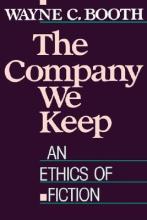 I’m not saying we can’t or shouldn’t defend our critical assessments, but awash as we are and always have been in such a variety of them, it would be naively arrogant at best and solipsistic at worst to imagine ourselves as “getting it right,” no matter who we are or where we publish. Blogging very often reflects that open-endedness in its tone, and its form is based on just the process Booth describes as “coduction”:
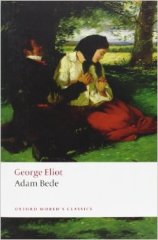 I have really enjoyed rereading Adam Bede for my graduate seminar over the past two weeks. Though I know the novel reasonably well, I have never spent the kind of dedicated time on it that I have on Middlemarch or The Mill on the Floss — or, for that matter, on
  I actually hadn’t intended to read The Story of the Lost Child. By the time I finished



 And, dedicated as I am to preserving the forest, I do often recoil from individual trees — and the less time I spend reading properly “academic” criticism, the harder it is for me to tolerate it when I dip back in. I recognize, however, that other people genuinely relish both reading and writing it, which is more than fine with me, because that’s how (to stick with the arborial metaphor!) the trees I do appreciate are able to take root and flourish. It continues to mystify me, though, that so many academics seem so content to keep planting trees in those woods knowing that hardly anybody will hear their hard-won knowledge or insight when it falls into its safely peer-reviewed place. Even people who have no professional reason to play it safe any more seem oddly uninterested in, or even resistant to, getting the word out about their research in other ways (I say this because I have proposed it to some of them!) — and I get no sense that this has changed in the past decade. Is it anxiety or snobbery that makes it seem preferable to them to hold out for acceptance by a journal or press that will deposit their work safely where almost nobody will read it, rather than to tell other people about it directly through the magic of WordPress? Surely at some point you have enough credibility just to speak for yourself, and you should do that if your actual goal is to increase the overall sum of understanding in the world. Mind you, then you’d also have to try your hand at self-promotion, something else that,
  Novel Readings