Finding My Voice: Posts on Criticism

I’ve been doing some housekeeping here on Novel Readings, setting up some index pages to make my archive of old posts accessible. I’m organizing them according to the categories you see on the tabs above: Academia, Criticism, Fiction, and Teaching. That’s not everything, but it turns out to be quite a lot! The process has been interesting and invigorating, because as I review and update the links I realize not just how many posts there are but how they reflect the evolution of my thinking about literature and criticism, as well as of my habits and practices as a critic. Most of the posts on criticism show me wrestling with my desire to reconcile the values inculcated over many years of academic training with a strong wish to write in a different way, with a different sense of purpose and for a different audience. In early 2008, for instance, I wrote a post for The Valve on “Literary Criticism in/and the Public Sphere”  that drew on my reading of scholars including Brian McRae, Morris Dickstein, and Ronan McDonald. When I wrote it, I wasn’t sure what criticism that lived up to some of its closing suggestions might look like. Now, however, I can point to my recent essay on Gone with the Wind at Open Letters as an example of the kind of thing I had in mind, what I called a “renewed and theoretically updated Victorianism”: a close reading with an emphasis on ethics but supported by an engagement with form. The Gone with the Wind essay also represents a step towards the goals I expressed in a more recent post about metacriticism and my sense that the conversation in academic blogging was going in circles:  “I just want to get on with it: trying to find a critical voice, and to hone and articulate perceptions that reflect both rigorous reading and a more personal, affective, and engaged vision of criticism.” I know I haven’t finished developing as a critic or a reader, but it is exciting to realize that I have moved forward and begun actually practising criticism differently, including speaking more as myself. Working on the index pages has really brought home to me how important blogging has been to this process.

The old post from The Valve is linked to from the ‘On Criticism’ page, but I thought I’d re-post it here (with updated links) as well in case anyone would like to comment on it (I don’t post at The Valve any more). It’s a bit long so if you want to read the whole thing be sure to click on the ‘read more’ link!

Literary Criticism and/as the Public Sphere

When I heard the learn’d astronomer,
When the proofs, the figures, were ranged in columns before me,
When I was shown the charts and diagrams, to add, divide, and measure them,
When I, sitting, heard the astronomer where he lectured with much applause in the lecture-room,
How soon unaccountable I became tired and sick,
Till rising and gliding out I wander’d off by myself,
In the mystical moist night-air, and from time to time,
Look’d up in perfect silence at the stars. (Walt Whitman)

It is a commonplace of the history of literary criticism that the character of criticism changed when and because criticism entered the academy and became professionalized, somewhere around the turn of the 20th century (and ever after). The nature and consequences of this change have been examined and re-examined often over the years, in books such as John Gross’s The Rise and Fall of the Man of Letters (1969), Morris Dickstein’s Double Agent: The Critic and Society (1992), Geoffrey Hartman’s Minor Prophecies: The Literary Essay in the Culture Wars (1991), Christopher Knight’s Uncommon Readers: Denis Donoghue, Frank Kermode, George Steiner, and the Tradition of the Common Reader (2003), or the essay collection Grub Street and the Ivory Tower: Literary Journalism and Literary Scholarship from Fielding to the Internet (1998)–to name just a few.

Brian McRae’s Addison and Steele Are Dead: The English Department, Its Canon, and the Professionalization of Literary Criticism (1990) is certainly among the more lively and provocative books I’ve read on this topic. As his title suggests, McRae frames his consideration of English departments as professional and institutional spaces with arguments about what features in the work of Addison and Steele “render it useless to critics housed in English departments”–not, as he is quick to add, that “their works are without value, but rather, that they are not amenable to certain procedures that English professors must perform” (11). The short version of his story is that professional critics require difficult, complex, ambiguous texts to do their jobs (e.g. 146); the “techniques of simplicity” that characterize Addison and Steele propel them, as a result, out of the canon. As he develops his argument, McRae offers an interesting overview of the 19th-century and then 20th-century critical reception of Addison and Steele. He explains the Victorians’ admiration for these 18th-century predecessors largely in terms of the different understanding that prevailed about the relationship of literature, and thus of the literary critic, to life. Rightly, I’d say (based on my own work on 19th-century literary criticism), he sees as a central Victorian critical premise that literature and criticism are public activities, that their worth is to be discussed in terms of their effects on readers; hence the significance attached, he argues, to sincerity as well as affect. Especially key to McRae’s larger argument is his observation that the 19th-century writers were not “academicians” or “specialists in a field” (89):

For Thackeray and his contemporaries, literature is a public matter, a matter to be lectured upon before large audiences, a matter to be given importance because of its impact upon morals and emotions. For the present-day academic critic, literature no longer is a public matter but rather is a professional matter, even more narrowly, a departmental matter. The study of literature has become a special and separate discipline–housed in colleges of arts and sciences along with other special and separate disciplines. The public has narrowed to a group of frequently recalcitrant students whose need for instruction in English composition–not in English literature–justifies the existence of the English department. (92)

As McRae tells the story (which in its basic outlines is pretty similar to that told in other histories of criticism), this decline in the critic’s public role has had both significant costs (among them, the critical ‘death’ of Addison and Steele) and significant benefits. At times the book has a nostalgic, even elegaic sound:

People who want to become English professors do so because, at one point in their lives, they found reading a story, poem, or play to be an emotionally rewarding experience. They somehow, someway were touched by what they read. Yet it is precisely this emotional response that the would-be professor must give up. Of course, the professor can and should have those feelings in private, but publicly, as a teacher or publisher, the professor must talk about the text in nonemotional, largely technical terms. No one ever won a National Endowment for the Humanities grant by weeping copiously for Little Nell, and no one will get tenure in a major department by sharing his powerful feelings about Housman’s Shropshire Lad with the full professors. (147)

Not that McRae thinks they should–and indeed we can all share a shudder at the very idea. But to me one strength of McRae’s discussion is his admission that marginalizing affect, pleasure, and aesthetic response is, in a way, to be untrue to literature, and that the professional insistence on doing so also, as a result, marginalizes our conversation, alienating us, as McRae says, “from our students, our counterparts in other academic departments, our families [unless, he allows, they include other professional critics–otherwise, as he points out, even they are unlikely to actually read our books and articles], and, ultimately, any larger public” (164-5). In Democracy’s Children: Intellectuals and the Rise of Cultural Politics (2002), John McGowan makes a similar point: “There remains a tension between the experience of reading literature and the paths followed in studying. . . . To give one’s allegiance to the academic forms through which literature is discussed and taught is to withdraw [at least partly] allegiance to literature itself” [65]. In A Mirror in the Roadway: Literature and the Real World (2005), Dickstein too remarks that “Since the modernist period and especially in the last thirty years, a tremendous gap has opened up between how most readers read if they still read at all, and how critics read, or how they theorize about reading” (1).

Continue reading

Bloggers and Critics: Everything new is old again

My previous post on appreciating book bloggers was in progress as the discussion unfolded on Twitter about ‘book bloggers ruining everything’ (via Ron Hogan, for one, who was watching a discussion from earlier this year between Charles McGrath and Daniel Mendelsohn* that involved a fair number of pot shots at book bloggers [see here if you want to watch it for yourself]). I’ve been thinking that one of the reasons these reductive and dismissive attitudes towards bloggers have any traction at all, and come from such otherwise very smart people, is the problem of filtering.

In blogging (as in every medium) there is good stuff (even some great stuff) and bad stuff (even some really truly terrible stuff). It is probably true, just because of the lack of inhibitions on blogging and other forms of self-publication, that the bad-to-terrible stuff  outweighs the good-to-great stuff by a larger margin than in old forms of print media. It takes patience, curiosity, time and open-mindedness to trawl the vast array of blogs (even in the subset of book blogs) looking for the good stuff. Lots of us do it, because there are real rewards for lovers of books and criticism and conversation. But it’s vanishingly unlikely that someone who gets all their links from the Big Established Sites, including their blogs, will find most of the sites we write for or read, because they all seem to read and link to exclusively other Big Established Sites. The Book Bench at the New Yorker, for instance, has its own often engaging posts, but it links around pretty much exclusively to places like the Nation, or the Guardian, or the Wall Street Journal, or PEN. These are worthy sites, of course, but anybody who’s interested in the Book Bench is probably already following them, one way or another. At most, all the Book Bench is doing is letting us know which pieces in these esteemed sources were of particular interest to them, or saving us the trouble of sorting through more than a couple of our RSS feeds for the day. The blogroll at the Book Bench has 24 links–not a bad start, but all, again, high profile already (mostly other mainstream media outlets, plus Maud Newton, Sarah Weinman, and a couple of the best-known online book sites–The Millions, The Second Pass). Again, all worthy of our attention–well, there’s one on their list I’m not sure about, actually, and why it’s there and not some of the ones I admire, I have no idea.  The Guardian has a smaller and even odder selection; at the TLS, both Peter Stothard and Mary Beard have small blogrolls too, though ones that reflect a bit more idiosyncrasy, which is nice. Still, none of these sites (or a number of other blogs associated with major papers and magazines) seem genuinely bloggish, in that there’s really no sense of the reciprocity I suggested distinguishes blogging as an especially open and generous form. The major aggregator sites (I’m thinking of Arts and Letters Daily, for instance, or Three Quarks Daily) also rarely step outside the rarified world of the ‘top’ sites. It would be refreshing, and good for the general conversation about books (which we’re all passionate about–or at least amateur book bloggers are), if these Big Established Sites would participate in the remarkable opening up of the cultural conversation that the internet has enabled.  Right now, I think  followers of the big sites are bound to feel a bit claustrophobic after a while, not to mention excluded. The exercise of looking for the good stuff among the bad would be tiring and discouraging some of the time, but acknowledging the smart, articulate blogs that are more than what Mendelsohn calls “unchecked effusions”–and doing so in a forum that already has  a little credibility in the world of old media–might help people like McGrath and Mendelsohn stop conflating form and content–or just ignoring content altogether. A good place to start would be with the handful of sites I listed.

*I admit that I was particularly disappointed at the tone of Mendelsohn’s comments (though he does acknowledge that there are some good lit blogs, and his point about chasing ‘hits’ by writing what gets attention is a fair one) because I wrote what I still consider one of my best blog posts about his remarkable book The Lost. What difference does it make that I wrote this sitting in my basement fairly late at night? (I’ll spare you the detail of whether or not I was actually in my pyjamas: the blogger’s wardrobe seems to be an issue of surprising concern to some people.) It’s either good writing and analysis or not. It’s true that I wrote it without the benefit of an editor (well, besides myself–and I’m pretty tough on myself, as I am on others), but the unmediated scrutiny of online readers is another way to test the merits of the result. In my case, I was gratified to be recognized for my work by Three Quarks Daily, where the editors named this post a finalist in their arts and literature blogging contest last year (these contests, by the way, are a great step towards the kind of sorting project I wish sites like this should do–but I don’t notice 3QD linking regularly to the winners or finalists in their regular posts).

Open Letters Monthly Reading and Book Launch!

It’s almost here: the day you’ve all been waiting for!

Friday is the Open Letters Monthly Reading and Book Launch at the Housing Works Bookstore and Cafe. The line-up of readers (including Nathan Schneider, Lianne Habinek, Sam Starkweather, Jared White, Lisa Peet, Steve DonoghueJohn Cotter, and me!) reflects the  range in both styles and subjects that makes OLM such a great reading experience every month. Here’s hoping for good weather and a good turnout! I think that, for our part, we can promise you a good time.

August in Open Letters

The August issue of Open Letters is up and full of the usual wide range of readerly goodies. I’m especially pleased to call attention to my Valve colleague Amardeep Singh’s “The Original Wasn’t Better,” which presents arguments against the literary purist’s “fixation on ‘fidelity'” in film adaptations. I admit, I count myself among those for whom Mira Nair’s revised ending to Vanity Fair was “a step too far,” but Amardeep helps me think about my resistance to it, and about the general issues involved in adaptation, in a more complicated way. The issue also includes a complete “fitt” of Adam Golaski’s new translation of Sir Gawain and the Green Knight, Amelia Glaser on Peter Stein’s adaptation of Dostoevsky’s The Demons, Megan Kearns on veganism and ‘carnism,’ Max Ross on Alberto Manguel’s A Reader on Reading, Steve Donoghue on a new biography of Edward II, Garrett Handley on the Shakespeare authorship controversy, Ingrid Norton on Margaret Atwood’s Surfacing–and that’s not all. Come on over and see for yourself!

Recent Reading: Mina and Mantel

In my previous post about summer reading plans I forgot to mention that my daughter and I have committed once again to our local library’s summer reading club. (As an aside, let’s hear it for public libraries, perhaps the greatest public institutions we have!)  This year her pledge (for me to match) is 25 books over July and August. I’ve managed to read four titles since she signed up, but I haven’t blogged about any of them yet, so I have some catching up to do.

First up, I finally read Denise Mina’s Field of Blood, which was highly recommended when I put out my ‘bleg’ for ideas for my seminar on women and detective fiction. Unlike many of the titles I read as I worked on my book list, it’s very good! What makes it stand out from the others? The simplest answer is that it suits my own reading tastes better. It’s rich in context and characterization, but it’s not overwritten, pedantic, or (like the awful Stieg Larsson books) just one damned thing after another with intermittent pornography (I know, I know, Salander is a great character, but…). Paddy Meehan is flawed and conflicted, but not melodramatically so; her family and co-workers are effectively and efficiently specified so that we rapidly get a sense of the community she moves in, which is an interestingly complicated one. It’s not really a detective novel, and in fact one reason I think I couldn’t have fit it into my course very well is that the crime itself is almost peripheral to Paddy’s own story. I thought there were a few missteps: there’s a ‘killing-due-to-mistaken-identity’ episode that I found did cross over into cliche in the writing, for instance. I was most interested in the push-and-pull for Paddy herself between her family’s expectations and her ambitions. Paddy is also a good example of the type I now think of (thanks to Anita Brookner) as the tortoise: she’s plain, underappreciated intellectually, overlooked romantically–in short, she’s every socially awkward, ill-at-ease bookish young girl who can therefore read in her eventual success validation of their own painful experience as misfits. As Brookner points out (in Hotel du Lac), books are written for the tortoise market because in reality the hares are off winning the race (or the guy).

I did read one other mystery, though I finished it in June so I can’t count it towards my summer total: Katherine V. Forrest’s Murder at the Nightwood Bar. If I had read this sooner, I might have included it on the syllabus, though I would have had some misgivings. I had hoped to find a teachable example of lesbian detective fiction, which is a thriving subgenre now. Forrest was one of the earliest writers to establish herself in it: Amateur City, the first in the Kate Delafield series, was published originally in 1984, soon after Sue Grafton and Sara Paretsky had launched their female private eyes. Murder at the Nightwood Bar is far more overtly political than the Laurie King and Sandra Scoppetone ones I read earlier, and the crime is set up to resonate with those political interests and to stand as exemplary of a larger social problem, giving the book the kind of unified effect that lends itself to the kind of work we would do in a seminar discussion. On the other hand, it is perhaps a bit too obviously set up in this way: I like a little nuance with my social consciousness raising. Forrest is another competent but unspectacular stylist; nothing in the book seemed as literarily fine as, say, P. D. James’s An Unsuitable Job for a Woman. At any rate, the book didn’t make it on the list for this fall (though Nancy Drew ultimately did–we’ll see how that goes!) but I’ll revisit it next time around.

My other summer book for this post is totally unlike these two: I continued my trip through Hilary Mantel’s back catalogue with The Giant O’Brien. Once again, it was a surprise: like Beyond Black, it gives no sign of being by the same author as Wolf Hall, for instance, except in being strangely conceived but ultimately quite compelling. It follows the experience of a Giant who has travelled from Ireland to London in the 1780s, escaping poverty and famine at the cost, ultimately, of his self-respect, his integrity, his humanity, and even his life, though we realize from early on that all of these aspects have been compromised for him from the start simply by his being a giant, a freak, a spectacle. Juxtaposed against his story is that of the anatomist John Hunter. They are set up to embody a number of oppositions, not just scientist and potential experiment or subject, but also the man of facts, of physicality, and the man of imagination–ironically, in an extraordinary physical frame, but living the life that really matters to him in his mind alone, and through the stories he tells. They are also England and Ireland, I think, and to some extent, also winner and loser. There’s pathos, but Mantel downplays it, going instead for a combination of quirky and grotesque that, inevitably but rightly, one of the critics in the blurbs identifies with Hogarth’s famous prints of 18th-century London. The prose is beautifully styled, moving between short epigrammatic conversations, terse sections of exposition, brutal graphic detail, and passages of great lyricism without any hint of sentimentality:

The poet has his memorial in repetition, and the statesman in stone and bronze. The scholar’s hand lies always on his book, and the thinker’s eyes on canvas travel the room to rest on each human face; the rebel has his ballad and his cross, his bigot’s garland, his wreath of rope. But for the poor man and the giant there is the scrubbed wooden slab and the slop bucket, there is the cauldron and the boiling pot, and the dunghill for his lights; so he is a stench in the nose for a day or a week, so he is a no-name, so he is oblivion. Stories cannot save him. When human memory runs out, there is the memory of animals; behind that, the memory of the plants, and behind that the memory of the rocks. But the wind and the sea wear the rocks away; and the cell-line runs to its limit, where meaning falls away from it, and it loses knowledge of its own nature. Unless we plead on our knees with history, we are done for, we are lost. We must step sideways, into that country where space plaits and knots, where time folds and twists: where the years pass in a day.

Some of the most haunting passages in the novel are those in which the giant pacifies his motley associates with tales told in the resonant tenor voice that belies the monstrosity of his frame. The transcendence of his voice, his ability to take both himself and his listeners outside themselves, outside the ugly and inescapable realities of their literal lives and their physical selves, beautifully captures the promise of story-telling itself.

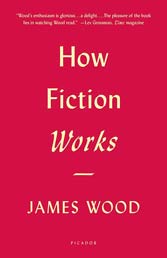
Best of ‘Novel Readings’: James Wood, How Fiction Works

This review first went up in March 2008. My brooding over deep vs. broad reading has had me thinking again about Wood’s criticism, which I wrote admiringly about when I first discovered him in 2007. (This remarkably belated discovery speaks volumes, I think, of the divide between academic and public criticism.) I have also been thinking a lot about Becky Sharp, because in an essay for the July issue of Open Letters Monthly I lay out a more elaborate version of the argument I touch on here for her incidental significance to the novel in which she is so captivating a heroine. Both lines of thought led me back to take another look at this piece. I haven’t kept up with all of Wood’s reviews since, mostly because he and I often choose different books to pay attention to, but when I do (as with his recent piece on David Mitchell) I’m still struck by the elegant erudition of his language and analysis. Still, as this review shows, I have some sympathy with Lauren Elkin’s proposal that Wood is “a fine specimen of a book reviewer” but not exactly a “literary critic.” Not, as they used to say on Seinfeld, that there’s anything wrong with that.

How Fiction Works was also very ably reviewed in 2008 in Open Letters Monthly, by Dan Green of The Reading Experience.


The dust jacket describes How Fiction Works as Wood’s “first full-length book of criticism.” Anyone led by this blurb to expect sustained analysis supported by extensive research and illustration will be disappointed, as in fact How Fiction Works turns out to be essentially a ‘commonplace book,’ a collection of critical observations and insights of varying degrees of originality and sophistication, developed with varying degrees of care and detail. Wood acknowledges having set deliberate limits on his project, likening it in his introduction to Forster’s Aspects of the Novel, proposing to offer practical “writer’s anwers” to “a critic’s questions,” and admitting (though with no tone of apology) that he used only “the books at hand in [his] study.” To some extent I agree with other reviewers who consider it only fair to evaluate the book Wood wrote, rather than regretting he didn’t write another one. Yet even within the parameters Wood sets, I think there are grounds for wishing he, with his exceptional gifts and qualifications as both reader and critic, had not sold himself (or us) short in fulfilling them. Further, beginning with the invocation of Forster but going well beyond it, the book has pretensions to grandeur: for instance, also in his introduction Wood remarks that Barthes and Shklovsky “come to conclusions about the novel that seem to me interesting but wrong-headed, and this book conducts a sustained argument with them” (2). With gestures such as this, Wood claims an elevated stature for his critical contribution that is undermined by its casual construction and over-confident approach to scholarship. Though How Fiction Works provides many further proofs of Wood’s critical gifts and considerable erudition, I think it also proves that even the best practical critic flounders when working only with what he has already to hand or in mind.

Right off the bat I was irritated by the book’s structure. Wood has said that he felt liberated by using the numbered “paragraphs” or sections, but allowing yourself to skip from thought to thought in this way means letting yourself off the hook too often. Frequently in the margins of my students’ work I write “And so? Finish the thought!” One effect of crafting, first paragraphs, and then longer pieces as sustained wholes is that in working out the overall movement of your ideas and building in appropriately specific transitions, you confront both the logic and the further implications of your claims: the form pressures you to think better. Numbered bits, however, relieve that pressure: you can just stop with one topic and start the next, and as long as they are more or less related, you can claim to be producing a unified whole, even if you are only papering over gaps. In How Fiction Works, the breaks often seem unnecessary: a new number sets off what is really just the next sentence in the idea already unfolding. Most of the time, however, they are substitutes for careful transitions. They allow a certain stream-of-consciousness effect to creep in: that last bit reminds me of this exception to a general principle, or of a writer who also does that, or of another favourite excerpt, or of a time I went to a concert with my wife. Well, OK, I guess, and no doubt it would have been much more difficult to do a coherent chapter offering a theory of, say, fictional character, realism, or morality and the novel. And I suppose it’s true that non-academic readers don’t want the kind of detail and complexity such a full account of these topics would require. Even so, the numbered bits felt lazy to me. The footnotes too had an aimlessness about them. Some of them covered ideas or examples that seemed no less important to their chapter than most of the bits allowed their own numbered section (note 53 on p. 150, to give one example) while others appeared entirely unnecessary to the book (note 40 on p. 121, or note 41 on p. 124, for instance).

The TLS reviewer objects to Wood’s “grace notes”: “It is sometimes hard to distinguish a gasp of admiration for another’s skill from the contented sigh when the books in one’s study satisfy one’s own theories.” I shared this reaction, not least because “how fine that is” (139) is an expression of taste, not criticism. But Wood is a compelling reader of details, even passages. It’s when he makes broader assertions that he leaves himself more open to objections. For one thing, he has some governing assumptions about what fiction is for that he treats as universal rather than historically or theoretically specific. In his chapter on “Sympathy and Complexity,” for instance, as a footnote to his remarks on fiction as a means of extending our sympathies (the occasion for one of his shockingly few references to George Eliot!), he adds this:

We don’t read in order to benefit in this way from fiction. We read fiction because it pleases us, moves us, is beautiful, and so on,–because it is alive and we are alive. (129)

Well, maybe, but not everybody, and not all the time: for instance, most of the Victorian critics I have been editing for my Broadview anthology [now that the anthology is actually out, I wonder if Wood would like a copy–maybe I’ll send one along!] would not have recognized this highly aestheticized motive for novel reading. Is it fair, or even sensible, to say that they were simply wrong? Or to ignore how the formal developments of the Victorian novel furthered ends not adequately respected by Wood’s post-Jamesian formulations? His is in many respects a teleological account of the history of the novel. “Progress!” he exclaims after a quotation from Proust: “In Fielding and Defoe, even in the much richer Cervantes, revelation of this altering kind occurs at the level of plot” (125). But were Fielding and Defoe trying to do what Proust did and failing? How much better we might understand them if we allow them what James calls their “donnee.” “It is subtlety that matters,” he declares in his chapter on character; “subtlety of analysis, of inquiry, of concern, of felt pressure”: “I learn more about the consciousness of the soldier in Chekhov’s The Kiss than I do about the consciousness of Becky Sharpe [sic] in Vanity Fair.” But Becky Sharp’s consciousness is surely not the point of Vanity Fair; indeed, I argue in my own lectures [and now, in my essay in July’s Open Letters] that too close a focus on Becky risks diverting us from Thackeray’s grand gesture of holding the mirror up to ourselves, so that the novel becomes an opportunity for us to reflect on our own morality and mortality. “Was she guilty or not?” the narrator asks–and, remarkably, will not tell us, because ultimately she is not the point but the occasion, the device. Thackeray is not a failed Chekhov any more than Dickens is a failed Flaubert. To Wood, “the history of the novel can be told as the development of free indirect style” (58), but that history is partial and often distorting.

About the operations of free indirect discourse and the importance of knowing who ‘owns’ which words, on the other hand, Wood is typically astute. Here’s one place where examples from Middlemarch would have served him well, though at the risk of undermining his generalizations. Consider this passage from Chapter 1, for instance:

And how should Dorothea not marry? — a girl so handsome and with such prospects? Nothing could hinder it but her love of extremes, and her insistence on regulating life according to notions which might cause a wary man to hesitate before he made her an offer, or even might lead her at last to refuse all offers. A young lady of some birth and fortune, who knelt suddenly down on a brick floor by the side of a sick laborer and prayed fervidly as if she thought herself living in the time of the Apostles — who had strange whims of fasting like a Papist, and of sitting up at night to read old theological books! Such a wife might awaken you some fine morning with a new scheme for the application of her income which would interfere with political economy and the keeping of saddle-horses: a man would naturally think twice before he risked himself in such fellowship. Women were expected to have weak opinions; but the great safeguard of society and of domestic life was, that opinions were not acted on. Sane people did what their neighbors did, so that if any lunatics were at large, one might know and avoid them.

Think how much is lost on a reader who improperly identifies the source of that word “naturally”–or the last two sentences altogether!

Wood is good on the telling detail as well as the quality he calls “thisness”: “any detail that draws abstraction towards itself and seems to kill that abstraction with a puff of palpability” (54). But again, when he moves into prescription, he becomes less persuasive, as when he objects to the “layer of gratuitous detail” in 19th-century realist fiction. Again, the challenge is in defining “gratuitous” (as, clearly, Wood himself is well aware), but he can’t propose any principle except, perhaps, his idea that “insignificant” details avoid irrelevance if they are “significantly insignificant” (68). After recounting an incident in which he and his wife had “invented entirely different readings” of a violinist’s frown at a concert, he claims that a “good novelist would have let that frown alone, and would have let our revealing comments alone, too: no need to smother this little scene in explanation” (72). Again, well, maybe. I can imagine at least one “good novelist” who might have done great things with their “different readings” of that little moment, perhaps even using their “revealing comments” as a chance to reveal even more about perception and reality as well as human relationships (“these things are a parable…”). Doesn’t it depend on what your novel is about and on the formal methods you are using to realize those goals?

I’d like to return before I close to the “Sympathy and Complexity” chapter, because this is a topic close to my heart, one on which I have spent a lot of my own critical energy recently, and one I expected Wood to handle particularly well. “Perfunctory” is the best word I can think of to describe it. I’ve mentioned already his dehistoricizing assumption that “we” don’t read in order to receive moral benefits. I doubt this is true in practice, and I also question the separation he implies between moral and aesthetic readings. Here is a case in which even a little research outside “the books at hand in [his] own study” would have immeasurably enriched his discussion: Wayne Booth’s The Company We Keep, for instance, would have helped him complicate exactly that separation. And the conversation about how fiction might do “what [Bernard] Williams wanted moral philosophy to do” (135) has many participants besides Williams: Martha Nussbaum comes promptly to mind. Further, not all novels avoid providing “philosophical answers”; he replicates Nussbam’s error in generalizing about “the novel,” but as a professional novel reader, he should know better.

Here the hybrid character of How Fiction Works proves a genuine weakness, I think. This chapter is not a full, responsible, or authoritative inquiry into its subject. Of course, it does not pretend to be (remember, the book promises only “a writer’s answers” to “a critic’s questions”). But then how should we evaluate it? Doesn’t Wood do even his non-specialist audience a disservice by taking up complicated subjects on which there already exists a rich body of scholarship and offering his own fairly casual observations with the confidence of real expertise? What a much greater contribution it would be to distill that complex material and present it accessibly! To grab what’s at hand and say just what comes to mind bespeaks an enviable but also problematic degree of confidence. And while the non-expert reader is in no position to object, the expert reader is easily deflected with the excuse that she is not the intended audience…

After I read How Fiction Works I re-read some of my collection of Wood’s essays, including his reviews of Never Let Me Go, Saturday, and Brick Lane. This is really wonderful stuff, as I have remarked before; I admire it wholeheartedly for its critical acuity, its literary elegance, and its moral seriousness. But considering How Fiction Works strictly as one among many books about books (and Wood is wrong, or perhaps disingenuous, when he says “there are surprisingly few books” of this kind about fiction [1]), I think there are many better choices available. I continue to recommend David Lodge’s The Art of Fiction, for instance, which takes up many of the same topics as Wood, though under a less grandiose umbrella of prescriptive claims. I think it’s an exciting development that Wood has landed a job in Harvard’s English Department. In taking this now unconventional route from journalism to the academy, he is following in the footsteps of many eminent Victorian critics (David Masson, for instance). But considering how bitterly difficult it is for those following the established professional route to land any academic job at all, it’s frustrating to think that he may not be held to anything like the same standard of rigour as many critics far less lauded and applauded. Here’s hoping that he has more books in him as good as The Broken Estate.

(Original post cross-posted to The Valve.)

Summer Reading Plans

With everything done but the marking in my class, I can now look ahead to July and August and ask myself what any self-respecting English professor inevitably asks: What will I be reading?

Actually, I recently spent a friendly evening with several other English professors and the question they asked me was “How do you ever find time for all that reading?”–which is an interesting question, when you think about it. It does rather imply that I’m reading when I should be doing something else, or at least I’m reading instead of doing something else, namely, whatever it is that they are doing. Or, to refine that insinuation somewhat, it implies that my reading isn’t the same as their reading. Perhaps what they really mean is “How do you ever find time to read so much for fun?” or “to read things that aren’t obviously for your research.” Or maybe it just means “You must be neglecting your garden/family/knitting/TV watching/sleep”  (to which the responses are, in order, yes (but my husband does a great job of it) / no, I’m pretty sure not / yes, definitely, and my quilting too / yes, pretty certainly, but after you have children you come too regard sleep as a rare luxury anyway).  Perhaps they just meant it as a compliment  (“Wow, you read a lot–good for you!”), or perhaps they suspect me of speed-reading! Probably, really, they didn’t mean much by it at all, and the fact that it has obviously made me feel defensive means that I have projected my own anxieties about how I use my time onto them–which I shouldn’t do to my friends!

Still, they got me thinking, not for the first time, about the relationship of my “leisure” or non-required reading to my work and professional life. It’s true that I never, ever pick up a book of academic literary criticism anymore to read just out of interest. Reading of that sort is strictly occasional for me now, meaning that I do it only when the occasion demands–when I’m either studying up on something I’m going to teach for the first time, or the first time in a while, or working on a specific research project. But I don’t think the other reading I do is strictly irrelevant. For instance, I’ve ended up teaching as well as developing research projects based on books I initially read initially “only” for my own interest. Without defining relevance quite so narrowly, too, it just seems right that someone whose job it is to talk to students about literature and perhaps even to put it into some meaningful relationship with their own lives should be an active, curious reader including of some currents in contemporary writing. I make a big deal in my classes about the texts we are reading, which come in such uniform and sanitized packages (no offense, OUP, Penguin, Norton, or Broadview-they’re beautiful and extremely useful editions!), but which were never intended for quite that kind of safe consumption–writers write to stir things up, whether social, political, aesthetic, sensual, or theoretical things. Reading widely, if miscellaneously, helps me sustain an interest in literature as that kind of living and purposeful venture, and I think that reading enhances–it certainly motivates–my classroom time as well as (of course) my own life. The diffusion of my reading attention, though, has in recent years made me less and less patient with the kind of deep, burrowing reading that academic research requires. I’m more and more aware of what I haven’t read, despite all that I have read, and I feel frustrated that the kind of reading I have done (still do) in deliberate pursuit of professional goals (scholarly articles and books) has been at the expense of the kind of broad reading experience that would give me the knowledge and confidence to write a different kind of criticism. And yet, I do have professional responsibilities, and even, maybe, a lingering interest in getting that last promotion, so for those reasons I need to remain a disciplined reader; and I do learn from and sometimes even enjoy the ‘work’ reading I do.

So, with these different priorities (reading deeply or reading widely), what will I be reading this summer?

One possibility that I feel, somewhat sadly, is slipping away from me is The Tale of Genji. When I learned of the summer project being co-hosted by Open Letters Monthly and the Quarterly Conversation, it was just before the beginning of my class, and at this point I’m about 200 pages behind. Though I am enthusiastic about the project in principle, and have been keeping an eye on the interesting and lively posts at its blog site, I fear I can’t catch up and keep up now without abandoning the other books I already had marked as summer prospects. Chief among these is War and Peace, which I’ve been yearning after for some time–so you see why I find adding Genji a difficult prospect. But I do have it from the library, and I have made a start on it, so we’ll see how that goes. I’m also just at the beginning of Margaret Oliphant’s The Perpetual Curate, as a further effort in the Scottish Literature Reading Challenge, and I’m finding it sharp and amusing so far, making it an attractive prospect to stick with it and finish it. I also need to read Virginia Woolf’s The Voyage Out, as one of my MA students is writing a chapter on it; so far, it’s not nearly as alluring a read as The Perpetual Curate (leading me to sympathize with James Wood’s remark that “when Woolf fails it is generally when she is being Victorian”). Still, duty calls! Rereads are also in my future, as I try to, at last, get my Ahdaf Soueif paper into form for submission to a peer-reviewed journal; I’ve been thinking of expanding it from In the Eye of the Sun to include comparative analysis of The Map of Love. On my TBR pile I also have Colm Toibin’s Brooklyn, William Volmann’s Europe Central, A S Byatt’s The Children’s Book, Azar Nafisi’s Things I Have Been Silent About, Hilary Mantel’s The Giant O’Brian, and Lorna Sage’s Bad Blood–tempting, all! Plus I haven’t finished the Hermione Lee biography of Woolf, and I recently picked up several second-hand copies of Woolf’s diaries and letters, which at the very least I would like to spend some concentrated time browsing in. Finally, I am still thinking about the whole ‘books of my life’ idea that came to me towards the end of my recent rant about getting away from metacriticism and on with finding my own critical voice, and the book I would most like to write about, if I can figure out how, is Lynne Sharon Schwartz’s Disturbances in the Field, so I will be reading that again, along with Gaudy Night, another of my top picks for that category.

Hmm. I still haven’t mentioned any scholarly books. I’m sure there will be some! But I doubt I’ll learn more, or even as much, from any of them as I’ll learn from finishing War and Peace.

Again with the metacriticism? Time to get on with it.

I’ve been keeping an eye on the fairly new site ARCADE developed by (and, it seems, primarily for) folks at Stanford. It’s an ambitious and complicated site; it’s interesting to me in part because it organizes and institutionalizes some of the usually more freewheeling features of “Web 2.0,” particularly blogging. I don’t much like the feel of things over there for just that reason: it takes the fun out, somehow, when there’s an editorial board rather than a blogroll. It also doesn’t seem as if the Arcade folks are much interested in linking up with the rest of the existing blogosphere–and there’s not much sign, either, that they have trawled around in it, including in its archives, to see how they might add to conversations that have gone on already, or to contextualize their site and its intentions against, say, key statements about academic blogging such as John Holbo’s launch post for The Valve. I think it would be a bigger draw for people who have been blogging for a while if its contributors seemed interested in what’s been going on in this form for the last several years.

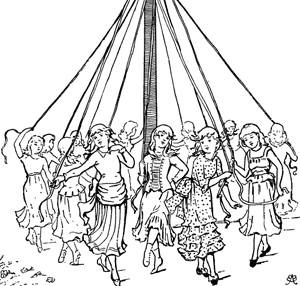
Of course it’s their place, and of course they can do what they want. It’s just a bit wearing to see posts like the latest one by Gregory Jusdanis called “Professors are from Mars, Journalists are from Pluto” and see that it sets up the same dance around the same maypole we’ve been around before. Indeed, this is the same set of concerns that got me started in blogging in the first place–so my objection is not that the questions about the relationship between academic criticism and what Jusdanis calls “journalistic” criticism aren’t important or interesting. I also know better than to pretend that my own forays into this territory were groundbreaking: for me, as for Jusdanis, presumably, a time just came when I wanted to think about the purpose and audience of literary criticism, to understand and contextualize my own dissatisfaction with the academic ‘research’ culture that (as a number of the professional histories I went on to read make very clear) is the result of a range of forces many of which have little to do with literature and a lot to do with economic and institutional developments. I think a lot of literary academics look sort of wistfully out of their office windows and wish their career hadn’t led them so far away from the wider public conversation about books and culture; they publish in dryasdust peer-reviewed journals but linger over the TLS and the NYRB hoping that some day they will write something that people will read by choice, not because they need to fill out their own list of works cited. And a lot of them (Jusdanis and me both included) look at James Wood and wonder why he has the cultural authority–even, as far as this is possible for a book critic–the celebrity, while their hard-earned credentials (and believe me, I appreciate that they are hard to earn) earn them no ‘street cred’ at all. In fact, as I was surprised to discover, holding a Ph.D. in literature is as likely to make non-academics resent your input on their reading (or worse) as seek it out.

So I am in sympathy with Jusdanis’s desire to explore the differences between what “we” do and what “they” do…except that I’ve been exploring that for some time, including looking pretty closely at books of criticism for general readers by both academics and non-academics. I’m not complaining that Jusdanis has not looked at any of my previous posts on this–though he might have looked around, as I tried to do as I was getting underway, to see who else is talking about these questions. Blogging is all about the linking, and I think he’ll find it’s a livelier and more varied conversation than he presupposes in all of his generalizations about what “we” do (some of us are, actually, “attuned to the language and style of those who make their living by writing literary criticism” and do not at all “prefer our colorless cell of functional writing”). But for me, now, having done this dance before, I don’t think I want to do it again. One of my earliest posts (and one of my snarkiest ones) was a lament about the infinite regress of metacriticism that characterizes so much academic work today. That wasn’t my finest moment as a blogger, but the claustrophobia it expressed continues to overwhelm me when I open another scholarly book and contemplate the obligatory ‘methodology’ discussion. We call this ‘rigor,’ and it is, in a way, but its value to our understanding of literary texts is not self-evident. Will I read Jane Eyre wrong, somehow, if I haven’t cleared a way through the lumber-room of recent criticism on the Brontes before hazarding an opinion? The risk is rather that I will fail to acknowledge or respond to someone else’s argument about what the novel means or how it works, but that’s a rather different thing. The debates may be interesting, but often they are more revealing about divisions or trends in academic criticism than about the works in question, so we’re inevitably talking both to and about each other. No wonder ‘outsiders’ don’t care. Frankly, I’m not that interested in us anymore, and I’m certainly not interested in scrabbling around to find some new angle on Jane Eyre or Middlemarch in the manner of what I’ve called the pickle approach to criticism. At this point I just want to get on with it: trying to find a critical voice, and to hone and articulate perceptions that reflect both rigorous reading and a more personal, affective, and engaged vision of criticism.

It has been surprising and exciting to me to realize how blinkered I was about non-academic book culture, and chastening to realize how little use my own specialized reading has been as preparation to join in. At the same time, I think it’s true (as Jusdanis implies) that the academic habits of research and argumentation, the contextual knowledge accumulated through years of study and teaching, and the years of experience as a writer and editor, are, in other ways, valuable preparation, if only I can learn to ‘wear’ them lightly enough. Jusdanis is right that it is “hard to shift up and down.” Despite my three years of practising here on this blog, for instance, where I have self-consciously tried to free myself to write in a more personal way, my review of Jane’s Fame for Open Letters is (as the editors pointed out) “straightforward”–I should feel free, they said pleasantly, “to digress.”

I know what they mean: I read with admiration and envy some of the pieces by, say, Lydia Kiesling at The Millions (this one, for instance), or, to look to OLM for an example, something like Sam Sacks’s review of Andre Aciman’s Eight White Nights–what a beautiful balance they achieve of personal revelation or response, reflective commentary, and precise analysis. But digression, personal revelation, even visceral response are all typically anathema to the conventions of academic criticism. I have some academic projects on the go, and it’s essential to me professionally (I think) that I keep working on them. But I’m also going to set myself some other goals that take me outside my critical comfort zone in a more deliberate way than my blog posts do–though they will likely begin as, or appear in, posts along the way. I’m thinking of a phrase in an essay by Lee Edwards: she concludes the essay by saying that Middlemarch is no longer one of the ‘books of her life.’ That specific conclusion is, of course, unacceptable to me! But I like the idea of the ‘books of our lives.’ What are mine, and what will I say about them? Stay tuned!

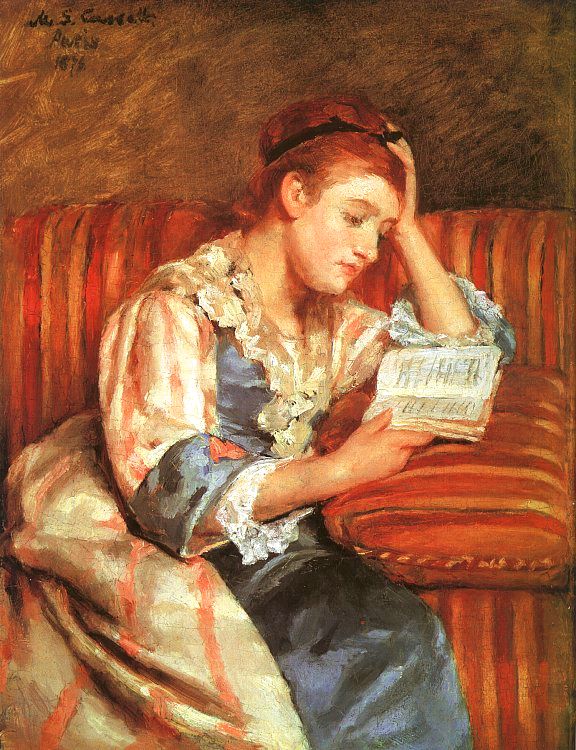
Image from Women Working, 1800-1930(Open Collections Program, Harvard University Library) (Digitized historical, manuscript, and image resources selected from Harvard University’s library and museum collections that explore women’s roles in the US economy between the beginning of the nineteenth century and the Great Depression)

Top 10 Picture Books

The lovely post at stevereads on I am the Mummy Heb-Nefert had me thinking all day about children’s picture books. At 8 (almost 9!) and 12 (almost 13!), my own children have moved on, but I miss both the nightly ritual of reading aloud and the verbal and visual pleasure of their great collection of children’s books. How nice, then, to have an excuse to put together a “Top 10” list. Maybe some other time I’ll do a “Top 10 board books,” since it seems a shame not to have included Eating the Alphabet or The Going to Bed Book.

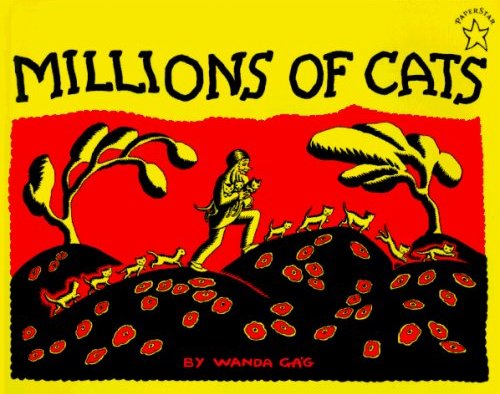
1. Wanda Ga’g, Millions of Cats. “Cats here, cats there, cats and kittens everywhere. Hundreds of cats, thousands of cats, Millions and billions and trillions of cats. . . . and not one was as prety as this one.” This one was a childhood favorite of my own. Maybe it’s the reason I wanted a cat so badly! (I finally got one, and indeed, mine was the prettiest cat of all.)

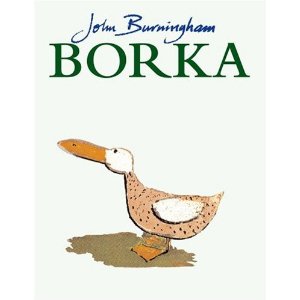
2. John Burningham, Borka. It’s hard to choose which John Burningham book is my favorite, but in the end, the nod has to go to the ‘Adventures of a Goose with no Feathers.’ If I had gone to Kew Gardens on my trip to England last year, I would definitely have tried to find “a goose who looks somehow different from the others.” My family had a budgie named ‘Borka,’ in his honor.

3. Robert McCloskey, Blueberries for Sal. Another tough call here, with Make Way for Ducklings close competition, but I always loved the “kuplink! kuplank! kuplunk!” of the berries landing in Sal’s bucket, and the endpapers of Sal and her mother in the kitchen.

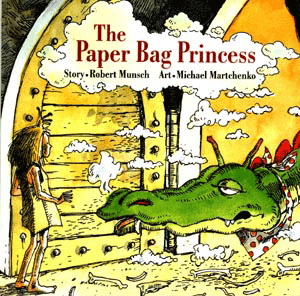
4. Robert Munsch and Michael Martchenko, The Paper Bag Princess. There are lots of revisionist princess stories now (I also like The Princess and the Dragon, and Princess Smartypants), but this is the best of them all. Every girl needs to practice Elizabeth’s parting shot: “You look like a real prince, but you are a bum.” Really, it’s a key to reading Jane Austen, all in one line.

5. David McPhail, Mole Music. The interplay between story and pictures is just lovely in this one, and I always get a bit misty as Mole puts down his violin to go to sleep, and dreams “beautiful, peaceful dreams.”

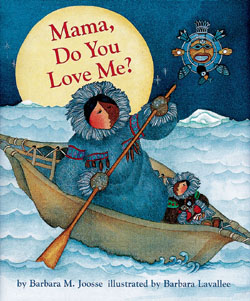
6. Barbara M. Joosse and Barbara Lavallee, Mama, Do You Love Me? Yes, dear one, “I’ll love you until the umiak flies into the darkness, till the stars turn to fish in the sky, and the puffin howls at the moon”–even if you put lemmings in my mukluks. It’s a unique, beautiful, and gently whimsical look at the universal strength of mother love.

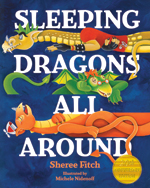
7. Sheree Fitch and Michele Nidenoff, Sleeping Dragons All Around. Another Canadian classic, enormous fun to read aloud, though it may make you hungry for Mocha Maple Chocolate Cake. Be careful not to wake the dragons as you go!

8. Quentin Blake, Fantastic Daisy Artichoke–no, Mrs Armitage on Wheels–no, wait, definitely All Join In–no, sorry, the best one is Lester at the Seaside–or, hold on: yes, that’s it, Snuff! Snuff rocks.

9. Shirley Hughes, Alfie and Annie Rose. Or Alfie’s Feet. But Alfie and Annie Rose always made me happy imagining my own children, also big brother and little sister, holding hands as they headed into the future.

10. Rick Walton and Page Miglio, So Many Bunnies: A Bedtime ABC and Counting Book. The kids, Maddie especially, just loved this one. I think it was the rhythmic combination and counting and rhyming–and the pictures (though actually a bit insipid for my taste) are very sweet. Also, I could always sympathize with that poor Mother Rabbit, who couldn’t help loving them all to pieces even when they undid all her hard work of putting them safely into their beds!

Oh dear. I’ve reached 10 and haven’t included Where the Wild Things Are, or Joseph had a Little Overcoat, or Kevin Henkes’s Owen–or Lily and the Purple Plastic Purse. Or Olivia, or Lullabye Hullaballoo, or The Library . . .

So, two questions for you. First, what are a couple of your favorite children’s books? And second, do you ever buy them for yourself, now that you’re all grown up, just because they are so enticing? I admit, I’ve already checked, and I am the Mummy Heb-Nefert is available to order. . .better yet, I might be near Woozles tomorrow. Maybe they have it!

Definitely better than not being talked about…

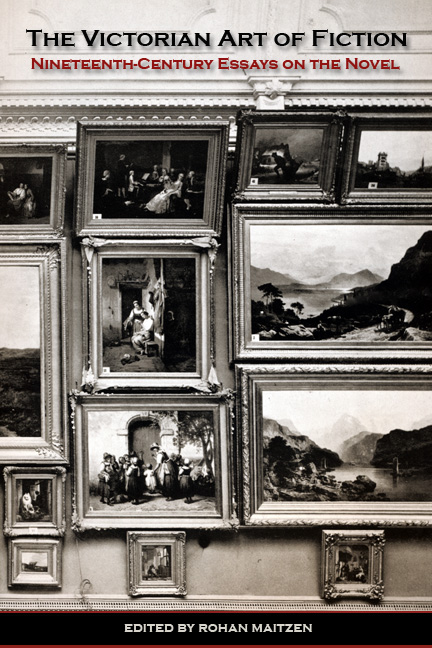
The book of the week at one of my favorite lit-blogs, Wuthering Expectations, will be my very own anthology The Victorian Art of Fiction: Nineteenth-Century Essays on the Novel (Broadview, 2009):

The authors range from major novelists (Eliot, Trollope, James, Stevenson) to the scintillating A. Nonymous.  The dates cover 1848 to 1884.  The essays are diverse but not comprehensive.  A story emerges, a debate takes place.  Are novels good or bad?  Meaning, novels as a whole – should one waste any time reading novels – and specific novels.  Perhaps Charlotte Brontë is bad for you and George Eliot is good for you.  Not that this debate has entirely ended, but we know which side won.  The Victorian Art of Fiction helped me see the path of the argument. . . .

The essays often work in pairs.  They are chronological, so Rohan will have to tell us how that worked. George Eliot’s sly “Silly Novels by Lady Novelists” (1856) is followed by W. R. Greg’s “False Morality of Lady Novelists” (1859), who at first sounds as bad as his title, but improves.  Anthony Trollope’s celebratory, even valedictory, “Novel-Reading” (1879) is followed by John Ruskin’s scathing, hilarious, utterly bonkers “Fiction – Fair and Foul” (1880), which functions in this anthology as the final scream of the “novels rot your brain” argument.  And we end with Henry James and Robert Louis Stevenson civilly discussing what the novel can do (anything) and how, exactly, it can do it (now there’s the difficulty), two master craftsmen who could not take the novel more seriously.  They win.

I spent such a long time deliberating over what to include in the collection (of course, it was literally impossible to survey all the possibilities!) and then laboriously, and no doubt imperfectly, editing and annotating them, that by the time the book finally appeared in print I had lost any sense of perspective about how interesting the essays were and why, so I’m really looking forward to seeing what stands out to fresh eyes. I am glad, already, to see that the selections communicate the sense of ongoing debates–and that ‘Amateur Reader’ enjoys, as I did, the remarkable variety and often wild idiosyncrasy of the voices in them.