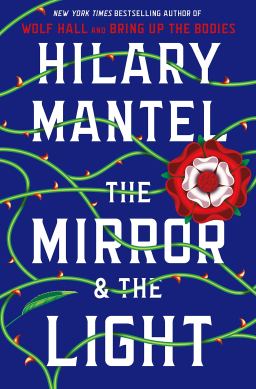
He closes his eyes. What does God see? Cromwell in the fifty-fourth year of his age, in all his weight and gravitas, his bulk wrapped in wool and fur? Or a mere flicker, an illusion, a spark beneath a shoe, a spit in the ocean, a feather in a desert, a wisp, a phantom, a needle in a haystack? If Henry is the mirror, he is the pale actor who sheds no lustre of his own, but spins in a reflected light. If the light moves he is gone.
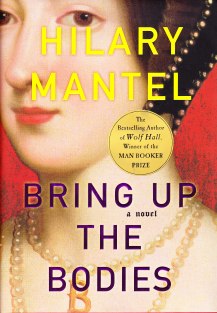
As I made my way through The Mirror and the Light, I found I was nearly as preoccupied with two questions about the novel’s form as I was with its detailed and sometimes mesmerizing chronicle of Cromwell’s last four years: why is the novel so long, and how would it end?*
My question about its length is a genuine one, not (or not exactly) a complaint or criticism. The novel is very long. I think possibly, if there is any way to measure such a thing, it is too long, by which I mean longer than it needed to be–but obviously it is exactly as long as Hilary Mantel thought it should be, and there’s a part of me that finishes that sentence by saying “and she should know.” She’s too smart and too artful a novelist to have left in anything that didn’t serve her purpose as she understood it, and she’s the kind of writer (meticulous, deliberate) who has earned my trust. That, arguably, shifts the burden to me: if the novel seemed too long to me, what was I missing?
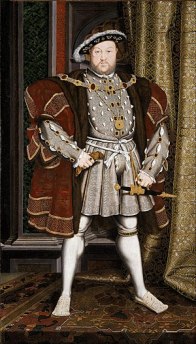 My question is not well-posed, perhaps. After all, it’s never actually length that’s the problem when a book seems too long, is it? It’s our experience of that length. Many of my favorite books are as long as or longer than The Mirror and the Light (its pages are not even that densely packed) and sometimes a book with relatively few pages or words can seem slack or be tedious to wade through. My question is really more about what Mantel includes than about how much. Compared to Bring Up the Bodies, The Mirror and the Light felt loosely woven: its nearly 900 pages do at once too much and too little. For around 300 pages in the middle of it, I shifted into what I think of as “maintenance” reading: scanning, rather than scrupulously studying, each page, so as to maintain momentum without (I hope) missing anything significant, slowing down when the action or the prose seemed to intensify. There is a lot happening throughout The Mirror and the Light, but much of this action is on a small scale, like individual threads fraying or breaking on a vast tapestry. Cumulatively, every little bit matters because it contributes to the large-scale catastrophe that is Cromwell’s eventual and inevitable fall, but that big pattern (the final phase of the remarkable rise that began in Wolf Hall and accelerated in Bring Up the Bodies) is what’s important, not the minutiae.
 Why, then, does Mantel include so much of it? Or (to set aside the tired and unhelpful question of authorial intent) what is the effect of her decision to include every little thing–to reject the taut intensity that made both earlier books in her trilogy feel so much shorter, go by so much faster, in favor of this more expansive process? One answer that occurred to me as I neared the novel’s conclusion is that our immersion in the daily nitty-gritty of Cromwell’s life at the peak of his power–the constant demands that he do something, fix something, say something; the endless petty but also perilous contests for political dominance with his rivals and enemies; the fraught delicacy of his dances with Henry’s needy vanity–made his death feel shockingly sudden, even though his eventual fate has always been the one absolute certainty of Mantel’s story. Right to the very moment that he finds himself surrounded, arrested, and imprisoned–the moment that he knows too well is the beginning of the end of his life–Cromwell is in the midst of the complicated business of living. While the dramatic irony that is an inevitable feature of historical fiction always hovers over the novel’s action, the steady hum of everything that’s happening in the moment made me less aware of it, papering over the gap between my knowledge of what’s coming and Cromwell’s ignorance. This effect really heightened the emotional power of the last 200 pages, when his efforts prove (as we knew they would) insufficient to save him.
 Another way I came to think about the novel’s length: The Mirror and the Life is very much a novel about middle age, a time of life in which (as I am learning) present experiences share mental and emotional space with intense memories of the past and a heightened awareness of the finite future. One reason The Mirror and the Light is longer than Wolf Hall and Bring Up the Bodies is that it contains (or Cromwell’s consciousness contains) both of them within it. In this final novel Cromwell is not just living through his present but constantly recalling his past, reaffirming his history and identity, puzzling out continuities and discontinuities between the boy he once was and the man he now is–and at the same time he is anticipating what will come next, always with a sense of being surrounded by the ghosts of his past actions and (not incidentally) his past victims. Also, like many middle-aged people he has reached a professional plateau: The Mirror and the Light is about a man at the height of his career but with no options for lateral movement and no possibility of a graceful retirement. All he can do is hang on and try to enjoy the rewards his many years of hard work have brought him, while others eye his accomplishments, underestimate the price he paid for them, and dream of succeeding him. There’s less intrinsic drama in maintaining power than there is in either winning or losing it–hence the feeling, at times, that both Cromwell and the novel are spinning their wheels and getting nowhere. When the likely next step is disgrace and death, though, just staying in place has its own particular kind of dramatic tension, and again, this set-up made the ending all the more
 Thinking about the novel’s length in these ways reminded me of George Eliot’s comment about Middlemarch: “I don’t see how the sort of thing I want to do could have been done briefly.” It is hard to tell a story that captures the whole scope of life–or, in Mantel’s case, of a particular life–without somehow reflecting that inclusive ambition in your formal choices. Still, my attention and interest did sometimes flag during the frequent scenes of Cromwell and his (few) friends and (numerous) rivals and enemies plotting and nattering and jockeying for position. In contrast, I was riveted by many sections that actually contributed comparatively little to the plot but showcase Mantel’s marvelous writing. Her long sentences are intricately shaped and ornately detailed but always completely controlled:
He used to think that the plums in this country weren’t good enough, and so he has reformed them, grafting scion to rootstock. Now his houses have plums ripening from July to late October, fruits the size of a walnut or a baby’s heart, plums mottled and streaked, stippled and flecked, marbled and rayed, their skins lemon to mustard, russel to scarlet, azure to black, some smooth and some furred like little animals with lilac or white or ash; round amber fruits dotted with the grey of his livery, thin-skinned fruits like crimson eggs in a silver net, their flesh firm or melting, honeyed or vinous; his favoured kind the perdrigon, the palest having a yellow skin dotted white, sprinkled red where the sun touches it, its perfumed flesh ripe in late August; then the perdrigon violet and its black sister, favouring east-facing walls, yielding September fruits solid in the hand, their flesh yellow-green and rich, separating easily from the stone. You can preserve them whole to last all winter, eat them as dessert, or just sit looking at them in an idle moment: globes of gold in a pewter bowl, black fruit like shadows, spheres of cardinal red.
Some readers might love the political maneuvering and find a long paragraph on plums extraneous, digressive–but I’ll take the plums every time: it’s like a still-life painting in prose, resonant with feeling but under perfect control. Here’s another characteristic example:
Don’t look back, he had told the king: yet he too is guilty of retrospection as the light fades, in that hour in winter or summer before they bring in the candles, when earth and sky melt, when the fluttering heart of the bird on the bough calms and slows, and the night-walking animals stir and stretch and rouse, and the eyes of cats shine in the dark, when colour bleeds from sleeve and gown into the darkening air; when the page grows dim and letter forms elide and slip into other conformations, so that as the page is turned the old story slides from sight and a strange and slippery confluence of ink begins to flow. You look back into your past and say, is this story mine; this land? Is that flitting figure min, that shape easing itself through alleys, evader of the curfew, fugitive from the day? Is this my life, or my neighbour’s conflated with mine, or a life I have dreamed and prayed for; is this my essence, twisting into a taper’s flame, or have I slipped the limits of myself–slipped into eternity, like honey from a spoon? Have I dreamt myself, undone myself, have I forgotten too well; must I apply to Bishop Stephen, who will tell me how transgression follows me, assures me that my sins seek me out; even as I slide into sleep, my past pads after me, paws on the flagstones, pit-pat: water in a basin of alabaster, cool in the heat of the Florentine afternoon.
For me, passages like these (and the novel is full of them) more than made up for the parts that failed to hold or reward my attention to the same extent, even though, or maybe because, they do little to propel the novel’s plot.
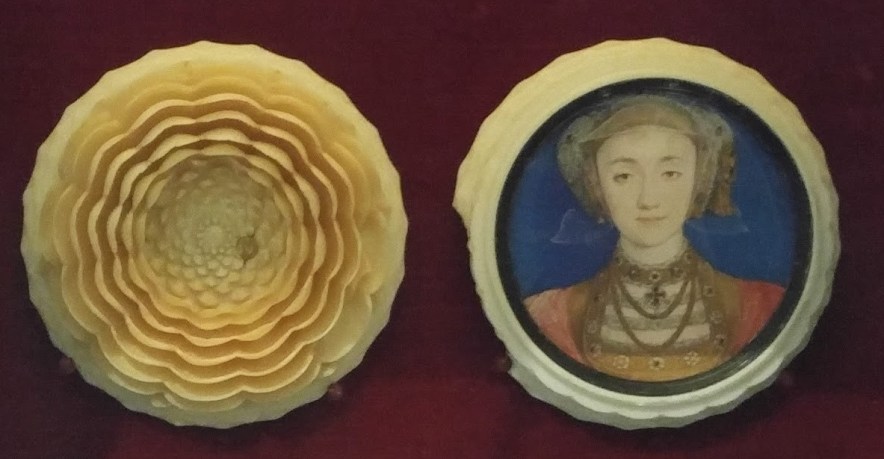
The plot of The Mirror and the Light is important, of course. Its most significant and decisive event is Cromwell’s negotiation of Henry’s marriage to Anne of Cleves: Henry’s disappointment in her, his fourth bride, was Cromwell’s ruin. This is a story I know well from other treatments, especially Margaret Campbell Barnes’s in her lovely 1946 novel My Lady of Cleves, so I was curious to see how Mantel told it. Like Barnes, she highlights the very plausible point that if either partner in this ill-fated marriage was entitled to disappointment or worse, it was Anne, trundled across Europe to marry a diseased and aging king known for ruthlessly discarding wives he didn’t want. Mantel’s Cromwell does his best to befriend Anne and coach her to please her irascible husband, but Henry’s antipathy (sparked by their unfortunate first encounter at which Henry, in disguise, took her by surprise as she traveled towards London) was worsened by his fascination with pretty young Catherine Howard. One reason I actually would have been happy for The Mirror and the Light to have gone on even longer is that I would have loved to see what Mantel did with Catherine: her Anne Boleyn is the best I ever met in any novel, and her doomed cousin’s fate is at least as grimly fascinating. (They are treated as a pair in Jean Plaidy’s 1949 Murder Most Royal, one of the most-read in my battered childhood collection of Plaidy’s novels.) We don’t get to know Anne of Cleves as intimately as we did Anne Boleyn: Mantel allows her some dignity, but she remains (as she was historically) a fortunate bit player in the larger drama.
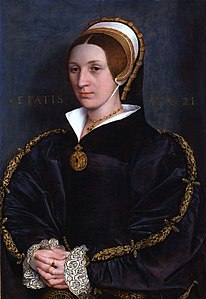 We can’t get close to Catherine, or follow her story to its bloody end, for a very simple reason: chronology. Cromwell’s execution preceded hers, though by barely 18 months. This returns me to the second of my questions about the novel’s form: how would it end? This is obviously not a question about plot; my interest was in the novel’s narration. One of the most discussed aspects of Mantel’s trilogy has been her use of a particularly close form of limited omniscient narration: it is in third-person but as if perched on Cromwell’s shoulder, barely acknowledging that it is not in fact first-person narration, never using the license Austen (to give one example of someone who also loves close third person) sometimes uses in her novels to change point of view once in a while to show us the story’s focalizing character from the outside, or to introduce a bit of information she’s not privy to. (I’m thinking of the rare but vital glimpses we get of Wentworth’s point of view in Persuasion, for example.)
Given her obvious interest in perception, consciousness, memory, and identity, and her obvious desire to bring us as close as she could to the mind whose outward manifestations she’s chronicling, why didn’t Mantel use first-person narration? She set herself the challenge, after all, of making a pretty unsympathetic historical figure–one who made many others his victims–into a character who is engrossing enough for us to care how he lives and dies, and first-person narration is a well-established trick for creating intimacy–sometimes sincerely, sometimes to exploit it to ironic effect (as in Ishiguro’s The Remains of the Day). The obvious answer is that then The Mirror and the Light would have had to be a ghost story. It is very much a novel about ghosts, and towards the end Cromwell feels their presence as vividly as that of any of his living companions, but it matters that they are dead while he is not, not yet. The novel, and its central subject, are profoundly interested in what happens when you cross over that line, both as a personal question (“He thinks of his daughters Anne and Grace; perhaps he will meet them as women grown?”) and as a religious one. Following Cromwell across the threshold would force answers to these questions and move us into territory that is beyond even Mantel’s exhaustive research. She’s not beyond imagining those answers (see, for example, Beyond Black), but I didn’t find her approach to them very convincing and I’m glad she let our awareness seep away with Cromwell’s, “going out on crimson with the tide of his inner sea.” She ends it as she should, with the very last of what “he”– long our eyes and ears, our whole consciousness caught up in his hands–can see, and hear, and feel.
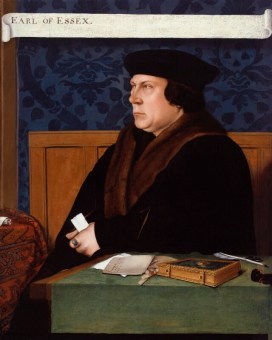 The Mirror and the Light starts in the immediate bloody aftermath of Anne Boleyn’s execution, making Cromwell’s own, less refined ending (“they don’t write words on the head of the axe”) a neat formal symmetry. The trilogy as a whole achieves something similar, beginning with Cromwell beaten to the ground by his father Walter, “pulled downstream on a deep black tide,” and ending with Walter’s voice still challenging him to “get up.” Even at the very last, the force of personality Mantel has created for Cromwell is so strong I almost expected that he would, like the case he recalls even as he mounts the scaffold: the Earl of Arundel “was axed down on this spot and his corpse leapt upright to say a Pater Noster. All headsmen … talk of it as a fact.” He doesn’t, of course, and at the last moment Mantel’s third-person narration proves its value as well as its logic, because he slips away and we are left behind. It is hard to mourn a man like Cromwell, but she has made it impossible not to miss him now that he’s gone.
* A postscript to this post: I realize I never really got around to discussing the basic features of the novel–stuff like its plot and characters and religion and politics–with much specificity, but it has been reviewed widely, so if those things are of more interest to you than these ramblings, it’s easy to find someone talking about them. That’s one reason I decided to address these particular aspects of the novel (which for better or for worse are the ones I was thinking most about as I read it and after I finished it) rather than doing more of a standard review post. In case I haven’t quite made this clear, I think it’s a really good novel, even though I ended up skimming some portions of it–not as good as the first two in the trilogy, where I was never tempted to skim, but still better than most novels. If I had to choose, I’d probably pick Bring Up the Bodies as the best of the three. You?
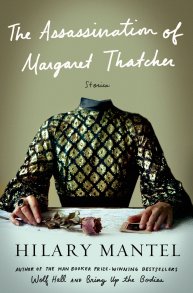 The adjectives in my post’s title all come from the nearly four pages of blurbs at the front of my paperback edition of The Assassination of Margaret Thatcher and Other Stories. Looking them over after finishing the book, I was struck by how consistent the clips are, and how accurate: “exhilarating if dark,” “brilliantly chilling,” “artfully controlled savagery,” “brutally dissecting,” “brusque and brutal,” “cruelty is made manifest,” “dark and judgmental,” “harsh and comic,” “satisfyingly chilling.” I agree that these are just the qualities of the stories in this collection. I’m just not as sure as either these reviewers or the publicity team at Harper Perennial seem to be that these are signs of its greatness — that they are, or should be, unqualified selling points.
 I found myself thinking, as I worked through the volume, about why I enjoyed the stories in Adam Johnson’s
 Clearly Mantel did not consider Giving Up the Ghost the place to talk about her books — at least, not directly. Perhaps the most revealing thing she says about being a writer is a passing remark about Jane Eyre: “I remember the first time I read Jane Eyre: probably every woman writer does, because you recognize, when you have hardly begun it, that you are reading a story about yourself.” But again, she just moves on, so it’s not just her books she’s not talking about, it’s her whole experience of being a writer, a woman writer, a person writing, a person thinking about books, which — though we know they are integral to her life — seem oddly peripheral in her life story.
 There’s a feeling of power in reserve, a power that drives right through the bone, like the shiver you sense in the shaft of an axe when you take it into your hand. You can strike, or you can not strike, and if you choose to hold back the blow, you can still feel inside you the resonance of the omitted thing. (Hilary Mantel, Wolf Hall)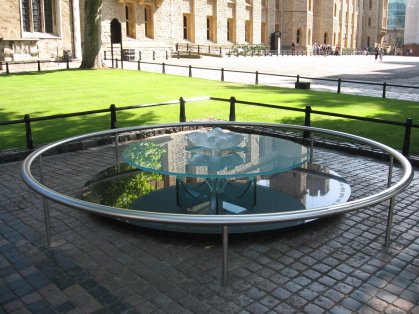
 Unlike Anne, we knew all along that this was how the game would end: though most of the multitudinous details Mantel provides will probably be unfamiliar to all but the Tudor connoisseur, Anne’s execution cannot surprise any reader. Mantel knows this perfectly well and even plays with it — the very title of Wolf Hall foreshadows Anne’s failure even as the novel details her success. Historical fiction can hardly be built around suspense. Bring Up the Bodies is gripping nonetheless because, knowing what will happen, we still wonder how and why events unfolded as they did, and because also Mantel is brilliant at the other aspects of the novelist’s craft: characterization above all (Cromwell, of course, and Anne, but also Henry, who is miraculously liberated from the burden of clichés and caricatures that have accreted around his bullish figure over five centuries) and setting, too, all of the elements contributing to our understanding of the world she has created, which is permeated with implications that reach well beyond plot:
 George Eliot considered the writing of historical fiction “a task which can only be justified by the rarest concurrence of acquirement with genius,” requiring “a form of imaginative power [which] must always be among the very rarest, because it demands as much accurate and minute knowledge as creative vigour.” Novels of “the modern antique school have a ponderous, a leaden kind of fatuity,” she complained, “under which we groan.” The extraordinary difficulty of the genre is testified to by her own attempt “to reanimate the past” in Romola, the only one of her novels set back more than a couple of generations. She began writing Romola as a young woman and ended it an old one, she said herself, and having worked through the novel recently in my graduate seminar, I know that the effort it demands can make it feel as if it is having the same effect on its readers. To be sure, Romola does have its thrilling moments, and it certainly demonstrates both “accurate and minute knowledge” and “creative vigour”–just not always at the same time, or always in harmony with each other. And there’s the whole “cheese to the macaroni” moment…but I digress from my main point, which is that really good historical fiction is really hard to write, and thus really rare to read.
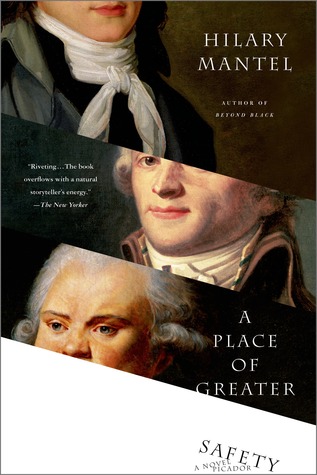
 Many of the same qualities and techniques are evident in Mantel’s earlier novel A Place of Greater Safety, particularly the lack of sentimentality and the sharpness of the writing, which is at once prolix and poignant, even uncomfortable–if, as I recently suggested, reading Ian McEwan’s prose is like getting acupuncture to your brain, I found reading A Place of Greater Safety akin to walking barefoot across a stretch of gravel towards a graveyard: you aren’t particularly enjoying the experience, but it has its own vividness and particularity, and there’s a morbid fascination in the direction you know you’re headed. (I seem to be finding my reading especially, if only metaphorically, tactile lately.) A Place of Greater Safety also, like Wolf Hall, builds momentum gradually by developing our relationship, with not just one complicated protagonist this time, but with three, the revolutionary triumverate of Georges-Jacques Danton, Camille Desmoulins, and Maximilien Robespierre. Again, there are neither heroes nor villains in this crowd, though each has his heroic, as well as his villainous, moments. (Desmoulins, beautiful, erratic, alternately effervescent and enervated, and writing, always writing, seemed to me a particularly brilliant characterization.) And just as Wolf Hall only incidentally informs its readers about the causes and contexts of the Reformation, A Place of Greater Safety eschews the potential pedagogical role of the historical novel. At the end of its 750 pages I really didn’t feel much better informed about the events or even the political and philosophical stakes of the French Revolution than I was already. Here again, Mantel adopts a slantwise approach: not altogether personal, not just the ‘human story’ of the men and women who lived it, but not abstract, theoretical, or fully contextualized either. Here’s a rare but characteristic ‘explanatory’ passage, terse and ominously proleptic:
 Novel Readings