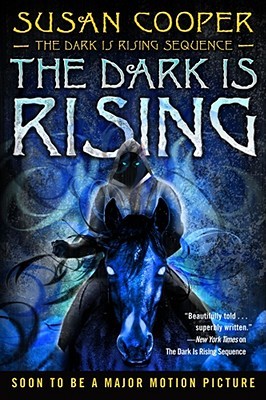
 On a bit of a whim, I decided to join in with “The Dark Is Reading”: a mass reading of Susan Cooper’s fantasy classic The Dark Is Rising, originally published in 1973. I read The Dark Is Rising often as a child, along with the other books in the series, especially Over Sea, Under Stone and Greenwitch. I don’t have my original copies any longer, but (probably at my urging) my parents gave new copies to Owen for his 10th birthday in 2007. Sadly, I don’t think he ever read them; I found them on Maddie’s bookshelf, but I don’t think she has read them either. I never did quite learn the lesson that my children won’t necessarily share my taste! I’m certainly glad we still had them, though, if only for my own sake.
I hadn’t reread The Dark Is Rising in decades, and one interesting aspect of rereading it now was actually realizing how my own taste has changed–or perhaps it is more accurate to say how my reading habits have changed, as it isn’t that I didn’t like the book so much as I wasn’t quite at ease with its conventions and demands. In fact, I really loved some things about rereading it, starting with how immediately I remembered it. I couldn’t have told you the details of the plot, but as each event unfolded it was vividly familiar, as was the overall atmosphere of the book, which opens on Midwinter’s Eve and is full of wintry beauty and dread comingled. Cooper is really good at taking an ordinary landscape and imbuing it with magic, as when her hero, Will Stanton, looks out of his window to see his usual world transformed by snow:
In the first shining moment he saw the whole strange-familiar world, glistening white; the roofs of the outbuildings mounded into square towers of snow, and beyond them all the fields and hedges buried, merged into one great flat expanse, unbroken white to the horizon’s brim. . . .
His attention is briefly drawn away from the window by a flash of uncanny music; when it fades away, he looks out again and finds it has taken his world with it:
In that flash, everything had changed. The snow was there as it had been a moment before, but not piled now on roofs or stretching flat over lawns and fields. There were no roofs, there were no fields. There were only trees. Will was looking over a great white forest: a forest of massive trees, sturdy as towers and ancient as rock. . . . the only break in that white world of branches was away over to the south, where the Thames ran; he could see the bend in the river marked like a single stilled wave in this white ocean of forest, and the shape of it looked as though the river were wider than it should have been.
The book as a whole turns on such revelations of different worlds somehow coexisting, layered by time but not fixed in it, at least not to those who, like Will, belong to all times.
 The Dark Is Rising is the story of Will’s discovery that he himself, like the landscape, is not as he has always seemed, and of the quest his uncovered identity as one of the “Old Ones” imposes on him as part of the ongoing struggle between the elemental forces of Dark and Light. There’s plenty of high drama and some epic confrontations, though I think Cooper does chills better than thrills: she excels at building up a sense of menace through small details, particularly as Will’s new awareness begins to separate him from his merrily innocent family.
Much as I liked revisiting Cooper’s evocative descriptions and enjoyed the familiarity of the story and characters, I found the plot itself somewhat unconvincing–the wrong standard, perhaps, for a fantasy novel, but at the same time, isn’t it a sign of successful fantasy that you give yourself over to it without puzzling over its coherence or internal logic? I don’t know if the mild dissatisfaction I ended up feeling is because I am out of practice at reading fantasy (which, like science fiction, is a genre I have almost never read as an adult) or if it’s because, for all its elegance, The Dark Is Rising is a children’s book, and thus a bit sparse on exposition. Is its world a fully realized one? When I began it, I was relieved not to be plunged into an info-dump of “world building,” but is it possible that’s what I was missing, by the end?
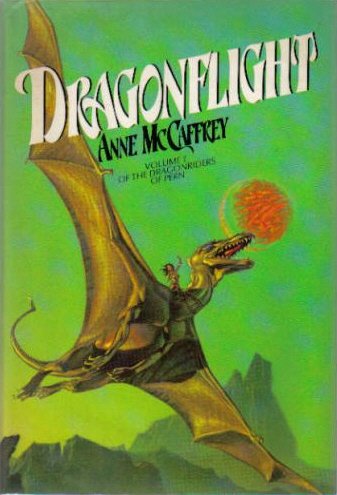 I do think my own recent reading habits account at least in part for my mild disenchantment. Every genre makes its own kind of demands and has its own conventions: my experience learning to read romance on its own terms taught me a broader lesson about that, and (closer to the point here, perhaps) so did my adaptation and then conversion to Buffy. In her very engaging Tolkien lecture Cooper gives a good primer on how fantasy works; her emphasis on its elements as vehicles for more universal ideas and conflicts makes a lot of sense, but it’s just not how I usually read now, or that’s not how the books I currently like best work. It’s interesting to me, though, that I didn’t have or need this kind of conceptual apparatus to enjoy The Dark Is Rising as a child, and in fact I don’t recall ever thinking much about genre as a classifier or about the possible need to read different kinds of books differently–I just read what I liked, which at the time included not just Cooper but Tolkien and Anne McCaffrey alongside historical fiction, mysteries, and everything else.
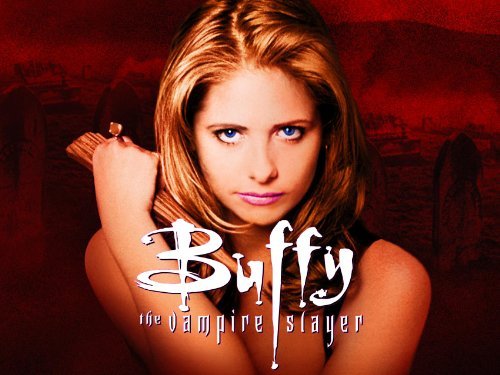 I never consciously decided not to keep reading fantasy; it just fell away. I think I began (however unfairly) to associate its overt inventiveness–its dragons and sorcerers and improbable made-up worlds–with a kind of childishness, like fairy tales, and never made the further connection that, also like fairy tales, such stories might be a means to deeper ends. Understanding better how a genre works doesn’t of course, mean admiring or enjoying every example. What I came to love about Buffy is how rich the characterizations are, and how well so much of the story-telling develops them even as (at its best) it explores ideas about good and evil. So far, I haven’t been tempted to try most of the other shows Netflix now recommends for me because I’ve watched Buffy so much: it’s not the genre in general that I have embraced, it’s the specific show. Interesting as I found Cooper’s lecture, and much as I enjoyed some aspects of The Dark Is Rising, I’m not currently inspired to go on a fantasy-reading binge either. For me, the book was most powerful in its nostalgia: it reminded me of the reader I once was, but it didn’t really inspire the reader I now am.

 My initial thought at this point is that overall, while I like Buffy the series better than Buffy the character, I like Angel the character more than Angel the series. I would happily watch another two or three (or more!) seasons about Angel, despite how dreadful Angel occasionally was, because I find him complicated and fascinating, whereas Buffy (though she does develop over the course of her series) always seems somewhat two-dimensional to me. I suppose this is a version of the age-old artistic problem that virtue is intrinsically less interesting than vice, except that of course with Angel we’ve got the best of both worlds: good and evil in unending tension, Angel and Angelus distinct but never entirely separable. Buffy, on the other hand, has a clear and singular role to play: while she sometimes rebels against it, when things turn bad she always, always, rises to the occasion — which is great and inspiring, because she’s strong and principled and brave and autonomous, but also somewhat predictable.
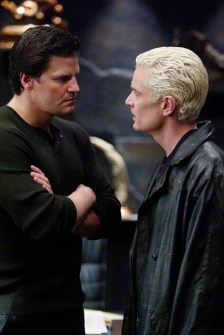
 I didn’t like the Angel ensemble as much as the Scoobies in Buffy, but another thing Angel and Buffy have in common is that they both show individual characters transforming in ways that leave them astonishingly far from where they started but that somehow happen in utterly believable ways. Other long-running shows I’m familiar with put fairly consistent characters into lots of new situations, but what happens with Spike in Buffy happens with both Cordelia and Wesley in Angel. If you’d told me while I was watching Buffy that one day Wesley would make me cry, I would not have believed you! As for Cordelia, I couldn’t possibly do better than
 A few days ago I picked Dorothy Dunnett’s The Ringed Castle off my bookshelf to look up a particular scene and ended up not just reading to the end (again) but following up with a reread of the next novel in the Lymond Chronicles, Checkmate.
 First, they are both fundamentally about leadership, and particularly the cost it exacts on “the chosen one.” Francis Crawford, of course, is not chosen in the supernatural way that Buffy is — though there are many hints through the novels of forces and purposes beyond the understanding and control of individual human actors, through characters like the Dame de Doubtance and the recurrent appearances of Nostradamus and John Dee bearing astrological charts and prophesies. Even setting aside fate or destiny as factors, though, Dunnett emphasizes that extraordinary gifts such as Lymond’s bring responsibilities: to be both extremely talented and highly charismatic is to invite discipleship, and much of the drama of the series turns on Lymond’s struggles to find the right use of his exceptional self. For him as for Buffy, leadership means isolation, risk, and hard choices — which we watch him make over and over, often amid the burden of other people’s misunderstanding, jealousy, or hatred. Morally, he is a much more complicated figure than Buffy, but beneath his often flamboyant disregard for conventional propriety or morality, there’s an absolute integrity that we come, as readers, to trust as much as Archie Abernethy does. And Archie isn’t the only one: there’s a parade of people across the novels who end up giving Lymond their loyalty, even their love, as they learn to see past the distracting sparkle of his brilliant, ruthless surface. (Did I mention Christian Stewart? That relationship establishes something absolutely vital to the rest of the series.) For Lymond, as never really for Buffy, the question is whether he can remain worthy of his own rather extraordinary Scooby gang, or whether his excesses will finally destroy it, and him.
 The other thing I found myself thinking about is how far both series rely on the power of storytelling and especially of great characterization to get us to accept features that might otherwise seem ridiculous. I’ve been watching
 Over the weekend I finally wrapped up my first ever run-through of Buffy the Vampire Slayer. When I started watching the series last summer, I actually came to it with remarkably little information and no preconceptions except that (and obviously I got over this one) it probably wasn’t going to be a hit with me, since vampires — and supernatural / fantasy stories generally — are just not something I gravitate towards. So why did I even bother giving it a try? Well, if enough people whose insights I have learned to trust and respect in other contexts find value in something, I’m usually willing to give it the benefit of the doubt, and often I’m won over. (
 The full series is a lot of episodes and I watched them over a period many months. I couldn’t begin, then, to write up any kind of comprehensive response. So far I’ve avoided what I know is an extensive body of commentary on it online and in print: I didn’t want my own impressions to get drowned out too fast! But if those of you who are longtime fans have any favorite essays, articles, or interviews, I’d be happy to be pointed in the right direction. (I know
  4. …which brings me to the Scoobies. Sure, Buffy is the leader, and I warmed to her, but it’s the ensemble makes the show magic. I didn’t love every member of it equally (I didn’t miss Oz when he drove away, for instance, and I thought Tara was always a weak link — but Anya became a favorite, and I even got pretty fond of Andrew by the end) but the core friendships really mattered to me after a while: there’s something so absolute about their love and trust for each other, and so touching about the way they all, given the chance, can rescue each other. It isn’t always Buffy who saves the day, and it’s not Buffy alone who (over and over!) saves the world.

 6. … the Big Bad! For me, this aspect of the show was always its biggest weakness. I appreciate the value of a larger plot arc to give each season continuity, but the super-villains always just got so irritating by the end! Worst, I think, was Adam from S4, but S5’s Glory is a close second for sheer flamboyant tedium. I enjoyed the evil Mayor in S3, and I found the Trio pretty funny in S6, though I guess they did kind of trivialize the process. (There wasn’t anything trivial about Willow flaying Warren alive, though!) Bad Angel was really interesting, and Spike was a delightfully gleeful villain in the early years. In S7, I thought some interesting things went on with The First, especially the coming and going as different characters from the past. I was very annoyed, though, by the pendant-ex-machina that brought about The First’s climactic defeat. (And why is it Spike who becomes both hero and martyr — shouldn’t that final victory have belonged to Buffy, or to the newly-minted Slayers collectively? And why didn’t Spike — or Anya! — survive the final battle?!)

 Novel Readings