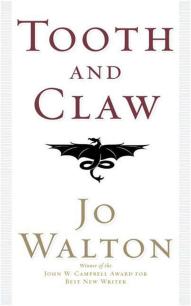
 My title comes from one of Walton’s epigraphs and also inspirations for Jo Walton’s Tooth and Claw, Tennyson’s In Memoriam AHH, specifically the famous bit about nature being “red in tooth and claw.” The premise of Walton’s novel, as she explains in her author’s note, is to see “what a world would be like … if the axioms of the sentimental Victorian novel were inescapable laws of biology.” Picking up on Tennyson’s line about “dragons of the prime” and a passing reference to dragons in Trollope’s Framley Parsonage, Walton’s thought experiment recasts Trollopian characters as dragons, complete with scales, wings, treasure hoards, and (best of all) fancy hats. She sets them in motion in a Trollopian plot (close, I think, to the plot of Framley Parsonage, though it has been a long time since I read it, and Tooth and Claw is so much shorter that I assume a lot of Trollope’s subplots are tidied away), complete with contested wills, shifting social classes, unpleasant suitors, sweet love stories, and religious quibbling.
 The result is delightful but (perhaps inevitably) also sort of silly. The incongruity of dragons behaving exactly like Trollope characters is sometimes hilarious and sometimes (for me at least) too much: references to their swirling eyes and burnished scales and “beds” of gold coins made it hard for me to engage with them as characters with the usual kinds of motives and feelings. But there’s also something slyly thought-provoking in Walton’s literalization of the inequalities and hang-ups of the period – or, probably more accurately, of the novels of the period. One clever aspect of Tooth and Claw, for example, is that the female dragons “pink up” when in love – though they may also, and this proves problematic, pink up when approached too closely even by a male they don’t love, and that can have serious consequences for their reputations. It is both appropriate and necessary for female dragons to react this way to their potential spouse – and once married they turn increasingly rosy, a sign of their sexual maturity. Any reader of Victorian novels is familiar with the novelists’ trick of having heroines blush as a delicate sign of sexual attraction or arousal, and also with the impossible trick these heroines are supposed to perform of never desiring except where and when it’s acceptable, staying ignorant and virtuous until the switch is flipped and they go from innocent girl to bride, wife, and mother (and thus, implicitly but by definition sexually active). Navigating this terrain is treacherous for both the heroines themselves and their authors; reconciling sexuality and propriety or principle is a key theme of 19th-century novelists from Austen to Hardy and Gissing. Walton’s spin on this doesn’t tell us anything about it that her Victorian predecessors haven’t explored already, but it’s still ingenious and amusing to follow.
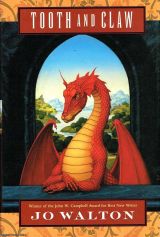 Another smart aspect of Tooth and Claw is its attention to the ways wealth is hoarded and shared (or not shared), so that the powerful elite not only maintain their status but expand it, while the weaker and more vulnerable compete (quite literally) for the scraps. When a dragon dies, for instance, its heirs eat it, their shares apportioned by custom and privilege. Eating a dragon makes the consuming dragon bigger and stronger: thus the laws of inheritance perpetuate inequality. Weakling members of families are also eaten, thus guaranteeing the greater size and strength of the survivors (hello, Darwin); servants who have outlived their usefulness are eaten – and so too, sometimes, are servants who disobey or betray the family they serve. Legal disputes can be settled by combat, with the loser getting eaten – which would certainly have had implications for Jarndyce v. Jarndyce! Again, it’s ingenious, a dynamic of competition and entitlement familiar to readers of Trollope but shown up as more ruthless than Trollope’s gentle satire typically acknowledges.
 I don’t think Tooth and Claw is more revealing or insightful, or more critical, about Victorian society than the actual Victorian novelists I know best, but Walton’s novel is a lot of fun to read: it is satisfying in the way that watching any highly original concept be executed well is satisfying. I found it thoroughly entertaining. Her dragons are fearsome but also pretty lovable; she finds a way to make “mellow music” with them. Unlike one of the reviewers quoted on the cover, I didn’t finish it “wishing it were twice as long,” but Framley Parsonage is twice as long and more, and Tooth and Claw did make me think it might be time to reread it.

 When I visited my parents in Vancouver last May, one of the many nice things we did was watch the recent adaptation of Doctor Thorne. I thoroughly enjoyed it. Trollope (like Austen) adapts very well–much better, in my opinion, than Dickens or George Eliot, the brilliance of whose fiction lies so much in the narrator’s voice and in the other very written qualities of their novels that (for me) adaptations almost always seem inadequate.
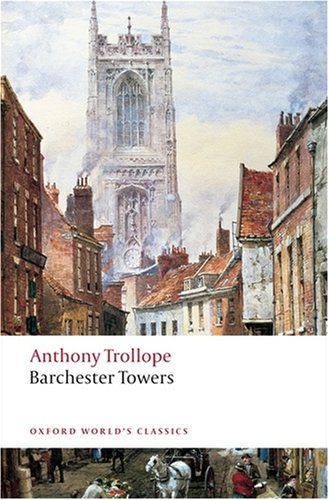
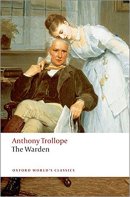 The very qualities that make Trollope such a pleasure to read, though, also make him a bit challenging to teach. The thing about people just “going about their daily business” is that often not much is really happening–there’s not much action, or at least not much dramatic action. To put it another way, the action and the drama in Trollope are often internal, and usually subtle: the characters puzzle through personal and moral problems in infinite shades of grey, rather than the more “glaring colours” of a writer like Dickens (that’s Trollope’s own characterization of Dickens’s method, from the parody of him as “Mr. Popular Sentiment” in The Warden). Given that Trollope’s novels are mostly also quite long, there’s a significant risk that students’ reaction will be boredom: pressed for time as they are, and unaccustomed to fiction that rolls out quite so slowly, they can struggle to find pleasure or interest in the process.
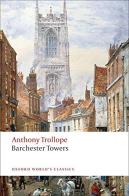 That, at least, has been my experience with Barchester Towers, which I have tried in my standard 19th-century fiction class a couple of times. I’ve had somewhat better reactions to
  It was the longing to get away from just those humming distractions that sent me back to Doctor Thorne last week: not just my own to-do list, but the overwhelming clatter and clutter of the rest of the world. Especially on the news and on social media, what a constant clamor of catastrophes there is, big and small, near and far away, with everything from Can Lit to the CDC in crisis, all demanding attention, all generating takes and counter-takes in an unceasing cascade of anger, fear, and weaponized self-righteousness–much of it wholly justified, but all of it eventually exhausting. It’s all very well to advise simply “unplugging,” but even setting aside the obligation we might have to be informed citizens of both our personal and our political worlds, for me there’s a lot of good mixed in with the bad–a lot of people and issues I don’t want to lose contact with or miss insight into.

 Novel Readings