The May Marks Meeting: That’s What It’s All About

Today we held one of our department’s most cherished and loathed rituals: the “May Marks Meeting.” It’s called that because one of its key elements is the annual review of students’ marks in aid of awarding our departmental scholarships and prizes, and also because we go over the standing of all of our current graduate students. Other fun features include receiving year-end reports from all the department committees.

title_english

In the old days, this meeting used to run all day and leave everyone bitter and exhausted. One reason was that before so much of the university’s business was computerized, things like calculating credit hours and grades often had to be done manually, while many other questions could be settled only by phone calls to the Registrar’s Office. Many of the awards we administer also have very particular terms set by well-intentioned but ill-advised donors that leave too much open to interpretation (word to the wise: if you want to leave a bequest to set up an academic award, please confer with some academics about wording): does “woman student who leads her class in English” mean “woman student majoring in English who has the highest grades”? or, our long-time favorite, what exactly is “an inquiring and original mind”? Oh, the hours, quite literally, that sometimes went into impassioned debate, or frantic recalculations, or reassignment of prize money on the discovery that for some reason the chosen candidate was ineligible!

Over the years we have refined our processes, and not just because we can now call up student records instantly online: wherever possible, we have clarified or set precedents for vague award terms, and we have essentially banned nominations from the floor and shifted the burden of decision making from the department as a whole to our undergraduate committee. Today, only about half an hour was spent on this business. In so many ways, this is a huge improvement — not just because it’s more efficient but because the results are less arbitrary. I would not want any of my colleagues who happened to read this post to imagine that I am in any way nostalgic for the old days! (Well, OK, sometimes I miss the old department lounge, which was a friendlier place to spend a day.)

What I have been thinking since today’s meeting ended, though, is that the half hour we spent talking about the nominees and recipients of our prizes and scholarships was by far the best half hour of the meeting (which, today, actually ran less than 5 hours, including our lunch break). Almost everything else on the table, you see, was bad news: budget woes, declining enrollments, graduate recruiting challenges, disappointing graduate fellowship results. So much of this seems beyond our control (as one colleague finally exclaimed, “Look, I don’t know how to change the Zeitgeist!”), and so much of it seems to reflect not just a broad cultural disengagement from the humanities but the failure of our more immediate leaders to stand up and fight for us — even though, as another colleague pointed out, we teach a lot of students and we do it, on the whole, very cheaply compared to other faculties. When you go to a VP’s office seeking support for something of national significance and get turned down coldly even as all around you are the signs of administrative expansion (not to mention office renovations) … when you’re aware that there is always money for something but that we are constantly told we need to cut and cut  … well, over time it’s pretty demoralizing, and as I’ve written about here before, our work turns nearly as much on our energy and creativity as it does on our expertise and professional training.

Despite the atmosphere of generalized gloom in which we have all been working for some time, though, most of us still find ourselves excited about and renewed by our classroom time and our students. And finally, during that last half hour, that’s what we got to focus on. Listening to people speak with such obvious delight about their students’ merits and successes — from admission to Oxford to clever revisions of 18th-century poems — did a lot to counterbalance the cynicism and pessimism brought on by the earlier items on our agenda. Our collective appreciation of our students as interesting, promising individuals also confirmed (as if I needed it) how much more our teaching is about than “content delivery.” It’s not, ultimately, the marks the students earn that matter the most, after all: it’s the mark they will make in the world. Our role in making that future possible may be difficult to measure, but it’s still important to remember, and to value.

Should Graduate Students Blog?

blogger-logoOn Thursday I’m speaking to our graduate students’ “professionalization” seminar about academic uses of social media, particularly blogging. I’ve given related talks a few times now, but this is the first time I will have led a session about blogging specifically for an audience of graduate students, for whom some of the issues I typically address have somewhat different implications. Thinking about this, I was reminded that last spring Leonard Cassuto (with whom I had a couple of initially testy but ultimately amicable exchanges about the place and value of academic blogging) asked me for my thoughts about whether graduate students should blog. He was working up a piece for the Chronicle of Higher Education on the question that, as far as I know, never ended up in final form — at any rate, I didn’t see it, and he never got back to me to ‘preview’ his use of any quotations from my reply, which he had promised to do. I thought I might as well “repurpose” the response I sent him, as I had taken some pains over it, so here it is, lightly updated. I’d be very interested in any responses, qualifications, objections, or counter-arguments, not least because they will help me refresh my own thinking about this as I head into Thursday’s seminar.

Should Graduate Students Blog?

Should graduate students blog? That’s a tricky question with at least two important aspects to it. One is whether graduate students should blog with the specific aim of advancing their professional academic careers (that is, improving their chances of getting tenure-track work). Another is whether they should blog for its intrinsic benefits.

These are not, of course, entirely separate questions: some of the things that can be gained from blogging (greater ease and confidence in writing, experience with the give-and-take of post-publication peer review, connections with other people in your field but also with a wider audience, a sense of purpose and accomplishment, freedom to experiment with topics and with voice) can contribute to professional success by making better scholars, teachers, and intellectuals of us all. It can also inculcate work habits conducive to producing more conventional publications: regular bloggers can all testify to the ever-present awareness that the blog needs to be fed!

But it would be naive to ignore that blogging (for some good and some bad reasons) is not yet widely recognized as a legitimate form of academic publishing and that the case for it as productive academic work at all remains a difficult one to make. Graduate students aspiring to tenure-track positions hardly need to be told that for most hiring committees, the crucial measure of their competitiveness as candidates will be the number of conventional peer-reviewed scholarly publications on their c.v.–and the more prestigious the venue, the better. Though blogging one’s research projects can be a useful stage en route to achieving those conventional publications, or even to finishing the dissertation (Scott Kaufman’s Acephalous blog was once the place to look to see this in action!), in itself it is not the same thing and will almost certainly not be valued in the same way. And maintaining a good blog takes time–not necessarily or exactly time away from that kind of clearly marketable scholarly work and publication, but time that might be better used to focus directly on finishing that thesis and getting those lines for your c.v. There are definitely risks involved, then, in deciding to blog.

That said, blogging is increasingly acknowledged as having a place in the overall ecology of academic scholarship. Graduate students who choose to blog should by now be able to make a thoughtful and well-supported case for the value of that effort as part of their overall scholarly portfolio. I think a crucial point is that this case needs to be backed up by faculty members who can explain, to their colleagues and to administrators, the role blogging can play in developing original scholarship as well as in knowledge dissemination and outreach. Those of us who have used the protection of tenure, for instance, to experiment ourselves with alternative modes of writing and publishing need to be advocates for graduate students who take the risk of doing less conventional kinds of work. (See, for instance, Kathleen Fitzpatrick’s piece on supporting students working in Digital Humanities, which is not the same thing as blogging but raises many similar issues, including how such non-traditional work can be recorded and evaluated).

There’s one more angle that’s maybe worth considering: with tenure-track positions so rare, graduate students may look at blogging, not just as an activity related (however equivocally) to their potential academic careers, but as one way of turning their skills and knowledge outward from the academy. Though this can hardly be counted on, blogging can help someone establish an identity and a following that might create new kinds of opportunities–in online journalism, for instance, or in other ways not strictly imagined at the outset. Again, there are risks in investing time and effort in something without a clear professional pay-off, but just what that profession or pay-off might be should certainly no longer be defined in solely academic terms. Aaron Bady, proprietor of the blog zunguzungu and one of my former colleagues at The Valve, comes to mind as a good example of someone who has established a significant online presence.

So, do I think graduate students should blog? I do think they should consider it, because I know from my own experience how intellectually beneficial blogging is and how it creates contacts and opportunities. It would be hypocritical of me to recommend against graduate students engaging in work I believe to be good for us and for our profession. But I think they need to be aware that as far as I can tell, my view remains a minority one, and they should think carefully about how they manage their time and about what kind of blog, if any, might serve them best. Defining a niche, for instance, might be important; collaborating in a group blog might be a way to spread the work around (see, for instance, The Floating Academy, whose contributors would be good people to ask about blogging — I’d be happy if they weighed in here). If graduate students do decide to blog, I think they should be ready to explain clearly how doing so contributes to their professional development and to the advancement of understanding in their field, and I think we should listen to them and find a responsible way to evaluate the value of the work they’re doing. (Blogs are just a form, after all; their value and impact depend on how that form is used, on what it is used for. We should be well past the point of generalizing about blogging as such.)

I certainly don’t think we (t-t faculty, administrators) should expect or demand that graduate students blog, at least not until we’ve normalized giving professional credit for blogging: that just adds one more thing to the already daunting set of expectations they labor under.

What do you think?

“Move it or lose it”: on stagnation and (im)mobility

DALHOUSIE-UNIVERSITYCraig Monk’s column in the latest University Affairs really struck a chord with me. Energized by the presence of a new colleague, he reflects on the challenge of “elud[ing] stagnation” in academic work. Hiring often happens in cycles, and right now at many places (Dalhousie included — or at least in my faculty at Dalhousie) there’s no new (full-time) hiring going on at all, with the result that there are no infusions of fresh ideas or enthusiasm that aren’t compromised by uncertainty. In addition, as Craig points out, “tenure limits lateral mobility”; while he is a wholehearted supporter of tenure (as am I), he recognizes that even as it protects the core of our work and values as academics, it also makes some kinds of positive change difficult to effect. “It would be nice to work,” he observes, “in a field that eludes stagnation.”

Security and stability in one’s jobs are wonderful – and increasingly rare – things to have. No tenured academic can help but feel both incredibly lucky and incredibly privileged. Like Craig, more than anything I value the autonomy that comes with these advantages: “I have never,” he notes, “felt pressure to teach only certain texts, and I built a research program around satisfying my curiosity.” That same description of why this is such a great job also hints, though, at why it is also a challenging one. A great deal of the work is self-motivated, and to do it well requires not just curiosity but also enthusiasm, creativity, and energy.

I see very little evidence in my daily work that tenured faculty live up to the stereotype summed up in the term “deadwood.” The path to tenure is too hard and uncertain and requires too intense a personal commitment to requirements that you have to really care about to do at all, never mind successfully. In my experience, academics are driven — by passion, by interest, by ego, by a need for constant affirmation … by many things, none of which magically dissipate when tenure is finally won. But that drive needs fuel, and I think Craig is right that stagnation is a risk, especially when economic conditions are difficult, class sizes are rising, resources are scarce, colleagues are not replaced, and students seem more interested in credentials than education. Add to these pragmatic concerns the constant messages humanities faculty get (from outside as well as inside the university) that our work is not valuable and our expertise is dispensable, and it can be difficult to sustain the enthusiasm that generates excitement and new ideas in the classroom or in our writing.

I’m particularly prone to feeling stagnant in spring (or what passes for it here). It’s not just the dreary grey weather, though that’s certainly part of it: after all these years, I still get painfully homesick around the time the cherry blossoms start to come out in Vancouver. For some years after I came to Dalhousie I continued applying to jobs in the hope that I could be closer to my family. Realizing that this was never going to happen was very depressing for me and made me feel quite trapped. One of the cruelties of academic life is that you become less mobile the more experienced you are — until and unless you cross the magical threshold and become a contender for something like a Canada Research Chair, or take a turn into administration, though even then moving to a particular location is hardly something you can make happen. I do try not to brood about this any more, but I’m reminded of my immobility every spring when students start reporting on the results of their various applications: as they move on to new programs and new jobs, very often in different cities or even different countries, I find myself wistfully telling them “send me a postcard – I’ll be here, where I always am!”

office

Anyway, because literally moving is not something I can any longer work or hope for, I have tried to find ways to avoid stagnation while staying in the same place, and the paradoxical thing is that while tenure is a major impediment to the former, it provides crucial protection for the latter because it gives me the freedom to experiment. I’m not that interested in the particular changes Craig mentions (such as secondments, exchanges, cross-appointments, advising, recruitment, administration). What I have done, sometimes deliberately and sometimes by accident, is reinvent myself as a scholar and professor. Dreaming up new courses is one obvious version of this. I also took a big turn in my research interests in the years just after I got tenure and my monograph came out, away from gender and historiography, where I’d been focusing since graduate school, and towards literature and ethics. This meant a gap in my publication output, but the work was very rewarding and led not only to a couple of articles but also to significant changes in my pedagogy. Then in 2007 I started blogging, not realizing how much of a change this would ultimately lead to in the way I conceptualize both academic work in general and my own professional life more particularly. More than anything else, my work with Open Letters Monthly (though it’s not clear that it will help me advance professionally) has helped me feel that I am not standing still — that while I may sit at the same desk in the same office I’ve had since 2001, I have moved on in some ways that really matter.

Still, a little more literal change might also be refreshing. I recently learned that a colleague in my faculty is leaving for a position somewhere else (yes, a rare example of lateral mobility!). I wonder who’s in line for his office.

Incalculably Diffusive? The Impact of the Humanities

From the Novel Readings archives, a response to early reports on the UK’s “Research Excellence Framework.” Collini’s critique (and this post) came out in November 2009 (sadly his piece now appears to be behind a paywall). UK academics can no doubt update us on how far his concerns have proven justified.

BalliolAt the TLS, Stefan Collini has a trenchant critique of the British government’s “Research Excellence Framework” for research funding in the universities. A key factor will the assessment of “impact”:

approximately 25 per cent of the rating (the exact proportion is yet to be confirmed) will be allocated for “impact”. The premiss is that research must “achieve demonstrable benefits to the wider economy and society”. The guidelines make clear that “impact” does not include “intellectual influence” on the work of other scholars and does not include influence on the “content” of teaching. It has to be impact which is “outside” academia, on other “research users” (and assessment panels will now include, alongside senior academics, “a wider range of users”). Moreover, this impact must be the outcome of a university department’s own “efforts to exploit or apply the research findings”: it cannot claim credit for the ways other people may happen to have made use of those “findings”.

Collini’s main interest is in the “potentially disastrous impact of the ‘impact’ requirement on the humanities”:

the guidelines explicitly exclude the kinds of impact generally considered of most immediate relevance to work in the humanities – namely, influence on the work of other scholars and influence on the content of teaching

Collini points out a number of profound “conceptual flaws” in the proposed process, among them the assumption that all disciplines across the university can and should be assessed in the same way, and the pressure on researchers to devote their time not to the “impact”-free zones of writing and teaching in their areas of specialization (because influence on work in your field, for instance, does not count as “impact”) but on marketing. His concluding peroration:

Instead of letting this drivel become the only vocabulary for public discussion of these matters, it is worth insisting that what we call “the humanities” are a collection of ways of encountering the record of human activity in its greatest richness and diversity. To attempt to deepen our understanding of this or that aspect of that activity is a purposeful expression of human curiosity and is – insofar as the expression makes any sense in this context – an end in itself. Unless these guidelines are modified, scholars in British universities will devote less time and energy to this attempt, and more to becoming door-to-door salesmen for vulgarized versions of their increasingly market-oriented “products”. It may not be too late to try to prevent this outcome.

Though I agree it is essential to make the argument about the intrinsic value of “the humanities,” it seems at least as important to challenge (as he does) the mechanisms for measuring impact, because the “end in itself” argument risks perpetuating popular misconceptions about the insularity of humanities research, when in fact it is quite possible to argue that our impact on the wider world (particularly, but not by any means exclusively, the cultural world) is already substantial, but probably too diffuse to be measured even by the “thirty-seven bullet points” comprising the “menu” of “impact indicators.” Two academic articles I read recently provide some supporting evidence for this claim.

fingersmithHere’s Cora Kaplan, for instance, in a recent essay in The Journal of Victorian Culture:

Sarah Waters has a PhD in literature . . . ; she has said that her research on lesbian historical fiction suggested to her the potential of an underdeveloped genre. In its citation and imitation of their work, Fingersmith paid generous tribute to Victorian novelists; it also has a considerable indebtedness to feminist, gay, lesbian and queer critics and social and cultural historians of Victorian Britain. It would not be too frivolous to see Fingersmith – together with other examples of fictional Victoriana – in their synthesis of the detail and insights of several decades of new research on the Victorian world and its culture as one measure of the ways in which Victorian Studies has developed over the last half century. (JVC 13:1, 42)

And here are Patricia Badir and Sandra Tomc responding, in English Studies in Canada, to calls to take the humanities “beyond academia.” Offering a polemical summary of “what the humanities in general, fueled by highly esoteric post-structural theory, have accomplished in the way of widespread social and cultural contributions over the last twenty years,” they begin with the premise that poststructuralism began as a “theory propounded by a tiny priesthood of high intellectuals”:

But this priesthood had acolytes–graduate students at first, then, by the mid-1980s as “theory” inevitably made its way into the classrooms of ivy league professors, undergraduates. The undergraduates . . . did not uniformly move into Ph.D. programs, thereby assuring theory’s continued enclosure in a specialized community. They moved into a variety of illustrious professions and industries, including, most significantly, America’s powerful and ubiquitous culture industries. . . . [T]he Hollywood of today is ruled by ivy league degrees, most of them earned in the 1980s or 1990s, and most of them . . . heavily larded with humanities courses–courses in English, film studies, American studies, gender studies, history. These people were taught by their professors to value certain kinds of aesthetic objects. As they assumed positions of authority in the late 1980s and early 1990s, they began to patronize films and filmmakers that meshed with what they had been taught was cutting-edge culture. The signature films of the early 1990s . . . featured the “politically correct” identity issues and self-referential formal experimentation lauded in the postmodern classroom: Thelma and LouisePhiladelphiaThe Crying GamePriscilla, Queen of the DesertThe PianoPulp FictionThe English Patient. In television, . . . the transformation to postmodern forms has been even more radical: Buffy, the Vampire SlayerThe X-FilesAlias. . .

“One could make the same argument,” they go on, “for the field of journalism,” and they go on to do so, and to the “massive industry” in “‘literary’ objects” including not just books but adaptations. To calls that the humanities address the interests of “civil society,” they reply that “the humanities have, in a large measure, already shaped contemporary civil society”: “the fashions we are being asked to follow are our own.” (ESC 29:1-2, 13-15). I’m sure it’s easy to argue about which are the “signature films” of the 1990s, but the general case that specialist research in the humanities makes its way into the wider world by way of our classrooms seems presumptively strong–but that is just the kind of “impact” apparently discounted by the Research Excellence Framework.

I’m sure more (and perhaps more concrete) examples could be provided by most academics looking at intersections between their own fields of specialization and the world “outside” the academy. A concerted campaign to demonstrate the “impact” of humanities research might do as much good as insisting also that, whatever its “impact,” the work is valuable in itself. And it should probably be carried on not (just), as with my two examples, in the pages of academic journals, but as publicly as possible–in the TLS, but also through blogs, letters to the editor, talking to our neighbours–you name it. Many thousands of our students are out there somewhere, too, who could surely testify to the “impact” of our work, not just on their cinematic tastes, but on their thinking, reading, and voting lives. After all, the REF may be specific to the UK, but the narrow version of utilitarianism it represents is not.*


*Narrower than J. S. Mill’s, certainly: “Next to selfishness, the principal cause which makes life unsatisfactory is want of mental cultivation. A cultivated mind – I do not mean that of a philosopher, but any mind to which the fountains of knowledge have been opened, and which has been taught, in any tolerable degree, to exercise its faculties- finds sources of inexhaustible interest in all that surrounds it; in the objects of nature, the achievements of art, the imaginations of poetry, the incidents of history, the ways of mankind, past and present, and their prospects in the future. It is possible, indeed, to become indifferent to all this, and that too without having exhausted a thousandth part of it; but only when one has had from the beginning no moral or human interest in these things, and has sought in them only the gratification of curiosity.”

Intellectual Curiosity: True Confessions Edition

wordpressEven as I wrote my previous post about how disengagement from online discussions strikes me as evidence of a lack of intellectual curiosity, I was nervously aware that in my own ways I too am disengaged and incurious. For example, I almost never attend my department’s weekly colloquium. I used to go faithfully every Friday. My initial falling off coincided more or less with the arrival of my children and the attendant complications of having to get to the daycare before it closed — that, and not liking the poor kids to have longer days than I did, since of course you have to drop them off before work as well as pick them up after. And for a tired working parent, 3:45-5:00 Friday afternoons is a particularly difficult time to do one more work-related thing that’s not strictly required. It was still possible to go, of course, and sometimes I did, while other times my husband went to the corresponding event in the philosophy department.

But the truth is, I didn’t really miss it, and I have not gone back to anything like regular attendance. I don’t doubt — and don’t mean to impute anything about — the quality of presentations. Every talk I’ve been to (and, I’m sure, every one I’ve skipped) has been erudite, polished, and professionally delivered. Nonetheless, the experience of attending such academic talks is one I don’t usually enjoy very much or feel I benefit very much from, and so when I miss them, I don’t usually feel I’m missing out,  any more than I feel I’m missing out when I play hooky for a while from a conference I’m attending to go to a museum. The honest if shameful truth (and I really am kind of ashamed of it) is that I have real trouble staying interested at a lot of academic talks, just as I have trouble getting or staying interested in a lot of academic criticism. I used to feel a lot more angst about this than I now do: I was sure (especially when the first symptoms of this disengagement came over me in graduate school) that the problems all lay with me. It didn’t help that some of my peers in graduate school, and at least one of my professors, pretty clearly thought so too (it takes a while, I can tell you, to recover your confidence after a professor has declared you “intellectually calcified”). I struggled very hard to care about critical debates that seemed so urgent to others  (if, to me, so obscure and often incomprehensible); now I believe that, though I was and am, no doubt, dull in some ways, I might have been sharper if I’d been working on different material.

Anyway, theoretical obstructions have been one cause of (or excuse for) my disengagement. Now that I don’t have to worry about certain kinds of academic discourse, I don’t even try. I even gave away my volumes of Foucault and Derrida, my Judith Butler and my New Historicism reader. They may be interesting to other people, but to me they were neither interesting nor, as far as I could ever tell, useful for the kind of critic I have turned out to be.

It’s not just abstraction (or abstruseness) that is an impediment for me, though (and I don’t think actually that most of the talks I don’t attend are particularly theory-headed). I think it’s the combination of their specialization (really, hyper- or micro-specialization) and their format that turns me off. The pressure to specialize leads, among other things, to quite a lot of what I think of as “pickle” criticism (see the long footnote to this post; see also this thought-provoking post from D. G. Myers about “an end to readings”). It also reduces the portability of the ideas in most papers: rarely does such a narrowly focused reading give me something I can take away and use. I might still find it intrinsically interesting, informative, or just entertaining, but the odds of that are reduced by the standard presentation style, which is to read a very carefully constructed paper full of rhetorically deft bits all intricately related to each other. I’ve seen reasonable arguments made for this format, particularly for literary interpretations (which do, indeed, turn on precise turns of phrase both in the original text and in the analysis). I’ve seen it used very well, and that’s exactly the kind of paper I’ve typically given myself (though I do try to write it for speaking, as a lecture, rather than a document). It can be a very alienating experience, though, at least for me, to hear someone read a very dense text aloud on a very narrow topic. Though I am committed in principle to the value of open-ended inquiry, and I would never want my own interests to determine what projects are or aren’t pursued, that doesn’t mean I always want to sit for 90 minutes and listen to all the gory details. My notes and doodles often begin hopefully and responsibly enough, but too often they deteriorate. Recently I flipped through the little notebook I bring along to talks and saw, in big block letters across the page, “WHY???” I don’t know what exactly prompted that particular silent outburst, but clearly, at some point, I had let go of the rope.

title_english

So why should my colleagues spend their time in the blogosphere if I can’t show up regularly for our colloquium or manage an entire conference day without some time out? What right do I have to chastise other academics for their lack of intellectual curiosity, given how far I now indulge my own failure to find things interesting? I think that’s a fair question because it reminds me that in both cases we are making cost-benefit analyses: we’re asking what we will get out of a given activity. Many of my colleagues (though certainly not all!) do go every Friday, and they seem able to engage with almost any paper they hear. I admire them — and I’m entirely sincere in saying so. I also envy them. My own career path would have been much more straightforward, and my general level of anxiety lower,  if I felt the same.  But I don’t!  Maybe I should, or should keep trying (trying harder). But why? I have been in this profession for 23 years — longer, if you count my undergraduate years. Though I can’t predict what any specific paper will be like, I have a good general idea of how this whole process works. I make informed guesses, not about which papers will be good ones of their kind, but about which ones I want to attend as well as which ones (for one reason or another) I ought to attend. I don’t scorn people for continuing to present formal papers; I don’t shrug off the value conferences have for other people despite my own indifferent experiences of them; I don’t call for an end to our colloquium because on the whole I don’t find it professionally valuable, however much I might enjoy individual papers. I guess all I’d like is for people not to take for granted that this way of doing things is the only (or even the best) way to share our work with each other.

I feel as if I should say, for the record (though the presenters themselves are not blog readers, as far as I know) that the last two colloquium papers I heard were super — engaging, original, and thought-provoking! One was my fellow-Victorianist Marjorie Stone on “Robert Browning’s ‘Porphyria’s Lover’ on YouTube:  Contemporary Popular Culture, Erotomania, and Psychology in the Dramatic Monologue”; the other was the brilliant and funny Len Diepeveen on “Smudges and Shiny Things.” (Speaking of Len’s paper, if any of you know of any paintings of shiny things with smudges on them, he’d like to hear from you.) There’s another talk coming up quite soon that I really wish I could go to but can’t because of a scheduling conflict. My not showing up is not a judgment of anyone in particular! Sometimes I’d rather hear from you about your work in some other way, though. In fact, I bet I’d rather read about it on your blog, if you had one.

Blogging and Intellectual Curiosity

birds to fishInger Mewburn, a.k.a. the Thesis Whisperer, has an interesting post up at PhD2Published about academics and social media in which she asks a question that I have often wondered about too:

While I can understand not writing a blog (sort of) I really can’t understand people who don’t read blogs, take part in Twitter or otherwise take part in the scholarly dialogue which is happening online.

She addresses the “how do you have time for social media?” question that I expect every academic blogger (or tweeter) has encountered. (Mewburn links to this post on that specific issue.  I agree that this question always seems to express “some kind of unspoken criticism.” Like the other question I often get about “how do you have time to read so much?” it also assumes a strict distinction between “real” work and other things I do that Pat Thompson notes is hard to make for her own newspaper reading.) The bottom line is that we all have time, or make time, for the things we believe to be valuable. So the harder question is why many academics still don’t consider spending time reading blogs (or being on Twitter) to be valuable:

I don’t have to point out the benefits to the converted. The question I have for you is, how many of your colleagues are doing the same? And more importantly – why don’t they? It’s a question that is beginning to fascinate me and one which I don’t have a ready answer for.

She has a theory about the source of the resistance: “have I become the cool kid?” I don’t really have an opinion on whether that theory is plausible! I find it hard to think of myself as “cool,” that’s for sure. But I share her general puzzlement, because I am so excited and fascinated by the voices and perspectives and information I encounter day after day thanks to the time I spend reading the blogs in my RSS feed or following up on links from – or eavesdropping on, or exchanging ideas with – the diverse people I follow on Twitter. Now that I know how much of intellectual value is out there, I can’t imagine shutting myself away from it. Sure, there are risks: the only thing worse, after all, than having nothing good to read is having far, far too much good material to read than you’ll ever have time for and having to make, again and again, the conscious effort to turn away from “that tempting range of relevancies called the universe” to the one “particular web” I’m supposed to be spinning myself.

Maybe it’s just a pragmatic fear of being overwhelmed in that way that holds some academics back. That’s not the general impression I get from the derisive way some of my colleagues still talk about Twitter or blogs, though: for them, the lack of engagement does seem to bespeak contempt, disbelief that there could be any merit in spending one’s time with such frivolity. (How they don’t realize the implicit insult to me when they say such things baffles me! Do they think I’m an idiot, then, to bother with all this?) Then there are those who overestimate the technical effort involved, or who don’t know about basic tools like Google Reader that simplify the process of sorting through multiple sources. There’s also simple inertia: people have a certain way of doing things, a certain workflow, a certain relationship to their reading and their computers.

Whatever the inhibitions or prejudices involved, I think they all hint at an unfortunate lack of intellectual curiosity. Like Mewburn, “I can understand not writing a blog” (in fact, I’m on record saying I really don’t think every academic should blog), but I can’t understand not exploring the world of blogs (academic or otherwise) if only to find out if one’s skepticism is justified, or not signing up for Twitter for a while to find out how a well-curated community  there might complement or even enhance one’s other professional (or personal, or intellectual) exchanges.

Some support for my conviction that there’s plenty (indeed, too much) worth reading online comes from something else I read online today (thanks to a link I followed from Twitter), an essay by Robert Cottrell, editor of The Browser. Here’s how he describes his job:

I read all day. Were it not for the demands of sleep and family life, I would read all night. My aim is to find all the writing worth reading on the internet, and to recommend the five or six best pieces each day on my website, the Browser.

 Here’s Cottrell’s general conclusion:

The amount of good writing freely available online far exceeds what even the most dedicated consumer might have hoped to encounter a generation ago within the limits of printed media.

Cottrell estimates that only 1% of what he finds is really great stuff, material of real value to the serious general reader. Since I read only a tiny fraction of what he does, I’m not in a position to argue. I would say that of the material I read, the proportion of good stuff is (happily) much more than 1%, but that’s probably because a lot of the links I get are already filtered, either by my own curation efforts or by sources including The Browser. About that 1%, he is eloquent: “the 1 per cent of writing by and for the elite is an embarrassment of riches, a horn of plenty, a garden of delights.” And where are the “scores” of worthwhile pieces coming from?

Some of it comes from professional journalists, writing for the websites of established publications or on their own blogs. But much of it – the great new addition to our writing and reading culture – comes from professionals in other fields who find the time, the motivation and the opportunity to write for anyone who cares to read. I am sorry that the internet gifted this practice with such an ugly name, “blogging”, but it is too late to change that now.

As a gross generalisation, academics make excellent bloggers, within and beyond their specialist fields. So, too, do aid workers, lawyers, musicians, doctors, economists, poets, financiers, engineers, publishers and computer scientists. They blog for pleasure; they blog for visibility within their field; they blog to raise their value and build their markets as authors and public speakers; they blog because their peers do.

Given the skepticism with which blogging is still met within the academy (and, for that matter, outside it as well), it was gratifying to see its value acknowledged like this. Yes, “blogging” is an ugly name, and the form itself is no more a guarantee of high quality than any other. But blogs have enormously enriched our intellectual and cultural conversations as well as our academic ones.  I think Mewburn is right that it’s time to stop being defensive. She suggests asking “What do you have to give? How can you make a difference?” I would add, “What do you want to know about? What conversation would you like to have? What are you curious about?” Maybe that will help my skeptical colleagues feel excited, rather than dubious, about what they’re missing.

Do your academic colleagues read blogs? Are they on Twitter? Do you think that skepticism towards new media or social media has subsided now that blogging has been around for a while? I don’t notice much of a shift here since I started blogging in 2007. Maybe there’s a smidgen more respect for what I’ve been doing, if only because I’m still doing it.

“Who shall tell what may be the effect of writing?”: On Audiences and Serendipity

Bonnard The Letter

Who shall tell what may be the effect of writing? (Middlemarch, Ch. XLI)

One of the things I always emphasize to my students is the importance of considering your audience when you are writing. Knowing your intended audience settles a lot of questions about tone as well as style and content: formal or informal, colloquial or specialized, anecdotal or analytical. I usually recommend that they not think of me as their primary audience but aim their writing at another member of the class — a really top-notch, well-informed one who knows the readings and has followed our discussions closely.  You know you don’t have to summarize the plot for this reader. What you can do that such a reader will appreciate is draw attention to a pattern or idea or formal issue that deserves more sustained attention. And so on.

One of the unsettling things about writing a blog is that you can’t be certain who your audience is or will be. Given the competition for readers’ attention, you can’t be sure you even have an audience, much of the time, and most of us will never have a big one. And one of the questions every blogger surely confronts at some point is: how much should I care about this?

I think it’s disingenuous to pretend the question is “do I care?” Of course we care. If we really didn’t care about anyone ever reading what we write, we’d use old-fashioned notebooks — the kind you write in with pens! Writing in public is a symptom of a desire for readers, not because we’re egomaniacs or narcissists (though all writers, no matter their platform, surely need to have a bit of the egomaniac in them, enough to make them believe they have something worth writing down) but because we want to be part of the larger conversation about whatever it is that we are passionate about.

But the fact remains that readers are scarce, and attention (the currency of the internet) is hard to get. If you feel, as you are bound to sometimes, that the big conversation is going on somewhere else, without you, you can start thinking that you should do something, change something, write something, to get attention. You should write deliberately for an audience, and not the audience you actually do have of people who care about you and the writing you’re actually doing, but some imagined audience that would care if only you did something different. And yet, as Kerry  Clare eloquently explains in her recent post “Blogging Like No One Is Reading,” this is a bad idea:

To do the opposite of blogging like no one is reading is terrible advice for a variety of reasons. First, because most of the time, no one is going to be reading, and so there has to be something more than feedback from the outside world to push a novice blogger on. Second, because you’re never going to be able to predict what readers will respond to and what they won’t. It’s the strangest serendipity, and attempts to orchestrate this will absolutely drive you crazy. It will also result in the naked tap-dancing that just looks ridiculous, and never more so than when it doesn’t work and still, no one is reading. And there you are in your feather boa and your silly top hat, when dancing wasn’t even what you planned to be doing in the first place.

You need to write as who you really are, so that you will want to do the writing, and so that you will be pleased about the conversations you do get into, whether with your readers or just with yourself in a follow-up post. As Kerry says, there’s a strange serendipity to it all, and not only would you go crazy trying to orchestrate it, but you can go kind of nuts trying to figure it out when it does happen. Why my most-read post of all time is “How to Read a Victorian Novel” is puzzling to me; that it is my most-read post of all time is, if I think too hard about it, kind of annoying, considering it’s not by any means the best writing I’ve ever done here…but I had a great time writing it, so if it had stayed in peaceful obscurity, I would have had no regrets, and since I believe every word of it, I can only find its popularity cheering.

anthologyI mostly don’t fret too much about the audience for this blog: it’s my space, and I just do my thing, at my own pace. But when I write for Open Letters Monthly, I often struggle more with how to write or who to write for — or just what to write, since there are no limits and no imperatives, thanks to the deliberate breadth of the journal itself and the latitude my colleagues allow their co-editors. Though there have certainly been pieces I have been invited or urged or even pressured to write, I can’t imagine the topic I could propose that they would actively discourage! In puzzling out what project to take on next for Open Letters, I sometimes get caught up in questions about who would want to read what I have to say on a particular book or subject. What audience would I be writing for? Is there an audience I should be deliberately aiming for? Because of my own training and pedagogy, these have always seemed reasonable questions. But to my surprise, the most vehement advice I got from my most ruthless and motivating mentor was: never, ever, think about your audience! That’s the one thing you must put entirely out of your mind!

But how could this be? why is this wrong? I have always wondered. I’m coming to realize that the reason it’s wrong in that case is the same as the reason it’s wrong in blogging: if you’re hoping to second-guess the erratic interests of an amorphous online readership, you’ll end up endlessly second-guessing yourself, and you won’t write well (or, at least, you won’t write your best) or write things you believe in absolutely. Forget the timely hook, the link-bait trend, the ambulance-chasing review. If you have the luxury I have of not having to write anything in particular, then write what you know, write what you care about, write what you’d love to talk about if you got the chance, and write as well as you possibly can. That way if you do get the chance to join in a bigger conversation, it will be one you’re excited to be in. And in the meantime, you’re being your best, and also your unique, writing self — who else would you want to be, and who else, really, would anyone want to read?

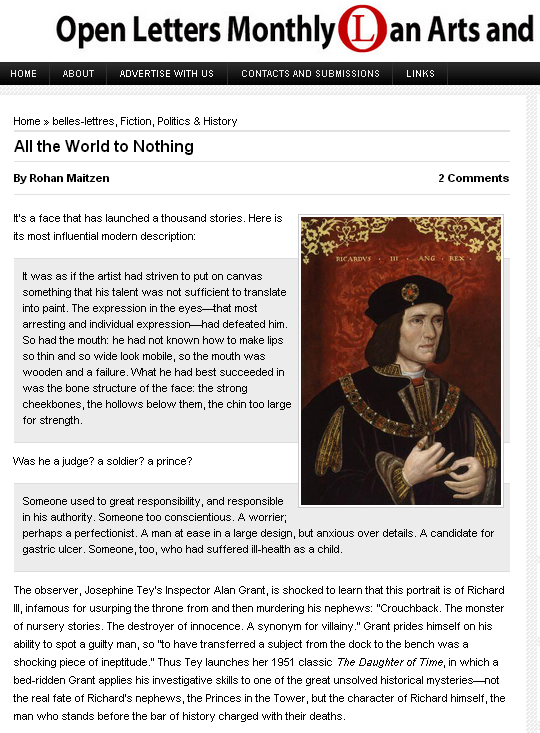
I’m feeling buoyed about this perspective on writing because I’ve been caught up in a bit of that strange serendipity Kerry talks about as a result of the essay about Richard III mentioned in this recent post. It’s an essay that had no extrinsic reason at all to get written. My only justification for writing it was that the topic has been dear to my heart since childhood and then turned out to be intertwined with many intellectual strands from my later life as a scholar. It had its roots in a blog post prompted by one of my very earliest encounters with Open Letters. I began working up notes for an essay on this material in the summer of 2011 and got all excited about it (and wrote about it here and here) and then, as I later explained to Steve, “lost faith in the project: it seemed too esoteric to be of general interest.” Obviously, he talked me back into it, and it was great fun (if also a fair amount of work!) getting it into shape and finally published in May 2012. After all that time I had made something I was proud of from an unlikely but, to me, fascinating combination of elements.  That was that, and that was enough! Nobody commented on it, it didn’t get any external links, I doubt it reached a very wide audience — but there it was.

AlltheworldThen last fall they started digging up the skeleton that turns out almost certainly to be Richard III’s. Suddenly there’s a surge of interest in his story, and when people go looking for something to read about it, one of the pieces they find is mine. It hasn’t gone viral or anything, but it has found a new audience, including the author of this Globe and Mail story, and also a producer for CBC who contacted me to confer about ways I might contribute to a potential documentary about the discovery of his remains. I don’t know yet what, if anything, will come of the proposal, but no matter what, that’s twice in a week I’ve had a chance to talk with curious people about one of my pet subjects, and, through them, to share my enthusiasm and my ideas with others. Once again, I’m immensely cheered by the whole process, even as I’m amused at its unpredictability. Fond as I am of the Richard III essay, I don’t consider it the best writing I’ve done for Open Letters. It is among the more personal pieces I’ve done. If I’d really thought about who might read it, maybe I would not have included the hopelessly nerdy picture of my younger self beside Richard’s statue in Leicester! I’m glad I didn’t worry about that, though. Another piece of advice I often give my students is that your writing represents you. It might as well represent the whole you, warts (or 80’s glasses) and all.

One final thought about audiences. Academic prestige (not to mention professional advancement)  is strongly tied to writing for academic audiences. Sure, there’s rhetoric about outreach and “knowledge dissemination” and so on, but my experience is that most academics don’t take writing and publishing outside conventional academic channels very seriously: it doesn’t really count. Just recently a colleague praised my Open Letters essay on Anne Brontë for its interest and originality, then spoiled the nice moment by adding “You should really publish it sometime.” I was genuinely pleased that a specialist found the essay valuable, but I did already “really” publish it. I just placed it — and wrote it — so that it would be accessible to non-specialists as well. I have persisted with this kind of writing and publishing, despite the likely professional disadvantages, because I believe  in it: I believe that one thing (not the only thing) we should do with our expertise is share it widely and show people why we’re excited about it. The CBC producer was explicit that her interest in contacting me came from her reading of the essay, which she described as “fun academic writing” — not, that is, the kind of academic writing she usually runs into, but nonetheless writing she recognized as expert. As I told her, that was music to my ears! The specific attention to Richard III that drew her to this piece was certainly serendipitous, but the existence of the piece in the first place, and its presence out in the open where she could find it, was not, and it’s not just cheering but gratifying to have the value of writing for a different audience affirmed in this way.


This Week and Last Week … But (I hope) Not Next Week!

It has been quiet over here, I know. That’s a symptom, as usual, of things not being quiet elsewhere and so my not having enough time and energy to spare for blogging. For the past couple of weeks it seems we haven’t had two straight days in which at least one member of my family hasn’t been home sick. When it’s the kids, that means extra pressure on the usual efforts to juggle schedules (and, of course, time spent giving them all the TLC we can muster). When it’s me, as it was (conveniently?) over the weekend, that means a fair amount of deferred maintenance on everything from class prep to grocery shopping. However, tonight things are looking up–I am mostly better, and my daughter is well (well enough, even, to get to her singing lesson, which we had to cancel two weeks running — ironically, this week her teacher wasn’t well, but she soldiered on so Maddie wouldn’t be three weeks behind). Only my poor son is still feeling pretty lousy, but at least he was sitting up and even eating a bit by the end of the day, so maybe he’s turning a corner, though I know it doesn’t seem that way to him right now because he mostly still can’t breathe.

One of the books I’m prepping for class this week is Gaudy Night–I find myself very sympathetic, on this reading, with poor Mrs. Goodwin who keeps having to leave work to tend to her sickly son. It is reassuring to think (or at least believe) that my own professionalism and suitability for my job isn’t being called into question the way Mrs. Goodwin’s is because I’ve had to cancel some office hours and miss a meeting or two! On the other hand, it hasn’t gotten conspicuously easier, in the intervening century, to find a really happy balance between the demands of work and the demands of family. Although it would be nice, once in a while, to take a real sick day and not actually do (or worry about) any work, I feel very fortunate that in this electronic age much of my work can be done from wherever, and whenever. My husband and I have also, for many years, been able to arrange to teach on alternate days, so that cancelling an actual class meeting is a rarity for both of us. It’s interesting to reflect on the complex triage we’ve developed. Classes trump meetings, meetings trump office hours, specific appointments trump office hours, office hours alone just get rescheduled, class prep gets done one way or another in the interstices, and research and writing … well, you can see how much non-essential writing I’ve been able to do in the past week! It’s notable that for both of us actually making it to class is so clearly the top priority. I have learned that students don’t usually much mind a cancelled class here or there, but we put a lot of thought and planning into our courses and for us, a missed hour can throw off a whole sequence (though I have also learned that it’s easy to overestimate how much that really matters). We are still clearly convinced that there’s real value-added in our physical presence and face-to-face engagement with our students. Just call us “the enforcers.”

Anyway, since I have little of intellectual substance of my own to offer right now, how fortunate that the new issue of Open Letters Monthly is fresh and full of goodies! By the time you’ve read every piece there from top to bottom, surely I’ll actually have finished a book or otherwise come up with something to say. And there’s lots of other good stuff around on teh internets, from proposals to remake the humanities PhD to discussions about the ethics of live-tweeting conferences to posts on Argentinian literary doom. Happy reading–and wish me luck.

What We Talk About When We Talk About Academic Blogging

Logistics and institutional issues: how do you find time for it, where (if anywhere) should it go on your c.v., and how should tenure and promotion committees evaluate it?

At least, this is what the audience questions were almost exclusively about when I spoke about blogging at my faculty’s “research retreat” on Friday. Here’s a link to the Prezi I used, which is basically a condensed version of the one I prepared for the British Association of Victorian Studies conference in August. I was supposed to speak for only 8-10 minutes, so I just highlighted the arguments for and against blogging as I see them and quickly pointed out what the illustrative quotations were, on the principle that interested parties can easily find the Prezi and read them (and follow the links) themselves. What I really tried to emphasize in my own remarks is that if we think about why we do research and publish it in the first place–to advance or improve a conversation–then writing online makes perfect sense. I also stressed that for me, the real benefits are intellectual. I specifically invited follow-up questions about ways my blogging had affected my teaching, my research, my writing, and/or my intellectual life. I didn’t get any questions about that at all, leading me to think that the single most important quotation in the presentation is the one from Jo VanEvery: “Scholars lose sight of the fact that academic publishing is about communication. Or, perhaps more accurately, communication appears disconnected from the validation process.” What people wanted to talk about was “validation.” As I said at the close of the discussion, I think that preoccupation in itself is worth reflecting on. It’s inevitable, perhaps, because we are professionals trying to get and keep jobs and build careers, but I think concern about bureaucratic processes should follow on reaching a better understanding of the value of the activity, to the individual scholar, to the university, and to the broader community. Maybe people were taking for granted that blogging could be beneficial in the ways I was describing and so didn’t need to ask about it, but the impression I got (perhaps unfairly) was that they couldn’t quite imagine those benefits trumping the low likelihood of professional rewards for the time spent. The one specific positive benefit someone raised from the floor was that blogging might help lay the groundwork for a grant application–but as I noted, that assumes that getting grants is itself a priority. What if we don’t need them to do the work we think is important? (You certainly don’t need a grant to keep a blog.)

And my responses to the questions that were asked? Well, the “how do you find time” question is not one that gets asked about activities that we do not perceive as “extra” to our “real” work, so the answer to that would depend on how you find time for anything you think should be among your priorities. I don’t have a strong opinion about what heading the blog should be under on a c.v. except that I think it should in some way be treated as a research, writing, and publishing project, not as “service.” And I think tenure and promotion committees should evaluate it by reading it — not one post, or even a few posts at once, but ideally by following it for a while as well as exploring the archives. I think bloggers (and academics involved in any non-traditional kinds of work) need to help by explaining clearly what they are up to and contextualizing it so that people who have never read a blog before (and there are still many of these people in academia) have some appropriate frameworks for what they are looking at, and they should also help by thinking about how to curate their blogs so that newcomers can easily grasp their range as well as follow key examples. In my own case, I think (I hope!) the index pages I’ve built are useful in this way. As indicated in the new MLA guidelines for evaluating digital scholarship, I also think that tenure and promotion committees need to include people who understand new forms of scholarly communication, including as external reviewers. Someone who is also a blogger, for instance, is more likely to appreciate and fairly assess the quality and contribution of another blogger’s site than someone who reads only conventional scholarship.

The other panelists  were talking primarily about newspaper op-eds and letters to the editors. It was interesting to me that in general, they expressed more discomfort or dislike for the experience of being exposed to the unfiltered world of the internet. Being social scientists and historians, though, they were talking about writing on political topics, so they are engaging in conversations where stupid virulent attacks are more likely, not just because a national newspaper is much higher profile than my own quiet corner here, but also because politics rile people up more than whatever someone happens to think about The Good Soldier or Lightning Rods.* I can understand why one piece of advice they had, then, was simply not to read the comment threads that follow but to wait for the wave of attention to pass and hope to have made a small difference to the public conversation and perhaps to create further networking or writing opportunities for yourself by the exposure. I felt lucky, really, that though I am not Utopian or idealistic about the openness of the internet, my own experience of it has been, by and large, really positive and rewarding.

*Though it is possible to rile people up a bit on these topics, if you have the right audience!

The Unbearable Lightness of the Digital

I had an interesting chat with a colleague the other day about academic writing and publishing that shifting over, inevitably, into the changing ways we do our writing and publishing now. My colleague said, basically, that he can’t shake the feeling that there’s something particularly ephemeral about online publishing: when it’s not in front of you, after all, where is it? Or, when its original home has expired in some way–whether it has been taken down or the site is no longer maintained or updated (as is the current status of The Valve, where I did a lot of writing for a while) or the content has migrated–where is it then? With hard copies, they are always somewhere. I have offprints of my articles and reviews, for instance, as well as copies of my books. No matter how old they are (and how unlikely it is that anyone might want to pick them up and take a look) I know where they are and the medium they are in will not be outdated. Just the other night I was actually working on a piece and trying to remember something that, it occurred to me, could be easily found in my U.B. C. honours thesis c. 1990, which exists now only in a cerlox-bound copy on my shelf.

Even though I know digital content is (or at least can be) archived and stored and in many ways is actually more accessible and durable than some kinds of paper archives, I have sometimes had the same feeling as my colleague about online writing, especially blogging. I know that all my posts are still “there” and can be searched for and viewed easily enough. (I also make back-ups by way of preserving the content against unforeseen catastrophes. What if WordPress just shut down one day?!) But there’s something relentless about the way the posts scroll off the bottom of the page. That makes them seem to lose currency, even though, with book reviews at least, there’s no reason why they should. I have tried to counter that ‘out of sight, out of mind’ effect by building the blog index, which groups and lists posts in what I hope are useful ways and gives a little form to the range of topics I write about. But there’s something about not having anything tangible to show for all these years of writing. It’s one thing to pull a book off the shelf and put it in someone’s hand: here, look what I made! It’s more complicated to do that with a blog.

I thought of this recently when my faculty held its annual “Book Launch,” which (as journals and articles are also displayed) is really more of a research showcase than a book launch. There was no provision made this year for displaying digital projects, so as not one of my 2011 publications was in print, I had nothing to contribute. Well, I could have printed out copies of my book reviews and essays–but you don’t end up with something that looks quite right when you do that unless you can figure out some way to recreate banners, not to mention links. And how do you display a blog without a computer, if you did decide to insist that it deserved, literally, a place at the table?

I know that the kind of publishing I’ve been doing doesn’t really count as research by academic standards. It’s not just that I’m publishing in digital-only forms but that I’m writing for a non-academic audience, and while I do often draw on original research, I’m putting it to slightly unconventional purposes. Because I’m well aware of this and have decided to live with the professional consequences, I’m not really upset about the book launch, though I will suggest that next time they make sure to have computers set up, as I know I’m not the only one whose research is being disseminated electronically, while other people in the faculty are at work on archival or other digital projects that really deserve to be shown off even though they aren’t books. The MLA has been advising us for years now to “decenter” the monograph, after all: here’s an opportunity to think through how we can do that.

But I do feel odd–bereft, even–that I’ve done all this writing and from a certain perspective it’s invisible. It’s not any less “there” than the offprints of articles I have filed away, but why does it feel as if it is more transient, more ephemeral? Am I just still, in spite of everything, in thrall to print? Is it a sentimental thing? Do those of you who also keep blogs ever find yourself fretting that for all your hours of writing, you have created something that seems oddly insubstantial?