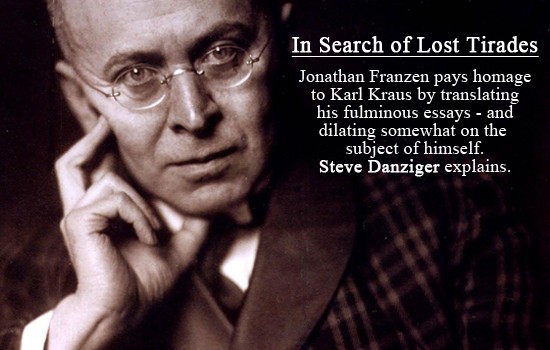
 What if Jonathan Franzen opened a bookstore, called it “The Good Novel” and refused to carry any of Jennifer Weiner’s books — not to mention Dan Brown’s, Tom Clancy’s, Jodi Picoult’s, or E. L. James’s?
It’s only too easy to imagine the brouhaha that would ensue, with cries of “excellence!” on one side and “elitism!” on the other, with one side proclaiming itself literary purists trying to break the cycle of commercialism that’s leading to the decline of Great Literature while the other side set itself up as democratic champions of the common reader, their store (call it “For Every Taste” ) selling pleasure rather than High Art. Who would be right? Which side would you be on? And, perhaps most to the point, where would you shop?
This is the basic premise of Laurence Cossé’s A Novel Bookstore, though the characters who establish “The Good Novel” bookstore are not set up as smug Franzen-style curmudgeons but as passionate idealists. When they come under attack for their governing principles, their patron issues a stirring defense:
For as long as literature has existed, suffering, joy, horror, grace, and everything that is great in humankind has produced great novels. These exceptional books are often not very well known, and are in constant danger of being forgotten, and in today’s world, where the number of books being published is considerable, the power of marketing and the cynicism of businesses have joined forces to keep those extraordinary books indistinguishable from millions of insignificant, not to say pointless books.
But those masterful novels are life-giving. They enchant us. They help us to live. They teach us. It has become necessary to come to their defense and promote them relentlessly, because it is an illusion to think that they have the power to radiate all by themselves. That alone is our ambition. . . .
We have no time to waste on insignificant books, hollow books, books that are here to please.
We have no time for those sloppy, hurried books of the ‘Go on, I need it for July, and in September we’ll give you a proper launch and sell one hundred thousand copies, it’s in the bag’ variety. . . .
We want splendid books books that immerse us in the splendor of reality and keep us there; books that prove to us that love is at work in the world next to evil, right up against it, at times indistinctly, and that it will always be, just the way that suffering will always ravage hearts. We want good novels.
Stirring, as I say, and because the founders of The Good Novel are A Novel Bookstore‘s protagonists, it seems pretty clear whose side Cossé is on and wants us to be on too. And it’s tempting, because after all, who wants to be on the side of insignificant books, hollow books, or sloppy hurried books?
But the devil is in the details, of course, or, in this case, in the identification of these unworthy books — in discriminating decisively between the good and the bad. The Good Novel team orders their stock following lists submitted by a secret committee of writers, among whom there are in fact some differences of taste and interest, and all of whom (along with the bookstore staff) relish the opportunity to be advocates for lesser-known novels they believe deserve a wider readership. (One of the treats of A Novel Bookstore is noting the authors and titles that are batted around, many of whom were certainly unknown to me.) They are united against most bestsellers and prize-winners, however. Are they doing readers a disservice by refusing to stock books that, as they point out when challenged, are available by the thousand in every other bookstore in town? Is their insistence on exercising their own exclusive literary judgment heroic or, as one critic argues, fascistic?
This . . . is nothing more nor less than a totalitarian undertaking . . . What does good novel mean? Who are these kapos who have the nerve to place their seal of approval on this book and not that one? Where are they coming from? What gives them the right?
Those most offended, of course, are the excluded novelists as well as those in publishing who rely on highly commercial titles for their profits. The actual plot of the novel is put in motion when some members of the selection committee are attacked. The investigating officer sums up his theory of who’s behind the attacks and why:
The Good Novel has caused every element of a fairly limited socio-professional group to break out in hives. Far be it from me to suggest . . . that this group represents everyone in publishing, the media, or criticism, or bookselling. They are a sub-faction of people who share the view that a book is a product that can make a lot of money and that literature can be a rich seam.
He goes on to compare the cabal working against The Good Novel to Al Qaeda — there’s not much middle ground in A Novel Bookstore, and that’s actually one reason I didn’t love it the way I expected to. The oppositions seem polarized in a way that suits this novel’s concept better than the novel as a genre, or novel readers.
The mystery plot is one of several facets of A Novel Bookstore: there’s a love story as well, and a number of subplots, really more like anecdotal digressions, about the various characters involved in setting up the bookstore. It all has a certain charm, and it is certainly executed with panache. But without the central debate about the value of ‘great’ literature, it would be a fairly insubstantial book, and even with it, it seemed somehow superficial, the working through of an idea for a novel more than a novel of the kind that The Good Novel would stock.
Yet I couldn’t help thinking about Cossé’s conceptual gambit as I was shopping in an actual bookstore myself yesterday. As I browsed the fiction shelves, I was frustrated as always at the crowding out of backlist titles (or just less mainstream titles) by stacks of the latest releases. What a different experience it is to shop at the London Review Bookshop, clearly curated on different principles! Yesterday I was also plagued by an over-enthusiastic employee who (when he wasn’t badgering me to see if he could help me, which he couldn’t, except by stocking more good novels!) was selling — by which I mean both promoting and taking money for– a lot of James Patterson and Tom Clancy. My inner literary snob cringed at his loud sales pitches even as my better angel (or was it?) reminded me not to look down on other people’s genuine reading pleasures. I wouldn’t be able to find everything I like to read at The Good Novel (yesterday I bought Tana French’s Broken Harbour, for instance), but I’d still rather browse there than at Coles.
 First of all, I did decide to do something different, rather than just pressing on with my usual strategies. I had to admit to myself — and I admitted this morning to my class — that if year after year a critical mass of students just isn’t getting engaged by the novel, at least to some extent this is a failure on my part — a pedagogical failure. Dropping Waverley from my reading list was also a failure: some students in Waverley-free years have told me how happy they were to have missed it, but missing out on it was not a win for them any more than it was one for me. As I told my class this morning, it’s a novel that deserves its place on our syllabus, one that is well worth reading for our curriculum, whatever anyone’s personal response to it. But the failure isn’t all mine. To use the analogy I suggested to my class, if you’re stumped by a difficult calculus problem, you don’t blame the problem: you work it as hard as you can, get more help if you need it, and try to bring your skills up to the level you need to solve it.
 Again, this is all standard classroom procedure — lecture mixed with discussion prompted by questions designed to build interpretations out of observations. But it just doesn’t go well with Waverley, though there are always a few stalwart souls who put their hands up (thank you!). I’m always a bit puzzled by the conspicuous collapse: the novel doesn’t strike me as that opaque, especially once we’ve done our warm-up sessions. On the assumption that incomprehension is a problem, though, my first response is usually to step up what I think of as the ‘modeling’ component of class — that is, walking the students through those key episodes and showing them what’s in there to notice, enjoy, and work with. Then I try backing off again — but still with lackluster results. Is it me, I wonder? Perhaps I come on too strong: if they are feeling bemused or bored, then my enthusiasm, rather than ‘selling’ them on the novel, may just alienate them from both it and me. Also, sometimes I catch myself hectoring them: this week, for example, I gave them a heads-up that we’d be discussing three particular incidents, and when hardly anyone seemed prepared to do that, well, I did take them to task! But that backfires too, I bet: rather than feeling challenged to do better, they probably just feel defensive.
 First she worked on a journal called Argentor, “the official quarterly journal of the National Jewellers’ Association.” Then she stepped in as editor of the Poetry Review — and it’s here, in recounting the eccentric personalities, egos, and feuds of the poetry world, that you sense her really settling in to put the record straight. She’s got a particular genius for quoting writers to their own disadvantage, like Robert Armstrong, “a physically and morally twisted, small, dark fellow, a veritable nightmare” who takes umbrage at her decision not to name him on the journal’s front cover. “I had been working hard for the opportunity to put the Society and yourself on the map,” he self-aggrandizingly complains; “I had also put in some groundwork with influential friends so I am puzzled and assume something must have arisen to sidetrack your promise.” “This was a mere taste of things to come,” Spark says, almost gleefully, before quoting her sharp reply and then noting, “I never in future put this man’s name on the front cover.” She was eventually dismissed from her position: “I was delighted to get out of that scene of strife and of that mortal sin of art, pomposity.”
 The second full week of term has gone by already: it’s amazing how time seems to accelerate when things get busier. In both my classes we have moved from throat-clearing and context-setting to richer discussions about our readings: in The 19th-Century Novel from Austen to Dickens, we’ve wrapped up our work on Persuasion, and in Mystery and Detective Fiction we’ve got only one more class on The Moonstone. Starting the term with these two novels eases the transition from summer’s languors to fall’s stresses because both are so delightful. At least, I think so — and it seems as if a lot of students are enjoying them as well. Discussion in the Mystery class has been particularly good so far this term, especially considering it’s a big class (capped at 90), which can sometimes be inhibiting. I hope they keep putting their hands up!
 One thing I’ve been thinking about as our work gets underway, and as I contemplate my own non-teaching ambitions for this term, is trying to make the process as meaningful and rewarding as possible, shifting some emphasis away from the product — which for students is often the course credit or the grade, and for me is the finished piece of writing. I’ve been reading Donald Hall’s The Academic Self: An Owner’s Manual (thanks to