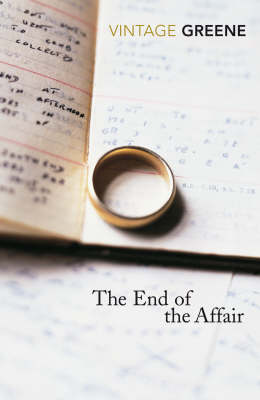
I’m tired and I don’t want any more pain. I want Maurice. I want ordinary corrupt human love. Dear God, you know I want to want Your pain, but I don’t want it now. Take it away for a while and give it me another time.
My local book club met Tuesday night to discuss Graham Greene’s The End of the Affair. We chose this novel as the follow-up to Lady Chatterley’s Lover: as I’ve explained here before, we pick a thread to follow from one book to the next, which in this case was adultery. (The last time we read Graham Greene we had followed a “depressing novels about priests” thread from Such Is My Beloved to The Power and the Glory.)
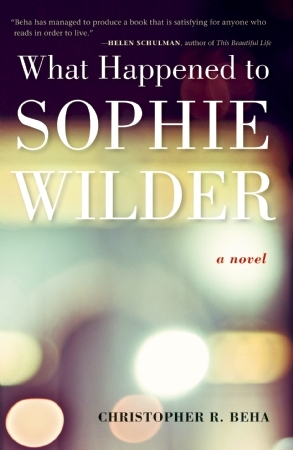
Quite by coincidence, because I had forgotten that they had often been compared, I started Christopher Beha’s What Happened to Sophie Wilder just before I had to turn to The End of the Affair. (Or was it a coincidence? Perhaps it was all part of some grand design by the great publisher in the sky!) The connection came back to me as I was reading and writing about Beha’s novel, though, thanks especially to Nicole’s comparative discussion at Book Riot, so inevitably I was thinking a lot about Sophie and and Charlie as I read about Sarah and Bendrix. As Nicole very adeptly explains, the two novels are indeed strikingly similar in structure, but reading them feels very different: Beha’s has a (somewhat deceptive) colloquial clarity to it, and (I thought) a lot more emotional detachment, especially, and paradoxically, where Sophie’s religious experiences are concerned, while Greene’s is more overtly written, more conspicuously literary, as well as emotionally intense — to the point of claustrophobia.
At the purely subjective level of taste, I preferred Greene’s: I enjoyed (if that’s the right word) Bendrix’s palpable bitterness, and the twisty self-justifying but also self-loathing ways he tells his story. I was fascinated to learn that Greene tried this experiment in first-person narration because he’d been reading Great Expectations: apparently he felt he hadn’t really pulled it off:
Dickens had somehow miraculously varied his tone, but when I tried to analyze his success, I felt like a colourblind man trying intellectually to distinguish one colour from another. For my book there were two shades of the same colour — obsessive love and obsessive hate; Mr. Parkis, the private detective, and his boy were my attempt to introduce two more tones, the humorous and the pathetic.
I can’t think of a novel I would be less inclined to compare to The End of the Affair than Great Expectations if I were approaching it thematically, but it’s interesting to think of it, as Greene apparently did, as a technical problem he was unable to solve. One thing Dickens does that perhaps he didn’t adequately consider was use retrospective narration to add a layer of painful self-knowledge over top of Pip’s obsessive love. The End of the Affair is told retrospectively (except for Sarah’s diary), but all that does is infuse the love story with that “obsessive hate.” Imagine the novel told in a way that really reflects the religious conversion that the ending points us towards: wouldn’t that complete or perfect the narrative by returning Bendrix, and thus us, to love, by way of forgiveness? It’s impossible to imagine any Dickens novel, much less Great Expectations, stuck in hatred the way Bendrix is: even Miss Havisham is brought to repentance, after all. As for “the humorous and the pathetic,” well, I agree with Greene that he doesn’t quite achieve either (at all, never mind to Dickens’s level), but it’s hardly a fair contest.
Anyway, I liked reading Greene better for the style and the emotional intensity … but I also found myself thinking back on Sophie Wilder (and bringing it up during our discussion) because there were things about The End of the Affair that left me dissatisfied, too, in ways that Beha’s novel helped me understand. I was particularly frustrated by Sarah’s “conversion.” Having protested Beha’s failure to explain Sophie’s conversion in more depth, I found I objected to Sarah’s on different grounds: it didn’t seem religious at all! She has no epiphany, no spiritual revelation, no breakthrough. She just makes a deal with a deity she only kinda sorta believes in, and then feels coerced into keeping up her end of the bargain. It seemed so pragmatic — and hardly inspiring, as it boils down to “I’ll be good if you grant me my wish” — which rather neatly sums up negative clichés about Catholicism.
That moment is only the beginning of Sarah’s newly-defined life, of course: does her contract with God lead her into genuine faith? She spends a lot of time doubting and arguing, as in the bit I chose for my epigraph (which nicely captures the central conflict between human and divine love, fought in the novel over the territory of the human body). But she does seem to find something like peace eventually, and of course once she dies she’s apparently capable of working miracles. There’s little saintly about her during her life, as far as we know, or as far as Bendrix will admit (“She was a good woman,” says Father Crompton: “She was nothing of the sort,” retorts Bendrix irritably) but being a saint doesn’t necessarily require that: as Father Crompton replies in his turn, “There’s nothing we can do some of the saints haven’t done before us.” But it didn’t seem that Sarah was working towards doing good, not the way Sophie is when she cares for her dying father -in-law. Still, struggle and debate are compatible with belief, and Greene did well precisely at conveying faith as something to be achieved through effort, not simply succumbed to or carried along by.
That said, I certainly didn’t see why Bendrix came round (or is on the verge of coming round) to it in the end. Greene apparently said he wanted to box him into a corner so he couldn’t help but accept the religious explanations. Here too I end up giving Beha the edge: both novelists play metafictionally with novelist / God comparisons and make room for ambiguity about the ultimate source of structure and meaning, but in offering the resolution I thought I wanted (“all right, have it your way. I believe you live and that He exists”), Greene frustrated me in a different way, because his ending felt both manipulative and reluctant. If your conversion is really a reluctant concession, what’s the thrill in that, especially if you haven’t in fact earned it by winning the argument against coincidence or rationalism? Beha at least seems to be saying “make up your own mind.”
We had a pretty lively discussion of The End of the Affair over our book club dinner. There, of course, the immediate comparison was to Lady Chatterley’s Lover, since I was the only one who’d read Sophie Wilder, and plenty of interest came out of that, particularly around the affair itself and what it meant to the characters, as well as the overall treatment of sexuality and desire in the novel (we thought poor Henry seemed not altogether unlike Clifford, for instance). We were intrigued by the war setting, and by the possibility that the blast that leads to Sarah’s deal with God might itself be interpreted as some kind of divine intervention. By and large we thought the ending of the novel was unsatisfying because the crucial interventions that build up to the “Sarah is a miracle-working saint in Heaven” theory seemed ad hoc: there’s the mother ex machina, for instance, who appears on the scene just in time to save Bendrix from himself. We were all fond of Parkis, which made me think we should maybe try some Dickens one day (or some Trollope — isn’t Parkis a bit like Bozzle in He Knew He Was Right?). We were also intrigued by the discussions of the novelist’s craft, and from this we picked up on the mentions of Forster and decided that should be the thread to our next book. Though Maurice would have been a cute choice (because that’s Bendrix’s name), we settled on Howards End, which I am very pleased about as it has long been near the top of my Humiliation list.
 I’m sure you have all been wondering whether I have managed to get my


 In 19th-Century Fiction we’ve finished our first two novels, Villette and Great Expectations. Although Villette is a fascinating novel, I had more fun (rather to my surprise) rereading Great Expectations. I’ve read and taught it so often that my own expectations were kind of low as we started it up, but I fell right into it, especially the climactic confrontation between Pip, Estella, and Miss Havisham after Pip’s world has been up-ended:
 In Mystery and Detective Fiction we’ve wrapped up not only The Moonstone but Sherlock Holmes and a sampler of other great detectives as well (we read one story each by G. K Chesterton, R. Austen Freeman, and Jacques Futrelle). Today we started our discussion of Agatha Christie’s The Murder of Roger Ackroyd. I enjoy using Christie to spark discussion about canonicity: I point out that despite being possibly the best-selling novelist of all time, she has no literary standing compared to her contemporaries Henry James, Virginia Woolf or James Joyce, which gives me a chance to suggest that modernism set a lot of the terms for discussions of literary merit that we now often take for granted. This means talking about things like linguistic or syntactical difficulty, which on the face of it, Christie is having none of: her prose is remarkably lucid. Next time, though, when all is known, we’ll go over just how tricky she actually is — telling us everything while keeping everything from us. Is this its own kind of difficulty, or is it just trickery, and if so, is that somehow a lower order of skill? To some extent I am playing devil’s advocate in asking why she should be taken any less seriously than Woolf: for me, conversation about Christie flags pretty quickly once the game is played out, and for my money there are other mystery novelists who are a lot more interesting to think about. But she’s excellent of her kind, and I think it’s worth provoking a conversation about whether it makes sense to value some kinds more than others. This is the “genre fiction” version of the YA debates, of course.
 I’m glad I didn’t take Levi Stahl’s advice. If I had, I would have walked away from The Getaway Car, which is “the first book by Donald E. Westlake [I’ve] ever held in [my] hands.” Not that it seems like bad advice to get my hands on some of Westlake’s actual novels — indeed, reading The Getaway Car has made me quite enthusiastic about doing that! But a book in the hand is worth many dozens in the store (even if, as turns out not to be the case, my local bookstores had any Westlake on their shelves) or at the library (especially since my local branch is currently closed). So I blithely disregarded the advice to “stop right here” and read on.
 Over the last week or so we’ve done our first small assignments in both classes: an in-class writing response in Mystery & Detective Fiction, paper proposals and then a “mini-midterm” in 19th-Century Fiction. Also, since the start of term students in the 19th-Century Fiction class have been keeping reading journals. These assignments have all been developed as parts of my attempt to shift the emphasis from
 Novel Readings