 I’m back from Louisville, where Dan Green, David Winters, and I presented a panel of papers on criticism in the internet age at the 44th annual Louisville Conference on Literature and Culture since 1900. The panel itself was something of an anticlimax (more on that in a bit), but it was a genuine pleasure to meet both Dan and David in person and share stories and ideas about blogging, criticism, and working online. Another highlight was hearing Mat Johnson read from and discuss his latest novel Loving Day, and I also really enjoyed chatting with the amiable Woolf scholars I sat with at the conference dinner.
I built some slack into my travel schedule as I was quite anxious about being delayed by winter storms, if not here, then in one of the other wintry airports I had to pass through coming or going (Ottawa, Chicago, Montreal): miraculously, even the record-breaking snowfall in Ottawa that hit just as I was passing through did not hold up my flights, so I arrived a day before the conference began and had a little time to play tourist (on my own dime, don’t worry). I passed up the Louisville Slugger Museum in favor of the Frazier Museum, as I’m not a baseball fan and I like to get a sense of the local history; then, when that turned out not to be a particularly time-consuming expedition (it’s not the biggest or most fascinating museum in the world), I headed to the Kentucky Derby Museum where I paid tribute to the spirit of Dick Francis. After a lot of diligent conference-going, I took a bit more time near the end of my stay to walk in Waterfront Park, including trekking across the Big Four Bridge to the Indiana side and back. It’s probably a prettier park when it greens up, and the river itself seemed kind of a muddy mess, but (after a bitter cold start to my visit) it was 21 C that day and a treat to be outside coatless in the sunshine.
 Even taking these good things into account, though, I left Louisville feeling more than ever that, as a profession, we need to rethink how we do things. One of the main incentives for me to participate in this panel was that I have recently been given emphatic notice that I haven’t been going to the number of conferences expected of someone in my position. A significant number of academics apparently consider frequent conference-going a key measure of scholarly productivity and knowledge ‘dissemination.’ Frankly, I thought this was bollocks when it first came up as a criticism of my record, and my experience in Louisville only confirmed me in that view. Here’s why: Under pressure to show I am doing the “right” things professionally, I traveled a long distance at great expense (a significant amount borne by me personally, as the funding available did not cover nearly the full cost) to present a 20 minute paper to an audience of 8 people. All around me, hundreds of other academics were there doing the same, sometimes to even smaller audiences (the smallest I saw was 3 people plus the panelists, the largest, excluding keynotes, was about 16 — for a panel on Joyce — and one of the keynotes itself had an audience of maybe 15). Though there’s no doubt that some of the attendees were genuinely engaged with the papers they heard, most of them will take little concrete away besides a vague sense of the argument. One questioner at a panel I attended prefaced his remarks (as usual, questions were usually of the discursive rather than inquisitive variety) by saying that he’d heard a paper at another conference by someone whose name he couldn’t remember making an argument he dimly recalled had been somewhat similar to the one he’d just heard: though I’m sure there are some exceptions, that impressionistic result seems to me pretty typical, at least of a conference as diffuse as this one.
 The small audiences and inchoate overall experience is in part a function of the kind of conference this was: papers were collected under a very large umbrella, and (I suspect) accepted somewhat indiscriminately, perhaps with the admirable goal of being inclusive. But when there are 10 or more concurrent sessions in every time slot, there’s little chance of robust numbers at any given panel, and even less chance of a sizable cohort of conference-goers having much of a common experience and thus much deep, shared conversation. My experience of ACCUTE (not to mention the MLA) has been very similar: I’m not faulting the Louisville organizers in particular. Even the BAVS conference that I went to in 2011, though considerably more focused and thus more productively collegial, was fairly dispersed. At BAVS, though, I felt my own contribution got more attention and thus generated more valuable discussion for all concerned: remember, the purpose of these events is not supposed to be accumulating lines on one’s c.v. but having a face-to-face intellectual experience that matters so much it’s worth the time and money and environmental impact of all this gadding about.
 Once upon a time going to conferences really was our best option for letting a wider audience know what we are working on, for getting feedback on work in progress, and for networking with colleagues in our field. But while I think it is possible for a conference experience to be genuinely valuable, particularly if the conference has a narrower focus and a different format (a friend of mine speaks very highly, for instance, of the Shakespeare Association‘s annual meetings), we really do have other options today for many of the functions conferences used uniquely to serve. Just for instance, Novel Readings may be very small potatoes as blogs go, but I still reach more people with every post here than I have ever spoken to at a conference (sometimes more than all of my conference audiences combined), and the comments are every bit as engaged and engaging as any in-person sessions, and often more because they arise from a written text (not, as with most conference papers, a written text read aloud, with all the attendant disadvantages). Here I can link to things I’m talking about, creating a tangible network of related material, and my writing can be referred and linked to in turn. As I have often observed, my blog is not a particularly “academic” blog (setting aside for the moment the question of when reading, or writing about reading, counts as research) — but the form of a blog is perfectly suited to sharing just the kind of thing usually presented as a conference paper and getting feedback and suggestions for furthering “the larger project” (if I had a dime for every time I heard that phrase in Louisville, I think it would have covered the rest of my hotel bill!). Twitter is great for networking — admittedly, there’s a learning curve, but compared to the dreary 24 hours (literally) I spent traveling to and from Louisville, the time it takes to populate a useful Twitter feed and learn how to use a hashtag is nothing. And these are just the most obvious alternatives to flying half way across the continent to sit in a dingy room telling a few hardy souls (some of whom, it must be said, are actually editing their own papers or checking Facebook rather than listening intently to you) about your insight into Woolf’s aesthetics.
 I think I personally would have found the Louisville conference more intellectually stimulating if I were a modern literature scholar myself: I had a harder time even than usual latching on to the papers’ arguments because they were typically quite specialized contributions to scholarly inquiries I know little about. I went mostly to Woolf panels because at least there I knew the primary sources a bit! (I was interested to note that there were no papers, much less panels, on Winifred Holtby or Vera Brittain at all; there was one paper on Sayers, but I saw no sign of Rebecca West or Rosamond Lehmann or Mollie Panter-Downes or Elizabeth Taylor or Olivia Manning or any of those I think of as the ‘Virago’ set. Eliot, Pound, Woolf, Joyce, a bit of Lawrence and Forster — this was a pretty canonical outing. You 20thC people can tell me if that’s typical or just Louisville.)
I’m not sorry I went: it was an adventure, it was a change of scenery (which I really needed), I spoke with a number of really interesting people and made a couple of new friends. But why anyone would insist I should do this kind of thing more often, while shrugging off the other ways I share my writing, network with other academics, and facilitate not just my own but other people’s ‘knowledge mobilization’ completely escapes me. Just because that’s how the profession has operated for a long time, or just because it is the kind of scholarly activity some academics are used to and perhaps even enjoy, simply does not mean it is the best use of my time or the university’s resources. We need to be open-minded about other options that serve the same purposes, often more efficiently and effectively. In this, as in scholarly publishing, it seems to me that the familiar form is too often valued over the real function of the work itself.

 It’s an image that is specific to Lily’s situation and history, but it’s also the familiar refrain of women seeing the myth of their influence, and the perfection of their weakness, exposed as lies that serve everyone but them. It’s not just Becky shamelessly marketing herself, but Amelia, trying to scrape together enough money to keep her son at home, and Gwendolen presenting herself to Klesmer in the vain belief that she can be a great singer just by wishing it so, and Isabel imagining she has not just the freedom but the wisdom to choose her future.
 Lily’s life does end on a “tragic yet sweet” note: tragic because she is hopeless and, she believes, loveless; sweet because she spares herself (or is spared — Wharton carefully avoids the specificity of suicide) the further — perhaps even worse — compromises she sees in her future, and also because at least in death she is loved for herself, not just for the market value of her beauty. I don’t think Wharton means to leave us in despair, despite Lily’s catastrophic decline: Selden’s belated arrival is one sign that something better is at least imaginable. As he thinks, kneeling by her death bed, “at least … if the moment had been fated to pass from them before they could seize it, he saw now that, for both, it had been saved whole out of the ruin of their lives.” That such a moment is even possible is a slim but real victory for optimism. That its promise is unfulfilled leaves us with the dissatisfaction that we also feel finishing Daniel Deronda and The Portrait of a Lady. Surely something better should be possible for these remarkable women: what a waste their worlds have made of them!
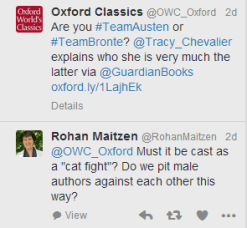 I got a bit snippy with the tweeters from Oxford World’s Classics a couple of days ago. Poor things: they were just doing their job, spreading some news about great books and trying to get people to click through and read it. How could they know that I was already feeling grumpy, for reasons quite beyond their control, and that this particular gimmick pushes my buttons on a good day?
 But (and you knew it was coming, right?) if for some absurd reason I absolutely had to choose, not which novelist is in any absolute sense “the greatest” but whose team to play on, it would be Brontë all the way — and I say that having only just enjoyed Pride and Prejudice entirely and absolutely for about the 50th time. We’ve just started working our way through Jane Eyre in the 19th-century fiction class and what a thrill it is. I know it’s a cliche to associate the Brontës with the moors, but it does feel as if a fresh, turbulent breeze is rushing through, stirring things up and bringing with it a longing for wide open spaces. The freedom and intensity of Jane’s voice, the urgency of her feelings, and of her demands — for love, for justice, for liberty — it’s exhilarating! I brought some excerpts from contemporary reviews to class today to demonstrate the shock and outrage with which some 19th-century critics received the novel: it’s striking how much the very qualities that enraged and terrified them are the same ones that make so many of us want to cheer Jane on. By the end we know that we should not have allied ourselves so readily with Jane’s violent rebellion, and we may even be equivocal about the conclusion to her story, but I think it’s impossible to read the novel and not be wholly caught up in her fight to define and then live on her own terms.
 I started rereading Emma recently and had to put it aside. I appreciate that it is aesthetically and morally complex and infinitely nuanced, but I felt smothered by it: I found it claustrophobic. Brontë’s criticism of Austen is well known: she told G. H. Lewes that in Pride and Prejudice she found only “an accurate daguerrotyped portrait of a commonplace face; a carefully fenced, highly cultivated garden, with neat borders and delicate flowers; but no glance of a bright vivid physiognomy, no open country, no fresh air, no blue hill, no bonny beck. I should hardly like to live with her ladies and gentlemen,” she went on, “in their elegant but confined houses.” I think she underestimated the novel — a lot of people do, still, who see just the delightful characters moving on the surface and not the currents of social and historical change carrying them along. I’m also sure that my trouble with Emma is about me, not Austen. But I understand Brontë’s reaction, and it is just the one you would expect, too, from the author of such an entirely different book, one that opposes itself in every way to both literal and mental confinement. I think that’s why Jane Eyre refreshes my soul: it rushes with us out into the hills. Jane is so defiant, so passionate, so forthright: she speaks up so fearlessly, for herself and for the right! I wish I could always do the same: I admire her principles and envy her courage. So much as I would miss Elizabeth Bennet if for some reason I had to give her up, Jane’s the one I really couldn’t do without.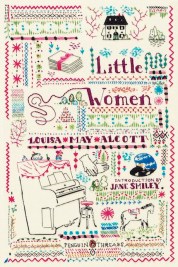
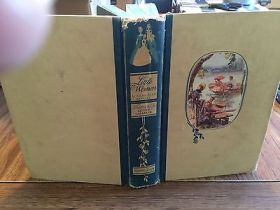 I used to read about them in my mother’s old, cherished copy: I discover, peering around online, that it was the “Illustrated Junior Library” edition from Grosset and Dunlap, with an original copyright date of 1947. The cover alone is immediately evocative of my childhood! I loved the novel and reread it often; I had been feeling mournful that I didn’t have a nice copy of my own, so I put the Penguin Threads edition on my Christmas wishlist this year and was thrilled to get it. It’s very satisfactory: not only is the cover delightful to an embroidery buff like me, but the whole volume is tactile in all the right ways, from the raised graphics on the artwork to the heavy, deckle edged pages. It feels the way a classic should.
 Like a lot of other early – to mid- 20th-century women’s fiction I’ve read (Elizabeth Taylor’s
  I ended up thinking that its lack of direction and energy was its governing idea. The narrator is stifled by her family life and by the social constraints on her behavior as well as her options: she would like to have a vocation, but she can’t really imagine what it might be. The visit that changes everything by showing her how other people live actually changes very little, at least about how she can live: its effects arise only through the new connections she makes, most of which turn out to be far less consequential than she expects. Even when they do lead to something significant (like a marriage proposal), the promised transformation ultimately has no appeal. The one big change that finally occurs at the novel’s end is so artificial, so unanticipated, that it doesn’t seem to solve or promise anything either, except perhaps that it is the beginning of the real bildungsroman, the real story of her life, which we don’t get because our novel is the story of the stuttering, inchoherent, mostly pathetic existence that preceded it. (Is it also factitious? There’s an odd moment when she frankly remarks her difficulty in figuring out how to end the autobiographical novel she’s writing / we’re reading.)
 That she is well-suited to be a writer is often asserted by people she meets, mostly because she is so observant. I suppose The Beautiful Visit does give us some evidence of that: mostly silent herself, the narrator watches those around her with a sharp, if often somewhat puzzled, eye. Her lack of experience limits her insights into others as well as herself, but what she sees, she describes. That her account is so episodic suggests her own lack of direction. Other people find her more interesting than I did: when the young man she met on the initial visit reappears and declares his passionate love for her, I wondered if he had mistaken her for someone else because she seemed such a shadow of an actual person. Is that the necessary quality of a writer, to be self-effacing enough that they elude our attention even as they claim it?
 Mantel makes the Cazalet Chronicles sound well worth reading. I’m not sure how convinced I am, however, by her broader argument that Howard is relatively unknown “because she’s a woman” writing what were perceived of as “woman’s books.” “Good books by women,” Mantel rightly notes, “fell out of print and vanished into obscurity: not just because, as in the case of male writers, fashion might turn, but because they had never been properly valued in the first place.” But I’d have to read more of Howard’s novels to see if I think they are as good as Mantel does. “Her virtues are immaculate construction,” she asserts, “impeccable observation, persuasive but inexorable technique.” I didn’t discern these qualities in The Beautiful Visit: nothing about it seems to justify falling into critical rhapsodies. I’m quite prepared to believe I am missing something about it, though — that I could learn to read it better. I’m looking forward to our discussion on the weekend.
 Thanks to Dalhousie benefactor
  In 19th-Century Fiction, we focused today on Chapter 53, “
 I got to do an extra class this morning, making a guest appearance in a colleague’s first-year seminar. I say “got to” because although it was extra work, it was of a particularly pleasing kind, as she asked me in to speak on the role of “Dover Beach” in Ian McEwan’s Saturday. I taught the novel myself an astonishing (to me) nearly 10 years ago, so I had some notes to draw on but, oddly, none specifically on the scene with “Dover Beach,” so that left me some work to do! I am
 Vera Brittain’s
 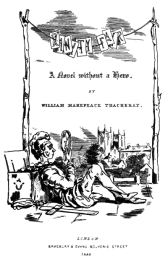 Teaching Vanity Fair is always a morally significant experience: it prompts so much reflection on what really matters, both in the world you actually live in, and in the world you wish you lived in.
 I can tell I sound peevish, and I suspect, too, that I’m not doing the novel justice — that I was reading it wrong, that I am hung up (as we can all get) in wondering why it isn’t a different kind of book, my kind of book, instead of the book it is. But I am also trying to put my finger on what about it turned me off, especially because it took a while for me to start chafing against it. Perhaps it is telling that my irritation began more or less when it switched from his story to hers, and she’s the one with the malignant capacity for deceit, she’s the angry one, she’s the one who may not, in spite of what Lotto thought, have “goodness at her core.” We’re supposed to be uncomfortable with her, I’m sure — but in her beautiful duplicity does she turn out to be just a sexist cliché, a kind of modern-day Duessa? Or is my vision of her as wrong as Lotto’s?
 Defining my terms, which in turn will define my boundaries, is clearly one of the first thing I have to do. It’s inevitably going to be a somewhat arbitrary exercise, and the stakes aren’t that high given that the course is one of our first-year writing requirement classes and, as the calendar description implies, its main purpose is just to begin students’ training in literary studies. It doesn’t have to be an in-depth, theoretically complex, or even particularly thorough exploration of pulp fiction, whatever that is. It differs from the first-year class I usually teach (Introduction to Prose and Fiction) only in having what we hope is a sexier hook — it promises readings that at least sound more fun than what you might get in a standard literature class. Students in recent incarnations of the course, then, might have been surprised to find themselves reading Pride & Prejudice, Jane Eyre, or Much Ado About Nothing, all of which I have seen in recent Pulp Fiction syllabi!
 I’m not actually 100% sure True Grit is “pulpy”: does it transcend its genre? I think maybe it is to the general run of Westerns what Hammett or Chandler might be to crime fiction: still definitely of its kind, but the best, or most intense, version of it. Its story is simple and its pacing is relentless, but it’s the narrator that makes it particularly interesting. Mattie bristles with paradoxical qualities: she’s prim, abstemious, and insistently righteous, even as she’s razor-sharp and ruthless. She won’t touch a drop of whisky (“I would not put a thief in my mouth to steal my brains”) but she doesn’t hesitate to pull the trigger when she finally comes face to face with her father’s killer (“I pointed the revolver at his belly and shot him down”). She doesn’t much like the sight of hangings, but when she has to, she pulls the arm off a corpse and uses the long bone to save herself from falling into a pit of rattlesnakes (“I was grateful to the poor man for being tall”). Is she hilarious or heroic? Both and more, I think, and it’s her combination of naiveté and grit that wins over her jaded allies, who don’t want her along but then won’t leave her to die. And we hear all about it in the voice of aged Mattie, who still has no patience for people who waste time on pointless talk:
