Dubious Comfort: Barbara Pym, Quartet in Autumn

quartet

There was something to be said for tea and a comfortable chat about crematoria.

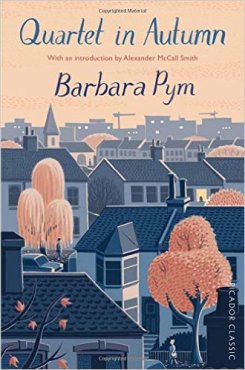
Early in Quartet in Autumn, Letty — one of the novel’s quartet of main characters — reflects on her past as an “unashamed reader of novels”: “she had come to realize,” we’re told, “that the position of an unmarried, unattached, ageing woman is of no interest whatsoever to the writers of modern fiction.” They are of great interest, of course, to Barbara Pym, who could be considered the patron saint of all such overlooked and underestimated women.

Quartet in Autumn actually balances our attention between two more in Pym’s panoply of spinsters and two — what to call them? what is the male equivalent of a ‘spinster’? That we don’t really have one is suggestive of the ways in which aging alone is different for women than it is for men. Still, terminology aside, the characters have a lot in common besides having worked for many years in the same office (that we never learn anything about where they work or what they actually do becomes one of the novel’s tragi-comic aspects). Though one of the men is a widower, now they are all equal in their mutual isolation, and if that sounds like a paradox (how can they be so alone if they’re all together so much?), I think that’s one of Pym’s points: that simply sharing time and space, even over many years, does not in itself create meaningful connections between disparate people. And yet by the end of the book, which is certainly one of the gloomier Pym novels I’ve read, the connection between them has become something just slightly more than any of them thought or expected, and therein lies what small comfort a book about aging, retiring, losing one’s strength and faculties, and dying unmourned can offer.

I thought Pym was especially good — meaning both funny and painful — about retirement, which for many working people surely seems as much a looming threat as an anticipated promise. When Letty and Marcia retire, they are not replaced: “indeed,” we’re told, “the whole department was being phased out,” which raises discouraging questions for them about the value of the work they’ve done for all those years, and even about the reality of their entire working lives:

It seemed to Letty that what cannot now be justified has perhaps never existed, and it gave her the feeling that she and Marcia had been swept away as if they had never been.

This gives her, understandably, a “sensation of nothingness” that is hard to overcome despite the opportunity retirement affords “to do all those things she had always wanted to do” — “unspecified” things that turn out not to be all that fulfilling after all, and which hardly take up all the time she now has. Her first day of retirement is “as tiring as a working day” from the very effort to occupy herself, including during “a period between tea and supper which she did not remember as having existed before.” Perhaps because retirement is much in the air at my own workplace, with similar non-replacement policies raising questions both practical and principled, personal and existential, for all of us, her experience seemed particularly poignant to me: I know how much it can hurt someone to get the message the institution they have devoted themselves to can treat them as an expensive redundancy, someone to be urged out and happily done without.

Sad as the novel’s premise is — it is, indeed, autumnal, with its focus on unwelcome but inevitable changes in all facets of its characters’ lives — it is somehow never, or never completely, melancholy: Pym is too funny for that. There’s the saga of the misfit milk bottle, for instance, which I won’t spoil by relating — it’s not so much that I would ruin any suspense about it as that I could never capture quite why it is so daftly comical, but also so spot on about human nature. Alexander McCall Smith is quite right, in his introduction, to say that “we all have something that is the equivalent of that symbolic milk bottle.” It’s a smaller-scale comedy here than we get in Kingsley Amis’s Ending Up (which is the earlier book club choice that led us here), but it’s also kinder: wry, rather than bitter. Though Pym gives us one truly depressing story about ending up alone, she softens the blow by helping us realize that even in age there are choices, and as long as you have a little life left in you, there are still “infinite possibilities for change.” The novel ends up feeling like a calming cup of tea on an otherwise bad day: it can’t really fix anything, but in its own way, it is bracing.

Responding to Srigley, Over and Over and Over

Lady (Waterhouse)I have been very glad to see eloquent and well-informed responses to Ron Srigley’s screed “Pass, Fail” in The Walrus (which largely reiterates his screed in the Los Angeles Review of Books). I was disappointed in both venues, frankly: it seems to me to show poor editorial judgment to publish rants of this kind without checking their intemperate anecdata and wild generalizations against at least a broader sampling of facts and opinions about the very complex business that is higher education. I would have expected both journals to think better of themselves and their readers. Both Aimée Morrison and Melonie Fullick have offered valuable critiques — but because these writers don’t go to extremes, either rhetorically or ideologically, their thoughtful pieces almost certainly won’t get as much attention, and because Srigley is preaching to a nasty choir of higher ed haters, rather than actually trying to engage people interested in meaningful dialogue, critique, or reform, the people who are gleefully linking to his article are unlikely to step back and reconsider the nature or value of his arguments.

I thought about writing a detailed response as well — not because I have done the kind of research that makes Melonie so well-qualified to speak up, but because I found Srigley’s sweeping denunciations of “contentless” classrooms, the replacement of what he considers important topics by “narcissistic and transparently self-promoting twaddle,” and professors who “pandered to [students’] basest inclinations while leaving their real intellectual and moral needs unmet” profoundly insulting — to me and my colleagues and to the generations of students we have taught. Further, the claim that “most degrees involve no real content” is not just a lie but, in our current economic and political climate, a damaging lie. Yes, there are grains of truth in his criticisms of the way universities are run and in his descriptions of the sometimes incompatible priorities of students, staff, and faculty. But most of us who are dealing with these problems every day on the job (and evenings and weekends too, much of the time) do not need “friends” like Srigley, who is actually an enemy of the enterprise we are all, collectively, engaged in, in good faith if sometimes with flagging spirits.

By the time I finished his LARB piece I was seething, and I was seething again, and also profoundly discouraged, when I saw it resurrected in The Walrus. Is this really the story about higher education that people want to read? It must be, or relatively sober publications that could certainly afford to turn it down wouldn’t run it: they must have figured that it would generate traffic, and I’m sure they were right. (You’ll notice I have not linked directly to either iteration here, because I hate that the internet incessantly rewards the worst over the best.) I fervently believe that my work, and the work of thousands of others like me, is not a “retail scam”: maybe, I thought, I should try to explain why not.

WP_20140827_005But then I realized that I have said so, that I have made my argument — over and over, for almost 10 years. Here at Novel Readings I have posted regularly about my teaching, for instance, since 2007, when I began my series on “This Week In My Classes” because of other equally vitriolic and unbalanced public criticisms of my life’s work. I have shared details about what my classes are studying, I have raised questions about pedagogy, I have fretted about students who don’t seem engaged and celebrated the much more numerous ones who care a lot, I have explored new subjects and developed new material, I have sought advice and sometimes comfort. In other words, I have tried to do the opposite of Srigley’s grand dismissive gestures: I’ve invited anyone who’s interested to come inside the academy and see for themselves what I’m up to.

I can’t rule out the possibility that someone would read through my archive of teaching posts and still reach Srigley’s dire conclusions about the state of higher education. I know, too, that I’m just one professor, so my first-person experience is also, in its own way, anecdotal rather than conclusive. But I honestly think my efforts to meet my students every time with the best that I can come up with are more representative than Srigley’s dystopian exaggerations. I’m surrounded every day with colleagues who similarly strive, with all their intelligence, creativity, and fortitude, to bring their students with them to intellectual places they think are both interesting and vitally important. Every day, we are all surrounded with students who meet us at least half way, and some who take us further than we would have gone on our own. Sure, some don’t, or won’t, for both good and bad reasons, some of them individual and some of them structural. But an imperfect process is a sign of a work in progress, which is always what education is.

Novel Readings is still a pretty quiet corner of the internet; whatever hope I had, back in 2007, that my teaching posts would make even a slight difference to the larger public narrative about higher education has long subsided. But the archive is there for those who want a different perspective: rather than grand statements, they provide a steady record of particulars. I’m not going to attempt any further response to Srigley, because in these posts I have, implicitly, responded already, over and over and over: instead, I’m just going to keep doing what I’ve been doing, both here and, especially, in the classroom, where it really matters.

On This Day I Complete My 49th Year

hyacinthIt sounds more poetic when Byron says it! Also, of course, he was only 36 — and I think that was the last poem he wrote, whereas I certainly hope this is not my last post! There’s nothing particularly poetic about turning 49, in any case. It’s not a landmark age, and I’m not doing anything in particular to mark it: pizza and a beer, probably, and I made cupcakes yesterday that Maddie should be frosting as I write. Then probably last night’s episode of The Good Wife, and time to call it a night! Sounds relaxing. Sounds middle-aged. Sounds about right!

Birthdays do inevitably prompt reflection, though, more (for me, anyway) even than New Year’s Eves do. I was thinking about numbers this morning: in 2016 it will be 26 years since I moved away from Vancouver (still, in my heart, the place I consider home); 24 since I got married; 21 since I moved to Halifax and began my job at Dalhousie; 19 since I first became a mother. It’s approximately 44 years since I started reading, and since I started listening to opera — still the biggest sources of enrichment and pleasure in my life. It’s 16 years until I reach retirement age…but who’s counting, right? 🙂

Those seem like big numbers! They represent a lot of change but also a lot of continuity: as another poet said, though much is taken, much abides — and at the same time, the old order changeth, yielding place to new: it’s 9 years since I started blogging, 6 years since I joined the editorial team at Open Letters Monthly, and less than 1 year since my first review ran in the TLS. I don’t know what the next year will bring, personally or professionally — as George Eliot says, “Among all forms of mistake, prophecy is the most gratuitous” — but the older I get, the better I understand what I want and don’t want. I suppose that’s progress of a kind, if not necessarily wisdom.

It’s Easter Monday here today, which is not a holiday at Dalhousie, so my classes met as usual. There are worse ways to spend a couple of hours on my birthday than talking about Indemnity Only and Hard Times. It felt good today that I needed my notes so little — that we could keep the discussion going, and keep it interesting. File that under things I want more of in my 50th year: good books, good talk about books. I know some of that will happen here at Novel Readings, so thanks as always to everyone who reads and comments!

This Week In My Classes: Hard Times – for these times

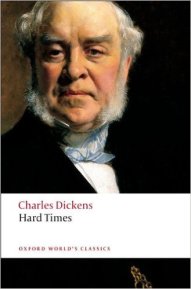
hardtimes

Dear reader! It rests with you and me, whether, in our two fields of action, similar things shall be or not. Let them be! We shall sit with lighter bosoms on the hearth, to see the ashes of our fires turn gray and cold.

Dickens’s subtitle for his 1854 novel Hard Times was “for these times.” I can’t remember another occasion teaching this novel when it has felt so much as if it is also for these times: in the U.S., especially, where Mr. Bounderby is running for president, and Gradgrinds dominate state houses and the governing boards of public universities. There’s a lot not to like about Dickens’s approach to the ‘condition of England’ question but my reservations about, for instance, his anti-union stance and the unbearably condescending (if also unbearably touching) presentation of Stephen Blackpool seem less important right now than his urgent call to readers to resist the dehumanizing influences of greed, materialism, suspicion, and general Gradgrindism. Is there a more stinging and eloquent indictment of these tendencies than his memorable description of Coketown in the chapter aptly called “The Key-Note”?

Fact, fact, fact, everywhere in the material aspect of the town; fact, fact, fact, everywhere in the immaterial. The M’Choakumchild school was all fact, and the school of design was all fact, and the relations between master and man were all fact, and everything was fact between the lying-in hospital and the cemetery, and what you couldn’t state in figures, or show to be purchaseable in the cheapest market and saleable in the dearest, was not, and never should be, world without end, Amen.

Is there a more despicable figure imaginable than Mr. Bounderby, with his insufferable, dishonest cant about his own prowess?

He was a rich man: banker, merchant, manufacturer, and what not. A big, loud man, with a stare, and a metallic laugh. A man made out of a coarse material, which seemed to have been stretched to make so much of him. A man with a great puffed head and forehead, swelled veins in his temples, and such a strained skin to his face that it seemed to hold his eyes open, and lift his eyebrows up. A man with a pervading appearance on him of being inflated like a balloon, and ready to start. A man who could never sufficiently vaunt himself a self-made man. A man who was always proclaiming, through that brassy speaking-trumpet of a voice of his, his old ignorance and his old poverty. A man who was the Bully of humility.

“You may cut the piece out with your penknife if you like, Tom. I wouldn’t cry!” exclaims Louisa after Bounderby kisses her on the cheek, and the violence of her antipathy seems if anything inadequate to the rage and disgust we feel on her behalf at his creepily pedophiliac obsession with her. Such a grotesque predator should have nothing, be nothing, count for nothing — and the genius of Hard Times is that it makes us feel how horrible it is that such a man gets any kind of respect, and lets us enjoy seeing him exposed for the repellent bully he is.

The novel also, in more subtle and moving ways, unfolds the tragedy of Gradgrindism, personified in Tom’s dishonor and Louisa’s collapse. Here the conversion of Mr. Gradgrind himself holds the novel’s most significant promise: that the unnatural domination of fancy by fact can be overcome by pity and love — that humanity is greater and stronger and more beautiful than is dreamed of in the Gradgrind philosophy, and that if we can all be brought to laugh and cry together, we can save it.

If only real life gave us the same satisfaction, the same hope. Dear reader — let it be so!


Weekend Miscellany: Reading and Watching

SweetDisorderIt’s a busy time at work, with papers and midterms piling up a bit, so it’s still a bit quiet over here at Novel Readings.

I have been doing some extra-curricular reading, but the serious stuff has been for reviews, which I don’t usually anticipate with commentary here. I’ve been filling in the interstices with some light reading, mostly romances. I’ve been trying out some more recent “historicals” to see if I can find more writers among the many, many there are to chose from that I can reliably enjoy. I have had pretty mixed success with historicals up to now: a lot of them seem really thin and formulaic, and only a few authors so far (notably Cecilia Grant and, sometimes, Loretta Chase) have become personal favorites. I read Rose Lerner’s Sweet Disorder and quite liked it (I’d read her In For  a Penny before, and liked it too). Then, encouraged by having mostly liked My American Duchess, I also read another of Eloisa James’s, Any Duchess Will Do, and I enjoyed it as well, enough that I’ll probably keep poking around in her vast back catalog. Both of these books, however, did add to my sense that, for me, the pacing, or maybe the balance, is off in a lot of modern romance novels: when the hero and heroine have sex fairly early on, instead of as the culmination of their developing relationship, the book becomes (again, for me) too much about their lusty goings-on and the romantic tension is lost. Other forms of angst are typically introduced, something to tear them apart before they can finally have it all, but I usually find that angsty part tedious and the final resolution belated. This is one reason I often skim the last third of these books: the fun part seems to be over before then. In contrast, I just reread Heyer’s Venetia and it seemed to me perfectly balanced: just sexy enough, just tense and surprising enough, and just charming enough to be thoroughly satisfying.

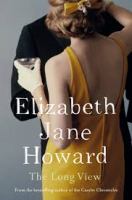
longviewThe “literary” book I’ve been reading “for fun” is Elizabeth Jane Howard’s The Long View, which I bought after my book club read and enjoyed The Beautiful Visit and, in the same week, Hilary Mantel coincidentally published a persuasive essay about Howard in which she singled out The Long View as exceptional. It is very good of its kind, I think, and yet I am bogged down about half way through it because right now that “kind” feels claustrophobic. It’s an emotionally intense, scrupulously nuanced examination of an unhappy marriage — well, it’s unhappy when the novel begins, but because of the novel’s ingenious backwards-chronological structure, the relationship is building towards happier beginnings. Howard’s prose is wonderful and the psychological, social, and sexual complications of the couple’s life together are exquisitely, if painfully, drawn, but the novel feels airless to me: it doesn’t seem to be offering me any sense of the broader view of their life — of its impersonal contexts. The novel feels too personal, too minute, and it makes me restless for a narrative, or a narrator, that looks around and draws connections between these small complicated lives and the bigger world they’re set in. I may be missing ways in which Howard’s subtleties do exactly that, and of course since I’m not finished the novel yet, I can’t say whether things change in it, either. But my boredom (shocking! but true) with the novel got me thinking about the books that have really excited me lately and they have tended to be books with wider scope, often (though not always) historical: Dunnett’s King Hereafter, Nicola Griffith’s Hild, Adam Johnson’s The Orphan Master’s Son. Is it because I already live a narrowly personal existence (and spend enough time scrutinizing the complex nuances of marriage on my own behalf) that right now I want fiction that does something, goes somewhere, else? Or maybe it’s just that when I’m busy and distracted, I lack the patience for novels that are all about the finely-wrought sentence and the emotional minutiae of daily life.

happy-valleyAlso, when I’m busy and distracted, the lure of television is very strong! And, conveniently, Netflix recently dropped two tempting series — the fourth season of House of Cards and the second season of Happy Valley — both of which we’ve now seen. In retrospect, I’m actually kind of sorry I watched House of Cards. After the third season, I wasn’t sure I wanted to see any more of it, and this season will almost certainly be my last. The show is just so unpleasant: the people are loathsome; the acting is … well, it has its moments, but mostly it’s uninspiring; the plot is absurd; and the show overall is so cynical, not just about the world it depicts but also, I think, about what its viewers want or will tolerate. I did admire the color palette and cinematography, but otherwise, it’s a show that made me feel bad about myself for wanting to see what would happen next. Happy Valley, in context, though very grim in its own way, is brilliantly acted and tells stories about richly human individuals trying to bring some sense and order into their lives, with a protagonist whose anger and toughness are offset by compassion and a strong, if often thwarted, desire for justice. Even the crimes, horrific as they are, come out of contexts that are believable and morally complicated. It’s also almost absurdly refreshing to see women play prominent roles without having to look like stick insects and wear ridiculous stiletto heels.

OK, that gets me about caught up! Now, back to the next book I’ll be reviewing, if I can just get it all read, and then to Hard Times, which I start with my 19th-century fiction class tomorrow. Now there’s a classic that still has something to say “for these times.”

What Price Genius? Helen DeWitt, The Last Samurai

samuraiGreat news: New Directions is putting out a new edition of Helen DeWitt’s The Last Samurai, which is without a doubt one of the best, most surprising, and most moving novels I’ve read in the last decade or more. I’m excited to reread it when it appears in all its finery. In the meantime, here’s what I wrote about it when I read it for the first time.


The Last Samurai is the story of a single mother, Sybilla, and her son, whom she calls “Ludo”–though on his birth certificate it says either ‘David’ or ‘Stephen,’ ‘one or the other.’ It makes sense that Sybilla would consider it pointless to be certain, because one of the things this novel is about is precisely how we figure out and then live up to who we think we are. It’s also about the accidents that determine the lives we lead, regardless of who we might be, and about the choices and values and loves and hates and languages and books and ideas and music and art and movies and people that constitute those lives and make them worth living–or not. It’s a celebration of genius and an attack on mediocrity, a paean to the human capacity to create and learn and think and reason and a lament for the seductions of banality. It’s about quests and heroes and, of course samurai. Its parade of erudition is at once dazzling and surprisingly entertaining, and also inspiring, because it’s in the service of intellectual curiosity and love of knowledge, not accomplishment or grades or prizes. It’s Ludo’s curiosity, in particular, that gives the novel its momentum: he is a child prodigy whose brilliance at once thrills and terrifies his mother. Ludo’s voice, and his quest for his father, eventually take over the novel from Sybilla, but she remains its presiding genius; without her, Ludo’s endless questions would go unanswered. Though their relationship is never sentimental (indeed, they rarely seem like parent and child, at least in the ways we would casually expect), their attempts to care for each other have an emotional intensity and an intellectual integrity that are ultimately very moving. A book so extravantly episodic and allusive risks losing its humanity. Somehow, miraculously, for all its jouissance, all its postmodern display, The Last Samurai never does.

This is a novel that feels exceptionally difficult (and more than usually pointless) to excerpt from–and yet, the temptation! And it incorporates so much that it’s difficult to know what to single out for commentary. One aspect of it that is obviously very important, both structurally and thematically, is its engagement with Kurosawa’s The Seven Samurai (which I have never seen–but the range of things alluded to in this novel that I don’t know first-hand is so long there’s no point remarking them all). The Seven Samurai is Sybilla’s favourite film. Not only does she watch it over and over, but she thinks of it as taking the place of a male role model in Ludo’s life. What she doesn’t expect, when she first shows it to him (when he’s five) is that it will prompt him to demand to learn Japanese.

L: When areyou going to teach me Japanese?

I: I don’t know enough to teach you.

L: You could teach me what you know.

I: [NO NO NO NO NO] Well

L: Please

I: Well

L: Please

Voice of Sweet Reason: You’ve started so many other things I think you should work on them more before you start something new.

L: How much more?

I: Well

L: How much more?

The last thing I want is to be teaching a five-year-old a language I have not yet succeeded in teaching myself.

I: I’ll think about it. . . .

Her problem is that Ludo is urgent with his demands to learn, not just Japanese, but Latin and Greek and much much more, and that there isn’t, really, any reason not to teach him whatever he wants to know except the widespread (mis)understanding that he is too young for this kind of thing–a view they encounter over and over as they ride the Circle Line to keep warm:

. . . he has been reading the Odyssey enough for a straw poll of Circle Line opinion on the subject of small children & Greek.

Amazing: 7

Far too young: 10

Only pretending to read it: 6

Excellent idea as etymology so helpful for spelling: 19

Excellent idea as inflected languages so helpful for computer programming: 8

Excellent idea as classics indispensable for understanding of English literature: 7

Excellent idea as Greek so helpful for reading New Testament, came through eye of needle for example mistranslation of very simple word for rope: 3

Terrible idea as study of classical languages embedded in education system productive of divisive society: 5

Terrible idea as overemphasis on study of dead languages directly responsible for neglect of sciences and industrial decline and uncompetitiveness of Britain: 10

Stupid idea as he should be playing football: 1

Stupid idea as he should be studying Hebrew & learning about his Jewish heritage: 1

Marvellous idea as spelling and grammar not taught in schools: 24

(Respondents: 35; Abstentions: 1,000?)

Oh, & almost forgot:

Marvellous idea as Homer so marvellous in Greek: 0

Marvellous idea as Greek such a marvellous language: 0

 What place genius, what price genius, in a world like this? These are among the difficult questions Sybilla faces, as she reads about the education (and eventual breakdown) of John Stuart Mill, or about “the example of Mr. Ma (father of the famous cellist).”

samurai (1)One of the most fascinating explorations of this in the novel is the story of the pianist Kenzo Yamamoto, who becomes obsessed, not with how to play a particular note or phrase or piece, but with how else you could play it, or how else it could sound:

Yamamoto: To put it another way, let’s just take a little phrase on the piano, it sounds one way if you’ve just heard a big drum and another way if you’ve heard a gourd and another way if you’ve heard the phrase on another instrument and another way again if you’ve just heard nothing at all–there are all kinds of ways you can hear the same sound. And then, if you’re practising, you hear a phrase differently depending on how you’ve just played it, you might play it twenty or thirty different ways and what it actually is at any time depends on those things it might be–

He gives a disastrous concert at Wigmore Hall in which he played “about 20 minutes of drum music after each of six [Chopin] Mazurkas . . . with the result that the concert ended at 2:30 in the morning & people missed their trains & were unhappy.” Sybilla takes Ludo to hear Yamamoto in concert at the Royal Festival Hall. The first half is uneventful, but after the interval, Yamamoto begins to play the Brahms Ballade Op. 10 No. 1, first just phrases and then eventually the whole piece:

For the next seven and a half hours Yamamoto played Op. 10 No. 1 in D minor, and sometimes he seemed to play it exactly the same five times running but next to the sound of a bell or an electric drill or once even a bagpipe and sometimes he played it one way next to one thing and another way next to another. . . .

Eventually he plays it through nine times along with a tape of traffic and footsteps, then when the tape stops and there is silence he plays it “so that you heard it after and over the silence.” Then, after all those hours playing Op. 10 No. 1, the audience is “shocked to hear in quick succession Op. 10 No. 2 in D major, Op. 10 No. 3 in B minor and Op. 10 No. 4 in B major, and you only heard them once each”:

It was as if after the illusion that you could have a thing 500 ways without giving up one he said No, there is only one chance at life once gone it is gone for good you must seize the moment before it goes, tears were streaming down my face as I heard these three pieces each with just one chance of being heard if there was a mistake then the piece was played just once with a mistake if there was some other way to play the piece you heard what you heard and it was time to go home.

Her bitterness at the inadequacies of the Circle Line riders is balanced by this moment of grace. Why do we put such limits, not just on our children, but on our art? Much, much later in the novel, Yamamoto says to Ludo, “When you play a piece of music there are so many different ways you could play it. You keep asking yourself what if. You try this and you say but what if and you try that. When you buy a CD you get one answer to the question. You never get the what if.” There’s no place for Yamamoto’s “what if” in the world of concert halls and recording studios and trains to catch.

The risk DeWitt takes is that this dedication to the highest possible forms becomes, or at least will come across as, sheer elitism, a blunt attack on popular taste. About a third of the way through the novel, pestered endlessly by Ludo for the name of his father, Sybilla presents him with a challenge: she gives him a tape of Liberace, a drawing by Lord Leighton, and a magazine article and tells him “You will not be ready to know your father until you can see what’s wrong with these things.” More than that,

Even when you see what’s wrong you won’t really be ready. You should not know your father when you have learnt to despise the people who have made these things. Perhaps it would be all right when you have learnt to pity them, or if there is some state of grace beyond pity when you have reached that state.

As Ludo takes over as the novel’s narrator and the plot (to the extent that it is linear) becomes the story of his attempt to find (or choose) his father, this quest to discern the failings of Liberace (which is, not incidentally, also  the code name Sybilla uses for Ludo’s father), of Lord Leighton, and of the boring magazine article runs in parallel. I wasn’t sure I wanted Ludo to grow up into another Sybilla, or even to pass her test–Sybilla herself does not live happily or  easily with her ideas, after all–and yet the whole book pits itself against relaxing into easy compromises, whether moral or ethical or aesthetic (and I’m not sure that the novel allows for a distinction between these). There’s nothing easy about Ludo’s progress towards the novel’s conclusion, but I think that through each of his encounters with potential fathers, he learns and grows in ways that eventually exceed what Sybilla wanted, or even thought was possible, for him.

There’s much more to The Last Samurai than this, but if I started listing off more of its ingredients it would make the novel sound like a kind of flamboyant bricolage rather than the gratifyingly readerly treat it is.

Originally published at Novel Readings October 26, 2011.
This Week In My Classes: Teaching as Therapy

ScreamNot for them — for me!

I have actually noticed this often over my teaching career, but it has been particularly evident to me this week, when I have been feeling quite frustrated, angry, and disheartened by things that need to stay off this blog (at least for now): teaching is good for my mental health. However glum or grim I feel as I head over to my classroom, by the time I come out I almost always feel better: more energetic, more focused, happier about my job and even, usually, happier about my life in general. Why do you suppose that is? Fellow teachers, do you also experience this effect?

I think for me at least one reason it happens is that I always inhabit a persona when I’m teaching: class is always a bit of a performance, with me playing the role of “Myself, Only More So, And More Positive.” Though I am always sincerely enthusiastic about our readings and topics of discussion, I make a point of showing that enthusiasm and being as upbeat and energetic as I can manage about our work. My hope, of course, is that this enthusiasm is contagious, or at least that it gets and maybe even keeps people’s attention, if only in the spirit of “What is this strange woman so excited about?” Even when I’m depressed or cranky otherwise, I try to get into this role once class begins, and after a while, especially if participation is good and the discussion is interesting, I usually forget I’m in a bad mood and just carry on as usual. Advice to “fake it till you make it” has always sounded shallow, even a bit creepy, to me, but in this context, there’s definitely something to it.

marybartonAnother reason teaching is a tonic for me, though, is precisely that I am not faking my interest in the course materials, and time spent really focusing on them brings me back in touch with the things that brought me into this profession in the first place. I loved being an English student myself (well, I loved being an undergraduate student – I mostly hated being a graduate student), and it’s in the classroom that the reasons for that are most present to me: the books themselves, of course, but also the open-minded engagement with them — teasing out what is most interesting, looking at the details and trying to put them into patterns that illuminate the whole, thinking and talking about the ideas that animate them, and all this, best of all, in conversation with other keen readers who bring their own questions and ideas to the process. This week’s readings are very purposeful, too, which gives our work on them extra urgency: in Mystery & Detective Fiction, we’ve just wrapped up Sjöwall and Wahlöö’s The Terrorists, and in 19th-Century Fiction we’ve just started Gaskell’s Mary Barton, so  in addition to their literary particulars, they raise lots of questions about art and politics, about class conflict, about women and economics and law and justice and equality … about values, in other words, and how novels can serve them. That’s good stuff! I have spent a fair amount of time in recent months dealing with the aspects of academia that I like the least. Time in the classroom reminds me that all the rest of it is, ultimately, in service of something I really do cherish.

It’s also just a good thing in general to be forcibly distracted from the source of one’s stress. I am something of a brooder, and when things are giving me trouble they go round and round in my mind, interfering with my concentration during the day, keeping me up at night, and generally infecting my consciousness. At these times, it’s not ideal to have reading as my chief hobby and pleasure, as it is a relatively passive activity and does not necessarily keep the troubled mind from wandering. Writing, too, can become pretty compromised by stress. If I do get caught up in either reading or writing, it can be wonderfully transporting and restorative, but sometimes that turns out to be a big “if.” Teaching, however, absolutely demands my full attention — which is why it can be so exhausting, but also, I think, why it can be so therapeutic. If for an hour or more you simply can’t get on that mental hamster wheel of doubt or anxiety or confusion, you may be a little slower clambering back on it when you return, and who knows, eventually you may even bypass it entirely and find a clear, positive path forward.

“There Was More To It”: Elmore Leonard, Valdez Is Coming

valdeziscoming

He would say to Tanner, ‘You see how it is? The woman doesn’t have a man, so she needs money. You have money, but you don’t have a woman. All right, you pay for the man and you get your woman.’

It seemed simple because in the beginning it was simple, with the Lipan woman sitting at her husband’s grave. But now there was more to it. The putting him against the wall and tying him to the cross had made it something else.

Elmore Leonard’s Valdez Is Coming is the second Western I’ve read and the first real Western, since I gather True Grit is properly considered more of an anti-Western, a self-conscious (if appreciative) tongue-in-cheek revision of Western tropes rather than a sincere instance of them.

Although I already feel as if these two might be enough Westerns for me, I thoroughly enjoyed Valdez Is Coming, partly because it is so sincere, not to mention suspenseful. It is also stylish: the prose is terse, repetitive, and epigrammatic in ways that reminded me of hard-boiled detective fiction — which makes sense, of course, as the two genres are closely related. When setting up Hammett or Chandler in my Mystery & Detective Fiction class, I always talk about frontier justice and the appeal of the vigilante, and also about the idea of the hard-boiled hero as (quoting Robert B. Parker) “the last gentleman”: he belongs, Parker says,

to the chivalric tradition — a tradition he shares in this country with the Westerner. He is not of the people; he is alone.  His adventures are solitary statements.  his commitment is to a private moral code without which no other code makes sense to him.  He regularly reaffirms the code on behalf of people who don’t have one.  He is the last gentleman, and to remain that he must often fight.  Sometimes he must kill.

It’s a central paradox of the hard-boiled private eye that his violence elevates rather than condemns him: for us to accept that, we have to be convinced of his “private moral code,” to believe that he kills for the right reasons. This means that though the stories are filled with action, they really turn on principle — and that is exactly true of Valdez Is Coming. By the end of the novel Valdez has killed over a dozen men, but even though by then things are more complicated than they seemed at first, there’s no doubt that he’s in the right, that we are rooting for him as he picks them off one by one in defense of himself but also of the code he can’t quite articulate but follows without equivocation.

What exactly is that code? It begins with an instinct for justice: Valdez kills a man for the wrong reasons, not without meaning to but certainly without wanting to, and figures that he and the others responsible owe the man’s pregnant widow reparations. The dead man is black, however, and his woman is Apache, so nobody else believes they owe her anything. When Valdez confronts Tanner, whose wrong identification led to the shooting, with his proposals, Tanner’s men test his nerve by using the wall around him for target practice:

Valdez felt his hat move and felt powder dust from the adobe brick in his eyes and in his nose and felt chips of adobe sting his face and hands and felt a bullet plow into the wall between his knees and a voice say, “A little higher you get him good.”

He keeps his cool, staring them down and eventually, when Tanner’s “segundo” calls enough, riding away. But when he comes back a second time with the same request, Tanner’s men beat him, tie him to a cross, and send him crawling home — or, more likely, to die in the dust and the sun. Now it’s not just about justice for the woman: it’s also about his own honor and the need to turn this humiliation and defeat into victory. I won’t spoil the fun by giving away any more details. It’s enough to quote the pitch-perfect cover blurb: “They were still laughing when Valdez came back. And then they began to die . . . ”

valdez2Valdez himself is an interesting character: though he feels no ambivalence about his specific conflict with Tanner, he is less certain about his own role in life more generally, and the relationship he develops with Tanner’s fiancée Gay (whom he kidnaps as leverage) adds more nuances. It’s to be expected, though, that the protagonist will have some depth, so what I appreciated more is the way key secondary characters also have their own motives and their distinct roles to play in the denouement, including Gay herself but also Tanner’s “segundo.” One of the best bits in the novel is wholly inessential to its plot but adds a great deal to the atmosphere and to our sense of the kind of world its characters live in. Valdez shoots one of Tanner’s men and sends him back with a message. He delivers it and then lies dying, and we spend nearly two pages with him as he reflects on Valdez, and on his own life and immanent death:

He should have thought more about the way the man stood at the wall and watched them shoot at him. He should have remembered the way the man got up with the cross on his back and was kicked down and got up again and walked away. Look — someone should have said to him, or he should have told himself — the man wears three guns and hangs a Remington from his saddle. What kind of man is that? And then he thought, You should know when you’re going to die. It should be something in your life you plan. It shouldn’t happen but it’s happening. He tried to raise his left arm but could not. He had no feeling in his left side, from his chest into his legs. His side was hanging open and draining his life as he looked at the sky. He said to himself, What is the sky to me? He said to himself, What are you doing here alone?

Life may be cheap in this world, death may be fast and sure, but the existential pathos here counteracts the indifference, courage, or grim determination with which the characters otherwise seem to confront their harsh circumstances.

I’m surprised, really, how much fun I found Valdez Is Coming. Still, I can’t imagine reading a lot of books like this — not in a row, certainly. I also have some hesitations about teaching it: it is full of racial slurs, for one thing, and while I think it’s pretty clear not just that they are historically and contextually appropriate but also that the novel as a whole rejects the attitudes they express, that does create some pedagogical challenges. There’s also a lot about its contexts that I don’t know, and of course this is not the kind of novel that’s available in a helpfully annotated edition! That can be rectified with research, though, and for better and for worse it does seem more “pulpy” than True Grit.

This Week In My Classes: Catching Up

When it’s quiet over here at Novel Readings, that’s generally a sign that I’m busy elsewhere, and that is more or less what’s been up this week. After I got back from Louisville, I had some catching up to do, especially with midterms that needed to get graded so we could all move on to the next thing. Don’t you find, too, that a break in routine throws you off when you get back? I felt really off my teaching game last week, though I hope it didn’t show too badly in the classroom. There are non-teaching things that have also been taking my attention away from teaching more than is usual during the term: our workload is usually described as 40% teaching, 40% research, and 20% administration, but for me the distribution during a teaching term tends to be closer to 60-20-20, with the summer months bringing things back into alignment. For various reasons the balance has been different for me this year — not, perhaps, officially, but at least in where my attention is. So I don’t think I’ve been at my best in class.

Still, we are moving along. In Mystery & Detective Fiction we’ve wrapped up our discussions of The Big Sleep, and in 19th-Century Fiction today was our last day on Jane Eyre. Next week we start Mary Barton, and I’m looking forward to it partly because it’s not a novel that’s well known, in itself or through adaptations. I mentioned before the challenge of teaching a book as beloved as Pride and PrejudiceJane Eyre isn’t quite as much of a general favorite, but it definitely still a personal favorite for many students — which, again, is great in some ways but occasionally challenging. I don’t think anyone has any preconceptions or cherished readings of Mary Barton (well, except me, and that kind of goes with the territory!). I began my own rereading of it while the students were writing their Jane Eyre “mini-midterm” today, and I felt a momentary pang that I’d chosen it over North and South (my usual Gaskell), but then I started to get drawn into both its personal stories and its class politics. It isn’t as neat and artful as North and South, but that very untidiness can be something of an advantage for discussion.

I’ve been doing some reading outside of school, but the two books I’ve finished are both ones I’m reviewing elsewhere, so I didn’t want to blog about them. (In case you’re interested, they are Dan Vyleta’s Smoke and Dinitia Smith’s The Honeymoon; details about the reviews will be forthcoming if all goes well.) I guess if you want some nice fresh book writing you’ll have to go to Open Letters instead, where the March issue — our 9th anniversary issue — is full of good things, from Sam’s review of A. O. Scott’s Better Living Through Criticism to Steve’s happy appreciation of a gorgeous new book on frogs. But come back soon! Because I’ve got Valdez is Coming to read this weekend, and I promise to post about it.

On Having and Earning Critical Authority

IMG_3141I don’t want to leave the impression that frustration with the rigidity of academic practices is all I took away from my Louisville conference experience. There was definitely value for me in the work I put into my own paper, as well as in hearing and discussing the papers my co-panelists presented. So I thought I’d follow up my previous post with a sketch of the questions I went to Louisville to talk about.

My paper was called “Book Blogging and the Crisis of Critical Authority.” During the discussion after our papers, all of the panelists agreed that things have died down since the days when you could hardly turn around without seeing yet another “bloggers ruin everything” article. A few diehards still take every opportunity to decry the temerity of feckless amateurs who think they can just go online, say whatever they want, and call themselves “critics” (I’m looking at you, William Giraldi), but by and large (as Dan’s paper convincingly argued) the success of many serious web magazines has proven that online criticism can be as good as if not better than its old media competition, and book blogs in all their idiosyncratic variety are now a familiar, if not always respected, feature of the critical landscape.

Daniel Mendelsohn’s conspicuously temperate “Critic’s Manifesto” was one sign of the changing times; in it he acknowledged (as so many of his professional colleagues would not) the existence of “serious longform review-essays by deeply committed lit bloggers.” Mendelsohn did still conclude that “everyone is not a critic”; he cites “expertise and authority” as crucial qualifications (“knowledge … was clearly the crucial foundation of the judgment to come”) along with a more ineffable quality that he sums up as “taste” (“whatever it was in the critic’s temperament or intellect or personality that the work in question worked on“). Though he concedes that the requisite knowledge does not depend on formal credentials such as Ph.D.s, he does ultimately describe the critic’s job as being “to educate and edify” — so, it’s still a top-down or hierarchical model.

ao scottMendelsohn’s article was one of the sources I cited in my paper, in which I explored some questions about what we mean by “critical authority.” As he notes, once you move outside the academy degrees are neither a necessary nor a sufficient measure of the relevant expertise. But it’s not easy to pin down what does count, how authority is established, especially in a field of inquiry where there are no sure or absolute standards of judgment. Literary critics know that their authority is unstable because the history of criticism teaches us how judgments change over time, while simple experience shows us how much they differ among individuals. We can call variant assessments “gaffes” or “errors in individual taste,” as Mendelsohn does in his recent New York Times review of A. O. Scott’s Better Living Through Criticism, but he can’t actually prove that “early and wince-inducing takedowns of John Keats’s poetry, [or] of “Moby-Dick” are flat-out wrong any more than I could convince my Modernist colleagues that George Eliot is objectively a better novelist than James Joyce. Still, the rhetoric of criticism as well as its traditional methods of delivery typically seek at least the appearance of offering definitive judgments. As Sebastian Domsch argues in his interesting essay about ways the internet transforms critical genres, criticism has typically attempted to be and sound “monologic,” as if “everything that needed to be said has been said and there are no more follow-up questions possible.”

One reason blogging aroused such hostility, I proposed, was that it exposed the artifice of this model, and indeed of any idea of literary criticism as a series of edicts issued from on high, leaving critics themselves exposed, not as frauds, but as less authoritative than they pretended to be. As Mendelsohn says in his review of Scott, “the advent of the Internet” has “rais[ed] still further questions about authority, expertise and professionalism”; I argued that it has done so by breaking down monologic forms and exposing the inherently dialogic nature of both critical judgments and critical authority. Domsch defines “critical authority” as “the level of acceptance that is conceded by a reader to an aesthetic value judgment”: I think he is right to emphasize that this kind of authority is not inherent in the speaker but conferred by context and audience. In my paper I drew on Wayne Booth’s notion of “coduction” to make the case for the importance of dialogue in developing critical judgments, and I pointed to blogging as a form that establishes “follow-up questions” as both a natural and an inevitable part of criticism.

MendelsohnBarbariansIf critical authority is not something you simply have but something you have to earn and maintain by your own participation in a dialogue — if it is best understood not so much as a top-down assertion of superiority (“the critic’s job,” Mendelsohn proposes in his recent review, “is to be more educated, articulate, stylish, and tasteful … than her readers have the time or inclination to be”) but as a process of establishing yourself as someone whose input into an ongoing conversation is sought and valued — that helps explain why “expertise” is such a tricky thing to define for a critic. Mendelsohn’s original formal training is as a classicist — despite his wide-ranging erudition and critical prestige, he would almost certainly not qualify for an academic position in any other field — but obviously he has written with considerable insight on a wide range of subjects, from Stendhal to Mad Men. That so many of us read Mendelsohn’s criticism with interest and attention no matter what he writes about is a sign that we have come to trust him, not as the last word on these subjects, but as someone who will have something interesting (“meaningful,” to use one of his key terms) to say about them. If we disagree with him, we are not challenging his authority but continuing the conversation — and in fact one thing I’ve been thinking a lot about is how little disagreement really matters to this kind of critical authority. If what we go to criticism for is a good conversation, then engaged disagreement can be seen as a sign of authority — a sign that you care enough about the critic’s perspective to tussle with it, if you like. I can think of a number of critics in venues from personal blogs to the New Yorker whose views I would not defer to, but which I want to know because they provoke me to keep thinking about my own readings — which (however definitive the rhetoric I too adopt in my more formal reviewing) I always understand to be provisional, statements of how something looked to me in that moment, knowing what I knew then, caring about what I cared about then.
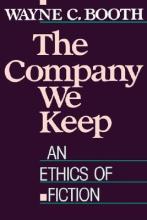
boothcompanyI’m not saying we can’t or shouldn’t defend our critical assessments, but awash as we are and always have been in such a variety of them, it would be naively arrogant at best and solipsistic at worst to imagine ourselves as “getting it right,” no matter who we are or where we publish. Blogging very often reflects that open-endedness in its tone, and its form is based on just the process Booth describes as “coduction”:

‘Of the works of this general kind that I have experienced, comparing my experience with other more or less qualified observers, this one seems to me among the better (or weaker) ones, or the best (or worst). Here are my reasons.’ Every such statement implicitly calls for continuing conversation: ‘How does my coduction compare with yours?’

The comment box makes that implicit call explicit. This doesn’t mean “erudition, taste and authority” (the qualities Mendelsohn repeatedly invokes) don’t matter — though the extent to which they matter will depend on what you want from criticism. Domsch argues, for instance, that Amazon reviewing ultimately returns us to the most monologic form of criticism: people seek out, or are steered to (by algorithms, ‘like’ buttons and so on) the reviewer whose views and tastes are closest to their own, and once they find their “virtual” critical self, their critical proxy, as it were, they have found their perfect authority, a guarantor of their own well-established tastes. But Amazon is fundamentally about shopping. If you read criticism for some reason other than deciding which book to buy next, you are likely to look for and concede authority to different qualities. In my paper I noted that I don’t want to be told about books — I want to talk about books. So sympathetic as I am with most of what Mendelsohn says, I resist his insistence on the critic’s superiority as a necessary or structural part of the relationship.

The result of accepting, rather than resisting, the challenge blogging poses to old-fashioned critical forms is, I argued, not a catastrophically relativistic criticism of the kind Peter Stothard dreaded but a pluralistic criticism, such as that described by Carl Wilson in Let’s Talk About Love:

a more pluralistic criticism might put less stock in defending its choices and more in depicting its enjoyment, with all its messiness and private soul tremors — to show what it is like for me to like it, and invite you to compare. This kind of exchange takes place sometimes on the internet, and it would be fascinating to have more dialogic criticism: here is my story, what is yours?

I’d be very interested to know what you think about this argument, particularly about my proposal to redefine “critical authority” in a more reciprocal and context-dependent way than the anti-bloggers always do. What makes a critic “authoritative” to you? Or is “authority” not something you think or care about? If it isn’t, how would you explain what makes a critic someone you want to listen to or engage with? Are there critics you pay attention to because their taste (I might prefer the term “sensibility” myself) reflects yours, or because they push you to less familiar points of view? Does disagreeing with a critic make you doubt them, or does it depend on the critic, or the context? More generally, what do you want from criticism, and how do you think that affects where you read it and who you listen to?

The first picture here is one I took of the Big Four Bridge across the Ohio River from Louisville to the Indiana side. It was a really nice walk across and back!