 Tomorrow we start our work on Adam Bede in my 19th-Century Fiction class. As I was rereading the opening chapters last week, I tweeted, a bit facetiously, that you could probably “launch a successful attack on the whole foolish ‘show, don’t tell’ myth using excerpts from Adam Bede alone.” This was in part a delayed reaction to a comment on my post about Lillian Boxfish Takes A Walk: “it didn’t work for me at all as fiction,” Irene said; “A lot of telling, not showing.” To which I replied, “I’m a fan of telling. How could I not be, as a Victorianist?” Because when people invoke this supposed rule, what they usually seem to mean is that good writing should be dramatic, not descriptive, and that, above all, it should avoid extended passages of exposition — and what would Victorian fiction be without description and exposition? Frankly, I’ve also read a few too many recent novels that leave empty space where telling might in fact be really valuable, and where its absence looked to me a bit like shirking the admittedly hard work of doing it well.
Obviously, the casual assumption that good writers show rather than tell is a pet peeve of mine, but it’s also not an assumption that I think is actually that widely or strongly held by avid readers, who in my experience tend to agree with Henry James that “the house of fiction has many windows.” (Not that we don’t have own own favorite styles, but confusing taste with objective evaluation is … well, OK, it’s inevitable, but it should at least be self-conscious!) The source of this “rule” seems to be creative writing classes, but I wonder how strong its hold is even there. The creative writers I know seem unlikely to be so narrow-minded, and here is an admirably nuanced ‘lesson’ on showing vs. telling from novelist Emma Darwin.* The right technique, surely, is the one that best achieves a writer’s goals, including not just formal, stylistic, and aesthetic ones but also substantial ones. There are things that exposition in particular can do that simply can’t be provided in any other way: historical or philosophical context for the novel’s action, for instance, or psychological insights unavailable to the characters themselves.
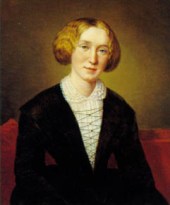 If your ideal fiction is not analytical in these ways, then showing might be enough for you. But that means your novels will never include anything like Chapter 15 of Middlemarch — in which almost nothing actually happens, but we, as readers, learn an enormous amount — or, to get back to Adam Bede, anything like its Chapter 15, “The Two Bed-Chambers,” which is a stunning set piece of characterization. It includes both showing and telling. The actions of both Hetty and Dinah, for instance, speak volumes about who they are: most obviously, Hetty stares into her mirror while Dinah gazes out the window. The narrator layers meaning onto their actions with pointed descriptions — Hetty’s “pigeon-like stateliness” as she paces back and forth in her shabby faux-finery, for instance, and Dinah’s tranquility as she feels “the presence of a Love and Sympathy deeper and more tender than was breathed from the earth and sky.” We are brought close into each character’s consciousness, and then drawn out again to a broader perception, which is the characteristic pulse of George Eliot’s fiction, and running through it all is her perspicacious commentary:
Nature has her language, and she is not unveracious; but we don’t know all the intricacies of her syntax just yet, and in a hasty reading we may happen to extract the very opposite of her real meaning. Long dark eyelashes, now — what can be more exquisite? I find it impossible not to expect some depth of soul behind a deep grey eye with a long dark eyelash, in spite of an experience which has shown me that they may go along with deceit, peculation, and stupidity. But if, in the reaction of disgust, I have betaken myself to a fishy eye, there has been a surprising similarity of result. One begins to suspect at length that there is no direct correlation between eyelashes and morals; or else, that the eyelashes express the disposition of the fair one’s grandmother, which is on the whole less important to us.
“What a strange contrast the two figures made!” exclaims the narrator after Dinah, provoked by intuitive anxiety about where Hetty’s “blank” nature might lead her, interrupts Hetty’s dreams of becoming a “lady” by rapping on her door:
Hetty, her cheeks flushed and her eyes glistening from her imaginary drama, her beautiful neck and arms bare, her hair hanging in a curly tangle down her back, and the baubles in her ears. Dinah, covered with her long white dress, her pale face full of subdued emotion, almost like a lovely corpse into which the soul has returned charged with sublimer secrets and a sublimer love.
I’m pretty sure that’s telling — but how could you simply show that contrast, which lies less in the details visible in the “mingled twilight and moonlight” than in the difference they represent between the flesh and the spirit, or between egotism and altruism, which the whole previous sequence has prepared us to realize?
 I know that what some readers object to in Eliot’s style of telling is that she doesn’t seem to leave us to draw our own conclusions about her characters: her commentary usually steers us firmly in a particular direction. Her narrator is much less forgiving than Dinah, for example, about Hetty’s vanity, and so too is Mrs. Poyser, who sees Hetty’s “moral deficiencies” quite clearly. It’s not that she doesn’t leave us plenty to think about, though. Adam Bede dedicates much more than this one chapter to analyzing Hetty’s character and motives, for example, as well as to exploring the effect on them of her specific circumstances. A great deal of effort, in other words, goes into understanding Hetty — including the unarguable fact of her vanity, which means not just her pleasure in her own beauty but her inability to tell any story without herself at the center of it. Also, we know that “Hetty could have cast all her past life behind her and never cared to be reminded of it again” — which, in Eliot’s world, means she is morally unmoored. (“If the past is not to bind us,” as Maggie Tulliver will say in Eliot’s next novel, “where shall duty lie?”) What, though, is the relationship between this deep understanding (the kind required by Eliot’s theory of determinism) and forgiveness? If we can explain so thoroughly what someone does so, and if we are under a moral obligation to sympathize with them, what happens to accountability, to blame, to justice? If you know where Hetty’s journey takes her, and why, then you know how painfully these questions arise in Adam Bede.
 My point, I guess, is that this central problem of the novel is vivid to us — it matters to us — in part because of what we have been told. It is an intellectual problem, not (to borrow from Darwin’s post) a “scratch-and-sniff” one. Yet, having said that, it’s absolutely true that we feel its urgency in part because the narrator gets out of the way at crucial dramatic moments, such as during the novel’s second great set piece with Dinah and Hetty much, much later, in Hetty’s prison cell:
Slowly, while Dinah was speaking, Hetty rose, took a step forward, and was clasped in Dinah’s arms.
They stood so a long while, for neither of them felt the impulse to move apart again. Hetty, without any distinct thought of it, hung on this something that was come to clasp her now, while she was sinking helpless in a dark gulf; and Dinah felt a deep joy in the first sign that her love was welcomed by the wretched lost one. The light got fainter as they stood, and when at last they sat down on the straw pallet together, their faces had become indistinct.
What a great return this is to the earlier scene, with Dinah’s premonition of trouble: “Dear Hetty,” she says, “it has been borne in upon my mind to- night that you may some day be in trouble . . . I want to tell you that if ever you are in trouble, and need a friend that will always feel for you and love you, you have got that friend in Dinah Morris at Snowfield.” When her prediction comes true and Dinah comes to her in her time of trouble, almost all the telling in the chapter is Hetty’s own.
*Actually, after reading her post I am not so sure I really understand what people mean by “showing,” which going by her examples just means “doing description better.” That has never seemed to me to be the implication of “show, don’t tell.” If it is, I don’t think I disagree after all, and you can disregard this entire post! What do you think that rule means — or, perhaps a different question, what do you think people typically mean when they sling it around?
 This week is Dalhousie’s Reading Week, so I’m enjoying a break from the routine of classes. Last week, though, was also sort of a break, or at least a broken up week, thanks to the massive blizzard that arrived late Sunday night and shut the city down almost completely until Wednesday. And then on Thursday another storm hit — meaning we had three full snow days last week on top of a partial closing the week before. That’s a lot of disruption in a hurry! It was also the first time I can remember Dalhousie announcing a closure the day before, instead of at 6 a.m. the day of (ah, the lovely treat of waking up early to find out if you need to wake up early).
 Anyway, one way and another we made our way through the week, and the snow, and now it’s Reading Week. Just because classes aren’t meeting doesn’t mean there isn’t plenty to do, including prepping and grading for them. After the break, we’re starting Adam Bede in 19th-Century Fiction. As this is the first time I’ve assigned it in an undergraduate class, I have no pre-existing materials to draw on, so working some up has been a priority this week. I do know the novel pretty well from having taught it several times in
  Also on my to-do list this week was finishing a review of Lesley Krueger’s Mad Richard for Canadian Notes & Queries, which looks like it will be ready to submit tomorrow, and finalizing my own and my contributors’ pieces for the March issue of Open Letters Monthly. This issue will mark OLM’s 10th anniversary! I didn’t join up as an editor until 2010; I was in time, then, to contribute to our 5th anniversary celebration,


 I enjoyed Lillian a lot. I particularly appreciated the pleasure she takes in words, which is both appropriate to her vocation and part of what she stands for in the face of a world that she thinks is giving up its commitment to civility and to cleverness in favor of appealing — like the insidious Oreo commercial — to our subconscious desires, rather than our reason and our imagination. She misses the clever “verbosity” she and her friends treasured in her youth. During her New Year’s Eve walk, she finds herself trying to walk to the beat of a rap song she heard from a car window as she set out and reflects that “this is where playful language is cherished now”:
 Rooney’s author’s note explains that Lillian is based on Margaret Fishback, a copywriter and poet whose verses stand in for Lillian’s in the novel. I don’t know how closely Lillian’s character (as opposed to her life) is meant to resemble Fishback’s, but Rooney has given us a woman who is frank and tough enough that the novel is never twee or sentimental. It’s also very evocative of New York, a city where I too have always preferred to walk, so as not to miss anything. When I was a student at Cornell, I used to go there regularly, and I always loved the feeling of freedom it gave me, as if anything is possible on its hectic streets. Lillian Boxfish Takes a Walk doesn’t indulge this visitor’s fantasy — Lillian’s New York is gritty as well as iconic — but I ended the novel feeling renewed enthusiasm for going back and talking another walk around Manhattan myself.
 You’d think from my recent blog posts that I wasn’t doing anything but teaching these days! That’s not quite true, but like a lot of people I know, I’m finding myself too distracted to get a lot of “quality” reading done in my leisure time – what ability I have to concentrate hard I’m expending on work, and on books I am reading for off-blog reviews that have deadlines. The rest of the time my reading alternates between anxiety-inducing news stories and pleasantly diverting romance novels.
 I have some completed reviews that should see the light of day in the near future. One of those is my TLS review of Danielle Dutton’s Margaret the First (which I loved); another is my Quill & Quire review of Jean McNeil’s The Dhow House (which is strange and uncomfortable and gripping); and the last is my review of Yasmine El Rashidi’s Chronicle of a Last Summer, which I wrote last summer and is expected to show up, at long last, in The Kenyon Review Online in early March. Though there are some down sides to all this reviewing, one definite up side is that it has made me a bit more sure-footed as a critic, including with books that are not obvious “fits.” I can’t really say if I am developing my critical voice or style: I’m not deliberately trying to do anything other than what I’ve always done here and at OLM, which is find the best way to express whatever I think about the book. I don’t focus on answering “should I buy this book or not?” — because that’s the kind of review I find the least interesting to read — but instead I try to figure out what kind of book it is and what’s the most interesting conversation for me to have with it or about it. Academics (myself included) often hesitate to get into conversations outside their official area of expertise: this is an anxiety I have largely overcome when it comes to fiction, partly because blogging loosened me up so much as a reader and a writer, and partly because the more I teach, the more I’m aware that my expertise is as a reader — it’s my skill and experience at reading, as much as or more than my body of scholarly knowledge, that equips me to do this kind of criticism.
 As for my romance reading, I’ve been rereading some favorites, just for the good cheer (Georgette Heyer’s Devil’s Cub, for instance, and Tessa Dare’s Any Duchess Will Do), but I’ve also read a scattering of new ones. I have all of Courtney Milan’s Brothers Sinister novels but hadn’t gotten to
  I read Eloisa James’s Seven Minutes in Heaven and thought it was fine — as I mentioned on Twitter, I especially appreciated the heroine’s competence, which is a quality not often portrayed as attractive, and I enjoyed following the character through to their HEA. I also read Fool for Love, which I chose somewhat at random from the ebooks the library had available: I liked the set up but was a bit let down by the conclusion, for reasons I won’t give in case they are spoilers! I have yet to really fall in love with one of James’s novels. They seem very competent and usually keep me interested to the end, but they don’t make me laugh the way Loretta Chase’s do, and I don’t find them as entertaining as Tessa Dare’s (which seem more sprightly, somehow) or as touching as my favorite among Mary Balogh’s. Maybe I haven’t found the right one for me (not all of Dare’s work well for me either, after all).
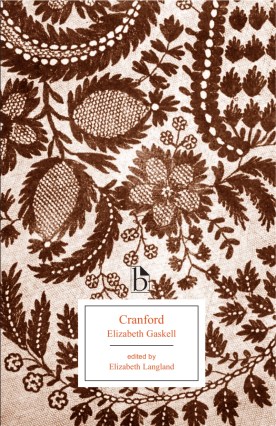 We’ve started our discussions of Elizabeth Gaskell’s Cranford in 19th-Century Fiction, and like last week’s reading, it has special resonance in these turbulent times, but not because it is a call to action: more because it provides a refuge. This is not to say that it’s “escapist” in the pejorative way that term is often applied, or that it is all (metaphorically) rainbows and lollipops. Actually, rereading the first few chapters I’ve been particularly struck this time by how melancholy they are, despite the wonderful touches of comedy. There are so many deaths — not nearly as many as in Valdez Is Coming, of course, but whereas in that novel most deaths leave little emotional mark, each of the losses in Cranford is deeply felt. There’s little drama (well, Captain Brown’s is pretty startling) but much tenderness. I love the delicacy with which we are brought to understand the depths of Miss Matty’s grief after Mr. Holbrook dies:
 Although it is often difficult to concentrate on reading fiction right now, amidst the clamor of current events, it is also the case that current events have their usual uncanny way of making some of the novels I’m reading seem more important than ever.
 The other novel I’ve been working on for class is Valdez Is Coming. It is a pretty different reading experience in almost every way, but it too turns on questions about what’s right and what’s fair, and about when and where to draw the line in the face of an injustice. “Why do you bother?” Valdez is asked about his quest to get restitution for a widow whose fate nobody else cares about because she’s Apache and her dead husband (though shot by Valdez himself) was the victim of their unrepentant racism. “If I tell you what I think,” he replies, “it doesn’t sound right. It’s something I know.” By that time we know too why standing up to the men who mocked him, shot at him, then crucified him when he asked for justice is something he has to do. It’s about not letting them win, yes, but that outcome matters because of who they are, and who he is — and, if we’re on his side, who we want to be, and how we want the world to be. “You get one time, mister, to prove who you are” he tells his antagonist during their final showdown. Valdez (true to his genre) proves who he is through action, including a lot of violence. (I wouldn’t like this novel as much as I do if this violence were treated differently — simply as action, for instance, or drama — but Leonard imbues it with
  The past couple of weeks have felt pretty hectic to me, mostly because any time you teach a new course, or just new material, you have to build up all its materials from scratch. This term it’s Pulp Fiction that needs, well, everything! Not only do I not have any lecture notes to draw on for most of the readings (but boy, am I looking forward to our weeks on The Maltese Falcon, which I
  In 19th-Century Fiction we are nearly through Bleak House. They seem to be hanging in there! In this class too I have felt myself falling into too much lecturing, but I have been consciously working on balancing that out with some much more open-ended sessions. I feel as if lecturing in a more orderly way can be an important part of our work on a novel as long and complex as Bleak House, where a risk for newcomers to the novel is getting overwhelmed by minutiae: I try in my lecture segments to give them big grids or maps on which they can later place specific characters or incidents as they arise, or rise to prominence. I also try to plant interpretive seeds in the form of questions to be followed up on as they read further. That way, when we do approach topics through discussion, they will already have been thinking about some of them on their own — which usually seems to work!

 I don’t mean to sound unduly negative about it. I did think it was a good novel; I was just hoping, even expecting, that it would be better than good. Probably it’s another case of my expectations being raised unreasonably by the generally effusive reception it got, or maybe I just read it too soon after


 Novel Readings