 Though I suppose in a technical way the bicentenary year really ended with George Eliot’s birthday on November 22, why stop celebrating before we have to? My only regret is that I’m not actually teaching any of her novels this term–in fact, because of my sabbatical, I haven’t taught any George Eliot in 2019 at all! Shocking! So I haven’t been able to integrate any bicentenary activities into my classroom time. I did point out to the students presenting in Women & Detective Fiction on November 22 that it was an especially auspicious day, but they didn’t seem convinced or otherwise excited. 🙂
My own contributions to the bicentenary since attending the big conference in the summer have both come to fruition in the last week or so. The edition of the TLS that recognizes George Eliot’s 200th includes my review-essay on novels about or inspired by her, including Kathy O’Shaughnessy’s new In Love With George Eliot, as well as essays by renowned Eliot biographer Rosemary Ashton and scholar Gail Marshall; it also reprints Virginia Woolf’s well-known TLS essay from 1919. That’s excellent company to be in!
 And speaking of excellent company, also in honour of the bicentenary I was invited to be a guest on the CBC Radio show ‘Sunday Edition,’ to talk to host Michael Enright about George Eliot and Middlemarch. You can listen to the interview here if you are interested, or just read the story, which includes some highlights as well as a photo of me post-interview looking perhaps a bit flustered but also genuinely happy to have my battered teaching copy of Middlemarch in hand. Inevitably, no doubt, there are a few questions I wish I had answered a bit differently (including being a bit more precise about ‘the Catholic Question’ – but on the other hand, would anybody really have wanted me to get into the weeds about it?), but overall I think I represented Team George well. I only wish I had taken more opportunities to quote directly from the novel. I really do think the best advocate for Middlemarch is the novel itself.
 As I browsed through it in preparation for the interview, I stopped to reread many of the moments I love the best–the description of Lydgate’s discovering his vocation in Chapter XV, with its poignant commentary on “the multitude of middle-aged men who go about their vocations in a daily course determined for them much in the same way as the tie of their cravats,” for instance:
there is always a good number who once meant to shape their own deeds and alter the world a little. The story of their coming to be shapen after the average and fit to be packed by the gross, is hardly ever told even in their consciousness; for perhaps their ardor in generous unpaid toil cooled as imperceptibly as the ardor of other youthful loves, till one day their earlier self walked like a ghost in its old home and made the new furniture ghastly. Nothing in the world more subtle than the process of their gradual change! In the beginning they inhaled it unknowingly: you and I may have sent some of our breath towards infecting them, when we uttered our conforming falsities or drew our silly conclusions: or perhaps it came with the vibrations from a woman’s glance.
Or the passage in which Mr. Casaubon, having met with Lydgate about his prognosis, confronts his own mortality:
Here was a man who now for the first time found himself looking into the eyes of death — who was passing through one of those rare moments of experience when we feel the truth of a commonplace, which is as different from what we call knowing it, as the vision of waters upon the earth is different from the delirious vision of the water which cannot be had to cool the burning tongue. When the commonplace “We must all die” transforms itself suddenly into the acute consciousness “I must die — and soon,” then death grapples us, and his fingers are cruel; afterwards, he may come to fold us in his arms as our mother did, and our last moment of dim earthly discerning may be like the first. To Mr. Casaubon now, it was as if he suddenly found himself on the dark river-brink and heard the plash of the oncoming oar, not discerning the forms, but expecting the summons.
This is the scene that leads first to his cold rebuff to Dorothea’s proffered sympathy and then to this moment, one of the most quietly moving in the novel but also one that shows us both the beauty and the cost of its doctrine of sympathy:
“Dorothea!” he said, with a gentle surprise in his tone. “Were you waiting for me?”
“Yes, I did not like to disturb you.”
“Come, my dear, come. You are young, and need not to extend your life by watching.”
When the kind quiet melancholy of that speech fell on Dorothea’s ears, she felt something like the thankfulness that might well up in us if we had narrowly escaped hurting a lamed creature. She put her hand into her husband’s, and they went along the broad corridor together.
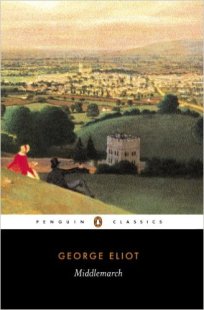 I don’t know if Middlemarch is, as the CBC headline proposes, “the greatest English novel of all time.” I think Eliot (for reasons I discuss in the interview) can reasonably be called the greatest Victorian novelist, and Middlemarch is certainly her greatest book, but there are other models of the novel and other ideas of greatness: as Henry James said, the house of fiction has many windows. One of the things I said to Michael Enright during our conversation was that our judgments of any given novel will depend on what we think the novel (both the particular example and, I think, the genre as a whole) is for. I’m not (much) interested in defending Middlemarch to people who don’t like it, but I am always happy to explain what I think is wonderful about it. I wouldn’t be much good at my job, also, if I didn’t believe we can all learn to read books–all books, any book–better than we do, if someone will just help us along. I hope my interview does some of that work for listeners, and of course for readers who want even more help, there are lots of resources at my Middlemarch for Book Clubs site.
But, as I often say and said in the interview too, I loved Middlemarch when I read it as an ardent teenager with really no understanding of the multiple layers I see in it today. In fact, it is possible that the pressure to declare it, defend it, or dethrone it as “the greatest English novel” hinders rather than helps, by making it seem less accessible than it really is. In any case, I loved it then and I love it now, and any book that withstands multiple rereadings over more than three decades is surely worth celebrating, as is its brilliant author. So, happy 200th birthday to George Eliot, and I can’t wait to teach Middlemarch again in 2020.
 Ask anyone on campus — student, staff, or faculty — how they are doing and it’s likely you’ll get some version of “hanging in there.” It is ever thus, in November! The weather has turned grey and the unrelenting chill of winter has set in, deadlines that seemed far off loom, work piles up. It can be hard to keep one’s spirits up! One of the things I try to do is stay as positive as possible in the classroom, exuding as much enthusiasm as I can manage for our work in the hope that I can give a bit of a boost to my students’ understandably flagging energy. It’s sometimes a bit tricky, especially because for them I am one of the people setting the deadlines and demanding the work: I can’t really just play nice, at least not all the time. But at least I can try to show them that I scare because I care!
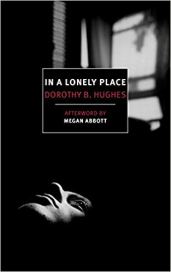 Both of these books seem to have gone over well. Hughes in particular seems to have been a favorite, so much so that I am contemplating assigning In A Lonely Place in the Mystery & Detective Fiction survey class next year instead of my usual hard-boiled options (The Maltese Falcon and The Big Sleep). But Neely too has provoked really engaged conversations: I think we all appreciated the bluntness of Blanche’s critiques as well as Neely’s resistance to feel-good outcomes. Today, for example, we talked about Blanche’s decision not to accept the position she is offered after the case has wrapped up. It would have been sentimentally gratifying for her to stay on as Mumsfield’s caretaker, but throughout the novel she highlights how condescending as well as burdensome she finds the expectation that she’ll play the “Mammy” role, and fond as she is of Mumsfield (and generously as they promise to pay her) it makes sense that she can’t say yes. More broadly, too, an ending in which she stays on with the family after everything that has happened and everything she knows–not just about them but also about the world she lives in–would endorse an optimistic but facile vision of racial reconciliation that the rest of the novel has rejected as at best naive.
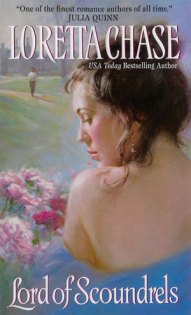 We are well along in our romance unit now in Pulp Fiction, and about two-thirds through Lord of Scoundrels. I think it’s going OK. Today I got peevish towards the end of class because we were working collectively through some passages–it was going pretty well, from my perspective, with a reasonable number of students participating–and as the end of our time approached quite a few students started packing up and then sat poised on the edge of their seats, clearly impatient to get away. I try not to take this personally (it happens, to some extent, almost every time): I know they are busy and anxious and for all I know the ones who were most visibly disengaging had a big midterm in their next class or something. Still, I never go over our time, and not only is it rude to me and to the students who are talking to have all that rustling going on, but it’s demoralizing to see them visibly not caring about the work we’re doing. It undermines that positivity project I mentioned! It also frustrates me that they clearly see class discussion as expendable in a way that lecture time isn’t. From my perspective, that’s the most important thing we do! I’ve made this point to the class more than once, of course. See? Peevish.


 On the other hand, I did appreciate the metafictional commentary on the genre scattered throughout Magpie Murders, though it was (as far as I could tell) somewhat gratuitous or incidental to the novel(s). If the stories Horowitz was telling subverted expectations more than they do, or if their resolutions turned in some way on critiquing the ubiquity of murders on page and screen or the idea that anything about crime is in any way “cozy,” then the whole novel would (for me) have taken on much greater significance. Still, he raises good points about the perverse gratifications of the form even as he unapologetically offers them up, twice over. “I don’t understand it,” says Detective Superintendent Locke when Susan meets with him to discuss her questions about Conway’s death. “All these murders on TV–”
 That, she concludes, is “why Magpie Murders was so bloody irritating”–unfinished as it is when she first reads it. For me, though, the end of Horowitz’s Magpie Murders did not provide much satisfaction. The dotting of the i‘s and the crossing of the t’s seemed to show up the whole elaborate exercise as artificial, an impressive display of plotting but little to feed any deeper curiosity. I prefer my crime fiction more character driven, and also more embroiled in social and political contexts. I know Horowitz can write that kind of mystery, because he wrote
  I certainly did not desire the disruption that has characterized my last few days at work! My office building was evacuated Thursday morning–just as I was settling in to do, well, a whole bunch of things! It turned out that due to some kind of maintenance mix-up,
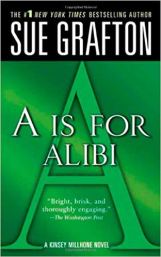 We have been working through Sue Grafton’s A is for Alibi, which everyone seems to have enjoyed quite a bit. It is fast-moving and sassy in a way that (IMHO)
  I was reminded this week, though, that besides being a bit more fun, Grafton’s novel has its own thought-provoking elements, particularly in its development of a male character who plays the part of the femme fatale and also (as other critics have noted) of an extreme form of the Byronic hero–mad, bad, and dangerously sexy to the female protagonist. In our discussion, we found it interesting that while the male hard-boiled PI rarely seems genuinely attracted to the femme fatale, whose allure (at least in the examples we could think of) is too transparently a decoy, Kinsey and Charlie do seem to have an actual spark, even an affinity. Desire is conventionally disruptive to the detective’s work, and it is to Kinsey’s too, but at the same time it almost feels as if it’s just bad luck he’s a murderer, because otherwise they’re pretty well suited! Kinsey’s resolute independence–her refusal to be domestic or to conform to gendered expectations–is refreshing, though I think some aspects of it (like the pride she takes in pumping her own gas) also feel a bit dated now.
 In Pulp Fiction we have been wrapping up work on the second assignment, with drafts and peer editing on Friday and the final versions due Wednesday. Today I gave my opening lecture on romance fiction. Our initial readings are two somewhat polemical primers on the genre (Jennifer Crusie’s
 I didn’t start enjoying the novel more just because the plot became more engrossing, though it did–or because the prose became more pleasurable, because it really didn’t. The other thing that happened was I got used to the slow pace and came to appreciate all the cultural context I was getting through what initially seemed like digressions. It’s true that all the many (many!) descriptions of meals aren’t strictly necessary to the plot, but they certainly added to my sense of what life in Shanghai in the 1990s was like, as did the meticulous accounts of where and how people live:
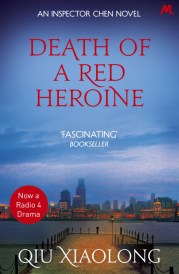 I also really enjoyed the role of Chen’s poetry in his life and in his case–and in the case against him. The idea that his elusive (and allusive) verses harbor subversive messages at once works with the intense suspicion shown by loyal Party members towards anything suggestive of a “Western bourgeois decadent lifestyle” and seemed to me a sly play on the literary difficulty of modernist poetry and the challenge of figuring out what it means. Poring over Chen’s poem “Night Talk,” Zhang wonders if the phrase “mind’s square” is a reference to Tiananmen Square:
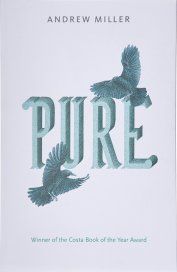 Wine and unsuspected depths of loneliness have produced in him an effusiveness he would not, sober, trust or like in another. Nearly, very nearly, he tells Armand what he is in Paris to do, for surely Armand would be impressed, would see what he himself (in the ruby light of tavern wine) has come to see — that destroying the cemetery of les Innocents is to sweep away in fact, not in rhetoric, the poisonous influence of the past!
 Over time the finds vary: the miners Jean-Baptiste has imported to do the excavation find well-preserved coffins (“inside is a skeleton, the residue of a man, his bones connected by patches of leathery sinew”); a school’s worth of children, laid head to toe; two young women, astonishingly preserved by “a form of mummification” (“skin, hair, lips, fingernails, eyelashes“). These last are of particular interest to the doctors consulting on the dig, using its finds for their own experiments. One is Dr Guillotin, not yet famous for his advocacy of the swift and relatively painless means of execution that came to bear his name. His presence is one of many reminders that this literal purification process is taking place on the cusp of a different kind of transformation, a purging of the past to make way for an as-yet unimagined future.
 Maybe that’s what Miller wanted: to evoke a scene (which he does pretty brilliantly) and a moment, without attaching it to a larger narrative, whether personal or political. But it frustrated me that so many of the novel’s elements felt seeded with meaning that then didn’t bear fruit. I wanted something from the novel that it didn’t give me, some momentum or culmination. That is about my expectations as much as Miller’s accomplishment, I suppose. Still, when the church they are demolishing breaks open to let the light in and Jean-Baptiste observes, “How filthy everything below now appears! How much the place had depended on its darkness!” it seemed to me that the moment was crying out to be read symbolically in a way that the novel more generally didn’t support. Miller writes wonderfully, though, and if you want a really vivid sense of what it would look, feel, and especially smell like to dig up thousands of old corpses, though, you won’t be disappointed!
 Technically, actually, it was in someone else’s class: I was invited to come and talk about social media to our Honours Capstone Seminar, which (among other things) features a range of guest speakers talking about everything from digital humanities to graduate school to (non-academic) career paths.
 As I told the class, I really struggled with what to say. I have given quite a few talks on the subject by now, especially on blogging: these include relatively informal sessions at faculty
  nce upon a time I might have considered these topics equally relevant for our Honours students, many of whom (in those days) were likely heading on to graduate school. A lot has changed, though, and I no longer feel comfortable actively grooming students for an academic path that (as I said to them) now seems strewn with broken glass. (There’s more about how the dismal academic job market has affected academic blogging in
  In my short talk, I did not go into more detail about the arguments pro and con about graduate school in the humanities (and I know there reasons, some of them pretty good ones, or at least not terrible ones, that other people still insist that encouraging students to head into Ph.D. programs is perfectly rational and ethical). I just highlighted some of the many articles they could read about it if they wanted, and urged them to talk to their professors if they were thinking about it. What I decided to use most of my own time for was making sure that they knew graduate school was not the only (and might be far from the best) way to keep talking about the literature they love in ways they find exhilarating. There are, I said, other places, other people, other opportunities, for people who love books, and I know that because of the time I spend on social media.
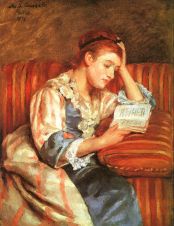 I don’t know if they were very interested in what I had to say. If they were, they didn’t express it through a torrent of follow-up questions, that’s for sure, and I’m also pretty sure that I didn’t make a dent in anyone’s plans regarding graduate school applications. I said things I really believe in, though, which is consistent with what I would have said if I had talked about “best practices” instead, namely, be authentic. Further, and more important, as I worked up these remarks I realized that my own case for twitter and blogging is not really about their academic value anymore either. Whether the students needed or wanted to hear it or not, for me it was useful discovering that I still feel quite passionately about the positive value of reading, writing, and commenting on blog posts, and sharing ideas, tips, enthusiasms, and disagreements about reading via Twitter. Why should they care how much my life changed for the better because one day, without really knowing what I was doing or why, I pressed ‘publish’ on my first Novel Readings post? But I care, and really it has, in ways I could not possibly have predicted. So to the doubters and skeptics (if for some reason you happen to stop by), well, you do you, but I think you’re missing out. And to those of you who, like me, are out here living your best bookish life online and discovering friends and comrades along the way, cheers!
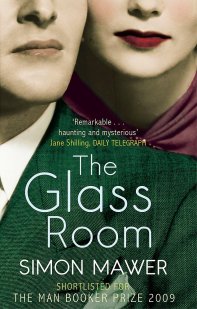 She stands for a moment, one last moment, looking at the Glass Room. Rain runs down the windows like tears from her eyes. The light is diffused, refracted, blurred by the water; just so are memories distorted by time and mood. This is no place for sentiment. It is a place of reason. And yet sentiment is what she feels, the anguish of departure, the exquisite pain of remembering, the fragility of being. When will she be here again?
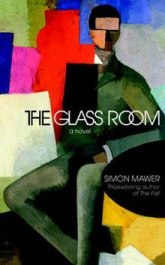 The room itself is beautiful, especially its onyx wall, which reflects the setting sun in an astonishing flare of colour. But not all of its uses are benign: the novel’s historical setting inevitably reminds us of the term ‘Lebensraum,‘ and that anticipates the way the house changes hands and uses when the Landauers flee to Switzerland–Viktor is Jewish, and that puts him and his family at risk. Their house is taken over by German “scientists,” who use it as a laboratory for their research into racial differences:
 Overall, this works well: it’s a good concept, and Mawer comes across as an extremely competent novelist. If that sounds like damning with faint praise, though, it sort of is. I am surprised that The Glass Room was shortlisted for the Booker Prize (in 2009): to me it was a well-executed concept but not an exhilarating accomplishment. At times, it seemed to me to be trying too hard to be great and profound. Its symbolism and its prose both felt heavy-handed, as here:
 We have started our unit on detective fiction in Pulp Fiction and moved from Sayers to Hughes in Women & Detective Fiction, meaning it’s time to test
 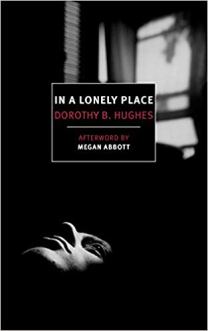 I know The Big Sleep reasonably well at this point (though I still rely heavily on the helpful sketch of the basic plot, complete with who killed whom and why, that I drew up the first time I taught it!). This is my first time teaching In A Lonely Place, though, and so I am feeling my way along, trying to anticipate the most useful lines of discussion to open up, to tell what’s obvious and what isn’t, what examples are most thought-provoking, and so on. One small but important logistical thing you can’t really be sure of until you try it is whether you’ve chosen the right place to break up the novel for reading. I think I should maybe have assigned a bit more of it for today than I did (we read just the first two sections,just about 50 pages), but we didn’t run out of things to talk about, so that was reassuring.
 Novel Readings