Christmas Music

For me (as for many people, I’m sure) one of the things I like best about the holiday season is its music. I grew up in a house full of all kinds of music, and for about six years I worked part time (and sometimes full time) in what we then called a ‘record’ store, The Magic Flute, which specialized in classical music. Getting out the Christmas records was part of an elaborate set of holiday rituals and meals in my family, beginning with our ‘Advent’ brunch the first weekend in December (Eggs Benedict) and culminating on New Year’s Eve (Chicken Florentine and Pêches Flambées, followed by charades and then banging pots and pans on the front porch when we heard the ships in the harbour signal midnight). For probably a decade, somewhere in between these dates my parents hosted a big carol singing party and pot-luck dinner: as their friends are all both musical and great cooks, this was always a joyful occasion! Music was either playing or being played (and sung) nearly all the time, so it’s no wonder that hearing carols now brings back a lot of memories–some more specific than others. For instance, we usually sang ‘Children, Go Where I Send Thee’ driving back over the Lions Gate Bridge from my grandmother’s house in West Vancouver after Christmas dinner (we loved Odetta’s Christmas Spirituals). A highlight of the carol sing event was always ‘The Carol of the Bells’ with all its parts. I used to take Joan Baez’s Noel up to my room when I wanted some quiet time. As a die-hard Joan Sutherland fan, of course I had her Christmas album, and though sometimes I admit her operatic flair is too much for the simpler songs, her version of ‘O Divine Redeemer’ still brings tears to my eyes. (I met her once–but that’s a story for another post.) And of course we had many traditional choral albums, and the Canadian Brass, and Bing Crosby, and Burl Ives singing ‘A Holly Jolly Christmas,’ and a great LP with “Mr Pickwick’s Christmas” on one side and “A Christmas Carol” on the other, read by Ronald Coleman and Charles Laughton (and how fabulous to discover that this is still available! I highly recommend it).

At The Magic Flute, Christmas was a big season, of course. My fellow employees and I used to shudder at the first playing of the Bach Choir Family Carols because we knew we would hear it probably 3000 times before the doors closed on Christmas Eve. The year Kathleen Battle’s A Christmas Celebration came out, it sold like crazy; I recommended it to one woman who came back the next year and sought me out specially to tell me how much she loved it (I love it too, especially its version of ‘Lo, How a Rose E’er Blooming,’ though lately I have been listening more to the Christmas album Battle recorded with Christopher Parkening, Angel’s Glory, which includes what I consider the most beautiful recording of ‘Silent Night’ ever made). One of the biggest issues every year was which recording of Messiah to recommend. Opinions were always divided between ‘original’ and modern instruments; the version with the English Baroque Soloists under John Eliot Gardiner was a big seller. To soothe our nerves during quiet spells, my colleague Mandy and I used to slip on George Winston’s December.

Music is still essential to all holiday festivities, as far as I’m concerned. We got out our current stash of Christmas CDs this weekend. A lot of my old favourites are in the collection, along with ones that evoke holiday memories for my husband (Andy Williams, for instance, and Jo Stafford). We enjoy the Boston Camerata’s Renaissance Christmas and the hyper-traditional O Come All Ye Faithful with the Choir of King’s College, Cambridge; On Yoolis Night by the Anonymous Four will undo any damage wrought by long days at work–or at the mall, which is equally likely this time of year. There are now, too, albums that evoke memories, not of our childhoods, but of our childrens’, such as Loreena McKennit’s To Drive the Cold Winter Away and Sarah McLachlan’s Wintersong. We have rituals of our own, including decorating the tree while listening to Michael Bawtree’s wonderful recording of A Christmas Carol (available only by private sale at this time, as far as I know)–and when we gathered this morning for our own ‘Advent’ brunch, the first thing we did was to put on some Christmas music.

I do think sometimes about the potential incongruity of an atheist embracing Christmas. But then I think of all the sacred music–and art, and architecture–that brings so much aesthetic and emotional pleasure, and I feel reassured that there is no hypocrisy in loving the music even though I do not believe in the specific doctrines it sometimes expresses. After all, when the overall worldview for so long was overwhelming theistic, it is inevitable that art and music should have taken religious form; to turn our back on these great achievements because they belong to a different mentalite is to turn our back on the past simply for being the past. I think, too, of George Eliot’s attitude, expressed implicitly and explicitly in so much of her fiction–that, as she wrote in a letter in 1874, “the idea of God, so far as it has been a high spiritual influence, is the ideal of a goodness entirely human.” I feel the same about the “Christmas” spirit: it’s really just the human capacity for love, charity, forgiveness, and generosity (not to mention reverence, sacrifice, and inspiration) that’s being celebrated, with nothing supernatural about it. The feelings evoked by carols such as ‘Silent Night,’ ‘It Came Upon a Midnight Clear,’ or ‘I Heard the Bells on Christmas Day’ (to mention just a few of my personal favourites) are really no different from the feelings evoked by any beautiful music, and the fundamental ideals of peace on earth and goodwill to men do not in fact require (and may even be hindered by) the specific myths of the Christian tradition. And yet that tradition (as GE acknowledges) for centuries provided a key framework for the development of these ideals (if not their perfect realization–indeed, quite the contrary, as history shows). And so I’m quite comfortable with the secularization of Christmas, which seems to me consistent with the goal of recognizing in ourselves–claiming for ourselves–those qualities most important to making the world a better place. It’s not God who blesses Tiny Tim, after all, it’s Scrooge! Why tie ourselves to the Christian calendar, then? Well, just as Christian traditions were superimposed on pagan and other rituals, so too our modern values and ideas are incorporating old ways and turning them to our own purposes. And the music really is beautiful–so I sing along, rejoicing.

What about you? What holiday albums bring back your fondest memories? Is there a song or a singer you can’t do without at this time of year?

This Week in My Classes (December 3, 2009)

There’s less than one week of classes left in the term–amazing, because it seems like just a moment ago that I was printing off my introductory handouts, getting familiar with the A/V setups in new classrooms, and luring my students through our first readings. I think it’s the relentless need to keep looking towards the next thing (you walk out of your last lecture on North and South, say, and your mind is already buzzing with preparations for your first class on Great Expectations) that makes teaching terms go by so fast. It has felt like a fairly busy term, which is a bit nerve-wracking when I consider that I’m only teaching two classes, both of which are repeats and so I have quite a lot of notes and handouts I can reuse–but next term I have three classes, including one brand new one covering all kinds of material I have never taught before and one graduate seminar for which the expectations and demands are different and harder than u/g lecture courses. Pause for deep breaths . . . but before I get there, there’s still work to be done for this term.

In 19th-Century Fiction we’re working our dreary way through Jude the Obscure. For some reason I’m feeling more kindly towards Hardy’s prose this time. Usually I find him a fairly clunky stylists, blunt in his statements and awkward in his development of both plot and character. But this time I am appreciating the pithiness of his declarations, which gives the novel a polemical cast quite different from our other readings (even though, at heart, most of them have also been polemical, or at least didactic). Here he is describing Jude’s marriage to Arabella, for instance:

And so, standing before the aforesaid officiator, the two swore that at every other time of their lives till deathtook them, they would assuredly believe, feel, and desire precisely as they had believed, felt, and desired during the few preceding weeks. What was as remarkable as the undertaking itself was the fact that nobody seemed at all surprised at what they swore.

Of course, this intrusive commentary ensures that we have the opportunity to be surprised, to look at what is more typically treated as a culminating romantic moment (“I do!”) as a misguided attempt to fix in rigid form something that, as the novel will repeatedly emphasize, is naturally wayward–and to make compulsory feelings, and expressions of feeling, that ought to be (as Sue will later argue) wholly voluntary. That marriage itself is (at least potentially) immoral, rather than a solution to, or a guard against, immorality is one of the radical proposals of this novel. Thus, for instance, Jude’s reunion with Arabella near the end of Part Third has the feeling of an adulterous liaison, even though she is his legal wife; thus, too, Sue’s declaration to Phillotson, her legal spouse, that for her to live with him on “intimate terms” given her feelings for Jude “is adultery, in any circumstances, however legal.” It’s an argumentative book, pressuring us intellectually into emotional reactions that run contrary to a number of both literary and social conventions. Hardy’s language, if not especially elegant and only rarely poetic (in descriptions of landscape, for instance), is effective for that purpose. “Yet he perceived with despondency that, taken all round, he was a man of too many passions to make a good clergyman; the utmost he could hope for was that in a life of constant internal warfare between flesh and spirit the former might not always be victorious”–even if we read this as Jude’s language, it’s stilted, almost pedantic, and yet it makes perfectly clear that a central problem, for Jude and for the novel, is that ‘warfare between flesh and spirit,’ and there’s something to be said for clarity.

Yesterday we spent some time on stones and buildings. I came at this topic by way of Ruskin’s Stones of Venice and the idea that architecture can be “read” as expressing the spirit or values of an age (I tried an analogy also to Carlyle’s “Clothes Philosophy,” though I ended up feeling that trying to explain what he means by that makes things more, rather than less, confusing). This is not a subtle aspect of Jude (as I’ve already suggested, this is not a particularly subtle book in any respect): arriving in Christminster, which Jude has long dreamed of as an “ecclesiastical romance in stone,” he reads the “numberless architectural pages around him.” His work as a stone mason repairing the “rottenness of the stones” is at once practical and symbolic; we considered some of the ways it represents his attempts to realize his dreams even as he learns that the walls around him are keeping him out. We also considered the ways walls and stones and buildings come to represent the burdensome weight of the past, and I proposed some comparisons to the concept of history in Middlemarch, where success seems to lie more in acknowledging, understanding, and developing from the past, rather than rejecting it. Indeed, Eliot’s strongly organic view of history and society make the idea of escaping from the past not just illogical but dangerous (those who ignore their roots are bound to trip over them), whereas in Hardy, the wish seems to be to emerge somehow free from the coercive pressures of the overhanging ages. Mind you, Hardy too does not suggest that such an escape is possible–but for him, I think that’s a tragic impossibility.

In Victorian Sensations we’ve wrapped up our discussions of Fingersmith (such a smart book, as well as a thoroughly gripping read, even after multiple times through it). It really does provide an excellent conclusion to a course in which we have considered not just a series of primary texts in sensation fiction (the ‘inspiration’ or generic genealogy for Fingersmith) but a series of literary historical and critical questions about the genre, its subversive potential or ideological limits, its revisions (or not) of gender identities and class boundaries, its fears, threats, and promises, and its implications for questions of canonicity and literary merit. Waters seems clearly to have considered most of these things too, and to have written many of them into her own book. I don’t think it’s just a pastiche or a period piece, though: one of the reasons sensation fiction has become such a hot area of critical inquiry in recent years is surely that its issues remain ours, and Waters is also engaging in a very contemporary way with problems about writing, gender, and authority, about sexual identities, about eroticism and pornography and exploitation, and about distinctions between genre and ‘literary’ fiction. Every one of her novels has given me that satisfying sense of reading something that has ideas at its heart. I can’t wait to read The Little Stranger–it’s at the top of my Christmas wish list!

In Victorian Sensations Wednesday’s and Friday’s classes this week are devoted to student presentations. I’m using an assignment sequence I’ve used once before with (I thought) great success. I have some reservations about how it is going this year, and I can’t really put my finger on why it has seemed so much more difficult. I thought, in fact, that I had prepared for it better and provided clearer instructions this time around, and yet . . . But Wednesday’s presentations certainly included a lot of good material, and evidence of good thinking and research; I hope Friday’s will too.

Juvenilia

for Ric–little arms!

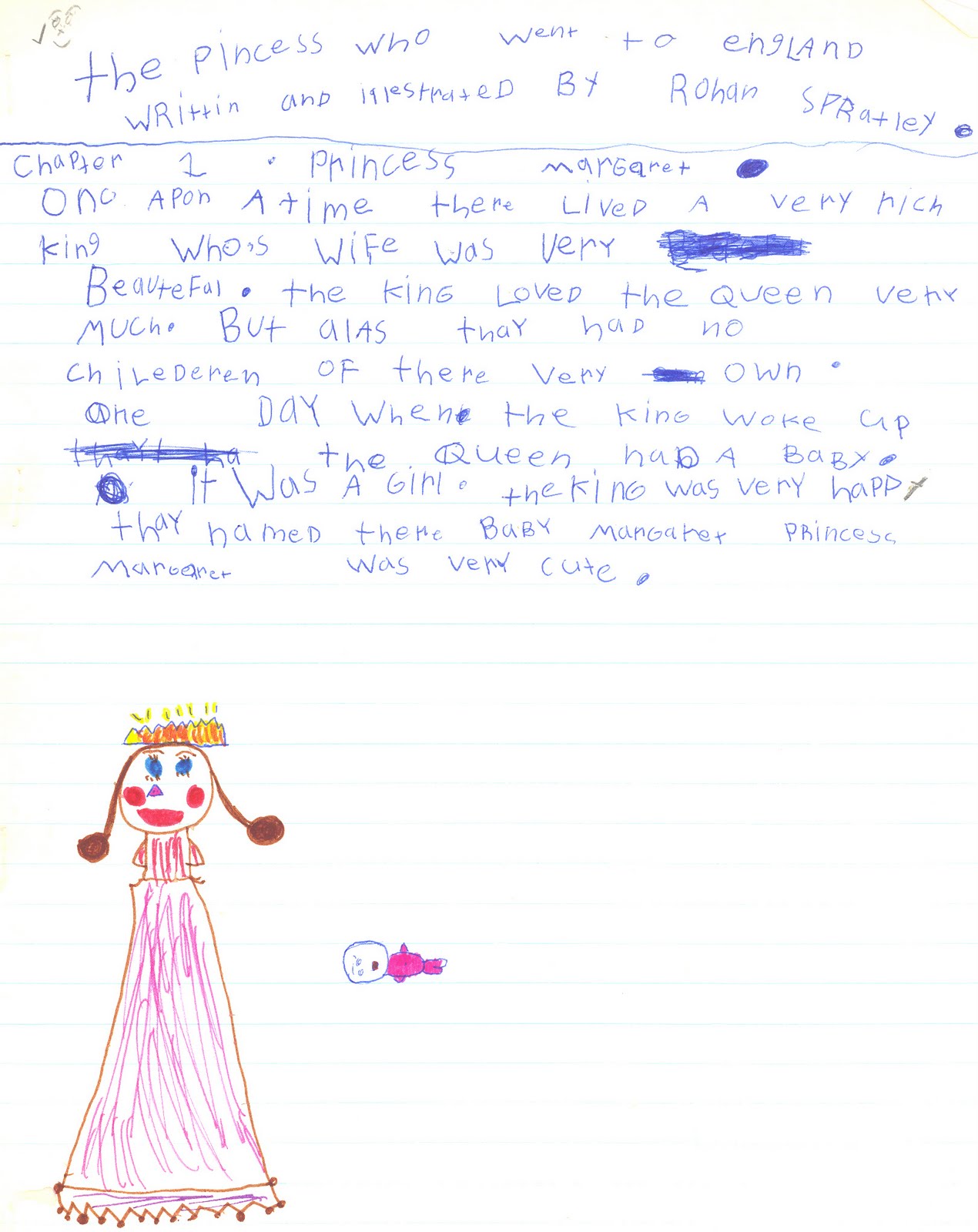
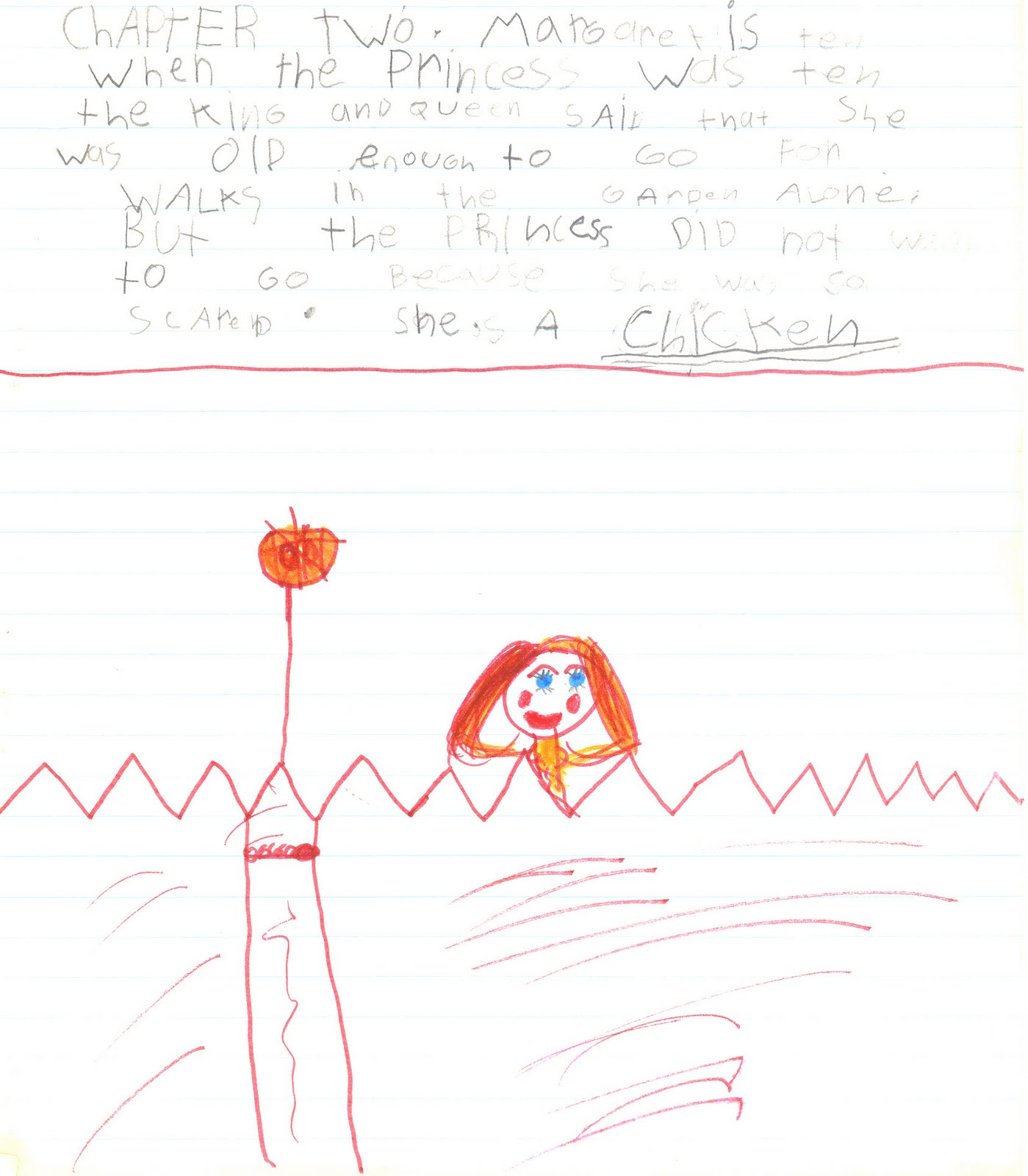
Forget Jane Austen’s History of England. . . Introducing, for the first time ever in digital form, The Princess Who Went to England — also partial, also prejudiced, with even fewer dates, and with a surprise ending!

(technical hint: clicking on the image brings it up full size)


See? I bet you hadn’t anticipated the war. And how postmodern is it to end, and then to end again?

Bonus Feature: Lucia Di Lammermoor in a nutshell:


More real posts soon.

P.S. Princess Margaret is still a chicken; she had a lovely time in England this time too.

This Week in My Classes (November 25, 2009)

In Nineteenth-Century Fiction it’s time for Jude the Obscure. It always strikes me as a fairly gloomy way to wrap up the term, but there’s not much I can do in a course that’s supposed to cover “Dickens to Hardy”! Maybe because of the time I’ve been spending this week thinking about the “impact of the humanities,” I have more sympathy for Jude on this re-read than I sometimes do: the folly (Fawley!) and the collapse of his dream of scholarship and learning has poignancy precisely because (despite his later conclusions) there is value in that ideal, however imperfectly it is realized within the walls of the colleges that shut Jude out so pitilessly. Where would be the tragedy, after all, if it were otherwise? In the context of our readings this term, Jude fits easily into a long line of foolish dreamers, especially Pip (though his dream of becoming a “gentleman” is as foolish but less ennobling) and Dorothea. But he seems also to have something in common with both Casaubon and Lydgate, whose failures are touched with pathos because they, like Jude, can perceive the worth of what lies outside their grasp. This is my first time through the novel since actually being in Oxford this summer; not least because of the novel’s own attentiveness to the physicality of the city–its stones and walls and cobbles and spires and arches–I appreciate being able to picture it more fully in my own mind as I read. Jude is a novel that would lend itself well to a hypertext edition that would somehow activate both its literary and its visual references.

We’re discussing Fingersmith in Victorian Sensations. It really is the perfect book for this course, not only because its details hum with significance thanks to all the reading we’ve done in and about sensation fiction, but because Waters plays with the tropes and conventions of her Victorian predecessors in ways that involve us also with questions about how we (and our own critical and reading predecessors) have worked with that material. For instance, the biggest twist in the novel works–surprises us–partly because up until that moment we have seen just what we expected to see (notice how carefully I’m avoiding spoiling just what that twist is!). In fact, several features of the novel strike me as deliberately using our expectations of Victorian fiction as well as of Victorian characters against us. The most obvious thing Waters does is break apart the line between proper and improper fiction–a line already blurred or crossed, as we’ve discussed all term, by the sensation novels we’ve read, but trampled in her version. Not only does she include Victorian pornography (and the active trade in it) as a plot element, which could (but doesn’t) read as an almost patronizing move to expose the repressed other side of Victorianism, but she studies the (often unexpected, always disruptive) effects of desire on her characters in ways that make you reflect on the more oblique representations of similarly disruptive forces in mainstream Victorian novels. Desire is everywhere in Victorian novels: why is it so easy to mistake and condemn these novels as somehow repressed, and what advantage do we imagine is gained by being more explicit–particularly for women? Maud envies Sue her illiteracy; through her reading, she has become, perversely, disembodied, unsexed. The challenge, of course, is to write desire differently, and thus Fingersmith itself ultimately stands as a kind of counter-example to, say, The Lustful Turk and the rest of Mr. Lilly’s collection.

The Impact of the Humanities

At the TLS, Stefan Collini has a trenchant critique of the British government’s “Research Excellence Framework” for research funding in the universities. A key factor will the assessment of “impact”:

approximately 25 per cent of the rating (the exact proportion is yet to be confirmed) will be allocated for “impact”. The premiss is that research must “achieve demonstrable benefits to the wider economy and society”. The guidelines make clear that “impact” does not include “intellectual influence” on the work of other scholars and does not include influence on the “content” of teaching. It has to be impact which is “outside” academia, on other “research users” (and assessment panels will now include, alongside senior academics, “a wider range of users”). Moreover, this impact must be the outcome of a university department’s own “efforts to exploit or apply the research findings”: it cannot claim credit for the ways other people may happen to have made use of those “findings”.

Collini’s main interest is in the “potentially disastrous impact of the ‘impact’ requirement on the humanities”:

the guidelines explicitly exclude the kinds of impact generally considered of most immediate relevance to work in the humanities – namely, influence on the work of other scholars and influence on the content of teaching

Collini points out a number of profound “conceptual flaws” in the proposed process, among them the assumption that all disciplines across the university can and should be assessed in the same way, and the pressure on researchers to devote their time not to the “impact”-free zones of writing and teaching in their areas of specialization (because influence on work in your field, for instance, does not count as “impact”) but on marketing. His concluding peroration:

Instead of letting this drivel become the only vocabulary for public discussion of these matters, it is worth insisting that what we call “the humanities” are a collection of ways of encountering the record of human activity in its greatest richness and diversity. To attempt to deepen our understanding of this or that aspect of that activity is a purposeful expression of human curiosity and is – insofar as the expression makes any sense in this context – an end in itself. Unless these guidelines are modified, scholars in British universities will devote less time and energy to this attempt, and more to becoming door-to-door salesmen for vulgarized versions of their increasingly market-oriented “products”. It may not be too late to try to prevent this outcome.

Though I agree it is essential to make the argument about the intrinsic value of “the humanities,” it seems at least as important to challenge (as he does) the mechanisms for measuring impact, because the “end in itself” argument risks perpetuating popular misconceptions about the insularity of humanities research, when in fact it is quite possible to argue that our impact on the wider world (particularly, but not by any means exclusively, the cultural world) is already substantial, but probably too diffuse to be measured even by the “thirty-seven bullet points” comprising the “menu” of “impact indicators.” Two academic articles I read recently provide some supporting evidence for this claim.

Here’s Cora Kaplan, for instance, in a recent essay in The Journal of Victorian Culture:

Sarah Waters has a PhD in literature . . . ; she has said that her research on lesbian historical fiction suggested to her the potential of an underdeveloped genre. In its citation and imitation of their work, Fingersmith paid generous tribute to Victorian novelists; it also has a considerable indebtedness to feminist, gay, lesbian and queer critics and social and cultural historians of Victorian Britain. It would not be too frivolous to see Fingersmith – together with other examples of fictional Victoriana – in their synthesis of the detail and insights of several decades of new research on the Victorian world and its culture as one measure of the ways in which Victorian Studies has developed over the last half century. (JVC 13:1, 42)

And here are Patricia Badir and Sandra Tomc responding, in English Studies in Canada, to calls to take the humanities “beyond academia.” Offering a polemical summary of “what the humanities in general, fueled by highly esoteric post-structural theory, have accomplished in the way of widespread social and cultural contributions over the last twenty years,” they begin with the premise that poststructuralism began as a “theory propounded by a tiny priesthood of high intellectuals”:

But this priesthood had acolytes–graduate students at first, then, by the mid-1980s as “theory” inevitably made its way into the classrooms of ivy league professors, undergraduates. The undergraduates . . . did not uniformly move into Ph.D. programs, thereby assuring theory’s continued enclosure in a specialized community. They moved into a variety of illustrious professions and industries, including, most significantly, America’s powerful and ubiquitous culture industries. . . . [T]he Hollywood of today is ruled by ivy league degrees, most of them earned in the 1980s or 1990s, and most of them . . . heavily larded with humanities courses–courses in English, film studies, American studies, gender studies, history. These people were taught by their professors to value certain kinds of aesthetic objects. As they assumed positions of authority in the late 1980s and early 1990s, they began to patronize films and filmmakers that meshed with what they had been taught was cutting-edge culture. The signature films of the early 1990s . . . featured the “politically correct” identity issues and self-referential formal experimentation lauded in the postmodern classroom: Thelma and Louise; Philadelphia; The Crying Game; Priscilla, Queen of the Desert; The Piano; Pulp Fiction; The English Patient. In television, . . . the transformation to postmodern forms has been even more radical: Buffy, the Vampire Slayer; The X-Files; Alias. . .

“One could make the same argument,” they go on, “for the field of journalism,” and they go on to do so, and to the “massive industry” in “‘literary’ objects” including not just books but adaptations. To calls that the humanities address the interests of “civil society,” they reply that “the humanities have, in a large measure, already shaped contemporary civil society”: “the fashions we are being asked to follow are our own.” (ESC 29:1-2, 13-15). I’m sure it’s easy to argue about which are the “signature films” of the 1990s, but the general case that specialist research in the humanities makes its way into the wider world by way of our classrooms seems presumptively strong–but that is just the kind of “impact” apparently discounted by the Research Excellence Framework.

I’m sure more (and perhaps more concrete) examples could be provided by most academics looking at intersections between their own fields of specialization and the world “outside” the academy. A concerted campaign to demonstrate the “impact” of humanities research might do as much good as insisting also that, whatever its “impact,” the work is valuable in itself. And it should probably be carried on not (just), as with my two examples, in the pages of academic journals, but as publicly as possible–in the TLS, but also through blogs, letters to the editor, talking to our neighbours–you name it. Many thousands of our students are out there somewhere, too, who could surely testify to the “impact” of our work, not just on their cinematic tastes, but on their thinking, reading, and voting lives. After all, the REF may be specific to the UK, but the narrow version of utilitarianism it represents is not.*


*Narrower than J. S. Mill’s, certainly: “Next to selfishness, the principal cause which makes life unsatisfactory is want of mental cultivation. A cultivated mind – I do not mean that of a philosopher, but any mind to which the fountains of knowledge have been opened, and which has been taught, in any tolerable degree, to exercise its faculties- finds sources of inexhaustible interest in all that surrounds it; in the objects of nature, the achievements of art, the imaginations of poetry, the incidents of history, the ways of mankind, past and present, and their prospects in the future. It is possible, indeed, to become indifferent to all this, and that too without having exhausted a thousandth part of it; but only when one has had from the beginning no moral or human interest in these things, and has sought in them only the gratification of curiosity.”

Woolf on the Victorians: “I’m a good deal impressed”

From Virginia Woolf’s letters:

Whatever one may say about the Victorians, there’s no doubt they had twice our – not exactly brains – perhaps hearts. I don’t know quite what it is; but I’m a good deal impressed.

She had just been reading “the entire works of Mr. James Joyce, Wyndham Lewis, Ezra Pound, so as to compare them with the entire works of Dickens & Mrs Gaskell; besides that George Eliot; & finally Hardy.” About the experience of reading “G.E.” she writes to another friend, “I was so much struck by her goodness that I hope it wasn’t my article that you thought hard. She is as easy to read as Tit Bits: and it was a surprise to me; magnificent in many ways.” The “article” to which she refers is her piece on George Eliot for the Times Literary Supplement, originally published exactly 90 years ago today. It is a wonderful essay, at once stringent and sympathetic:

[T]hough we cannot read the story [of GE’s early life] without a strong desire that the stages of her pilgrimage might have been made, if not more easy, at least more beautiful, there is a dogged determination in her advance upon the citadel of culture which raises it above our pity. Her development was very slow and very awkward, but it had the irresistible impetus behind it of a deep-seated and noble ambition. Every obstacle at length was thrust from her path. She knew everyone. She read everything. Her astonishing intellectual vitality had triumphed. Youth was over, but youth had been full of suffering. Then, at the age of thirty-five, at the height of her powers, and in the fulness of her freedom, she made the decision which was of such profound moment to her and still matters even to us, and went to Weimar, alone with George Henry Lewes. . . . By becoming thus marked, first by circumstances and later, inevitably, by her fame, she lost the power to move on equal terms unnoted among her kind; and the loss for a novelist was serious. Still, basking in the light and sunshine of Scenes of Clerical Life, feeling the large mature mind spreading itself with a luxurious sense of freedom in the world of her ‘remotest past’, to speak of loss seems inappropriate. Everything to such a mind was gain. All experience filtered down through layer after layer of perception and reflection, enriching and nourishing.

The books are astonishingly readable and have no trace of pomposity or pretence. But to the reader who holds a large stretch of her early work in view it will become obvious that the mist of recollection gradually withdraws. It is not that her power diminishes, for, to our thinking, it is at its highest in the mature Middlemarch, the magnificent book which with all its imperfections is one of the few English novels written for grown-up people. But the world of fields and farms no longer contents her. In real life she had sought her fortunes elsewhere; and though to look back into the past was calming and consoling, there are, even in the early works, traces of that troubled spirit, that exacting and questioning and baffled presence who was George Eliot herself. . . .

[Her heroines] do not find what they seek, and we cannot wonder. The ancient consciousness of woman, charged with suffering and sensibility, and for so many ages dumb, seems in them to have brimmed and overflowed and uttered a demand for something – they scarcely know what – for something that is perhaps incompatible with the facts of human existence. George Eliot had far too strong an intelligence to tamper with those facts, and too broad a humour to mitigate the truth because it was a stern one. Save for the supreme courage of their endeavour, the struggle ends, for her heroines, in tragedy, or in a compromise that is even more melancholy. But their story is the incomplete version of the story that is George Eliot herself. For her, too, the burden and the complexity of womanhood were not enough; she must reach beyond the sanctuary and pluck for herself the strange bright fruits of art and knowledge. Clasping them as few women have ever clasped them, she would not renounce her own inheritance – the difference of view, the difference of standard – nor accept an inappropriate reward. Thus we behold her, a memorable figure, inordinately praised and shrinking from her fame, despondent, reserved, shuddering back into the arms of love as if there alone were satisfaction and, it might be, justification, at the same time reaching out with ‘a fastidious yet hungry ambition’ for all that life could offer the free and inquiring mind and confronting her feminine aspirations with the real world of men. Triumphant was the issue for her, whatever it may have been for her creations, and as we recollect all that she dared and achieved, how with every obstacle against her – sex and health and convention – she sought more knowledge and more freedom till the body, weighted with its double burden, sank worn out, we must lay upon her grave whatever we have it in our power to bestow of laurel and rose.

(You can read the whole essay here.)

Look Who’s Talking in Middlemarch: Quiz Show Version

Sorting through a file of old teaching materials for Middlemarch this morning, I came across a worksheet I put together a few years ago when I assigned the novel for a course on ‘close reading.’ One of my goals was to help the students see the language of the novel up close, to appreciate how it hums with life, for all the philosophical, historical, and other wisdom it carries. One particular aspect of Middlemarch that gets more fun (and more impressive) the closer you look is the dialogue. Andrew Davies, who adapted the novel for the BBC production, talks in the DVD special features about just how good GE’s dialogue is: “her posh characters aren’t just posh, they’re posh in different, distinct ways,” he notes. Back in 1871, John Blackwood wrote to GE, on reading the second vlume, “I had quite forgotten Mr Brooke, but I knew his voice the moment he came into the room.” In 1919, Virginia Woolf wrote, “one can muse and speculate about the greater number of George Eliot’s characters and find, even in the least important, a roominess and margin where those qualities lurk which she has no call to bring from their obscurity.” Hoping to stir up some appreciation for the craft involved in making characters speak, as it were, for themselves, I put together a mix-and-match exercise, asking the students first to see if they could identify the speaker in each case, and then to see if they could identify how they “knew [the] voice”–was it the tone, the diction, the sentence structure, the subject, the emotion, or lack of it? (It’s worth considering which speakers sound like or unlike each other, too, and how that hints at possible relationships between them.) Think you know your Middlemarchers? Give it a try! Be sure to say something about what gives it away.

Quotations

A. “I am glad you have told me this, Mr Lydgate. I feel sure I can help a little. I have some money, and don’t know what to do with it—that is often an uncomfortable thought to me. How happy you must be, to know things that you feel sure will do great good! I wish I could awake with that knowledge every morning. There seems to be so much trouble taken that one can hardly see the good of!”

B.“You can, if you please, read the letter. But I may as well say beforehand, that I must decline the proposal it contains to pay a visit here. I trust I may be excused for desiring an interval of complete freedom from such distractions as have been hitherto inevitable, and especially from guests whose desultory vivacity makes their presence a fatigue.”

C. “You talk as if you had never known any youth. It is monstrous—as if you had had a vision of Hades in your childhood, like the boy in the legend. You have been brought up in some of those horrible notions that choose the sweetest women to devour—like Minotaurs. And now you will go and be shut up in that stone prison at Lowick: you will be buried alive. It makes me savage to think of it! I would rather never have seen you than think of you with such a prospect.”

D. “Young ladies don’t understand political economy, you know. I remember when we were all reading Adam Smith. There is a book, now. I took in all the new ideas at one time—human perfectibility, now. But some say, history moves in circles; and that may be very well argued; I have argued it myself. The fact is, human reason may carry you a little too far—over the hedge, in fact. It carried me a good way at one time; but I saw it would not do. I pulled up; I pulled up in time. But not too hard. I have always been in favour of a little theory: we must have Thought; else we shall be landed back in the dark ages. But talking of books, there is Southey’s ‘Peninsular War.’ I am reading that of a morning. You know Southey?”

E. “We are all disappointed, my dear. Young people should think of their families in marrying. I set a bad example—married a poor clergyman, and made myself a pitiable object among the De Bracy’s—obliged to get my coals by strategem, and pray to heaven for my salad oil. However, Casaubon has money enough; I must do him that justice. As to his blood, I suppose the family quarterings are three cuttle-fish sable and a commentator rampant.”

F. “Excuse me, mamma—I wish you would not say, ‘the pick of them.’”

G. “Lord, you made a pretty thing out of me, and I got but little. I’ve often thought since, I might have done better by telling the old woman that I’d found her daughter and her grandchild: it would have suited my feelings better; I’ve got a soft place in my heart. But you’ve buried the old lady by this time, I suppose—it’s all one to her now. And you’ve got your fortune out of that profitable business which had such a blessing on it. You’ve taken to being a nob, buying land, being a country bashaw. Still in the Dissenting line, eh? Still godly? Or taken to the Church as more genteel?”

H. “[James] says it is abominable, and not like a gentleman. And there never was a better judge than James. It is as if Mr Casaubon wanted to make people believe that you would wish to marry Mr Ladislaw—which is ridiculous. Only James says it was to hinder Mr Ladislaw from wanting to marry you for your money—just as if he ever would think of making you an offer. Mrs Cadwallader said you might as well marry an Italian with white mice! But I must just go and look at baby.”

I. “I could not love a man who is ridiculous. Fred has sense and knowledge enough to make him respectable, if he likes, in some good worldly business, but I can never imagine him preaching and exhorting, and pronouncing blessings. His being a clergyman would be only for gentility’s sake, and I think there is nothing more contemptible than such imbecile gentility.”

J. “You must be sure of two things: you must love your work, and not be always looking over the edge of it, wanting your play to begin. And the other is, you must not be ashamed of your work, and think it would be more honourable to you to be doing something else. You must have a pride in your own work and in learning to do it well, and not always be saying, There’s this and there’s that—if I had this or that to do, I might make something of it. No matter what a man is—I wouldn’t give twopence for him—whether he was the prime minister or the rick-thatcher, if he didn’t do well what he undertook to do.”

K. “I just do what comes before me to do. I can’t help people’s ignorance and spite, any more than Vesalius could. It isn’t possible to square one’s conduct to silly conclusions which nobody can foresee.”

L. “I am perhaps talking rather superfluously; but a man likes to assume superiority over himself, by holding up his bad example and sermonising on it.”

M. “With memory set smarting like a reopened wound, a man’s past is not simply a dead history, an outworn preparation of the present: it is not a repented error shaken loose from the life: it is a still quivering part of himself, bringing shudders and bitter flavours and the tinglings of a merited shame.”

Speakers

1. Mr Brooke
2. Dorothea Brooke
3. Celia Brooke
4. Mrs Cadwallader
5. Mr Casaubon
6. Will Ladislaw
7. Tertius Lydgate
8. Rosamond Vincy
9. Raffles
10. Mr Farebrother
11. Mary Garth
12. Caleb Garth
13. the narrator

The first one to get them all right wins–hmmm–I guess a copy of Middlemarch would be redundant.

This Week in My Classes (November 17, 2009)

This is the point in the term when I look up from my daily class prep and the endless line-up of papers to mark and realize that (holy cow!) the end is in sight. Though there is always a bit of relief in the mix, the chief emotion this elicits is panic: so much left to do, so little time! And if I feel this way, imagine how the poor students feel, as they contemplate the term papers and exams they have to begin planning for even as we continue to expect them to show up keen and well-prepared for class. No wonder they look a bit worn. But we all have to press on: we are in books stepped in so far that to return (if we even could) would be, not just tedious, but regrettable…

In 19th-Century Fiction, we’ve pretty much run out of time for Middlemarch: I have one more lecture, in which I have all kinds of work to do concluding the particular web of connections I’ve been following–leaving all kinds of other tempting relevancies untouched. Having worked up a lecture on politics in the novel, now I’m regretting not having addressed religion directly, especially because a bright, curious student was in my office talking to me about plans for her assignment and returned to this a couple of times as something she’d like to spend more time on. It is certainly something I consider important in the novel, and I’ve written a bit about how I think the novel works to move us towards Eliot’s commitment to a secular morality (e.g. here and here). Next time perhaps I’ll spend less time on narrative strategies (but they are so interesting!) and conflicts between egotism and altruism (but they are so important!) and use a class to consider, not just the general idea that religion can be understood as a wholly human phenomenon, but also the specific examples of different religious attitudes we get, by way of Tyke, Farebrother, and Bulstrode, for instance. I also, as usual, feel that in focusing primarily on Dorothea and Casaubon, and Lydgate and Rosamond, I neglected Fred and Mary–especially Mary. By way of compensation, here’s a bit of the narrator’s description of her from Chapter 12:

Only a few children in Middlemarch looked blond by the side of Rosamond, and the slim figure displayed by her riding-habit had delicate undulations. In fact, most men in Middlemarch, eexcept her brothers, held that Miss Vincy was the best girl in the world, and some called her an angel. Mary Garth, on the contrary, had the aspect of an ordinary sinner: she was brown; her curly dark hair was rough and stubborn; her stature was low; and it would not be true to declare, in satisfactory antithesis, that she had all the virtues. Plainness has its peculiar temptations and vices quite as much as beauty; it is apt either to feign amiability, or, not feigning it, to show all the repulsiveness of discontent: at any rate, to be called an ugly thing in contrast with that lovely creature your companion, is apt to produce some effect beyond a sense of fine veracity and fitness in the phrase. At the age of two-and-twenty Mary had certainly not attained that perfect good sense and good principle which are usually recommended to the less fortunate girl, as if they were to be obtained in quantities ready mixed, with a flavor of resignation as required. Her shrewdness had a streak of satiric bitterness continually renewed and never carried utterly out of sight, except by a-strong current of gratitude towards those who, instead of telling her that she ought to be contented, did something to make-her so. Advancing womanhood had tempered her plainness, which was of a good human sort, such as the mothers of our race have very commonly worn in all latitudes under a more or less becoming headgear. Rembrandt would have painted her with pleasure, and would have made her broad features look out of the canvas with intelligent honesty. For honesty, truth-telling fairness, was Mary’s reigning virtue: she neither tried to create illusions, nor indulged in them for her own behoof, and when she was in a good mood she had humor enough in her to laugh at herself.

It’s a characteristically rich passage, bringing out not just Mary’s gift for looking realistically at herself and the world (a great moral advantage), but the portentous contrast between her and Rosamond, whose ability to indulge in illusions sets up one of the novel’s saddest failures. In the “intelligent honesty” with which Mary looks out of her canvas, we might see a truer reflection of George Eliot than in the well-known identification the novelist made of herself with the tiresomely pedantic Mr Casaubon.

In Victorian Sensations, we have begun our series of workshops intended to build on our experience of reading four key examples of sensation fiction by putting them into some specific contexts. On Friday we considered questions of genre and canonicity by grappling with comparisons between our novels and some specific novels more firmly situated in the list of ‘great books’ but which were in their day, and might still be now, seen as more alike than distinct from sensation fiction. In particular, I asked the students to think about Jane Eyre and Great Expectations and about the technique of intrusive narration (which, we have speculated a couple of times this term, is used by our sensation novelists with the aim of elevating their work by adding philosophical perspective). I was interested in how far we were prepared to say that there is, indeed, something different about the novels that carry the ‘sensation’ label. As might be expected, we didn’t settle the question, but I think it is valuable to consider why people care(d) about drawing distinctions of this kind. We did (partly at my prompting) spend time on the idea of literary merit as well. Yesterday we moved on to a selection of 19th-century critical responses; tomorrow and Friday we will be discussing a range of contemporary critical articles and books. The discussion yesterday seemed pretty stilted to me, and perhaps it was my fault for not structuring it more carefully or for allowing (even encouraging) it to range over a fairly wide range of issues. My feeling was that the students were not really accustomed to metacritical questions, such as what assumptions underly a particular approach to fiction or particular judgments. I think some things will come into better focus, though, as we compare what critics do today with what the Victorian reviewers did. A key distinction that always strikes me is how closely the 19th-century critics assume we are affected, personally, by what we read–no academic critic today is worried (at least, not overtly) about whether readers will be corrupted or learn bad moral lessons from sympathizing too closely with Fosco or Isabel Vane. As we began to discuss yesterday, there are some moralizing assumptions in some contemporary criticism when the focus is on class relations, for example, or gender politics, but I don’t think anyone is debating whether Lady Audley is a subversive or a misogynistic characterization because they think it will make a difference to how we actually live. Historical distance is part of this, but so too is an assumption about our relationship to the book–although, as we also touched on, perhaps audience matters a lot here. Academics aren’t worried on behalf of other academics, as there is a tacit assumption of our independence in the face of a novel’s blandishments or appeals to our senses or prejudices. There’s a bit of a different attitude, I think, when it comes to the ‘mass reading audience’–today, as in the 19th-century, there is an implicit (occasionally, perhaps, even today, an explicit one) that there are good readers and bad readers, and the bad readers are the ones vulnerable to false consciousness, bad ideology, etc. (I have noticed this attitude in relation to women’s reading especially, as if women will simply fall for the worst possible invitations to materialism or fairy-tale fantasies of romance etc. I’ve been thinking about this and related issues because of the recent Guardian post in defense of “chick-lit” and the subsequent thread at Bookninja…but more about that later, I hope, in a separate post.)

The Wit and Wisdom of George Eliot (III)

Wit

What does it say about the political tendency of a novel when Mr Brooke is its “Reform” candidate? Whatever it means at that interpretive level, for us as readers it means we get to enjoy his speeches:

When Mr. Brooke presented himself on the balcony, the cheers were quite loud enough to counterbalance the yells, groans, brayings, and other expressions of adverse theory, which were so moderate that Mr. Standish (decidedly an old bird) observed in the ear next to him, ” This looks dangerous, by God! Hawley has got some deeper plan than this.” Still, the cheers were exhilarating, and no candidate could look more amiable than Mr. Brooke, with the memorandum in his breast-pocket, his-left hand on the rail of the balcony, and his right trifling with his eye-glass. The striking points in his appearance were his buff waistcoat, short-clipped blond hair, and neutral physiognomy. He began with some confidence.

“Gentlemen — Electors of Middlemarch!”

This was so much the right thing that a little pause after it seemed natural.

“I’m uncommonly glad to be here — I was never so proud and happy in my life — never so happy, you know.”

This was a bold figure of speech, but not exactly the right thing; for, unhappily, the pat opening had slipped away — even couplets from Pope may be but ” fallings from us, vanishings,” when fear clutches us, and a glass of sherry is hurrying like smoke among our ideas. Ladislaw, who stood at the window behind the speaker, thought, ” it’s all up now. The only chance is that, since the best thing won’t always do, floundering may answer for once.” Mr. Brooke, meanwhile, having lost other clews, fell back on himself and his qualifications — always an appropriate graceful subject for a candidate.

“I am a close neighbor of yours, my good friends — you’ve known me on the bench a good while — I’ve always gone a good deal into public questions — machinery, now, and machine-breaking — you’re many of you concerned with machinery, and I’ve been going into that lately. It won’t do, you know, breaking machines: everything must go on — trade, manufactures, commerce, interchange of staples — that kind of thing — since Adam Smith, that must go on. We must look all over the globe: — ‘Observation with extensive view,’ must look everywhere, ‘ from China to Peru,’ as somebody says — Johnson, I think, ‘ The Rambler,’ you know. That is what I have done up to a certain point — not as far as Peru; but I’ve not always stayed at home — I saw it wouldn’t do. I’ve been in the Levant, where some of your Middlemarch goods go — and then, again, in the Baltic. The Baltic, now.”

Plying among his recollections in this way, Mr. Brooke might have got along, easily to himself, and would have come back from the remotest seas without trouble; but a diabolical procedure had been set up by the enemy. At one and the same moment there had risen above the shoulders of the crowd, nearly opposite Mr. Brooke, and within ten yards of him, the effigy of himself: buff-colored waistcoat, eye-glass, and neutral physiognomy, painted on rag; and there had arisen, apparently in the air, like the note of the cuckoo, a parrot-like, Punch-voiced echo of his words. Everybody looked up at the open windows in the houses at the opposite angles of the converging streets; but they were either blank, or filled by laughing listeners. The most innocent echo has an impish mockery in it when it follows a gravely persistent speaker, and this echo was not at all innocent ; if it did not follow with the precision of a natural echo, it had a wicked choice of the words it overtook. By the time it said, “The Baltic, now,” the laugh which had been running through the audience became a general shout, and but for the sobering effects of party and that great public cause which the entanglement of things had identified with ” Brooke of Tipton,” the laugh might have caught his committee. Mr. Bulstrode asked, reprehensively, what the new police was doing; but a voice could not well be collared, and an attack on the effigy of the candidate would have been too equivocal, since Hawley probably meant it to be pelted. (Ch. 51)

Poor Mr Brooke. In some ways he has exactly the qualities a politician needs, including an elasticity of principle and a thick layer of self-satisfaction to repel barbed remarks, but even he is no match for this mischievous effigy and its refrain of pelted eggs. It’s interesting to consider why GE didn’t make Will her candidate at this point, instead of deferring his political career until after the action of the novel. He would have made a far more dynamic figure of a radical than Felix Holt.

The confrontaton of Caleb, the man of “business,” with the limits of a gentleman’s education is also good for a wry chuckle, of the “kids these days!” kind:

“Let us see,” said Caleb, taking up a pen, examining it carefully and handing it, well dipped, to Fred with a sheet of ruled paper. “Copy me a line or two of that valuation, with the figures at the end.”

At that time the opinion existed that it was beneath a gentleman to write legibly, or with a hand in the least suitable to a clerk. Fred wrote the lines demanded in a hand as gentlemanly as that of any viscount or bishop of the day: the vowels were all alike and the consonants only distinguishable as turning up or down, the strokes had a blotted solidity and the letters disdained to keep the line — in short, it was a manuscript of that venerable kind easy to interpret when you know beforehand what the writer means.

As Caleb looked on, his visage showed a growing depression, but when Fred handed him the paper he gave something like a snarl, and rapped the paper passionately with the back of his hand. Bad work like this dispelled all Caleb’s mildness.

“The deuce!” he exclaimed, snarlingly. ” To think that this is a country where a man’s education may cost hundreds and hundreds, and it turns you out this!” Then in a more pathetic tone, pushing up his spectacles and looking at the unfortunate scribe, ” The Lord have mercy on us, Fred, I can’t put up with this!”

“What can I do, Mr. Garth?” said Fred, whose spirits had sunk very low, not only at the estimate of his handwriting, but at the-vision of himself as liable to be ranked with office clerks.

“Do? Why, you must learn to form your letters and keep the line. What’s the use of writing at all if nobody can understand it?” asked Caleb, energetically, quite preoccupied with the bad quality of the work. ” Is there so little business in the world that you must be sending puzzles over the country? But that’s the way people are brought up.”

Wisdom

Here are some moments from the narrator’s searching analysis of the evangelical Mr. Bulstrode, unmatched in the novel (and thus perhaps in almost any English novel) for its psychological subtlety as well as for its blend of compassion and ruthless exposure:

Even without memory, the life is bound into one by a zone of dependence in growth and decay; but intense memory forces a man to own his blameworthy past. With memory set smarting like a reopened wound, a man’s past is not simply a dead history, an outworn preparation of the present: it is not a repented error shaken loose from the life: it is a still quivering part of himself, bringing shudders and bitter flavors and the tinglings of a merited shame. (Ch. 61)

There may be coarse hypocrites, who consciously affect beliefs and emotions for the sake of gulling the world, but Bulstrode was not one of them. He was simply a man whose desires had been stronger than his theoretic beliefs, and who had gradually explained the gratification of his desires into satisfactory agreement with those beliefs. If this be hypocrisy, it is a process which shows itself occasionally in us all, to whatever confession we belong, and whether we believe in the future perfection of our race or in the nearest date fixed for the end of the world; whether we regard the earth as a putrefying nidus for a saved remnant, including ourselves, or have a passionate belief in the solidarity of mankind.

There is no general doctrine which is not capable of eating out our morality if unchecked by the deep-seated habit of direct fellow-feeling with individual fellow-men. (Ch. 61)

This last quotation is one of the most important hints we ever get (along with the ‘men of maxims’ passage in The Mill on the Floss) at both the method and the purpose of George Eliot’s moral philosophy–it indicates, for instance, why fiction rather than treatises was the form she chose.

Tenderness

The moral effort with which Middlemarch is most concerned is the movement of sympathy towards those whose faults make them most difficult to forgive or love. Thus there is often a poignant intermingling of judgment with tenderness, as in this description of Will Ladislaw recoiling, understandably, from Bulstrode’s profferred atonement:

He was too strongly possessed with passionate rebellion against this inherited blot which had been thrust on his knowledge to reflect at present whether he had not been too hard on Bulstrode — too arrogantly merciless towards a man of sixty, who was making efforts at retrieval when time had rendered them vain.

That the capacity of such tenderness makes one vulnerable is the great tragedy of Lydgate’s marriage, as here:

Lydgate drew his chair near to hers and pressed her delicate head against his cheek with his powerful tender hand. He only caressed her; he did not say anything; for what was there to say? He could not promise to shield her from the dreaded wretchedness, for he could see no sure means of doing so. When he left her to go out again, he told himself that it was ten times harder for her than for him: he had a life away from home, and constant appeals to his activity on behalf of others. He wished to excuse everything in her if he could — but it was inevitable that in that excusing mood he should think of her as if she were an animal of another and feebler species. Nevertheless she had mastered him.

But he could not spurn her without ceasing to be his own best self–this is, of course, the dilemma Dorothea faces when Casaubon asks her to promise that she will continue his work after his death. And just as such moments of “resolved submission” can be the first steps towards a life at a “lower stage of expectation” (Ch. 54), so too they can be the expression of the moral generosity of trueloving selflessness, as we see with Mrs Bulstrode’s response to her husband’s disgrace:

But this imperfectly taught woman, whose phrases and habits were an odd patchwork, had a loyal spirit within her. The man whose prosperity she had shared through nearly half a life, and who had unvaryingly cherished her — now that punishment had befallen him it was not possible to her in any sense to forsake him. There is a forsaking which still sits at the same board and lies on the same couch with the forsaken soul, withering it the more by unloving proximity. She knew, when she locked her door, that she should unlock it ready to go down to her unhappy husband and espouse his sorrow, and say of his guilt, I will mourn and not reproach. But she needed time to gather up her strength; she needed to sob out her farewell to all the gladness and pride of her life. When she had resolved to go down, she prepared herself by some little acts which might seem mere folly to a hard onlooker; they were her way of expressing to all spectators visible or invisible that she had begun a new life in which she embraced humiliation. She took off all her ornaments and put on a plain black gown, and instead of wearing her much-adorned cap and large bows of hair, she brushed her hair down and put on a plain bonnet-cap, which made her look suddenly like an early Methodist.

Bulstrode, who knew that his wife had been out and had come in saying that she was not well, had spent the time in an agitation equal to hers. He had looked forward to her learning the truth from others, and had acquiesced in that probability, as something easier to him than any confession. But now that he imagined the moment of her knowledge come, he awaited the result in anguish. His daughters had been obliged to consent to leave hi-m, and though he had allowed some food to be brought to him, he had not touched it. He felt himself perishing slowly in unpitied misery. Perhaps he should never see his wife’s face with affection in it again. And if he turned to God there seemed to be no answer but the pressure of retribution.

It was eight o’clock in the evening before the door opened and his wife entered. He dared not look up at her. He sat with his eyes bent down, and as she went towards him she thought he looked smaller — he seemed so withered and shrunken. A movement of new compassion and old tenderness went through her like a great wave, and putting one hand on his which rested on the arm of the chair, and the other on his shoulder, she said, solemnly but kindly —

“Look up, Nicholas.”

He raised his eyes with a little start and looked at her half amazed for a moment: her pale face, her changed, mourning dress, the trembling about her mouth, all said, ” I know; ” and her hands and eyes rested gently on him. He burst out crying and they cried together, she sitting at his side. They could not yet speak to each other of the shame which she was bearing with him, or of the acts which had brought it down on them. His confession was silent, and her promise of faithfulness was silent. Open-minded as she was, she nevertheless shrank from the words which would have expressed their mutual consciousness, as she would have shrunk from flakes of fire. She could not say, ” How much is only slander and false suspicion?” and he did not say, ” I am innocent.”

Such a moment is one of the few in the novel that represent the ideal, rather than the real, yoke of marriage.

Workday Miscellany: Ph.D. Problems, Institutional Inertia, Graduate Teaching, and the Yoke of Marriage

I’m feeling a bit scattered this week. Here are some of the things buzzing around in my head.

1. It’s hard not to want to say something about Louis Menand’s much-linked-to post on “the PhD problem,” but what? Readers of this blog will not be surprised that I nodded emphatically at this statement:

The non-academic world would be enriched if more people in it had exposure to academic modes of thought, and had thereby acquired a little understanding of the issues that scare terms like “deconstruction” and “postmodernism” are attempts to deal with. And the academic world would be livelier if it conceived of its purpose as something larger and more various than professional reproduction—and also if it had to deal with students who were not so neurotically invested in the academic intellectual status quo.

But I don’t really know how to assess some of his larger claims, especially the more sociological or statistical ones; I can’t even compare them to my own experience, really, because the information is exclusively about American institutions and I don’t know how closely the patterns he describes are repeated here in Canada–despite having spent two years as coordinator of our graduate program. One of the reasons is that the concerns of that position were, of practical necessity, extremely local: it’s a two-year stint by departmental policy, with an incessant stream of relatively small bureaucratic and advising tasks and intervals of intense labour around major fellowship deadlines and, of course, admissions. In the first year of the position the learning curve was steep and my dependence on our (exemplary!) office staff nearly total; the second year was slightly better but the end was already in sight. New initiatives? Policy development? Research into large-scale professional questions and how they might impact or play out in our tiny program? Not a chance: there was just no time, and frankly no incentive, to explore broader issues.

2. In a related vein, I was struck by Menand’s passing suggestion that “If every graduate student were required to publish a single peer-reviewed article instead of writing a thesis, the net result would probably be a plus for scholarship,” but this seems to me another of those ideas about changing “the system” (not unlike the MLA’s call to “decenter the monograph” as the gold standard for evaluating tenure and promotion files) that can never be addressed on a local level and so may never be addressed at all. Which department wants to be the first to say that they will award a Ph.D. without requiring a thesis? For that matter, which department could make such a change in policy without losing their accreditation or funding? Which department could independently assert its ability to evaluate the work of its members without the sacred stamp of “peer reviewed publications,” or at least giving equal weight to less conventional modes of knowledge dissemination? (How far, as the MLA report suggested, has “peer review” become an excuse for farming out the job of scholarly evaluation to editors?) Anecdotally, conversationally, there’s plenty of dissatisfaction with the professional status quo and interest in making various features of it more flexible and more responsive to changing conditions in, say, publishing or employment. But this week, in a couple of different contexts, I was reminded again of how rigidly current practices are enforced by administrative structures that assume certain models for estimating academic productivity and value (for instance, fellowship competitions in which quantity of publications is taken as the only ‘objective’ measure of excellence, or research models that promote applications for large grants as if more expensive projects are both necessary and desirable). People grumbled about the implicit principles but the atittude appears to be “that’s the way things are now, and we’d better stay in the game.”

3. I was also struck by Menand’s remark that “Inquiry in the humanities has become quite eclectic without becoming contentious. This makes it a challenge for entering scholars to know where to make their mark.” This certainly echoes my strong feeling for the last several years that English, for one, has become a field so inchoate that it is unable to declare and defend itself in any compelling way that all of its members can agree on–at least, not without resorting to unbelievably bland formulations (all the world’s a text!). How can we sustain a sense of ourselves as a functioning discipline under these circumstances? Though I don’t want to fall into conservative lamentation about the good old days when everybody knew what books were valuable and why (when were those days, exactly, and how long did they last?), anyone who has worked on curriculum reform (and probably everyone working in an English department anywhere has done so at least once) knows that the lack of an identifiable core is a practical as well as an intellectual problem. It’s a problem for us, as we try to define priorities in hiring as well as teaching, and it’s a problem for students, whose programs include so much variety it is possible to meet a 4th-year honours student and be more struck, somehow, by what they don’t know or haven’t read than by what they do and have, and certainly impossible to predict what experience or knowledge they bring to your class (in my 4th-year seminar on Victorian sensation fiction, I have students who have never studied 19th-century novels before–they have a lot of catching up to do, to participate effectively in some aspects of our discussions). But what, if anything, to do about that? Too often, I think, we resort to a rhetoric of skills (critical thinking!) that (as Menant points out with his remark about the dubious efficiency of studying Joyce to achieve more general ends) rather strips away the point of working through literature to achieve such general, marketable ends.

4. All of this mental muddle is particularly distracting because one of the things I’m trying to get done is course planning for next term, and particularly the plans for my upcoming graduate seminar on George Eliot. When I first taught such a class (in 1997-98), I thought it was pretty obvious what I should do: graduate courses are training for professional work in the field of literary criticism, right? That shouldn’t have seemed so obvious to me then (I didn’t take into account, for instance, that Dalhousie’s program includes a ‘terminal’ M.A. and thus serves a student population that is not necessarily headed down an academic path), and it certainly does not seem so obvious to me now. But what difference does, or should, it make that there seem to me to be a number of uncertainties about the purpose of their degrees more generally, our seminar in particular, and even literary criticism itself? Is a (real or mock) conference paper a reasonable goal, or a paper suitable to be revised and submitted to a peer-reviewed journal? Should I diversify the requirements to suit a wider range of possible applications of scholarly expertise–say, a resource-rich website, an experimental hyper-text edition of a chapter, a paper aimed at a general audience, a portfolio of book reviews, a class wiki? Is it possible to accommodate such a range and still to ensure equal workloads and fair evaluation? I’ve been reading and rereading a swathe of critical articles in preparation for the usual “secondary readings” requirements but if I can’t even be sure myself what we need to accomplish in the class, how can I choose what they should read? Probably I’ll just do what I usually do, which is pick some articles that seem particularly useful or interesting, or that stand for some reason as key or classic pieces; require a couple of short response papers, a seminar presentation, and a term paper (of the usual academic variety). It’s tempting to reinvent the course–but it’s part of a whole system of requirements and expectations, and so there I am again, reluctant to deviate from local norms, to point out that most of them will never need to do academic criticism (or get a permanent job in which it is required of them for tenure) and so we should really find something else to do about what we read.

In the meantime, my classes seem to be going fine. I was particularly pleased with the lively discussion in the Sensation Fiction seminar the last couple of meetings; I think we have some real momentum now, having bulldozed through four major novels in preparation for the next phase of the course, which involves a series of workshops and then a series of student presentations. In the other class, assignments just went back and besides the inevitable angst and resentment that generates, I think most of them are behind on their Middlemarch readings. But I’m doing my best to keep the energy up and to give them ideas about how to make the most of the reading as they work their way along. We talked about Lydgate and Rosamond, and the “ideal not the real yoke of marriage” (a phrase actually used about Dorothea and Casaubon, but widely applicable in this novel). For a happily “married” woman, George Eliot could sure put her finger on just how and why marital relations can turn from bliss to pain. To my knowledge there are only two married people in the class; they seem to be the ones doing most of the nodding as I explain the process of disillusionment and then adaptation to reality the novel describes.