I intend no introspection. I mark Henry James’s sentence: Observe perpetually. Observe the oncome [sic] of age. Observe greed. Observe my own despondency. By that means it becomes serviceable. Or so I hope. I insist upon spending this time to the best advantage. I will go down with my colours flying. (VW, Diaries, 8 March 1941)

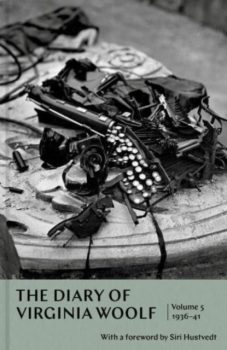
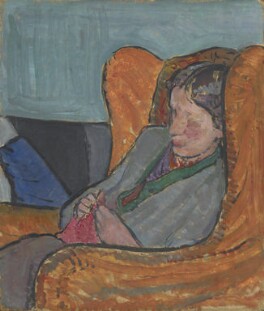
When Woolf wrote those words in her diary, she had 20 days left to live. She didn’t know it yet, though perhaps (it is hard not to wonder) she suspected it wouldn’t be much longer. “Oh dear yes,” that entry concludes, “I shall conquer this mood,” but she didn’t. I resist saying that it conquered her; that seems to strip her of both courage and agency right when, arguably, she showed both qualities the most.
In any case, it is difficult reading the last volume of her diaries in that poignant condition of dramatic irony created by our inescapable knowledge of her suicide–both the fact of it and the specific date of it. “The end,” she wrote in June 1940, “gives its vividness, even its gaiety & recklessness to the random daily life.” At this point war had become a reality and she and Leonard had made their plans: for “suicide if Hitler lands. Jews beaten up. What point in waiting? Better shut the garage doors.” For her, the omnipresence of death seems to have given extra vividness especially to the landscape, which she writes about with particular attention over what would indeed be her final months. “Ought I not to look at the sunset rather than write this?” she wonders in October 1940;
A flush of red in the blue; the haystack in the marsh catches the glow; behind me, the apples are red in the trees. L. is gathering them. Now a plume of smoke goes from the train under Caburn. And all the air a solemn stillness holds till 8.30 when the cadaverous twanging in the sky begins; the planes going to London. Well it’s an hour still to that. Cows feeding. The elm tree sprinkling its little leaves against the sky. Our pear tree swagged with pears; & the weathercock above the triangular church tower above it.
“Why try again to make the familiar catalogue, from which something escapes,” she wraps up the passage; “Should I think of death?”
The last time I wrote about how it was going with my project of reading all the way through the diaries, I admitted to being a bit bored by their mundanity. Her approaching death gave that day to day reportage–the dinner parties, the endless rounds of visits and visitors, the fussing about servants and payments and deadlines, the stress about her dresses and her reviews–a different quality, both in the moment, for the final months’ entries, and in retrospect. Because what becomes clear and wonderful and terrible as March 28, 1941 approaches is that we, her unanticipated audience, have now been with her for twenty-six years, since 1915. Not her entire life, but a lot of it, probably the most important parts of it, for her as a person and especially for her as a writer. The diaries are as close as we can get to Woolf unfiltered. Of course we can’t really know her; she comments herself (as most diarists probably do once or twice!) that she tends to write in her diary in particular moods and about particular things, and even when she doesn’t expect any reader besides herself she is self-conscious in the way that a highly reflective, observant person is bound to be. After so much time in the company of this version of Woolf, to reach the end–of the diaries and of her life–feels like a strangely personal loss. We have been through some things with her! On a more personal level, since May of last year I have had a volume of the diaries on the table by my reading chair. I’m going to miss that!
A lot of specific things happen in this final volume, including the writing and publication of The Years and Three Guineas as well as her biography of Roger Fry; the Spanish Civil War and the death of her nephew Julian (which I wrote about before, not long after Owen’s death); and then the lead-up to and early stages of World War II. One striking feature of the 1940-41 entries is the juxtaposition of the Woolfs’ ongoing ordinary concerns and the anxieties and dangers of the war, which grows increasingly disconcerting during the Blitz. “I cant get the odd incongruity of feeling intensely & at the same time knowing that there’s no importance in that feeling,” Woolf notes in May 1940. And yet life, and the feelings it stirs up, always does go on. “Paris is in the hands of the Germans,” she records in June 1940, “Battle continues. We spent the day seeing Penshurst with Vita – picnicked in the park.” “I feel, if this is my last lap,” she writes a few days later, “oughtn’t I to read Shakespeare? . . . oughtn’t I to finish something, by way of an end?” (She did–Between the Acts, although she wasn’t satisfied with it.)
I’ve talked and written many times now about my admiration for Winifred Holtby’s Virginia Woolf: A Critical Memoir. Something I always comment on is how exuberant it is as Holtby looks ahead to what Woolf will do next and celebrates what she sees as Woolf’s most inspiring quality:
She is in love with life. It is this quality which lifts her beyond the despairs and fashions of her age, which gives to her vision of reality a radiance, a wonder, unshared by any other living writer. . . . It is this which places her work, meagre though its amount may hitherto have been, slight in texture and limited in scope, beside the work of the great masters.
Because Holtby died before Woolf, she was spared the shadow that has to come between us and that radiance. While there is plenty of struggle visible in the diaries, though, (and more suffering offstage, signalled only in the editorial notes that explain gaps in the chronology), I don’t think that overall they contradict Holtby’s joyful version of Woolf. I know there are many Woolf experts and aficionados who regret the extent to which her public image has become dominated by her depression. The diaries convey such a sense of energy, of vitality, of curiosity. If ultimately she decided that the examined life too might not be worth living, it was not without having given all she had to the effort.


Yes, those little things take on much greater significance when we know what’s around the corner (such is life, I suppose…).
LikeLike
Holtby is someone I’ve wanted to explore more devotedly for many years (I’ve read a fair bit, but not chronologically, and there are a lot of gaps); I’m sure her writing about Woolf would interest me too. And it’s funny how one central idea seems to take hold in the public conversation, even when there is often so much evidence (even without looking too hard) that the opposite could also be proved to be true/accurate. I’ve never finished VW’s diaries; I was reading them alongside the novels, to avoid spoilers of the fiction, and only noticed a couple of years ago that that project halted with The Years (no reason, just reading other things: I ended up loving The Years).
LikeLike