 In my year-end post last year I remarked that the final months of 2023 had been “frantic.” The reason, as I’ve since explained, is that near the end of that year my husband and I separated, one consequence of which was that we both moved out of the house we’d lived in for over 20 years—which in turn meant I dove headlong into “downsizing,” some of it as rapidly as we could manage together before he moved to North Carolina last December, and the rest on my own, before I moved into my new apartment in February. Yes, that’s a short timeline for changes this big!
As a result of all of this, in 2024 my relationship to books and reading was unusual in a couple of ways. In the first place, as I moved into a 1-bedroom apartment, I had to confront a significant reduction in shelf and storage space, which meant, one way or another, getting rid of a lot of books. I know many folks online who are really dedicated book collectors—by which I don’t at all mean that they don’t also read their books, but they have extensive and cherished libraries. I have never had quite that relationship with books, more for practical reasons than principled ones, but I have always loved owning books and feel, as I know so many of us do, that my book shelves are in some ways an expression of my self. I also have many books that mean a lot to me for personal reasons, ones inscribed by my mother or my grandmother, for example, or ones that I picked out on my travels, or ones that I have reread so often I can’t imagine who I would be without them. Still, I always tried to be reasonable about how much room I actually had on my shelves (no teetering stacks on the floor for me!), and I regularly rounded up a bag or two to donate to the big book sale that raises money for the symphony, or some nice volumes to trade in at Agricola Street Books, both of which are great ways to maintain what I like to think of as the circle of (bookish) life.
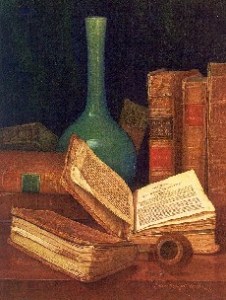 Still, this kind of incidental and largely voluntary pruning is nothing compared to the process I went through before I moved, which was often both logistically and emotionally overwhelming, especially at first. It got a lot easier as it went along, and in some ways it even started to feel good as the burden (literal and metaphorical) lifted. It involved admitting that there were books on my shelves I was never going to read again, and some I was never going to read at all, however good they might actually be (sorry, Europe Central, which took up the space of 2 or 3 other books for over a decade). It involved confronting the truth about dictionaries, desk encyclopedias, the Mayo Clinic Family Health Book, and the rest of our fine “reference” collection: nobody wants them anymore, including me, so their covers came off and their pages went into recycling. It meant carting bags of aging paperback mysteries to the Salvation Army and around 15 boxes of good quality fiction and non-fiction to the book sale depot. Hardest of all, it meant facing Owen’s books, which was particularly poignant for me because so many of them are ones I picked out for him over the years, for birthdays and Christmases. Most of his chess books went to the Dalhousie Chess Club, where he was a regular during his student years, though I kept Bobby Fischer Teaches Chess, his first and favorite book about the game. I kept all of his beloved Calvin and Hobbes collection, and many others that speak to me of the child he was and the young man he became—more than I needed to, maybe, but unlike my own books, his can never be replaced.
In the end I brought around 22 boxes of books with me to my apartment. I still sometimes look for a title only to realize I let it go, but mostly I think I did well: I cleared a lot of space mentally as well as physically. And in fact I cleared enough shelf space that I have room now for more books! I find pruning easier after all of this: my attachment to (most) books is just lighter. Sometimes I even put a book in the ‘donate’ pile as soon as I finish it! I don’t think of those purchases as wasted money. I want bookstores to thrive and authors to make money, after all. My wise sister pointed out once that a paperback is about the same price as a bottle of wine, and we don’t think we’ve wasted that money just because we can drink the bottle up in a single dinner party! And I still keep plenty: any that really hit hard, any that aren’t readily available, any that come with extra sentimental attachments, any that I think I’ll read again, or that I might want to write about.
 So I started 2024 by clearing out a lot of books. The other change since the separation has been to my reading time. I don’t quite understand why, but there seem to be a lot more hours in the day now that I live alone! I have wasted an awful lot of them watching TV, and many of them idly scrolling online, and plenty also just moping or mourning. I think (though this may be just making excuses) that I should not be too hard on myself about these bad habits, as the past few years have been pretty tough and we are all entitled to our coping strategies. I make intermittent resolutions to do better, to use my time better; I have made some of these for 2025. (Yes, blogging regularly again is one of them. We’ll see.) However! I have had more time for reading, and I have sometimes taken advantage of it. I have especially enjoyed taking time to read in the mornings. For many years—around two decades, really—mornings were my least favorite time of the day, what with all the kid stuff (breakfasts, lunches, getting dressed, remembering backpacks and permission slips and other forms, trying to get out the door on time) on top of bracing for my own work days, with the non-trivial (for me) anxiety of driving in winter weather adding a nice additional layer of stress from November through April. Things were simpler once the kids were older then out of the house, but I never felt like it was a good time for relaxing: I still had to get off to work, for one thing. Now, between habitually waking up early and living easy walking distance to work, even on weekdays I can afford to get in some peaceful reading while I have my tea and toast. We used to end most days in front of the TV; I still do that, especially on days when I’ve read a lot for work, but other days I can settle into my reading chair, put on some quiet music, and there’s nothing and nobody to interrupt me.
The combination of chaos and quiet time over this time of significant personal change has meant that overall 2024 was neither a particularly good or a particularly bad year for reading. I don’t think that in total I read a lot more books than usual, though I have never kept count, so I can’t be sure. I read a lot in some months and hardly anything in others. Since this post (which I realize is probably not of much interest—sorry!—I’m trying to recover my willingness to just sit down and write what’s on my mind) has already gone on long enough, I’ll do my usual year-end review of highlights and low points in my next one.


This is all of interest to me! As you know, I have been through this experience too, divorce downsizing (maybe not enough) in 2023. I am still getting back to using more of my abundant free time for reading and less for mindless scrolling and viewing — which is partly a needed distraction for sure! But I felt things starting to shift at the end of last year, and I am hoping to keep it up. Wishing you lots of good things, and good books, for 2025.
LikeLike
Why is there more time? It is strange, isn’t it? We must have been spending more time on ‘being married’ than we knew. 🙂
I am glad things are shifting in the right direction for you: it gives me hope for my own movement along this path. May we both feel better and read better in 2025!
LikeLike
Things will always take more time if you’re living with someone, no matter how well or badly that is going. Not having to update someone else or consult with them frees up a lot of time and emotional energy.
I also downsized – not to the same extent – when I moved from my first post-separation (now divorce) apartment to my current one. I went from “enough books to fill a big bookcase and a small one” to “enough to fill a big bookcase,” which was a good thing, because the small bookcase now serves as a pantry in an apartment with no separate kitchen (it’s all in the living room and is woefully short on storage).
LikeLike
Ah yes, negotiating and updating – both definitely take time, even if they are positive interactions, and when they aren’t, the emotional energy you are using up is probably easy to underestimate until suddenly you aren’t spending it that way.
My den / office space in my current apartment has enabled me to keep a perfectly reasonable number of books, but at some point in the next 5-8 years I will probably retire and I have a wall of filled bookshelves in that office, so storage will definitely become an issue. I suppose I won’t want to keep most of the more academic books. Who knows if I’ll always have this extra space. It sounds like your moves have allowed you to take the downsizing in stages, which eases the psychological stress of it somewhat, I expect; if I have to do another round (if I move to an apartment with just 1 BR and no den, for example) maybe it won’t be as hard the next time!
LikeLike
I also didn’t start with as many books as you and had switched to primarily ebooks by 2014. I never had a real TBR pile before ebooks, but on the other hand, they don’t take up space in the same way.
LikeLike
Twenty-two boxes is still quite a haul! To be honest, I don’t want to think about how I’d manage a move like that as I’ve accumulated quite a collection over the years (about 500-600 books in my J-Lit library alone…).
LikeLike
Yes, I am lucky that my apartment does also have a den so I have an office space with room for some shelves. Because you read so much in translation, you probably have a lot of books that would be harder to find elsewhere than many of the ones I off-loaded. “Collecting” them makes more sense, in that case. I live very close to our main public library now, as well as to good bookstores, so I consoled myself for my losses by reminding myself that if I missed a particular book, I could almost certainly still get my hands on it.
LikeLike
Yes, that’s true – when I do occasionally have a bit of a clear out, I’m very reluctant to get rid of anything I think might be tricky to find again later…
LikeLike
I for one found this engrossing! I am always interested in thinking about what it means to own books.
LikeLiked by 1 person
And I know (or gather, at any rate) that you are in the process of doing some unloading yourself via your Etsy shop, which is another great way to keep them in circulation.
LikeLike
I appreciate your having shared this, despite your inner mutterings that it might not be of interest particularly. I think many of us can relate to wondering how much of a period of “moping and mourning” is alright and how much is “too much” (causing its own kind of pain), to how our visions of ourselves change when we must part with books for practical and pressing reasons, to the sense of time itself changing when we are in solitude and no longer sharing space with the same people we’ve become accustomed to spending time and space with. I hope 2025 is filled with the most delightful kinds of surprises, new joys you haven’t yet articulated for yourself.
LikeLike
Thank you, Marcie: you are right that precisely because experiences like this are pretty common, we can share our experience of muddling through them, with sympathy for each other! I appreciate your good wishes. Learning (or daring) to articulate “new joys” is definitely an ongoing challenge for me.
LikeLike
I bought my parents’ house after my father died (many years after my mother died), and moved all of my boxes of books into a space that held a lifetime of their books, my childhood books, my siblings’ childhood books, and an attic full of clippings and magazines. That accumulation was nowhere as large as what I brought with me, as my parents didn’t have a lot of money or space for the luxury of owning books, but it was plain the house couldn’t hold everything, and something would have to give. It was painful. I made rules. I kept everything my mother had written her name in or put her bookplate in. I gave away everything I hadn’t read and couldn’t remember why I’d bought in the first place, and everything that no longer interested me. As soon as I forced myself to admit I’d lost interest. I kept my childhood books but donated the childhood books my grandchildren had abandoned in the house. I argued with myself about my daughter’s musty smelling books, and in the end reserved an entire bookcase for visiting children. But what about research books? Things I’d pored over, learned from, used to gather information I promptly forgot as soon as I finished the project at hand? What if I needed the information again? What if I was giving away some piece of my mind or self that couldn’t be replaced if the book that formed it was gone? It was all too much, but as you say, it got easier, and was somehow liberating. And the buy it, read it, put it immediately into the donation bag routine is becoming habit. They say books do furnish a room, or a house, but there’s a limit. Maybe one of the things we learn from books is admitting where the limits are?
Thank you for a thoughtful take on the issue. I wish you a peaceful and contented new year.
LikeLiked by 1 person
All of those decisions you outline sound so familiar: on what basis to keep, to give away, to simply discard? I can imagine that being among your parents’ collection added to the emotional weight. One (sobering) thing I realized was that doing at least some of this yourself is a gift to whoever is likely to end up handling your things eventually. I think that’s also one reason it’s so hard: as you so nicely put it, our things are pieces of ourselves, and clearing them out can’t help but be a reminder or our own finiteness.
Since I moved I have actually cleared out some more miscellaneous stuff that in the first wave I thought I “needed” to keep, so it’s an ongoing lesson in what matters. I also have found I don’t really want to live in a diminished version of my previous life, which feels sad in its own way, but to live in a space that reflects my new life, not a whole new start, of course, but an evolution. That too is a work in progress.
LikeLike
“An ongoing lesson in what matters”—that’s a keeper. (How nice that we can keep phrases and sentences and they don’t take up shelf space.)
As my family worked to clear my parents’ house, a process that took about five years, my sister-in-law—who did the lion’s share of the work—gave me this mantra: Everything has a shelf life. The tattered, hand-stitched quilt too fragile for daily use, which would have to be kept in museum-level light to preserve its fibers? Maybe it becomes a beloved dog’s resting place, or finishes its days as a picnic blanket. The fat Penguin Classic paperback novels that I bought with such zeal at the beginning of every college semester, with their underlinings and margin notes? Now the pages are brown and falling out, and if I ever reread those novels I’ll get them as e-books on my Kindle. Reminding myself “Everything has a shelf life” makes it easier to pitch something and move on.
The somber subtext is that everything has a shelf life, us too…and maybe the book and object pruning helps us deal with that reality, as you had to do far too early and so painfully after losing Owen.
Thank you for this post and conversation, Rohan!
Hope
LikeLiked by 1 person
Oh my goodness, five years. That’s really a labor of love. I think “everything has a shelf life” is a wonderful way to put it. There are things that do and should endure – but most of us don’t own many of those.
I had plenty of those yellowed old paperbacks, including my old set of Dorothy Dunnett’s Lymond Chronicles. I read and reread them and still do – they are perhaps my very favourite books. But that set of them was in terrible shape, and I have a whole new set. I had the idea to cut out the page of the old set that my lovely mom had inscribed to me in 1979 (!) and paste it into the cover of the new version of the same book, so I could keep the memory but save the shelf space. It was still hard putting those tatty things into recycling, but they had definitely outlived their shelf life.
Thanks for your thoughts and comment, Hope. I hope 2025 is coming in easily for you.
LikeLike
Great hack about those inscription pages! My family has always been big book-signers, and the personalization makes it so hard to give away even books I wouldn’t otherwise hold on to. I love the idea of cutting out the inscribed page and saving just that.
Wishing you a good 2025 as well—health and light and hours of tranquil reading time.
LikeLiked by 2 people
Don McKay wrote (in Vis a Vis), a lot of interesting things about what we keep and what we let go of. A man sitting in a garage after his yard sale was rained out, looking at ‘stuff,’ He starts from Levinas and decides that “home is the action of the inner life finding outer form, it is the settling of the self into the world. As such, it makes the first appropriation, the fundamental move that possesses the other, the hand grasps the thing and removes it from its element, relieving it of its autonomy… He says that before ‘home’ we related to things sensuously, through the caress, but home, was responsible for the drive to possess. It’s easy to see how that drive ends up in accumulation.
On the other hand, Walter Benjamin claimed that ownership is the most intimate relationship we can have with things. Which could easily provide an emotional justification for retaining everything.
I brought a few things from my old life into my new life, but they were mainly things I’d taken with me when I embarked on the old life. I definitely filled the house with things of my own choice, all old things, all with histories of their own. They give me the sense that I don’t in fact “possess” them. We’re just hanging out together for the time being. It’s a pretty nice arrangement.
LikeLiked by 1 person
Oh Rohan, what a terrible time you have been having, and how brave you are to share it here. You write quite a lot before you mention Owen’s books, and I think of myself writing through (different kinds of) loss and remember how the emotion overwhelmed me when I put things into words. I can see now with the passing of a great deal of time that writing beyond my private pages to putting coherent thoughts in places where other might read them was cathartic for me, but I wept myself into oblivion when I was doing it. I hope that you will come to know, as I do now, that no matter what things you might keep or have to shed because life makes us do that sometimes, that your son will always be with you, will be a presence in your life, and that a time may come when those memories bring you not just solace, but occasionally happiness too.
LikeLiked by 1 person
You put it so well, Lisa, and I appreciate your understanding and sympathize with your similar experiences. I talked here about books but there was so much else, since we’d lived there such a long time, from household and kitchen items to all the kids’ stuff you stash when you have a house with a full basement and plenty of other storage – toys and school projects and craft projects and all kinds of memorabilia, all of this absolutely fraught with memories. Yes, weeping myself into oblivion: I did a lot of that as I worked through it. But then you find yourself on the other side of what felt like an almost insurmountable task and there is relief in having dealt with it, isn’t there? because after a loss you do know that eventually you will have to do something about all of it. Going through Owen’s clothes was incredibly hard – but it actually helped a lot to have done it, after. I try not to second-guess the choices I made about what and how much to keep.
Thanks again for your kindness. The comments on this post have been such a nice reminder that there is a still a community out here, however odd the rest of the internet has become.
LikeLike
It’s book people. Book people have a special gene that even the internet can’t spoil.
LikeLiked by 1 person
I so hear you on the Calvin & Hobbes books, and my heart goes out to you. Our son, who now lives in his own place, LOVED those as a little boy, and they were the first books he read by himself. I’m keeping the whole collection!
Some years ago I donated 20 bags of books to the annual library sale. I need to do that again.
LikeLike
Yes, those are definitely keepers. One day I hope they will make me laugh again instead of cry.
Donating to library sales is a great option, I think. It helps me let go of books to think that they are going to other readers: what good are they just sitting on my shelf, if I’m not likely to open them again myself?
LikeLike