TWO YEARS AND TEN MONTHS LATER:
No time at all. No Time.
THREE YEARS AFTER:
And by now I’ve stopped making these notes.
– Denise Riley, Time Lived, Without Its Flow
Content warning: depression and suicide.
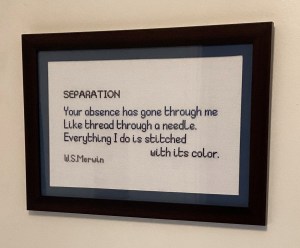 Owen died three years ago today. I wrote about his death a lot in the first year: I felt a strong urge to write about it. I needed to gather up my pain and shock and confusion and shape them into something that made some kind of sense—to bring the chaotic, unbearable feelings under some kind of control. (“In words, like weeds, I’ll wrap me o’er,” Tennyson says on In Memoriam, a poem I have returned to over and over since that first day.) I also wanted to reach out to my community of friends and readers, who showed me so much kindness, and still do. I also see now that this writing was a way of holding on to Owen by showing what I could of who he was and what he meant to me, what his loss meant. There’s a lot I don’t remember very clearly about the first few months after his death, but I do remember the way sentences would rise up in my mind and nudge at me until I used them—and the way lines of poetry would surface (as they still do), haunting me until I figured out where to put them, whether in my journal or in a sampler or in a post.
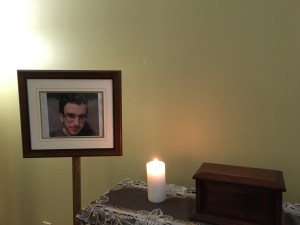 I also remember how angry it made me, in what I now know to call the “acute” phase of grief, to be told “it takes time.” Time for what? What could possibly change, with any amount of time? “My son is in a box!” I raged at the nice woman on the other end of the help line I called, before I had the right kind of person to talk to. “What difference is time going to make to that?” Seeking my own way to understand that, however I felt, time was going to keep passing, I thought about Woolf’s idea of To the Lighthouse as two blocks joined by a corridor:
One way I suppose I could think about where I am right now is precisely in a corridor between two blocks, one of them my previous life, which included Owen, and the other my future life, which will go on without him.
I have thought about that model a lot, as time has passed—time in which I have learned that both things are true, that it does take time, and that the passage of time doesn’t change how much it hurts that Owen’s life ended the way it did (or that Owen’s life itself was, to him, so painful that he ended it the way he did). When people said, kindly, helpfully, “it takes time,” I resented the implication that I would one day stop grieving, even though the prospect of feeling the way I did indefinitely was also terrible. What I think they actually meant, or should have meant, is rather that over time you learn to live with those feelings: that they do not destroy you. The grief does not end—how could it? It does not get any less—why would it? A. S. Byatt said of the death of her young son that she was haunted by the thought “He is dead . . . that will go on and on till the end of time.” People say, she said in an interview, that “after a time, you get to want to celebrate somebody’s life. All I can say is no, you don’t. It’s just terrible. It stays like that.”
The model of grief that makes sense to me now is that, as time passes, you build new layers around it: it is a lasting part of you, a big part, but it is not all of you any more. So I’m not sure that a corridor was the right metaphor. I like these lines from Julia Copus’s poem “The Grievers” a lot:
What we can’t absorb we carry in us,
a lumpish residue. It’s truly a wonder
we manage to move at all; let alone
as freely as this, with the ease at times
of our old and lighter selves.
Her emphasis on the heaviness of grief matches my own experience of it as weighty, hard to carry. I still carry it with me, but I do also sometimes move now with ease, with lightness. I am doing much better. I am stronger. I have worked hard at this: therapy is hard. The work is not done, but I am better at it too.
 Like Riley, whose meditations on grief have been interwoven with my own since almost the beginning, after three years I have nearly stopped writing about it, at least publicly. As I realized long ago, there is a terrible sameness to grief: it is repetitive, including for me. I don’t talk about it much any more either, and sometimes that’s tough, because it means I’m not always honest. How are you? Oh, fine. I’m fine. For other people, time has passed; they have moved on, and probably it seems as if I have too. I have, of course, in a way, because time does pass – for me, just not for Owen. “The dead slip away,” Riley says, “as we realize we have unwillingly left them behind in their timelessness.”
It’s a grey, foggy day here today; the lines that are pressing on my mind on this sad anniversary are Tennyson’s again, the starkest lines in In Memoriam:
He is not here; but far away
The noise of life begins again,
And ghastly thro’ the drizzling rain,
On the bald street breaks the blank day.
He is not here: after three years, what else is there really to say? But it has helped me, as always, to put some of what I’ve been feeling and thinking into words.
 Novel Readings
Looking at that embroidered quote, I can’t help thinking that his presence must also be stitched into you, not just his absence. I have never liked the idea that they are in the next room, I think that they are in us forever.
LikeLiked by 1 person
I like that idea. Sometimes it feels as if the absence itself is a kind of presence, if that makes sense.
LikeLiked by 1 person
When I read “The dead slip away,” Riley says, “as we realize we have unwillingly left them behind in their timelessness” I thought maybe that becomes part of the missing that person, that we’ve had to leave them behind.
Wishing you strength and some measure of consolation.
LikeLike
Thank you, Jeanne.
Riley goes on to call that the second loss; I think that’s right.
LikeLike
I’ve been thinking about you the last few days, as this anniversary approached. I also don’t see how this sort of tragedy can be “gotten over”–so please just be extra kind to yourself and remember how widely and deeply beloved you are.
LikeLiked by 1 person
I’m thinking of you, Rohan, and sending you a virtual hug (if you’d like one) through the drizzling rain. The idea of the layers is very interesting. It makes sense to me that the grief would still be there, and still big, but that there would be new layers as well.
LikeLiked by 1 person
I’ve been wandering around the house doing things, while thinking about how to respond to this.
The trouble is, there is no right thing to say. Except that we are here, reading and thinking about what you have written.
LikeLike
Thank you, Lisa, for your kindness.
LikeLike
My heart breaks for you. Thank you for sharing where you are at. I am so sorry.
LikeLike
Grief, of whatever kind, is something we all have to live with (and through) ourselves. Here’s hoping things get ‘better’, for the want of a more apt word, in the coming year…
LikeLike
It’s so true that nobody escapes it forever, though loss comes in different forms. Everyone is walking around with their own version of it.
I wish you well for the new year too.
LikeLiked by 1 person
Another year of Novel Readings with its steady proofs that reading is not merely a form of life, more akin to life itself. Another year of reading your writing, not merely sharing, but a confirmation that there is a world for sharing. Thanks for all
LikeLike
What a kind and affirming comment, Scott: I really appreciate it.
LikeLike