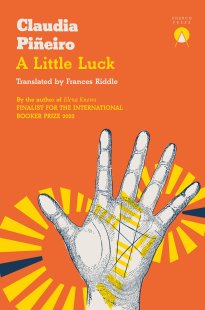
 Like Elena Knows, A Little Luck is a small book that packs a powerful punch. Now that the first impact of reading it has passed, I do find myself wondering: did it earn its effect? Is that even a fair question? But Elena Knows is about so much: so much is at stake in it. A Little Luck, in contrast, strikes me (though only after the fact, after the immersive experience of reading it) as founded on something slighter, something that maybe can’t quite hold up the weight Piñeiro brings to bear on it. But there’s no denying what an intense and gripping novel it is in the moment.
A Little Luck is about an accident. After the fact, again, I think the way Piñeiro spools out information about it is a bit too manipulative. We return over and over to the moment it happens, each time gaining a bit more information. On the other hand, that’s how traumatic memory works, and the strategy does force the reader into questions, not just about what happened, but about the role of the narrator, first introduced to us as Mary Lohan—about the way she is haunted by it, and the price she pays for it, which it also takes a while for Piñeiro to fully reveal.
Like Elena Knows, A Little Luck turns out to be about motherhood, and (also like Elena Knows) about ways it can go awry and lead to pain on both sides. “Most mothers,” Mary reflects,
never have to go through such terrible circumstances to prove they can be a mother. But life decided to test me, and I, in so many ways, failed.
Did she fail? I think that is one of the novel’s central questions, and Mary’s own answer changes over its course. Arguably, she passed the test with flying colors by unequivocally putting what she believed to be the best interests of her son Federico first by, paradoxically, abandoning him: “I knew I was hurting my child by leaving,” she says, “but by staying I might hurt him even more.” Was it the right decision? Was it the wrong decision? Or was it, like so many decisions we make, the only decision she could make in that moment, under those circumstances? “Motherhood is full of little failures that pass unnoticed,” Mary observes;
If the circumstances had been different, no one, not even me, would’ve ever known who I could become.
Some mothers have all the luck; life never puts them to any kind of test.
I only have a little luck.
Mary—or Marilé, to give her back the name she gave up along with Federico—made an innocuous-seeming decision, one she had made often before and that others also make just moments before she does, with no bad outcomes. The difference is a bit of bad luck, a series of small but incredibly unfortunate events, and thus a massive, irreparable catastrophe. One life is lost, other lives are ruined, and Marilé gives her own life up, which is the closest thing she can imagine to making some kind of restitution:
Not being there, that was the kind of suffering I deserved. To keep on living, without him. Much worse that suicide, without a doubt. An endless, bottomless pain. The agony of never being able to hug him again.
Piñeiro is really brilliant at immersing us in both moral uncertainty and psychic pain. The suspense of the novel comes eventually from wondering if Marilé has any chance at genuine redemption, but the overall emotional effect of it comes from inhabiting her tormented mind, or really her relentless grieving conscience. Happiness has come to her since she abandoned Federico and Marilé to become Mary—the storyline around this is kind of thin and relies heavily on complete coincidence or, to keep within the novel’s terms of reference, an enormous stroke of good luck. What she really wants, though, remains off limits, or so she assumes until she returns to the place she used to live, dreading recognition.
It’s recognition that brings about reconciliation, though, and I found myself wondering if I had been taken in a bit by Mary’s insistent attention to all the efforts she has gone to not to be known. Surely she is actually hoping for just such an outcome, even though she wouldn’t dare admit it to herself? As for the novel’s resolution, again the set-up itself is a bit thin or overelaborate, but it felt so true, and I was glad, given how agonized so much of the novel is, that it ended with a moment of happiness.
 I’ve always loved these lines from Tennyson’s The Princess:
 Actually, thinking about it now, maybe there are more moving parts than there used to be. Once upon a time we didn’t use an LMS, for example, and while there’s no doubt that Brightspace (formerly Blackboard formerly Web CT formerly DIY websites) is a useful back-up system for in-person courses—a storage facility available to your students 24/7 so they can never not locate their syllabus!—it’s also the case that expectations have gone up considerably around our use of them (and students’ reliance on them). Now I post my PPT slides on Brightspace after class, for example, something that requires multiple additional steps, assuming I remember to do it in the first place. (I never used to use PowerPoint, either, and I blame it and Brightspace, which both require incessant mousing, for my now chronic shoulder pain.) I used to give quizzes and midterms in class; now, they are all taken in Brightspace—but that too means many more steps than devising the questions and making copies, setting up all the many features just right and entering the questions in the optimal way. When we were all online, I posted weekly announcements for my classes: it turns out students really appreciated these, so I’ve kept doing them, but they take me (no kidding) hours to compose, both to make sure they are optimally clear and useful and because heaven forbid there’s a mistake in one, like a wrong deadline, that gets fixed in their minds or calendars in spite of any subsequent efforts to correct it! Recently, too, in a departmental discussion around class size and workload, one of my colleagues pointed out ruefully that “there didn’t used to be email” and that is such a good point, especially as our class sizes have gone up even as we became not just teachers but customer service representatives! (And yet somehow, without an LMS and without Outlook and without PowerPoint, we managed to do our jobs. Imagine that. Did we do a worse job? Maybe in some respects—accessibility seems like a key point here—but I really do wonder how much all of this apparatus actually helps, rather than hinders, us in our core mission.)
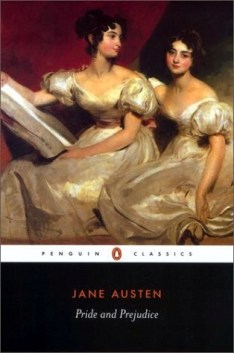 How are things going otherwise in my classes? So far 19th-Century Fiction seems great (I hope it’s not just me who thinks so!). It’s the Austen to Dickens version this term, and I took the risk of assigning Pride and Prejudice, which as regular readers will know
  My other class this term is a section of intro, once again the prosaically-named “Literature: How It Works.” But this time it’s in person, because I was so disheartened by the end of
 It used to be a ritual for me to post a recap of
 Like everyone else I know, I was really impressed by Elena Knows; it was a treat to find that Piniero’s
  Devotion or Semi-Detached (or, in parts, North Woods)—that otherwise deal in wholly human or natural problems. De Gregorio doesn’t resort to wish-fulfillment or fantasy and that is both the pain and the strength of her treatment of love and loss.
 My last two reads of this summer were Yiyun Li’s The Book of Goose and Ann Patchett’s Tom Lake. For me, one was a hit, the other a miss.
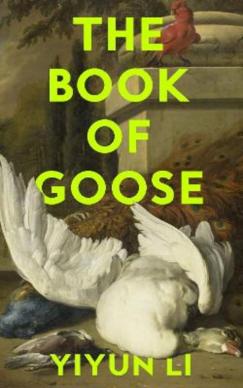 Another warning sign should have been how many reviews (including some quoted in the pages of “Praise for The Book of Goose” that lead off my paperback edition) compare it to Ferrante’s Neapolitan novels. I am cynical about these tendentious excerpts so I don’t pay very close attention to them when I’m making up my mind about what to read. Maybe I should change my habits! Because the Ferrante comparison occurred to me not too far into Li’s novel, and not for good reasons. (
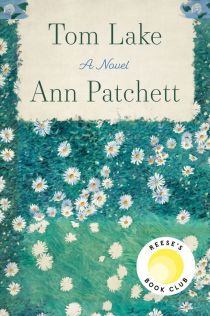 Tom Lake was a much more enjoyable read, although like the other Patchett novels I have read recently, it didn’t seem to me to go particularly deep. Still, there was something really satisfying about it: I liked it a lot more than either
  Novel Readings