 April comes and April goes, whether you want her to or not. In the teaching term, it is always a blur of a month—a bit out of control, like rolling down a hill. I used to welcome the feeling—the exhilaration of finishing up, the anticipation of summer—but this year it is just one more reminder of how relentlessly, and how strangely, time passes.
I have been busy and tired and sad this month, which means that I haven’t done much reading outside of work. The good news is that all three (just three!) books I finished this month were very good. The first was my friend John Cotter’s memoir Losing Music. I was completely engrossed by this searching account of John’s experience with what he eventually learned was Ménière’s Disease, a syndrome that has devastating effects on balance—lengthy, debilitating bouts of vertigo—as well as on hearing. As the title indicates, an important dimension of the book is what it meant to John to be unable to hear music, which had always been a significant part of his life and identity. One of the most moving passages describes a night when (as occasionally but unpredictably happens) his hearing comes back— “but who knew for how long.” “I knew exactly how to proceed,” John tells us:
Carefully, I laid myself down on my childhood bed . . . and set in place an expensive pair of Audio-Technica headphones I’d been saving against the day. Jascha Heifetz, back in 1952, in Hollywood, playing Bach’s partitas for solo violin. It’s vertiginous, sinister, and somehow a kind of duet, the way he plays it, a dance at the edge of a cliff.
Another night, he wakes up and can hear birds:
I can hear them fading, going—they’ll be gone at any second. As I listen to the last catches of song, I can feel my heart break in every sound. Don’t let that one be the last one. Don’t let that one. Don’t let that.
Losing Music follows John’s extensive and often desperate quest for first a diagnosis and then a treatment (there is no cure); he is frank about his occasional, very understandable, collapses into self-pity and also about his painful depression and frequent suicidal thoughts. He looks for help but also for ways to sustain some meaning and purpose in a life spiraling out of his control. He finds sustenance in teaching, in volunteering, in love and friendship, and also, vitally, in writing; he finds, eventually, a kind of peace born of hard-won compassion:
Compassion for the world, over which we have only narrow dominion, and awe at the world’s mutability, can germinate in the cultivation of a gentleness in one’s self, a gentleness for one’s future self, over which we have only narrow dominion. In feeling a little sorry for myself, I also feel sorry for the world, the evening world of half measures and regrets, the morning world when we sweep up and start again.
I was frequently moved to tears by Losing Music, and I feel very proud to have had a small part in it (it began as an essay for Open Letters Monthly) and to be mentioned in the acknowledgments.
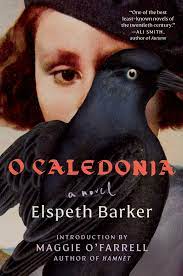 The other books I read all of in April (I’m assuming I won’t finish another one by Sunday) were Elspeth Barker’s O, Caledonia and Martin Riker’s The Guest Lecture. It’s hard to imagine two books with less in common! I enjoyed O, Caledonia a lot, although it is strange and wild and—I thought—a bit random, almost artless: as I read it, I was often surprised, even confused, by it, uncertain why this was what was happening or this particular detail was in it. Yet it felt unified, nonetheless: maybe that strangeness itself unifies it! Its fierce protagonist Janet takes the “not like other girls” trope to an extreme: she’s equal parts compelling and appalling. It has something of the flavor of We Have Always Lived in the Castle.
The Guest Lecture, by comparison, is more cool and cerebral. Its whole premise is so unlikely—who would write (and who would want to read) a novel about Keynes?—and yet I found it completely engaging, and I always like that feeling of seeing someone succeed with a completely idiosyncratic idea. The plotline about tenure denial had a lot in common with my own experience of being turned down for promotion, although the consequences of the former are of course more dire. Still, when Keynes says “Part of you clearly thinks they are right about you, even though they can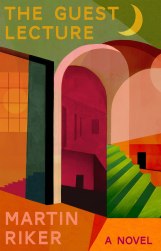 ‘t be, they have to be wrong or else your life’s work is pointless, and that is a level of personal negation you cannot possibly survive”—well, yes, exactly. Just thinking about the report of the final appeals committee for my promotion case still makes me shrink back inside myself. I appreciated The Guest Lecture as an attempt to show the examined life from the inside: what is it like to be someone who takes ideas seriously, and who tries (successfully or not) to live with and among them in some kind of meaningful way? It’s no picnic, that’s for sure: the unexamined life may not be worth living, but (as I have often thought myself in recent months) surely in many ways it is an easier way to live. I liked the last part of the novel the least: it spirals into a version of the “teaching dream” every academic has had, where things make sense but don’t, and you are ready and present but somehow, also, you aren’t. Rebecca pointed me to an interview with Riker that I hope to listen to soon. I’m sure there are many subtleties about it, especially its form, that I missed.
I started but abandoned a couple of other novels this month. One was Mexican Gothic. It looked like so much fun—but I really wasn’t into it. Maybe another time. Another was Niall Williams’s This Is Happiness. It looked like the kind of novel I would love, and actually there wasn’t anything wrong with it. If I hadn’t been tired and busy and sad, I might have loved it, so again, another time. Up next is Clare Chambers’s Small Pleasures, which I’ve just begun* and am liking so far, and then maybe Nicola Griffith’s Spear, which has been in my TBR pile for quite some time. Oh, and I need to get back to Demon Copperhead, which I bailed on months ago: my book club is meeting in May to talk about it, which is just the incentive I need. I wasn’t finding it Dickensian enough, which is perhaps not a fair criticism, except that it is so closely modeled on David Copperfield in its plot and characters that it is hard not to expect it to have something of the same heart and humour as well. I know Mark Athitakis really liked it, which encourages me to approach it with a more open mind.
I will save reflections on this term’s teaching for another post.
*Just a quick update to note that I actually did finish Small Pleasures already (it’s amazing what a difference it makes to my mood and concentration to be done with grading!) and it’s very good. It seems at first like a charming period piece, full of 1950s atmosphere and mores depicted with an edge that keeps it from tipping into nostalgia, but it gets more emotionally intense as it goes along—which it does at a pretty good clip, as the “what really happened?” question underlying its plot gives it momentum. I thought the answer we finally get to that question was underwhelming, but the mystery is more of a device than the real heart of the novel, and its actual resolution hit harder than I expected.
* “April Come She Will” is one of the songs I used to sing to Owen at bedtime when he was little. Like so many things, it will always make me think of him; maybe it won’t always make me so sad.
 March was a rough month. For one thing, I had more academic integrity hearings stemming from a single assignment than I’ve ever had in one term. It was an exceptionally disheartening experience, especially given the lengths I have gone to in my introductory class to reduce the risk for students of just trying to do the work for themselves: this is the class in which I’m using specifications grading, meaning there is really no risk involved. As I plaintively reminded the class as it became clear just how widespread the problem was, the class is designed to make it safe to be wrong, safe to be confused, safe to be learning. But if you don’t actually do your own writing, you strip the whole process of its meaning. Plus (as I pointed out to many students in the actual hearings), if your uncertainty leads you to copying other people’s writing, you will never build your own skills and your own confidence: you will never find out that you can in fact do the work, and get better at it.
 Easily the best novel I read in March was Claudia Piñeiro’s Elena Knows. This was recommended to me last year when I was (as I so often am) casting about for new ideas for my two mystery fiction courses. I started it then but had to abandon it, as a novel about suicide and a mother’s grief was not an experience I could bear. I kept it on my mental TBR, though, and I’m glad I tried again, because it really is exceptional: slight but fierce and complex, with its overlapping interests in disability, ageism, misogyny, and autonomy. I think it would be a really interesting book to read in my course on Women & Detective Fiction, even though in many ways it is not really a mystery. It is certainly about a crime – or, crimes, if you think socially and systemically – and there is an investigation, even if there isn’t a detective, or evidence, or any of the other conventional elements.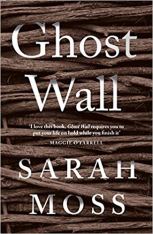
 Novel Readings