 Ask anyone on campus — student, staff, or faculty — how they are doing and it’s likely you’ll get some version of “hanging in there.” It is ever thus, in November! The weather has turned grey and the unrelenting chill of winter has set in, deadlines that seemed far off loom, work piles up. It can be hard to keep one’s spirits up! One of the things I try to do is stay as positive as possible in the classroom, exuding as much enthusiasm as I can manage for our work in the hope that I can give a bit of a boost to my students’ understandably flagging energy. It’s sometimes a bit tricky, especially because for them I am one of the people setting the deadlines and demanding the work: I can’t really just play nice, at least not all the time. But at least I can try to show them that I scare because I care!
The last time I posted a teaching update, we were just getting back to normal after the strange incident of the contaminated water in my building; in Women and Detective Fiction we were reading Sue Grafton and in Pulp Fiction we had just started our unit on romance. Today in Women and Detective Fiction we had our third session on Barbara Neely’s Blanche on the Lam — the seventh of our eight readings. I worried while I was planning the class that it might seem like too many books, but I think the pace has been pretty reasonable overall, as most of them are quite fast-paced. The benefit has definitely been variety: although of course we keep circling around related questions about crime and gender and genre, we have now read books that treat them in quite different voices and versions as well as books that explore intersections between gender and class as well as gender and race. Reading Agatha Christie’s “The Blue Geranium” is a very different experience from reading Dorothy Hughes’s In A Lonely Place, which in its turn has little in common, on the surface at least, with Neely’s book.
In A Lonely Place and Blanche on the Lam are both books I hadn’t taught before–The Break, which we start next week, is another. Although it is always a bit nerve-wracking leading discussion on books I don’t know as well, it is also somewhat freeing, especially with as good a group of students as I have this term. I may not always be able to find the right example or remember the exact details of some twist in the plot (though I do try hard to be ready!), but at the same time I’m not stuck on any previous interpretation or looking for any particular outcome. I come in with ideas about how things fit together, of course, but I enjoy the work of puzzling through questions with the students, who bring their own different experience and expertise to the table.
 Both of these books seem to have gone over well. Hughes in particular seems to have been a favorite, so much so that I am contemplating assigning In A Lonely Place in the Mystery & Detective Fiction survey class next year instead of my usual hard-boiled options (The Maltese Falcon and The Big Sleep). But Neely too has provoked really engaged conversations: I think we all appreciated the bluntness of Blanche’s critiques as well as Neely’s resistance to feel-good outcomes. Today, for example, we talked about Blanche’s decision not to accept the position she is offered after the case has wrapped up. It would have been sentimentally gratifying for her to stay on as Mumsfield’s caretaker, but throughout the novel she highlights how condescending as well as burdensome she finds the expectation that she’ll play the “Mammy” role, and fond as she is of Mumsfield (and generously as they promise to pay her) it makes sense that she can’t say yes. More broadly, too, an ending in which she stays on with the family after everything that has happened and everything she knows–not just about them but also about the world she lives in–would endorse an optimistic but facile vision of racial reconciliation that the rest of the novel has rejected as at best naive.
 We are well along in our romance unit now in Pulp Fiction, and about two-thirds through Lord of Scoundrels. I think it’s going OK. Today I got peevish towards the end of class because we were working collectively through some passages–it was going pretty well, from my perspective, with a reasonable number of students participating–and as the end of our time approached quite a few students started packing up and then sat poised on the edge of their seats, clearly impatient to get away. I try not to take this personally (it happens, to some extent, almost every time): I know they are busy and anxious and for all I know the ones who were most visibly disengaging had a big midterm in their next class or something. Still, I never go over our time, and not only is it rude to me and to the students who are talking to have all that rustling going on, but it’s demoralizing to see them visibly not caring about the work we’re doing. It undermines that positivity project I mentioned! It also frustrates me that they clearly see class discussion as expendable in a way that lecture time isn’t. From my perspective, that’s the most important thing we do! I’ve made this point to the class more than once, of course. See? Peevish.
But that’s the thing: it’s November. We’re all struggling a bit to be our best selves. It doesn’t really help knowing the term will be over soon, either, because that just reminds us how much we have to get done before then!


 On the other hand, I did appreciate the metafictional commentary on the genre scattered throughout Magpie Murders, though it was (as far as I could tell) somewhat gratuitous or incidental to the novel(s). If the stories Horowitz was telling subverted expectations more than they do, or if their resolutions turned in some way on critiquing the ubiquity of murders on page and screen or the idea that anything about crime is in any way “cozy,” then the whole novel would (for me) have taken on much greater significance. Still, he raises good points about the perverse gratifications of the form even as he unapologetically offers them up, twice over. “I don’t understand it,” says Detective Superintendent Locke when Susan meets with him to discuss her questions about Conway’s death. “All these murders on TV–”
 That, she concludes, is “why Magpie Murders was so bloody irritating”–unfinished as it is when she first reads it. For me, though, the end of Horowitz’s Magpie Murders did not provide much satisfaction. The dotting of the i‘s and the crossing of the t’s seemed to show up the whole elaborate exercise as artificial, an impressive display of plotting but little to feed any deeper curiosity. I prefer my crime fiction more character driven, and also more embroiled in social and political contexts. I know Horowitz can write that kind of mystery, because he wrote
  I certainly did not desire the disruption that has characterized my last few days at work! My office building was evacuated Thursday morning–just as I was settling in to do, well, a whole bunch of things! It turned out that due to some kind of maintenance mix-up,
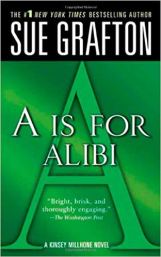 We have been working through Sue Grafton’s A is for Alibi, which everyone seems to have enjoyed quite a bit. It is fast-moving and sassy in a way that (IMHO)
  I was reminded this week, though, that besides being a bit more fun, Grafton’s novel has its own thought-provoking elements, particularly in its development of a male character who plays the part of the femme fatale and also (as other critics have noted) of an extreme form of the Byronic hero–mad, bad, and dangerously sexy to the female protagonist. In our discussion, we found it interesting that while the male hard-boiled PI rarely seems genuinely attracted to the femme fatale, whose allure (at least in the examples we could think of) is too transparently a decoy, Kinsey and Charlie do seem to have an actual spark, even an affinity. Desire is conventionally disruptive to the detective’s work, and it is to Kinsey’s too, but at the same time it almost feels as if it’s just bad luck he’s a murderer, because otherwise they’re pretty well suited! Kinsey’s resolute independence–her refusal to be domestic or to conform to gendered expectations–is refreshing, though I think some aspects of it (like the pride she takes in pumping her own gas) also feel a bit dated now.
 In Pulp Fiction we have been wrapping up work on the second assignment, with drafts and peer editing on Friday and the final versions due Wednesday. Today I gave my opening lecture on romance fiction. Our initial readings are two somewhat polemical primers on the genre (Jennifer Crusie’s
  Novel Readings