
Gradually, as my bruised forehead healed, and as I absorbed my own words, I developed a growing sympathy for the man in these pages, the intelligence operative of doubtful intelligence. Was he a fool or too smart for his own good? Had he chosen the right side or the wrong side of history? And were not these the questions we should all ask ourselves?
Viet Thanh Nguyen’s The Sympathizer is about as impressive a novel as the adulatory blurbs dripping from my paperback edition declare it to be, though I puzzled at some of the ways they characterize the book (“sparkling”?). For me, its interest built as it went along: at first it was gripping, certainly, but the narrator’s self-conscious ironic detachment felt like a trick that might lose its magic over time, unbroken as it is by any alternative voices to inject either critique or sincerity. After a while, though, I realized that these qualities are in fact part of the narrator’s own account–competing parts of it, in a way, as his self-criticism makes his moments of genuine sympathy more about indictment than redemption. That he can sympathize–that he remains so human–makes his acts of betrayal that much worse, and he knows it. By the end, too, we learn that his story–his confession–is not complete, that even as he admits his own duplicity, his own complicity in horrible acts of violence, he has also excused himself, tried to absent himself, from the worst of it.
That this first-person narrator, supposedly writing a full confession, has misrepresented himself is just one of the many ways in which The Sympathizer complicates the kinds of binaries the novel exposes as creations, or at least fixations, of those in power. Himself a double agent, both a member of the Secret Police and a mole for the Communists, the narrator is on both sides at once, “a man,” as he says, “of two faces.” He is also, as other people constantly remind him, “a bastard,” child of a French father and a Vietnamese mother, never able to be quite one thing or another. In a way that turns out to be characteristic of the novel as a whole, this is a problem that operates on two levels: it is about him in particular, and about the specifics of his history and situation, both personal and national; and it is a universal issue, because his is not the only context in which a destructive idea of purity is part of a larger structure of oppression. The “reeducation” camp where the narrator ends up is just the horrific extreme of a world in which all too often enemies are defined by their resistance to the kind of single-mindedness that is antithetical to the narrator.
 My edition of The Sympathizer includes as appendices a New York Times opinion piece by Viet Thanh Nguyen called “Our Vietnam War Never Ended” and an interview with him by Paul Tran called “Anger in the Asian American Novel.” I read both of these through before I read the novel (cautiously at first, ready to turn away if there seemed to be significant spoilers). I did this because I thought I might not recognize important features of the novel given my own limited knowledge of the Vietnam War, or of other representations of it. I have never, for example, read Graham Greene’s The Quiet American or Denis Johnson’s Tree of Smoke (both discussed in these articles); I have never seen Apocalypse Now, and though I’ve seen Platoon, I have no particular memory of it. Growing up in Canada, the Vietnam War was never a big part of my historical mythology except insofar as it featured largely in American history, particularly (in my own intellectual experience, anyway) in the form of anti-war protests and draft dodgers.
The additional materials did give me a heads-up about some of the novel’s goals, but I think I would have grasped the key issues in any case. Though it’s not a novel that flaunts its metafictionality, it is overtly concerned with representation, which inevitably highlights its own status as an alternative story of the Vietnam War. “Not to own the means of production,” observes the narrator, “can lead to premature death, but not to own the means of representation is also a kind of death.” Within the plot, he attempts to seize the means of representation–or at least to have a small share in them–by his work as a consultant on “the Movie.” When he first sees the script, it is for “a movie about our country where not a single one of our countrymen had an intelligible word to say.” “The lack of speaking parts for Vietnamese people in a movie set in Vietnam,” he points out to the famous director (sardonically called “the Auteur”) “might be interpreted as cultural insensitivity.” In his interview with Paul Tran, Nguyen says that he meant The Sympathizer to fill a gap: “I felt that there still wasn’t a novel that directly confronts the history of the American war in Vietnam from the Vietnamese American point of view.”

Not only does The Sympathizer as a whole offer a different perspective on the war that (Nguyen points out) is called “the American War” in Vietnam, but it addresses the “lack of speaking parts” formally, because in it the narrator himself obviously has the only “speaking part.” Nguyen does not, however, use the narrator’s voice as a tool to “humanize” the Vietnamese for an American audience accustomed to the kind of reductive, two-dimensional portrayals he resists in the Movie. This is something, again, that he addresses in the interview:
Rather than writing a book that tries to affirm humanity, which is typically the position that minority writers are put into, the book starts from the assumption that we are human, and then goes on to prove that we’re also inhuman at the same time.
Everybody in this book, especially our protagonist, is guilty of some kind of terrible behavior.
I thought Nguyen’s explicit interest in reclaiming the right to be inhuman was really interesting: it includes but goes beyond insisting on complexity. The narrator certainly is complex, and he is guilty of terrible behavior, and he is also subjected to terrible behavior. He is highly critical of America, but his criticism isn’t based on a tidy dichotomy between American evil and Vietnamese victimization. Being sympathetic, the novel insists, is neither a necessary nor a sufficient condition for humanity–and neither is sympathizing.
The Sympathizer is a fairly high concept novel, then, but it is also a compelling read as a war novel and a spy novel. I didn’t find it as funny as a lot of other reviewers apparently did, but it is certainly a stinging satire, of American hypocrisy and self-delusion in particular but also of pomp and corruption and ideological posturing on all sides. I did think at times that it was a bit overwritten: Nguyen is fond of extra-super-clever metaphors in particular (“Longing flooded the basement of my heart . . . The vodka, when served, was . . . the paint thinner I needed to strip down the stained, flaking walls of my interior”). There’s a certain flamboyance to this that wore on me, although it could be argued that these are the narrator’s flourishes, not the novelist’s, and meant as evidence of what he is later accused of by his interrogators: that he has been corrupted by the West. “In practice,” says the Commandant to whom his confession is nominally addressed, “you are a bourgeois intellectual. . . . your language betrays you. It is not clear, not succinct, not simple. It is the language of the elite. You must write for the people.” Once again, the threat is to his voice, to his role as a speaking part. That makes the narrator’s confession, the novel itself, a revolutionary act. As a result, in spite of everything he has said and done–maybe even because of it–it’s hard not to find the narrator himself, “the man in these pages,” a sympathetic character.
 A friend recently mentioned that she’d been reading and enjoying Maggie O’Farrell’s novels, so the next time I was at the library I checked out two of them: Instructions for a Heat Wave and The Vanishing Act of Esme Lennox. Both are essentially family dramas; both turn on long-held secrets and their repercussions, though in Instructions for a Heat Wave the consequences are mostly moral and emotional, while by the end of Esme Lennox two people have paid (in very different ways) with their lives. Both are very good–well written, evocative, psychologically astute, and thematically layered — but it’s Esme Lennox (both the novel and the eponymous character) that’s really going to stick with me.
 Instructions for a Heat Wave ends on a faint note of optimism: the novel’s ultimate revelations may be initially devastating, but as people’s secrets come out, healing seems possible — no harm is ultimately irredeemable. The Vanishing Act of Esme Lennox, on the other hand, offers no such soothing hope: some wrongs, it suggests, can never be made right, at least not through forgiveness. The novel is a compelling blend of chilling and heartbreaking: as it takes us from Esme’s childhood to the present-day life of her grand-niece Iris, splicing in segments from the point of view of Esme’s sister Kitty, now suffering from Alzheimer’s, we gradually realize just how Esme came to spend 60 years confined to an asylum. One of O’Farrell’s sources is Elaine Showalter’s The Female Malady: Women, Madness and English Culture, 1830-1980; Esme’s story dramatizes the horrors of a society that conflates nonconformity with “hysteria” and madness, and punishes it accordingly. I was a bit disappointed in the novel’s ending, but it’s a haunting story, both poignant and gripping.
 Do any of you know the delightful children’s rhyming book The Piggy In the Puddle? For the last couple of days, as I sat at desk or table, staring at my computer screen and messing around with the pieces of what I hope will eventually be an essay on Dorothy Dunnett’s Lymond Chronicles, lines from it kept running through my head:
 When Colwin comes up, people seem to talk a lot about her prose, and I can see why. The strength of A Big Storm Knocked It Over isn’t really its characters, though they are crisply delineated and believable (an achievement I certainly don’t mean to underestimate). Its plot, too, is well executed but minimal. It’s the voice of the novel that matters, which is often the voice of the protagonist, Jane Louise, since it is narrated in close third person with lots of free indirect discourse: wry, sharply observant, occasionally but self-consciously sentimental. There are lots of good epigrammatic moments (“Soon the holidays would be upon them like an oncoming train, loaded with complicated feelings”) but also, more rarely, passages that (like my epigraph) expand into something more and unexpectedly poetic.
 Those are the kind of moments we (or I, anyway) read fiction like this for. It’s not simply the solipsistic pleasure of seeing something you’ve experienced reflected back at you, shaped into something more elegant than your own amorphous feelings and memories could create–though that is part of it. Right now my own children are almost gone: one basically moved out, the other, though still at home, less and less tethered to it and to us. My feelings about this are more complicated than I ever would have predicted during the years when the demands of parenthood seemed nearly overwhelming; more than once I have been caught in a wave of nostalgia as intense as what Jane Louise feels just anticipating the changes to come. The recognition I feel reading this scene also brings a comforting sense of connection, reassurance that there is a story to be told about these everyday pains and joys.
 This is definitely exciting stuff, as is the unusually explicit way in which Nell frames her choice between love and prosperity as a degrading and openly sexual kind of barter:
 The problem for me is that things don’t get this interesting until so far along in the novel. Up to that point, though the ground was certainly being laid, very little actually happened: the novel is almost all talk and no action. Why is that a bad thing, you might ask? Well, it isn’t, of course–not necessarily. Nell is an engaging narrator, and as Pamela Gilbert’s smart introduction to the Broadview edition convincingly argues, her unapologetic desire for Dick makes her an unusual and subversive one as well, as the contemporary reviewer I already quoted from indicates when protesting “the unmaidenly manner” in which she “dwells on her lover’s physical charms.” The relationship between Nell and Dolly is unconventionally fraught, and Dolly herself is an interesting twist as a woman who achieves villainy by her unrepentant pursuit of exactly what nice young woman are supposed to win, namely a “good” (wealthy) husband. Perhaps on a second read I would do better at appreciating these subtler effects. This time, however, I was bored by the lack of plot. A great deal more suspense and excitement might have made up for the long stretches of watery philosophizing like this:
 I thought Cometh Up As A Flower would be more in the Collins vein because it is cited as an example of sensation fiction. Gilbert’s introduction is good on the issue of genre. While acknowledging that the novel “is not heavily plotted” and has “little of the crime and madness characteristic” of other sensation novels, she notes that “Broughton gives us desiring heroines, women actuated by sexual desire.” She goes on to link Cometh Up As A Flower to novels of different kinds, including “the religious conversion narrative” and autobiographical fictions including Jane Eyre. I saved the introduction to read until after I’d finished the novel; thinking about it in those terms would probably have given me more patience with the first 250 pages. On the other hand, I was reading it in the first place because I’m shopping for an alternative to Braddon’s Aurora Floyd for my seminar on sensation fiction, which I’m offering again this coming winter term. (I have nothing against Aurora Floyd, but including two novels by the same author has always seemed a bit narrow.) I can see ways in which it would work very well with the other readings (The Woman in White, Lady Audley’s Secret, and East Lynne), both because there are some common themes and because it is so different in tone, style, and treatment. It’s just not as much fun as the others.
 I don’t suppose there’s anything wrong with Harris’s book on its own terms, though it turned out not to be the book I was looking for. It’s primarily about the challenge (as Harris sees it) of finding and coping with solitude in our hyper-connected technological age. As he tells it, nearly every activity that used to be solitary has become social. But while there’s no doubt that everything from reading to dating can now be carried on in a hyper-linked-up way, I thought he too hastily and completely conflated “using technology” with “not being alone.” Also, like many authors of this sort of book, he seemed to rush from his own habits and experience to universal proclamations. “Is there no middle road,” he asks,
 I must grow up, she thought. I must stop being so humble. I can make decisions and initiate actions like anyone else. I am not stupid. I am not poor. If I want to do something I do not have to wait for permission. I am old enough to make up my own mind. . . . But I must act, she thought. I am a total bore as I am. A nonentity. Not even a pawn in the game.
 Over the past week I read three novels. Only one, Michele Roberts’s
 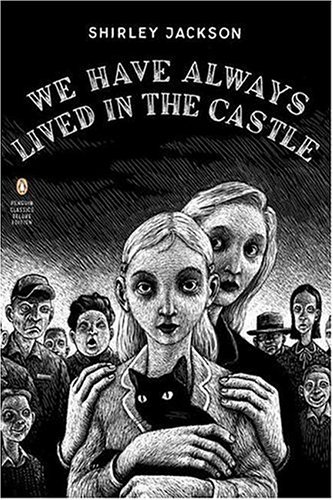 For my book club, I read Shirley Jackson’s We Have Always Lived in the Castle. What a treat that was. It’s like a perverse inside-out fairy tale. In our discussion of it, we got particularly interested in the way it destabilizes our sympathies. There’s the initial instinct to side with the narrator, which of course quickly turns out to be a mistake, except that she is being persecuted–though not unfairly, since after all, she is a murderer. Jackson evokes the horror of mob violence as well here as she does in “The Lottery”: the scene that begins with the fire chief throwing the first stone unfolds in an equally horrifying way–except that at least one of the targets is in no way an innocent victim, and later on, some of the villagers seem to be horrified, in their turn, at what they’ve done. We puzzled over Merricat’s motivation, or rather, over whether she has one, for killing her family. The suggestion seems to be that she didn’t much like being sent to her room without dinner, or in any way being thwarted or crossed. So the murders may be the act of a vengeful narcissist, a spoiled brat gone rogue. On the other hand, maybe there is no reason, which in its own way is even scarier. It’s a brilliantly written little book. I was hooked from the first paragraph, which is a perfect combination of whimsy and menace:
 I expected Sarah MacLean’s The Day of the Duchess to be a lot of fun too, but I really didn’t enjoy it and ended up skimming the last third or so of it just to get to the end. I have liked some of MacLean’s romances a lot, including The Rogue Not Taken, the first one in this series, but this book tilted too far towards the “feels” for me: it’s all angst and yearning, without any frolicking. I’m not necessarily saying it isn’t well done. It’s just that my own taste in romance tilts instead towards comedy. Also, more than I remember noticing in MacLean’s books before, The Day of the Duchess is full of the kind of writing that seems meant to force feelings on you, rather than allow you to arrive at your own reactions–lots of fragments, and lots of single line paragraphs, devices which to me almost always backfire: rather than increasing the impact of the line, they make it seem artificial, especially if the trick is used over and over again. I’ve been trying to think if there are any consistently serious romances that I really like. Laura Kinsale’s Flowers from the Storm is the only one I can come up with. Blame my inner cynic, which, as I’ve said before, makes me accept an HEA only if it doesn’t take itself too seriously.
 Novel Readings