Jane Gardam, Old Filth

I enjoyed Old Filth a lot. It has everything I like in a novel: thoughtful, often elegant prose, artful (but not gimmicky) construction that allows the gradual unfolding of plot and character, heartfelt emotion conveyed without sentiment, a story that ranges across time and place. It does all the right things, and does them well–and yet now, thinking back over the book, I’m uneasy by just how ‘right’ it felt. Is it possible that the novel made it too easy for me to like it? Deft, pointed, dry as it is, is it also, in a way, formulaic? Not as a mystery novel or a romance is formulaic, but in a specifically literary fiction way, and a very British literary fiction way too? The evocation of Britain’s fading imperial past, the old judge with his upright bearing like a last symbolic remnant of its problematic dignity, the indifference of his young associates to the complexities of his personal history, the staunch wife with her own, never fully specified side of the story (she gets her own novel, later), the eccentric family, London during the wars: how much of this is really very new or different? Perhaps I read Major Pettigrew’s Last Stand too recently (and Old Filth is the earlier novel), but even the shades of Kipling seem, in retrospect, a little too easy, a little too familiar. Of course I liked it: it was practically custom-made for readers like me. Not (as the saying goes) that there’s anything wrong with that…but somehow realizing how nicely the novel fits into a certain niche thins it out for me, in retrospect.
Yet I did like it; I admired it, even. The writing is persistently satisfying. Gardam finds and places details so that they surprise our attention; her people, especially Old Filth himself, are made admirably distinct through deft touches rather than extensive exposition. Old Filth–properly Sir Edward Feathers–is a wonderful mix of acerbic intelligence and suppressed humanity; the early episode with his old rival Veneering is deliciously comic. The cuts between time frames are occasionally disorienting, but the gradual accumulation of knowledge about his difficult past adds poignancy to the story of his old age, poignancy that is deliberately enhanced (a little too deliberately?) by the sniffing carelessness of the current Benchers. ‘Pretty easy life,’ they mutter, looking at him as he seems to doze after lunch in the Inner Temple; ‘Nothing ever seems to have happened to him.’ The novel is built on the dramatic irony thus introduced, as we come to know the inadequacy of this summation. ‘Nothing’ is not the sum of anyone’s experience, and yet how easy it is for them to underestimate him. The novel eloquently substitutes, for that casual ‘nothing,’ a complicated blend of suffering and happiness, work, sickness, friendship, passion, violence and humor. It ranges widely; it is engaging, often amusing, often moving. The only false note in it, I thought, was the melodramatic story of Filth’s abusive foster mother and its traumatic outcome: this is used to provide a unifying thread for other aspects of the plot as well as to develop the central problem of his emotional detachment (“You became no good at love,” his cousin tells him). Again, this is all artfully handled, but it didn’t seem necessary to me to give him such a past. It’s a concession to the idea–rejected so beautifully by the novel in its other aspects–that ordinary life is “nothing.”

Trollope Time!

Not here at Novel Readings, unfortunately–indeed, I’ve been a pretty poor source of Victorian material lately. But two of my favourite bloggers have recent Trollope posts well worth reading–and every much in their own distinctive styles, which makes it particularly fun to juxtapose them. At stevereads, it’s The Duke’s Children:

when the first chapters of The Duke’s Children began appearing in 1879, readers were thunderstruck:

No one, probably, ever felt himself to be more alone in the world than our old friend the Duke of Omnium, when the Duchess died … It was not only that his heart was torn to pieces, but that he did not know how to look out into the world. It was as though a man should be suddenly called upon to live without hands or even arms. He was helpless, and knew himself to be helpless.

The Duchess … dead? It seemed inconceivable, and Trollope is entirely right to shock us so (in the realm of television much later, after “All in the Family” had ended, an oddly similar shock was delivered to viewing audiences when the show’s sequel, “Archie Bunker’s Place,” featured the funeral of Archie’s ‘dingbat’ wife Edith – as one stunned critic aptly put it, “Oh Edith, how could you up and die on us?”). The main action of the first half of The Duke’s Children, at least for those in the Duke’s personal orbit, is one of shocked spasm at the sudden vacuum where once so much life had been. The Duke is all but destroyed by the loss, as Trollope writes with exceptional sensitivity:

In spite of all her faults her name was so holy to him that it had never once passed his lips since her death, except in low whispers to himself, – low whispers made in the perfect, double-guarded seclusion of his own chamber. ‘Cora, Cora’ he had murmured, so that the sense of the sound and not the sound itself had come to him from his own lips.

And his troubles are only beginning. His eldest son and heir, Lord Silverbridge (at one point Trollope drolly remarks that everybody had been calling the young oaf ‘Silverbridge’ so long they’d almost forgotten his actual name), in addition to racking up astronomical racing debts, has also fallen under the amorous sway of Isabel Boncasson, a high-spirted and wealthy young American heiress. His younger son Gerald is in trouble with his school. And his daughter Mary is in love with a nearly penniless young man named Frank Tregear – and had been encouraged in the match by her mother before her death, much to the Duke’s confused mortification (readers of the earlier Palliser novels noted that the family appeared to have mislaid a daughter, since a second girl is mentioned in The Prime Minister; I have my theories as to what became of her). The workings of the novel center on these inroads being blasted into the Duke’s privileged world – he fights both encroachments with a desperate, incremental determination.Trollope’s audience can’t for an instant entertain any serious doubt as to how either plot will eventually resolve – times are changing, after all, and it would be merely perverse for a novelist like Trollope to stand in their way.

And at Wuthering Expectations, it’s a series (here, here, and here) on The Loves and Adventures of Francis Newbold Gresham the younger, better known as Doctor Thorne:

There’s also a romantic plot – will Frank be able to wed Mary?  The latter is the novel’s heroine, “a point on which no choice whatsoever is left to anyone” (Ch. 2).  Frank would be the hero:

had not that place been pre-occupied by the village doctor.  As it is, those who please may so regard him.  It is he who is to be our favourite young man, to do the love scenes, to have his trials and his difficulties, and to win through them or not, as the case may be.  I am too old now to be a hard-hearted author, and so it is probable that he may not die of a broken heart.

Trollope was forty-three, so judge “too old” accordingly.  I remind the reader that we are still in Chapter 1, on page 7 of 569 in my orange Penguin, where we have been told how the “story” “ends.”  Tony, of Tony’s Reading List reminds me that “Trollope never lets suspense build up when he can tell us in advance what is likely to occur.”  Why does Trollope do that?

Perhaps Trollope is incompetent.  Such is his own claim at the beginning of Chapter 2:

It can hardly be expected that any one will consent to go through with a fiction that offers so little of allurement in its first pages; but twist it as I will I cannot do otherwise.  I find that I cannot make poor Mr Gresham hem and haw and turn himself uneasily in his arm-chair in a natural manner till I have said why he is uneasy…  This is unartistic on my part, and shows want of imagination as well as want of skill.  Whether or not I can atone for these faults by straightforward, simple, plain story-telling–that, indeed, is very doubtful.

He is as bad as Thackeray or Fielding, isn’t he, a terrible liar.  I, as a reader, should be insulted.  As a quite different reader – instead, I am openly laughing at Trollope’s mockery of simple story-telling.

I’ve had a few things to say about Trollope over the years myself, and of course these posts make me feel it has been too long since I read him (especially the Palliser series, which I last read fully a decade ago).

Update: There’s more at Wuthering Expectations, here and here…and the promise (or is it a threat)? of a “ten part series on Orley Farm” in which “at least three of the posts will be on the fictional treatment and metaphorical meaning of 19th century manuring techniques.” I think he’s kidding. Actually, I’m not sure–and I don’t think I want him to be!

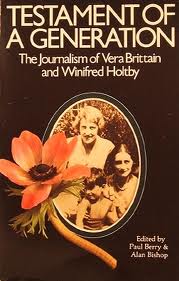
Testament of a Generation: The Journalism of Vera Brittain and Winifred Holtby

The more time I spend in the company of these two extraordinary women, the more I appreciate their energy and commitment, as well as the clarity and force of their prose. All of these qualities are on full display in this collection of their journalism. The editors, Paul Berry and Alan Bishop, have organized the contents thematically, a decision which makes sense on many levels, though the chronological leaps backwards as a new section begins are occasionally disconcerting. There is also an element of arbitrariness in the divisions, particularly, I found, between what was filed under “A Writer’s Life” and what under “Politics”–for such intensely political writers, always aware that the personal is also political, there’s not really much difference. In fact, the most striking thing for me across the collection was the consistency of tone, regardless of subject: straightforward, direct, assertive, drily humorous. To some extent, in their fearless confrontations with prejudice, folly, and hidebound tradition, they remind me of Victorian writers like Frances Power Cobbe (some of whose outstanding essays can be found in the excellent Broadview anthology Criminals, Idiots, Women, and Minors). But both Brittain and Holtby seem to me less artful than Cobbe, which I don’t mean as a criticism but as recognition that Cobbe and her contemporaries had worked hard enough for women’s causes that by the time these two are writing, there is less need (not no need, mind you) to dance around the issues, to pander strategically to masculine egos or social norms, or to adopt disingenuous poses.

A straightforward recapitulation of just how much progress  had been made comes from Holtby in an essay she wrote for Time and Tide about King George V’s Jubilee. She refused the invitation to join a resolution protesting against the celebrations on the grounds that the previous twenty-five years “were, on the whole, the most propitious that women in this country had ever known”:

Twenty-five years ago forty thousand women marched through the streets of London in what was known as the Women’s Coronation Procession. It was a protest against desires unfulfilled. It represented arts, sciences, authorities, powers; lawyers and doctors walked there, the prototypes of peeresses and abbesses; and they were led by women carrying banners who had been imprisoned for insisting on women’s right to use their abilities in such service. ‘It will not come in my time, ‘ Mrs Pankhurst said. But do I not remember the extraordinary service at which Mr Baldwin unveiled Mrs Pankhurst’s statue under the shadow of Parliament, in which he, the constitutionalist, honoured her, the rebel, for having ‘set the heather on fire,’ at which Dame Ethel Smythe in the robes of a doctor of music led the police band playing The March of the Women, which she had once conducted with a tooth-brush through the bars of a window in Holloway Gaol to a chorus of exercising prisoners? I have seen a woman cabinet minister walking through the lobby of the House of Commons; I have seen a woman architect chosen to design the Shakespeare Memorial Theatre; I have seen my own mother applauded by a county council when she was elected as its first woman alderman; I have myself been heckled as an agitator at Marble Arch, demanding the vote in the equal franchise campaign of 1927 and 1928; and I have been enfranchised. I have voted. And I know that those people who say that the world is no better off since ‘women have been let loose in it’ simply do not know what they are talking about.

She goes on to detail the “revolution in social and moral values” which is “a direct result of that challenge to opinion which we call the Women’s Movement.” But for all her appreciation of these positive developments, she is clear about “the imperfections of the movement,” about which she is equally clear and specific. Though these great gains have been made, the challenge going forward (which may sound all too familiar, depressingly, to feminists in the present moment) is to maintain momentum, build on successes, and extend the principles underlying it beyond those who have so far benefited–including looking beyond gender to consider inequalities of race and class. “I am constantly reprimanded for ‘flogging the dead horse of Feminism,'” Holtby observes; “I do not think the horse is dead.”

The articles, then, carry on the work of social analysis and criticism, sometimes at the micro level (as in the nice little piece “Should a Woman Pay,” about the explicit assumptions and implications of men’s picking up the tab–“the ethics of social encounter reflect the economics of an earlier epoch,” Holtby observes), sometimes at the level of state or even international politics. Holtby writes stringently, for instance, about South African leader Jan Christiaan Smuts, “an indefatigable general in the nationalist Boer War; an architect of empire in the years succeeding it.” Smuts “has achieved superb feats of generalship, statesmanship, and intellectual synthesis,” Holtby acknowledges; he has unified “the Dutch and British sections of the white community” of South Africa; and he has recently given a “speech upon liberty” at St. Andrew’s University “which has won the acclamation of the English-speaking world.” Holtby’s critique is relentless. Having conceded his skill, renown, and accomplishments, she takes him apart for presuming to speak as a champion of freedom and equality:

‘Popular self-government and parliaments are disappearing,‘ he said. ‘The guarantees for private rights and civil liberties are going.‘ Quite. Smuts should know. In Cape Province, until 1931, there was no constitutional distinction between European and non-European citizens in the matter of franchise and property. True, the educational tests and property qualifications for voting were so arranged that only a minority of black men were enfranchised . . . Still, liberty broadens down from precedent to precedent, we are told. . . . All change, we thought, would be an extension of freedom, at least under men like general Smuts. In 1931 European women were admitted to parliamentary franchise; non-European women were excluded. Today before the country is a Bill, almost certain … to be passed, disenfranchising non-European males as well as females. The Native Conference, supposed to serve as a substitute for other constitutional powers, criticized this and other Government proposals in 1926 and 1927, so has not subsequently been summoned . . . .

‘Dissident views are not tolerated and are forcibly suppressed.’ Smuts should know. He himself encouraged the South African Government to pass the Riotous Assemblies Act – an Act which makes ‘incitement to ill-feeling between black and white’ an offense punishable by banishment. Now where conditions in a country as as they are in South Africa . . . merely to speak aloud of the laws and administrations precisely as they exist is adequate to ‘incite ill-feeling.’ The Act has been used to prevent the development of trade unionism, to prohibit political protest, to render inarticulate any form of native criticism; it has been used to enable politicians to say – ‘But the natives themselves do not protest.’

Smut should know: the refrain is initially, disarmingly, innocent-sounding, but ultimately damning. Holtby’s conclusion goes beyond South Africa to a wider indictment of the consequences of failing, as Smuts fails, to imagine other people, different people, as fully human:

These abrupt failures of the imagination are among the most fruitful sources of injustice in the world. They are more common than deliberate sadism, more insidious than fear. Indeed, they breed fear. . . . The Jews to Nazi Germany, the Catholics to the Ku Klux Klan, Negroes to a southern states lynching party, women to eighteenth-century liberals – they are not human; they need not be accorded human privileges. The mind closes against any conception of their own point of view.

This is only one of many references to Nazi Germany, which is not surprising if you consider the general historical context (the piece on General Smuts is from Time and Tide in 1934), but it did surprise me a little because the majority of them are specifically feminist critiques, which is not the most familiar argument against Nazism today. In the piece on the Jubilee, Holtby makes a passing reference to “what has happened in Germany, where the pendulum of reaction has swung back so violently that all that had been gained seems lost again.” In “Black Words for Women Only” (1934) she considers Sir Oswald Mosley’s assertions about the importance of women to the Fascist movement–which would, he declared, “treat the normal wife and mother as one of the main pillars of the state.” “It is not irrelevant,” Holtby proposes, “to compare what Sir Oswald promises with what Herr Hitler has performed”:

The German Constitution of 1918 granted equality before the law to all citizens. Women entered politics, the professions, the civil services. Between thirty and forty-two sat in each of the various Reichstags as deputies between 1919 and 1933 – a higher proportion than in any other country. They held high executive and municipal offices.

But the Nazi movement has reversed all that. Women may vote, but none stand on the lists as candidates. Their associations are all now directed by men; since July, 1933, all the girls’ high schools have been controlled by men. Professional women are finding themselves compelled for one reason or another to resign from work. Married women are persuaded to leave their employment, and unmarried workers are often asked to surrender their jobs to men, as in one Hamburg tobacco factory, where 600 girls were asked to hand over their work to fathers, brothers or husbands, or to retire, marry, and claim the State marriage loan.

There is little hope for ambitious young women in Nazi Germany, where the brightest contribution of constructive economic thought towards the solution of the unemployment problem appears to have been the expulsion of large sections of the community from paid work, as a penalty for being women, Socialists or Jews, and their replacement by unobjectionable loyal male Aryans. Individual women have protested against this mass campaign to restore their economic dependence and drive them back to the kitchen. But their protests are penalized; public influence is strong, and there are women who have been temporarily persuaded to believe that Hitler’s policy really serves their interests.

Quoting one such woman, who wrote to the Manchester Guardian declaring that “Woman has again been recognized as the centre of family life, and today it has again become a pleasure and an honour to be a mother,” Holtby acerbically observes, “No explanation is offered of why or when motherhood ceased to be a pleasure and an honour – perhaps when children were driven to concentration camps?” “Throughout history,” she concludes,

whenever society has tried to curtail the opportunities, interests and powers of women, it has done so in the sacred names of marriage and maternity. Exalting women’s sex until it dominated her whole life, the State then used it as an excuse for political or economic disability. . . . Today, whenever women hear political leaders call their sex important, they grow suspicious. In the importance of the sex too often has lain the unimportance of the citizen, the worker and the human being. The ‘normal’ woman knows that, given freedom and equality before the law, she can be trusted to safeguard her own interests as wife, mother, daughter, or what you will.

I was reminded in these articles of Gaudy Night, which also ties together Nazism and the gathering clouds of war in Europe with hostility to women’s rights at home: the strongest clues to the perpetrator’s identity turn out to be her strong view that women’s place is in the home, her most important identity that of wife and mother, not citizen, worker, or human being.

Brittain’s political writing focuses more on her pacificism, which leads her to support, provisionally, Chamberlain’s deal with Hitler at Munich in 1938–“a policy beset with problems and fraught with peril,” she acknowledges, but an alternative to “an ever-darkening night of hatred, suspicion, and fear.” Once that dark night has arrived, she continues to write about the horror of war and the need to act with what compassion and justice are possible under its terrible pressure. About “massacre bombing,” such as that of Dresden, she is eloquent: “It made no undeniable contribution to military victory,” she says (having cited a number of military experts on this controversial question), “and it relegated men, for whose salvation Christ died, to the level of hunted and outraged beasts”; “the ruthless mass bombing of congested cities is as great a threat to the integrity of the human spirit as anything which has yet occurred on this planet.”

The section on “A Writer’s Life” (though overlapping in some of its concerns with the sections on feminism and politics) takes us in some more personal directions, as with Holtby’s account of her development as a writer–complete with quotations from a book of her juvenile poetry published, at her mother’s instigation, when she was thirteen. “I was,” she says, and it is borne out by the verses she quotes, “a creature of completely uncritical piety and sentimental convention.” (I too endured the complex blend of satisfaction and utter humiliation of having my  private poetic scribblings taken up and prepared for public viewing, though in my case the little volume was not released to the genuine public, only to a select group of family and friends–this at my grandmother’s instigation. All I can say in defense of the poems in it is that they are not conspicuously worse than Holtby’s, except in formal specificity.) Holtby’s review of Woolf’s The Waves was of particular interest: it shows the same generous reaching towards understanding of an aesthetics wholly unlike her own that she shows when explaining her decision to write her volume on Woolf’s life. And Brittain’s essay on “The Somerville Novelists” would probably be the kicking off point for the  seminar I imagine offering on that subject.

Summer Reading Update: Some Hits, More Misses

I’m up to six books in my quest to reach thirty this summer. I can’t say I’m off to a very good start. Of these, two were awful, two mediocre, and two were very good. I’ll quickly survey them all here, but I plan to give the best two their own proper posts.

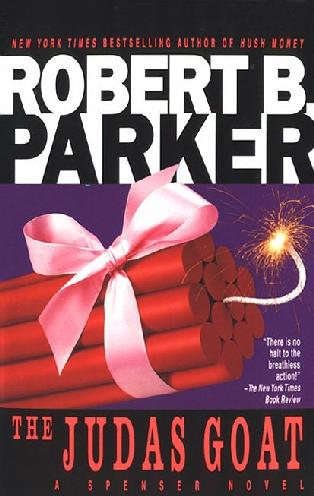
The two awful ones were Robert B. Parker’s The Judas Goat and Anne Easter Smith’s A Rose for the Crown. The Parker was a real and unpleasant surprise. I wrote recently about my long-standing fondness for this series and mentioned my interest in rereading some of the earlier ones. I don’t think I had ever read The Judas Goat before. If it had been the first time I ever met Spenser, our beautiful friendship would never have developed: I’m morally certain I would not have read another one in the series. I didn’t like the writing style, which seemed arch and insincere; I didn’t like Spenser, who seemed similarly arch and insincere, gratuitously violent, and also (to my surprise) sexist. To be sure, there are shades of the moral scrupulosity that I associate with him, but not enough. Most of all, I didn’t like Hawk–or, more accurately, I didn’t like the way Hawk is characterized here or the way he and Spenser interact. You can see a glimmer of the wry astute humor that infuses their zippy repartee in the later books, but I had the feeling that Parker hadn’t figured out how to do that yet. Plus Hawk kept on calling Spenser “babe,” which I found affected and annoying. The plot was not bad, and it is rare and therefore interesting to have Spenser abroad, but it was only loyalty that kept me reading to the end.

A Rose for the Crown was awful in different ways: it’s historical fiction of the thinnest variety, with tedious faux-antique dialogue, laborious exposition, and lots of forced emotion. I turned every page but by about half-way through I was skimming because I couldn’t bear to put in the effort to read every word. I figure I can count it as “read” for my summer tally because I also skimmed Reay Tannahill’s The Seventh Son, which was equally dreadful. Between them, calculating generously, you have something approximating the substance of a whole book. Honestly, I try to be open-minded in my reading, but I can’t understand the popularity of books of this type: who could not find the transparency of their efforts to be dramatic and affecting, not to mention the alternation between ploddingly pedestrian prose and a kind of loosely imagined old-fashioned idiom kind of insulting after a while? Compare something like The Children’s Book or Wolf Hall–or Waverley or The Heart of Midlothian or Romola: historical fiction can be so much more, and need not neglect originality of style or thought in order to tell a compelling story and animate our imaginings of the past. But I suppose they are no different from other fiction that has no aspiration to ideas, much less to art.

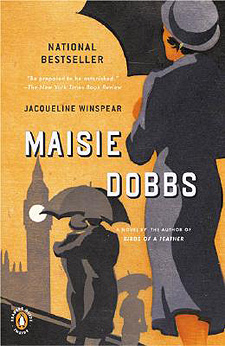
Maisie Dobbs is in the “mediocre” category. Perhaps it was a mistake to read it at a time when I have been reading a lot of much better writing about Britain during the wars. I would call it “Vera Brittain Lite, with a smattering of Dorothy Sayers (but absent her intellectual range).” How’s that for a cumbersome tag line? There’s nothing wrong with Winspear’s careful evocation of either WWI or its social and psychological after-effects, except that she is not a particularly good stylist (a lot of the novel seemed to be, again, striving after effects, rather than earning them) and so many of the notes she plays are so obvious if you already know anything about the context. Maisie is a reasonably interesting character, and reasonably well-drawn: one structural aspect of the book that surprised me was the amount of time spent going back over Maisie’s childhood and development. I wondered, in fact, if Winspear really wanted to write a “real” novel about someone growing up with these kinds of “Upstairs-Downstairs” issues, but thought it would be easier, either to write or to market, if this story were packaged as part of a detective novel. The detective plot is almost peripheral, and as the specific problem under investigation comes into focus, we are left sort of outside it, not knowing the steps Maisie has taken, for instance, to uncover it. I thought it was interesting that the case did connect the ostensible crime to the more complicated question of war and the damage it does–but there are far more original and compelling literary explorations of this (Pat Barker’s Regeneration trilogy, for instance). Maisie’s intense relationship with Maurice was not made compelling to me; it felt formulaic, perhaps because it reminded me too much of Cordelia’s relationship with Bernie in An Unsuitable Job for a Woman (which is a much better, more surprising, more literary mystery). So for me the book was just OK, but it had enough interesting aspects that I’m willing to read at least one more in the series, to see if they get better. I just hope Winspear got better editing later on. The book opens with a dangling modifier, for crying out loud (how does an editor at a major publishing house not flag and fix this?),  it is full of clichés (“Maisie felt a strong stab of emotion”), and it seems overwritten, as if the author doesn’t think we’ll get it, or if we do, that we won’t feel what she is anxious for us to feel (“a threat to the family of the woman she held most dear, the woman who had helped her achieve accomplishments that might otherwise have remained an unrealized dream”; “a feeling of anticipation and joy welled up inside her as she realized how very lonely it had been working without Maurice”; etc.).

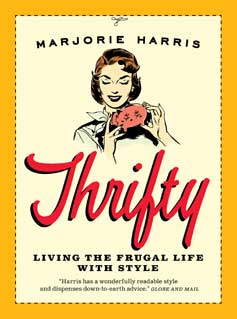
Finally, also mediocre was Marjorie Harris’s Thrifty: Living the Frugal Life with Style. I picked this up from the library because a friend recommended it to me enthusiastically, and I can see why she enjoyed the chatty style and the lifestyle advice, which is sensible and pleasantly concerned to differentiate “frugal” from “cheap.” Being thrifty, Harris argues, is about deciding what you really need, as opposed to what you merely want, and then focusing your efforts and controlling your finances so that these are the things you have. When I tell you that her list of “must-haves” is “delicious organic food, decent wine and candles,” you’ll understand that this is not in fact a book about things you really need in that you could not physically survive without them. That’s fine: we all understand that the real necessities include a roof over our heads, food on the table (organic or not), and so forth. Although there is some discussion in this book about how to understand and stretch your resources to make sure you can have these basics, it’s really more of an argument against foolish consumerism among those who have enough wealth to spend foolishly but might repent–by squandering it and ending up in debt, for instance. I like the idea of identifying priorities and being wary of the immediate but impermanent gratification of purchases that have no lasting value (not economic, again, as this is not really her focus, but value as in making your life better in the ways you really want it to be good). My own list would not include candles, but books, certainly, and music. So her advice for the “frugal fashionista” or the “frugal foodie” was not of much interest, but the general discussion of thrift was, as well as the repeated emphasis on putting your time and money where your heart is–including room for things you love and cherish for their beauty or other special qualities, for example, provided you do not do so at the expense of actual necessities. So far, fine, but the book is not really very well written (“she immediately turned [the fabric] into a suit for my brother and dresses for my baby sister and I” [emphasis ADDED]????–again, how is it that an editor did not flag and fix this?–and there’s trouble with modifiers again, here, too), it gets pretty repetitive, and some of the examples of “thrift” go a little too far towards justified self-indulgence. Great retro cover, though.

What a relief it was to turn to Testament of a Generation: The Journalism of Vera Brittain and Winifred Holtby, and to discover the gently painful delights of Jane Gardam’s Old Filth–about both of which, more later.

This Month in My Sabbatical: It’s Over!

Six months ago, I posted the first in a series of updates on my progress (if that’s what it was) through my winter-term sabbatical. As of July 1, I’m back on regular duties. Though in some ways, unless you’re doing summer teaching (which I am not, this year), July and August have a lot in common with sabbaticals, the several hours I have already spent preparing for, attending, and following up on committee meetings are clear signs that times have changed.

Looking back at my original goals and plans for this “teaching-free” interval is sort of disorienting. As the subsequent posts in the series show, my actual accomplishments differ  somewhat from those on the list I made in January! I would not say, exactly, or only, that I did not get them done, but that the plans mutated or evolved. For instance, my top priority then was to finish my essay on Ahdaf Soueif and submit it to an academic journal. I did finish an essay on Ahdaf Soueif, but it was this one at Open Letters; I have yet to decide if I want to do more with the academic one.

My next stated priority was a series of essays on Virago Modern Classics, specifically Margaret Kennedy’s novels. I did read both The Constant Nymph and The Ladies of Lyndon, but Kennedy disappointed (or puzzled and stymied) me. Spurred on in part by what I read on other blogs during Virago Reading Week, I did look into other writers of this period: a great highlight was reading Testament of Youth and Testament of Friendship. I still aim to read more of the Viragos I have gathered, starting soon (I hope) with Rosamond Lehmann’s The Weather in the Street. I also read a biography of Dorothy Sayers, and this plus what I’ve read by and about Winifred Holtby and Vera Brittain and my general interest in the period has made me quite thoughtful about proposing an honours seminar on the Somerville novelists for 2012-13. I don’t think I could work up to the level of expertise necessary for a graduate seminar, but I think I’d be spurred on to read with more focus with such a course in mind, and an honours seminar can be a great venue for exploring material you are somewhat but not completely knowledgeable about. Branching out like this, provided it is done with due humility, seems to me a good thing on all fronts: students get exposed to something we wouldn’t cover otherwise, and I get the fun of feeling a bit like a student again as I learn my way into the material. Imagine: the reading list could include Testament of Youth, Gaudy Night, and South Riding, plus something by Margaret Kennedy so I’d finally have to figure it out.  I’m nearly through Testament of a Generation now–a proper post on that should follow before too long.

I did do a lot of the things described in my paragraph about refreshing my teaching. I reviewed and, to an extent, revamped my reading list for Mystery and Detective Fiction. The amount of time this took, especially surveying options for the anthology, reminded me why so often–especially as ordering deadlines for fall books creep further and further back into the spring–I just stick with what I’ve done before. This is a good example of bureaucratic processes hampering pedagogical innovation–that, and the absence of any kind of book-buying budget for course development, since I find “trade” publishers more stingy with exam copies than, say, the very helpful Oxford University Press, and popular titles are hard to get at the public library. I also did some extensive re-organization of my electronic files: instead of being filed by course and then year, now my syllabi, handouts, lecture notes, worksheets, essay topics, and exams are now mostly sorted by teaching area, and then by author or function. In theory, it should be quick to find lecture notes on Wilkie Collins or all the versions I’ve done of final exams for English 3031, without having to remember which year I taught which book or which course, or which year I did or did not give a final exam. We’ll see how this works out!

With an eye to my Victorian classes as well as my own edification, I looked at a number of new books in my field, mostly without much excitement, and I read, or at least skimmed, dozens of articles and reviews. What I realized, going through this material, is that most of it makes no difference to me at all. I don’t mean that there aren’t interesting individual insights or original readings, but most of it operates on a very small scale or turns on a very particular interest or angle. None of it is paradigm-changing; nothing I saw made me feel I needed to re-think (rather than, say, re-tool a little) the approach I take when I teach Victorian fiction. Much of it is filed away for me to come back to when or if I need to take my critical attention to the next level–in a graduate seminar, for instance, or in more specialized work of my own. I’m glad to know it’s there. But I’m also, truth be told, glad to discover that I don’t need to feel so anxious about “keeping up.” What’s the benefit to it, in general, if I can read so much after such a long gap and still be satisfied that what I have to say about Jane Eyre or Middlemarch to my undergraduate fiction class remains what I want to say, has not been undermined or rendered inadequate or outdated? A year or so ago I read two good overview texts on Victorian fiction (George Levine’s How to Read the Victorian Novel and Harry E. Shaw and Alison Case’s Reading the Nineteenth-Century Novel) and they were similarly reassuring. Note that I don’t conclude from the minimal significance of this published scholarship to my immediate pedagogical goals that it is insignificant in a more general way: its purposes are different, for one thing. But also, as I have written about here before (but where? I can’t find it!), the cumulative effect of specialized critical inquiries can be dramatic–the undergraduate Victorian novels courses I teach have little in common with the one I took at UBC, and sensation fiction (on which I teach an entire seminar) had no place in either my undergraduate or my graduate coursework.

One thing that went just as expected was the steady stream of thesis material from the four Ph.D. students I’m working with. It is a very good thing that they are all writing steadily, and they are all working on interesting and substantial projects–but I admit, I wasn’t always glad to see another installment appear, especially when it often seemed I had barely turned around the last batch. Speaking of which, there’s one waiting for me now…

I had a general plan to read a lot, because, I proposed,

the more you read the richer your sense is of what literature can do, of how it can be beautiful or interesting or problematic or mediocre. I am convinced that I talk better about Victorian literature because of the contemporary literature I read, and that I teach with more commitment, and more hope of making connections with my students and their interests, because I read around and talk to them about books as things of pressing and immediate significance

I think my reading this term definitely added to my intellectual life and resources in the ways I’d hoped. Besides Testament of Youth, I’d point to the Martin Beck books as a great “discovery” for me (thanks very much to Dorian for the prompt). I’ll be teaching one in my mystery class, and I’ve written an essay on them which will be appearing elsewhere later this summer. Among the other books that really made an impression are  Graham Greene’s The Power and the Glory, Elizabeth Bowen’s The Heat of the Day, May Sarton’s The Education of Harriet Hatfield, Brian Moore’s The Lonely Passion of Judith Hearne,  Shirley Hazzard’s The Transit of Venus, and Carolyn Heilbrun’s The Last Gift of Time. Less successful reading experiences included Jennifer Egan’s A Visit from the Goon Squad and Terry Castle’s The Professor, along with Christina Stead’s The Man Who Loved Children, which is the first book in a very long time I have deliberately decided not to keep reading.  I have my two book clubs to thank for steering me towards titles I might otherwise not have chosen, or not have stuck with. The Transit of Venus is one I’m especially interested in teaching, but it seems a risky choice, so I’d have to pick the right course.

While there are things on that original list that I did not exactly get done, I also accomplished some things on sabbatical that I didn’t specifically anticipate. I wrote three more pieces for Open Letters, including the Ahdaf Soueif piece already mentioned but also two book reviews, one of Sara Paretsky’s Body Work, the other of Marjorie Garber’s The Use and Abuse of Literature. Though not, strictly speaking, academic publications, both of these (like the Soueif essay) are based on my professional expertise. I wrote a number of posts on academic issues, including one on “The Ph.D. Conundrum” and two on aspects of academic publishing (“Reality Check: ‘The Applicant’s Publication Record is Spotty’” and the recent one on Leonard Cassuto and blogs). I got feisty about Rebecca Mead’s high-profile, low-substance New Yorker essay on George Eliot, and went on and on about Sex and the City. I kept on soliciting and editing pieces from other writers for Open Letters, a process that is always satisfying. Finally, I accepted an invitation to participate in a conference panel, submitted a proposal and then the funding applications. Now I’m beginning to organize my miscellaneous notes and links into what will eventually be my lively, coherent (!) presentation. Along with my next essay project for Open Letters (on gender, genre, and novels about Richard III–no, really!), preparing this presentation will be my priority for the next few weeks–that, and getting things in order for my return to teaching, by which I mean preparing Blackboard sites, updating syllabi, keeping on top of waiting lists, and psyching myself up for the return to the classroom. I’m actually happy to be heading back: I have missed teaching a lot (remind me in October that I said this, will you?)

And so, onward! If I’m counting correctly, I am eligible for another half-year leave in 2014/15, provided the powers that be are convinced that I used the time wisely this year. Here’s hoping. I know that I feel pretty good about it. I have indulged my intellectual curiosity, expanded my horizons as a reader and a writer, and contributed in a variety of ways to discussions I think are very important to my profession and my discipline. I have advanced projects I’m excited about and discovered literary interests I didn’t know I had. I am eager to get back to teaching. To me, that adds up to a pretty productive sabbatical.

Cassuto On Blogs: “I have nothing against them, but I don’t read them, either.”

The quotation is from a comment by Leonard Cassuto in a recent Guardian “live chat” on academic publishing. Here it is in full (he’s responding to an inquiry from Melonie Fullick about “how academic blogging might fit in with a kind of publishing ‘portfolio'”):

Another thing about blogging: lots of people with certain reading habits don’t read blogs. I have nothing against them, but I don’t read them, either. This is as much a function of available time as anything else. By restricting myself to published writing (whether digital or print), I am in effect ascribing value to the gatekeeping function of editors. I don’t do this because I’m a snob, but rather because there are only so many hours in a day.

Especially in the context of a discussion explicitly intended to address how academic publishing is changing in the digital age, this remark strikes me as both disingenuous and disappointingly narrow-minded. To begin with, he does have something against blogs: he does not consider them “published” (huh?), and they haven’t been seen by an editor, and thus he doesn’t consider them worth reading. At all. The first objection is incoherent, especially as he later goes on to say that blogs lack prestige because of “the absence of intermediaries between writing and publication”–in other words, they are published, but without (to use his vocabulary) gatekeepers. He doesn’t read them because they are self-published. The second objection is understandable from a pragmatic point of view: there is a lot of writing out there, on and off the web, and as he says, “there are only so many hours a day.” It’s not as hard as all that, though, to do a little filtering yourself, and to me it bespeaks an astonishing lack of intellectual curiosity not to look around to see which blogs might be of professional and/or personal interest and value.  (It turns out he is able to name at least two bloggers with “street cred,” Brad DeLong and Michael Bérubé–which dates his info a bit, as Bérubé has, at least temporarily, stopped blogging–so he knows where he might start looking for others, or he does if he understands the function of the “blogroll.”)

There’s also some lurking hypocrisy here: the Guardian feature opens with a link to a “blog post” by Cassuto himself, at the Chronicle of Higher Education. Now, I don’t know the mechanics of publishing in the CHE. Perhaps there’s a careful gatekeeping process there, determining which pieces deserve to appear under that illustrious banner, or perhaps there’s at least an editor who mediates between Cassuto’s unfiltered thoughts and his posts–which he calls “columns.” (I hope so, else by his own logic, why should we read them?) Perhaps the gatekeeping process begins and ends with the invitation to write for the Chronicle, which gives you a general stamp of approval. In that case I’m sure Cassuto scrupulously edits his posts columns himself, after writing them and before posting publishing them: he’s an experienced professional writer, after all, and well-qualified to do so. If so, it might occur to him that there are others who can do so as well and get good results, even without the Chronicle‘s sheltering umbrella of authority.

Here’s the exchange that followed (in the original thread, of course, it’s interspersed with the rest of the ongoing discussion):

RM: I know this is common (I have many colleagues who say the same thing), but this attitude implies, even assumes, “blogs” as a category have nothing in them worth competing for that time with other forms of writing/publishing–which is odd, since we would never trust in such wide generalizations about “magazines” or “books” or “articles”–the content should matter, not the form. It’s an odd, and inherently conservative, form of complacency, I think.

LC: You’re missing my point about teh [sic] value of the gatekeeping function. In general, I like to invest my time in writing that an editor has seen first.

RM: I agree that editors can provide a valuable service, and that it is helpful given the array of reading options out there to let someone else provide a filter, but in 20 years as an academic I’ve also read plenty of poor stuff that somehow passed through that gate! But my main point is just that people should be wary of generalizing about (or making decisions about) blogs if they don’t read any. Kathleen Fitzpatrick’s Planned Obsolescence has some really good discussion of the ways peer review (as one kind of gatekeeping) can hold back innovation and new ways of thinking.

LC: I don’t want to overwork this, but part of my point has to do with the credibility of blogs in the larger world of publishing, which is what we’re talking about. Some blogs (Brad DeLong’s and Michael Berube’s come to mind) have huge street cred that has been built up not only through years of steady and high-quality output, but also (and this is significant to me) by the work that these prolific and influential scholars do outside of their blogs: in other words, lots of people read the blog because they already respect the writer’s scholarship. Of course there are good and bad blogs, just as there is good and bad refereed scholarship and good and bad articles in the TLS, but the relative lack of prestige of blogs as an outlet has at least partly to do with the absence of intermediaries between writing and publication. You might think that prestige deficit a bad thing and I might disagree, but it’s a fact that bloggers need to consider as part of their decision to devote their time and energy in that direction.

So again we have a veil of pragmatism thrown over an argument for accepting (even reinforcing) the status quo–pragmatism, at least, from a careerist perspective (see digiwonk‘s comment on that post column). Yes, it’s true: there is a “prestige deficit.” But I would have expected a discussion about ways the digital age is changing academic publishing to at least evaluate, if not actually challenge, that normative thinking. Once you acknowledge the imperfections of the gatekeeping system (“of course … there is good and bad refereed scholarship” [emphasis added]), you should be open to more imaginative ways of conceptualizing the processes or forms of scholarly discussion and knowledge dissemination. Based on Cassuto’s own admission, the presence of “intermediaries between writing and publication” is no guarantee of quality in communicating the results of specialized research. We might also consider whether there are other goals in academic publishing (particularly related to work in progress or collaboration) or other values (such as open access) that are better served by non-traditional forms including blogging. Nobody that I know of is trying to argue that blogging in general, or even particular highly scholarly blogs, should replace traditional publications. But surely it’s time people stopped saying “I don’t read blogs” as if there’s nothing questionable or retrograde about that.  At the very least, if you don’t read any of them, there’s absolutely no way you can know what their value is, which means you aren’t really qualified to speak about the place they should have in academic publishing–only to pass along the news (which is no news to bloggers) that most academics are prejudiced against them.

Cassuto is actually inconsistent about all this, though. In the comments I’ve quoted so far, he sounds resolutely against the professional utility of blogging–again, narrowly construing ‘utility’ to mean ‘useful in building a professional resume.’ Upthread, however, he makes what I thought was a very encouraging statement about avoiding preemptive assumptions based on the form of someone’s writing:

For me personally, I now judge everything case by case. if I were reviewing the work of a job candidate who writes a blog, I’d want to see if it were a good, substantial blog, and evaluate accordingly. But there are plenty of people in my discipline who would simply say that blogging is not scholarship, however broadly conceived.

Here, then, he differentiates himself from  his stodgy colleagues. Here’s my pleased reply to that earlier remark:

It is good to see you say you would actually *read* the blog to evaluate it. This seems crucial: those who simply dismiss blogging as “not [being] scholarship, however broadly conceived,” at least in my experience are usually people who don’t read blogs and make assumptions about their content and their value (and their potential role in scholarship and scholarly communication) based on what they think they know about the form of blogging.

Later on, he sets himself up as the champion of a “new world of possibilities.” A participant in the discussion proposed that it would be good if graduate programs encouraged

digital writing as part of a research portfolio. Academia will still push for “traditional” publishing outlets[;] however blogging, video and other media formats help students collect, archive and curate knowledge – which helps with research and publishing goals.

“Yes, it would,” Cassuto says:

I’ve been writing about this in my own columns in hortatory tones. But most of my peers don’t know how to teach “digital humanities.” I’ve just started to take my own advice and encourage it, but there’s an entrenched population who has to be educated about the new world of possibilities.

Perhaps it’s not really an inconsistency but rather a slippage between the broader category of “digital writing” in the first comment and Cassuto’s use of the term “digital humanities,” which (to me, at least) means something rather different. Though there are digital humanists who blog, there are many bloggers (myself included) with no particular affiliation to digital humanities as an area of specialization. At any rate, his comments specifically about blogging do not suggest he is quite as different from his “entrenched” colleagues as he believes. Blogging is a part of that “new world”; the way to be educated about it is to actually read some blogs. He has some catching up to do. One place to start, if only for its historical interest, might be here (on the internet, 2005 is pretty ancient history!).

Like Cassuto (who, to be fair, is rather taking the fall here for the many other people who have said similar things to me about their “reading habits”), I don’t want to overwork this, particularly as I understand the main purpose of the Guardian chat was to give advice on how to be a successful academic, and all practising academics know that the safest strategy is to do the most familiar (and prestigious) things.  But even so, there are no guarantees, and I do find it discouraging that, a few years after the MLA issued its own recommendations on rethinking how we approach academic publishing for tenure and promotion (PDF) (see also Stephen Greenblatt’s 2002 letter) , the conversation here unfolds in a way that ultimately reinforces not just traditional but constraining and conservative ideas about how to “get ahead.” Despite gestures towards “portfolios” and nontraditional forms of scholarly writing (both of which the MLA encourages), the emphasis is on placing articles in journals and book manuscripts with publishers–the more prestigious, the better. Even in these forms, priority is given to print over online or electronic forms. From one press rep: “most authors and academics have a preference or taste for printed books”; Andrew Winnard of Cambridge UP also  comments that:

Digital developments continue apace but print has a suprising [sic] resilience. In terms of academic career progression in the humanities, there is still, it seems, nothing that quite replaces a physical book when presenting evidence to one’s Head of Department. Compared to 300 pages in a weighty binding and an attractive cover, a ‘click’ struggles to compete.

Again, they all seem to be strangely deferential to people’s habits, which I can see if your business is marketing, but not so much if your interest is (as Aimee says at the Chronicle) “to disseminate good ideas and advance our collective understanding of the world.” (The recurrent assumption that form determines the value of content–or its prestige, if that’s any different–is increasingly bizarre to me. How many of these folks go get the print journal if they can download the PDF of the article they want? Why should this be different for another source just because it’s book length?) Blogging is approved of as a “marketing tool,” with a couple of arguments floated about the way it proves interest in (and perhaps facility for) communicating with wider audiences. When/if a blog has any “street cred,” it’s because of its author’s previous success in traditional forms of scholarship and publishing–which  creates something like an ‘argument from authority’–these must be good blogs (because “of course” there are both good and bad blogs) because they are written by people whose other work was good. And so now they don’t need editors to come between us and them! Hooray! We can read them happily–even though they’re online!–not because they are good in themselves (though they may well be) but because they come trailing the clouds of their authors’ reputations–never mind what problems there might be with the system of peer review on which conventional academic publishing (and thus prestige, and reputation) depends. No need to go looking for the little people. They’re out there, though, and in fact one great thing about blogging is that while the attention is often hierarchical, the form is not–and the results can be surprising. Even lowly graduate students can sometimes use it to clamber out of obscurity! There are more kinds of prestige, perhaps, than are dreamt of in our conventional philosophy.

In some of the recent discussions among bloggers about hostility towards academic blogging (some good links are helpfully rounded up here), some raised the point that to some (non-blogging) academics, blogs are seen as self-aggrandizing. I should be clear that I don’t defend blogging in these discussions because I think of my own blog as exemplary as an “academic” or scholarly blog. It would be a mistake, that is, to look here and draw general conclusions about whether blogging “counts” as a kind of academic publication. My particular style of blog makes that issue harder to puzzle through than blogs like, say, Timothy Morton‘s that are more (if not exclusively) oriented around specialized research interests and projects. Though I do find writing my blog helpful as I think through ideas for my academic work, I don’t use it primarily as an outlet for that academic work. Instead, particularly in the past year or so, I have been using it to different ends (see here). I don’t think those ends are irrelevant to my work as a teacher and scholar, but I think my interest in redefining that work–getting away from specialization, writing more for a broader audience, and so on–is somewhat different. Somewhat–not entirely! Given the traditional parameters of academic publishing, I could not practice (or share with readers) the kind of writing I want to do without an outlet of this kind. From that perspective, then, my blog is exemplary of the kinds of things that are shut out by the preoccupation with prestige and gatekeeping reflected in Cassuto’s comments. I have my own recent experience with the consequences of my decision to “devote [my] time and energy in that direction.” So I agree that bloggers need to be realistic about the place of blogging in their overall professional development, including about the widespread assumption “that blogging is not scholarship, however broadly conceived.” But I think it does both bloggers and the profession a disservice to let “realism” be an excuse for leaving people’s (or our own) habits and prejudices unchallenged.

And with that, I’ll edit and proofread this post, hit ‘publish,’ and welcome (as always) your comments.

Summer Reading Plans

It’s that time, once again: we have signed up (Maddie and I, but also Owen this year) for the Summer Reading Club at our local public library.  We’ve done this before, in 2009 and 2010. This is a great way to encourage kids to read over the summer: I just wish the summer camps we often enroll one or both kids in would also encourage reading by allowing some quiet time during their usually packed days! I know their main goal is to keep kids active, but reading is an activity too. However, there are evenings and weekends, and also not as many weeks of camp this year as in the past (for Owen especially–he’s getting a bit old for the available options). So we’ll just make sure some of that time is spent in the company of books! One way I encourage the kids to persist  is by pledging to match them, which means this year I am supposed to get through (cough cough) 30 books in the next 8 weeks. For some people (I’m looking at you, Steve Donoghue!) that’s nothing, but … Mind you, they don’t all have to be long or serious books, and I believe re-reads are acceptable, at least occasionally. Last summer I read some YA fiction, which was helpful! Maybe it’s time I read Philip Pullman.

Anyway, I have lots of ideas, some of them ones that I see were on my mind this time last year: Colm Toibin’s Brooklyn, William Volmann’s Europe Central, War and Peace. Maybe (following Woody Allen’s lead) I can speed read that one: it’s about Russia, right? I’m glad to see I did get through some of the other ones there, including Bad Blood, The Children’s Book, and The Giant, O’Brien. I mentioned in my last post that I’m looking forward to Testament of a Generation, which I began today–the pieces are short and the voices are emphatic and impassioned, making it a good choice for a sunny holiday. I am keen to try the Maisie Dobbs mysteries; I actually just bought the e-book of the first one from Kobo (they tempted me with their special offers!) so that may be up next. And I’m interested in the Elly Griffiths series, of which I also have the first, and Annie has convinced me to try Helene Tursten. That should set me up for mystery reading!

I have read a couple of the short stories in the big Elizabeth Bowen collection I took out of the library soon after reading The Heat of the Day; I’d like to read more, and also The House in Paris and The Death of the Heart. Rosamond Lehmann’s  The Weather in the Streets is sitting right next to the Bowen volumes on my shelf here, and nearby are the two Rebecca Wests I picked up last week. That looks like a great cluster. Also nearby is Penelope Lively’s City of the Mind, which perhaps I will save to read on the plane to London in late August.  And then there’s Old Filth not far away, and also Laila Lalami’s Secret Son still waiting from my Boston book-buying binge. You see why I think I should put off getting State of Wonder? No matter how good it is, I’m sure it isn’t really more worth reading this summer than all these ones I already have.

Somewhat less enticing are the rest of the Richard III novels I’ve got stacked on my desk, which I need to at least look at before I feel I can get my essay quite underway. I’m not sure if it’s kosher to count them towards my summer total if I kind of skim them…but I’m just not sure, either, if I will care to read them patiently. They look like easy enough reading, but to some extent that’s my objection (the Philippa Gregory novel in particular looks like it’s written for simple-minded people, with the short sentences, short paragraphs, short chapters, and laboriously simplistic first-person narration–is this why she’s so popular, do you suppose? because she gives her readers no work to do? or do I underestimate her books?).

Probably it makes more sense to talk about reading ideas then reading plans. Who wants to plan out their reading in some rigid way? Sure, it’s nice to cross things off your list, but it’s also nice to follow where things lead, from one book to another, from one interest to another. My sabbatical is over (more about that in another post) and pretty soon, once again, reading purely by choice will be a luxury. Even now, with fall classes looming and thesis chapters still appearing with regularity in my inbox, there are plenty of things I have to read. We’ll just have to see, then, where my summer reading takes me.

If you are looking for ideas for your own summer reading (which seems unlikely, since anyone reading this is probably, like me, quite overwhelmed with possibilities already–but just in case!) you might enjoy browsing through the two-part  summer reading feature I ‘curated’ and contributed to for the new issue of Open Letters Monthly (which itself is a good reading option, I think). The members of the team pitched in to suggest books we love that we think are good for taking along to the cottage or enjoying on the back porch. I found it fascinating, and often surprising, which books people decided on. I think the two I find most tempting are I, Claudius (how have I not read that already?) and Patrick Leigh Fermor’s A Time of Gifts. Here are the links to the feature, in case you want to take a look: Part I, Part II.

W. Somerset Maugham, Cakes and Ale

Cakes and Ale is the latest reading selection for the Slaves of Golconda group. I think I read Of Human Bondage years ago, but I have no recollection of it, so at this point Cakes and Ale represents the sum total of my knowledge of W. Somerset Maugham’s oeuvre. Based on what I know about Of Human Bondage, though, it would be a mistake to attempt any generalizations about Maugham based on Cakes and Ale–so I won’t!

Cakes and Ale struck me as quite an odd book. It has many passages in it that are amusing, interesting, and eminently quotable, such as the set pieces on the role of beauty in art and criticism, or on the place of the first-person singular in the art of fiction. The book is about a writer writing about a writer, narrated by another writer; between this set up and the embedded commentaries on fiction and criticism, the book overall seems as if it must be metafiction of some kind, and yet it doesn’t seem so, and this is one reason I found it odd: I can’t quite see how to connect all this self-referential potential with the story the novel tells about Edward Driffield and his putatively enchanting first wife Rosie, bar-maid turned society beauty turned scandalous absconder. That is, the metafictional commentary doesn’t seem to be saying anything about the kind of book Cakes and Ale actually is. I suppose this means it isn’t metafictional after all but incidental, just the kind of stuff a narrating writer would write about. Here’s a bit from the excursus on first-person narration, for instance:

A little while ago I read in the Evening Standard an article by Mr Evelyn Waugh in the course of which he remarked that to write novels in the first person was a contemptible practice. . . . I was much concerned, and forthwith asked Alroy Kear (who reads everything, even the books he writes prefaces for) to recommend to me some works on the art of fiction. On his advice I read The Craft of Fiction by Mr Percy Lubbock, from which I learned that the only way to write novels was like Henry James; after that I read Aspects of the Novel by Mr E. M. Forster, from which I learned that the only way to write novels was like Mr E. M. Forster; then I read The Structure of the Novel by Mr Edwin Muir, from which I learned nothing at all.

Amusing, as I said. Ashenden goes on to conclude that the value of first-person narration is that in an increasingly confusing life, it makes sense to focus on our own limited experience, which is, after all, all we can really be sure of and hope to understand. Yet Cakes and Ale is not really about him, is it? Or, is it? If so, it does a good job effacing his part in it: he’s a Nick Carraway type, significant (or so it seems) primarily as a device for delivering Maugham’s gentle literary and social satire and for telling us about other people, especially Driffield and Rosie.

Driffield, too, is a fairly absent main character: in his case he seems to be there to provide the occasion for the literary commentary, as well as for some pretty funny stuff about the rise and fall of literary reputations and the dubious reliability of critical judgments. Ashenden does not admire Driffield much himself:

But of course what the critics wrote about Edward Driffield was eyewash. His outstanding merit was not the realism that gave vigour to his work, nor the beauty that informed it, nor his graphic portraits of seafaring men, nor his poetic descriptions of salty marshes, of storm and calm, and of nestling habits; it was his longevity. . . But why writers should be more esteemed the older they grow, has long perplexed me. . . . After mature consideration I have come to the conclusion that the real reason for the universal applause that comforts the declining years of an author who exceeds the common span of man is that intelligent people after the age of thirty read nothing at all. As they grown older the books they read in their youth are lit with its glamour and with every year that passes they ascribe greater merit to the author who wrote them.

Let’s not start naming contemporary authors we think might be unduly revered for just this reason! Again, this is funny, with just enough sting to make it interesting too. But the novel does not give the issue of literary merit any momemtum as a theme (by, say, really focusing on whether Driffield does have any genius besides longevity), and I don’t think it also takes it on as a formal problem by trying to embody in its own narrative any special genius.

The only element of the novel that has much forward momentum is the story of Rosie–but to me, she was too flat a character, and too representative of a kind of male fantasy of undemanding available amoral female sexuality, to captivate me the way she (to me, inexplicably) enchants young Ashenden. So enamoured is he that even after she has run off with the coal merchant of Blackstable and started a new life as Mrs Iggulden in America, he defends her for having “carried on” behind Driffield’s back: “She was a very simple woman. Her instincts were healthy and ingenuous. She loved to make people happy. She loved love.” Challenged on this sappy conclusion (“Do you call that love?”), he responds,

Well, then, the act of love. She was naturally affectionate. When she liked anyone, it was quite natural for her to go to bed with him. She never thought twice about it. It was not vice; it wasn’t lasciviousness; it was her nature. She gave herself as naturally as the sun gives heat or the flowers their perfume. It was a pleasure to her and she liked to give pleasure to others. It had no effect on her character; she remained sincere, unspoiled, and artless.

Well, not so artless she doesn’t welcome the gift of a very expensive fur cloak from one of her lovers, and not so fond of giving pleasure to others that she hesitates before causing them pain. Her acts have little effect on her character because Maugham (or Ashenden) gives her very little character to begin with. The absence of complexity in her personality is not liberating: it’s limiting, if you intend the portrait to be in any way related to reality. But maybe Rosie isn’t intended to be more than an animated, good-natured fantasy figure. Or maybe there’s something dimly progressive about the freedom with which she enjoys her own sexuality, and about Maugham’s (or, again, Ashenden’s) refusal to judge her for it–but I’m not convinced.

And yet–near the end we learn a bit more about Rosie’s history, something that adds darker shades to the radiant glow in which she always seems bathed (her skin is so “dewy” that at one point Ashenden asks if she rubs vaseline on it). More interesting still, that sad past is linked to the one novel of Driffield’s that Ashenden particularly admires, for having a “cold ruthlessness that in all the sentimentality of English fiction strikes an unusual note.” This novel, The Cup of Life, is also the novel that drew censure down on the novelist for being “gratuitously offensive [and] obscene.” The incident in the novel that so outrages the righteous public turns out to be taken almost straight from life. So perhaps there is a metafictional angle after all, and it turns on Rosie: perhaps her story, and her character, with its overt and unapologetic sensuality, is a challenge to Maugham’s (or Ashenden’s?) readers, to see, for instance, if they will appreciate her beauty without decrying her morality, or find beauty in her freedom from social constraints. Is the novel about the relationship between beauty and virtue? Does that help us make sense of the title? But again, I’m not convinced, because I just don’t find Rosie, or the novel as a whole, for that matter, substantive enough to hang a theory on.

The novel is funny, though, if only in strange fits and starts, so to close, another of the many quotable passages, this time about a poet who becomes, for a time, the rage of London literary society:

Now that he is so completely forgotten and the critics who praised him would willingly eat their words if they were not carefully guarded in the files of innumerable newspaper offices, the sensation he made with his first volume of poems is almost unbelievable. The most important papers gave to reviews of it as much space as they would have to the report of a prize-fight, the most influential critics fell over one another in their eagerness to welcome him. They likened him to Milton (for the sonority of his blank verse), to Keats (for the opulence of his sensuous imagery), and to Shelley (for his airy fantasy); and, using him as a stick to beat idols of whom they were weary, they gave in his name many a resounding whack on the emaciated buttocks of Lord Tennyson and a few good husky smacks on the bald pate of Robert Browning. The public fell like the walls of Jericho.

Maybe fun is the key: Maugham had an idea for Rosie, he tells us in his Preface, and wanted a book to put her in, and he also had a lot of experience with the vagaries and vapidities of literary celebrity and the satirical skill to write them up elegantly. Why not put these ingredients together into a little confection of a book?

I’m sure I’ll learn from the discussion. Anyone interested is welcome to join in; usually we cross-post at the Slaves of Golconda blog, and there’s contact information there for those who also want to participate in the forum as well.

Catching Up: Bookish Miscellany, with a Special Note on Loins

I haven’t done a lot of focused reading in the past week or so–I blame (but very much welcomed!) my visiting parents, for diverting me with conversation. I also blame my daughter, who celebrated her 10th birthday on the weekend–an occasion involving much festivity but also, in advance, much planning, bustling, and shopping. Not that we did anything particularly fancy for it (not like last year’s bouncy castle, which really was quite a big deal). This year we had a “pajama day” party, with pillows and “stuffies” and movies, all very cozy. Of course, it would turn out to be the one beautiful sunny day in about a month! But everyone seemed to enjoy curling up to watch, and then we had games (‘freeze dance’ is a ritual favorite with this crowd) and pizza and ice cream sundaes with all the peanut-free toppings I could think of (Maddie’s very allergic).

I have been gathering books to read, though, and puttering through some of them, especially various books (fiction and non-fiction) about Richard III, as I think through what my essay will be about. I haven’t kept up with Ricardian novels since about 1985, and it turns out there have been quite a few, so I’ve been searching them out at the library and taking a look. At this point I’m not inclined to pay much attention to these “new” ones in my essay because they seem, well, awful. I suppose they aren’t, really. What they are is pedestrian and unconvincing. That said, I’ve been wondering: are the old books I cherish, including the two I just reread (The Broken Sword and The White Boar) really any better, or do I just read them through sentimental eyes? I think they are better. For one thing, by and large they avoid tedious attempts to make the characters sound medieval by having them speak in stilted, artificially antique dialogue–like this, from the page that happens to be open in front of me: “Ay, young Richard has proved a good student of arms. I do hear he wields a fierce sword.” You do hear that, do you? 15th-century speakers would have sounded perfectly idiomatic to themselves: I think that (for any but the most ingenious and talented writers) the smartest choice is to make them sound perfectly idiomatic to us, and to let the strangeness of their world-view come through in some other way. An old-fashioned oath or two is fine, and certainly allusions to period details of clothing, food, ritual, whatever. But stay away from ” ‘Tis unnatural in the eyes of God what they are doing” or “Certes, ’tis hard to explain.” Rather than creating an air of authenticity, this kind of labored stuff distances us–or me, at least–from the characters whose immediacy is crucial to our imaginative engagement with the novel. And for crying out loud, leave their loins out of it: across just a few pages of my current example, Anne Easter Smith’s A Rose for the Crown, we get “his exposed loins telling the tale,” “Kate’s loins all but melted into her shaky knees,” and “she experienced the familiar flutter in her heart and stomach that affected her loins.” Our heroine Kate has yet to get passionate with Richard of Gloucester, but I have a familiar flutter of my own that says loins will once more be involved, though maybe this time they’ll keep quiet and stay above the knees. I am hopeful that Jean Plaidy’s The Reluctant Queen will be better. I read and reread Plaidy’s novels as a teenager and have often regretted having discarded most of my collection over the course of many moves. This particular one is unknown to me, though: it is a late one, early 1990s, I think. (One of the unexpected convergences of my thesis research was discovering that the reason Agnes Strickland’s 1840s series Lives of the Queens of England seemed so familiar to me was that Strickland was one of Plaidy’s main sources.) I also dug up Sandra Worth’s The King’s Daughter and took Philippa Gregory’s The White Queen as I roamed the library, as both are at least peripherally about Richard and the Princes in the Tower.

One book I did get through, because I was writing it up for the summer reading feature we’re preparing at Open Letters and I couldn’t resist refreshing my memory, is Pauline Gedge’s The Eagle and the Raven. This is another old favorite, and again it raises the question of how far sentiment affects my judgment. I think I could find passages in The Eagle and the Raven that are as banal and cliched as any in A Rose for the Crown–but overall, I really do think it is fiction of a different order, richer, more challenging, more imaginatively rich. I can’t be quite sure, though, because about half way through it I developed an unnerving tendency to start weeping over every loss or betrayal in the plot, which means over most of the second part of the book. I can certainly be this kind of emotional reader (I’m a Victorianist, remember–I always cry at the end of A Tale of Two Cities too), but I wondered if it was really the tragic failures of the ancient Britons in their struggle against the Roman Empire that made me cry this time: I was full of memories, because of my parents’ visit, and emotionally stirred from reflecting on Maddie’s first completed decade, and The Eagle and the Raven is one of the books that made a great impression on me in my younger years, so that reading it was never just about the book but always about some volatile combination of who I was, who I am now, where I am now (literally and figuratively), and so on. How could I possibly assess its literary quality in these circumstances? And, I suppose, why would I really want to? I loved rereading it, so much that I think I may soon reread Gedge’s first novel, Child of the Morning, about Hatshepsut, Egypt’s only woman pharaoh–another old-time favorite.

Among the other books I have collected for my TBR pile recently is Testament of a Generation, the collected journalism of Vera Brittain and Winifred Holtby: I ordered “a lovely copy” through Abebooks (actually, from Silver Tree Books in Malvern, in the UK), and it finally arrived once the postal dispute was concluded (I won’t say “settled,” since it wasn’t, not properly). I’m more interested in reading this than in reading any more about Brittain and Holtby just yet, but I’ve also got Testament of Experience waiting. My mother and I had a nice browse at the Jade *W* downtown, too, and while she took home about 5 more books about Virginia Woolf to add to her impressive collection as well as their copy of Ursula Nordstrom’s Dear Genius (which I really hope she enjoys–I rather urged it on her!), I took Rebecca West’s The Fountain Overflows and This Real Night from their well-hidden Virago section.

First up for some sustained attention, though–which will have to be tomorrow–is Somerset Maugham’s Cakes and Ale for the Slaves of Golconda. It is worrisome to me that I read this barely a month ago (mistakenly thinking that was our deadline) and can barely recall it now!  But I’m sure it will all come back to me, especially since I see I made some helpful little notes in the back of my copy.

And that’s a start on getting back to blogging. I was actually starting to feel quite fretful about not having written anything here for so long, not because I felt guilty but because I felt sort of pent up, even with nothing in particular to write about.


Summer Rerun: Ann Patchett, Bel Canto

It has been quiet around here, as I have been busy with family visitors and special events–including my daughter’s 10th birthday party. I’ll be back in business soon! In the meantime, I’ve been hearing a lot about Ann Patchett’s new novel, State of Wonder, and that made me think again about how much I was moved and surprised by Bel Canto, which I wrote up after reading it back in 2008. I have so many other books I’m excited to read that so far I’ve resisted buying State of Wonder, but I’m not sure how much longer I can hold out–or why I should, at that.


Bel Canto is a beautiful, poignant, and fragile novel about the beauty, poignancy, and fragility of art and love. The simplicity of its narrative suits the underlying simplicity of its ideas: that music can transcend differences, for instance, or that art and love and beauty matter and should be nourished and shared.

In the early parts of the novel, these insights, which sound hackneyed stated so baldly, nonetheless come upon the characters as surprises borne in upon them by the extremity of their circumstances. Even Mr. Hosokawa, whose love of opera brings soprano Roxanne Coss to the party aborted so dramatically when the guests are taken hostage, has a complex life to which music can be only an accessory, an indulgence that makes a gift of a few days home with food poisoning: “He remembered this time as happily as any vacation because he played Handel’s Alcina continually, even while he slept.” The party itself is a business occasion: Mr. Hosokawa is “the founder and chairman of Nansei, the largest electronics corporation in Japan,” and “the host country” hopes he can be seduced into investing, perhaps even building a factory. Only Mr. Hosokawa is there only to hear Roxanne Coss sing–and as it turns out, only he is there for the right reason, the only reason that matters. And yet, her singing propels the other guests beyond business to love:

They were so taken by the beauty of her voice that they wanted to cover her mouth with their mouth, drink in. Maybe music could be transferred, devoured, owned. What would it mean to kiss the lips that had held such a sound?

Some of them had loved her for years. They had every recording she had ever made. They kept a notebook and wrote down every place they had seen her, listing the music, the names of the cast, the conductor. There were others there that night who had not heard her name, who would have said, if asked, that they would much rather pass three hours in a dentist’s chair. These were the ones who wept openly now, the ones who had been so mistaken.

In retrospect, we realize that this transformation captures the essence of the novel. But because this moment of intense aesthetic and erotic passion coincides with the moment the terrorists cut the lights, it initially seems associated with weakness or vulnerability, especially as the guests continue applauding. This impression builds as the guests in their party finery are surrounded by gun-toting guerillas who first take rough command of the house and then order their hostages to lie down; the guests are relieved, “like small dogs trying to avoid a fight.” Easy oppositions lurk, ready to cheapen the novel’s effects: music, refinement, civilization, under siege by bullets, brutality, savagery.

But (and what do we expect, in a novel called Bel Canto?) the music connects, rather than divides, guests from intruders. Quickly we learn, for example, that the uneducated terrorists (“No one having explained opera, or what it was to sing other than the singing that was done in a careless way . . . No one having explained anything”) have been emotionally overwhelmed (or is it undermined?) by listening to Roxanne Coss from their hiding places in the air-conditioning vents:

When a girl in their village had a pretty voice, one of the old women would say she had swallowed a bird, and this was what they tried to say to themselves as they looked at the pile of hairpins resting on the pistachio chiffon of her gown: she has swallowed a bird. But they knew it wasn’t true. In all their ignorance, in all their unworldliness, they knew there had never been such a bird.

And so it begins: an impossible, unrealistic, dream-like sequence in which, bit by bit, the underlying humanity of each character surfaces. The stale-mate of the hostage-taking, which maroons many men, one woman, and two girls of wildly different nationalities, backgrounds, and characters in a bizarre suspension from ordinary life, gradually liberates them to seek new loves, mostly of music, but also of each other; it’s a brave (but, we always understand, endangered) new world in which the worst come to lack conviction and the best discover their passionate intensity.

The sad but fundamental implausibility of all this requires that we suspend not only our disbelief but, to some extent, our critical faculties, liberating ourselves, you might say, to test and extend the limits of our own artistic sensibilities, to consider seriously, for instance, that song might, in its own way, be wielded as a weapon against petty tyranny:

In retrospect, it was a risky thing to do, both from the perspective of General Alfredo [a leader of the terrorists], who might have seen it as an act of insurrection, and from the care of the instrument of the voice itself. She had not sung in two weeks, nor did she go through a single scale to warm up. Roxanne Coss . . . stood in the middle of the vast living room and began to sing “O Mio Babbino Caro” from Puccini’s Gianni Schicchi. . . . All of the love and longing a body can contain was spun into not more than two and a half minutes of song, and when she came to the highest notes it seemed that all they had been given in their lives and all they had lost came together and made a weight that was almost impossible to bear . . . .

Roxanne took a deep breath and rolled her shoulders. “Tell him,” she said to Gen, “that’s it. Either he gives me that box right now or you will not hear another note out of me or that piano for the duration of this failed social experiment.”

How can it work? What can such a threat possibly mean to a man such as General Alfredo? Even he does not know, for the music has “confused him to the point of senselessness.” The stupidity of opposing art with violence incapacitates the Generals, as General Benjamin points out when they consider how to reassert complete control:

“If we put a gun to her head she would sing all day.”

“Try it first with a bird,” General Benjamin said gently to Alfredo. “Like our soprano, they have no capacity to understand authority. The bird doesn’t know enough to be afraid and the person holding the gun will only end up looking like a lunatic.”

However artificial the forms of art may seem (and surely opera is among the most contrived), over and over here the association is with nature, with transparency, with revelation. One of the loveliest epiphanic moments, less melodramatic than Roxanne’s confrontation with Alfredo, is Kato’s ascension from “a vice president at Nansei,” a man known “for being very good with numbers,” to pianist and accompanist. Kato’s playing of Chopin brings the young fighter Carmen to a new life; another terrorist, Cesar, is inspired and finds his own voice. Love and beauty are contagious in this novel. We are all either musicians or music-lovers, Patchett seems to be saying: isn’t that enough to allow us to live together?

Even within the novel, though, the answer has to be that it is not enough, and the certainty of tragedy on an operatic scale haunts the novel from the beginning. This is one cause of what I referred to as the novel’s fragility: it imagines impossibilities, dreams and hopes drawn from yearnings its readers may well recognize from their own encounters with art, especially with music, but its characters recognize, as do we, that theirs is not the real world. We are reminded of this by the recurrent visits of the Red Cross negotiator, Messner, painfully aware that the military is literally undermining the paradisaical garden in which hostages and terrorists play soccer. He knows, and they know, and we know, that they can’t in fact live there forever, despite Carmen’s prayer that “God would look on them and see the beauty of their existence and leave them alone.”

On the novel’s own terms, this kind of fragility adds to the beauty and poignancy of the situation: like fine lace or delicate filigree, the loves that form inspire a protective tenderness, a desire to save them from tearing or breaking. I think there is a further kind of fragility to Bel Canto as well, though, that is potentially more problematic because it arises from the novel’s deliberate distancing from history and politics. Take the refusal to place the novel in any particular time or place. As I noted, it’s always just “the host country”; the terrorists’ grievances and demands are boilerplate, even stereotyped; the government is an implacable yet vague force against them. This separation from real-world politics is necessary to preserve the fable-like sensibility of the novel, yet it undermines its credibility and perhaps even its own arguments: the solution the novel implicitly proposes is, after all, to real-world problems, isn’t it? But to imagine a way out of them, it has to leave them altogether behind, or reduce the conflict to the simplistic oppositions between beauty and power, art and guns, that seemed to have been avoided earlier: the only difference at the end is that by and large the terrorists too have been converted, seduced away from politics by love and opera. The novel also skips over any possible association of music in general and opera in particular with history or politics. Verdi, for instance, to whom Mr. Hosokawa is so loyal (Rigoletto is his first opera, and he “never forgot the importance of Verdi in his life”) was a hero of Italian nationalism; crowds at his funeral procession sang the chorus of the Hebrew slaves from Nabucco. Opera may once have been a popular form, but today too it is inseparably associated (however justly or unjustly) with cultural and economic elites of just the kind attending the party at the Vice Presidential mansion. Do these considerations matter to the affective or aesthetic aspects of opera? I’m not sure, but there’s something a bit naive and wishful about ignoring them completely in a novel that pits opera against so many of the brutalities and vulgarities of modern life. This naivete is echoed in the extra materials at the end of my edition, which include a piece by Patchett called “How to Fall in Love with Opera”:

The fact is we need opera. We especially need it now. It is an enormous, passionate, melodramatic affair that puts the little business of our lives into perspective. . . . Opera, more than any other art form [really? even novels?] has the sheer muscle and magnitude to pull us into another world, and while that world may be as fraught with heartache as our own, it is infinitely more gorgeous.

As a life-long opera lover* who loves to bliss out to the Sutherland-Horne recording of “Mira, O Norma,” of course I agree. But I recognize that my bliss is based on escape, and while it may be escape into something transcendent and “gorgeous,” I’m not comfortable using it to measure the rest of my life.

And, speaking of being a life-long opera lover, I thought Bel Canto betrayed some signs of its author having (as she admits) come to opera relatively late. For one thing, Roxanne Coss’s repertoire is entirely predictable, from “O Mio Babbino Caro” to the “Song to the Moon” from Rusalka. I suppose familiar tracks were meant as a way to make the novel’s emphasis on opera (to some, as initially to Patchett, an esoteric expertise) user-friendly. Still, the risk is that the transcendent aesthetic moments in the novel approach cliche to the knowledgeable reader. (My own operatic taste is quite mainstream, but even I might have sought out arias with more thematic resonance–facing Alfredo with “Vissi d’arte” instead, for example, an area which does come up later on but more incidentally). Patchett points to Renee Fleming as one of her favourite singers (“I came to believe that Renee Fleming was the living embodiment of art”), a feeling I certainly second, but like Mr. Hosokawa, she shows little historical reach in her other recommendations, and even Fleming, whose voice is certainly beautiful, is no better to my ear, and maybe not as breathtaking, as early recordings of Leontyne Price or Montserrat Caballe. But here, of course, I’m heading well away from the novel (and into the dangerous waters of opera fandom, where everyone notoriously steers by their own stars).

The final weakness I felt in the novel was its epilogue. Patchett should have had the courage of her operatic predecessors and ended with her catastrophe, which I found painful, shocking, and inevitable. Tragic operas don’t rescue you from the emotional impact of their conclusions. Alfredo does not find consolation in Flora’s arms for the loss of Violetta; Rodolfo has no second chance at love after Mimi’s death; nobody responds to Pinkerton’s anguished cries of “Butterfly!” as he rushes upon her corpse; Amneris does not force open the tomb and give Radames a second chance he wouldn’t want anyway. Operatic love is total; there are no compromises. Perhaps Patchett could not accommodate this aspect of opera into her utopian vision, but the result of the epilogue for me was not the sustenance of hope but the bathos of anti-climax.

That said, I carried Bel Canto around for several days after I finished it. I wanted to read parts of it again and again; I needed to think about it; and I was sorry it ended, sorry its dream was over.


*Life-long, you ask? Not really an exaggeration: I still cherish an LP of highlights from La Traviata I got for my 5th birthday and had signed by La Stupenda herself in 1976 (I was 9).