The sheen is definitely off the new term now: we are in the thick of it, and the challenge of juggling its many demands has not been helped by (and probably contributed to) the cold-y flu-y virus I’ve been struggling with for about ten days. It was at its worst this past Friday,when in a rare moment of weakness I even let one of my morning classes go early! They looked so tired themselves, and they weren’t really rising to the bait of my discussion questions–but the bait itself was kind of limp with no fight left in it, not the fresh wiggly kind you need to … well, whatever. Probably best for us all that I stay away from fishing metaphors. Anyway, I was tired and slightly foggy at that point and suddenly just couldn’t keep the song and dance routine going. Some quiet working time in my office and some hot tea perked me up enough to get through the last class of that day, and by Monday I was more or less healthy, but it sure has felt like a slog. It’s good to feel better, but the work is still piled up, more than it would be if I hadn’t been sick last week, and that’s despite how much I did over the weekend and routinely do at night as well. This is the time of term when it’s particularly galling that all the mainstream media coverage of higher ed so often seems focused on what a bad job we are doing teaching undergraduates because we are either lazy tenured slackers or self-important research kingpins who can’t be bothered to spend time in the classroom.
So. Where are we now? Well, in Mystery and Detective Fiction we have just wrapped up our discussion of The Maltese Falcon, which I continue to find a particularly depressing novel, and tomorrow we turn to Ed McBain’s first 87th Precinct novel, Cop Hater. This is one of the books I read during my sabbatical quest to refresh the reading list for this course. When I wrote up my first impressions, I noted,
What seems really different about Cop Hater compared to earlier detective novels is its attention to the specific procedures of the police investigation, even including reproductions of gun licenses and rap sheets, but also detailed explanations of forensic measures (such as fingerprinting) and lab work. These features, along with the spread of the novel’s attention across several detectives (though Carella is clearly the main character) help us see the police as a system, as part of a bureaucratic organization operating within a network of other supporting (or, sometimes, hindering) systems. The case is not solved by the ingenuity of Poirot or the ratiocination of Dupin or Holmes but by the persistence of men who just keep looking and asking until they find something out.
This is one of the things I want to talk about tomorrow, though I think we’ll start with some attention to the setting, especially since we’ve talked quite a bit about the whole “mean streets” idea in Chandler and Hammett. Rereading the McBain, I was struck again by some of the stylistic tics I found annoying the first time, but I’m more interested in the dynamic of the squad room. I’m curious to see how the class reacts to this one. It is quite a good group: there’s a core of keen participants, and as far as I can tell most of the rest of them are reasonably engaged, with the exception of a couple of them who sit at the back and pretty obviously scrawl notes to each other and smirk. The room has tiered seating and isn’t that deep, so they are quite visible to me. Pretty soon I may actually say something to them, as it does occasionally throw me off my mental track wondering what they’re writing…
In 19th-Century Fiction (where, actually, there are also a few scribblers / whisperers and smirkers, and it’s a much smaller room, so again, it gets distracting!) we are working our way through The Tenant of Wildfell Hall. Happily for me, given how much else I’m trying to stay on top of, I just did this novel in The Victorian ‘Woman Question,’ so it’s pretty fresh in my mind, though I’m still rereading pretty much all of each instalment. It is interestingly different doing a book in a seminar and a lecture class. I don’t just lecture, of course, but even when we’re working through points together I’m steering things more than in the seminar. The participation level is definitely better with Tenant than with Vanity Fair. It helps that some of the students, too, just read the novel for my other class! But it helps even more, I think, that the novel is simply more straightforward, in some ways more familiar, and definitely shorter. I’m a big admirer of Tenant, which is a really artfully constructed novel as well as a compellingly told one. For some time I have been meaning to do another Victorian ‘Second Glance’ piece for Open Letters (which I haven’t done since I wrote on Vanity Fair in the summer of 2010) and Tenant is at the top of my list. Another one that would be fun is Ellen Wood’s East Lynne … but no time to think about that now!
And in The Victorian ‘Woman Question’ we wrapped up Aurora Leigh last week. I thought our discussions of it went well–better than I expected, frankly! They did not find its blank verse bulk nearly as off-putting as I had anticipated, and we had some good lively sessions on it. This week we’re doing more poetry: yesterday was D. G. Rossetti’s “Jenny” and Augusta Webster’s “A Castaway,” both complex and fascinating dramatic monologues focusing on ‘fallen women,’ and tomorrow and Friday it’s Goblin Market.
Behind the scenes, I marked the first set of Mystery midterms last week and this week I’m trying hard to get through the Vanity Fair papers for the novels class. On the weekend I wrote up my final evaluation of an honours thesis I’d agreed to examine for the University of Western Sydney and sent it off. The letters for the three tenure and promotion cases I was involved in have been submitted, and I don’t think there’s any major committee business looming again for a while–so that’s a relief, because there’s a Ph.D. thesis chapter languishing in my inbox that I’d like to get to before another week goes by, and it’s starting to seem possible that I will manage it!

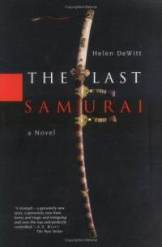 The Last Samurai
 This is a novel that feels exceptionally difficult (and more than usually pointless) to excerpt from–and yet, the temptation! And it incorporates so much that it’s difficult to know what to single out for commentary. One aspect of it that is obviously very important, both structurally and thematically, is its engagement with Kurosawa’s The Seven Samurai (which I have never seen–but the range of things alluded to in this novel that I don’t know first-hand is so long there’s no point remarking them all). The Seven Samurai is Sybilla’s favourite film. Not only does she watch it over and over, but she thinks of it as taking the place of a male role model in Ludo’s life. What she doesn’t expect, when she first shows it to him (when he’s five) is that it will prompt him to demand to learn Japanese.
 One of the most fascinating explorations of this in the novel is the story of the pianist Kenzo Yamamoto, who becomes obsessed, not with how to play a particular note or phrase or piece, but with how else you could play it, or how else it could sound:
 Her bitterness at the inadequacies of the Circle Line riders is balanced by this moment of grace. Why do we put such limits, not just on our children, but on our art? Much, much later in the novel, Yamamoto says to Ludo, “When you play a piece of music there are so many different ways you could play it. You keep asking yourself what if. You try this and you say but what if and you try that. When you buy a CD you get one answer to the question. You never get the what if.” There’s no place for Yamamoto’s “what if” in the world of concert halls and recording studios and trains to catch.
 Life is short, I’m busy, my TBR list is long and endlessly proliferating — so why would I waste my time on books that are shallow, badly written, and pander to silly, juvenile fantasies of finding Mr. Right? They’re so formulaic as to be essentially interchangeable and so numerous they are clearly also disposable. And their covers are so embarrassingly lurid!
 On Twitter, in the meantime, my tweeps joked, good-naturedly, about actually persuading me to read a romance novel someday, and they batted around titles they thought might be my “conversion” novel–so finally I took the bait and borrowed Loretta Chase’s Lord of Scoundrels, apparently known to some as one of the best romance novels of all time, from the library. Well, that was a setback.
  Thinking about why I liked Anyone But You (not loved, mind you, but liked–to the tune of 2 stars on Goodreads), I realized that it is really a prose version of a romantic comedy, a movie genre I enjoy. I actually have a collection of favorite romantic comedies I own on DVD, including Moonstruck (the best!), When Harry Met Sally, Notting Hill, You’ve Got Mail and Sleepless in Seattle. These are not high art films–but then, almost none of the films I watch are! I don’t reject these films for being “only” what they are. I appreciate how well I think they do what they set out to do, which is tell a romantic story about people I can be brought to care about, with humour and a touch of grace. They indulge happily-ever-after fantasies, yes, but with just enough realism to be engaging and just enough tongue-in-cheek self-consciousness about their own love stories (sometimes, with overt meta-commentary on it, as with the invocation of Pride and Prejudice in You’ve Got Mail or of An Affair to Remember in Sleepless in Seattle) to give a little tartness to their sweetness. As mystery novelists work within but manipulate conventions, these films follow formulas but succeed insofar as they tweak them to make them new. There’s comfort in knowing how things will turn out (again, as in mystery novels, with the reassurance of order restored). They are feel-good movies. What’s wrong with a feel-good book? Anyone But You is exactly that. In fact, it would make a nice little rom com. I can totally see Meg Ryan in it! It even has the quirky secondary characters. If it’s perfectly OK with me to enjoy Sleepless in Seattle even though I know it is not a great, profound, or innovative film–just a charming one–then why shouldn’t there be a place for charming, light-hearted romance in my reading life?

 Novel Readings