This Week in My Classes: Modelling the Process

We’re deep into the reading in all three of my courses now. On Monday we ‘wrapped’ The Moonstone in Mystery and Detective Fiction; we’re finishing up The Tenant of Wildfell Hall in The Victorian ‘Woman Question’ tomorrow; and in 19th-Century Fiction we’ve moved on from Persuasion to Vanity Fair. Those hours spent in the classroom actually talking with students about these fabulous novels are my favorite hours of the day–better even than the hours spent rereading the novels.

In recent years, and this term especially, I’ve been trying especially hard to make explicit what I think I (we) are doing in our classroom time. In particular, I’ve been commenting explicitly during class discussions on ways I see those discussions as models for the kind of work I want the students to do on their own. I have always thought of my class time as “exemplary” in this way — that is, as providing examples. When I lecture, sometimes I am delivering information and context, but more often I am offering an example of literary interpretation, building observations from the text into an organized “reading” of the text. In class discussion, we go through this process together: I pose questions and solicit the students’ observations and ideas, collecting them in a loose way on the whiteboard, often in the form of lists of words or phrases–and circles and arrows and many lamentable attempts at drawing. Then I encourage them to look over what we’ve come up with and think about what it means. My role at this point is to help the students appreciate the significance of what they’ve noticed, and to lead them to make explicit things they are already more or less aware of. I try to do this in an open-minded and open-ended enough way that it builds their confidence: they are noticing important things, they can discover patterns and connections, they can develop their own interpretations based on careful reading and thinking. At the same time, especially early in a course, I don’t proceed entirely randomly! I ask about aspects of our readings that I know will prove interesting and fruitful to analyze, and in that way I try also to model the kinds of questions and approaches that are appropriate to the class.

But until fairly recently I had basically assumed that it was obvious what we were doing and why. It isn’t, of course, at least not for students who aren’t already somewhat experienced in the process of moving from reading and taking notes about what’s on the page to finding an interpretive framework that makes sense of what they’ve noticed. Gradually (and perhaps I was just obtuse in not having realized this much earlier on) it occurred to me that the mismatch between my expectations and students’ work could be attributed to a mismatch between what they thought I / we were doing and what I understood us to be doing. The more I thought about this, the more I noticed that, for instance, lots of students busily write things down when I’m talking but not the rest of the time–waiting for me to deliver the information, rather than engaging in the process of analysis. In their written work, they often weren’t transferring ideas or practices from the examples “covered” in class to other characters or situations or features of the novel. Often, they were reiterating plot summary in answer to questions about why things are significant, rather than making that move from observing the plot to thinking about what their observations meant. In other words, many of them were approaching our class time as the time when I would tell them what things meant, rather than showing them how to figure out meaning. Of course, sometimes I do tell them what things mean, but the purpose is to show them how it’s done (when I lecture more formally) and to show them how to do it (when I summarize and synthesize their observations during more open discussion).

One factor in making me more aware that it would help to talk more explicitly about method and process was teaching a lot of non-majors in the Mystery and Detective Fiction class. I began to adapt for it some of the assignments but also some of the commentary I use in my first-year classes to orient students in the methods of literary criticism–not just addressing terminology but also things like how you identify what a theme is in a literary work, how you get from the literal words on the page to a reasonable idea about what else the book is about–and how you know when you’re going too far (not that there are strict rules for this, but I think all English professors are used to complaints that we are “reading too much into it,” so it’s helpful to be as clear as possible about how you legitimate an interpretation, about the kind of evidence as well as, frankly, the kind of experienced intuition that leads you to say that this, but not that, is a good “reading”).

I don’t know for sure whether my new meta-commentary is really that helpful, but I hope it is doing at least a little to clarify that literary criticism isn’t really that mysterious a process, and it’s certainly not something that I should do while they watch (and then write down the results). It’s what they are supposed to be learning and doing, as much as they are also learning what the contexts are for their readings and what the books are like as reading experiences.

John Williams, Stoner

I’ve finished Stoner, and I’m still uncertain how I feel about the way Williams handles his academic context. Far from ending it awash with nostalgia for an era before the intense professionalization of literary studies (and the academy more generally), I actually found myself thinking that it makes a case (albeit indirectly) for greater professionalism, given the ways Stoner’s career is hampered and diminished by the pettiness of colleagues and the lack of clear and consistently enforced policies about everything from graduate admissions to workload! And just what he does as a professor remains quite vague, though we are told repeatedly how hard he works, what long hours, and so on. But even though I couldn’t entirely shake off these concerns about the imprecision of this aspect of the novel, I did end up feeling that his academic life wasn’t really–or at least, wasn’t entirely– the point. I’m not sure the novel would have worked no matter what job he had, but it’s a story about one man’s life and death in a more abstract way, about the experience of being Stoner, of having his feelings and hopes and setbacks and disappointments. I suppose the academic job helps to establish him as someone whose hopes and expectations are of a particular kind: intellectual, perhaps also spiritual, though not religious. His conversion to English studies does, actually, have something of the aura of a religious conversion, as he listens to a Shakespeare sonnet and finds his perception of the world transformed:

The thin chill of the late fall day cut through his clothing. He looked around him, at the bare gnarled branches of the trees that curled and twisted against the pale sky. Students, hurrying across the campus to their classes, brushed against him; he heard the mutter of their voices and the click of their heels upon the stone paths, and saw their faces, flushed by the cold, bent downward against a slight breeze. He looked at them curiously, as if he had not seen them before, and felt very distant from them and very close to them. He held the feeling to him as he hurried to his next class, and held it through the lecture by his professor in soil chemistry, against the droning voice that recited things to be written in notebooks and remembered by a process of drudgery that even now was becoming unfamiliar to him.

Implicit in this (and perhaps throughout Stoner, though here again the vagueness of its treatment makes me uncertain) is an idea of literature that is at once elevating and profoundly anti-intellectual (there’s no mention of any analysis of the sonnet, any contexts provided for it, not even any commentary on its formal elements). The introduction to this edition quotes Williams objecting, in a “rare” interview, to the idea that “a novel or poem is something to be studied or understood rather than experienced,” but there’s no reason why these must be antagonistic approaches, and in his sympathetic portrayal of Stoner, who does, after all, dedicate himself to studying and teaching literature, Williams does not seem to rule out the possibility that analysis can further the “joy” he claims in the interview is the purpose of reading. Through Stoner’s relationship with Katherine Driscoll late in the novel, we are told that Stoner reconciles “the life of the mind and the life of the senses,” after having come to believe, “without ever having really thought about it, that one had to be chosen at some expense of the other.” This discovery motivates and enhances Stoner’s research as well as his teaching–but we have had only the most impressionistic sense of his work before this: this emphasis on a conflict between head and heart comes upon the novel somewhat belatedly, I think, and thus does not stand as an overall gloss on the novel’s presentation of academic life.

But as I said, I don’t think Stoner really is an “academic” or “campus” novel at heart (though I’d be curious to know what other readers think). It’s more a portrait or character study, of a protagonist whose life comes to be defined by his inabilities to transcend his petty circumstances or his vexed relationships with the people in his life who misunderstand and thus inhibit him (most notaably his parents) or those who actively hamper his attempts at happiness. The story is beautifully told, with economy and restraint but also, as the quotation above shows, with compelling details and often real and moving eloquence. I felt the novel’s power most strongly in the final chapter. I felt most distant from it as it told the story of Stoner’s marriage to the neurotic, unstable, passive-aggressively vindictive Edith. There seemed something tediously predictable about the tale of a man whose potential is hindered by his foolish infatuation with the wrong woman, a man whose path is beset with obstacles because of her unreasoning opposition and inability to love.  In its own way, I think Stoner represents yet another variation on what Nina Baym labels the “melodrama of beset manhood” (see here and here for some explorations of how this myth of what constitutes a “great” American novel may still be reflected in contemporary fiction, or in how contemporary fiction is received). Katherine Driscoll provides a foil to Edith, of course, but she’s used primarily to show a better but inaccessible option for Stoner, one more thing that his bad wife and nasty colleagues drive out of his reach. That Stoner’s working world is primarily masculine (Katherine, a visiting “instructor” who is finishing her dissertation, is the only academic woman we meet) is to a large extent a historical phenomenon, but it’s interesting to consider the contrast between Stoner and Private Life. Smiley’s novel covers much of the same chronological period but gives a very different impression of its protagonist’s relationship to the wider world. In Stoner the focus really is intensely singular. I enjoyed Private Life more, but Williams has the edge in eloquence and beauty of style. More than any of the other issues and ideas I have touched on here, a moment like this gets to what I ultimately felt was the heart of the novel:

There was a softness around him, and a languor crept upon his limbs. A sense of his own identity came upon him with a sudden force, and he felt the power of it. He was himself, and he knew what he had been.


Reading Stoner: Another Time, A Different Academy

I’m reading John Williams’s understated and fairly depressing novel Stoner (I’m only half-way through, so perhaps it gets less depressing, though I doubt it, the way things are going–and I’m reasonably certain the tone and style won’t change–but we’ll see). One of the reasons I have been very interested in reading it is that it’s a novel about an English professor, and who doesn’t have a prurient curiosity about seeing how their occupation looks in fiction? And the smattering of other academic novels I’ve read have been either satires (David Lodge, Kingsley Amis, Zadie Smith) or mysteries (Amanda Cross — and there’s a strong satirical element there too, especially in Death in a Tenured Position). The exceptions I can think of are Wallace Stegner’s Crossing to Safety, which I liked very much but can’t now remember in much detail because I read it in the era Before Blogging, and May Sarton’s The Small Room. I tire of the satires, because though I agree academics are prone to take themselves and their work a bit too seriously, at the end of the day a lot of us are at least really sincere about what we do, and the values that motivate us are not ridiculous, however bizarre or arcane their outward manifestations may seem to others. The flip side of this “look at the funny creatures” mode is idealism of the somewhat problematic kind found in The Small Room, or, in a way, in Gaudy Night (my favorite academic novel of all). What’s more elusive, in my experience of academic fiction, is straight-up realism. Perhaps writers fear that if they show the mundane business of academia they will bore everyone–my husband and I have often speculated that this fear lies behind the very odd distortions of university life that break out any time a television show goes to college (seriously, Friday Night Lights, a freshman class with a professor who holds weekly salons? and a TA who gives a student a C because–knowing basically nothing about her at all–he imagines she can do better?)–or any time a movie has a professorial character (I can’t remember how which one it was that showed a professor meeting with his agent and getting a large advance for his next book, but again, seriously?). Even when I know being realistic is not really the point, as in On Beauty, I find it distracting when issues like timetables for tenure and promotion or the granting of sabbatical leaves, never mind actual teaching and grading, are handled with no concessions to the way these things are actually done.

So far, Stoner seems to be more or less aiming at realism. Certainly, there’s little idealism beyond the traces of it in Stoner himself, and Stoner is too sincere for the novel to seem like satire–though the characterizations of his colleagues all trend towards caricature. But the English Department of Stoner’s experience is still far from my own, and in this case what is distracting me is trying to figure out whether the differences are just historically accurate–whether what Williams is trying to capture is just a sense of the way things used to be, that is, amateurish, vague, unregulated–or in service of some larger idea. Stoner begins his career in the early decades of the 20th century, and things definitely were different then. English itself was only recently professionalized as a field of study and was in the early stages of its development as an academic discipline. But there’s something disturbingly indistinct about the world Williams is describing. What I keep wishing for is some exposition, some active narrative work to contextualize Stoner’s academic experience as a historical phenomenon, or as part of Williams’s broader interests (which at this point I am finding elusive). Here’s Stoner being advised to go on to graduate school, for starters:

‘But don’t you know, Mr. Stoner?’ Sloane asked. ‘Don’t you understand about yourself yet? You’re going to be a teacher.’

Suddenly Sloane seemed very distant, and the walls of the office receded. Stoner felt himself suspended in the wide air, and he heard his voice ask, ‘Are you sure?’

‘I’m sure,’ Sloane said softly.

‘How can you tell? How can you be sure?’

‘It’s love, Mr. Stoner,’ Sloane said cheerfully. ‘You are in love. It’s as simple as that.’

It was as simple as that. . . . He went out of Jesse Hall into the morning, and the grayness no longer seemed to oppress the campus; it led his eyes outward and upward into the sky, where he looked as if toward a possibility for which he had no name.

I realize that I will have at least one further context for this kind of moment by the time I finish, namely the rest of the book. Perhaps as we follow the rest of Stoner’s career the tension between this naive, if lovely, idea of professing literature and its eventual professional realities will be developed. I’m not disavowing love as a motive for professing literature-I think it remains one of the chief motivators for anyone who starts down this path, and often shows through in our teaching, if not so often in our academic writing–only, nobody could end up as a professor now based on their love (or their teaching) alone. It is not as simple as that any more (though not without reason, and perhaps not without benefits either). I’m curious to see what the novel does about this, if anything.

There are little things too that distract me. At one point, Stoner heads off to a funeral and we’re casually told he gets someone else to take his classes. While this is not impossible, it’s a lot harder than it sounds, or so I’ve always felt–and found. For one thing, it’s not easy to find someone available to teach at a moment’s notice, but even putting aside logistics, it’s tricky to find a substitute who can carry on where you left off and leave things ready for you to pick up again: often, we are teaching things our colleagues know little or nothing about, and even when they do know the texts, their approach may be quite different–which is not a bad thing in itself, but can be confusing for everyone. This may reflect Stoner’s more canonical time, when expert knowledge was concentrated around a narrower body of material, or just my own no doubt disproportionate skepticism about having other people cover for me. (Now that I think about it, I have a serious scheduling conflict coming up that would be great to resolve by having someone else step in for at least one of my classes–I should explore that possibility further rather than assuming I’m going to have to cancel them!) There’s the way the appointment of a new dean and a new department chair is handled–in both cases, in ways radically unlike the elaborate and transparent process we would expect to go through in my own university. Again, things were different then–but I’m interested in some commentary on that, on how that kind of cronyism and inside politics and informality reflect not just different practices but also an idea of the university that has been superceded. Then there’s the impressionistic account of Stoner’s research, especially as he moves into work on his second book…

Probably everyone exposed to fictional treatments of their profession gets similarly hung up on whether the portrayal seems fair and accurate. I can only imagine what ER doctors and nurses think about ER or surgeons about Grey’s Anatomy, or lawyers about The Practice, etc. Is accuracy a legitimate thing to fret about, I wonder? Perhaps I’m especially sensitive about how English professors are depicted because these days there seem to be so many belittling, reductive, anti-intellectual assumptions about them in circulation that reflect at most only the extreme outliers. Somewhere there may be English professors who work only four hours a week from September to April, who farm out all their grading to teaching assistants in order to jet-set around, who spend what little classroom time they have on political indoctrination–but I don’t know any of them, any more than I know any, or at least many, who are starry-eyed idealists or absent-minded bores shuffling around in tweed jackets, lost in intellectual abstractions. It’s not a novelist’s job to counter these stereotypes with the specificities and complexities of our reality, but it’s hard not to bring your reality with you when you read a novel that is, ostensibly, in some way, about the work you do.

This Week in My Classes: Back in the Saddle Again!

Finally! I planned to write this post last week, which was my first full week of classes since last December. But the Evil Virus of Doom spoiled that plan. Here I am, though, ready to start my fifth year in this regular series. I began it as a defensive reaction to some truly vituperative comments about English professors I encountered back in 2007. I guess I was sheltered, because I was quite shocked to discover that people hated us so! And also quite puzzled by the caricature of our work that they offered. Now that I read a lot more mainstream journalism and other public commentary about higher education, I have, sadly, come to expect just such ignorant vituperation. No amount of reason, argument, or enthusiasm seems likely ever to make a difference. But I thought, in my early 2.0 days, that greater transparency would help, and thus the very imaginatively-titled series ‘This Week in My Classes’ was born. As I’ve written about regularly since then, the value of the exercise proved to be as much intrinsic as anything else, and I look forward to continuing to reflect on my teaching as yet another semester gets underway.

So, what does this term have in store? I have another round of Mystery and Detective Fiction. I spent quite a bit of time on my sabbatical reconsidering the reading list for this class, which I have offered almost every year since I first introduced it to our curriculum in 2003. I continue to find it a lot of fun to teach, which I think is the result of tweaking the book list regularly, of the open-endedness of the course agenda, and of the lively mix of students I typically get–it’s a popular class with non-majors, and an absolutely elective class for English majors (at least, as far as I know it doesn’t fill any of their specific requirements). By and large, everyone is there out of interest and with the hope and expectation that it will be a fun class. Sure, some of them are also hoping that it will be an easy class–which is why we do The Moonstone early on, to show them that they are going to have to put in time and effort to keep up. (Well, that, and of course The Moonstone comes pretty early in our chronology!) I have a good feeling about this year’s group. Right from the first day, when we read aloud and then discussed James Thurber’s delightful story “The Macbeth Murder Mystery,” there were plenty of hands up and plenty of appreciative chuckles, and quite a few people seem engaged with The Moonstone as well.

I’m also teaching 19th-Century British Fiction from Austen to Dickens again. I last taught this in the spring session of 2010, which is quite a different kind of teaching–very compressed and high intensity–and for which I therefore compromise somewhat on the reading load by assigning more short texts (“The Two Drovers” for Scott, A Christmas Carol for Dickens, and Silas Marner for Eliot). For this go-round I am back with my more traditional list of five full-length novels (when I started teaching these courses, I always assigned six, but somehow now that seems like too much). Here too I routinely shuffle my choices, sometimes to reflect a particular theme, but more often just to keep favorite books and authors in circulation. We have begun with Persuasion, and by next week we will be on to Vanity Fair–which I certainly did not try to assign in the 3-week version of the course! Austen is usually a pretty easy start; this year, as usual, many students have read Austen before, some of them a lot. Those who haven’t read her are usually predisposed to like and admire her (though I long for a student who dares to be contrary and call her “boring”–if only to see what kind of discussion follows). Also, her novels are quite short. Vanity Fair, on the other hand, demands a lot of everyone. I’ll do my best to carry them along. There’s always someone who loves it, and really, one a year is enough.

And my other fall course is a 4th-year seminar on The Victorian ‘Woman Question.’ The last time I offered this course was 2008, when I did a variation focusing exclusively on novels and, more exclusively still, on novels that take us past or beyond the courtship plot and the marriage ceremony: The Tenant of Wildfell Hall, East Lynne, Middlemarch, He Knew He Was Right, and The Odd Women. It was an amazing course: I had a great group of students who really rose to the challenges of this rather daunting reading list, and we had some of the best class discussion I can remember. Before that, I always used to do more or less the readings we are doing this time: a mix of poetry, non-fiction prose, and fiction, including The Tenant of Wildfell Hall, Aurora Leigh (all of it!), The Mill on the Floss, The Odd Women, “Goblin Market,” an assortment of short poems, Mill’s The Subjection of Women and various essays from the excellent Broadview anthology Criminals, Idiots, Women, and Minors. I’m looking forward to going back through this set again. The discussion has been quite good already, and today we already had our first group presentation. I always discourage the students from holding forth for very long in their presentations, and I require them to include some kind of game or activity that gets us all involved. It’s always fun and surprising to see what they come up with. Today, for instance, after learning some general context and then focusing on some passages from our readings, we played “Snag, Marry, Kill,” in which those playing women had to give up their share of the candy they won to those playing men when they married. The bluntness of this unjust process made us laugh at first, but in the end it stimulated some very insightful discussion about entitlement, resentment, and the effect of individual character on systemically unjust rules (for instance, those who had to give their candy to classmates who were already their friends felt better about it, which brought us back to what Mill and Cobbe say about how “well” unjust laws work if everyone involved is kind and honorable enough not to take advantage of them).

Although this term has gotten off to a rocky start in other respects and, as usual, I resent the administrative and pedagogical confusion created by our long add-drop period, it does feel good to be back doing the part of this job I like the best. This week has its share of further complications–Maddie was home sick today with a bad cold and may need one more day before she can go back to school, my husband is headed to Amherst College to give a talk and is anxiously keeping an eye on the Air Canada news, and tomorrow night I am giving a talk myself at the Halifax Public Library, which I am quite excited about. It all feels rather hectic after the more ambling pace of a sabbatical and of the summer months! I’m just so happy to have my laptop completely restored, though (as of today, I think I have reinstalled and reoorganized everything that needed installing and organizing), that I feel ready for anything.

Recent Reading: Wharton, Dickens, Pym, Heyer

I have a backlog of books I’d hoped to write detailed posts on, but the time I lost to that evil computer virus–and then to reinstalling and reorganizing everything so that I could get back to work–makes that an unrealistic goal. Still, all of them deserve at least some discussion, so here’s a run-down of what I found most interesting, provocative, delightful, or uninspiring about each of them.

Edith Wharton, The Age of Innocence. There’s no denying the elegance and acuity of Wharton’s prose, the fine touch with which she fills in the details of her social drama. My appreciation of this book was undermined, though, by my skepticism about Newland Archer and my uncertainty about how far we were being encouraged to find his thwarted romance with Ellen Olenska poignant rather than pathetic. He’s such a passive wannabe, reading his Swinburne and Pater and fancying himself so different from those around him even as, in all affairs except his own, he is utterly conventional and priggish. His passion for Ellen (and her professed passion for him) seemed based on nothing more than fantasy. It seems that he, too, is the subject (if unwittingly) of Wharton’s satire, but the final chapter suffuses his earlier experiences in a glow that replaces criticism with wistfulness. Is the irony enhanced here (because even at this point he does not recognize the shallow folly of his grand amour?), or are we brought into fellowship with him as he mourns the loss of the man he (thinks he) might have been? The world of the novel also felt very small to me, and while I realize that is consistent with the way Wharton depicts it, as a closed society resistent to change and outsiders, I missed the overt presence in the novel of a wider perspective. To me, it was claustrophobic reading the way Henry James is; I like the “cool draught” that James complained came in through the open door of philosophy in George Eliot’s fiction.

Charles Dickens, Our Mutual Friend. This is a wonderfully dark, funny novel. Reading it, I was struck by Dickens’s mastery of his own form and by the readerly confidence that I felt, knowing he knew what he was doing. The novel is splendidly diffuse and prolix, but it is bound together by Dickens’s brilliant, all-encompassing metaphorical imagination, the unifying motifs appearing and recurring with symphonic assurance. In the end, though, I was dissatisfied with the novel’s morality, which struck me as false in a highly problematic way. Central to the novel is its critique of the corrupting power of wealth, the insinuating bad effects of greed and vanity and social climbing and conspicuous consumption. And central to this critique is the exemplary story of Bella Wilfer’s reeducation from a shallow, selfish, materialistic girl into a “boofer” lady who learns the value of love, honor, and fidelity. But Bella is rewarded for her transformation precisely by being rescued from any threat of poverty and rewarded with wealth and status. There’s all kinds of thematic fitness to this, and of course all the elaborate machinations of the plot are required to bring about this triumphant conclusion, but it’s hard not to find it a dangerous moral that if you abjure riches, riches will be your reward–or, thinking of the other characters, that if you dedicate yourself to the self-interested pursuit of wealth, you will meet your come-uppance. But nobody can make me laugh or cry while I read the way Dickens can, and no other author that I have read gives off from his pages the same sense of ebullient, irrepressible joy in language. Dickens goes on and on, even when there’s no formal or thematic necessity to his elaborations, not because he is “paid by the word” or doesn’t understand novelistic form, but because he is loving it–how can we resist? Why would we want to?

Barbara Pym, Jane and Prudence. Jane and Prudence is a charming read, to be sure, but it doesn’t deserve the effusive comparisons to Jane Austen that litter its blurbs. In its wry social comedy, its limited range of characters and setting, and its precise prose, it resembles Austen’s novels, but I thought this stylistic resemblance was not matched by a similarly rich undercurrent of ideas.

Georgette Heyer, Sylvester. I believe that this is the first Georgette Heyer novel I’ve read, which surprises me a little. But the Regency was never “my” period (the historical fiction I devoured in adolescence was overwhelmingly Tudor, with a sideline in the early Plantagenets, and then of course there was Richard III). I enjoyed Sylvester OK, though I found the writing fairly stilted and the plot predictable–which was fine for most of the book, really, as another way to say “predictable” is that it is true to the conventions of its genre. Towards the end, though, I thought it went off the rails: though it had to happen, the “discovery” that Phoebe and Sylvester are in love was handled clumsily, with Sylvester’s first proposal really coming out of nowhere, and Phoebe’s outraged response seemed forced. I didn’t like Phoebe herself much, actually: she had a good feisty side to her, but I was really disappointed by the way she limped around the novel being embarrassed and apologetic for putting Sylvester in as the villain of her novel. (The heroine of the otherwise ridiculous Lord of Scoundrels, which I read over the summer, was at least more consistent and sure of herself.) I did appreciate this little metafictional moment:

‘But, Phoebe, you don’t suppose he will read your book, do you?’ said Tom.

Phoebe could support with equanimity disparagement of her person, but this slight cast on her first novel made her exclaim indignantly, ‘Pray, why should he not read it? It is going to be published!’

‘Yes, I know, but you can’t suppose that people like Salford will buy it.’

‘Then who will?’ demanded Phoebe, rather flushed.

‘Oh, I don’t know! Girls, I daresay, who like that sort of thing.’


Infected!

In my all happy anticipation about getting back into a regular routine for the fall, including getting back into the classroom, I did not imagine finding myself the victim of a truly evil computer virus that somehow (despite my anti-virus software)  got so deeply into my little netbook that after four days of intensive care with our tech people, it has proved impossible to clean out. Today they are wiping the hard drive, and I hope to have the computer back by tomorrow. Thankfully, it seems that they will be able to preserve a backup of most of my files, but there will still be a lot of reinstalling and reorganizing to do before I’m back in business. As a result, I haven’t been able to do either much work or any blogging in the evenings–hence the sudden silence over here. It has been interesting realizing how much I depend on being properly equipped, not just for my own interests and personal activities, but for getting done the array of work tasks, from e-mail to class prep, that can almost never be completed during regular work hours. As a result, I feel particular strain on my regular work hours right now, which is why this post will be short! As if heading into a three-course term and picking up all the other regular duties of the term wouldn’t be stressful enough without this added complication… and as if dealing with losing what feels like my life-support system doesn’t induce enough frustration without people commenting, “well, you do spend a lot of time online,” as if I somehow had this coming to me for my risky behavior. Anyway, here’s hoping that my next post will be about books or teaching and this will all be behind me.

Summer Reading Recap

As the warm days dwindle down to a precious few, so too has time run out on our public library’s summer reading program, and Maddie and I have both tallied up our final scores. Neither of us quite reached the number we’d set as a goal, but we feel good that we read a lot, including a lot of books that we really liked. Since, as usual, the number of blog readers went into a bit of a slump over the summer, I thought I’d help people catch up with a look back at some of the books that were highlights for me, with links to the full posts.

At the top of my ‘best of the summer’ list would have to be the two books I read about the ‘troubles’ in Ireland, J. G. Farrell’s Troubles and Elizabeth Bowen’s The Last September. It’s hard to imagine two more different books dealing with such similar historical territory.  Farrell’s dry, acerbic absurdity was more immediately engaging, but Bowen’s prose, full of beauty but shot through with both pain and humor, made her novel linger in my mind well after I finished it. Both resist all temptation to melodrama; even the inevitable violence and suffering emerges perfectly (though in completely different registers) from the tone and form of each book.

I was pleasantly surprised by just how much I enjoyed and admired Jane Smiley’s Private Life. It’s a carefully paced, understated novel, a family saga without any of the grandiosity such books often rely on; it moves us through a tumultuous period of American history and deftly balances attention to the events and complexities of that context against its primary interest in the small-scale achievements and struggles of private life.

Testament of a Generation was everything I’d hoped it would be: sharp, intellectual, passionate journalism from Vera Brittain and Winnifred Holtby. It fed my enthusiasm for one day developing a seminar on the Somerville novelists. Brittain’s The Dark Tide, on the other hand, was a more … ambivalent … reading experience.

Rosamond Lehmann’s The Weather in the Streets took me completely by surprise with its strange, drifting prose and stark confrontations with different kinds of loss. If, as the introduction proposes, it was the Bridget Jones’s Diary of another generation, either I’ve been wildly misreading Bridget Jones’s Diary all this time or that generation had radically different expectations of itself and its books.

I, Claudius was ultimately more fascinating to me for the formal choices Graves made than for the story or characters. It wasn’t easy pushing through some of the longer paragraphs (and if you’ve read I, Claudius, you know that pretty much all of the paragraphs are pretty long!), and I admit I was greatly helped by having watched the BBC adaptation just previously, or I don’t think I could have kept the family tree sorted or felt the drama of the events, which come to us in such abundant yet muted detail.

I thoroughly enjoyed Jane Gardam’s Old Filth, though I wondered after just how much that pleasure came from Gardam’s pushing all the ‘right’ buttons for a reader like me. Yet I had similar expectations of Colm Toibin’s Brooklyn (that it was just the book for me), and didn’t like it very much after all, finding its flat affect ultimately too flat. I didn’t write up Ann Patchett’s State of Wonder, as I finished it while in Birmingham and the moment for posting on it had passed by the time I got home, but I was similarly underwhelmed by it: though Patchett’s writing is wonderfully readable and the story had plenty of momentum during reading, somehow (and of course it’s possible this was in part the effect of reading while traveling) I was never deeply engaged by it emotionally, and at the end I couldn’t really decide where it had taken me intellectually. I’ll hang on to it, and to Brooklyn: I’ll reread them someday, I expect, and maybe I’ll find something more in them then. I haven’t written up The Age of Innocence either. It’s wonderful, of course, and yet I ended it a skeptic about it, feeling the brilliance of Wharton’s prose and the minuteness of her analysis was squandered on Newland and Ellen, neither of whom I liked or believed in at all. More about that, maybe, in a later post.

I read four more early Spenser novels, one of which, The Judas Goat, was so awful that, had it been my first experience of the series, I would not have read any more. But the other three were excellent of their kind. I’m still trying to get ahold of God Save the Child, the second in the series, in which Spense and Susan first meet. I read it many years ago, before I had quite the same interest in how their relationship is handled. By just a few books later on, they are very nearly into their lasting patterns, which in many respects have always epitomized to me the relationship between equals that is (or is it?) the ultimate romantic fantasy.

Finally, of the summer books worth any further comment, there’s Murder Must Advertise, an old favorite but one I haven’t read attentively in some time. I enjoyed rereading it, but the real fun came in writing it up, which was by far the best time I had doing any writing all summer. That’s the feeling I wish I could always having when writing: overflowing with ideas, enthusiasm, and energy, and just happy to be putting it all out there.

Everything else I read was disappointing to mediocre, really, or, in one case, laughably bad. Looking back, it doesn’t seem like a great reading season overall. Happily, I have just finished Our Mutual Friend, though. If I’d reached the end before the library’s deadline, the average would have been raised considerably.  I’m currently feeling a bit overwhelmed with the start of the teaching term, but I’m determined to get a proper post up on that dark, hilarious novel before too much longer.

London Books

In the grand tradition of May’s post on Boston by the Books and last summer’s post on my equally bookish expedition to New York, here’s a recap of my book buying adventures in London. First of all, as I have mentioned here a few times, the London Review Bookshop was my top destination for the trip. It was everything I’d imagined. It proves that, when it comes to bookstores anyway, size really doesn’t matter: it’s far from the largest bookstore I’ve ever been in, but every shelf is packed with interesting titles, with no space wasted on the mass-market blockbusters of the mostly disposable kind that fill huge display racks at so many other stores. I could have spent hours more exploring and learning. I didn’t even really go downstairs, except to grab the one Mr. Gum title missing from our collection from their children’s section–this series, much beloved of both my children, is very hard to get on this side of the pond. I was especially looking for a couple of books I hadn’t found locally, John Williams’s Stoner and Alaa Al-Aswany’s The Yacoubian Building, and sure enough, they were both in stock. I couldn’t resist Judith Flanders’s The Invention of Murder, which has not been released here yet in paperback, and having just helped edit Michael Adams’s lovely piece on Barbara Pym for this month’s Open Letters Monthly, I leapt on Jane and Prudence when I spotted it. I could easily have bought another dozen titles, but I had to respect not only my budget but also the impracticality of adding too much more weight to my suitcase when I knew I still had to lug it to Birmingham and back. So I made it out of there with only five additions to my library–restrained indeed!

I enjoyed browsing in a number of other bookstores, including Blackwell’s on Charing Cross Road and two Waterstone’s locations, the one on Gower Street (just up from my little hotel) and the giant one at Piccadilly Circus. There, after much dithering deliberation I picked out another couple of books that have proved elusive locally, Susan Hill’s thriller The Woman in Black and Salley Vickers’s Miss Garnet’s Angel. Again, there were many other tempting choices (including Elizabeth von Armin’s Elizabeth and Her German Garden, which I am still rather regretting having put back on the shelf, and Sebastian Faulks’s One Day in December–though deciding against that one, I think, was probably the right call). But I had already added Avrom Fleishman’s George Eliot’s Intellectual Life to my stash from the Cambridge University Press table at BAVS, and while roaming Waterstone’s Piccadilly I was actually carrying with me, in my trusty Lug shoulder bag, the beautiful book on the Devonshire Hunting Tapestries that I treated myself to at the Victoria and Albert Museum Bookshop, so I was keenly aware of the increasing weight of my luggage! My final book purchase in London was a tiny one, the British Museum’s Little Book of Mummies. Then, having arrived virtuously early at Heathrow for my flight home and checked my heavy bag, I felt at liberty to explore WHSmith, where seeing Mary Stewart’s Stormy Petrel  brought to mind a recent chat with a former student and fellow avid reader about her novels and how much I had once enjoyed them. And now here they all are, just waiting for me!

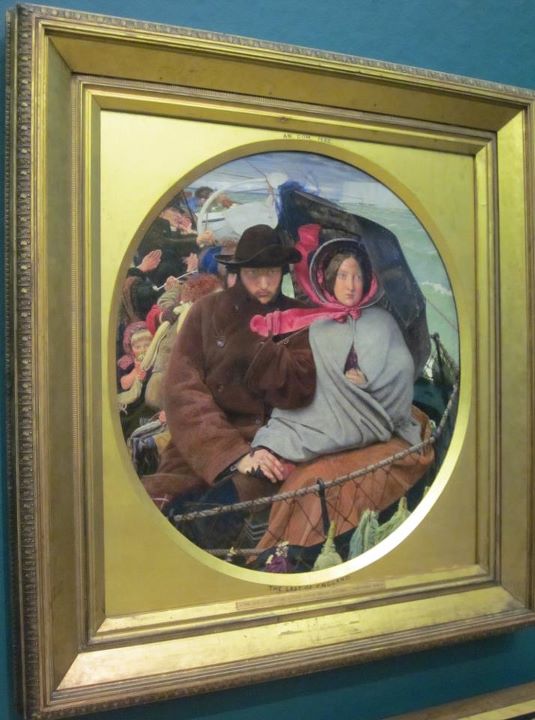
Both the tapestry book and the mummies book are part reading material, part souvenir: they will remind me of and teach me more about some of the museum exhibits that moved and interested me the most on this visit. In the same spirit, here are two related pictures from those exhibits for you to enjoy!


Back from BAVS

I got back Monday afternoon from my long-anticipated trip to Birmingham for the British Association of Victorian Studies conference–and, of course, my stop-over in London for sightseeing and book shopping. I’m now in the midst of back-to-school preparations. Though I am feeling very glad that I did so much work for my fall courses before I left, inevitably there are still details to be finalized, and in fact it’s a good thing I didn’t quite finalize things like my syllabi, as for various reasons (such as the last-minute announcement from higher up that we are not renewing our contract with Turnitin.com for this year–ask me how good an idea I think that is…), a number of sections needed to be tweaked. So I ‘m doing that, and making plans for the actual classroom time on Friday and Monday, updating PowerPoint slides and lecture notes, and making sure I have things like sign-up sheets for presentations and attendance lists. It adds to the excitement that the printer in our main office is defunct: as Dalhousie does not provide individual faculty members with printers (or, more significant these days, with ink cartridges, which typically cost more to replace than the whole darned machine), I rely on the office printer for my course materials, reference letters, and so on, so this is pretty inconvenient. The workaround in place is our new copier, which is “networked” so that we can send documents to it straight from our offices–except that the networking is itself a work in progress, to be completed by the end of September, and my computer remains out of the loop. So there are various extra steps involved any time I want a document sharp enough to copy.  I know, you’re all fascinated by this trivia about the glamorous life of the professoriate! Anyway, bit by bit the pieces are falling into place, the handouts into the folders, the notes into order, the graphics into position.

As for BAVS, I feel good about the experience. It was a big conference, with five parallel sessions running in most time slots and thus there was a lot of competition for everyone’s attention. In my own case, I find that my capacity to listen to specialized academic papers is somewhat limited at the best of times, and so I rationed out my attention a bit stingily, not attempting to attend a panel in every time slot but rather taking one break to go into downtown Birmingham to explore the Birmingham Museums and Art Gallery (which was wonderful, and topical, too, since it houses a terrific collection of Pre-Raphaelite art), and another to go across the street from the main conference site to the Barber Institute of Fine Arts (also wonderful, a real gem, as Ann promised when we met for our very pleasant dinner the night before the conference). The genre of the academic conference paper is, in my view, a somewhat problematic one. Typically, papers are highly specialized, and they are also usually very tightly crafted, polished to a high degree of rhetorical sophistication. As a result, I find it isn’t easy to engage with them, to see how to get into a conversation with (or about) them. If your own research isn’t highly proximate, it’s unlikely you know enough to get into the details, and if you’re interested anyway, you may feel kept at a distance by the effect of closure such a paper generates. I guess I wish conference papers were more like blog posts: preliminary or open-ended (or open-minded) enough that you feel invited into a conversation rather than impressed by a performance. That said, I heard some interesting papers, good things of their kind: they told me things I didn’t know or addressed questions I hadn’t thought of. A highlight for me was Colin Cruise’s plenary on ‘Arranging meanings: Pre-Raphaelite compositions and narratives,’ not only because it was intrinsically interesting and well presented, but because I had only just seen, in the BMAG, many of the paintings he focused on.

I think my own presentation went well. Our panel on ‘knowledge dissemination in Canada’ offered snapshots of three quite different projects, one the well-established Disraeli Project based at Queen’s University, presented by its director, Michel Pharand; another the Affect Project, a large-scale interdisciplinary endeavor recently launched at the University of Manitoba under the leadership of my good friend Arlene Young; and the other my adventures as an academic who blogs. We had a reasonable audience, considering the number of alternatives they had (if I’d had the choice, I too might have been at the Carlyle panel!)–around 20 people, maybe? I’m terrible at estimating these things, especially when I’m buzzed from nerves, as I always am when speaking in public. My prezi worked fine, which was a relief, after all that time spent on it, and I was even able to do a little last minute tinkering and get in a snippet from the Guardian piece that went up just that morning in response to my earlier post about Leonard Cassuto’s dismissive attitude towards blogs. There was some pretty lively discussion after. I was not surprised that the first couple of questions were, let’s say, skeptical–one of them was prefaced with a hope that it wouldn’t sound “too adversarial.” I didn’t think so, but I did think it skipped past a number of the quite careful framing statements I had made in order to present a kind of extreme worst-case scenario the logic of which, to be honest, I didn’t completely grasp. The concern seemed to be that somehow if we started doing something besides the conventional, highly structured and hierarchical and gated forms of academic publishing, we were heading down the slippery slope to having all our research funding and graduate programs cut — because (and this part of the question, or response, I do remember quite clearly) “in that case why would we need to do research or train graduate students?” As one of my main points was that the non-academic writing I’d been doing was closely integrated with, or reliant on, expertise acquired through my own specialized research, I don’t think I did, myself, offer evidence that such research was irrelevant or beside the point beyond the gates of the traditional publishing models. In fact, to the contrary, I was trying to make the point that such research has more value outside those gates than we typically believe, or at least than we typically let it. As for training graduate students, well, as readers of my blog know, I have a lot of doubts about whether we should continue to train graduate students in quite the way we have been doing for the last several decades, and it was really in service to those concerns that I emphasized my own belief that we need to make a place for (and make the case for) the value of unconventional scholarly practices including blogging in the overall landscape of recognized academic activities.

It struck me, listening to the more dubious voices in the audience, not just that they gave some signs of the defensiveness people like Alex Reid have written about, but also that they tended to talk about “the system in which we are embedded” as if we have no agency in that system. Has Foucault made cowards of us all? Who makes up the academic system, after all, if not the people who embody it? To be sure, there are all kinds of people in that system, often people with administrative or executive powers, who show no appreciation for the academic humanities. But if we really believe we can change our profession for the better, surely we should advocate for those changes, and seek to explain them in the strongest and clearest and most aggressive ways, rather than condemn ourselves–and, more pressingly, those coming after us–to persisting in a system we believe is dysfunctional. It may also be that breaking open the current rigid paradigms of academic scholarship and publishing will help us make the case for the value of our work to those administrators by showing it to be less insular, to serve a broader public. This is part of the logic behind the support structure for the new Los Angeles Review of Books, as I understand it; Tom Lutz, the founding editor, noted in his powerful essay on the state of book reviewing that academics are able to contribute to “as part of our commitment to the dissemination of knowledge that is integral to that job.” In any case, the questions were not, really, “adversarial,” but curious and eager to consider the further implications of the fairly modest proposals I specifically made, and it seemed worthwhile to have stimulated that kind of discussion. I think it’s telling that quite a number of young scholars, mostly continuing Ph.D. students, came up to me later to express their interest in what I’d said. Maintaining the status quo is not, overall, in their interests, I think, and their eagerness to think about how else things might be done was energizing.

Unusually for me, the conference felt most useful as an opportunity to have these informal exchanges, and also to meet people I knew from blogs or Twitter or the long-standing VICTORIA listserv, or from reading their scholarship, to make the personal contact that moves conversations and relationships forward — networking! It was a real pleasure putting faces to names, especially Rosemary Mitchell, whom I have ‘known’ for many years (since we both wrote essays on 19th-century needlework and historiography and decided we would be not competitors but allies) but never met in person. David Skilton was there! I was able to tell him how useful I have found his book Anthony Trollope and His Contemporaries. And I met Regenia Gagnier, whose book Subjectivities was one of the first critical books I bought when I was a student at Cornell, and Lyn Pykett, whose work on sensation fiction I rely on, and I was able to reconnect with one of my very best former students, now completing her Ph.D. in the UK (hi, Emily!).  I could wish there had been a bit more time for simply mingling, as we were either in sessions, standing in the crowded atrium eating the (very good) lunches provided, or seated at tables for dinner. Perhaps if I hadn’t been too tired from traveling to go to the pub …

Next up: some self-indulgent posts about my eagerly awaited visit to the London Review Bookshop and other bookish haunts.

“The Measure of Blogging”: More from Leonard Cassuto

Leonard Cassuto has published some further thoughts on blogging at the Guardian, with some specific attention to my response to a couple of his earlier comments in the live chat back in July.

I don’t have time to reply in detail right now as (ironically) I am at a conference in Birmingham heading off to give a presentation about blogging as knowledge dissemination. I will quickly say that the “critical error of fact” he points out (that “[his] writing for the Chronicle is in fact a column, not a blog”) doesn’t seem that critical to me, really, but I accept the correction. The difference between the two as he explains it has to do with only two things: where in the Chronicle his writing appears (including that it appears in the print version), and that it is edited by others (including fact-checked). That process, he notes, “almost always” improves the product. It’s true that my blog is not fact-checked except by me, and as it turns out, my attempt to identify just what the process was for his pieces was not thorough enough – I didn’t altogether rely on the statement in the Guardian that identified his pieces as a blog post for the Chronicle, but when I looked around the online version I didn’t see anything that clearly contradicted that description.  I guess the Guardian doesn’t fact-check very thoroughly either. In any case, it seems only fair to retract the suggestion of hypocrisy about that example. Now that he’s posted a declared blog post, he has also softened his general stance on blogging: “I mostly don’t read blogs. I’m reading this one right now, and I’m even posting to it.”

But the point of my previous post is not to determine exactly the right label is for Cassuto’s writing (as Cassuto acknowledges, “the world does not turn” on that question). The Chronicle publishes a lot of articles I think are surprisingly poor (many seem like nothing more than link-bait), despite whatever editing they have received, and by far the most valuable resource it offers, in my opinion, is the Profhacker blog. I don’t decide what to read based on the form or label.

There’s more I’d like to say, including about the model of “authority” Cassuto gives (how does “going viral” confer “authority,” for instance?) and the value of “visibility” (an argument which reproduces existing publishing and prestige hierarchies) as well as the assumption that to succeed, graduate students and junior faculty are best advised to continue in the most conservative way possible in their work. As senior, “established,” faculty, we are the ones in a position to encourage alternative models of productivity and scholarship, and if blogging is valuable to me in the ways I described, there would be real hypocrisy in my case if I didn’t consider it valuable work for people at earlier stages of their careers and work to recognize it as such when they do it.

Finally, I’ll note that I disagree with Cassuto’s conclusion that ‘if Dr Maitzen’s blogging is “unofficial,” then it doesn’t deserve the same kind of attention that her “official” publication does.’ I used “scare quotes” around “official” in my earlier comment for a reason: I don’t like that distinction, and one of the points I’ll be making today in my presentation is that I think we, collectively, as a profession, need to broaden our understanding of what counts as real, official, scholarly work. But more important, I think my blogging deserves as much, if not more, attention than my other publications. It’s more interesting and wide-ranging and intellectually curious, and it’s relevant to a wider audience. In many cases it is better written, too. It does indeed “demand a fair amount of attention” to follow blogs and to participate in the conversations that a post can generate. On that note, I think it’s interesting that Cassuto chose to publish his reply as a blog post in the Guardian but never engaged in the discussion that unfolded in the comments after my post went up last month.