The Stars Look Down is an actual book!

OK, this is admittedly a very trivial discovery, and one I could have made easily enough long ago, if it had ever occurred to me to inquire. No doubt I’m just revealing yet another embarrassing gap in my reading knowledge in pointing to it as a book I’d never heard of. Still, I felt a little amused thrill yesterday as I was browsing  in J. W. Doull’s and happened across a battered copy of a novel called The Stars Look Down. I instantly recognized the title because it is mentioned several times in the opening section of one of my long-time favourite books, Dorothy Sayers’s Busman’s Honeymoon. Peter’s mother is reading it as the drama of Peter and Harriet’s engagement and marriage unfolds: “Was reading The Stars Look Down (Mem. very depressing, and not what I expected from the title–think I must have had a Christmas carol in mind, but remember now it has something to do with the Holy Sepulchre–must ask Peter and make sure) after ea, when Emily announced ‘Miss Vane,'”  reads the Dowager Duchess’s diary for 21 May. Then she loses track of it (“Must remember to ask Franklin what I have done with The Stars Look Down“). It turns up again in October (“Tried The Stars Look Down again, and found it full of most unpleasant people”) and then finally, on October 8, after the wedding (“H. looked very lovely, like a ship coming into harbour with everything shining and flags flying at wherever modern ships do fly flags…”), she puts it aside once more: “Find The Stars Look Down not quite soothing enough for a bed-book–will fall back on Through the Looking-Glass.” I’m pretty sure The Stars Look Down has no thematic relevance to Busman’s Honeymoon: Wikipedia tells me that the novel chronicles injustices in a mining town. I have no particular interest in reading it. It was just such a surprising start of recognition the minute I saw the title. I guess I may have read Busman’s Honeymoon a few too many times. A while back, a colleague gave a paper in the department on Sayers and the automobile, focusing particularly, of course, on Peter’s Daimler, and I was disconcertingly able to provide exact quotations for the examples she brought up in the Q&A session: “Not waking the baby, are we, Bunter?” “The vibration is at present negligible, my lord.” The mystery plot of the novel is absurd; it was always Peter and Harriet I loved, Harriet especially–though I admit, the Peter Wimsey of Gaudy Night and Busman’s Honeymoon is one of a tiny elite group of fictional crushes of mine. (And no, neither Heathcliff nor Mr Rochester is in the group.)

As a completely irrelevant aside, while I was browsing in Doull’s the staff received a phone call from a woman asking for ‘books that would look pretty on her shelves.’ I kid you not. The woman who took the call was remarkably patient (“No, you really would have to come in and take a look to see which books would suit your decor. No, we don’t offer special discounts on books sold “by the foot”; no, we won’t sell our books to you for 25 cents apiece if you buy over a certain quantity; yes, our books are all priced individually based on what they are worth.”) It reminded me of my own days in retail: it’s odd how customers are at once essential and the bane of your existence!

Daphne du Maurier, Frenchman’s Creek

A kind friend (thanks, SD!), on learning that I wanted to read some Daphne du Maurier besides Rebecca, sent me a wonderfully enticing stack of her novels, including the pictured 1959 edition of her 1941 novel Frenchman’s Creek. I was hooked from the moment I saw the cover (not just the picture, which you have to agree is delicious, but the caption, which begins “A memorable novel about a lady and a pirate”). Notice that it sold for the bargain price of 35¢ (inside is a tear-away card for a special promotional offer on a subscription to Time–27 weeks for $1.97). The volume itself is a wonderful period piece.

Frenchman’s Creek is a ridiculous novel. It features a bored 18th-century aristocratic lady impatient with the artifice of her pampered life and with “her fat and stupid husband” (to quote the back cover). She meets Jean-Benoit Aubery, a sexy Frenchman who shares her restless spirit–but in his case he has found an outlet for it, in piracy. Is there really any need for me to fill in the rest? The only surprise, really, in a quiet sort of way, is the ending…but of course I won’t give that away.

There is one other surprise, actually, something that shouldn’t have surprised me because, after all, I had already read Rebecca. Daphne du Maurier is a beautiful writer. I haven’t read any recent examples of this genre, which I would call a hybrid of historical fiction and romantic suspense, but I am skeptical that many writers today would either be able to or bother to surround their plots with the kind of detailed, luxurious, but never cheaply self-indulgent prose du Maurier lavishes (wastes, I’m tempted to say) on Lady Dona St. Columb and her piratical escapades. The opening of the novel, for example, is an evocative historical palimpsest, layering the homely present of Navron House and the nearby waters over the lingering traces of the past,  filling the dreams of a contemporary yachtsman: “as the tide surges gently about his ship and the moon shines on the quiet river, soft murmurs come to him, and the past becomes the present”:

All the whispers and echoes from a past that is gone teem into the sleeper’s brain, and he is with them, and part of them; part of the sea, the ship, the walls of Navron House, part of a carriage that rumbles and lurches in the rough roads of Cornwall, part even of that lost forgotten London, artificial, painted, where link-boys carried flares, and tipsy gallants laughed at the corner of a cobbled mud-splashed street. He sees Harry in his satin coat, his spaniels at his heels, blundering into Dona’s bedroom, as she places the rubies in her ears. He sees William with his button mouth, his small inscrutable face. And last he sees La Mouette at anchor in a narrow twisting stream, he sees the trees at the water’s edge, he hears the heron and the curlew cry, and lying on his back asleep he breathes and lives the lovely folly of that lost midsummer which first made the creek a refuge, and a symbol of escape.

Curlews, herons, and other wildlife figure largely in the novel, suggesting that du Maurier herself was, if not a birder, at least an avid naturalist; certainly her care to evoke the local fauna goes beyond what would be strictly necessary for a plot about running away to sea in borrowed britches and finding freedom and passion there. As for the sea, du Maurier is in her element there:

Slowly the ship gathered way, and the wind of the morning, coming across the hills, filled the great sails. She crept down the creek like a ghost upon the still water, now and again almost brushing the trees where the channel ran inshore, and all the while he stood beside the helmsman, giving the course, watching the curving banks of the creek. The wide parent river opened up before them, and now the wind came full and true from the west, sending a ripple on the surface, and as La Mouette met the strength of it she heeled slightly, her decks aslant, and a little whipping spray came over the bulwark. The dawn was breaking in the east, and the sky had a dull haze about it and a glow that promised fine weather. There was a salty tang in the air, a freshness that came from the open sea beyond the estuary, and as the ship entered the main channel of the river the sea-gulls rose in the air and followed them.

Even her melodrama is finely tuned. Here’s Lady Dona presiding over a dinner party for the fat stupid husband and his obnoxious cronies, who have gathered to plot the pirate’s capture:

She held her head high in the air, and there was a smile on her lips, but she saw nothing, not the blaze of the candles, nor the long table piled with dishes, nor Godolphin in his plum-coloured coat, nor Rashleigh with his grey wig, nor Eustick fingering his sword, not all the eyes of the men who stared at her and bowed low as she passed to her seat at the head of the table, but only one man, who stood on the deck of his ship in the silent creek, saying farewell to her in thought as he waited for the tide.

Lady Dona and her pirate may be, at best, lavishly presented cliches, and their adventures (though entertaining, I confess), ridiculous, but the long rhythmic sentences, the abundant details, even the vocabulary all give the novel a richness that makes reading it quite a paradoxical experience. Purple prose perhaps (as I was warned on the outside of the package)–but it’s royal purple, richest velvet. I can’t wait to work my way through the rest of the pile, which includes Mary Anne (a Regency novel), My Cousin Rachel (about the “enigmatic Countess Sangalletti”!), The Parasites (“They were the fabulous Delaneys–chasing love and luxury in a world they believed was strictly their own”!), and Kiss Me Again, Stranger, which may have the best cover of all:

Two Iranian Women’s Memoirs: Things I’ve Been Silent About and Iran Awakening

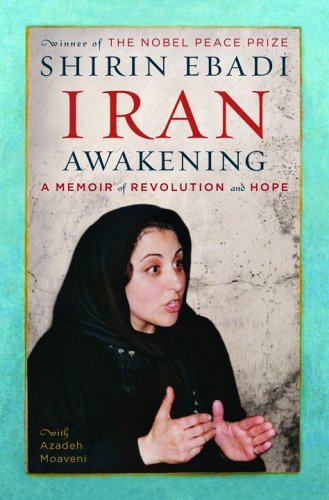
I read both Things I’ve Been Silent About and Iran Awakening a few weeks ago, inspired in part by the discussions with one of my students mentioned here–she also very kindly gave me her copy of Iran Awakening when I mentioned I had not been able to find it in stock locally. I’m not entirely sure why I have put off writing about them for so long! But until I do, I can’t put the books back on the shelf, so here I go.

I had a passing idea that I would, maybe should, reread Reading Lolita in Tehran before writing on Nafisi’s memoir, but I didn’t. Perhaps if I had, I would have more to say about Things I Have Been Silent About, which I didn’t actually find very engaging. It’s primarily about Nafisi’s relationship with her parents, which wasn’t what I wanted to know about. I also felt uncomfortable reading her account of them, particularly of her vexed relationship with her mother. Though she is self-conscious about her own failures to understand or sympathize with her mother, and works to contextualize her mother’s choices and values, she ultimately still comes across as both unsympathetic and resentful. I guess I’m just wary of the inevitable one-sidedness of such a personal account, and wince at exposure of family feelings in this way. Consider the tone of this passage:

Some families try to cover up their tensions in front of strangers, but for Mother, a woman otherwise so insistent on social etiquette, no such niceties existed. She gave in to her emotions regardless of where she was. I tried not to let her know about my interest in Mehran, but she had a hunter’s instinct, alert and sensitized to my secret hideaways. Her instinct was helped, in this instance, by daily intrusions into the most private corners of her children’s lives. She listened in on my phone conversations, read my letters and diaries, and walked in and out of my room whenever she felt like it. I could never be certain which I resented more, the fact that she read my diary and letters or that she never allowed me to feel indignant about her actions: she would use her new evidence as proof of my betrayals.

Sure, Mother sounds intrusive–any teenager would find her so. But Nafisi seems to be still caught up in the resentment she describes. She’s far more forgiving of her father’s infidelities than she is of her mother’s transgressions. In fact, she gets angry at her mother about them, as here, when her mother befriends one of Father’s mistresses:

It irritated me, the innocent and persistent way my mother had of being attentive toward this woman and her family. It made us all uncomfortable, since we all knew what was going on. . .

To some extent Things That I Have Been Silent About does trace a process of reconciliation for them, and the book ends, after the death of both parents, with some touching reflections on what–almost despite themselves, you get the impression–her parents have left her with, “a portable home that safeguards memory and is a constant resistance against the tyranny of man and of time.” But as I read the book, I wanted to get away from Nafisi’s own perspective on them–which of course is a desire that goes against the grain of a memoir.

Shirin Ebadi’s story is intrinsically interesting, even inspiring. The oddity of Iran Awakening, for me, was that the book does not perform that inspiration. If anything, it consistently downplays the drama of Ebadi’s confrontations with the Islamic Republic. Individual chapters often open with appalling anecdotes of injustice and brutality against women and children, like the story of 11-year old Leila Fathi, raped, beaten, and discarded. Two of the three perpetrators are convicted and sentenced to death (a third hangs himself in prison).

In this instance, the judge ruled that the ‘blood money’ for the two men was worth more than the life of the murdered eleven-year-old girl, and he demanded that her family come up with thousands of dollars to finance their executions.

Leila’s father sold all of his worldly possessions, including the little clay hut where his family slept. Homeless but convinced that they would at least reclaim their honor, they offered the money to the court. It was not enough. The family took to sleeping at the shrine of Ayatollah Khomeini, a vast mausoleum on the road to Qom, while trying to raise the reminaing cash. First Leila’s father volunteered to sell a kidney, but his organ was rejected because of his past drug abuse. Next Leila’s brother offered his up, but the doctor refused because he was handicapped by polio. [Remember, they are doing this to raise money to pay for the legal sentence to be carried out on the men who raped and murdered their daughter!] ‘Why,’ asked the doctor, ‘are you two so insistent on selling your kidneys?’ Out poured the tale. They could not return to their village, they explained, stained by tthe shame of Leila’s rape. [their shame?!] Family honor rests on the virtue of women, and nothing less than the perpetrator’s execution could erase their shame.

As Ebadi remarks, this case is evidence that the ‘postrevolutionary legal system’ is not just flawed but ‘effectively pathological’; she agrees to represent the family. But things get worse, not better:

Over the course of the proceedings, the court acquitted both defendants [though there’s at least one eye-witness, Leila’s male cousin], overturned the acquittals, and then relaunched the investigation. The family’s grief slowly descended into madness. Leil’as mother took to sitting outside the courthouse in a white funeral shroud, holding a placard that described her daughter’s violation. During one trial, she threatened to set herself on fire, and began screaming profanities at the court. As though the whole proceeding was not dramatic enough, the judge held her in contempt of court and filed legal charges against her that took us weeks of mediation to settle.

The case, she tells us, “remains open to this day.” The whole scenario is so outrageous I found it difficult to sit still just reading about it, and along with Ebadi’s other examples, it more than makes her case about the “pathological” system. What I found disappointing was her understated treatment of her own courageous commitment to fighting for the rights of women and children. “While I was arguing Leila’s case,” she says, “the judge repeatedly accused me of speaking against Islam and its sacred laws.” She doesn’t detail either those accusations or her responses, either here or elsewhere by and large, though surely those exchanges exemplify the conflict between an evil state and those it oppresses, something more elaborate reconstruction of the debates would have dramatized. The prose of the book overall is just prosaic, even flat at times, considering the events it describes. But then, though Ebadi is clearly heroic, her heroism was always on behalf of other people, and of principles: if she spent the book grandstanding about herself, it would draw our attention to her performance rather than to the issues and people she fought for. The incidents and details she does provide, too, including her stay in Evin prison, are dramatic enough not to need a lot of heightened rhetoric.

Of particular interest to me were the sections discussing her decision to “draw on Islamic principles and precedents in Islamic law” in fighting her reformist battles. She is explicit and eloquent about her own conviction that the right and best option is a secular state: fundamentally,” she points out, “Islam, like any religion, is subject to interpretation,” and thus “there will never be a definitive resolution. . . . I am a lawyer by training, and know only too well the permanent limitations of trying to enshrine inalienable rights in sources that lack fixed terms and definitions.” She talks about ijtihad, the tradition within Islam of “intellectual interpretation and innovation” advocated by, among others, my own former UBC classmate Irshad Manji:

On the one hand, ijtihad imposes flexibility on Islamic law and creates an exciting space for adapting Islamic values and traditions to our lives in the modern world. But this flexibility is also precisely what makes ijtihad, and Islamic jurisprudence altogether, a tricky foundation on which to base inalienable, universal rights. Ijtihad frees us by removing the burden of definitiveness–we can interpret and reinterpret Koranic teachings forever; but it also means clerics can take the Universal Declaration of Human Rights home and argue about it richly for centuries. It means it is possible for everyone, always, to have a point. It means that patriarchal men and powerful authoritarian regimes who repress in the name of Islam can exploit ijtihad to interpret Islam in the regressive, unforgiving manner that suits their sensibilities and political agendas. As with the mullah who summoned his clerk and removed me from the floor of parliament, fighting for women’s rights in the Islamic Republic is often not a battle of wits or reason, nor is it always a fair fight. This does not mean that Islam and equal rights for women are incompatible; it means that invoking Islam in a theocracy refracts the religion through a kaleidoscope, with interpretations perpetually shifting and mingling and the vantage of the most powerful prevailing.

But she’s a pragmatist, and recognizing also the “permanent limitations” of her own position as a “citizen of the Islamic Republic,” she resolves to “advocate for female equality in an Islamic framework.” She has taken criticism from all sides for her decision:

I have been under attack most of my adult life for this approach, threatened by those in Iran who denounce me as an apostate for daring to suggest that Islam can look forward and denounced outside my country by secular critics of the Islamic Republic, whose attitudes are no less dogmatic. Over the years, I have endured all manner of slights and attacks, been told that I must not appreciate or grasp the real spirit of democracy if I can claim in the same breath that freedom and human rights are not perforce in conflict with Islam. When I heard the statement of the [Nobel] prize read aloud, heard my religion mentioned specifically alongside my work defending Iranians’ rights, I knew at that moment what was being recognized: the belief in a positive interpretation of Islam, and the power of that belief to aid Iranians who aspire to peacefully transform their country.

I admit, it was a problem for me to read about her arguments that, for example, male consent need not be given for divorce, not because of the inequities created by that requirement, but because the Shar-e Lomeh or Shia Textbook of Jurisprudence, does not explicitly require it. She works hard drafting a law to broaden women’s rights basing it “on the central texts taught in the holy city of Qom’s seminaries, showing that a basic right for women could be guaranteed within an Islamic framework of governance, provided [she concedes] those in government were inclined to interpret the faith in the spirit of equality.” My own view would be that women’s rights are not conditional on the inclinations of men or mullahs, and even as I am overwhelmed with admiration for Ebadi’s courage and accomplishments, it’s difficult for me to accept her strategic concessions precisely because, as she herself argues so elqouently, arguing for the compatibility of women’s rights “within an Islamic framework” is no guarantee at all because they can always be argued away again–really, arguing at all about the validity of women’s rights in the first place basically gives the game away. Though, as Ebadi’s memoir (like Nafisi’s) makes clear (as if it needed clarification), the Islamic Republic violates the human rights of all of its citizens, it’s women on whom the heavy hand of the state always falls the hardest– Ebadi remarks, “Reza Shah was the first, but not the last, Iranian ruler to act out a political agenda . . . on the frontier of women’s bodies.” The current case of Sakineh Mohammadi Ashtiani, currently under sentence of death by stoning for alleged adultery, is just one appalling recent example. (Both Nafisi and Ebadi are signatories on the petition to free Sakineh; if you aren’t already, follow the link and add your name.) As Ebadi would have to concede, Sakineh’s trial and sentence reflect an interpretation of Islam–just not the one that guarantees “a basic right for women,” thus proving her point about the need to base “inalienable rights” on a different foundation. But, of course, that’s easy for me to say. Nobody’s going to put me in prison for it.

Florence Nightingale, Letters from Egypt

Having cleared at least the semblance of a path through the draft thesis chapters that have taken up the bulk of my time since my summer class wrapped up at the end of June, I’m finally turning my attention back to my summer research project, which is to extend and perhaps even complete the essay on Ahdaf Soueif that I’ve posted about here and at The Valve before. Yes, that’s right, it’s not done yet. It got as far as a conference paper last year, and since then, in between other projects, I’ve been collecting references and sources for it and trying to conceptualize what it is I hope that the final essay will do, or be about and where exactly I might submit it. My basic idea is to fill in more details about In the Eye of the Sun and then develop a comparison between it and The Map of Love–which I’ve just finished re-re-reading. The Map of Love has a more complex form than In the Eye of the Sun, interweaving the story of two 20th-century women (Isabel, an American, and Amal, an Egyptian who turns out to be Isabel’s cousin) with the story of Lady Anna Winterbourne, an Edwardian Englishwoman who travels to–and eventually marries and lives in–Egypt. While my motivating interest is still the intertextual relationship between Soueif’s work and George Eliot’s, The Map of Love clearly has strong ties to other literary sources, particularly accounts of “lady travellers” in Egypt. Lucie Duff Gordon is probably the most famous, but I’ve also signed out of the library a lovely illustrated edition of Florence Nightingale’s Letters from Egypt: A Journey on the Nile 1849-50, which turns out to be quite entertaining. For instance, like me she wages war on biting insects:

I and the gnats have so many ways of outwitting each other. X and Mr B. look as if they had the small-pox; but I, who would sleep in an Indian rubber tub with a tallow candle in my mouth if it were suggested, shut my windows before sundown; and I hear those who are in, furling their wings and uttering little infernal cries of triumph. Then I set my door open, and put a light in the passage, and they think I’m there, and follow; but I’m not,–don’t tell them. Then, when night comes, I take out a large sheet of paper and begin to write, and they believe I’m not thinking of sleep. But I leave off in the middle of a word, run with all my might at the Levinge [an elaborate netted sleeping bag], where I insert myself by so small a hole that you would say a camel could get through the eye of a needle; and then I clap my hands, and sing a little ode in honour of Mercury, the god of theft, because I have stolen myself from the gnats. Meanwhile I hear their whistle of rage and disappointment, and I see their proboscises coming through the curtains, as if they would fly away with the whole concern.

In a more serious vein, she often reflects on what she perceives of “Mahometism.” Carefully fitted up in “Egyptian dress,” including a complete veil, for instance, she is able to step inside a mosque to observe:

That quarter of an hour seemed to reveal to one what it is to be a woman in these countries, where Christ has not been to raise us. God save them, for it is a hopeless life. . . . Still, the mosque struck me with a pleasant feeling; X was struck with its irreverence. Some were at their prayers; but one was making baskets, another was telling Arabian Night stories to a whole group of listeners, sitting round him–others were asleep. I am much more struck with the irreverence of a London church.

It is so pleasant to see a place where any man may go for a moment’s quiet, and there is none to find fault with him, nor make him afraid. Here the homeless finds a home, the weary repose, the busy leisure,–if I could have said where any woman may go for an hour’s rest, to me the feeling would have been perfect,–perfect at least compared with the streets of London and Edinburgh, where there is not a spot on earth a poor woman may call her own to find repose in. The mosque leaves the more religious impression of the two, it is the better place of worship,–not than St. Peter’s, perhaps, but better than St. Paul’s.

I don’t know why it surprised me, from the author of Cassandra, after all, but I was struck by how often her interest and enjoyment in the scenes she observes are undercut, or at least rendered more problematic, by her consciousness of her sex and the complications it brings:

We have had a delightful week at Cairo. I wish we were going to stay longer. It is the riding in the streets, above all, which is so delightful, of which one never wearies; the latticed windows meeting overhead, the pearls of Moorish architecture at every corner, the looking up to the blue sky and golden sunlight from the wells of streets and in the bazaars, the streets entirely roofed in; and as you stand bargaining for a pair of yellow slippers, you see the corner of a street with the spring of an arch covered with Moorish network, and the sunlight pouring through the square holes left in the roof which shuts in the street. . .

In riding home by moonlight, … there is not a corner which is not a picture; and no picture can give an idea of the colouring. But you don’t enjoy all this for nothing. A Christian female dog has two titles of dishonour here, and she cannot stir out without her ass, her running ass-driver, and at least one gentleman or a dragoman. A la langue this dependence becomes tiresome beyond what a European can conceive. It is not that one minds being spat at (which I have been) for a religion which one loves, but one is so afraid of the gentlemen of one’s party noticing any insult, as an Englishman’s complaint would bring a bastinado upon the poor wretch, which has often ended in death.

Like Soueif’s Lady Anna, she is particularly fascinated and spiritually moved by the desert. “The oftener you are astonished at it, the more like a stranger a mysterious power it seems,” she remarks;

While the earth in our country is rich and variegated with light, and crowded with animation, the sky above contrasts with its deadness. Here, on the other hand, the sky is radiant, the light is living, the golden light which seems to pour not only from the sun, but from all the points of the transparent blue heavens. One looks down, and the ungrateful earth lies there, hopeless and helpless, a dying, withered desert: one almost fancies one hears the Devil laughing as he dares even Almighty power to bring forth bread.

This is what gives one a supernatural, mysterious feeling in Egypt,–the looks naturally turn to the sky when the earth has no beauty that one should desire it, and the heavens have all beauty. The struggle between God and the Devil is perpetually visible before one’s thoughts, for the earth seems the abode of the Devil, the heavens of God; and you do not wonder at the Orientals being the mystical people they have become, nor at the Europeans, where all beauty is of the earth, and the thoughts turn to the earth, becoming a practical, active people.

Here’s an excerpt from Lady Anna’s (fictional) journal:

We rode on, and we stopped only twice. Once when we made camp for the night. The other earlier: when the sun set beyond the Gulf of Suez, making clear to me whence came the name the ‘Red’ Sea, for the setting sun brought out the red and black of the ore in the mountains and the sea reflected it all back. All the reds, and yellows and orange and purple, were in that wonderful landscape, and as it faded and the colours all round us melted more and more into gentleness, I thought there should be some act–some formal recognition of this daily magnificence. Even as the thought formed itself in my mind, we came to a halt as if by agreement. The animals knelt, the men dismounted and turned towards the South-East. One voice was lifted: ‘Allahu Akbar’, and they prayed silently together.

I might think that Soueif is delicately parodying the orientalizing English tendency to translate the Egyptian landscape into something exotically mystical, except that in her scene, Anna too is moved to prayer and to peace–and after all, isn’t there something spiritually uplifting about extraordinary natural beauty? For George Eliot, it’s the landscapes of one’s childhood that carry one towards “religious” peace and truth. What’s interesting in these examples (well, one among many interesting things) is the way an unfamiliar landscape opens up new spiritual ideas or possibilities.

Meg Federico, Welcome to the Departure Lounge

Well, here I am, right after making a big to-do about reviewing a book by an author I know–reviewing another book by an author I know! Who knew I knew so many authors–and, happily, such good ones, too! In the interests of full disclosure, then, Meg Federico is my near neighbor here in Halifax, and while I am still only looking forward to meeting John Cotter in person, I have chatted with Meg many times, and I thought it was about time I read her book. I’m glad I did: it’s both funny and touching.

Welcome to the Departure Lounge is a memoir about Meg’s mother’s decline into dementia. Depressing as that sounds (and depressing, of course, as it actually was), the book itself is not, actually, depressing but rather finds and exploits a fine line between hilarity and pathos as Meg takes us through the chaos that descends on her family as a result of her mother’s illness. “The Departure Lounge” is the nickname she and her brother give to the house where her mother, Addie, lives with her second husband, Walter–whose Alzheimer’s is also steadily advancing. Addie’s doctor won’t declare her incompetent (“Oh, right, competence,” he says to Meg. “Like anyone is ever competent”), so she and Walter are left nominally in charge of their increasingly haphazard home, cared for by a rotating roster of caregivers overseen, as far as possible, by their children, most of whom, like Meg, live many miles away. The mounting confusion is worsened by Addie and Walter’s fondness for booze. Together, they are a defiantly loopy team:

Ornella often answered the front door to find a deliveryman with a TV set and a case of scotch. Mom couldn’t see well enough to dial the phone, but Walter could. Together, they called liquor stores and placed large orders. The stores were only too happy to oblige and took credit cards over the phone. There were fifty liquor stores in a twenty-mile radius. I called as many as I could and asked them not to take Walter’s orders. But I couldn’t get them all. If it wasn’t booze, it was TV sets. Walter was having trouble working the remote, so he thought the set was broken. And unfortunately, he couldn’t remember that he’d already placed an order, so more TV sets kept showing up. That made him very angry. “Who thinks they can send us these things?” he said. The UPS man and the FedEx lady became regulars at the house. “There’s two more TVs. What do you want me to do with them?” Ornella asked me, a million miles away in Canada. I added “Return Unusual Purchases to my list”.

That list of things for Meg and the other offspring to deal with is ever-growing, and the stress and chaos spill over into Meg’s regular life as a “soccer mom” up in Halifax.  She gets phone calls incessantly about one crisis or another, sometimes with her mother and step-father, sometimes among the staff. “Astrid is putting voodoo on us at night, in your mother’s bedroom,” Addie’s helper Ornella phones to report; later on, the cook, Cassandra, calls to say “Those people are robbing your mother blind”–the supplies she lays in Friday night are gone by Monday morning, and Meg also discovers that her mother’s jewelry box has been emptied. There are falls, and worse. Through the fog of his Alzheimer’s, Walter clings to a protective instinct for his “Bride”–but because he rarely understands what is going on around him, this leads to its own catastrophes as he lashes out in what he thinks is her defense:

Walter started out the following day with his usual round of breakfast gin and tonics. Mother fell. As Ornella lifted her, Walter launched a two-fisted frontal assault. Ornella managed to duck the first punch, but the left hook caught her on the jaw. Edward [Walter’s helper] was nowhere to be found. Ornella called the police, who called me in Halifax. Walter, Edward and Ornella were shouting at one another in the background, punctuated by Mom yelling, “Stop it!” at the top of her lungs.

“Okay, buddy, calm down,” a male voice said, presumably to Walter. “Mrs. Federico? This is very confusing here.”

I heard the other police officer saying, “No more drinking. I am a policeman and you are not going to drink anymore!”

. . . The officer on the phone said to me, “Look, I don’t think you want me to arrest your father.”

I resisted the impulse to say, That would be ideal.

The police are called again later, when Meg and the staff intervene to protect Addie from Walter’s disinhibited lust. During one of Meg’s frequent visits, she gets the lock fixed on Addie’s door; later that night, Walter beats at it yelling “I want my Bride!” and eventually “take[s] a whack” at the worker trying to dissuade him. Someone calls 911, but then Addie refuses to file any charges.

In the course of these events, Walter and Mom had become united against the rest of us. “You want Walter to go to jail,” Mother said accusingly. “Why would you do a thing like that?” Walter had gone blank, as he sometimes did. Totally baffled, he followed Mother down the hall. “You better come and stay with me tonight, Walter,” she said, as they got to his bedroom door. “I’ll need help if the police come back.” “The police?” he asked. “Really?”

As Meg says, “the whole thing was absurd,” but as she’s also well aware, it has its dark, even frightening side always shadowing the comedy. Further, as she interweaves stories about her family history into the narrative of her mother’s mental disintegration, she helps us get to know Addie enough that we feel the force of her former personality enough to appreciate her loss. Their relationship was never an easy one, and the book offers no idealized or sentimental picture of the past. At one point we learn, rather shockingly, that Addie tied little Meg to her bed at night for a while, to keep her on her strict bedtime schedule–much later, when Addie takes to launching herself deliberately and damagingly on to the floor, Meg notes that “the urge to tie her up was hard to resist.” An unhappy teenager suffering at boarding school, Meg runs off home, but when she shows up at the front door, her mother “looked out through the screen and said ‘Yes?’ as though I were a stranger”:

I went absolutely hollow. If I’d thought I might be welcome, I was mistaken. Mom kept me standing on the steps. She said through the screen that she had company, and they were just sitting down for dinner. “You have to understand that now you are a guest. You come home when you have an invitation,” she said. But it dawned on her that she could not really send me away, and she let me in.

But family feeling runs deep and it takes more than a vexed history to undo the longing for a mother’s love and approval. As Addie declines, things become simpler, but not easier, as in this poignant scene:

One morning when I arrived for my monthly shift, Mom scuttled towards me, rolling her walker. . . . Mother’s blank and dull face lit up like a sunflower. “Meggo, dear!” she said, with a huge toothy smile, lurching at me, hugging me, and ramming me with the walker. She was so glad to see me, pressing her face into my shoulder, gripping my arms. To share a moment of simple uncalculated love, my mother had had to become a dependent old lady with a dismantled intellect.

During long dreary days at the Departure Lounge, Meg comes to understand her mother better, seeing her “in a new light, one that illuminated the background.” Those moments of connection are intermittent, broken by Addie’s drifts back into confusion, but they help Meg think differently about her own role as both daughter and mother.

The story moves towards its inevitable conclusion. Even then, however, in what the book urges us to see as the paradox of real life, there’s no tidy separation between laughter and grief. Addie dies even as the caterer is arriving with the supplies she had ordered herself for her birthday party, and her passing is marked, not with dignity or heartfelt tears, but with a ridiculous struggle with the EMS team that arrives to “pronounce,” who will not recognize the DNR order as legitimate and hassle the family about liability as Meg holds off them and their defibrillator. At the wake, poor Walter is brought in to see Addie in her coffin and can’t grasp the situation: “Why is that woman asleep at this party?” he asks innocently. Like so many moments in Welcome to the Departure Lounge, this one makes you want to laugh and cry at once.

John Cotter, Under the Small Lights

This is only the second time I’ve written on Novel Readings about a book by someone I know. The first time was my post about my Dalhousie colleague Ian Colford’s hauntingly elusive collection Evidence. Actually, I don’t exactly know John Cotter–not in person, at least. But in about six weeks I hope to be drinking with him in New York, along with my other new colleagues at Open Letters (where I have just recently joined the editorial team). We have met virtually, you might say, and know each other almost exclusively through our writing, of one kind or another. Reading John’s book is another step towards getting to know him, then, not least because, as he explains here, he has given some of his own afternoons as an aspiring writer to his protagonist Jack.

In both of these cases, I hesitated about posting a review, not because I hesitated about the quality of the books, but because interpretation suddenly seems a more precarious undertaking when you’re that much more aware of the real-life author as someone with plans, intentions, and opinions about his carefully crafted work–ideas with which your own idiosyncratic reading may well be at variance. Of course, this is always the critic’s situation, and usually I just press on. Obviously, that’s what I’ve decided to do here too, not only because of the basic principle that writers want to be read and must expect that nobody else’s reading will be quite their own, but because in this case (as with Evidence) the book is just too interesting for me to leave alone. After I finished it, I kept thinking about what I would say about it if I blogged about it, and after a couple of days it seemed silly not to have a go. John can always set me straight over our drinks in August–or here in the comments section, if he feels the urge.

So. One of the cover blurbs describes the novella Under the Small Lights as a bildungsroman, that is, a coming of age story or a novel of education or development (‘Bildung‘ is one of those German words we can’t quite translate into English). This seems basically apt, though it’s not entirely clear to me how far Jack has developed at the end of the book: he’s looking towards his developed self, perhaps, having cleared away some of the youthful confusions and delusions that have been muddling his progress. It’s also a kunstlerroman, the story of an artist’s development, though here too Jack is looking ahead, aspiring, rather than having achieved–unless, as it’s a first-person narrative, we take Under the Small Lights itself as the end result of that process. There’s no overt metafictional gesture towards that, but with first-person narration there’s always that question of whether we are to take the speaker as the ‘author’ or simply as a device. If the former, we might expect some evidence along the way that the narrator’s perspective has changed, has distanced itself from the in-the-moment experience he narrates (as, for instance, in Great Expectations or Jane Eyre the retrospective narrator displays insight not available to young Pip or young Jane). Again, there are no overt gestures in this direction, but the fairly elaborate construction of the book, which cuts between times and episodes, certainly creates a perspective that, cumulatively, does exceed what Jack seems capable of during the events he describes.

As a character, Jack is indistinct: his creator calls him a “collage personality,” and the novel’s epigraph calls our attention directly to the permeability of identity: “I often think that we’re all mere composites of our favorite people’s habits,” it begins. Though I found Jack’s slightly vaporous quality a problem for a while, it eventually seemed like the point of the book, that is, he needs to define his own character, to declare himself, rather than trying to find it outside himself or borrow it from other people. He has to stop asking:

Next I knew, I was at the Mass Ave. foot of alley #902, still holding my empty gin glass. Barefoot, knowing they were watching from four stories up, I took off running toward the big oak growing by the dumpster. As I threw the glass, aiming for the oak but hitting the dumpster with a tin shatter, I shouted Who am I.

Jack may not know who he is, but he knows who he wants: Corinna. She was his friend Bill’s girlfriend; when the novella opens, she has recently married his friend Paul. For a moment, in between these relationships, it looked as if she might be Jack’s, and his desire for her (or is it his desire to be Bill? or to beat out Paul?) drives him, and the story, forward. Corinna, as I read her, belongs with Hardy’s Sue Bridehead and Waugh’s Julia: they are all fey, elusive, alluring, teasing, putatively intellectual, and (to my annoyance) apparently endlessly attractive to deep-thinking men. That said, one sign of Jack’s development is that (unlike Jude or poor Ryder) he has seen through Corinna by the end, and through the fog of self-indulgent moping that masquerades as enduring love. Though I didn’t think much of poor Jack, it seemed pretty clear that Corinna was a false idol. A Victorian novelist would have given Jack a better option, one he would have proved his maturation by choosing in the end (as Waverley chooses Rose instead of Flora, or David Copperfield learns to love Agnes after Dora). Actually, there’s one Victorian novelist who leaves us with a threesome, rather than a choice (Walter, Marian, and Laura in The Woman in White) which is the kind of conclusion Jack thinks he wants for a long time, everyone living and loving together, but he can’t have it, perhaps because there is too much competition, as well as fantasy, in all of the relationships involved. No good alternative does emerge for Jack, then–certainly not the equally indistinct Star (who in her turn has been a kind of imitation Corinna). It’s just time, finally, to move on, to get on with it. The evocative final pages seemed to me to capture the slightly disorienting sense we probably all have when we realize that people and events that seemed momentous and all-encompassing recede, drift away. You don’t really understand that, when you’re young.

And the characters in this novel really did strike me as very young, not just literally, though they are that, but in their preoccupation with each other, their self-indulgent behavior, their insouciance, their artsy pretention. They weren’t people I recognized; I certainly didn’t recognize my own youth in them, and not, I think, just because it was a different decade, or a different country, though I suppose Vancouver in the late 80s was a pretty different place than Boston or New York in the late 90s. I actually found the picture of their lives quite alienating, as a literal story: I don’t find drunken idiocy or stoned pseudo-profundity entertaining in real life either. So I preferred the characters at their more abstract level, though the bildungsroman form, of course, does imply that they not only will but should change. I also found myself thinking, as I read, about something Claire Tomalin said about George Eliot: “She writes about sex perfectly,” Tomalin says; “She never mentions it at all. I mean, who needs the penis and the pubic hair? Sex isn’t that–sex is the feeling.”

But those are, as I’ve said, my own idiosyncratic responses. Under the Small Lights is an artfully written novel: the style is at once elliptical and allusive, and its parts are elegantly choreographed. It’s also sometimes quite funny: the climactic chapter “The Open Field,” for instance, develops with the painfully comic inevitability of the best episodes of Seinfeld. It has other aspects I haven’t touched on at all, including the play Jack and Bill are trying to write, including on their ill-fated expedition to Walden Pond, or the whole larger interest in acting and theater, and in poetry, all of which adds both intertextual and metatextual layering to the narrative. For a book that’s less than 200 fairly sparse pages, Under the Small Lights has a lot going on. Like Evidence, it’s a book I almost certainly would never have read if I didn’t know the author, and in both case I was glad to have gone that much further outside myself–to have been prompted by friendship to look at the world differently, or at a different world, thanks to their courage in putting their vision into words.

Recent Reading: Mina and Mantel

In my previous post about summer reading plans I forgot to mention that my daughter and I have committed once again to our local library’s summer reading club. (As an aside, let’s hear it for public libraries, perhaps the greatest public institutions we have!)  This year her pledge (for me to match) is 25 books over July and August. I’ve managed to read four titles since she signed up, but I haven’t blogged about any of them yet, so I have some catching up to do.

First up, I finally read Denise Mina’s Field of Blood, which was highly recommended when I put out my ‘bleg’ for ideas for my seminar on women and detective fiction. Unlike many of the titles I read as I worked on my book list, it’s very good! What makes it stand out from the others? The simplest answer is that it suits my own reading tastes better. It’s rich in context and characterization, but it’s not overwritten, pedantic, or (like the awful Stieg Larsson books) just one damned thing after another with intermittent pornography (I know, I know, Salander is a great character, but…). Paddy Meehan is flawed and conflicted, but not melodramatically so; her family and co-workers are effectively and efficiently specified so that we rapidly get a sense of the community she moves in, which is an interestingly complicated one. It’s not really a detective novel, and in fact one reason I think I couldn’t have fit it into my course very well is that the crime itself is almost peripheral to Paddy’s own story. I thought there were a few missteps: there’s a ‘killing-due-to-mistaken-identity’ episode that I found did cross over into cliche in the writing, for instance. I was most interested in the push-and-pull for Paddy herself between her family’s expectations and her ambitions. Paddy is also a good example of the type I now think of (thanks to Anita Brookner) as the tortoise: she’s plain, underappreciated intellectually, overlooked romantically–in short, she’s every socially awkward, ill-at-ease bookish young girl who can therefore read in her eventual success validation of their own painful experience as misfits. As Brookner points out (in Hotel du Lac), books are written for the tortoise market because in reality the hares are off winning the race (or the guy).

I did read one other mystery, though I finished it in June so I can’t count it towards my summer total: Katherine V. Forrest’s Murder at the Nightwood Bar. If I had read this sooner, I might have included it on the syllabus, though I would have had some misgivings. I had hoped to find a teachable example of lesbian detective fiction, which is a thriving subgenre now. Forrest was one of the earliest writers to establish herself in it: Amateur City, the first in the Kate Delafield series, was published originally in 1984, soon after Sue Grafton and Sara Paretsky had launched their female private eyes. Murder at the Nightwood Bar is far more overtly political than the Laurie King and Sandra Scoppetone ones I read earlier, and the crime is set up to resonate with those political interests and to stand as exemplary of a larger social problem, giving the book the kind of unified effect that lends itself to the kind of work we would do in a seminar discussion. On the other hand, it is perhaps a bit too obviously set up in this way: I like a little nuance with my social consciousness raising. Forrest is another competent but unspectacular stylist; nothing in the book seemed as literarily fine as, say, P. D. James’s An Unsuitable Job for a Woman. At any rate, the book didn’t make it on the list for this fall (though Nancy Drew ultimately did–we’ll see how that goes!) but I’ll revisit it next time around.

My other summer book for this post is totally unlike these two: I continued my trip through Hilary Mantel’s back catalogue with The Giant O’Brien. Once again, it was a surprise: like Beyond Black, it gives no sign of being by the same author as Wolf Hall, for instance, except in being strangely conceived but ultimately quite compelling. It follows the experience of a Giant who has travelled from Ireland to London in the 1780s, escaping poverty and famine at the cost, ultimately, of his self-respect, his integrity, his humanity, and even his life, though we realize from early on that all of these aspects have been compromised for him from the start simply by his being a giant, a freak, a spectacle. Juxtaposed against his story is that of the anatomist John Hunter. They are set up to embody a number of oppositions, not just scientist and potential experiment or subject, but also the man of facts, of physicality, and the man of imagination–ironically, in an extraordinary physical frame, but living the life that really matters to him in his mind alone, and through the stories he tells. They are also England and Ireland, I think, and to some extent, also winner and loser. There’s pathos, but Mantel downplays it, going instead for a combination of quirky and grotesque that, inevitably but rightly, one of the critics in the blurbs identifies with Hogarth’s famous prints of 18th-century London. The prose is beautifully styled, moving between short epigrammatic conversations, terse sections of exposition, brutal graphic detail, and passages of great lyricism without any hint of sentimentality:

The poet has his memorial in repetition, and the statesman in stone and bronze. The scholar’s hand lies always on his book, and the thinker’s eyes on canvas travel the room to rest on each human face; the rebel has his ballad and his cross, his bigot’s garland, his wreath of rope. But for the poor man and the giant there is the scrubbed wooden slab and the slop bucket, there is the cauldron and the boiling pot, and the dunghill for his lights; so he is a stench in the nose for a day or a week, so he is a no-name, so he is oblivion. Stories cannot save him. When human memory runs out, there is the memory of animals; behind that, the memory of the plants, and behind that the memory of the rocks. But the wind and the sea wear the rocks away; and the cell-line runs to its limit, where meaning falls away from it, and it loses knowledge of its own nature. Unless we plead on our knees with history, we are done for, we are lost. We must step sideways, into that country where space plaits and knots, where time folds and twists: where the years pass in a day.

Some of the most haunting passages in the novel are those in which the giant pacifies his motley associates with tales told in the resonant tenor voice that belies the monstrosity of his frame. The transcendence of his voice, his ability to take both himself and his listeners outside themselves, outside the ugly and inescapable realities of their literal lives and their physical selves, beautifully captures the promise of story-telling itself.

Music Books: “A little private imitation of what is good is a sort of private devotion to it.”

My title is a line from Daniel Deronda, from a conversation between Daniel and Gwendolen in which he urges her to look past the egotistic gratifications of performance (inaccessible to her, as she has discovered, because of her “middlingness”) to the other values of music as “private study.” As a long-time amateur pianist, I appreciate his suggestion that our private efforts are a way of paying tribute to musical excellence, a way, also, as he says, of preparing “to understand and enjoy what the few can do for us.” His sentiments give some dignity to my laborious attempts at the Rondo alla turca this evening! And I think he is right that playing privately, however badly, is a gesture towards something we believe in as good and beautiful, even aside from the intrinsic value of applying ourselves to something challenging and learning, if we are industrious, the rewards of getting a little bit better at it and maybe even, if we are lucky, approximating something good and beautiful ourselves.

I stopped taking piano lessons when I realized I had to decide between really taking music seriously and accepting myself as a dabbler, but I’ve never been sorry I learned to play–and not just because my former teacher was and is a kindred spirit and one of my favourite people in the world. Music has always been an emotional outlet for me, and over the years, as it turns out, the piano has been an essential accompaniment to all the major (and minor) changes in my life. As a moody adolescent, I channelled all kinds of angst through my family’s old Heinzman upright. After several years away from the keyboard, as a homesick, insecure  graduate student at Cornell, I took regular refuge in a practice room in the basement of the music building and rediscovered not just the challenge and pleasure of playing but also some important part of myself that helped me stand up to the intellectually intimidating environment I found myself in. I also, not incidentally, could eventually give quite a creditable rendition of at least one fabulous Schubert Impromptu.

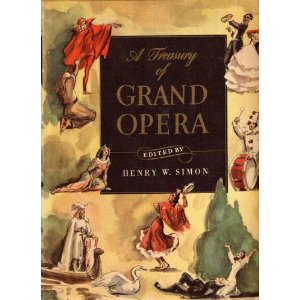
Then I became the accompanist in my family life: my husband and I share a fondness for the great songs of Cole Porter, the Gershwins, and Richard Rodgers, and later expanded our “songfest” repertoire to include old movie classics like “Laura” as well as sappy 70s hits like “The First Time Ever I Saw Your Face.” We used to soothe our infant son after bathtime (which he hated) with rousing renditions of “Di quella pira” (which may explain both his perfect pitch and his aversion to opera), and now our daughter loves to gather with us for carols at Christmas. On those rare occasions these days when I’m home quite alone, I sometimes treat myself to a browse through some old favourites, especially my beloved Treasury of Grand Opera, and almost every summer I vow (as I have again this year) to use some of my ‘down’ time to achieve at least some approximation of mastery over a real piece or two. Our library of music books is relatively small, but I consider them every bit as essential to what Nathan Schneider has just memorably discussed at Open Letters as my “memory theater” as the novels, memoirs, histories, and other genres in the collection. A lot of them turn out to be too old to find images of online–and that, in itself, is one reason I’ll continue to cherish them.

What about you? Do you have music books you cherish, or musical habits that are your own form of “private devotion” to the good?