This Week In My Classes: The Seventh Season Begins

I began writing posts about my teaching plans and experiences because I thought it might contribute to demystifying our profession — and perhaps counteract, just a little bit, the way it is sometimes demonized (or ridiculed).  I discovered after that first year that there were real benefits in this for me, and, not incidentally (if less directly) for my students, and so I’ve kept it up ever since (you can browse through the archive of posts here, if you’re interested). At this point, I’ve talked about pretty much all the courses in my regular teaching rotation at least once, but while there’s some repetition, I do vary the reading lists from time to time. And I’ve also strayed occasionally from straight-up reporting to broader reflections  on different aspects of pedagogy or extended reflections on our readings, so for me at least that keeps the exercise interesting.
The-Big-SleepHeading into my seventh season of this series, I have no specific ambitions or plans for it beyond keeping it up and seeing what arises from week to week. One of this term’s classes will already be quite familiar to regular visitors here as I have taught it literally every year I’ve been doing these posts, and that’s Mystery and Detective Fiction. I change it up a bit each time, and this year’s innovation is — finally! — switching to The Big Sleep from The Maltese Falcon. I’ve been thinking about this since at least 2009, when I read it and complained that I found it tiresome: “sexist, homophobic, convoluted.” Rereading this summer, I didn’t love it but I certainly appreciated it more (but yes, it is convoluted, and I’m also still pretty sure it is sexist, though I’ll invite debate about that in class when we get there). The only other tweak is that I’ve cut most of the short fiction: students often remark in their evaluation that there’s a lot of reading in the course, and this allows me to stretch out our time for some of the novels a bit more without losing anything that makes me particularly sad. Today we talked about “The Murders in the Rue Morgue,” and Friday we begin discussions of The Moonstone. Yes, I always reread it — though at this point I do sometimes skim selectively. I almost never get caught out on a detail I’ve forgotten!

copperfield

My other class this term is The British Novel from Austen to Dickens. I’ve taught this class pretty regularly in recent years but I haven’t assigned Waverley since before I started blogging. I stopped assigning it because the students were so petulant about it in their evaluations — most of them, I should say, as there were always a few who really got it and loved it. We’ll see how it goes this year:  it may well provide fodder for a post or two. The other big change is bringing in David Copperfield as my Dickens option: in previous incarnations of this class I have done Hard TimesGreat ExpectationsA Tale of Two Cities, or A Christmas Carol. It’s our only really loose baggy monster, and it does come right in the middle of term, but I’ve tried to allow enough time for it in the schedule that it won’t kill us all — or kill everyone’s enthusiasm for the class. I’m sure they’ll love it. How could they not? Right? Please? Right now we’re working our way through Persuasion and as far as I can tell they’re keeping up and appreciating it.
This Week In My Classes: Sitting Around Admiring Significant Texts

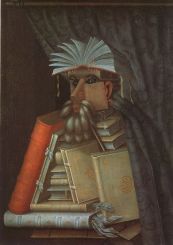
Arcimbolo LibrarianThis week in my classes, which are traditional English classes rather than warm and fuzzy creative writing classes, I am burdening students with historical background, wrapping ideas in grad-school jargon, and generally obscuring the pleasures of reading and the power of literature. No, really!
OK, not really, but if you believe this recent encomium on the virtues of creative writing classes in the New York Times, that’s what I’m usually up to. Bad English professor! Bad! Don’t I understand that “students don’t like to be told to sit around and admire something simply because it is theoretically or historically significant”?

The really frustrating thing for me about pieces like this is that I agree that love is an important part of reading – and that it can and should be an important starting point for discussion. (At least, it should be a starting point some of the time. I wonder what Professor Bakopoulos recommends his students do about works they don’t love. Should they stay away from them? Or just not talk about them or learn from them? What if they don’t have a “favorite line” — how does the discussion proceed then? What if the seduction fails? What if that “instinct” you’re urging them to trust is actually a prejudice or presupposition?) What I don’t agree with is that love is always and only a visceral reaction, a thing of the heart, and not of the head. There’s a not-so-subtle anti-intellectualism in proclaiming that pleasure is “something they may have experienced with Harry Potter but lost when they wrote a five-paragraph essay about Hawthorne.” Analysis can be dry and distancing, sure, but it can also be thrilling: fiction, after all, can make us think as well as feel, and novels are built by writers who thought deeply and worked hard, and not always with the primary goal of making us shiver. Appreciating their craft, understanding their historical context, and asking theoretical questions about their work are also ways to see how it “ripples with energy.”

The thing is, I don’t think Professor Bakopoulos wants his students to rest content with subjective first impressions any more than I do. That’s why he keeps using phrases like “to begin with” or “at first.” He understands that love is not all you need to be a really good reader (much less a really good writer). Indeed, not only is it not a sufficient condition for that, but it is not even a necessary one. For he also, I hope, (though you can’t tell this from his essay) does not want his students staying safe within a bubble of fiction they find immediately lovable–or even lovable at all. Surely he wants them to test and expand and redefine and go beyond what they already know they love. He doesn’t really want the bar for pleasure set by Harry Potter, or reading responses to be effusions rather than five-paragraph essays.

I’m also morally certain that he would not know nearly as much as he presumably does about the fiction he reads with his students without the training he has had in “traditional” English classes. When he talks about putting “further pressure” on favorite lines, he’s talking about prodding his students to notice aspects of form and meaning for which he provides, I’m sure, explanations, vocabulary, context — maybe even a little theory!

Why, then, does he set up such an artificial opposition — why set up as a straw figure the tiresome stereotype of the buzz-killing English professor? Who on earth in any kind of classroom tells their students to “sit around and admire something” f0r any reason, anyway? Well, it’s a big world, and there are tens of thousands of English professors in it, so I guess I can’t rule this out as a complete impossibility. But as for the rest of us, just because we may aim a little higher than the viscera (anatomically speaking only, of course – no other judgment intended!) does not mean that we are doing it wrong: we head into the classroom every day fired up to bring our students into the critical conversation, keen to equip them as best we can to be part of it in all of its complexity. It can be a difficult process — an intimidating one, even. If the comments on my teaching evaluations are to be believed, however,  a lot of students actually love doing exactly that.

This week, we’re reading Carol Shields’s Unless and Hardy’s Tess, by the way. I haven’t so far asked anyone to identify a favorite line. I have asked a lot of other questions, though.

As a final note, I’ll add that I started posting about ‘this week in my classes’ in response to negative stereotypes of what English professors do. It’s most depressing when they come from other English professors. (You can read the whole archive if you want – maybe you’ll catch me out ruining everyone’s fun.)

This Week in My Classes: Anger and Passivity

Donkey Ears

Andrea Kaston Tange’s post on ‘the chastising professor‘ at Curiouser and Curiouser was timely: on the very day it went up, I had started my intro class with a brief rant pep talk about last week’s disappointing attendance and lackluster participation. It was a subdued occasion: no hissy fits, I promise! My intervention was very much along the lines of Andrea’s “Sincere and Concerned Speech on Investment in Your Own Education,” with a dose of “We’re Talking About Things That Really Matter.” We were reading Adrienne Rich and Sylvia Plath, for crying out loud! This is not material to be encountered passively.

I share Andrea’s concern about whether these speeches are in fact motivating. In the moment, they are guaranteed to be downers: nobody who’s been publicly criticized is going to feel a lot like cooperating with the person who just chastised them. I thought hard over the weekend about whether to bring this negative energy into the room, but in the end I decided that it was important for me to make a public statement about expectations, and about what real success and productivity look like in a discussion-based class. It’s not like you get a lot of positive energy going anyway when people are arriving unprepared, or at any rate not prepared enough to contribute to discussion, or are putting their heads down on their arms to nap during discussion, or not showing up at all. We have been going along pretty well all year and the recent slump has been conspicuous – not for all of the students, of course, but for enough to make a significant difference in the overall class experience. I don’t know if it’s feminism causing them to disengage, or midterm exams in other classes, or what — but it seemed wrong just to press on as if nothing’s the matter, as if it’s quite OK to treat our class as a time and place when they can just show up and that will be good enough.

Things seemed a bit better yesterday. We’re working our way through A Room of One’s Own, which is not an easy text to make sense of, but I had given them a couple of specific things to think about beforehand (as I almost always do), and I also let them warm up in small groups first before we came together to talk as a class. We focused on the two college meals Woolf describes in such detail in the first chapter, working out the connections she makes, both implicitly and explicitly, between eating and writing. Then we went with her to the British Museum and considered her attempt to find “facts” — and the resulting analysis of the angry Professor she discerns behind the studies she reads. We’re reading Chapter 4 for tomorrow and I’ve asked them to focus on her comments about Austen and Brontë, especially about her idea that in great writing we are unaware of the writer’s state of mind. Since a lot of them don’t know Austen and Brontë well or at all, I suggested they think back over our course readings for examples of writers whose state of mind is or is not conspicuous in their work, and whether they agree that when we become aware of it, it deforms the writing the way she thinks Brontë’s anger deforms Jane Eyre. Martin Luther King is one of the first of our other authors that occurs to me: I’ll be interested to hear what they came up with. A follow-up question, of course, will be whether they think Woolf’s own quite discernible anger (beautifully controlled though it is) in any way diminishes the artistry of A Room of One’s Own.

In 19th-Century Fiction, we’ve moved on to Lady Audley’s Secret. I was a bit petulant yesterday when my questions for discussion elicited very little response. Maybe I need to give them the “Sincere and Concerned” speech too! But actually, in that class I think I probably just need to back off a bit more than I have been doing. When I have a lot to say, student passivity can become a self-fulfilling prophecy, and I think I’ve just been too quick in the last couple of weeks to fill in when their answers weren’t forthcoming. Lady Audley’s Secret certainly gives us plenty to talk about. So for now, I’ll do my best to stay upbeat, and hope that their apparent inertness is just fallout from the hour we lost with the time change.

This Week in My Classes: Feminism and Fatality

richThis week in my section of Intro to Literature we’re starting a unit organized around women writers and feminism. We’re starting this week with some poetry — Adrienne Rich’s “Aunt Jennifer’s Tigers” and “Diving Into the Wreck,” Margaret Atwood’s “You fit into me,” Marge Piercy’s “The Secretary Chant,” and Sylvia Plath’s “Daddy.” Next we’re working through A Room of One’s Own, and then we close out the unit — and the term — with Carol Shields’s Unless.

I decided to lead off yesterday with some introductory comments: a bit about the history of feminism, and a bit more about feminism and literature, with a focus on ways feminist critics have challenged and revised the literary ‘canon’ as well as on some of the ways feminist critics taught us to read differently. Am I alone in feeling an uncomfortable blend of diffidence and defensiveness when introducing these kinds of questions? I have had just enough comments over the years, on course evaluations and in class, from students who are offended by what they feel is an unnecessary or unwelcome emphasis on gender issues that I know there will be some resistance (whether or not it’s spoken aloud) to the idea that this is something we ought to talk about. The attitude I’ve heard expressed most often is that the time for all that is over and so it’s quaint but annoying to read a writer such as, say, Sara Paretsky (whom I teach often in Mystery and Detective Fiction) drawing overt attention to inequality and making openly polemical statements. (A variation of this is approval of Paretsky’s detective, V. I. Warshawski, because she’s a feminist but doesn’t make a really big deal about it — which isn’t true, actually. And there’s always a minority that enjoys V.I.’s outspoken politics and unapologetic attitude.) Once a student complained in an evaluation for a course on the 18th and 19th-century novel that the class was biased towards feminism, a bias clearly revealed by the preponderance of women writers on the syllabus: as it happened, that year the reading list for the course in question was split 50/50 between women and men, so I could only conclude that the bias was perceived because our male writers also raised pressing questions about women’s roles. In Intro a couple of years ago, a student (again, anonymously in his or her evaluation) protested that “the prof was such a feminist” — which struck me as odd because that year I honestly couldn’t think of what would have been the trigger for this complaint. It doesn’t take very many such remarks, however ill-founded or oddly calculated they seem, to make one aware that teaching feminism (or as a feminist) is a tricky business.

I believe (though I may be wrong about this, of course) that I do not approach gender issues or feminist interpretations in an aggressive or polemical way. However, it’s rare for these topics not to come up in my classes because they are so fundamental to my own critical apparatus — and, of course, for courses in Victorian literature, they are central to the material itself. One thing I don’t feel is apologetic, then. My guess is that just talking openly about gender issues and feminism simply comes across as polemical to people who aren’t used to, or are resistant to, having that conversation. (That probably explains the intro student’s comment above, as well as my own obliviousness to what exactly I’d done “wrong.”) Basically, these students just need to get over it!

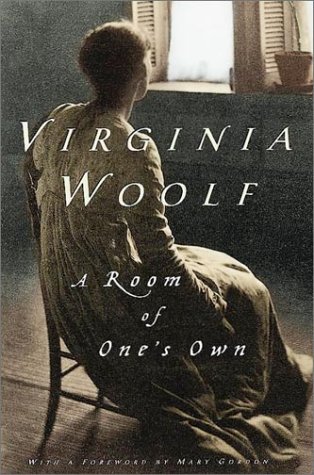
roomHowever, I do want to make our class discussions productive and inclusive, especially for this class of (mostly) first-year students, many of whom may not have had explicit discussions about feminism and literature before, so I fretted quite a bit about exactly what to say and what tone to take on Monday. One thing I pointed out is that politics broadly understood have been part of our discussions all year: we just haven’t identified what we’re doing as political criticism. And I noted that we’ve already talked about the challenge of literary evaluation, and about canonicity. We’ve also already worked on texts that are all about women’s position in society: “The Yellow Wallpaper,” for example, and “A Jury of Her Peers.” So we’re doing more of the same. Now that we’re doing a whole cluster of works with this focus, though, it makes sense to create a more explicit framework, both for what the authors are doing and for what we are doing. I hope I hit the right note in my introductory remarks. We’ll see how it goes. One of the particular challenges (something I’m going to address specifically tomorrow) is that a lot of the works we’ll be reading are angry ones — including A Room of One’s Own, though the anger there is very, very carefully managed (but is it entirely hidden?). I think anger can be off-putting: it makes the reader a bit squirmy, as if they are being blamed or attacked. It’s hard to like an angry person! The tendency (which I have been unable, despite my efforts, to quell completely) to prefer speakers or characters who are “relatable” makes anger a problem for a lot of students. My hope is that we can make it a useful problem — because after all, what does it mean to tell someone not to be angry, or not to listen to someone who is angry — especially if they have good reason for it? Angry women, of course, always get a particularly hard time.

I’d be interested in hearing from other people about their classroom experiences with feminism. Some of you probably teach (or have taken) courses much more completely and explicitly dedicated to the topic: classes on feminist theory, for instance, or feminist philosophy. I expect the population of such classes is more self-selecting so perhaps the awkwardness I sense (or am I just projecting?) does not arise.

In 19th-Century Fiction we are finishing up The Mill on the Floss this week. Tomorrow we’ll discuss the ending. I’ve collected a string of quotations from various critics onto a handout which I hope will provoke plenty of discussion…some of it about feminism! Reading “Diving Into the Wreck” over today for class, I found myself thinking that it resonates uncannily with the ending of The Mill on the Floss — not just in being watery but in being difficult to explain.

This Week In My Classes: Cranford and The Road

roadThe honeymoon is over. At the beginning of every term things putter along easily enough while I wonder why I felt so stressed out at the end of the previous term … and then marking starts to come in, and the new assignment sequences dreamed up over the break loom on the horizon and require planning and handouts and Blackboard drop-boxes, and forms for the letters of reference I forgot I still needed to do appear in my inbox, and the thesis material I made my students promise to have ready duly shows up. And that’s about where I am now, staying on top of things but with effort. It doesn’t help that it’s winter (when has winter ever helped with anything?). It takes more energy to do everything in the winter, from driving away in the morning (bundling up, scraping, clearing) to just staying warm (even my LL Bean fleece slipper socks are just not enough this year, down in my basement office with the cold, cold floor).

So that’s how things are going, in a general way. It’s a good busy, mostly, especially the class prep for the novels that are new for me this term: I enjoy figuring out what I want to do with them and trying out my ideas in the classroom. I’m out of time for Cranford now: next time, I think I’ll allow more than four classes, because it feels like our work on it ended too abruptly. But then, I don’t typically have more than six classes on any but the longest novels! I’m going to miss its subtle good humor, which has been a good antidote to the relentless gloom of The Road in my intro class. One of my favorite bits on this read was the Great Pea-Eating Challenge:

When the ducks and green peas came, we looked at each other in dismay; we had only two-pronged, black-handled forks. It is true the steel was as bright as silver; but what were we to do? Miss Matty picked up her peas, one by one, on the point of the prongs, much as Amine ate her grains of rice after her previous feast with the Ghoul. Miss Pole sighed over her delicate young peas as she left them on one side of her plate untasted, for they would drop between the prongs. I looked at my host: the peas were going wholesale into his capacious mouth, shovelled up by his large round-ended knife. I saw, I imitated, I survived! My friends, in spite of my precedent, could not muster up courage enough to do an ungenteel thing; and, if Mr Holbrook had not been so heartily hungry, he would probably have seen that the good peas went away almost untouched.

I’ve always found peas quite inconvenient myself — and not particularly tasty, though I do occasionally serve them now that I’m All Grown Up (my parents could testify that this is a sign of maturity beyond what they would have predicted, given my childhood aversion to most green vegetables). Next up in this class is The Mill on the Floss. It’s not cheerful (well, the first part is pretty funny, but after that … ) but I’m really looking forward to it, especially after having worked up my essay on it for this month’s Open Letters.

In Intro to Lit, we had our first general class discussion of The Road today, and the students seemed quite engaged with it. We warmed up by talking about things like the title (I always start there with novels!) — why “the” road, why not any road in particular (especially considering they have a map), why just “the man” and “the boy,” what seems to have happened, what matters to them now, what is their relationship like, and so on. There’s lots more to talk about, but for Wednesday I want us to focus on the language of the novel for a while. I am aware that admiration of McCarthy’s style is not universal, and I’m not altogether convinced about some aspects of it myself, for all that I find the novel both gripping and moving. It’s a conspicuous style: there’s no illusion of transparency and there are a lot of what could be considered affectations, from the eccentric punctuation (argh! the apostrophes!) to the use of obscure words (obscure to me, anyway — words I had to look up for today’s installment included “rachitic,” “gryke,” and “kerfs”). Most sentences are very short, and indeed many are fragments, but some are longer and more elaborate, even florid. Because the novel is quite suspenseful, it’s easy to read along quickly and not fret the details (I didn’t look up any of these words on my first reading), but that’s obviously not good enough. I think we might try an exercise on “found poetry” in The Road. I think that this would focus our attention very closely on details of wording, including not just meaning but also sound, placement, and relationships to major themes. It would also probably prompt some useful discussion about what we think makes prose “poetic.” So! A handout for a group activity along these lines goes on the to-do list for tomorrow.