 Is it possible that we’ve already finished two full weeks of classes? Well, that time just flew by!
I think one reason it seems as if the term is still only just beginning is that today is also the last day of the add-drop period, which is the bane of my teaching life ever single term. Why in my day you picked your classes before the semester began, you showed up for your classes when the semester began — and then you just kept on showing up until they were over! And it was up hill both ways! Harumph. But seriously, having two weeks out of a single term in which new students may show up at any point and supposedly current students may or may not . . . well, it’s a pain, because along with this “shopping period” often comes an attitude that nothing you might have missed during it should really count, which of course is impossible. I can’t let 1/6 of the term go by and do nothing that matters! And if I did, it would be an insult to the students who have shown up since Day 1. So, I start when the term starts, and if students want to shop around they have to be aware that there are consequences. This is a perennial complaint, and I am in fact starting to explore if there’s anything at all we can do to influence administrators so that the pedagogical insanity of the current system can be ameliorated. At the very least I dream of being able to remove registered students from the class if they fail to show up on the first day (or heck, in the first week) so that I can settle things one way or another for students on the waiting list. Attendance would go way up for the first week of classes, I bet, which would be good for everyone, and students would realize that their behaviour around registration isn’t just an annoyance for professors but can be a genuine headache for other students.
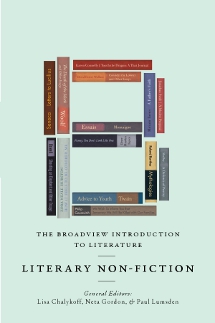
Anyway, enough grumbling. I have done my best to stay calm and just get on with teaching, and in my section of Intro that means we’ve actually almost finished our first unit, on essays. I’m using a new book this year, the literary non-fiction volume of Broadview’s new Introduction to Literature set, and I’m very happy with the selections in it. We started with Twain’s “Advice to Youth,” which I thought would be fun and thus help my campaign to be less intimidating. We’ve also read Swift, Orwell, Woolf, and, for today, Miriam Toew’s “A Father’s Faith,” which I like so much that I’ve added A Complicated Kindness to my TBR list.
I can’t know if the cause is my somewhat revised approach or the different group or both, but class participation in Intro is already more lively than it was most of the time last year, so I’m optimistic that as the term goes on and we get into longer and more challenging material, the atmosphere will stay engaged and collaborative. I use a lot of time early in the term for what I (unoriginally) call “stocking their critical toolboxes,” that is, building up a vocabulary of precise terms for discussing literature. This inevitably cuts into the time we have for talking in detail about the readings, but as we move along I can scale back on technical stuff, so today was mostly about Toews and Monday we should also be able to focus almost entirely on our grimly gripping excerpt from Philip Gourevitch’s We Wish to Inform You That Tomorrow We Will Be Killed With Our Families.
In Women and Detective Fiction we’ve also started with shorter works, and in a sense here too we began by stocking up on analytical tools, though of a different kind. What questions are illuminating and productive to ask of our readings? What contexts do we need – literary, historical, critical – to talk well about them? Because not everyone in the class has done any previous classes on detective fiction (though a majority have in fact taken the lower-level survey class) I lead off with a lecture on the history of the genre and reviewed some key critical concepts and conventions, and we read a handful of ‘classic’ texts (Poe, Conan Doyle, and Hammett). Then we looked at a couple of early women’s crime stories – Mary Wilkins Freeman’s “The Long Arm” and Susan Glaspell’s “A Jury of Her Peers.”
 For the last two classes we’ve been reading a selection of Agatha Christie’s Miss Marple stories. This is a group of smart, keen upper-level students, and so it is interesting to me both intellectually and pedagogically that it was difficult to generate much discussion of Christie. It’s possible that two classes on these readings is one too many because honestly, the stories aren’t that interesting. Can I say that? There are certainly many interesting aspects of them, considered in our context – Miss Marple herself is an intriguing character; the stories frequently make little points about how women’s expertise can be overlooked, or how women themselves, if they aren’t young and sexy, are overlooked; there are some class issues; there’s the problem of treating violent death as a puzzle rather than a human tragedy. But there’s not much to be said about language, style, and form, or about other themes. The students remarked how hard it quickly became to tell the stories apart or remember what detail came from which one. The characters are quite 2-dimensional, and the mysteries unfold with a predictable rhythm, right down to Miss Marple’s charmingly self-deprecating and digressive version of the “reveal” scene. My sense that we were already running out of steam in the first class led me to prepare an exercise for today that focused on precisely this problem (how well do these stories reward close reading?). I asked them to consider what other short fiction they’d studied and with what emphases, and then to consider Edmund Wilson’s infamous essay “Who Cares Who Killed Roger Ackroyd?” I explicitly and sincerely told them that I was not setting Wilson up as a straw man. I think he has a good point – several good points, in fact! But I also think a case can be made against his case for capital-L Literature. I thought this might generate some intense debate about literary merit as a concept, but it didn’t, quite. One reason was that it turned out many students had studied very little short fiction! I was surprised. I fully expected that they would all have read at least some of Dubliners, and/or some array of the usual suspects from Katherine Mansfield to Carver or Hemingway to Alice Munro. But no! So asking them what they “typically” focused on when discussing short stories went pretty much nowhere.
The other inhibition I thought I sensed, though I realize I may be misreading or over-reading (both hazards of my training!), was about the whole concept of literary merit: nobody who spoke up, at any rate, championed Wilson’s point of view or took the position that, clever as they are, Christie’s stories are, really and truly, just not as rich, interesting, or worth our time as “The Dead” (or, since most of them hadn’t read “The Dead,” some other work of Literature). I wonder if we have educated them into extreme caution about such value judgments (I do my part in that with my lecture on Christie vs. the Difficult Modernists in the mystery survey class – and, indeed, through the whole way in which I frame the class as a test of the oft-assumed hierarchy between literary and genre fiction). Or maybe they really do see no qualitative difference (which I admit would shock me), or if they are worried about criticizing the assigned course readings, or if they just in some way aren’t ready for that conversation, or if they really enjoyed Christie’s stories and don’t want to feel bad about it, or what. Well, as I remarked at the end of class, Nancy Drew (who we turn to next) is not going to make this question go away but in many respects will exacerbate it.




 First of all, I did decide to do something different, rather than just pressing on with my usual strategies. I had to admit to myself — and I admitted this morning to my class — that if year after year a critical mass of students just isn’t getting engaged by the novel, at least to some extent this is a failure on my part — a pedagogical failure. Dropping Waverley from my reading list was also a failure: some students in Waverley-free years have told me how happy they were to have missed it, but missing out on it was not a win for them any more than it was one for me. As I told my class this morning, it’s a novel that deserves its place on our syllabus, one that is well worth reading for our curriculum, whatever anyone’s personal response to it. But the failure isn’t all mine. To use the analogy I suggested to my class, if you’re stumped by a difficult calculus problem, you don’t blame the problem: you work it as hard as you can, get more help if you need it, and try to bring your skills up to the level you need to solve it.
 Again, this is all standard classroom procedure — lecture mixed with discussion prompted by questions designed to build interpretations out of observations. But it just doesn’t go well with Waverley, though there are always a few stalwart souls who put their hands up (thank you!). I’m always a bit puzzled by the conspicuous collapse: the novel doesn’t strike me as that opaque, especially once we’ve done our warm-up sessions. On the assumption that incomprehension is a problem, though, my first response is usually to step up what I think of as the ‘modeling’ component of class — that is, walking the students through those key episodes and showing them what’s in there to notice, enjoy, and work with. Then I try backing off again — but still with lackluster results. Is it me, I wonder? Perhaps I come on too strong: if they are feeling bemused or bored, then my enthusiasm, rather than ‘selling’ them on the novel, may just alienate them from both it and me. Also, sometimes I catch myself hectoring them: this week, for example, I gave them a heads-up that we’d be discussing three particular incidents, and when hardly anyone seemed prepared to do that, well, I did take them to task! But that backfires too, I bet: rather than feeling challenged to do better, they probably just feel defensive.
 The second full week of term has gone by already: it’s amazing how time seems to accelerate when things get busier. In both my classes we have moved from throat-clearing and context-setting to richer discussions about our readings: in The 19th-Century Novel from Austen to Dickens, we’ve wrapped up our work on Persuasion, and in Mystery and Detective Fiction we’ve got only one more class on The Moonstone. Starting the term with these two novels eases the transition from summer’s languors to fall’s stresses because both are so delightful. At least, I think so — and it seems as if a lot of students are enjoying them as well. Discussion in the Mystery class has been particularly good so far this term, especially considering it’s a big class (capped at 90), which can sometimes be inhibiting. I hope they keep putting their hands up!
 One thing I’ve been thinking about as our work gets underway, and as I contemplate my own non-teaching ambitions for this term, is trying to make the process as meaningful and rewarding as possible, shifting some emphasis away from the product — which for students is often the course credit or the grade, and for me is the finished piece of writing. I’ve been reading Donald Hall’s The Academic Self: An Owner’s Manual (thanks to
 Novel Readings