This Week In My Classes: Meetings, Deadlines, Poems, Mysteries, and Nymphs

This past week was very busy, which is why I didn’t manage to post this during the week. For one thing, one of the committees that I’m on had to do a series of consultations, which involves both the actual meeting times and a fair amount of correspondence and negotiation getting things set up. Another committee I’m on got an announcement that had extremely worrying implications for our department’s MA program, and until the details got sorted out and corrected, that generated a fair amount of worried conversation and debate. These are important things, even if sometimes they seem, or turn out to really be, tempests in tea pots: one of the things most academics value highly about their work environment is self-governance, and that takes both time and concern to do well.

Then, it’s getting to be reference letter season, for grad school applications and for academic jobs, and I came up on my first few deadlines this week. Just as one example, it took me about two hours to complete a satisfactory draft of one of these letters and then print, scan, and email it according to the directions. Because every single place has a different process , some of them including forms to be downloaded and/or filled in, others requiring hard copies, and still others scanned versions, it’s very hard to create efficiencies: ten letters for the same candidate may all need to be done differently. Also, students have started taking me up on my urging to come and see me in my office to talk about their assignments. I believe very strongly in the value of such one-on-one meetings, but it’s a good thing that so far only about 10% of my 140 students this term have set them up, only because I couldn’t possibly take care of my routine class prep, not to mention my marking, if they all did. I also did some graduate advising work, responding to a revised thesis chapter while also thinking hard about and then trying to address appropriately some really important questions my student is struggling with about her degree program. These are not the kinds of things people outside the academy think about, in my experience, when they talk about our workload: everyone focuses on hours spent in the classroom, and specifically the undergraduate classroom. But taking care of our students (at all levels) involves a lot more than just showing up for class.

Last but not least, I have been working on a review for the November issue of Open Letters Monthly, and although editors get a little leeway in our usual submission deadlines, I really wanted to get it to my colleagues before the end of the week so that I would be sure to have time for revisions. I sent it off late Wednesday night: hooray! And I already have their thoughtful comments back and can tidy it up easily enough in time for the new issue. It’s mostly because I was using all my spare time to do that reading and writing project that there hasn’t been any blogging going on: for the last couple of weeks I really haven’t read anything of substance besides the book for the review (Lynne Sharon Schwartz’s newest, Two-Part Inventions) and the books for my classes. What did I think of Two-Part Inventions? You’ll have to wait for November 1 to find out!

And speaking of the books for my classes, what were they, you ask? In my first-year class we’re moving through our ‘introduction to poetry’ unit, gearing up for the first essay assignment. We read ‘I wandered lonely as a cloud’ and ‘God’s Grandeur’ for Monday, which gave me some reference points for a later discussion of how to develop a comparative thesis for a close reading poetry essay. For Wednesday, we read Elizabeth Bishop’s ‘The Fish.’ I’m not sure I’d read that poem before this year! I really enjoyed it, both as a poem to read and as a poem to work on in class; there are a lot of striking word choices that were good for provoking discussion–one of my major ‘talking points’ for them so far is “Don’t take the words on the page for granted,” and that’s just easier to do when the words are really unexpected ones! And then on Friday we worked explicitly on how to write essays about poetry. I’m trying to demystify the critical process by focusing on straightforward tasks like note-taking and pre-writing strategies. I have ended up talking a few times about my own writing strategies, including the things I find difficult and some of the ways I try to get past them. As I had a deadline of my own to meet, how to get the writing done was very much on my mind! I hope it’s useful to them to realize that writing is something I do, and struggle with, too.

In Mystery and Detective Fiction, we’ve just finished The Maltese Falcon and started An Unsuitable Job for a Woman. I really have nothing new to report about these books or the experience of teaching them, except that I think that this time I’m finally done with The Maltese Falcon, at least for a while. I’m starting to tune out when re-reading it for class, which is not good.

In the Somerville seminar, we’ve finished with South Riding, which generated lots of very lively and interesting discussion right to the end. I’ve been so encouraged by the response to it, and also so engaged by the novel myself, that I’m feeling frustrated that I can’t quite think of another course in which I could reasonably assign it. We used to offer a year-long class called ‘The Novel to 1900,’ which was fun, if challenging to those of us not altogether at home in the 18th century, but even if that was still on the books, which I don’t think it is, 1936 is even more of a stretch than 1908, the date of A Room with a View, which was the novel I used to close the course with. We now have a class called ‘Fiction of the Earlier 20th-Century,’ but it’s not specific to British fiction, and a class called ‘British Literature of the Earlier 20th-Century’ which is, obviously, not just novels. Both of these would be a real stretch for me! And also they are usually offered by the people in our department who do specialize more or less in these fields…though technically I think we do not currently have anyone whose research area is ‘earlier’ 20th-century British literature. The easiest thing to do with anomalous interests such as mine in this cluster of ‘Somerville’ texts is to offer a special topics seminar at the upper level, which is what I’m doing now: to some extent that relieves you from the burden of really wide or deep knowledge. Maybe I’ll put in for one of the more general courses one day, though, just to shake things up.

After South Riding, we started Margaret Kennedy’s The Constant Nymph. It doesn’t seem quite as odd to me this time as it did when I first read it, which I hope is a consequence, at least in part, of the work I’ve been doing for this class. But even in the context of my seminar, it’s an anomalous book, not obviously related in theme, style, or structure to our other readings. We have come up with some ideas about ways it relates to them, including its interest in women’s roles and women’s education, and also its attention to the potentially destructive force of sexuality. Each of our other novels, though, at least arrives in front of us with some obvious critical frameworks; each of them belongs to a critical conversation that’s more or less familiar, even if our specific examples are not the most canonical ones. The Constant Nymph does not. Scrounging around for explicit commentary on the novel, I have come up with a few ideas: there’s a lengthy discussion of it in one book on literature of the 1920s as a “sex novel,” for instance, meaning (in the context that book establishes) a novel focusing on a young female protagonist and on female sexuality. That does fit with our general impression that the book is a bit like Lolita–the “nymph” of the title is fourteen when the novel begins and the love interest of a much older man, though he doesn’t exactly act on, or even quite acknowledge, his feelings for her at first. Kennedy herself said the book was meant to explore the conflict between “art” and “culture,” so we’ve been kicking that around a bit. It is unnerving in some ways not to know where I want our discussions to go, what patterns or priorities to pursue. But the class is full of smart, curious people and I think we are doing well trying out ideas and seeing where they take us.

One thing we talked about right away is how obscure this novel is now compared to how famous and popular it was in its early days. One sign of its popularity is that there were three different movie adaptations of it, including one in 1943 starring Joan Fontaine. I was amazed that the trailer for this version turned up on YouTube. Watch it and see if you don’t suddenly want to read The Constant Nymph for yourself! Except that you might end up surprised at just how little the book resembles what you get here.

I hope to get some good extracurricular reading done in the next week or two. I have to, in fact, as both of my reading groups have meetings coming up! For Slaves of Golconda we are reading Rose Macaulay’s Crewe Train (remember, you can join in if you want!) while for my F2F group we are reading Wide Sargasso Sea, which is one I really should have read before now. I also have to read a PhD thesis for a defense on November 16, and keep up with the books for my classes … should be another couple of busy weeks.
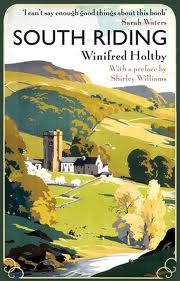
South Riding: They like it! They really, really like it!

I’ve just finished rereading South Riding, ready for our final discussion of the novel in the Somerville seminar tomorrow. I was caught up in it both intellectually and emotionally, more than I was when I first read it last spring. Rereading made the subtleties of the novel’s construction more apparent: the sophisticated way Holtby weaves together the stories of her vast array of characters, the tensions between their disparate visions for their own lives and the life of their community, the ironies of unintended consequences, the conflicts between political commitments and personal affections, the books each named for a council committee. More apparent also this time was the role of the communal events (concerts, festivals)  in returning us over and over to the intermingling of these lives and values. Though there are strong personalities that dominate the novel, it is, ultimately, a social novel, and our realization that even the strongest individuals cannot really shape their own destiny–cannot control either the forces of history or the forces of their own nature–is shared, in the end, by Sarah Burton, who in a different novel would be the heroine but here learns to subordinate her ego to a communal story.

I think she also learns to accept that there are currents in life outside her control. I wrote before of my dissatisfaction with Sarah’s discovery of her love for Carne. I still find it melodramatic in its presentation, but on this reading I had more ideas about how it belonged, thematically, to this novel. Sarah arrives in South Riding keen to bring reason to bear in the service of progress and reform. In a pivotal exchange with Mrs. Beddows, she asserts,

I think we have to play our own Providence – for ourselves and for future generations. If the growth of civilisation means anything, it means the gradual reduction of the areas ruled by chance – Providence, if you like.

Mrs. Beddows feels “sorry for the wilful unbroken girl before her.” South Riding is partly the story of how Sarah’s will is broken, and I’ve been thinking that her love for Carne is one of the ways that happens. Love – passion – desire – is not reasonable; it cannot be brought neatly under our control. It is, I think, shown as part of the natural world, in which raw forces like sex and death wreak havoc on well-laid plans. Many of the novel’s subplots, in fact, show people’s lives similarly wrought upon by their intractably physical elements: people get sick, they get pregnant, they inherit ‘tainted blood,’ they die. Sarah knows that Carne represents, politically, everything she opposes, and yet she loves him. Her feelings are characterized, in one of Holtby’s characteristically dry chapter titles, as a form of temporary insanity. In her conversation with Sarah after Carne’s death, Mrs. Beddows helps her to see that love carried her past their ideological differences: it was a response to Carne’s full presence and complexity as a human being. “He was everything I dislike most,” exclaims Sarah, ” – reactionary, unimaginative, selfish, arrogant, prejudiced.” “He may have been all that you say he was,” responds Mrs. Beddows,

but he was much more. He was courageous and kind and honest. He was, in dealing with people, the gentlest man I ever knew. He knew all about loving. . . . He never ran away from failure; he never whined, never deceived himself, never blamed other people when things went wrong. In the end – it’s not politics nor opinions – it’s those fundamental things that count – the things of the spirit.

Without suggesting that specific policies don’t matter, Holtby advocates the primacy of humanity over ideology. That’s an ideal, she suggests, for how we live our individual lives, but it’s also the model she endorses for civic government, because, in the novel’s simplest and most compelling idea of all, we’re all in it together. Thus Sarah’s conclusion:

She was one with the people around her, who had suffered shame, illness, bereavement, grief and fear. She belonged to them. Those things which were done for them – that battle against poverty, madness, sickness and old age – was fought for her as well. She was not outside it.

We end not with Sarah’s love for Carne, but with her love for the South Riding.

South Riding has been a hit with the class. Frankly, I’ve been both pleased and a little bit puzzled by their outspoken enthusiasm. It’s buoying, for sure, not just for me, but especially for them, given that before long they are going to be deep into their independent reading projects, and I think their expectations are now higher about what they might find as they explore other books that they hadn’t heard of before. The things they like about the book include its range of characters, its political and social engagement, and its dry humor. I was worried that they would find the novel too diffuse, but they’ve talked a lot, with enthusiasm, about the frequent changes in perspective and how Holtby keeps shifting and complicating how we see people and situations. We can’t ever rest in simple judgments, seems to be the message they are taking away from that. The introduction of the love plot provoked a lot of discussion, but mostly they had accepted Sarah’s declaration less skeptically than I had. To be fair, it’s prepared for by a broad hint on the back cover blurb, as one student pointed out with justifiable annoyance. But they liked the frankness of Sarah’s confrontation with her feelings and the way her love contradicts her political principles. I’m curious to find out how they react when they see how things turn out! It is certainly not a conventional romance plot.

It’s great that they like it and are really energized to talk about it. I know I won’t have to carry the discussion tomorrow! But at the same time, I am reminded why I usually try to set the terms of my classes to rule out a lot of talk about ‘liking’ or ‘not liking.’ I have allowed, even encouraged, them to explain why they like South Riding, partly because it’s so clear that they do and it’s interesting to know why. And their positive response to the book is clearly motivating them to think about it and ask questions about it and make connections and generally be good readers of it. Yet there’s also a temptation for them to use the book they do like as a stick to beat the books they didn’t like as much or didn’t find as easy to appreciate–that is, both of the other books we’ve read for the course.* There’s a risk in setting up South Riding as a standard for success, as if other books that have very different aims and methods are not as good in some absolute way: for our purposes, that’s not a very productive way to proceed. It encourages complacency about their own preferences and interpretations and reading habits, which is just the kind of thing I’m guarding against when I worry that I’m not challenging my own reading of Gaudy Night. I’m certainly not sorry that so many of them seem so fired up about South Riding. I’m just going to do my best to channel the resulting energy back into ideas about why Holtby’s form and style serves her ideas so well, while Brittain and Sayers are doing other kinds of things.

*I can’t help but reflect that this is how I sometimes use Middlemarch. Ahem. But my purposes here are not the same as my purposes in the classroom. If I were teaching Madame Bovary I would save the possibility of a comparative critique of that kind for the very last day. The rest of the time would be all about appreciating Flaubert for being Flaubert. Honest!

This Week In My Classes: Love Poems and Social Novels

In English 1000, we’ve started our first poetry unit. We’ll be doing more poetry after Christmas, organized into what I hope will be provocative thematic clusters, but for now we’re just working through the basics of reading and analyzing poetry — meter and scansion, figurative language, poetic forms and modes. We haven’t really talked much about specific poems yet, since I’ve been using the assigned ones mostly to teach vocabulary for poetic devices, but on Wednesday we’re reading a little group of love poems and I hope to open things up a bit more than I have been doing so far. I haven’t quite decided how, though. The poems are Anne Bradstreet’s “To My Dear and Loving Husband,” EBB’s “How do I love thee,” and Shakespeare’s “Let Me Not to the Marriage of True Minds.” I guess some talk about sonnet form is probably appropriate, and about EBB’s appropriation of the conventions of love sonnets for a woman’s voice. Maybe we’ll get a bit silly and play Poetry Survivor: set up some standards for a great love poem and then vote one off the island out of the anthology as the weakest of the three. All this talk about metrical variation and synecdoche has probably made them afraid to react viscerally to a poem! The challenge, an exercise like that might show them, is to channel that gut reaction into an energetic analysis of the actual poetry.

In English 2040, it’s hard-boiled detective fiction time. Every year I swear I’ll dump The Maltese Falcon for The Big Sleep and I never do. But the thing is, first of all, that I really do think The Maltese Falcon is brilliant, and it teaches so well, by which I mean it brings up so many of the themes we’re interested in across all of our readings. Also, and this is not incidental, I have been working with it for a while and feel pretty confident talking about it. Even just considering how convoluted the plots of these novels are, that’s no small thing! Still, I’m sure The Big Sleep is just as brilliant in its own style. Maybe next year, since it looks like I’ll be teaching this class yet again…which is fine, as I really do enjoy it. I just find it kind of funny that the class I have offered most often in the last decade is this one, because it gets bums in seats (83 bums this year, to be precise).

Most fun this week is working on South Riding in the Somerville seminar. The students are very engaged, especially now that we’re past the initially disorienting ‘getting to know all the characters’ phase. We had a lively discussion today about the variable points of view in the novel and how they affect our understanding of the community and also our sympathies. One idea we considered is that the constantly shifting perspective makes it hard for us to arrive at moral judgments about the characters: just when we think we condemn their choices or actions, we are brought to see them in a different context. And yet there seem to be exceptions to this, people whose points of view show off their faults or limits. Alderman Snaith attracted the most attention. He seems clearly set up to be the bad guy, but it was pointed out that he isn’t really after anything so different from what everyone else wants (money, power, success)–he’s just smarmier about it. Also, he is indifferent to suffering caused by his pursuit of his own interests. Holtby has given him a back story that seems calculated to awaken our sympathy: it seems that he was abused or raped as a child by “evil men” and he’s been left “a psychological cripple for life,”  feeling only horror at “all thoughts of mating and procreation.” We haven’t really worked out how this particular trauma fits into the larger themes of the novel, or even into the overall portrayal of his character, but we were noticing other scenes or intimations of sexual violence and the destructive potential of sexual desire, from the death of Mrs. Holly in childbirth to the suggestion that Robert Carne raped his wife (the word he uses is “forced”). It’s a novel full of the rhythms and forces of the natural world, but it’s hardly a pastoral idyll: perhaps this is a way of showing that human life, despite the best efforts of civilization, is driven by the same powerful urges. One implication would be that reform (social, political, educational) is both urgently needed and inevitably futile. Sarah Burton’s idealism can make us want to stand up and cheer. “We’ve got to have courage, to take our future into our own hands,” she declaims to Mrs. Beddows. “If the law is oppressive, we must change the law. If tradition is obstructive, we must break tradition. If the system is unjust, we must reform the system.” But Mrs. Beddowss has “seen compassion impotent and effort wasted”; she reflects on the parade of miseries she has seen, on illness and suffering and injustice all brought on “by circumstances which neither courage nor intelligence could have altered.” Sarah dreams of “the gradual reduction of the areas ruled by chance,” but so far the novel has not filled its readers with optimism that such transformation is possible. Perhaps the novel is a lesson in lowering expectations. As Alderman Astell, the once-idealistic socialist, remarks to Sarah, “You begin by thinking in terms of world-revolution and end by learning to be pleased with a sewage farm.”

When is Reading Research?

I’ve been thinking more about what we mean when we say “research.” In my post on the ‘duties of professors,’ I quote C. Q. Drummond’s remark,

If research in an Arts Faculty means humane learning, then we all hope our teachers are as much involved in research as they possibly can be. We want them to know better and better what they are talking about, so that they will have, and will continue to have, something intelligent and important to profess to their students. But if research means output or publication, as it so often does today, how do the students profit?

In his turn, Drummond quotes George Whalley, who suggests that the word “research” is altogether misleading or inappropriate when applied to humanistic inquiry: ““The functions of research are specialized and limited; … the word research is not a suitable term for referring to the central initiative and purpose of sustained inquiry in ‘the humanities.'” “Most professors in Arts Faculties,” Drummond proposes, “would be better off reading more and publishing less.” Of course, reading is research for most humanists–that is, it’s the research process. But not all reading is research–or it it?

When we talk about “doing research,” I think we conventionally mean reading in service of a particular research project, that is, reading in pursuit of a foreseen research product, a published essay or book. Does that mean that reading for which we cannot already identify such an outcome is not research, then? Certainly it’s reading for which we can get no particular institutional support. For instance, if I want to get a research grant, it does me no good to justify my budget on the grounds that I am gathering materials on subjects about which I would simply like to know more than I do, or in which I have a developing interest but, as yet, no idea what, if any, payoff there will be in terms of publications. I also can’t get research support to develop new classes. I might be able to get a grant from our Center for Teaching and Learning–although peering at their page, the only grants I see them offering are for “faculty members who are seeking new and innovative ways to incorporate technology into their teaching practice” and “high impact initiatives that address student engagement activities/projects in the first year of their studies.” Too bad if I just want to follow my curiosity, acquire new expertise, and then gather students up to share it through reading and discussion.

My own new class on the ‘Somerville Novelists’ may, in fact, incorporate technology (brace yourselves, students–I’m thinking wikis again!), but it will have been developed from reading I did initially purely out of interest–and of books I bought with my own money. I don’t mind about the money–though it’s sometimes frustrating to realize how much the university relies on our willingness to do things “on our own” without which the institution would be a much poorer place, and by that I don’t mean poorer financially. (I bought the laptop I’m using with my own money too–the university doesn’t provide “home” or portable computers, or at least our faculty doesn’t, but imagine how academic work would grind to a halt if we could not work evenings and weekends, or not without coming in to campus. But that’s another issue…sort of.) I don’t really draw strict lines between what I do for work and what I do for myself, precisely because being a professor is not just having a job but having a certain identity–filling (or aspiring to fill) a certain kind of role in the world. But especially since reading Drummond’s essay I’ve been thinking about the way our particular understanding of “research,” one that yokes together the process and the product, undervalues other kinds of reading. I do mind about that, because I think it artificially narrows both that job and that identity.

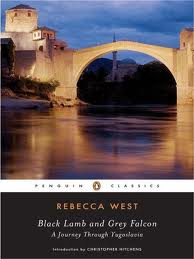
Is there really only one professionally worthwhile kind of reading? I’ve recently bought Rebecca West’s Black Lamb and Grey Falcon. I bought it out of interest: I’ve been exhilarated by learning about other early 20th-century women writers, and West is a major figure. I’m not sure where to place her: she’s not specifically in the Somerville crowd I’ve been looking into, and she’s not really a Modernist (I don’t think). I’m curious to figure out more about her. Reading The Return of the Soldier made me more curious. She is not–and Black Lamb and Grey Falcon is not–obviously continuous with any issues or genres I have an explicit “research” interest in. There are plenty of books in “my field” of Victorian literature that I haven’t read, and there are also plenty of books about Victorian literature that I haven’t read. I have some declared “research” projects that have not reached the official finishing point of publication in an academic journal (much less an academic monograph). Clearly, if I read (when I read) Black Lamb and Grey Falcon I am doing it only for myself: it’s not research. And yet reading it will almost certainly  help me have “something intelligent and important to profess to [my] students,” and that I don’t know exactly what else will come of it isn’t necessarily a bad thing. It isn’t even necessarily a bad thing that nothing concrete (beyond some blog posts) may ever come of it. But by some measures–the only ones that mean much, professionally, these days–it would be more productive for me to read the umpteenth specialized analysis of Middlemarch. Now that would be research.

This Week at Work: Reflections on Our Research Culture

DALHOUSIE-UNIVERSITYYesterday I received a reminder from the Mellon Foundation about a follow-up survey they are doing of people who did Ph.D.s supported by Mellon Fellowships.  I remember how exciting it was when I learned I had won one of these fellowships, which was both generous and prestigious. I had mixed success with my actual Ph.D. applications–indeed, I was rejected by many more schools than accepted me–and I’ve often thought that the crucial factor in my winning the Mellon was the interview. I was (am?) more charming in person than on paper–it’s something about my sense of humor, I think, which apparently doesn’t carry over much into my writing!

In any case, winning a Mellon Fellowship made me a more attractive target for the schools that had offered me places: I ended up with the luxury of comparing complete five-year funding packages from a couple of excellent schools, and the even greater luxury of comparing these North American alternatives to using a Commonwealth Scholarship to go to the UK. In the end, I chose Cornell, starting in 1990 and finishing in 1995 with job offer in hand–job offers, in fact: while my job market success was also mixed and I got a lot of rejections, when I got close, I did pretty well (speaking of rejection, though, I’ll never forget the message telling me I was not offered the job I wanted most of all, which hit me like an emotional bomb when I read it in the dank basement computer lab where, in those olden days, I had to go to check my email–would it have been so hard to give me a phone call so I could have absorbed the blow in private?). Anyway, I chose Dalhousie, and (though I have made a few attempts over the years to move on) here I still am today.

Dal_MarionMcCain_BuildingThe Mellon survey focused primarily on career paths and job satisfaction. Most of it was pretty easy stuff (how many peer-reviewed articles did you publish before tenure? what kind of pre-tenure mentoring did you get? were there explicit expectations about the kind or quantity of publications you’d need for tenure?), but towards the end there were some more open-ended ones, and the very final one proved a real poser: If you had to do it all over again, they asked, would you do the same? Same degree, same school? Same degree, different school? Different degree? Or no Ph.D. at all?

Maybe this would not have been such a stumper of a question if they’d asked it on a different day, but yesterday was kind of a tough day for me at work. It’s not that I was busier than usual or overwhelmed with new tasks or dealing with confrontational students upset with their grades, or dead-ended on a writing project or behind in my class preparation. Rather, it was a day (one of many recent days) in which different priorities clashed in the department and I ended up feeling that more and more, we are steering by (or allowing ourselves to be steered by) the wrong values. There are a lot of moving parts behind the motions we have voted on recently, but the net effect is that a majority of the department has carried through an agenda by which we will reduce class offerings at all levels and increase class sizes at the undergraduate level, in order to bring our nominal teaching load down and thus clear more time for research during the academic term.

macke woman readingI emphasize that last clause because we have dedicated research time already (the spring and summer terms, when we do not regularly teach undergraduate classes, as well as our sabbaticals); the argument was being made for the importance of making more time for research while teaching, and thus the new plan deliberately favors reducing our contact hours and prep time. We’ll remain individually responsible for the same number of students, so any time savings won’t come from reducing our grading. Now, I find marking assignments as tedious as the next prof. What I don’t find tedious or want less of is face time with my students. My hours in the classroom are almost the only hours during which I have no doubts about my answer to the Mellon Foundation’s question. It’s true that class prep can be relentless, and in the middle of my heavier teaching term, I’m too busy with it–too overwhelmed by it, in combination with the marking–to do anything ambitious regarding other research or writing projects. Not nothing at all, but nothing much. But class prep can also be  intellectually stimulating, and often is itself research, or feeds into ongoing research interests: I didn’t like the presumed opposition between teaching and research that dominated the arguments for the latest motion.

The problem is that this pitting of two of our essential tasks against each other is in large part a consequence of the pervasive research culture promulgated especially by administrators who talk about “productivity” and “output” in terms of grant dollars pursued and won, and of quantity (rather than quality and significance) of (conventionally peer-reviewed) publications. Tomorrow, for instance, we are invited to a “presentation” on “trends in FASS [Faculty of Arts and Social Sciences] research performance.” Let’s just say I will be pleasantly surprised if the emphasis is not squarely on those kinds of quantifiable measures. Everyone I’ve spoken to about it fully anticipates that the event has been set up as an occasion to chastise us for our failure to measure up, both to other faculties on campus and perhaps also to comparable faculties at other universities.

But the conversation we should be having is about the adequacy of the measures, about the damage they do and the absurdities they create. We should be talking about whether it’s really a good use of time for a humanities scholar to spend weeks, months even, on a grant proposal for a program with a success rate of below 25%; we should be talking about the culture of greed and hypocrisy and cynicism that has been created by the pressure to ask for more and more money whether you need it or not, because big grants bring prestige (and support graduate students–and that’s another can of worms right there); about the flawed logic of trying to get grants because the university relies on its share of them to cover ‘indirect costs.’ We should be resisting the pressure to increase our research productivity according to such ill-fitting measures, and we should especially resist chipping away at our curriculum and at our undergraduate students’ educational experience because we want to look like the kind of “productive researchers” the university seems exclusively to recognize and reward. I don’t measure my “performance” as a scholar exclusively on my output of specialized peer-reviewed publications, or on my success at competing for external funding, and I don’t think my university should either. Here too, there are a lot of moving parts, and the funding challenges universities faced are not something I take lightly (or understand completely, given their intricacies). But that doesn’t change the oddity of trying to twist and bend humanistic inquiry into something that looks like scientific research, and of treating us as failures precisely because we don’t do expensive projects.

woman-writing-1934Let me be clear: I don’t think there’s no point in our doing our research. I don’t think it’s a waste of time; I do think that there are both intellectual and social pay-offs from our efforts to understand the world better by way of understanding its literature. But I do think we produce enough of it already. I don’t think Mark Bauerlein makes a particularly fair or coherent argument about its excesses, but I also don’t think we need to “protect” more time to produce more of it faster. I actually think we should slow down and produce less of it, especially in conventional forms. How much “output” is enough? It’s not the quantity that should matter. How much research time is enough? If we let go of the artificial urgency fueled by the kind of presentation I’m looking forward to tomorrow, I think we’d find we already have enough time.

Now, to be fair, we haven’t exactly decimated our program, and we still have plenty of classes on the small side. But the pressure is undoubtedly upward. Big classes are routine elsewhere, I’m told, and a lower teaching load for full-time faculty is also the norm at other “research institutions.” But is this a good thing? Is this the way we want our resources distributed? Well, judging by yesterday’s voting, the answer for a lot of us is ‘yes.’   I understand why, but I feel that we’re in pursuit of a model of success or excellence that I just don’t believe in anymore. Sometimes sitting with my colleagues I feel like a nonbeliever in church! And it’s a church in which two things are sacrosant: our research, and our graduate program–in the interests of which we have made all of the recent changes to our overall curriculum.

And this is why the Mellon survey question was so hard to answer. How can I be sorry that I’ve been able to pursue this career, which in many ways suits me so well? How can I regret that I can dedicate my time to things I not only think are really important, but love? In what other job can you be paid to spend hours and hours a week concentrating on literature, and working with bright, eager students to nurture their love of reading and their interest in the kinds of questions it opens up? But the other values of the profession have troubled me from the start of my Ph.D. work, and the systems of incentives and rewards, and of prestige and reputation too, skew very far in one direction. How can I not feel I’m out of step and perhaps unsuited for the career I chose when I can’t commit myself wholeheartedly to two of its central pursuits?

If I had the choice, would I do the same again? Today, I’m not sure. But ask me again  after my small group discussion of Great Expectations on Friday. I bet my answer then will be “of course!”

This Week in My Classes: Contact Hours

One of my goals for this term was to increase the amount of direct contact between me and my students. One step towards that goal was my (re)introduction of seminar groups into my 3rd-year “lecture” class on the Victorian novel. It’s not a straight lecture class: hostile media reports to the contrary, I know no professors who literally only lecture, and in English, some degree of back-and-forth with the class is, I’m confident, 100% the norm in every class. English is not a fact-finding discipline at heart, after all: though we need to teach vocabulary, provide contexts, and model interpretation, the overall goal is students who can think and write their own way through the course material. My Victorian novels classes are probably pretty typical, in that sometimes I do hold forth for most of the 50 minute session, especially when introducing new material, but most often I gather ideas from the class and return them reorganized, or challenge them, or complicate them, or offer illustrative examples for them. The classes are capped at 40 and are usually full (this term, Barchester Towers seems to have scared a few away during the last bit of the add-drop period, and we are down to 34, which is an atypically small group). In a class that size you can get quite a bit of student involvement, but it’s still not possible to hear from everyone or to give everyone’s ideas a lot of sustained attention. And the more I talk specifically to a student, the more I find that student engages and learns. So I’ve broken them up into two groups, one meeting basically every Friday while the other had a dedicated reading hour (Friday afternoons–yes, I’m positive they will all use that hour to go to the library, definitely!).

We had our first small group session last Friday, and I was extremely encouraged about the plan: it went great! Although it was clear that many of them were not falling in love with Barchester Towers (the word ‘dry’ was used!!), the discussion was very lively and did not require a lot of intervention from me to keep it going. It was great to hear what they were thinking about and responding to, and to have a chance to steer them from observation to analysis in a more immediate way. Some students were particularly keen on the Stanhopes–one said that they had “saved” the novel for her by livening it up just as she was worrying that it would be all dull clergymen all the time (I’m paraphrasing loosely, but that seemed to be the gist of it). I am so fond of Mr Harding and the Archdeacon that I admit I hadn’t been focusing that intently on the Stanhopes (except the Signora, of course) but it’s quite right that they bring a degree of informality into the book, as well as a careless cosmopolitanism that does break up the intense provincialism of the other characters. That very looseness of theirs enables some key developments in the plot (for instance, it’s the Signora’s interference, improper as it is from some perspectives, that finally gets Eleanor and Arabin together), so that was a great place to take the discussion. The general topic I had settled on as the focus of the session was the women of Barchester Towers, as in the first lecture meetings our focus was primarily on the men and their ‘parties.’ Eleanor was not a great favorite! I guess she is rather dull at first. I hope by the time she boxes Mr Slope’s ears, they were giving her more credit.

So that’s one way I am changing things up. I’m doing something quite different in my Close Reading class that turns out to be another way of increasing direct contact, although that isn’t exactly how I’d thought of it–and that’s regular homework. We have tutorial groups already in Close Reading, as it is a skills-oriented course and supposed to include plenty of hands-on, collaborative, and consultative time. Because of that hands-on emphasis and my previous experience when reading assignments are light that students rather blow off class preparation (sure, you can breeze through a sonnet while waiting for the classroom to open and be ready to go, right? wrong! especially, though not exclusively, when it’s a Donne sonnet!)–because of those features of the class, and because for the first time I’m using an actual textbook that includes question sets and practice exercises, I thought it made sense to assign specific things to get done before each class, usually fairly simple questions that apply the current topic (say, meter and scansion, or figurative language, or poetic structure) to select texts. I actually called it ‘homework’ in the syllabus and have been feeling kind of self-conscious about that; I even acknowledged to the class that I know that terminology sounds a bit high schoolish. But I also stressed that all the homework does is make tangible what would be my expectation anyway, namely that they would actually work on the material before class, and practice applying what they have learned.

The thing is, I have graded four sets now, and to my surprise (I expected to find it tedious) I quite like the experience of it, precisely because it does put me in contact with the students so often and in such a non-threatening way (well, non-threatening to me, at least). The homework sets are not “worth” a lot each (2%), and as long as they are responsibly completed, I’m giving them full marks: it’s not about deducting points for scanning it wrong or calling something “anaphora” when it’s not. The point is I can see their work, see how they are doing, what they get and what they don’t, and give them prompt feedback. I can also see who’s doing the work and who’s not, and as the evidence about this accumulates, I’ll use it to nudge the slackers, because I bet there will be a strong correlation between doing the weekly work for the class and doing well in the class! It’s not like I haven’t given regular small assignments of one kind or another in a lot of classes. Often they are in the form of discussion questions and reading responses, or in-class writing starts, or reading journals (which is what these homework assignments will become when we have finished our time with the textbook). It’s just that these exercises feel very straightforward, both in their relationship to the course objectives and in terms of my interaction with them: they are about practising, for them, and about coaching, for me. I hope that getting that kind of personal feedback, even on such a small scale, will help them feel connected to me and to the work we are doing: as they see that I do go over their homework and use it to prompt them towards better work, I hope they won’t see it as “busywork” but as a meaningful, if minute, interaction between us.

This Week in My Classes: Poems and Prelates

And we’re underway! It’s still a bit chaotic (cue rant about Pet Peeve #47, the long class add-drop period, which sends students the message that they can join a 12-week course 2 weeks in and expect not to be behind) but most of the students seem to have made it back from the break (PP #53, why don’t they just come back for the first day of term?) and even if they haven’t, it seems reasonable to start acting as if they have, including holding them accountable for catching up to us. Though this makes me sound cranky, I’m actually feeling pretty perky today, mostly because I enjoy being back in the classroom and I’m pretty keen about the material we’re working on in both of my classes.

In Close Reading, we’re working through some basic elements of poetic analysis: last week, we talked about diction; today, I reviewed major types of figurative language; and Wednesday and Friday we’ll focus on scansion. In theory, this is review for most students, but in practice, especially since we have muddied diluted diversified our core curriculum and program requirements so much, there’s no guarantee they will have spent time on it. And if they have, there’s no guarantee, of course, that they will have retained, much less mastered, it. So I really do focus on the basics. The immediate goal is to grasp what the elements are–to be able to recognize and name them. But this in itself is not much of an objective, and especially because this is an upper-level course, I try hard to emphasize that the real goal is to be able to talk better about poetry, to be able to recognize what’s going on in a poem when we read it, to be as precise as we can about its effects. In the handout I prepared for them, I quoted this excerpt from a good book called Poetic Designs:

No one reads the rules for the game of … hockey for pleasure; yet no one can possibly understand the game without knowing the meaning of ‘icing the puck’ or ‘offside.’  Without this understanding, the game is a meaningless blur.  Only with it does the game begin to ‘make sense.’  But prosody, like the rules of hockey, is not simply a body of information that one learns and then ‘applies.’  The truly informed fan sees the offside happen before the whistle blows, experiences it in the stir of action.  In poetry as in sport, the observer’s eyes—and ears—must be educated to this same point of instinctive understanding.

Yes, I had some hope that the hockey analogy would appeal to a room full of Canadian 20-somethings! But the same principle applies to, say, quilting: if you know what the norms and standards and challenges are, you can appreciate “the achieve of, the mastery of the thing” when you see it, not just at an analytic level, but “in the stir of action.” If you don’t know much about it, you might like it just fine, and you might have a strong personal response to it, but you couldn’t appreciate it in the same way you could if you had that “instinctive understanding” that combines knowledge and excitement, insight and affect. One of our first readings was Frost’s “Design,” for instance. It’s a deceptively simple poem; it adds to my appreciation of its deceptive simplicity that I see how regular the first line is–that sing-song rhythm leads us along as if into a harmless nursery rhyme–and then find my poetic innocence betrayed by the irregularities that follow. I’m not a hard-core poetry expert, and I sometimes think that helps in this particular class: we’re not going after the most obscure or complex levels of analysis, just practicing how to develop and support our reading. We’re trying to understand how we know what we think we know about our readings, as well as why they have the effects and meanings they do.

In 19th-Century Fiction, today was our first day on Barchester Towers. I took pretty much the whole time myself, with some introductory framing comments about Trollope and his aesthetic, and then an explanation of the basic hierarchy and social significance of the Church of England in the mid-Victorian period. About Trollope, I noted the ways his rather literal novels resist ideas about what is literary, being neither difficult nor particularly poetic. He was never really the go-to novelist for the fancier kinds of literary theory, not yielding as well to symbolic, psychoanalytic, or deconstructive approaches. But he has proved amenable particularly to ethical criticism (as with Ruth ap Roberts’s nicely titled The Moral Trollope). I talked about his interest in institutions, not just the church in the Barsetshire novels but the law and government in the Palliser series, and about his exploration of the interaction between institutions–which have their own abstract logic and their larger missions and priorities–and the individuals who actually constitute those institutions. That’s the point at which some explanation of the Church of England becomes essential, from the general, such as the extent to which it is always already a political institution (not to mention a social and educational one), to the particular–such as what it means for the position of Warden to be ‘in the Bishop’s gift’ or why the impending change of government matters so much to the novel’s very opening question, who will be the new Bishop of Barchester? I always feel a bit bad when I talk so much, but then, it’s pretty hard to navigate intelligently in Barchester Towers without knowing something about these matters. Once you get the idea, you can be “in the stir of action” as you read it. Next time we will get into the novel itself, and into class discussion, starting (as you always must and should, in Trollope) with people: we’ll talk about Archdeacon Grantly, Mr Slope, and Mr Harding to start with, I think, sorting out what they stand for and what the larger implications are of the antagonisms among them.

I really hope that the students are finding Barchester Towers amusing. How could they not? There’s the brilliant comedy of Mrs Proudie’s reception, for instance, at which Signora Neroni’s sofa strips the Bishop’s haughtily arrogant wife of her finery, and there’s the constant entertainment of Trollope’s narrator, who really comes into his own here, after warming up so charmingly with The Warden: “And now, had I the pen of a mighty poet, would I sing in epic verse the noble wrath of the archdeacon.” Good heavens!

Another Year of Blogging My Teaching

My annual series of posts on ‘This Week in My Classes‘ has come to an end, once again, with the end–not of term, since I won’t file my grades and move on until the 125 exams coming in later this week are marked–but of class meetings. So it’s time again to reflect on what it meant for me to write here about my teaching.

Not much has changed since I first wrote about the experience back in 2008. Then, I emphasized how my initial motivation, to make my work as an English professor more transparent to a skeptical public, had been replaced by a sense of the intrinsic value of being more self-conscious about one of the most important and time-consuming aspects of my job:

I found that taking this extra step each week not only helped me identify the purpose, or, if writing retrospectively, the result of each class, but it made each week more interesting by giving me an opportunity to make connections or articulate puzzles or just express pleasure and appreciation in ways that went beyond what I had time for in class. I pursued links between my teaching and my research projects, for example, as well as between my teaching and my other ‘non-professional’ interests and activities. I articulated ideas suggested by class discussions that otherwise would have sunk again below the surface of my distracted mind. Blogging my teaching enhanced my own experience of teaching. That in itself is a worthwhile goal.

I also noted the benefits of writing more, and more openly: “Though perhaps nobody will read your posts, somebody actually might! And once you realize that, you try to write better–just in case.” And I liked contributing what I hoped might be useful material to the vast reservoir of expertise and enthusiasm that is the ‘blogosphere.’ All of these things are still true, though as I cycle through my classes over the years I am finding that it seems pointless to reiterate what I’ve said before about the readings or themes. I do change up the book list almost every time I offer a course, but rarely by more than one or two books (or else I lose the hard-won benefits of having “prepped” most of the material before–which can be a huge and essential time-saver as I become more senior and take on more administrative responsibilities, and as class sizes, also, creep up, creating more paperwork and demand for my attention from students). Still, this year with the Mystery class in particular it felt a bit repetitive writing up the weekly reports. Yet I still find that when I sit down and make myself give it some thought,  I pretty much always get caught up in writing about something that I find interesting. Indeed, my posts seemed to just keep getting longer!

The biggest teaching challenge for me this year was this term’s Brit Lit survey. I wrote often about the rapid pace of it and the disorienting experience of teaching a great deal of material well outside my comfort zone. Intellectually, though it was exhausting, it was also exhilirating, not least because of the treat of returning to writers I hadn’t paid much attention to since my own undergraduate survey class–though it was also interesting to note how the list of potential inclusions had expanded since those long-ago days (I’m quite sure, for instance, that we didn’t read any Elizabeth Barrett Browning back then, not even “How do I love thee?”). Although the day to day prep was intense for this course (the pay-off will be in the fall, when I get to do it all again), the hardest work I put in was before it started, when I researched and then committed to an assignment sequence involving having the tutorial groups build their own Study Guides using PBWiki. I’m in the middle of evaluating the finished projects now, and I am certainly glad I thought so hard about how to explain the assignment and the evaluation criteria. I was full of zeal and enthusiasm about the wikis when the course began, then I began to feel frustrated when I saw what my current review is confirming: most of the students did just fine on their assigned topic but very few entered with any spirit or creativity into the collaborative aspects of wiki-building. On the other hand, as I read through the final versions of all the pages, I’m satisfied that on the whole they put together a valuable resource–something I expect they are realizing now too, as they turn to them to study for their final exam. Some of them put in a lot of effort, too, and some of them, I think, had a little fun. They all learned something about using computers actively, rather than passively consuming content. These seem like good results to me. I don’t know what they thought about having to do this. I’m sure their course evaluations will tell me!

The other experiment I tried was having my graduate students maintain a course blog. Once they warmed up and got over their self-consciousness, they did a great job: they posted question sets and then followed up with comments, and every week there was a lot of lively online discussion that I thought made our classroom time more focused and energetic. I’m hoping they will post some retrospective thoughts about the pros and cons of incorporating that kind of writing into the seminar. I didn’t think it was that different from posting questions and responses to a discussion board, but several of them hadn’t done that for classes before either, and those that had seemed to find this form more exposed, even though the blog was (and so far, remains) password protected.

Writing this post, I realize that though blogging about my teaching has been interesting but not that revelatory this year, blogging has clearly affected my teaching, by giving me experience in new forms of writing and thinking that I think are worth using in pedagogical contexts and by exposing me to a community of innovative scholars like those at the very successful Profhacker site whose posts on using wikis in the classroom gave me courage (and know-how) to be a little bit innovative myself.

Reflections on Blogging My Teaching

I began my series of posts on ‘This Week in My Classes‘ back in September, in response to what I felt were inaccurate and unfair representations of what English professors are up to in their teaching. As I said then,

I don’t suppose that my own classroom is either wholly typical or exemplary, but I think it might contribute somewhat to the demystification of our profession, now that the teaching term is underway, to make it a regular feature of my blog to outline what lies in store for me and my students each week.

The resulting entries range from brief commentaries on key passages to meditations on larger critical or theoretical issues prompted by a particular reading or class discussion (on October 1, for instance, there’s some of each); from notes on pedagogical strategies or favourite discussion topics (such as ‘giant hairball’ day) to protracted afterthoughts on the central issues of a class meeting or reading (such as the didactic or instructional aspects of 19th-century courtship and marriage novels).

And so? What did I accomplish by writing all this up–and by putting it all out in public? I think there’s no way to tell if I made any difference at all to the kinds of pervasive and (in my view) pernicious attitudes towards literary academics expressed in the Footnoted posts that prompted me to do this. It seems pretty unlikely! How would these angry people even know my blog exists, after all? And even if they did come across it, the odds of conversion would surely be pretty slim for a determined anti-academic. Still, I think it was worth making the effort and putting some evidence against their version out there, just in case. Where in my posts would these people find evidence that I hate literature and spend my time on political indoctrination? (April 16: or, again with reference to this post, that I dismiss aesthetics, hold in contempt the notion of literature as “record and register of literary art,” and oppress my students with my hyperliteracy? Sigh. A classroom is large and can contain multitudes–of ideas and voices and critical approaches.)

As the weeks went by, though, I more or less stopped thinking about these lost souls. So who was I writing for? Well, as other bloggers often remark, your only certain audience is yourself, so you have to find the effort intrinsically valuable and interesting, which I almost always did. Teaching is, necessarily, something you do in a state of rapid and constant motion (and I mean not just mental but physical, as the Little Professor has recently proven). Classes follow on classes, and on meetings and graduate conferences and administrative tasks and attempts to meet proposal deadlines, in what becomes a blur of activity as the term heats up…and though a great deal of planning and preparation typically goes into each individual classroom hour, I hadn’t usually taken any time to reflect further on what just happened, or what’s about to happen. I found that taking this extra step each week not only helped me identify the purpose, or, if writing retrospectively, the result of each class, but it made each week more interesting by giving me an opportunity to make connections or articulate puzzles or just express pleasure and appreciation in ways that went beyond what I had time for in class. I pursued links between my teaching and my research projects, for example, as well as between my teaching and my other ‘non-professional’ interests and activities. I articulated ideas suggested by class discussions that otherwise would have sunk again below the surface of my distracted mind. Blogging my teaching enhanced my own experience of teaching. That in itself is a worthwhile goal.

But isn’t that a goal I could have achieved by keeping a teaching journal off-line? Well, sort of, but not altogether. For one thing, blogging (again, as other bloggers have remarked), precisely because it is a public form of writing, puts a different kind of pressure on you as a writer. Though perhaps nobody will read your posts, somebody actually might! And once you realize that, you try to write better–just in case. Maybe there are all kinds of dedicated prose stylists in the world who laboriously craft the entries in their private notebooks. But even they probably have their eye on posterity (“one day, when I’m famous, these notebooks will sell for a fortune on eBay!”). It’s true, too, that the ‘blogosphere,’ with its millions of members, includes many samples of writing done, as far as anyone can tell, with no care at all. But for me at least, the accessibility of writing in this medium (and the impossibility of ever really taking something back once it has been ‘published’ on the internet) raises the stakes, even while the relative informality of the blog post as a genre has been a welcome change from the demands of professional academic writing.

Further, I like the idea that I might write something that other readers find interesting, useful, or mentally stimulating. My teaching posts in particular seem to me likely, if chanced upon, to be welcomed by readers outside an academic setting who are, nonetheless, interested in learning more about the kinds of reading contexts and strategies I work on with my students. Looking through my posts, I think there is nearly enough in them for someone to do an ‘independent study’ of my reading lists for any of the four classes I taught this year. The frequent publication of ‘books about books‘ aimed at non-academic audiences suggests an appetite for what you might call ‘reading enhancement.’ Maybe other teachers, too, would get some ideas for how to approach some of the texts I’ve discussed, just as I have often sought ideas from posted syllabi or from the blogs of other people in my field or, more generally, my discipline. At its best, the ‘blogosphere’ is a great reservoir of information and insights made generously and collaboratively by people of all kinds; we can learn from each other and contribute to each other’s learning. This is not something that can happen off-line. (Here, of course, is the justification for blogging at all, not just for blogging about teaching.) And in the year or so that I have been blogging, I have been contacted by a few readers who have seemed genuinely appreciative of my efforts in this direction.

Finally, as a blogger, I found that carrying out this plan to do a regular series of posts on one theme added a helpful structure to my posting habits: it was a kind of productive discipline. Like all academics, after all, I’m used to working to deadlines. Often, I began my week thinking I had nothing in particular to say. But I ‘had’ to post about my classes (also like all academics, I have an over-developed sense of obligation and I’m used to generating my own necessities). And once I started writing, most of the time I quickly found I was invigorated by discovering that I did have something to say after all.

Overall, then, I’m glad I set myself this task, and reading through my posts, I’m pleased with the results. No doubt other English professors do very different things, including with the same primary materials I took on. No doubt there are some who would be alienated, rather than won over, if they happened upon this material; no doubt some who have read it have turned away impatiently (or worse), for their own theoretical, political, or other reasons. But my posts represent my classroom well, and thus I admit, they represent me well too. Yup, that’s me: the one who cries over Oliphant’s Autobiography and finds passages in Dickens poetic, who admires George Eliot’s stringent morality but worries about the way her better people seem driven to sacrifice themselves to their petty partners because ‘the responsibility of tolerance lies with those who have the wider vision,’ who watches House and Sex and the City and finds Agatha Christie clever but shallow, who goes all pedantic when homework comes in but relishes her students’ creativity and humour in devising class activities, whose children delight and torment and distract her. That’s the thing about teaching–and about blogging too. You put yourself out there, try to be your best self most of the time, have moments of irritability and moments of eloquence–and then you sit back and see if anyone was paying attention.

This Week in My Classes (February 12, 2008)

We wrapped up The Murder of Roger Ackroyd in Mystery and Detective Fiction yesterday. I enjoy going over the details of the text to demonstrate just how ingeniously Christie (by way of her narrator, of course) uses language to play the game in it, stating the truth but keeping, as Poirot points out, ‘becomingly reticent’ about Sheppard’s precise role in events. Of its kind, Ackroyd is no doubt close to perfect. If in the end I judge it an inferior book, which I do, that judgment rests on my sense that its kind is inferior: clever, amusing, entertaining, but also superficial, trivial–worst, trivializing, including of its central subject, murder. These are hardly new criticisms; they are made derisively and at length of the genre overall by Edmund Wilson in “Who Cares Who Killed Roger Ackroyd,” and more constructively by Raymond Chandler in “The Simple Art of Murder.” I think Chandler is right that the degree of realism introduced into mystery fiction by, for instance, Dashiell Hammett (and there already, though Chandler does not say as much, in earlier examples such as The Moonstone) is necessary to make the genre substantially meaningful as well as literary. The scene in which various members of Ackroyd’s household carry on a perfectly cool and collected conversation in the presence of his corpse, complete with dagger sticking out of his neck, is entirely ludicrous and morally objectionable except that emotional detachment (by both characters and readers) is a prerequisite of this type of detective story. Harmless enough for diversion, I suppose, but perhaps Carlyle’s comments on Scott’s achievement have some application here:

But after all, in the loudest blaring and trumpeting of popularity, it is ever to be held in mind, as a truth remaining true forever, that Literature has other aims than that of harmlessly amusing indolent languid men: or if Literature have them not, then Literature is a very poor affair; and something else must have them, and must accomplish them, with thanks or without thanks; the thankful or thankless world were not long a world otherwise!

Once we admit that literature (including mystery fiction) can be much more than a harmless amusement, I think the ‘cozy’ necessarily sinks to a low rung on the merit ladder. Mind you, I have related reservations about hard-boiled fiction, with what one critic has called its ‘poetics of violence’; that’s where we’re headed next this week, with one of Hammett’s “Continental Op” stories and Chandler’s “No Crime in the Mountains.” It’s P.D. James’s An Unsuitable Job for a Woman (of the novels on our reading list) that really takes up the ethical challenge of literary treatments of detection where the Victorians left off, in my opinion, and that’s no surprise given that James points to Trollope and George Eliot as her influences rather than her predecessors in detection. More on that when the time comes!

In The Victorian ‘Woman Question,’ we’ve had our first session on He Knew He Was Right and I’m feeling good so far about the synergy between it and our previous novels. The thematic and plot links are obvious, but the structure of Trollope’s multiplot monster is also of interest; like its other loose baggy cousins, HKHWR works as a kind of theme and variations, so the juxtaposition of the various stories, especially those of unmarried women in different contexts confronting their options, or their lack of options, cumulatively creates a rich sense of the complexities of social and political life for women. While Helen’s disastrous marriage to Huntingdon in The Tenant of Wildfell Hall comes to seem exemplary, if in an extreme way, of the novel’s whole concept of the relations between the sexes, here every case has its clear individual features even as the laws and rules of propriety are fairly fixed structures within which everyone has to find a way forward. My students were also intrigued at, and pleased by, what they felt was his complex presentation of the male characters, particularly Louis but also Colonel Osborne. No simple polarization of right and wrong here–and so we were able also to give some time to critical views of Trollope as a practitioner of a form of ‘virtue ethics,’ developing morality through practice and particulars, rather than precepts and prescriptions. I took the unusual step (for me) of leading off also with a clip from the BBC adaptation. My thinking was that it’s a very long book that relies heavily on our forming relationships with the characters: Trollope writes about people more than themes, abstractions, or anything else (our next book is Middlemarch, which I think will make a fascinating comparison in this respect). Given all the things competing for my students’ attention, I thought it would help to bring the people to life dramatically, even at the risk of substituting Andrew Davies’s ideas of them for Trollope’s. As always, showing an adaptation also helps us see some things about how the material is managed in the original. In this case, for example, the adaptation seemed more melodramatic, the action more sensational–and, as one of my students pointed out, it seemed to make Emily more clearly sympathetic. So I think we managed to use our clip to further our thinking about the novel. We’ll be working on the book for almost a month, so we need to build up enough momentum that finishing it does not become a chore. I’m optimistic! But of course I am, or I would never have assigned it in the first place…