
Why is book shopping part of any vacation I take? It’s not as if we don’t have bookstores in Halifax. I think it’s something to do with the feeling of freedom from constraints that holidays bring. If I’m not responsible for work, regular meals, or housecleaning, surely I can be irresponsible in other ways too! Not that buying books is necessarily irresponsible. As my wise sister once pointed out to me (and she’s a person who has bought a book or two in her day…) a new book costs about the same as a decent (not even a really good) bottle of wine — and it lasts a lot longer and can be shared more widely! Besides, I’m an English professor, a critic, and a book blogger: books are necessities, not luxuries, right? (I feel pretty safe asking this rhetorical question here, since people who disagree are unlikely to be reading.)
My book haul this time is actually quite modest, especially considering some were gifts and one is a loan from my mother. I could actually go “book shopping” just on her shelves and make out better than in most bookstores, as there is a lot of overlap between our interests and tastes. Her Bloomsbury section alone is a treasure trove! And if you want to read about the history of the Balkans, she’s there for you. But I restrained myself and took only Carol Shields’s Small Ceremonies. I’m teaching Unless again this fall and this is one of Shields’s that I have never read. It has a great opening line — understated but immediately engaging in a way that reminds me of Anne Tyler: “Sunday night. And the thought strikes me that I ought to be happier than I am.”
 My mother and I made our traditional trip to Hager Books in Kerrisdale, which has a relatively small but carefully curated selection that always provides many tempting options. Here too I was restrained, though! I chose Penelope Lively’s Dancing Fish and Ammonites, which I had eyed there last year in hardcover but which is now available in a neat paperback. I liked Oleander, Jacaranda a lot; this later memoir looks as if it will focus more on Lively’s writing life. My other choice was more impulsive. In general my book browsing this trip was influenced by my frustration with the highly-touted The Goldfinch, and as a result I was drawn to books I had heard little or nothing about — which has its own risks, of course! (Serendipity isn’t always the worst guide, though, as I found when against all precedent I chose Molly Peacock’s The Paper Garden a few years back.) I don’t know exactly what made me pluck Audur Ava Olafsdottir’s Butterflies in November off the shelf, but once I had, everything about it appealed to me, from the cover design to the description of it as “a charming story of a free-spirited woman who reaches a life-changing juncture and embarks on a whimsical Icelandic road trip that sets her on a new course.” Who could resist? (I’m not sure if I mean the book or “a whimsical Icelandic road trip,” which actually sounds pretty inviting to me. If you come calling in a month or two and I’m nowhere to be found, I may be in Reykjavik.)
 Words like “charming” can be warning signs for me, and yet I was also drawn to Martha Woodroof’s Small Blessings, which has a blurb from Oprah.com calling it “a charmer.” Oh dear, right? But it’s about a college professor and a book store manager, and (like Small Ceremonies) it looked like it would have an Anne-Tyleresque vibe. I looked at it in Hager Books but decided against it. When I stopped in at Indigo a couple of days later, though, there it was again, and this time I bought it. I read most of it during my long travel day home and finished it up this morning. It is charming. It’s not as good as the best of Anne Tyler, but it has the same interest in fairly ordinary people figuring out how to be happy, which is nowhere near as small a topic as it sounds. I appreciated how unpretentious the novel was: it never seemed to be straining after something the novelist couldn’t do. Usually I admire ambition: once again, I blame The Goldfinch — which, while not exactly a failure, seemed arrogantly inflated — for my seeking modesty for a while. Small Blessings does a lot less than The Goldfinch, and it doesn’t even aspire to be a novel of ideas (as far as I could tell). But what it does, it does nicely, with (yes) charm.
My other Indigo purchase is similarly small-scale, though not necessarily unambitious: I chose a volume of Alice Munro stories to add to the too-few I already have. I’m always vowing to read more short fiction in general and more Munro in particular. I chose Hateship, Friendship, Courtship, Loveship, Marriage because it includes “The Bear Came Over the Mountain,” which I have read and found thrilling and deeply moving. (It’s the basis for the film Away from Her, which I thought was very good.)

The only other book I bought on the trip was a slim book about Emily Carr, from the Vancouver Art Gallery. I have always loved Carr’s paintings, particularly the ones that are almost entirely trees: they so wonderfully capture the mystery and majesty of the coastal forests I grew up beside. Perhaps because her work was so casually familiar to me, I have never tried to actually learn about Carr as an artist, though I have owned her autobiography Klee Wyck since I was a child. There’s something poignant about looking at Carr’s rich, dark woods now, when fires are burning along the coast and this kind of dire forecasting is in the news:
Over the next century, climate scientists predict that Vancouver Island’s iconic trees—such as the cedar redwoods, western hemlocks and Douglas Firs—could die off in large numbers, completely transforming the island from a rainforest ecosystem to something else entirely.
The other books in my photo are also artsy. One is a collection of Arts & Crafts postcards, a souvenir from my parents’ recent trip to England. (My problem with this sort of thing is that the cards are always so lovely that I hesitate to use them as they are intended! Maybe I should buy one of those photo frames with a whole bunch of spaces and create something decorative out of them.) And finally, we visited a wonderful woman who is a dear friend of my parents and who recently celebrated her 100th birthday. Knowing my love of 19th-century literature, she very kindly gave me a beautiful Jane Austen “daybook” from the British Library. It is full of elegant illustrations and choice quotations from Austen’s novels. I hate to sully it with my not-so-elegant handwriting, but it would be very useful for me to enter the birthdays of everyone in my family: maybe if I did that I wouldn’t be late with gifts for anyone again!

My trip was about a lot more than books, of course: that’s just the part it seems appropriate to write much about here. Most important was the chance to spend time with my parents, and with my brother and sister and their families, and to catch up with some of my cherished friends. I was very happy to be able to do all that, even in the middle of a heat wave (and even when the city was blanketed in smoke from the fires). It’s good for my soul to reconnect with them all, and it’s also always restorative to soak in the beauty of the mountains and the sea.

 We may have been basking in some gorgeous summer-like weather lately, but classes have begun and that means we are well and truly into fall. It had been very quiet around campus — though I find the hush kind of dreary sometimes, I’d gotten used to it, and I’ve been feeling kind of cranky at the return of loud, cheerful voices in the hallway, doors opening and closing all the time, and other people impeding my progress on the narrow stairs! But the renewed energy is welcome, as is (mostly) the return to a more active, immediately demanding routine.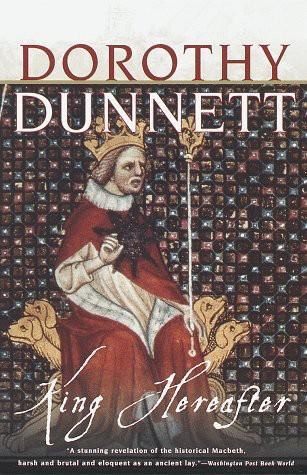


 I started teaching at Dalhousie in 1995-96, which means that 2014-15 will be my twentieth academic year at the university. What with maternity leaves and sabbaticals, that doesn’t mean 40 consecutive terms (though for many years I did also do summer teaching), but that’s still a long time to be in one place doing the same thing.
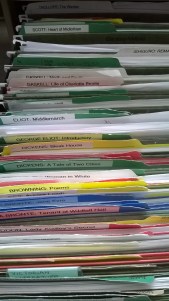 The other thing I have to show for my twenty years — something I benefit from every day I’m at work — is experience! It’s easy to forget, now, how new to all this I was in 1995-96. I was hired while still “ABD” (all but dissertation), and my hands-on teaching experience was limited to two of Cornell’s Freshman Writing Seminars (both capped — ah, luxury — at 17 students) and one stint as a TA (in a 19thC fiction class, too, because there were no first year writing classes big enough to use teaching assistants). The class on Browning’s “My Last Duchess” that I taught as part of my on-campus interview here was quite literally the first time I’d ever stood up in front of a room full of students (not to mention a back row of professors there to see how I did). So my first full-time term was really jumping into the deep end for me. I don’t recall any massive screw-ups beyond assigning way too much reading in my first section of Introduction to Literature and way too much writing in almost every class, because I had no idea how much time it would take to mark multiple papers for a class of 50 or 60. I had the time at first: I was keen to throw myself into a job I was excited about and knew I was lucky to have, and at first I had no children, either. But the hours and hours of marking … on top of having no files of teaching notes or materials to draw on, so absolutely every part of absolutely every class had to be prepared entirely from scratch. Good thing I was so young and energetic! (I was 28 when I came here, which means I was barely older than the first crop of graduate students I taught — in fact, now that I think back, I was actually younger than some of them.)
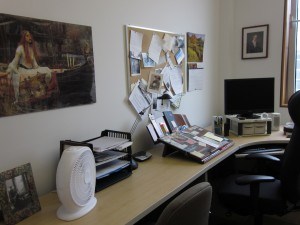
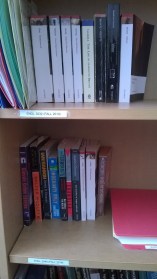 Another very simple thing I do is designate one shelf space for each course. Often coming back from class is a distracting time, with students tagging along for conferences or somewhere else to get to in a hurry, so I don’t have time to do fine sorting. Instead, I dump all the class material onto its shelf and organize it when I get my next chance — but in the meantime if I need to find a book or paper from it, my search is neatly delimited. Again, less scrambling! I have a pretty low tolerance for stress and confusion, so for me it’s well worth the little bit of forethought required. When I see offices with indistinguishable brown folders piled in heaps all over the place, I know that — while it must work for the office’s own occupant — I would be a nervous wreck by the end of a single day in there.


 The second full week of term has gone by already: it’s amazing how time seems to accelerate when things get busier. In both my classes we have moved from throat-clearing and context-setting to richer discussions about our readings: in The 19th-Century Novel from Austen to Dickens, we’ve wrapped up our work on Persuasion, and in Mystery and Detective Fiction we’ve got only one more class on The Moonstone. Starting the term with these two novels eases the transition from summer’s languors to fall’s stresses because both are so delightful. At least, I think so — and it seems as if a lot of students are enjoying them as well. Discussion in the Mystery class has been particularly good so far this term, especially considering it’s a big class (capped at 90), which can sometimes be inhibiting. I hope they keep putting their hands up!
 One thing I’ve been thinking about as our work gets underway, and as I contemplate my own non-teaching ambitions for this term, is trying to make the process as meaningful and rewarding as possible, shifting some emphasis away from the product — which for students is often the course credit or the grade, and for me is the finished piece of writing. I’ve been reading Donald Hall’s The Academic Self: An Owner’s Manual (thanks to




 Novel Readings
