‘Tis Aw a Muddle…or Is It?

I’ve been trying for a while to find a conceptual framework that will unify the various reading and writing activities I’ve been doing. The immediate, pragmatic motivation for bringing things into some kind of order is that it’s about time I applied for some research grant money to support those activities (and by “support,” I mean pretty basic stuff, like buying ink cartridges for my office printer or paying for research-related xeroxing, not to mention buying books, renewing memberships in professional associations, or upgrading my take-home computer equipment–all expenses that are not covered by my department or faculty). There is money to be had, internally and externally, but of course to get any of it you need to have a research project defined clearly enough to justify your demands. I have a couple of objections to this system. One of them is just to the principle of the thing: doing research is part of my job, so I’ve never understood why I have to scrounge up the money necessary to get it done. Another is to the inflationary effect of the grant application process. Except for the occasional conference trip, I don’t actually need much money–what I really need is time to think and read. In terms of funding, what I’d like is enough to cover the basics (cartridges, xeroxing, books) on an ongoing basis. I’d like to feel I can keep reading and thinking and looking things up and writing things until I reach a point at which I can’t express my ideas and findings adequately in short form but need the time and resources to produce a book that will do them justice. Instead, I have to start the process assuming I’m writing a book, because that’s the kind of project that gets grants. So I have to inflate the significance and scope of what I’m currently doing, and what I plan to do next, so that I can ask for enough money to get taken seriously. (SSHRC standard grants, for instance, now require a minimum budget of $7000, but we’re generally advised to ask for a lot more). Our main internal source of research funding clearly spells out in its terms that it is seed money for SSHRC-fundable projects, so it is also not hospitable to exploratory work, and it also rules out what it calls “basic research overhead,” which it declares is the responsibility of our departments and faculties. It doesn’t say exactly what counts as “basic research overhead,” but I’m thinking that category probably includes things like printing and xeroxing, and maybe books (which I know SSHRC used to refuse to pay for)–and it specifically excludes computer equipment. So some fancy footwork is required to explain one’s research needs in a way that will at once meet the approved criteria and actually provide the things one needs for one’s research. And, to get back to my main point, the whole thing has to be framed as an attempt to accomplish some clearly defined research endeavor…ideally, one that builds in some coherent way on past research accomplishments.

Of course, I have applied for research funding before, and I have used the resources I obtained responsibly and gotten things done–published, even. I haven’t made a successful SSHRC application yet; my one attempt (which, in retrospect, I admit was enthusiastic but naive in its presentation) was slapped down hard enough that I wasn’t very motivated to try again, though it’s interesting to me that I have, after all, gone on to do some key parts of the ‘program of research’ described in it, so it can’t have been altogether wrongheaded. The most recent internal money I got was to help me get the Broadview anthology taken care of. But now that’s all gone, and so is my last print cartridge and any remaining credits on my copy cards. So it’s time to go back and ask for some more. But for what?

My problem is (and I realize that I have brought it on myself by the choices I’ve been making about how to use my time) my attention has been increasingly diffused over the past couple of years. Instead of picking one critical problem and pursuing it consistently, I’ve been looking around at a lot of different things. Why have I been doing this? Well, for one thing, I can’t seem to bring into focus any one critical problem that feels urgent to me: I can’t find something to work on that seems truly necessary and exciting, and I’ve chosen to indulge–or respect–my weariness with the flood of academic microcontributions that has resulted from the incessant pressure to publish as soon as possible and as often as possible. I felt that academic scholarship tended too far away from the liveliness and urgency of literature and I wanted to look outside to see how non-academics talked about books, or how academics talked about books outside of ‘work’ that maybe had more mobility and potency. And the first thing to really hit me once I started looking around in this way was just how ignorant my own specialized research had made me. Behold, I knew not anything! Or at least not anything that anybody else was likely to take an interest in–or so it seemed.

This was the point at which I began a relatively systematic exploration of books about books, as well as books about the relationship between academic criticism and what we might call ‘public’ criticism. This was also the point at which I began taking more time writing blog posts and tentatively looking for a place for myself (small, no frills, just a corner of my own) in the wider world of book talk. It took me almost no time to realize that I am very poorly equipped to be a public intellectual: graduate training does not produce generalists, and life pre-tenure, not to mention life post-babies, does not make it any easier to broaden your reach. Still, my professional work has given me some equipment for analyzing books that aren’t Victorian novels, and it was both educational and fun to see how that might work. I have also written about academic issues and about my teaching, both exercises in mobilizing what I know in new ways. Along the way, I think I’ve done some decent thinking and writing. (I’ve written before about the intrinsic benefits of blogging; making connections with other readers and writers, academic and not, has been the very best part of this experiment so far.) I’ve also completed the Broadview anthology and puttered along with my inquiry into Ahdaf Soueif’s In the Eye of the Sun as an engagement with Middlemarch, so it isn’t as if I’ve been doing nothing but playing online. However, I do feel that I have fallen behind in my supposed area of specialization, because while I was looking the other way, the flood of new publications continued. Now I feel inadequate in two directions!

Overall, though, I’ve been doing so much reading and writing that it seems as if it must add up to something. So far, however, I just can’t see what. I can see a strong convergence between my metacritical inquiry into the nature of academic criticism and its alienation from the wider reading public, on the one hand, and my attempt (primarily through blogging) to find a different kind of criticism, though so far that attempt is not systematic or particularly ambitious. I can see links, too, between those issues and my work on 19th-century criticism (very much an activity of the public sphere). But I don’t really want to do a project about criticism so much as I want to do criticism differently…but it’s hard to see how to do writing about the literature I’m best prepared to write about (Victorian literature) in a non-academic way, because non-academic book talk seems (reasonably enough) preoccupied with contemporary writers about whom, and about whose contexts, I discover I am in many respects an amateur. So perhaps the Soueif project stands as a way of bringing 19th-century literature into a modern discussion because that is what Soueif herself does by taking Middlemarch as in some way her starting point?

Well, I’m not going to arrive at any answers tonight, and there may in fact be no answer that draws these different threads together. Maybe what I need to do for the grant application is articulate fully the interests and goals of the Soueif essay and never mind the rest. But I’d like to think there’s a point to the rest of it too. I’m also aware that exploring without a shaping purpose eventually becomes dilettantism, and I’m convinced of the importance of being earnest even without a research grant to strive for, so any time I can clear some mental space, I’ll think about it some more.

“Ruined by the Academics”: More on the Decline of Criticism

At The Guardian, John Sutherland adds to the chorus of lamentations about the death of literary criticism:

The UK has always had the world’s liveliest and most expansive lit-crit pages. A new book over here can hope for reviews in a dozen or more places in its first couple of weeks. It’s not just the (former) broadsheets, the nationals, the weeklies and the “heavies”. For my money, some of the fizziest reviews in London will be found in David Sexton’s Monday Evening Standard (always something pleasantly malicious), Private Eye’s “Bookworm” (where an anonymous DJ Taylor wields his assassin’s hatchet) and the Camden New Journal. (You don’t believe me? Pick up a copy next time you’re in NW1. It’s free.)

But this traditionally vibrant sector, with its myriad outlets, is on the wane. Terminally, it would seem. Pages are falling away, like leaves in autumn. They used, for example, to call the literary pages in the New Statesman “the back half”. Now it’s “the back sixth (in a good week)”. Why is lit-crit – as a main item in our cultural diet – going down the tubes?

Among the “hypothetical answers” he proposes to his own question, we get the familiar one, “blame the blogs” (“The most plausible explanation for hard-print lit-crit melting faster than the Arctic icecaps is flickering on the screen in front of you. . . .As literary pages have withered, literary blogs have bloomed”). And the “Emeritus Lord Northcliffe Professor of Modern English LIterature at University College London”* also blames “academics”–but not, as is more usual, because of jargon-bloated prose, incessant politicization, or refusal of evaluation. Sutherland argues, rather, that academics were discovered by literary editors to be cheap sources of labour, “that would write for pennies, had oodles of spare time and could spell”:

At the TLS party a couple of weeks ago, I overheard this paper’s senior political correspondent, Michael White, in conversation with the TLS editor, Peter Stothard. Having recently done a couple of pieces for Stothard’s journal, White asked – in evident perplexity – “Can anyone actually live on reviewing?” No, Stothard conceded. Staff journalists can, but not freelance reviewers. For pointy-headed profs, it doesn’t matter. Many would sell their children into slavery to pay for the privilege of a lead piece in, say, the Saturday Guardian Review. Unfortunately, excellent value (ie dirt cheap) as they are, academic reviewers come with heavy baggage. They can be dull. Really dull.

How unfair–one of my children, at most, at least for the Guardian Review. (For the TLS, on the other hand . . .) And my head’s not really that pointy. And I’m not dull. Well, rarely. OK, define “dull.” Does going on and on about Trollope qualify?

Meanwhile, Chris Routledge at The Reader Online points out a recent Guardian feature that once again pits bloggers against critics:

It appears that consumers no longer feel the need to obtain their opinions from on high: the authority of the critic, derived from their paid position on a newspaper, is diminished. Opinion has been democratised. . . .The advent of the net has been described as a revolution. If so, one of its most heated battles is being fought over the right to claim expertise. In the US the ancien régime, in this case the salaried critic, appears to be in retreat. The question is what will happen here? We need only look at television criticism, a once-noble calling pursued for this newspaper by both Julian Barnes and Clive James, for clues. In May the Daily Telegraph decided it no longer needed a daily TV review. Regular TV reviews have also gone at the Daily Mail, Mail on Sunday and London’s Evening Standard. Could the same happen to other arts?

The British critical tradition is long and rich and deep: from the pamphleteering of Joseph Addison and Richard Steele in the early 18th century, through the literary criticism of Oscar Wilde in the 19th to Graham Greene’s film reviews and Kenneth Tynan’s first-night theatre notices in the 20th, we have never been short of confident people to tell us what is good and what is not and why.

‘We have a wonderful tradition of criticism in this country,’ says Brian Sewell, art critic of the Evening Standard for nearly 25 years, ‘and it would be a tragedy if we lost it. The onlooker sees most. We are the skilled onlookers.’

Such discussions have been going on for a while now; I think Chris is entirely right when he says,

I can’t help feeling that this is a non-argument. Either ‘old media’ will ‘get’ the Internet or it won’t (as it happens I think The Guardian/Observer does). It’s more likely to end up being about what the words are printed on than it is about who wrote them and why.

The problem is not one of form; it’s one of filtering. It takes time, patience, diligence, and discernment to distinguish among the vast number of blogs offering criticism and commentary of one kind or another; the challenge is that there’s no established review process to create evaluative hierarchies or provide qualitative guidance (no, Google Blog Search does not count). But, as many have pointed out, it’s not as if there aren’t trashy print publications too, some of which sell millions of copies. Sure, it is discouraging to read ignorant nonsense parading around as serious criticism, but the best response seems to me to encourage what Sewell, above, calls “skilled onlookers” to show the value of their expertise, not to encourage a seige mentality. And, of course, many print publications are in the blogging game now, including The New York Times and the TLS. It was never an either/or option.


*from the author blurb on How to Read a Novel

The Death of the Critic, Reprise

Bill Benzon kindly pointed out this Salon piece to me:

Louis Bayard: The signs are ominous, Laura. Book reviews are closing shop or drastically scaling back inventory. Film critics at newspapers all over America are getting tossed on their ears. TV reviewers are heard no more in the land. All the indicators suggest that America’s critics are becoming an increasingly endangered species.

Or maybe something a little more than endangered, judging from the title that’s just come across our desks: “The Death of the Critic.” Ronan McDonald, the author, is a lecturer in English and American studies at Britain’s University of Reading, and he’s particularly exercised by what he sees as the loss of the “public critic,” someone with “the authority to shape public taste.” It’s only in the final chapter that the mystery behind the critic’s disappearance is solved. The culprit is none other than … cultural studies! (With a healthy assist from poststructuralism.) By treating literature as an impersonal text from which any manner of political meaning can be wrung, cultural studies professors have robbed criticism of its proper evaluative function — the right to say this is good, this isn’t, and here’s why.

So, Laura, it seems that, if we aren’t quite dead, we critics are on something like life support.

Laura Miller: I suppose it’s only natural that McDonald, being an academic himself, would blame the academy. He believes that substantive scholarly criticism acts as a foundation for serious non-scholarly criticism — such as reviews and essays in newspapers and magazines — lending credibility to the idea that criticism (specifically, literary criticism) is a job for trained experts. When academia falls down on the job of, as you put it, saying what’s good and what’s not, then all criticism starts to look arbitrary and dispensable. We don’t have celebrated “public critics” now because critics don’t care about the public, not because the public doesn’t care about critics. What do you think: Is criticism responsible for its own demise?

I didn’t see any great revelations in their discussion, but there are some good moments. Here’s one I liked:


Bayard: I like that phrase “go home with” because, when I think about the critics I love the most, they’re not necessarily the ones I agree with, they’re the ones I’d like to date. I argue with them, but when they’re gone, their music is still bopping around in my brain. Many years ago, Susan Sontag, in “Against Interpretation,” argued for “an erotics of art.” Is it time now for an erotics of criticism? Instead of bemoaning the decline of literature, should we be doing a better job of showing people what they’re missing: the excitement of unexpected insights, the thrill of new voices, the sex of ideas? That sounds like a lot more fun than figuring out which fiefdom we’re going to defend in the Theory Wars. (I’ve a hunch Ronan McDonald would be on our side.)

Miller: You’re right! Why pillory theory, when even the people who used to espouse it are saying it’s dead? Let’s talk about what makes for a good critic. I often think that there are two kinds: the ones whose taste I find simpatico — the ones I come to for recommendations on what to read — and the ones who are themselves terrific writers, irrespective of what they recommend. Sometimes there’s an overlap, but not often.

There are critics, like Wood, that I go out of my way to read, although I have no intention of ever opening the books they tout. That’s indicative of an additional aspect to criticism besides evaluation (which McDonald wants to bring back to academic criticism) and interpretation (that is, elucidating the work and its many meanings, which we could use more of in journalistic criticism). It’s the literary worth of the criticism in and of itself, and the chance to see a sophisticated reader at work.

Yes: “the chance to see a sophisticated reader at work”–that sums up a lot of the pleasure I too take in reading James Wood. And they also offer a couple of unusually reasonable remarks on the usual straw targets, bloggers and English professors:


Bayard: Yeah, the blogosphere is the elephant in the room that McDonald never really gets round to discussing, but to my mind, it’s a far more pressing issue for criticism than theory is. Why pay a professional critic to evaluate something when you have a gazillion volunteer evaluators ready to fire off at any given moment? . . . I myself don’t have any particular training or qualifications to be a reviewer, other than my own experience as a reader and writer, so I feel silly arguing that someone else isn’t qualified to deliver an opinion. And believe it or not, I’ve learned things from Amazon reviews, from letters pages, from literary blogs, from all sorts of non-traditional outlets. The quality of writing is certainly variable, but then so is the quality of traditional journalism. [that “believe it or not” seems gratuitous –why should it be hard to believe?]

and

Miller: . . . It hardly matters whether or not an English professor actually likes to read novels and poetry, does it? Books are the salt mine, and the academics are the miners. If anything, literary enthusiasm can be a detriment if your job is to prosecute books for their ideological crimes. When even English professors won’t stand up for literature, is it any wonder it’s failing? [Sigh!]

But in reply, Bayard: Well, it’s been a while since I was in college, but I do remember professors who loved English literature every bit as much as I do, so I don’t want to tar the whole profession out of hand. [Whew! Because I’m pretty sure some other people would be right there with feathers to finish the job!]

I wrote up some thoughts of my own about McDonald’s book here. McDonald and I share an interest in reviving the role of the “public critic,” but I can’t quite get on board with his emphasis on evaluation as the necessary method. I give some reasons for that here, in response to an inquiry from Nigel Beale–and, more facetiously, here!

Blogging, Criticism, Reviewing

A recent discussion at The Reading Experience raises questions related to some I have raised before here and have been thinking about a lot again as I try to imagine how best to direct the energy I have put into blogging–issues such as whether ‘litblogging’ is at its best when used as a form of literary journalism or reviewing (focusing on the new), what kind of writing about ‘classic’ or old literature has appeal or relevance to modern readers, whether (or how) blogging can also serve as a medium for popularizing or making literary expertise accessible, or whether there really is any comfortable middle ground between academic specialization and standards and the interests and habits of common readers. From Dan’s original post:

What the litblogosphere promises to offer is the possibility of multiple sources of well-supported reviews and commentary (many more than have been available in print publications, whose numbers are only continuing to decline, anyway), which can only enrich the discussion of current fiction (and poetry) and in turn encourage writers to believe their work is getting serious attention.

And from the comments that followed (all are excerpts; other comments also appear in the original thread):

Which is precisely why I grumble over the fact that an awful lot of Litcritbloggage (not the majority, probably, but a worry-worthy chunk) seems wasted on texts long-established in reputation (and thoroughly colonized by academics; in some cases for centuries), not to mention being relatively impervious to casual analysis. (Steve Augustine)

But has it ever occurred to you that people who blog about texts that are “long-established in reputation” do so because they are new to them? Because they didn’t read them in school? And that the odds that they have been exposed to much of the critical apparatus is rather small? Are you suggesting that one should first read all the extant literature before deciding whether something ought to be blogged? (Richard)

Bloggers discover as we discover (not everyone’s put paid to the canon the way you have); their essential charm (I think it’s charming) is that they flatten the mountaintop elevating the critic-priest above the rabble and allow us to watch them form and respond to ideas. In other words, their discovery of Austen or James at the age of X is crucial to *them*, if not to us, it provides answers to questions *they’ve* wondered about, fills holes in *their* knowledge that they (well, some of them) are happy to admit to having had. I don’t think it’s necessarily a critical form, I think it’s often a form of self-expression, and I suppose that to gripe about someone’s preoccupation with Thomas Hardy when there’s so little attention going to Jerome Charyn is to cast that someone in a role they haven’t sought out. (Chris)

I find classics blogging among “serious” litbloggers (ie, those positioning themselves to take the baton when periodical print collapses) relatively useless; not because of the medium, but because there are already metric tons of readily accessible critical analysis of Shakespeare, Homer, you name it, in print. Seeing centuries-old opinions on Hamlet rehashed (or mutilated) online in a not-entirely-serious fashion doesn’t float my boat. If I have to read civilian (non-academic) takes on Hamlet, I prefer to read something that Anthony Burgess or Victor Pritchett or George Steiner sweated over for weeks or months… otherwise, the results are fairly back-to-High-Schoolish…I’d just like to see more critical litbloggers who take themselves seriously step up to the plate and provide more of the kind of content that *really can* give the best of what we called “print” (past tense because I’m thinking of a Golden Age) a run for its money… (Steve Augustine again)

I certainly agree with those who don’t think there’s any call to be prescriptive about these issues: individual motives for writing and reading blogs vary widely, and the distinctive features of the form are precisely its accessibility to all (internet-connected) people and its adaptability to all voices, styles, and agendas. The questions I raise above, then, really have to do with my own interests and aspirations as a blogger and a critic: what can or should I in particular be writing out here, particularly if I want to identify this blog as part of my professional work in more than a very peripheral way? I’m not an expert on, or even an avid reader of, contemporary fiction, particularly of the more experimental kind for which Dan Green is such a persistent advocate. I can contribute only as an amateur reviewer, then, where new releases are concerned, and while I enjoy writing up comments on my recent reading and sometimes feel I have found something of interest to say, I can’t afford the time (and lack much incentive) to turn these posts into genuine thought-pieces. I’m in a better position to talk knowledgeably about Victorian fiction, but Steve is certainly right that there are “metric tons of readily accessible critical analysis” on all the classic texts, including any on which I feel qualified to opine. So here my contributions will be better-informed, but they are not likely to be especially original–meaning the key issue becomes purpose and audience. If I aim for the kind of originality necessary for a scholarly publication, I’ll be back to writing esoterica for fellow academics, and the claustrophobia that practice induced was what drove me to the blogosphere in the first place. But is it any more useful or productive–any more of a contribution to literary understanding–to add my own 2-cents worth to what’s already available to a general reader (including on the internet) about Middlemarch or Jane Eyre? Someone like Michael Dirda or James Wood has the ‘street cred’ (or market appeal) to do this (though I’m currently reading Dirda’s Classics for Pleasure and I think the same questions could quite reasonably be asked about the need for or value of his contribution as well). I think a key point, made by a couple of the comments quoted above, is that the classics are in fact new to everyone at some point, so there is genuine pedagogical value in critical material that helps them make the most of their reading experiences. In the classroom (or in the right internet context) there’s always a good reason to explain (again) ways of reading and thinking about Middlemarch

I realize that this is to put a fairly solipsistic spin on a more abstract discussion. But, hey, this is my blog, after all! Here are earlier some of the versions of this semi-internal debate, showing that, after over a year of blogging (and blog-reading), I have not moved very far ahead on these questions:

Literary journalism differs from literary criticism, it is usually assumed, in being prompted by an occasion needing a fairly prompt response to give it relevance. Criticism takes more of a long view. But without that occasion, that immediacy, what appeal does criticism have for the non-academic reader, especially in a medium like the internet? Is there an audience online for writing about Dickens or George Eliot? And what could be said that would matter, or appeal? The kind of stuff that gets written for academic audiences apparently (unsurprisingly) alienates almost everyone else, while the kind of stuff that gets written for popular audiences often seems trivial or redundant to those who read the academic stuff. And yet…books such as John Sutherland’s How to Read a Novel or Francine Prose’s Reading Like a Writer do get published, so there is presumably some interest out there in enhancing one’s experience of reading “the classics.” One approach might be to look for the contemporary relevance in past authors, as I attempted to do with my paper on George Eliot as “Moralist for the 21st Century.” But that means only highlighting authors and texts that lend themselves to modern purposes, which gets pretty tendentious and unsatisfactory pretty fast. (“The Occasion for Blogging,” May 24, 2007)

Of course, when past works are the ones at issue, there’s presumably no longer any question of reviewing them–or is there? Actually, that’s an interesting question, and one linked to my ongoing musings about the potential role of something like a blog in my own work. How or why could writing about a ‘classic’ be relevant, useful, desirable to a contemporary audience? I still hold to the fairly simple distinction that reviewing is a form of literary journalism that requires a specific occasion as an incentive, while criticism has more abstract (longitudinal?) interests. (“More on the Purpose of Criticism,” June 20, 2007)

The high degree of specialization in academia is one of the main reasons academic research is not particularly accessible, never mind interesting, to broad audiences. My own interest in blogging is motivated largely by a desire to escape or redefine the limits of specialization, not to reproduce them in an alternative medium. Cohen’s account of what makes a blog successful exacerbates my ongoing concern, though, that there’s not much point competing with thousands of other blogs for readers’ attention unless your own site offers something distinctive, some angle or attitude they can’t find anywhere else. To use my own blog as an example, I enjoy writing up my latest reading and I find it useful posting about subjects related to my embryonic project on ‘writing for readers,’ but if my ultimate goal is to provide something that will, in Cohen’s words, “frame discussions on a topic and point to resources of value,” I’m going to need to narrow, or at least define, my focus–ideally, in a way that still satisfies my desire to get out of the ivory tower and into a wider conversation. (“Professors, Start Your Blogs…,” July 18, 2007)

One aspect of this situation that I’ve been thinking about is the tension between generalization and specialization that academic blogs perhaps illustrate. It’s difficult to provoke comments on a specialized topic, except from other specialists. Non-specialists may be interested in reading or using your material, but they are unlikely to add to it. (I’m thinking, for instance, of the posts on The Little Professor about Victorian anti-Catholic texts: this is just not a topic on which many people can, or would, chime in, though now I know where to go if I want to learn something about them.) But if your offerings are general enough to interest a lot of people, they may lose their value in establishing a community of expertise, or in contributing to the development of your professional work. . . . Further to that last point, I’m starting to notice a divide in blogging between two kinds of literary sites, which I would roughly divide into ‘bookish’ and ‘academic’–and the academic ones really don’t seem that literary, in the sense of talking about, well, literature, as opposed to politics, philosophy, theory, and criticism. (I know, I know: talking about literature always involves politics, philosophy, and theory, etc….) I ‘m thinking especially at this point of The Valve, subtitled ‘A Literary Organ,’ after all. The bookish ones seem quite contemporary in their focus, so for those of us who spend most of our time reading loose baggy monsters from the 19th century, well, once again but for different reasons, we aren’t really equipped to jump in–and there too, I don’t see that much discussion, to return to my first point. (“If a Blog Falls in the Forest,” October 22, 2007)

Critical Questions: James Wood, How Fiction Works

woodThe dust jacket describes How Fiction Works as Wood’s “first full-length book of criticism.” Anyone led by this blurb to expect sustained analysis supported by extensive research and illustration will be disappointed, as in fact How Fiction Works turns out to be essentially a ‘commonplace book,’ a collection of critical observations and insights of varying degrees of originality and sophistication, developed with varying degrees of care and detail. Wood acknowledges having set deliberate limits on his project, likening it in his introduction to Forster’s Aspects of the Novel, proposing to offer practical “writer’s anwers” to “a critic’s questions,” and admitting (though with no tone of apology) that he used only “the books at hand in [his] study.”

To some extent I agree with other reviewers who consider it only fair to evaluate the book Wood wrote, rather than regretting he didn’t write another one. Yet even within the parameters Wood sets, I think there are grounds for wishing he, with his exceptional gifts and qualifications as both reader and critic, had not sold himself (or us) short in fulfilling them. Further, beginning with the invocation of Forster but going well beyond it, the book has pretensions to grandeur: for instance, also in his introduction Wood remarks that Barthes and Shklovsky “come to conclusions about the novel that seem to me interesting but wrong-headed, and this book conducts a sustained argument with them” (2). With gestures such as this, Wood claims an elevated stature for his critical contribution that is undermined by its casual construction and over-confident approach to scholarship. Though How Fiction Works provides many further proofs of Wood’s critical gifts and considerable erudition, I think it also proves that even the best practical critic flounders when working only with what he has already to hand or in mind.

Right off the bat I was irritated by the book’s structure. Wood has said that he felt liberated by using the numbered “paragraphs” or sections, but allowing yourself to skip from thought to thought in this way means letting yourself off the hook too often. Frequently in the margins of my students’ work I write “And so? Finish the thought!” One effect of crafting, first paragraphs, and then longer pieces as sustained wholes is that in working out the overall movement of your ideas and building in appropriately specific transitions, you confront both the logic and the further implications of your claims: the form pressures you to think better. Numbered bits, however, relieve that pressure: you can just stop with one topic and start the next, and as long as they are more or less related, you can claim to be producing a unified whole, even if you are only papering over gaps.

wood-10In How Fiction Works, the breaks often seem unnecessary: a new number sets off what is really just the next sentence in the idea already unfolding. Most of the time, however, they are substitutes for careful transitions. They allow a certain stream-of-consciousness effect to creep in: that last bit reminds me of this exception to a general principle, or of a writer who also does that, or of another favourite excerpt, or of a time I went to a concert with my wife. Well, OK, I guess, and no doubt it would have been much more difficult to do a coherent chapter offering a theory of, say, fictional character, realism, or morality and the novel. And I suppose it’s true that non-academic readers don’t want the kind of detail and complexity such a full account of these topics would require. Even so, the numbered bits felt lazy to me. The footnotes too had an aimlessness about them. Some of them covered ideas or examples that seemed no less important to their chapter than most of the bits allowed their own numbered section (note 53 on p. 150, to give one example) while others appeared entirely unnecessary to the book (note 40 on p. 121, or note 41 on p. 124, for instance).
The TLS reviewer objects to Wood’s “grace notes”: “It is sometimes hard to distinguish a gasp of admiration for another’s skill from the contented sigh when the books in one’s study satisfy one’s own theories.” I shared this reaction, not least because “how fine that is” (139) is an expression of taste, not criticism. But Wood is a compelling reader of details, even passages. It’s when he makes broader assertions that he leaves himself more open to objections. For one thing, he has some governing assumptions about what fiction is for that he treats as universal rather than historically or theoretically specific. In his chapter on “Sympathy and Complexity,” for instance, as a footnote to his remarks on fiction as a means of extending our sympathies (the occasion for one of his shockingly few references to George Eliot!), he adds this:

We don’t read in order to benefit in this way from fiction. We read fiction because it pleases us, moves us, is beautiful, and so on,–because it is alive and we are alive. (129)

Well, maybe, but not everybody, and not all the time: for instance, most of the Victorian critics I have been editing for my Broadview anthology would not have recognized this highly aestheticized motive for novel reading. Is it fair, or even sensible, to say that they were simply wrong? Or to ignore how the formal developments of the Victorian novel furthered ends not adequately respected by Wood’s post-Jamesian formulations? His is in many respects a teleological account of the history of the novel. “Progress!” he exclaims after a quotation from Proust: “In Fielding and Defoe, even in the much richer Cervantes, revelation of this altering kind occurs at the level of plot” (125). But were Fielding and Defoe trying to do what Proust did and failing? How much better we might understand them if we allow them what James calls their “donnee. “It is subtlety that matters,” he declares in his chapter on character; “subtlety of analysis, of inquiry, of concern, of felt pressure”: “I learn more about the consciousness of the soldier in Chekhov’s The Kiss than I do about the consciousness of Becky Sharpe [sic] in Vanity Fair.”

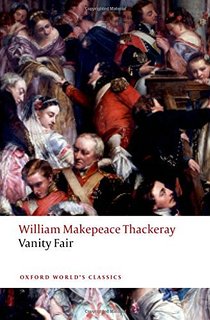
vanityfairoupBut Becky Sharp’s consciousness is surely not the point of Vanity Fair; indeed, I argue in my own lectures that too close a focus on Becky risks diverting us from Thackeray’s grand gesture of holding the mirror up to ourselves, so that the novel becomes an opportunity for us to reflect on our own morality and mortality. “Was she guilty or not?” the narrator asks–and, remarkably, will not tell us, because ultimately she is not the point but the occasion, the device. Thackeray is not a failed Chekhov any more than Dickens is a failed Flaubert. To Wood, “the history of the novel can be told as the development of free indirect style” (58), but that history is partial and often distorting. (About the operations of free indirect discourse and the importance of knowing who ‘owns’ which words, on the other hand, Wood is typically astute. Here’s one place where examples from Middlemarch would have served him well, though at the risk of undermining his generalizations. Consider this passage from Chapter 1, for instance:
And how should Dorothea not marry? — a girl so handsome and with such prospects? Nothing could hinder it but her love of extremes, and her insistence on regulating life according to notions which might cause a wary man to hesitate before he made her an offer, or even might lead her at last to refuse all offers. A young lady of some birth and fortune, who knelt suddenly down on a brick floor by the side of a sick laborer and prayed fervidly as if she thought herself living in the time of the Apostles — who had strange whims of fasting like a Papist, and of sitting up at night to read old theological books! Such a wife might awaken you some fine morning with a new scheme for the application of her income which would interfere with political economy and the keeping of saddle-horses: a man would naturally think twice before he risked himself in such fellowship. Women were expected to have weak opinions; but the great safeguard of society and of domestic life was, that opinions were not acted on. Sane people did what their neighbors did, so that if any lunatics were at large, one might know and avoid them.

Think how much is lost on a reader who improperly identifies the source of that word “naturally”–or the last two sentences altogether!)

Wood is good on the telling detail as well and the quality he calls “thisness”: “any detail that draws abstraction towards itself and seems to kill that abstraction with a puff of palpability” (54). But again, when he moves into prescription, he becomes less persuasive, as when he objects to the “layer of gratuitous detail” in 19th-century realist fiction. Again, the challenge is in defining “gratuitous” (as, clearly, Wood himself is well aware), but he can’t propose any principle except, perhaps, his idea that “insignificant” details avoid irrelevance if they are “significantly insignificant” (68). After recounting an incident in which he and his wife had “invented entirely different readings” of a violinist’s frown at a concert, he claims that a “good novelist would have let that frown alone, and would have let our revealing comments alone, too: no need to smother this little scene in explanation” (72). Again, well, maybe. I can imagine at least one “good novelist” who might have done great things with their “different readings” of that little moment, perhaps even using their “revealing comments” as a chance to reveal even more about perception and reality as well as human relationships (“these things are a parable…”). Doesn’t it depend on what your novel is about and on the formal methods you are using to realize those goals?

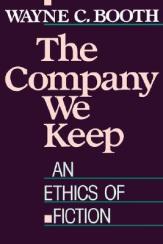
boothcompanyI’d like to return before I close to the “Sympathy and Complexity” chapter, because this is a topic close to my heart, one on which I have spent a lot of my own critical energy recently, and one I expected Wood to handle particularly well. “Perfunctory” is the best word I can think of to describe it. I’ve mentioned already his dehistoricizing assumption that “we” don’t read in order to receive moral benefits. I doubt this is true in practice, and I also question the separation he implies between moral and aesthetic readings. Here is a case in which even a little research outside “the books at hand in [his] own study” would have immeasurably enriched his discussion: Booth’s The Company We Keep, for instance, would have helped him complicate exactly that separation. And the conversation about how fiction might do “what [Bernard] Williams wanted moral philosophy to do” (135) has many participants besides Williams (Martha Nussbaum comes promptly to mind!). Further, not all novels avoid providing “philosophical answers” (here, he replicates Nussbam’s error in generalizing about “the novel,” but as a professional novel reader, he should know better). Here the hybrid character of How Fiction Works proves a genuine weakness, I think. This chapter is not a full, responsible, or authoritative inquiry into its subject. Of course, it does not pretend to be (remember, the book promises only “a writer’s answers” to “a critic’s questions”). But then how should we evaluate it? Doesn’t Wood do even his non-specialist audience a disservice by taking up complicated subjects on which there already exists a rich body of scholarship and offering his own fairly casual observations with the confidence of real expertise? What a much greater contribution it would be to distill that complex material and present it accessibly! To grab what’s at hand and say just what comes to mind bespeaks an enviable but also problematic degree of confidence. And while the non-expert reader is in no position to object, the expert reader is easily deflected with the excuse that she is not the intended audience…

After I read How Fiction Works I re-read some of my collection of Wood’s essays, including his reviews of Never Let Me Go, Saturday, and Brick Lane. This is really wonderful stuff, as I have remarked before; I admire it wholeheartedly for its critical acuity, its literary elegance, and its moral seriousness. But considering How Fiction Works strictly as one among many books about books (and Wood is wrong, or perhaps disingenuous, when he says “there are surprisingly few books” of this kind about fiction [1]), I think there are many better choices available. I continue to recommend David Lodge’s The Art of Fiction, for instance, which takes up many of the same topics as Wood, though under a less grandiose umbrella of prescriptive claims. I think it’s an exciting development that Wood has landed a job in Harvard’s English Department. In taking this now unconventional route from journalism to the academy, he is following in the footsteps of many eminent Victorian critics (David Masson, for instance). But considering how bitterly difficult it is for those following the established professional route to land any academic job at all, it’s frustrating to think that he may not be held to anything like the same standard of rigour as many critics far less lauded and applauded. Here’s hoping that he has more books in him as good as The Broken Estate.

Francine Prose, Reading Like a Writer

This book has a simple premise–that the best way for aspiring writers to learn their craft is to read (closely, attentively, alertly, appreciatively) the work of other novelists. Prose proceeds to elaborate on what she sees as the pedagogical benefit of close reading by moving through a sequence of chapters addressing specific aspects of novel-writing, each illustrated with examples from writers she admires. Her intended audience is primarily creative writing students; she offers her close-reading approach as a counter-balance to what she describes as the fundamentally negative tactics of writing workshops: “Though it also doles out praise, the writing workshop most often focuses on what a writer has done wrong, what needs to be fixed, cut, or augmented. Whereas reading a masterpiece can inspire us by showing us how a writer does something brilliantly” (11). I’m not in a position to evaluate how well either strategy would work for someone trying to produce an original work of fiction, though it does seem to me that Prose’s emphasis on writing as a craft that presents technical challenges needing to be acknowledged and worked through intellectually (rather than transcended through inspiration) is probably useful.

Prose’s subtitle (“A Guide for People Who Love Books and for Those Who Want to Write Them”) suggests that she also hopes to appeal to and help out avid readers (the same ones who might pick up Smiley’s Thirteen Ways of Looking at a Novel or Sutherland’s How to Read a Novel. It may be this hope that leads Prose to avoid most specialized vocabulary. For instance, in her chapter on narration, she acknowledges briefly that there are types of narrators (“should the narrator be first or third person, close or omniscient?” [85]) but does not explain in any systematic way just what these options are or that they are not exhaustive. As a result, her discussion of examples tends towards the impressionistic, rather than the analytical; she often seems to take for granted, too, that her reader will recognize the qualities she admires or finds effective, that she does not need to explain or justify her praise or her interpretation. Here is some of her commentary on a long quotation from Richard Price’s Freedomland:

Everything in the paragraph contributes to the speaker’s credibility, as a fictional character and as an honest human being: the diction, the rhythms, the slight repetitions for emphasis, the way that the tenses keep shifting from present to past and back. The choice of words and phrases (“used to like his cocktails,” “never raised a hand,” “passed on”) make us feel that this is how this woman might really recount an incident from her life. The language, the story itself, the specificity of the details (Jimmy Durante singing “September Song”) convince us that the woman is telling the truth. (91)

I can tell that she is convinced, but she has not explained the basis of her conviction to me in a persuasive or useful way. What aspects of the speaker’s diction are indicative of credibility and honesty? Why should including specific details convince us that someone is telling the truth? What are the signposts of unreliability?

I was also concerned at times about the qualities of Prose’s own reading. In some cases, she seemed to me an unduly trusting reader. Here’s some of her commentary on the opening scene of Pride and Prejudice, for example:

Lest we receive a skewed or harsh impression of the Bennets’ own marriage, Mr. Bennet compliments his wife by suggesting that she is as handsome as their daughters. In fact, as we are discovering, theirs is a harmonious union, and indeed the whole conversation, with its intimacy, its gentle teasing, and with Mr. Bennet’s joking reference to his old friendship with his wife’s nerves, is a double portrait of a happy couple. (127)

Well, maybe, and the same needs to be said about her confidence in Nelly Dean as “the most credible witness” in Wuthering Heights. But she writes well about the significance of details (they “aren’t only the building blocks with which a story is put together, they’re also clues to something deeper, keys not merely to our subconscious but to our historical moment” [207].

I think that what struck me as weaknesses in the book, particularly in its analysis of particular examples, come at least in part from Prose’s own deliberate distancing of herself from academic approaches to literature. “Only once,” she tells us in her account of her own development as a writer,

did my passion for reading steer me in the wrong direction, and that was when I let it persuade me to go to graduate school. There, I soon realized that my love for books was unshared by many of my classmates and professors. I found it hard to understand what they did love, exactly, and this gave me an anxious shiver that would later seem like a warning about what would happen to the teaching of literature over the decade or so after I dropped out of my Ph.D. program. That was when literary academia split into warring camps of deconstructionists, Marxists, feminists, and so forth, all battling for the right to tell students that they were reading “texts” in which ideas and politics trumped what the writer had actually written. (8)

I have written before on this blog about my own frustrations with aspects of “literary academia,” but I have also resisted (even resented) this kind of dismissive attitude to scholarly and theoretical expertise. It is possible to turn such expertise (including attention to ideas and politics) precisely to understanding “what the writer had actually written,” and the result will be a better, fuller reading–and thus, if Prose’s own pedagogical theory is correct, better new books.


Criticism as ‘Coduction’

I have remarked a couple of times that Wayne Booth‘s idea of ‘coduction’ seems to me to capture something important about the way thoughtful literary criticism unfolds. I was reminded of this yet again reading Dan Green’s lastest posting on the ethics of book reviewing, in which he proposes that any review that aspires to the status of criticism must take into account what other reviewers have said. As discussed in my previous post, one distinction between reviewing and criticism is that the critic may be aiming at explication rather than evaluation, while the main expectation most of us have of a review is that it will culminate in and justify a judgment. I think Booth would argue that criticism is always at least implicitly judgmental. In any case, here’s some of what he says about the process by which “we arrive at our sense of value in narratives”:

Even in my first intuition of ‘this new one,’ whether a story or a person, I see it against a backdrop of my long personal history of untraceably complex experiences of other stories and persons. Thus my initial acquaintance is comparative even when I do not think of comparisons. If I then converse with others about their impressions–if, that is, I move toward a public ‘criticism’–the primary intuition (with its implicit acknowledgment of value) can be altered in at least three ways: it can become conscious and more consciously comparative…; it can become less dependent on my private experience…; and it can be related to principles and norms…. Every appraisal of a narrative is implicitly a comparison between the always complex experience we have had in its presence and what we have known before. (The Company We Keep, pp. 70-71)

It’s not that the ‘primary intuition’ (especially of a reader with an already rich ‘personal history’ of literature and criticism) is invalid; it’s that putting that intuition into dialogue with other ideas enriches it and complicates it, and makes it better–more “serious,” to use Green’s word.

Just as a bit of an aside, this idea that criticism is not finite or absolute but always in process, part of an ongoing conversation, is what makes a medium such as a blog seem appropriate for it. Conventional academic publishing inhibits any real exchange of views, first because its pace is so unbelievably slow that by the time anything you write appears in print you can barely remember what you said or why you said it, and second because you have to at least sound as if you think what you’ve said is definitive. Hardly anybody reads most academic criticism, either, even within the academy (half the time it seems the real audience is the person who reads only the title, on your cv…).

More on the Purpose of Criticism

Some time ago I posted some thoughts on Cynthia Ozick’s Harper’s essay “Literary Entrails” (see “Academic Criticism Criticized”). Belatedly, I notice that there was a good posting in response to it at Scott Esposito’s Conversational Reading which concludes that “Ozick’s better criticism . . . would add another reason to read, a further way to engage a book once it had been closed and to continually re-think and re-evaluate books that have been around for a while. This might not bring any new readers into the fold, but it might make better readers out of those who already do so. Over time, I think that would make books better for everyone.” I like the idea that the critic’s role is to keep us engaged and to encourage us to “re-think and re-evaluate” what we have read; as both this author and Ozick emphasize, the pace of reviewing can be too hasty to allow for a “slower, more contemplative critical approach to literature.” For myself, I have been finding it exhausting trying to keep pace at all with the texts and topics addressed in litblogs and literary journals: I’m starting to look forward to the start of the teaching term in September because I will be back to worrying obsessively over a small handful of books, and to feel grateful for “the canon,” however unstable or elastic its definition, if only because the very idea of a canon implies that there is no obligation to pay attention to everything!

Meanwhile, at The Reading Experience, Dan Green has some good things to say about the distinction between reviewing and criticism: “The essential task of criticism is not to evaluate fiction. It is an essential task of reviewing, but criticism can take place entirely outside the context of judgment and evaluation, or at least it can take place in a context that assumes evaluation and judgment have already taken place. Some of the best criticism attempts not to argue for the merits of a particular work but to describe and analyze a work the critic already values and wants to “read” more closely. Sometimes this results in convincing readers of the quality of the work, but doing that has not been the critic’s primary task.” I like to think in terms of appreciation rather than evaluation, because it sidelines the issue of taste. I can appreciate a work of fiction for being artful, well-crafted, original, historically significant, etc. without actually liking it (Pamela, anyone?). Yet I am unlikely to devote a lot of critical time (or classroom time) to any text that I am not personally convinced has value, whether artistic, intellectual, social, or some combination. We value different books for different reasons, after all. I’m not sure I’d want to convince anyone of the quality of, say, Gaskell’s Mary Barton, though I enjoy reading and teaching it and consider it an important example of Victorian social problem fiction. On the other hand, I find I am prepared to expend a great deal of energy convincing people of the value of Bleak House or Middlemarch! Of course, when past works are the ones at issue, there’s presumably no longer any question of reviewing them–or is there? Actually, that’s an interesting question, and one linked to my ongoing musings about the potential role of something like a blog in my own work. How or why could writing about a ‘classic’ be relevant, useful, desirable to a contemporary audience? I still hold to the fairly simple distinction that reviewing is a form of literary journalism that requires a specific occasion as an incentive, while criticism has more abstract (longitudinal?) interests. In any case, I like Green’s comment that criticism is “a way of paying attention and of perhaps assisting others in the effort to pay closer attention.” Like the comments at Conversational Reading, this one reminds me of Booth’s idea of “coduction,” which seems to me an excellent model of the way our judgments of literature are in fact formed and reformed.

Blogging Reservations

Today’s New York Sun includes a short piece by Adam Kirsh on The Scorn of the Literary Blog. Kirsh is mostly writing about the much-noted rivalry between “professional” reviewers and literary bloggers, in the context of the also much-noted decline of book sections in print journalism. I don’t have much to say about these broader contexts, but I am interested in Kirsh’s remarks on the limitations of blogging as a form of literary criticism:

The blog form, that miscellany of observations, opinions, and links, is not well-suited to writing about literature, and it is no coincidence that there is no literary blogger with the audience and influence of the top political bloggers. For one thing, literature is not news the way politics is news — it doesn’t offer multiple events every day for the blogger to comment on. For another, bitesized commentary, which is all the blog form allows, is next to useless when it comes to talking about books. Literary criticism is only worth having if it at least strives to be literary in its own right, with a scope, complexity, and authority that no blogger I know even wants to achieve. The only useful part of most book blogs, in fact, are the links to long-form essays and articles by professional writers, usually from print journals.

That last bit seems disingenuous, as the links in fact take us to electronic versions of the longer pieces which are themselves seamlessly integrated into the web versions of journals, which include many features typical of blogs, including opportunities to comment and links to other related materials.

I agree that it makes a difference that “literature is not news” and that this distinction has implications for the kind of criticism that works on blogs. Literature can be news, in the sense that new books come out all the time and one function of book reviews is to let readers know about them. But not all kinds of literary criticism serve this market-oriented function. It’s not obvious to me that all blogs do either: many of the ones I’ve been reading don’t aspire to that kind of timeliness, but rather offer commentary on a range of reading material. If a book is not news, does that mean writing about it lacks relevance? It lacks urgency, I suppose, but surely not interest.

It’s also true that “bite-sized commentary” is common, but I’ve been reading a number of blogs that offer more of a mouthful–not in every post, perhaps, but often enough to make it seem unfair to dismiss all blogging as inevitably superficial. The literary posts on Amardeep Singh’s blog, for instance, can be quite extensive and detailed, as can those offered by The Reading Experience or The Little Professor.

Not coincidentally, I’ve used as my examples blogs maintained by writers who are are highly trained as professional readers and writers (two of them are English professors, one is a ‘reformed’ academic). While academic credentials are not the only things that can establish someone’s credibility as a literary critic, it’s hard to argue that the opinions of these three lack “authority,” even when offered in these less formal venues. Further, they set an example of thoughtful, historically-informed commentary that helps expose the inadequacy of the “anyone can say anything” culture of Amazon.Com reviewing and the many more slap-dash reading blogs. It’s hard not to see their efforts as complementary to those of the “professional writers” whose work Kirsh prefers.

And precisely because, as Kirsh says, “the whole point of a review is to set one mind against another, and see what sparks fly,” surely the bloggers who offer their expertise as generously as the three I’ve mentioned are doing us all a great service by putting their literary encounters out there for the rest of us to learn from and participate in.

The Occasion for Blogging

There has been a lot of public discussion recently about blogs in the context of the decline of book sections and book reviews in newspapers; much of it has consisted of attacks on literary blogs from more traditional writers and sources and defensive responses from bloggers (see, for instance, this response on The Reading Experience to an LA Times column that promised contemptuously to write “in language even a busy blogger can understand”). I have sympathies on both sides of this fence, as I agree that while anyone can write a book review or literary commentary, not anyone can write one that has interest and merit. In general, my position is simply the more people out there reading books and writing about them, the better all round. The more specific issue I’ve been wondering about is whether blogging is really only suited to be a form of literary journalism, focused on new releases and current authors in the way that book reviews are, or whether it is possible or useful for blogs also to write more in the spirit of literary scholarship or criticism of past literature. I’m also thinking more about the nature of literary blogs more generally, while well aware that so far I have still become aware of only a fraction of the options and styles out there.

One typical feature of successful blogging is apparently that it is incessant: unless they are constantly updated, it seems blogs lose their currency, their momentum and, presumably, their readers. I have already found that, at least for someone with other work to do, the rapidity of thinking and writing required to put up new posts even once or twice a week makes drafting and polishing impossible, which inevitably affects the kind and quality of writing you can do. This situation would differ, of course, for someone working full-time on a blog. It could also be overcome, or ameliorated, by writing off-line and not posting anything until it has been tidied up, though this too assumes that blogging is not a sideline to a “real” job. It may be as well that depending on the kind of site and voice you are trying to establish, you can take your time and post longer, more thoughtful pieces. It’s not as if there are deadlines, after all, and besides, who’s really reading most blogs all that frequently anyway, much less one like mine that hardly anyone even knows about? I started quite deliberately writing without a lot of second thoughts, to free myself up from academic hyper-self-consciousness, but all those first impressions are starting to seem inadequate, especially when the book at issue (The Map of Love, for instance) is quite complex, formally and thematically. I’m reaching a point at which I need to consider what I hope to accomplish by writing my posts in the first place and maybe experiment with some more in-depth analyses. But to do that, I would have to take the time and justify it professionally.

Another notable feature of the blogs I am most familiar with so far is their focus on fairly new releases and on the state of the current book and literary worlds. A next step for me will be looking around for people who write about the literature of the past. Literary journalism differs from literary criticism, it is usually assumed, in being prompted by an occasion needing a fairly prompt response to give it relevance. Criticism takes more of a long view. But without that occasion, that immediacy, what appeal does criticism have for the non-academic reader, especially in a medium like the internet? Is there an audience online for writing about Dickens or George Eliot? And what could be said that would matter, or appeal? The kind of stuff that gets written for academic audiences apparently (unsurprisingly) alienates almost everyone else, while the kind of stuff that gets written for popular audiences often seems trivial or redundant to those who read the academic stuff. And yet…books such as John Sutherland’s How to Read a Novel or Francine Prose’s Reading Like a Writer do get published, so there is presumably some interest out there in enhancing one’s experience of reading “the classics.” One approach might be to look for the contemporary relevance in past authors, as I attempted to do with my paper on George Eliot as “Moralist for the 21st Century.” But that means only highlighting authors and texts that lend themselves to modern purposes, which gets pretty tendentious and unsatisfactory pretty fast.

A number of my posts have been in the spirit of “work in progress” notes, thinking aloud though (maybe oddly) in public–partly in the hopes, of course, of eventually getting some input (a fading hope). At this point, especially with my sabbatical coming to an end, I need to start putting my thoughts together about what I’ve been learning by reading and (in this modest way) writing outside the academic box.