The first post for this summer’s group reading of Villette is up at The Valve. Come and play!
Lloyd Jones, Mister Pip
I think there is a contradiction in my response to this book, one I’m not sure yet how to resolve. Why do I feel–how can I justifiably feel–that the novel conveyed very powerfully to me an experience wholly unlike my own, that is, the experience of suspense, deprivation, and, ultimately, horror, of the young narrator, Matilda, and yet find so unconvincing the novel’s central premise, that is, that Matilda and her comrades on ‘Bougainville’ could find Great Expectations so thoroughly engrossing–because everything about it is so alien to their own situation and experiences? I believed in the role “Mister Dickens” played in the story only at the level of allegory or fable. Perhaps that’s appropriate: perhaps Great Expectations plays the part in this novel that I thought opera did in Bel Canto, standing for artistic possibilities, here narrative rather than musical but still representative rather than particular: the ability of one voice to reach across time and place, to speak, to summon up other worlds, to express identity even when nothing else is left to believe in. But then Great Expectations is such a very specific choice: why use this book to do this job?
Is it simply that Jones really does consider Dickens “the inimitable,” the ultimate storyteller, and Great Expectations his masterpiece–and so what better book to stand for all the possibilities of the novelist’s art? And yet Mister Pip is not reverential towards Dickens’s novel, for all its alusive dependency, as the “original” text is constantly rewritten, especially as Mr. Watts plays Sheherezade to the audience of islanders and “rambos” and weaves together Great Expectations with his own life story and the combined wisdom of the village:
This wasn’t Mr. Watts’ story we were hearing at all. It wasn’t his or Grace’s story. It was a made-up story to which we’d all contributed. Mr. Watts was shining our experience of the world back at us. We had no mirrors. These things and anything else that might have said something about who we were and what we believed had been thrown onto the bonfire. I have come to think that Mr. Watts was giving back something of ourselves in the shape of a story.
So Great Expectations is the vehicle, or the occasion, or maybe the example, for other stories: a model for the ways words can create, express, and convey identity. Pip’s first-person narration is one formally crucial aspect for Jones’s purposes, I think, not just because Pip speaks so distinctively for himself, in his own voice, but because he speaks retrospectively. This technique gives the novel much of its power, as we hear young Pip’s story refracted through the much greater wisdom of his matured self–matured, crucially, into a novelist, so that much of what Great Expectations is about (like David Copperfield, too, of course) is the process of dawning self-reflection that enables morality–which depends so vitally on recognizing the reality of other selves or voices than your own. So Matilda, too, matures into the narrator of her own book. I admit I was a bit disappointed by the metafictional turn (“I took the top sheet of paper from ‘Dickens’ Orphans,’ [her thesis], turned it over, and wrote, ‘Everyone called him Pop Eye.'” Yes, that’s the first sentence of Mister Pip). Not only has this been done kind of a lot, but it felt like an awkward shift of register for the novel, as in fact did the whole last section after Matilda leaves the island. Again like Bel Canto, the novel seemed to lack the courage of its conviction, particularly about the magic of art. Why take us from the artifice (as I saw it) of the earlier parts, which (like Bel Canto) offer a fable pitting human creativity against violence and destruction, and then retroactively frame it as realistic? (This is not to say that Jones hasn’t evoked horrors that are, tragically, only too real, but he seems to have extracted their essence for his purposes here–this is not a novel about a particular civil conflict but about the degeneration of warring factions into “redskins” and “rambos,” symbols of inhumanity countered by the frail and all-too-human Mr. Watts, also surely a symbol more than a man.) Although of course the confusion may be mine, I think Jones is struggling with the genre of his book. Or perhaps it is Matilda struggling with the genre of hers. She says she has become disenchanted with the “grotesque” qualities of Dickens’s characters and tried in her own narrative “not to embellish.” She believes that behind their “masks” you can find”what their creator understood about the human soul and all its suffering and vanity.” But stripping away Dickens’s grotesque embellishments diminishes his art in the (supposed) interest of credibility–and isn’t his language itself his greatest contribution to the flourishing of “fancy” and thus humanity?
And so I still find myself asking (with Matilda’s friends, as it turns out) “Why Dickens?” and why this Dickens in particular. Jones, by way of Matilda, does bring out some thematic echoes–orphans, leaving home, losing or remaking or finding one’s identity. Most moving for me was what Jones does with the idea of the “gentleman”: this begins in Mister Pip, as it does for Pip, as a seemingly superficial dedication to good manners but develops through Mr. Watts and then Matilda’s mother into a commitment to a profoundly simple but far-reaching (and ultimately devastating) principle: “to be human is to be moral, and you cannot have a day off when it suits.” Pip eventually comes to something like this realization when he looks on the dying criminal Magwitch and sees in him “a much better man than [he] had been to Joe.”
Hounds and Beasts: Catching Up on Some Classic Mysteries
The most frequent suggestion in the course evaluations for Mystery and Detective Fiction over the years has been “more Sherlock Holmes.” I’ve never been that engaged by Holmes, which is why I’ve always been content to represent him in the syllabus with just a short story or two, but there’s no denying his importance to the genre, so for the 2010 version of the course I added The Hound of the Baskervilles–without actually having read it first (shhh!). It seemed an obvious choice, and is certainly acclaimed enough that I felt confident taking it on faith. Now that I’ve actually read it, I have no regrets about having assigned it: of its kind, it is certainly good. I remain, personally, not that interested in its kind, but it is suspenseful and clever, and well-written, too, particularly in its evocations of the brooding moors on which the mystery plays out:
‘It is a wonderful place, the moor,’ [says Stapleton], looking around over the undulating downs, long green rollers, with crests of jagged granite foaming up into fantastic surges. ‘You never tireof the moor. You cannot think the wonderful secrets which it contains. It is so vast, and so barren, and so mysterious.’
Or there’s this, from Dr. Watson, who gets more than his usual share of this novel:
In the evening I put on my waterproof and I walked far upon the sodden moor, full of dark imaginings, the rain beating upon my face and the wind whistling about my ears. God help those who wander into the Great Mire now, for even the firm uplands are becoming a morass. I found the Black Tor upon which I had seen the solitary watcher, and from its craggy summit I looked out myself upon the melancholy downs. Rain squalls drifted across their russet face, and the heavy, slate-coloured clouds hung low over the landscape, trailing in grey wreaths down the sides of the fantastic hills. In the distant hollow oon the left, half hidden by the mist, the two think towers of Baskerville Hall rose above the trees. They were the only signs of human life which I could see, save only those prehistoric huts which lay thickly upon the slopes of the hills.
Though the competition between natural and supernatural explanations plays out just as we expect it to in a Sherlock Holmes story, the powerful atavistic forces evoked by this landscape with its stone relics of an earlier pre-scientific age give additional thematic resonance to Holmes’s eventual unveiling of the truth behind the ghostly hound. Even knowing there must be a rational explanation for this apparition does little to take away from its chilling description–the stuff of nightmares:
A hound it was, an enormous coal-black hound, but not such a hound as mortal eyes have evern seen. Fire burst from its open mouth, its eyes glowed with a smouldering glare, its muzzle and hackles and dewlap were outlined in flickering flame. Never in the delirious dream of a disordered brain could anything more savage, more appalling, more hellish, be conceived than that dark form and savage face which broke upon us out of the wall of fog.
As is conventional in “Great Detective” stories, we are spectators to Holmes’s work here: there are clues, of course, but there’s a lot we can’t know. Having Watson in charge for several chapters gives us the illusion of greater involvement for a while, but as ever, Holmes controls crucial information, and the conclusion is a typical display of his superior knowledge and ability. It’s a polished performance–for both Holmes and Conan Doyle. I think my students will enjoy it.
I’m not as convinced about The Big Sleep, which I similarly took on faith as the obvious alternative to The Maltese Falcon (I’ve done Falcon in this class five or six times running and have felt it getting a bit stale). I recall that it took me a while to work up an interpretive apparatus for Falcon, so before I give up on The Big Sleep I should certainly read around a bit. But my first impression is very negative. The plot is extremely confusing, for one thing. Mind you, the plot of The Maltese Falcon gets pretty convoluted too, but it gets a lot of momentum from the relationship between Sam and Brigid right from the start. Also, Falcon has a sense of humour: parts of it are fun, even funny (Sam’s first meeting with Joel Cairo, for instance, or pretty much every scene with Gutman), and I can’t think of any fun parts of the Big Sleep. Almost everybody in it is nasty, and though I know Marlowe is supposed to stand for a higher, more chivalric code (yes, I noticed that knight in the window trying to rescue the lady with the “convenient” hair), it wasn’t easy to see what he was fighting for. General Sternwood seems to get his loyalty, but not because he’s especially admirable or worth protecting, that I could see; there’s Harry Jones, I guess, but that’s setting a pretty low standard. And the women! At least Brigid is really in the game, and much of her ‘femme fatale’ posturing is theatrical. I’m not sure what to make of Vivian Sternwood’s play for Marlowe (Carmen, of course, is a psychotic nymphomaniac). Brigid at least never has a line quite as bad as Vivian’s “‘Hold me close, you beast.'” Is Vivian the damsel who needs rescuing? I guess her loyalty to her sister has a grain of something worth saving in it. Overall, anyway, I found the novel tiresome: sexist, homophobic, convoluted. Maybe I’ll warm to it–or maybe I’ll make a frantic call to the bookstore and see about changing back to The Maltese Falcon. Tips welcome on how to appreciate it!
The bygone ages of the world were actually filled by living men…
I’m back. I had a wonderful time playing tourist in both Oxford and London, though of course both cities are so saturated with potential delights for a lover of literature and history that it was impossible to take in everything I would have liked to see. But I was very happy with the priorities I had set. All of the ‘big ticket’ sites I visited–the Bodleian, and Christ Church, and Westminster Abbey, and Hampton Court, and the Tower–were thoroughly satisfying, but equally delightful was wandering down Chancery Lane past Lincoln’s Inn, or roaming through Chelsea and Bloomsbury. I went relatively light on museums and galleries this time, spending the most time at the National Portrait Gallery, with just brief stops at the National Gallery, the British Museum (I kept meaning to go back and never made it), the V&A (almost literally just passing through), and the Natural History Museum. It was just more fun doing other kinds of things.
Of all the places I went and things I saw, I was most moved by those that most vividly reminded me of Carlyle’s words about Scott, that he had “taught all men this truth … that the bygone ages of the world were actually filled by living men, not by protocols, state papers, controversies and abstractions of men.” For instance, at the Hampton Court exhibit on Henry VIII’s wives, on display was a locket containing some of Katherine Parr’s hair and a manuscript letter from Catherine Howard to her alleged lover, Thomas Culpepper. To someone who grew up on Jean Plaidy’s Tudor series and worked on Agnes Strickland’s Lives of the Queens of England for her thesis research, these are thrillingly personal remnants of an oft-told tale. In Oxford, I was enormously (and unexpectedly) stirred by seeing Newman’s pulpit in St. Mary’s:

Of course, I sought out this location in Chelsea:
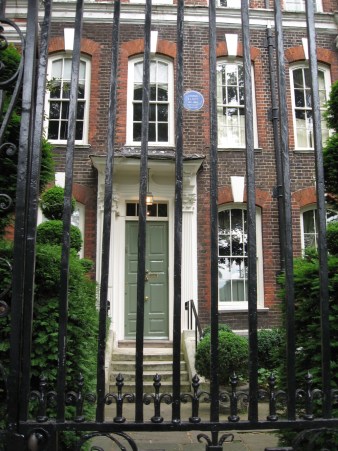
But it was Carlyle’s house that was really exciting to be in:

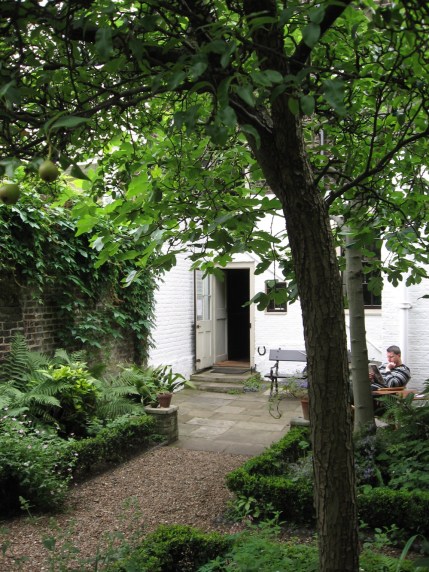
You can really imagine the Carlyles’ life there: it is all set up as they had it (90% of the items and furnishings, the staff told us, were actually owned and used by the Carlyles), and on display are all kinds of touchingly intimate artefacts including Valentine’s Day cards from Thomas to Jane, a screen decoupaged by Jane herself (if she were alive today, she’d be a scrapbooker), and even a fragment of the manuscript of The French Revolution burned by J.S. Mill’s hapless maid. Below are a couple of the most familiar contemporary images of the Carlyles’ home:
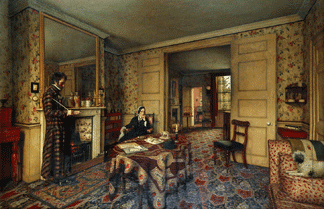

I sat in the garden by the door, and stood right where TC is standing in the painting! The guide told us that Chopin once played on their little piano, and of course they received all our favourite Victorians in that sitting room. The “soundproof” attic was particularly interesting, and another special treat was the 80th birthday ‘testimonial’ signed by George Eliot, Thackeray, Lewes, David Masson, and almost every other literary figure you can think of who was around in 1875.
The Dickens House Museum was good too, of course. Here’s his sitting room, with the “Cruikshank” chair”:

He didn’t live in this particular house that long, and many of its furnishings are approximations of what the Dickenses would have had, rather than their own pieces. Still, it’s something to stand in the room where Mary Hogarth died and see Dickens’s own report of the event. Best of all the many interesting items on display there were Dickens’s reading copies of his novels, complete with highlighting, annotations, and insertions. I love to feel the people behind the books and ideas I spend so much time talking about.
Although it’s impossible not to feel there’s something obvious, even cliched, about the Tower (and Hampton Court and Westminster Abbey too), still, to me these are irresistible places. I was interested in how much slicker these sites have become, with their guide ropes and audio tours and gimmicks (Clarence’s face projected in a butt of malmsey? really?)–but the enormous solidity of the stones and walls and towers speaks for itself of the continuity of history. I’m not sure the new memorial on Tower Green is an improvement on the simpler plaque that was there before:
 But you can still stand and look around and think about Anne Boleyn seeing virtually the same scene as she walked to the scaffold, and that’s what it’s all about: not abstractions, but men and women making their way along.
I did do some reading while I was away, including Murial Barbery’s very engaging The Elegance of the Hedgehog and Alaa Al Aswany’s Chicago. And at Heathrow I calmed my pre-flight nerves by browsing W. H. Smith and came away with Kate Atkinson’s When Will There Be Good News? and Nadeem Aslam’s The Wasted Vigil, which was A. S. Byatt’s book of the year. So once I recover from the travelling (and from my daughter’s birthday and my son’s Grade 6 ‘graduation’, both of which happened the day I got back), I should be able to do some novel blogging again. And our Villette reading starts soon. Oh, and as if all this isn’t exciting enough, waiting for me at my office was a box of actual hard copies of my Broadview anthology, a bit later off the press than originally planned but looking very handsome, if I may say so myself.
On Vacation!
I leave tonight on the red-eye for Heathrow. The last time I was in England I celebrated my 19th birthday at Hampton Court:

(It was the eighties, which excuses the glasses. I’m afraid there is no good excuse for the boots–though we were there in March and it was pretty damp and muddy everywhere.) So it has been a long time–OK, 23 years–since I was there, and I’m very excited about this trip. Last time I was there as a prospective history major with a lingering obsession for Richard III:
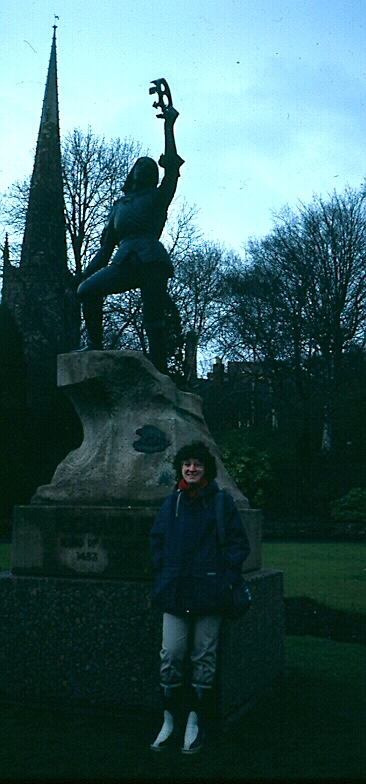
This time my interests are a bit different–and my time is much shorter. I’ll be in Oxford for three days and then in London for just about a week, which is not nearly enough time but will have to do. In Oxford I’m staying in a little hotel right across from Peter Wimsey’s college. The last time I was in Oxford I had never read Jude the Obscure; I wonder if the city will look more depressing this time. In and around London, I’m going back to Hampton Court, and to the Tower (both are having Henry VIII exhibits, as if they knew I was coming, though actually I probably have The Tudors to thank for this), of course, and to the Dickens Museum and the Carlyle House and the British Museum and the National Portrait Gallery and …
I will probably find it hard to leave the internet alone entirely, but I don’t expect to be posting anything here. When I get back, it will be time to start Villette!
Wherefore art thou, Romola?
This just in: the Oxford World’s Classics edition of Romola is out of print. Does that mean it is losing (or should I say winning?) the battle for “least read George Eliot novel”? Admittedly, it does contain the truly terrible line of dialogue “you are as welcome as the cheese to the macaroni” (an Italian friend of mine assures me that in Italian, this idiomatic expression does not sound nearly so, well, cheesy)–but Romola is a truly extraordinary novel in many ways. Romola herself can be a bit tiresome in her pursuit of virtue (she’s a bit like a trial run at Dorothea Brooke), but even she has some great dramatic moments–the encounter with Savonarola when she’s finally seized the courage to run away from her unworthy husband among them. And that unworthy husband, Tito Melema, may be George Eliot’s greatest portrait of an egotist whose small concessions to self-interest accumulate until he achieves a truly villainous status. And the “dead hand” that in Middlemarch is a metaphor for men’s grasping efforts to control events from beyond the grave, is literalized in Romola in this extraordinary scene between Tito and the adoptive father he believed long dead and thus unable to expose his self-serving lies:
“An escape of prisoners,” said Lorenzo Tornabuoni, as he and his party turned round just against the steps of the Duomo, and saw a prisoner rushing by them. “The people are not content with having emptied the Bargello the other day. If there is no other authority in sight they must fall on the sbirri and secure freedom to thieves. Ah! there is a French soldier: that is more serious.”
The soldier he saw was struggling along on the north side of the piazza, but the object of his pursuit had taken the other direction. That object was the eldest prisoner, who had wheeled round the Baptistery and was running towards the Duomo, determined to take refuge in that sanctuary rather than trust to his speed. But in mounting the steps, his foot received a shock; he was precipitated towards the group of signori, whose backs were turned to him, and was only able to recover his balance as he clutched one of them by the arm.
It was Tito Melema who felt that clutch. He turned his head, and saw the face of his adoptive father, Baldassarre Calvo, close to his own.
The two men looked at each other, silent as death: Baldassarre, with dark fierceness and a tightening grip of the soiled worn hands on the velvet-clad arm; Tito, with cheeks and lips all bloodless, fascinated by terror. It seemed a long while to them–it was but a moment.
The first sound Tito heard was the short laugh of Piero di Cosimo, who stood close by him and was the only person that could see his face.
“Ha, ha! I know what a ghost should be now.”
“This is another escaped prisoner,” said Lorenzo Tornabuoni. “Who is he, I wonder?”
“Some madman, surely,” said Tito.
He hardly knew how the words had come to his lips: there are moments when our passions speak and decide for us, and we seem to stand by and wonder. They carry in them an inspiration of crime, that in one instant does the work of long premeditation.
The two men had not taken their eyes off each other, and it seemed to Tito, when he had spoken, that some magical poison had darted from Baldassarre’s eyes, and that he felt it rushing through his veins. But the next instant the grasp on his arm had relaxed, and Baldassarre had disappeared within the church. (full text here)
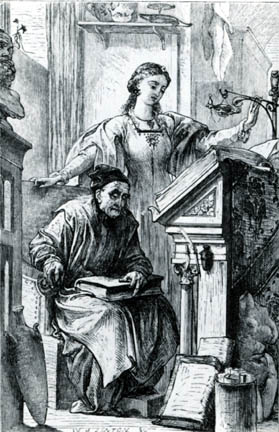
I think Oxford is missing a bet in letting this one slip out of its catalogue. All is not lost, however. The Penguin Classics edition is still available, as is the Broadview edition which, though it has two columns of tiny print and so is not kind to the weak-eyed among us, includes Frederick Leighton’s gorgeous illustrations:
Summer Reading Project II: Villette
I’ve posted the information for this year’s Summer Reading Project at The Valve. We’ll be reading Charlotte Bronte’s great, disturbing, unexpected novel Villette, which is about as unlike Adam Bede as another Victorian novel can be. All welcome!
E-Textbooks
I found this piece at the Chronicle of Higher Ed timely. I would certainly have been among the professors interested in trying the pilot project. I’ve been using my own Sony Reader for a few months now, and it really is an interesting case of balancing the advantages against the challenges. We are used to thinking of a printed book as a “perfect technology,” and yet depending on what you want to use that “technology” for, there are in fact some limits, particularly in an academic environment. There are physical limits, for one thing: books are heavy, and their sheer bulk can become a disincentive to actually reading them, whether you aren’t able to carry them around or pack them, or just find your arms getting tired. Students are particularly vulnerable to this problem. My students may need to bring Bleak House to class for me along with a hard-cover biology textbook, a short story anthology, a psychology textbook, etc. Imagine if they had all of those books in one elegant device weighing no more than a few ounces: more of them would show up with the text you want to discuss. It’s hard to search for things in a printed book, too. Most of us who read for a living have developed our own navigation aids, but there’s always that moment when you think, “didn’t it say this somewhere?” and it is extremely difficult and inefficient to check (again, imagine Bleak House as your text). Searchable e-books solve that problem brilliantly.
That said, e-books turn out to have their share of disadvantages too. As the article points out, all electronic devices need power to run, and though my Sony Reader’s batteries are impressively long-lasting, there still comes that moment when you go to flip it on and remember you forgot to recharge it overnight. A printed book always just works. Annotations are another issue. My version of the Sony Reader allows me to bookmark and annotate; I would consider this an essential function for any academic application of e-book technology. In fact, I have found that with a little forethought as I create my notes, I can generate a custom index that becomes extremely helpful when you need to draw on your reading. On the other hand, I haven’t figured out a way to move those notes from the device into any other document (there may be such a way, but I haven’t learned it yet). But then, things I write in my physical books also need to be rewritten into my word processor–and it’s at least as easy to find the right bit in the e-book version. But again, there are no page numbers in the e-book, because the whole point of the format is that you can resize the fonts (another plus, for my aging eyes), but that means in S something may be on page 153 that is on page 295 in L or XL. So how do you direct your students to that key passage in Bleak House? You’d have to use the fairly minimal pre-set internal bookmarks (usually chapter or volume beginnings) or the search function, either of which is less efficient than saying “everyone look at the paragraph at the bottom of page 110 in your Oxford edition”–but then, not everyone buys the assigned edition anyway…
Of course, e-books are also available for use on multi-purpose machines, i.e. computers. I do find the actual reading experience more pleasant, and less tiring for my eyes, on my Sony Reader (I’ve recovered from my initial disappointment about the glare created by the touch screen, partly because I really like the touch screen). The e-paper really does make a difference. But the Sony Reader does terribly with PDFs, which is a drawback for academic research, and Adobe Acrobat includes annotation functions that seem to integrate better with Office software. There’s much speculation that Apple will come out with an iReader someday, and they are very good about integrating their devices with each other, so if there were such a thing, its contents might well move easily between devices and programs. Overall, I’m enthusiastic about these developments and curious to see the direction they go. I love books, but my Sony is a pretty toy too, in its own way, and easier to tuck in my purse than most paperbacks.
If any publishers want to send me e-books to try out, textbooks or other, I’ll be happy to continue my reading and studying experiments and report back! Crucial to speeding up both the learning and the adoption curve is surely getting early attempts into the hands of actual users to find out what works and what doesn’t. One thing that will inhibit my move towards electronic versions is that academic e-books (of the scholarly, rather than classroom, variety) is that they seem to be very expensive. Maybe this is a missed opportunity for publishers; sales of scholarly books are typically very small, but I for one would usually prefer to have my own copy rather than rely on a library one that needs constant renewal. I wonder if personal sales would take off if the price point for the e-versions came way down.
Weekend Miscellany & Recent Reading
Weekend Miscellany: some things that have caught my eye in recent Internet ramblings:
Joseph Epstein reviews Gertrude Himmelfarb’s new book, The Jewish Odyssey of George Eliot (via). I agree with Open Letters‘s Sam Sacks that Epstein’s generalizations about the Victorians are tired (“The Victorians had a comprehensive and confident view of human nature”… ), though I think Epstein may to be trying to convey what the Bloomsbury-ites thought of them, rather than what he himself takes to be the case, as he moves on to praise the progress we have made from such Bloomsbury-inspired stereotypes. Sacks suggests that “when Epstein moves on to discussing George Eliot, he does fine”; I’d say there too, though, Epstein could do better. It’s tedious, for one thing, that he leads with a discussion of her appearance, complete with Henry James’s infamous insults (imagine a sentence along the lines of “A short, homely man with bulbous eyes, Charles Dickens nonetheless charmed audiences with his impassioned readings…”–why do so many people feel it necessry and appropriate to lead off with comments on her looks?). What can he mean by his remark, after noting that George Eliot was not a supporter of female suffrage (she was not much of a supporter of universal male suffrage either, it’s worth keeping in mind), that “George Eliot’s feminism was of a superior kind”? Superior to what? It sounds as if he might mean she wasn’t one of those shrill political types. He refers to Eliot as a “Zionist,” but as the work of Nancy Henry and others shows, it is tricky to use that term as if it applied in her moment as it came to later on.
George Eliot goes on Oprah: I’ve often thought Oprah should take on Middlemarchfor her Book Club, but its emphasis on failed ambition and entangled idealism would rather undermine her show’s relentless emphasis on overcoming obstacles and triumphing over “this petty medium.” As I always figure that the more people who read it the better, I’ll be interested (in sort of a “bystander at an accident” way) to see if this producer and those who read along find the expeience rewarding.
At ReadySteadyBlog, Mark Thwaite asks his readers to name “academics who manage to retain their rigour, but speak beyond the academy, if only to a quite self-selecting and small audience.” As he asks, “who is doing it for you?” I think in principle any academic could “speak beyond the academy” if you follow Mark’s lead in looking to academic books for insights on literary figures or topics of special interest; academics who write deliberately for a non-academic audience would be a much smaller group.
Reviews are piling up of Sarah Waters’s new novel, TheLittle Stranger. I don’t need to read any of them to know I want to read the novel, but this piece by Waters herself on the novel’s background and relationship to Josephine Tey’s classic The Franchise Affair really whetted my appetite for it. (via)
N+1 takes a couple more shots at bloggers (“Bloggers on the whole write carelessly, their ideas are commonplace, they curry favor with readers and one another, and their popularity is no index of their worthiness.”) even while admitting that there can be a “special eloquence” in the “speech-like qualities” of on-line writing (though that eloquence doesn’t really count, it turns out, as “the same discovery is made by bloggers and texters and chatters in a minor and disposable way all the time”). With 76 million blogs ongoing (or whatever the current estimate is), any claims about what they are like “on the whole” must be a difficult thing to ascertain. I wonder how many blogs the author read to come up with this generalization.
Recent Reading
Two of the books I finished recently are so dissimilar in tone and style–indeed, in almost every way–that it comes as a surprise to me to discover, on reflection, that I think they are pursuing a very similar idea. The books are Nawal El Saadawi‘s Woman at Point Zero, first published in 1973, and Anita Brookner’s Hotel du Lac, which won the Booker prize in 1984. El Saadawi’s novel is the fictional equivalent of repeated slaps in the face, if such startling, painful moments could also somehow be imagined as poetic. Brookner’s novel, in contrast, is subtle, patiently nuanced, and faintly sardonic. How can I say that the blunt first-person narrative of an Egyptian prostitute on death row for murder and a cool first-person account of a British romance novelist vacationing in Switzerland after leaving her fiance at the altar have anything in common? Perhaps the connection is a tenuous one, but both books seem to be fundamentally about the relationship a woman has with herself, and how that relationship is compromised and challenged by the sexual politics–the distribution of power, including physical and economic but also social and cultural power–of her world. Both bring these compromises and challenges into focus by emphasizing their protagonists’ struggles to discover their own identities and maintain their integrity, even when (especially when) that means disregarding how they are looked at by others.
El Sadaawi’s protagonist, Firdaus, fails: her courageous attempts to reinvent herself, to believe in herself and the possibility of her own economic, moral, and sexual freedom, are repeatedly–relentlessly, shatteringly–defeated. The cyclical structure of the novel, in which the same language (assuming the translation is accurate) is repeated for different incidents as if to prove no real progress has been made, that the core crisis remains literally identical, gives a formal pattern to this defeat. It would be an understatement to call this an angry book: to borrow from Matthew Arnold, it is full of “hunger, rebellion, and rage.” It is an activist book, a book designed to smack you out of your complacency. It is interesting to compare it, as I inevitably did, with Ahdaf Souef’s novels, which seem to speak from another world entirely. The timing makes some difference, though I wonder how much: is Firdaus’s experience impossible two decades, three decades, later? Today? How much of the difference between Soueif’s confident, ambitious women and El Sadaawi’s Firdaus is economic or class-based? The novel has been described as fable-like; it may also be that it is meant to transcend its time and place, to speak very fundamentally to the subjection of women, or of the roots and effects of all oppression.
Brookner’s protagonist ends her novel with no triumphant resolution but with a questing sense of possibilities. She has rejected two relationships that promise her social security, protection from the slights and indignities she faces daily and fears will overtake her as she ages: now she must discover what it is like to live on her own terms. To be sure, her situation is dramatically more secure than Firdaus’s, though in both cases money is seen to be key to both security and autonomy (“money is what you make when you grow up,” she tells a less independent companion). She faces no physical violence, no overt discrimination–but nonetheless she has difficulty imagining happiness for herself without love.
Hotel du Lac is the first Brookner novel I’ve read. I enjoyed the language a lot: it was descriptive but restrained. It opens with shades of grey that become thematically apt too, for the repressions that limit its protagonist’s expressiveness. I liked the “vast grey lake, spreading like an anaesthetic towards the invisible further shore”–that image of anaesthetic is proleptic of the life Edith might have. The novel surprised me repeatedly, not with big shocks or twists, but just by not being or saying quite what I expected. It felt like an Edwardian novel; I kept picturing its characters dressed like those in The Enchanted April (they use words like “smocks”–do people say that anymore?). But then someone said something about deconstruction and signifiers and I was reminded of its more contemporary moment. I wonder if the historical ambiguity created by its tone was deliberate, or if I just missed some basic clue as to when exactly its action takes place.
I’ve also recently read Emma Darwin‘s The Mathematics of Love, a novel which weaves together a historical with a modern plot. I thought both parts of the novel were individually well done, though the more contemporary (late 70s, so not really contemporary) part was more compelling. The 19th-century part was written in a more formal style, but that seems like an unnecessary artifice. Perhaps one reason Sarah Waters’s neo-Victorian novels read so well is that although she seeks out 19th-century slang and provides plenty of allusions and contextual details, she does not try to sound “Victorian” (which to so many seems to mean “stuffy”). I didn’t think Darwin brought the two stories together effectively: the interest of her 20th-century protagonist, Anna, in her 19th-century protagonist, Stephen, was never well-motivated. I liked the way she used photography as a device for evoking the strangely palimpsestic character of historical sites and stories, caught in time, leaving impressions that may be sharp or blurred, suggestive or specific, visible or even tangible to successive generations of viewers. The battlefield reminiscences are vivid, and the aftershocks of war provide another common element between the two plots, as do the various love stories that ask us to consider why we love who we do, what love is, and how we suffer for love. Just because I also read it recently, Emma Donoghue’s The Sealed Letter is the inevitable comparison for this book: with Donoghue’s novel, I couldn’t see what it was about beyond the story it told, while with Darwin’s, I felt it was about a number of things but not integrating them in a fully satisfying way. But I liked it enough that I might try her second novel, A Secret Alchemy–also because it has been a long time since I read any Richard III-related novels.
Academic Blogging at ACCUTE
I’ve been meaning to say a little bit about the lunch-hour session on academic blogging that I convened at ACCUTE last week. As some of you will know, this session was the down-sized version of a panel I proposed for which there were, well, not many submissions. I’m not altogether sorry. Our informal discussion was certainly more fun and interactive, and probably more productive, than a series of well-rehearsed papers would have been. I enjoyed meeting other bloggers, including The Classroom Conservative and some of the founders of the new, and highly recommended, 19th-century blog The Floating Academy. (During the conference I also met a couple of lurkers: if you’re still out there, thanks for introducing yourselves! Who says the Internet can’t foster actual human interaction?) Also present were some academics who blog but don’t necessarily define themselves as “academic bloggers,” which in itself raised some interesting questions about how (or whether) we define our working or professional selves as distinct from our personal or other selves.
I began with a few words about how I stumbled into blogging and then some comments on what seem to me its benefits from a specifically academic perspective: writing often, writing for a potentially wider audience, getting feedback on work-in-progress, making contacts. I think I also mentioned the slow pace of academic publishing (not conducive to the steady or collaborative development of ideas) and the frustration with writing more for careerist than intellectual or scholarly reasons. The flip side of all this is (again, from a narrowly academic perspective) lack of professional recognition for this activity, which then raises questions about the time commitment, particularly for junior faculty. Then we just went around the room and everyone explained their own interest in or experience with blogging, academic or otherwise. I thought it was a friendly and productive discussion. Probably what emerged most strongly for me was that, just as it is difficult to define “blogging” because the form itself determines almost nothing about the content, so too “academic blogging” can take many forms, from the scholarly to the personal to the literary. As a result, academics who believe their blogging is contributing in some significant way to their professional development and therefore want some credit for it (and let’s face it, most of us have an interest in moving forward, not just intellectually, but also professionally, so the issue of “what does this count for?” is bound to come up, given how many demands there are on our time) will have to make the case based on the specific kind of work they are doing. Still, it also seems to me that the primary value of blogging, whether academic or not, is and should be intrinsic. Whether you blog because you find the mental exercise stimulating or clarifying, or because you find it useful to have a repository for your unfolding ideas, or just because you enjoy it, then whatever else comes of it, you won’t be sorry. And given the ways academic work tends to meld with everything else we do and think about, our work is bound to benefit, even if only indirectly. Many of us remarked, for instance, that the simple challenge of writing often and (implicitly) for a broader audience than other specialists was, in itself, one of the chief attractions and rewards of blogging: it brought us back in touch with the pleasure of writing. I’d like to hear any follow-up thoughts from others who were there.Thanks to all of you for coming! I was afraid it might be a lonely lunch for me.
As it turns out, there was another blogging panel at the Congress, sponsored by University Affairs; unfortunately I didn’t know this one was on the schedule until I had already booked my return ticket for that day, or I would certainly have attended it as well. (If any of you were there, I’d be interested in your report. I found a bit more information about it, here and here.) I was surprised to see only one Canadian blogger on the panel, though perhaps I shouldn’t have been, considering my own experience trying to uncover other Canadian academics who blog.

