Black Lamb and Grey Falcon II: Easter in Zagreb

Over the long weekend I made a little more progress on Black Lamb and Grey Falcon. I’m going to keep at it in deliberately small increments so that I can stop and stare at the sentences. As it happens, one of the chapters I was just reading describes a visit to the Cathedral in Zagreb on “Easter Eve”:

It has been cut about as by a country dressmaker, but it has kept the meditative integrity of darkness considering light, the mathematical aspiration for something above mathematics, which had been the core of its original design, and at that moment it housed the same intense faith that had built it. This was Easter Eve; the great cross had been taken down from the altar and lay propped up before the stop, the livid and wounded Christ  wincing in the light of the candles set at His feet. It was guarded by two soldiers in the olive uniform of the Yugoslavian Army, who leaned on their rifles as if this was a dead king of earth lying in state. As I looked at them, admiring the unity enjoyed by a state which fights and believes it has a moral right to fight, and would give up either fighting or religion if it felt the two inconsistent, I saw that they were moved by a deep emotion. Their lips were drawn outward from their clenched teeth, they were green as if they were seasick. ‘Are they tired? Do they have to guard the cross for a long time?’ I asked curiously. ‘No,’ said Constantine, ‘not for more than an hour or two. Then others come.’ ‘Then they are really looking like that,’ I pressed, ‘because it is a great thing for them to guard the dead Christ?’ ‘Certainly,’ he replied. ‘The Croats are such Catholics as you never did see, not in France, not in Italy; and I think you ask that question because you do not understand the Slavs. If we did not feel intensely about guarding the dead Christ we should not put our soldiers to do it, and indeed they would not do it if we put them there, they would go away and do something else. The custom would have died if it had not meant a great deal to us.’ For a long time we watched the wincing Christ and the two boys with bowed  heads, who swayed very slightly backwards and forwards, backwards and forwards, like candle-flame in a room where the air is nearly still. I had not been wrong. In Yugoslavia there was an intensity of feeling that was not only of immense and exhilarating force, but had an honourable origin, proceeding from realist passion, from whole belief.

It felt odd reading this passage about “whole belief” after days when it seemed I couldn’t turn around without seeing garish rabbit cut-outs and hokey pastel-colored baskets full of cheap chocolate in every imaginable shape. Our customs continue even though they mean  almost nothing to most of us anymore, and the resulting hollow commercialism gets pretty depressing. At the same time, as an atheist as well as someone anxious about nationalism and other ways of marking off identities worth fighting for (“you do not understand the Slavs”), I recoil from this scene, evocative as it is, more than I am exhilarated by it. Something else I did over the long weekend was watch a lecture (which I did find exhilarating) about “Jesus, the Easter Bunny, and Other Delusions: Just Say No!.” The soldiers with their clenched teeth don’t look to me like people willing to change their minds, which (I agree with Dr. Boghossian) is an essential characteristic of rational thought. The problem with “intensity of feeling” is that it is no guarantee of “moral right,” much less of more mundane kinds of “right” or truth. I wonder if West really regrets (as her rhetoric often implies) the more anemic faith of her own country. It may be less exhilarating, but there’s something unseemly about someone who is buffered by it, herself, from the hazards of extremism describing this scene as if it’s an attractively exotic spectacle.

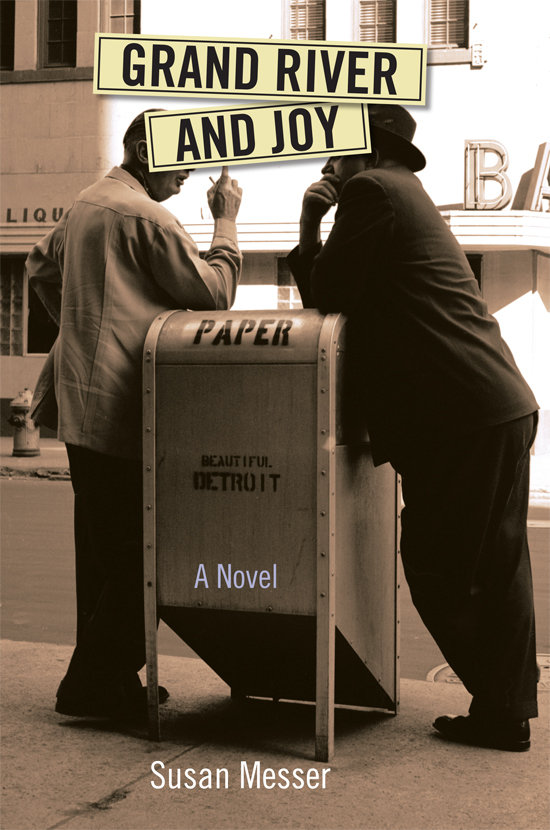
“Moving in Tandem Across the City”: Susan Messer, Grand River and Joy

I have posted here a couple of times before about books by people I know. It always feels a bit risky, though I don’t know why it is, really: it isn’t as if authors I don’t know personally aren’t also actual people with their own ideas and feelings! Perhaps it’s because people I know are more likely to read what I say and also, maybe, more likely to care if I’m not seeing the book as they did or hoped–more likely to take my blind spots or criticisms personally.

In one sense, I don’t know Susan Messer: we have never met face to face. But Susan has read and commented here for some time, and through the exchanges we’ve had, I do feel as if we know each other at least as readers and thinkers. I have found her comments always very thoughtful and engaged and encouraging. Naturally, I was interested in knowing more about her!  So I snooped, of course, like any good citizen of the internet era, and one of the first things I found out was that she had published a novel, Grand River and Joy, which I have now finally read. I didn’t tell Susan ahead of time that I was going to–I figured that was better in case of the awkward, if unlikely, event that I didn’t much appreciate it. But I did like it–a lot–and so I’m going to go ahead and post some thoughts about it. I gave Susan a heads-up once I knew I would be writing about it, so she wouldn’t feel snuck up on.

I came to Grand River and Joy as an outsider to its particular contexts. It is a historical novel–more specifically, as we Victorianist types say, it’s a novel of the recent past: it’s set in Detroit just before, during, and after the 1967 riot (which, as one of her chapter headings points out, could also be interpreted as a rebellion). Though of course I know a few general things about American history during this period, I’m no expert on it, and I’m certainly no expert on Detroit, which is not a city that has previously figured at all in my imaginative landscape of America. One of the aspects of Grant River and Joy that I liked the most was the intensely local detail, which is really evocative of both time and place. The novel opens as Henry Levine drives downtown to the building that houses his shoe wholesale business as well as his black tenant, Curtis, and Curtis’s teenage son, Alvin:

It was Detroit, and by 1966, Grand River south of Joy was all concrete and brick, with barely a tree or shrub, barely a patch of grass.

Joy Road – now there was a misnomer. That stretch had broken windows and traffic snarls, and grown men with nothing to do during the day. Up and down these broad streets, buses belched clouds of black smoke as they roared past the metal-grated building faces. And as if inviting trouble, Levine’s was the only business along the stretch that lacked one of those grates.

That first day in the novel, Hallowe’en 1966, Harry opens the business to find that trouble has accepted the invitation: scrawled in soap across his front windows are the words “Honky Jew boy“. Looking for the supplies to clean away the slur, Harry discovers that a room in his basement has been turned into a kind of clubhouse, with chairs, ashtrays, a phone, and a stash of books and papers including “a narrow pamphlet with big hand-lettered words. ‘Black Panther Party Platform: What We Want; What We Believe.'” Harry rightly guesses that it’s Alvin who has been using the space: “these were his things, and this was what he read.” He also suspects that Alvin and his friends Otis and Wendell are responsible for the slur, but he intervenes (to the disgust of his fellow Jewish business owners) when the cops start hassling them.

This near-confrontation and Harry’s well-meaning attempts at appeasement presents in microcosm the novel’s central tensions, which are not just between blacks and Jews but between individual identities and group allegiances, between narrowly-defined protective self-interest and the desire to reach out and make connections, and, crucially, between staying put and moving away. The times, and the neighborhoods, are changing, and the novel delicately but sharply scrutinizes the discomfort of a community well aware of its own legacy of discrimination and suffering as it rationalizes its own prejudices. ” ‘I don’t think it’s the skin color,'” says a young woman at the meeting of the Detroit Council of Jewish Women where Harry’s wife Ruth makes a presentation on “white flight:”

‘It’s the class differences, the worry that schools will be compromised if people don’t have the same values. The schools are the key for most families. They are for me.’ Her friends nodded.

But of course it’s about skin color: out on the street, when the neighbors talk, “[e]veryone had stories about the schwarze.”

It’s both a tense time and a dishonest time, and in this context conciliatory gestures are hardly guaranteed to be either welcome or successful: admirably, the novel offers no simplistic idealism about what it might take for everyone just to get along, no neat parable of cooperation. Suspicion and hostility are not just individual habits or traits, after all: they have historical, systemic causes, and good intentions are as likely to reveal as to heal fissures. “Leave the boys alone,” Harry tells the officer who’s hassling Alvin and his friends. “We’re not boys,” says Wendell  after the cop car drives away.

As this awkward, necessary correction emphasizes, Harry’s no hero: he is not a moral benchmark, not a visionary. He’s just a well-meaning guy, unhappy about the hostilities intensifying around him, uncomfortably aware of his own suppressed racist reactions, wishing he could somehow say or do the right thing to create a little more trust, a little less suspicion. One idea he gets is to donate the collection of bicycles that he and his daughter Joanna have salvaged and restored to the children in “the projects.” They borrow a truck, load up the bikes, and drive to “the stretch on Eight Mile, not far from their own home, which had once been an army barracks, and was now one of the few places on the north-west side where Negroes lived, represented as a solid black band on the census maps, and recently the focus of the urban renewal movement. The projects.” They have driven past often before, but never pulled over. Now they arrive on this errand of … what? charity? generosity? patronage? friendship? Is it a nice thing to do, or an insulting one? “To have some white guy drive in and stand on a corner, giving stuff away?” asks his daughter Lena skeptically, hearing his plan. “And something valuable, like a bike? Wouldn’t you wonder what the trick was?” “There’s no trick,” Harry replies, and there isn’t, but it is an odd gesture nonetheless, and as Lena expects, it’s met with something besides the simple happiness Harry seems to imagine. “What are you? Santa Claus or something?” he’s asked. It’s not easy, as it turns out, to give bikes way, not as simple as Joanna tells herself as she tries to get over her discomfort and get out of the truck: “Bikes were for riding,” she thinks, but it’s not just about that, and the mixed responses they get to their gifts refuse easy answers to what you should or can give, what you should or can take. You certainly can’t do much, single-handedly, about a long history of misunderstanding and injustice and anger. Does that mean you shouldn’t try?

The closest we get to an answer about what might be constructive arises from a long conversation between Harry and Curtis as they watch over the building’s malfunctioning boiler–a nicely handled symbol for the simmering conflict in the city around them. It starts out badly, with tension and resentment, and in fact Harry almost leaves, almost gives up on understanding or caring: “They wanted to determine their own destiny, or whatever that first point on the Black Panther program was, let them start with the heat in their own home.” But he goes back, and he and Curtis talk all night, first exchanging stories, “the kind men tell, about things they’ve done, and things that have happened.” Then, as they start drinking, they get looser and more daringly honest, until it becomes, Harry observes, a kind of “teach-in,” about racial attitudes and slurs and suspicions and jokes, the things that usually are said only about, not to, the other. “No one knows what to call your people anymore,” Harry says to Curtis. “Negro, black, colored?” “You only need the label when you’re talking about me,” Curtis responds. “It’s the talking to me that matters.Curtis and Harry don’t reach any epiphanies –for one thing, by the time morning comes they’re too drunk to make much sense, and Alvin, making his way down to the boiler room to see what’s happened, finds them (to his disgust and anger) wrestling in sodden hilarity on the floor. That’s hardly the high road to racial harmony, and yet it seems a lot better than the alternatives we see, from hostility politely masked to combustible violence. Man to man, face to face, talking to each other: what else is there, really, that two individual men can do?

After the riots Harry returns to his building at Grand River and Joy and (in an elegant parallel to the opening scene) finds writing, once again, on his window, but this time, it says “Soul brother.” On the one hand, this message is the encouraging fruit of Harry’s good will, a tangible marker of some hoped-for reconciliation. Because of it, we infer, Harry’s building still stands, the front window unbroken, though “a whole stretch of charred buildings lay in ruins – Bernie’s place, Stan’s.” But again, good will does not make everything come right: though in the post-riot chaos he has no market for his inventory and the business is doomed, he can’t make an insurance claim as “he had no ‘quantifiable loss,’ no police or fire report to attach, no photos of gaping holes in walls, of inventory strewn in streets. No smoldering ruins for the insurance examiner to survey, shaking his head, making notes.” “How is it,” Ruth asks, “that all the business owners we know are coming out of this with something?” But for Harry, there’s nothing.

Or, rather, not nothing, because for him too, the riot has been a cataclysm and, in an unexpected way, a catalyst for change. Trying to get to his building before normalcy has been restored, Harry ends up accidentally at an orthodox shul, where during the prayers, he reflects on his life and wishes to be free of the business, which was never his vocation but his inheritance from his father:

Deep within the privacy of his tallis tent, he saw that the horror that had seized the city could release him. It could open his life, push him out, tell him go, be, do.

He hoped, not that it would survive, but that it would burn–which is why when it doesn’t, it doesn’t feel quite like a blessing. When the business collapses, it feels freeing, rather than sad, as he is finally liberated to go, be, do something else, to be who he is.

I was surprised to learn, in the final section, that he and Ruth move to the suburbs after all.

There are other aspects to the novel, other incidents, worth discussing (Ruth’s session with the Detroit Council of Jewish Women, for instance, which is a great microcosmic survey of the situation as well as a bit of keen satire, or the section on the “riot/rebellion” itself, which incorporates Alvin’s experiences in the midst of the turbulence). But I think this post has gotten long enough. Susan, I hope you think I’ve read your book reasonably well! I learned a lot from it, and really enjoyed it too.


Teaching Texts: Taking The Road into 2012-13

Book orders for the fall term were due April 1. Apparently this early deadline helps the bookstore know which books are being re-used and thus which books they can buy back from students to re-sell next year–which makes sense and is a good thing to do for students! But April 1 is still very early to have worked out what you want to do next year, unless you are happy to just do exactly what you’ve done before and aren’t teaching any new classes. You know those legends about professors who show up with the same yellowed teaching notes they have used for 100 years? None of us wants to be that professor, honest! But this is the kind of bureaucratic thing that discourages innovation. When you are in the thick of one term, the easiest way to meet this deadline is by repetition. Not that there’s anything necessarily wrong with that! You can in fact teach the same books over and over (cough *Middlemarch* cough) and never feel you are just going through a tired routine. There’s always something new to learn, new to say–or a new way to say it, or to try to engage students with it. But I do try to shake up every reading list every time, if just by a book or two, so that the new juxtapositions will keep me fresh.

Anyway, April 1 has come and gone and I’ve only submitted two of my three fall term orders. Sorry, bookstore! The course I haven’t ordered for yet, English 1000 (Introduction to Literature)  is not a repeat for me, though: the books I’ll be probably be ordering have not, to my knowledge, been assigned by anyone else this year, and I haven’t taught the class myself since 2000-2001 in its full-year version, though I have taught a half-year introductory class three times in the past decade. It’s really the shift back to a full-year version that has slowed down my ordering: you can do so much in full-year classes, and they have become such rare creatures. I haven’t in fact taught a full-year class of any description in many years: I’m almost giddy with excitement about the increased chances of my learning every student’s name well before the class is over. And it’s equally dizzying to think of all the many, many different books I could conceivably assign…which, of course, is why it has taken me too long to make up my mind. Our intro classes are, deliberately, not historical surveys (we offer those at the 2nd-year level) but introductions to genre, to university-level writing, and to literary critical terms and skills. The genres we are supposed to cover are non-fiction prose, poetry, fiction, and drama–but it is entirely up to us how to do this. The range of different reading lists that results is supposed to be a strength of our first-year program: in theory, students can peruse the different offerings and choose a section they like the looks of. This almost never works in practice, as despite our efforts to publicize the variation, students (and advisers) usually assume all the sections are the same, and they choose based on timetable more than anything else. As a result, it is not uncommon to have a conversation that begins with a student saying things like “But my friend in Dr. Flumberly’s section of English 1000 isn’t reading any novels, only short stories. It isn’t fair that we have to read this long book.”

I don’t actually think there are any sections of English 1000 that assign no novels at all (possibly, just possibly, students’ reports of what goes on elsewhere may not be 100% accurate). But absent any particular principle about which novels to assign, it’s always hard for me to decide which ones to go with. Over the years I have assigned Hard Times, The Wars, A Christmas Carol, A Room with a View, Saturday, and The Remains of the Day – always along with an array of shorter texts. I was thinking of going with A Christmas Carol again this year (it’s fun to teach it in December just as holiday madness is breaking out) but I wanted to do a more contemporary novel as well, since I do have a whole year. English 1000 is the teaching assignment that gives me the most latitude, so it’s a great chance to get outside my comfort zone. I mentioned this on Twitter and within about 10 minutes I had a whole array of tempting suggestions, most of which I had heard of but not read. I couldn’t possibly consider them all by April 1!

As the tweets were flying back and forth, Mark Athitakis asked an important question: what makes a novel a good choice for teaching?’ This is obviously a key issue: you can love reading a book but still conclude that for one reason or another, it would not work in the classroom, or at least in a particular class. For an intro class, what are the desiderata? It will vary for individual instructors, I know. Those of you who also teach similar classes, what are the factors for you? For me, one issue is length–shallow, maybe, but I think realistic. 200-300 pages seems to me about right, though I have colleagues who regularly teach Jane Eyre or Wuthering Heights in their intro sections and it seems to go fine. Then there’s significance. It makes some sense to me that you would pick a book that either has some standing (why? is something you’ll want to talk about) or that you think deserves some standing — this helps you begin what you can hope will be a life-long engagement on their part with the puzzle of literary merit and reputation, and it gets them into an ongoing literary conversation. Merit itself is also a factor — I can’t see teaching a book you can’t in some sense get behind, as you are going to have to bring a lot of enthusiasm and energy to the classroom day after day, and it’s hard to do that for material you don’t think is any good. Sometimes it’s still important to do it, mind you: I teach novels I don’t think are great qua novels all the time, but in courses where coverage is a requirement in a way it is not for our intro classes. Then it has to be a book that gives us something to talk about and then something to write about — it needs to require and reward interpretation. Doesn’t every book? Well, no, at least not in isolation. Some very formulaic novels are much more interesting collectively than they are individually (from variations on repetitive patterns and tropes as in [some] romance or mystery novels, for instance). But I think that a certain level of complexity (thematic as well as aesthetic) makes for the best teaching texts. You want the feeling that the book is about something, and not just a simplistic, obvious single something but a problem, a crux. And you want the language and form to be related to that problem or crux in an interesting (and, again, not simplistic or obvious) way. Finally, it helps if you can see ways the book will create interesting conversations with the other texts you’re teaching in the course.

I looked up a number of new (to me) books, online and in the library. I started a couple and read two all the way through. One of these, The Talk-Funny Girl (recommended by D. G. Myers) was extremely interesting and gripping, but I felt in the end that not only was it a bit too alien for my purposes but it wasn’t as good as it could have been. The other one I read in its entirety was Cormac McCarthy’s The Road. This is a book I have deliberately avoided until now. Not only did it sound very depressing but it sounded gimmicky, cheesy even. Well, as those of you who have read it will know, it certainly is depressing! I was teaching Jude the Obscure the week I read it and I announced with some perturbation to my class that I had finally found a novel that made Jude look optimistic! But gimmicky? I don’t think so. From the beginning, it interested me, and though it horrified me, it also moved and surprised me. The father-son relationship is intense but stripped bare of sentiment, as is everything in the novel’s landscape: we’re left with just the essentials, and that simple idea is what makes the novel so powerful. What does matter? Why – how – do we keep going? The language put me off a bit at first, as it seemed unduly self-displaying, but ultimately I thought it provided the art, the artifice, that made the story bearable. It also highlights its literariness: we are clearly in allegorical territory here. I couldn’t stop reading

When I finished the novel, I was struck by the glimmer of optimism it offers at the last minute  (I don’t know yet if I think the ending undermines the novel) and I found myself thinking about it a lot. At first I thought there was no way I would assign it. I couldn’t imagine spending hours and days in that world — or making my students come along with me. Poor things! Isn’t their first term at university hard enough? But then I began to reconsider. At the heart of the novel there is something that is anything but depressing, isn’t there? The father and son talk a lot about “the light” they are carrying. It’s a metaphorical or symbolic light, and it’s something the novel carries too. Then I thought about one of the non-fiction texts I’m assigning, Eli Wiesel’s Night. Night is also about surviving devastation, hanging on to shreds of humanity. One of the moments in Night that is particularly haunting and terrible is the selection scene:

‘Men to the left! Women to the right!’

Eight words spoken quietly, indifferently, without emotion. Eight simple, short words. Yet that was the moment when I left my mother. There was no time to think, and I already felt my father’s hand press against mine: we were alone. In a fraction of a second I could see my mother, my sisters, move to the right. Tzipora was holding Mother’s hand. I saw them walking farther and farther away; Mother was stroking my sister’s blond hair, as if to protect her. And I walked on with my father, with the men. I didn’t know that this was the moment in time and the place where I was leaving my mother and Tzipora forever. I kept walking, my father holding my hand.

This scene breaks my heart. I expect every parent has felt the magic of a little hand in theirs, realized the awesome, beautiful, devastating weight of the innocent belief that if we say it’s OK, if we go there, if we hold hands, it is OK.  “It’s OK,” the father in The Road tells his son over and over. “It’s OK.” And the son goes along.  Now I can’t stop thinking about that resonance between the two texts. The underlying theme of my sections of Introduction to Literature is usually something as simple as “words matter.” One way I think I can show this and make it meaningful and alive to our students is to work with texts that are about things that really matter. I’m not sure yet how the pieces will fit together or what exactly we’ll talk about, but at any rate I’ve decided to order The Road and see where it takes us.

“The Awfulness of a Life Where Nothing Ever Happens”: Winifred Holtby, The Crowded Street:

Only the last section of The Crowded Street – a mere 16.5 pages – is named for the novel’s protagonist, Muriel Hammond. Each of the other sections is named for another woman whose life preoccupies and dominates Muriel’s: first her schoolmate Clare, then Muriel’s mother, then her sister Connie, then her friend Delia. Structurally, then, The Crowded Street reflects the central problem of Muriel’s life: that she has never been its main character, never lived according to her own values, never pursued-much less fulfilled-her own dreams, never known-much less got-what she wanted.

It’s a risky premise and a risky structure. It’s not, in practice, very interesting to read about someone whose life is so lacking in individual motivation and agency. “All books are the same,” Muriel reflects bitterly, late in the novel; “In books things always happen to people. Why doesn’t somebody write a book about someone to whom nothing ever happens–like me?” If we hadn’t already seen it, this assures us that Holtby has made a deliberate choice to write just such a book. She has risked boring us, alienating us, in order to drive home the point, not that there is something redemptive about a life in which nothing of note happens, but that young women should be liberated from the conventions and expectations that trap them in such a meaningless existence.

The Crowded Street is relentlessly, satirically critical about the stultifying provincial society in which Muriel is raised. Though as a young girl she dreams of studying “Higher Mathematics and the Stars,” such radical ideas are promptly crushed:

Mrs Hancock [her teacher] explained how there were some things that it was not suitable for girls to learn. Astronomy, the science of the stars, was a very instructive pursuit for astronomers [I love the circular logic!], and professors (these latter evidently being a race apart), but it was not one of those things necessary for a girl to learn. ‘How will it help you, dear, when you, in your future life, have, as I hope, a house to look after?’

“Her initial failure sapped her courage,” and Muriel never really tries again. Her passivity in the face of discouragement is frustrating (if, as seems plausible, Holtby had The Mill on the Floss in mind, we get none of Maggie’s rebellion against these gender-specific barriers to knowledge). But Muriel’s passivity is part of her character and stems, sadly, from her better qualities, including a strong sense of duty and loyalty to her family and a desire to help others. Though her grown-up life offers her no personal fulfillment, as long as she feels useful she can at least accept it.

In Muriel’s home community of Marshington, the only recognized option for women is marriage (or “sex success,” as the vicar’s outspoken daughter Delia calls it). Holtby chronicles with painful acuteness the maneuverings of Muriel’s mother (who herself made a questionable marriage) to get her girls accepted into the highest levels of Marshington society and land suitable husbands. Holtby balances satire with poignancy in some of the scenes of Mrs Hammond’s disappointments: the trick, when hearing another girl has caught the young man she thought might choose Connie or Muriel, is to rejoice in her good fortune and wish the new couple every happiness, to regroup, and to try, try again. But as the years go by her desperation increases.

Her daughters react somewhat differently to the pressure. Connie, the wild one, goes off to work as a “land girl” during the war, takes the risk (fairly calculated, it seems) of getting pregnant, and ends up in a loveless marriage when her parents coerce the child’s presumed father into agreeing. Muriel goes to live with her and tries to help her improve her situation a bit, but Muriel is ineffectual and Connie’s story ends miserably. It’s hard not to think that at least Connie screams and fights and runs, but there’s really nothing admirable about her except that emotional rebellion, and that’s not much, especially when she pays for it with her life. This is the price, we see, of respectability, which is the only value recognized by Marshington society.

The price Muriel pays is almost as high, though less literal. As the years go on, it starts to seem inevitable to her that she will never achieve that “sex success” but dwindle into the life of an unappreciated spinster. Her aunt gives her a chilling picture of what lies ahead:

‘Marriage is the–the crown and joy of woman’s life–what we were born for–to have a husband and children, and a little home of her own. Of course there are some of us to whom the Lord has not pleased to give this. I’m sure I’m not complaining. There may be many compensations, and of course He knows best. But–it’s all right when you’re young, Muriel, and there’s always a chance–and when my dear mother was alive and I had someone to look after I am sure no girl could have been happier. It’s when you grow older and the people who needed you are dead. And you haven’t a home nor anyone who wants you–and you hate to stay too long in a house in case someone else should want to come–and of course it’s quite right. Somebody had to look after Mother. Everybody can’t marry. I’m not complaining. I’m sure they’re very kind to me, but I sometimes pray that the good Lord won’t make me wait here very long–that I can die before everyone gets tired of me, and of having me stay around–‘

Now that’s a fate worse than death, isn’t it? And it’s hard to see any alternative, in Marshington. Muriel thought she might have a way out, once: for years she has loved (or at least admired and yearned after) Godfrey Neale, handsome, popular, endearingly stuttering, and once, in the dark, under the impetus of a war-time crisis, Godfrey kissed her. Does the kiss mean nothing or everything? Her answer finally comes with the news of his engagement to the flamboyant Clare. No other prospective suitor appears, and Muriel’s resignation becomes bitter passivity.

But marriage is not the only alternative; other people are not the only means to the end of self-actualization and worth. Muriel finally learns this lesson from Delia, who has left Marshington for London where she work for the Twentieth Century Reform League. “Things happen against our will,” Muriel says to her morosely, when Delia is back visiting Marshington.

We listen, we think, that we are moving on towards some strange, rich carnival, and follow, follow, follow. Then suddenly we find ourselves left alone in a dull crowded street with no one caring and our lives unneeded, and all the fine things that we meant to do, like toys that a child has laid aside.

Delia is impatient with this renunciation of agency. “You can’t wriggle out of responsibility with a metaphor,” she tells Muriel; “Your life is your own, Muriel, nobody can take it from you.” She insists that Muriel recognize that she has been making choices, that society and other people’s expectations are not, in themselves, determining factors. She invites Muriel to move with her to London–which, somewhat unexpectedly, Muriel finds the courage to do. In her new independent life, she begins to discover and use her own strengths and to define her self-worth on her own terms.

Muriel flourishes, but the portion of the novel dedicated to that flourishing is tiny. Did we need to see so clearly, in so much detail, how dull and destructive the world of Marshington (and everything it stands for) is, in order to welcome the alternative? Does that world really need such a long exposé? Not now, but maybe in 1924, when The Crowded Street was first published, it was harder to explain what was wrong with it, or harder to justify  Delia and Muriel’s new life (which was very close to Brittain and Holtby’s, of course). Maybe, too, it was important to thoroughly defamiliarize that world, to take its perfectly ordinary tennis parties and dances and committee meetings and visits for tea and wear us out with them so that we would end up unable to accept them as ordinary, unable to stand it for one more minute. “If ever I had a child,” Muriel tells Delia before her rescue, “and it was born a girl and not beautiful, I believe I’d strangle it rather than think  that it should suffer as I’ve suffered!” To understand that shocking statement as anything but hyperbole, we have to have felt the weight and especially the duration of Muriel’s suffering through “the awfulness of a life where nothing ever happens.”

The first graphic is the elegant endpaper from the handsome Persephone edition of The Crowded Street.

Willa Cather, My Mortal Enemy

My Mortal Enemy is an unlikely choice for my first experience of Willa Cather – it’s obscure enough that the Americanist colleague I hit up for a copy to borrow not only didn’t have it and hadn’t read it, but hadn’t even heard of it, and the only copy in our university library is a 1926 edition so old and fragile it is stored in a box because it is considered too flimsy even to restore. Apparently, then, My Mortal Enemy is not the go-to Cather text.

Because I haven’t read any other Cather, I’m not in a position to say whether that’s because it’s anomalous or in some way not up to her usual standards. The introduction to the Vintage edition I finally opted for as an e-book has a long introduction that holds it up as exemplary, particularly of her prose style, which has, says its author, ‘a relentless purity of style’ which is ‘never so pure and never so relentless as in My Mortal Enemy … the novel makes a raid on all amplitudes, all mere pleasantness, and all sloppiness.’

As I was reading it, I can’t say that I was noticing any particular purity of style, but I did feel the absence of pleasantness. The novella tells the story of Myra Henshawe, an heiress who abandons her father’s fortune to marry for love. Her elopement has taken on an almost mythical quality in her home town, where the narrator, Nellie, grows up hearing about her. When Nellie finally meets her, she feels ‘quite overpowered’ by her, and Nellie is indeed overpowered by Myra throughout the novella – she is a narrator of almost no interest herself, as far as I can tell, serving only as a device to present and contrast with Myra’s more showy and emotionally intense character. Myra lives life loud, but her sacrifice for love has not brought her happiness, and the love itself has not proved lasting: when Nellie goes to stay with Myra and her husband Oswald in New York, she eventually sees that despite their superficial displays of unity and affection, the reality is more complex and even sinister. The realization appalls Nellie in a way that would seem disproportionate if it weren’t for the status marvellous Myra and her magical marriage have had in Nellie’s youthful imagination:

This delightful room had seemed to me a place where lightheartedness and charming manners lived–housed there just as the purple curtains and the Kiva rugs and the gay water-colours were. And now everything was in ruins. The air was still and cold like the air in a refrigerating-room. What I felt was fear; I was afraid to look or speak or move. Everything about me seemed evil. When kindness has left people, even for a few moments, we become afraid of them, as if their reason had left them. When it has left a place where we have always found it, it is like shipwreck; we drop from security into something malevolent and bottomless.

 When Nellie next meets Oswald and Myra, they are living in a dingy apartment-hotel where she, having fallen on unspecified hard times, has also taken up residence. Myra is an invalid tortured beyond reason by the clattering and thumping and shrieking of their unsympathetic upstairs neighbours (actually, having lived in basement apartments, I understand how crazy this can make you!). There’s nothing left of even superficial glamour in their lives, only bitterness and defeat. Is it tempered at all by the Henshawes’ love for each other? Oswald waits on Myra faithfully, even devotedly, and she responds with occasional tenderness, but seeing them now and knowing what she knows, too, Nellie cannot see this as the last phase of a great passion.

Myra’s death is clearly meant to be climactic, but I had trouble discerning the precise nature of the conflict to which it is the crisis. “Why must I die like this, alone with my mortal enemy?” cries out Myra. But I didn’t understand what she meant or why (or whether) I was supposed to rebel with her or judge her. I wasn’t enthralled by Myra’s character, and I don’t think we are meant to be: there’s nothing truly grand or heroic about it, and there’s something unpleasantly melodramatic about the way she plays her own part. She’s more interesting than anyone else in the novella, though, which I suppose is, indirectly, a critical reflection on the roles people usually play. She’s not a tragic heroine–if there’s any tragedy, I think it’s in the gap between our (or at least Nellie’s) expectation that love is worth everything else and the sordid culmination of Myra’s life story, in which her grand gesture has done nobody any good.

After finishing the novella I turned to the introduction for ideas, and its author argues that Myra’s enemy is ‘friendship and love, human relationship itself.’ He reads her angry cry as a pun that refers also to her husband, who is ‘her enemy because he is the source for her of human relationship, of that which passes without fulfillment, of mortality.’ That is, I guess, her husband is standing in for all the false hopes and promises that human relationships bring meaning, and for the inevitable collapse of that beautiful dream in the face of mortality. That sounds plausible enough when he explains it, though it seems to me to take quite a bit of reading into – perhaps, quite a bit of bringing to – the novel what isn’t obvious to someone encountering Cather’s ethos for the first time. I didn’t feel like I was reading My Mortal Enemy very well: I couldn’t seem to get oriented in it, and then it was already over. What I’m left with is an interest in reading something more expansive of Cather’s, something that gives me a better chance at understanding her for myself.

My Mortal Enemy is this month’s choice for the Slaves of Golconda reading group. More comments and discussion can be found at the Slaves blog.

Black Lamb and Grey Falcon I: Sentences

One reason it is going to take me a long time to read Black Lamb and Grey Falcon is that so many of its individual sentences stop me in my tracks. I’ve been trying to figure out what it is about them that is so startling (in a good way).  Here are some examples of sentences that I’ve marked in the first 50 or so pages:

She was always thrusting the blunt muzzle of her stupidity into conclaves of state, treading down intelligent debate as a beast treads down the grass at a gate into mud.

All her life her corsets had deformed and impeded her beautiful body, but they did not protect her from the assassin’s stiletto. That cut clean through to her heart. Even so her imperial rank had insulated her from emotional and intellectual achievement, but freely admitted sorrow.

 But now I realize that when Alexander and Draga fell from that balcony the whole of the modern world fell with them.

 It is certain that he is dying, because he is the centre of a manifestation which would not happen unless the living had been shocked out of their reserve by the presence of death.

 I reflected that if a train were filled with the citizens of the Western Roman Empire in the fourth century they would have made much the same complaints.

 They are standing in the rain, and they are all different and they are all the same. They greet us warmly, and in their hearts they cannot greet each other, and they dislike us a little because it is to meet us that they are standing beside their enemies in the rain.

It takes the whole of Croatian history to solve the mystery.

[The Habsburgs] were bent on procuring the dissolution of their Empire, on raping time and begetting on her the Sarajevo assassination.

What quality is it in these sentences that makes them so impressive, so exciting? They certainly aren’t poetic, if by that we mean something like mellifluous or musical or beautiful–though they are rhythmic and sometimes startlingly metaphorical. I’ve been thinking that their excitement lies  in their intellectual daring: in West’s fearless reach from the particular to the historical, from the personal to the philosophical. Though they are eloquent, memorable, dramatic, I don’t admire these sentences as examples of rhetorical display–I don’t read them and wish I could write like that. Rather, they make me wish I could think like that…and then the writing, perhaps, would follow. It’s the voice of someone who has (or at least believes she has) not just the whole of European history at her disposal but the whole of human nature in her sights. ‘You can’t say that,’ they make me exclaim; ‘you can’t know that.’ But she does know it; she does say it.

This Week In My Classes: (How to Avoid) Reinventing the Wheel

It’s too late now to do anything organized about this problem this term, but as I work my way through the next-to-last assignments my students are doing I’m puzzling over why so many of them seem not to have learned much from the assignments they have already turned in and had returned. It seems a no-brainer to me that you would scrutinize a returned assignment to learn how to do better next time: that’s the point, that’s why this is called ‘education,’ that’s why I write comments and corrections on it in the first place–that’s why I hold office hours, too, so that if my written comments don’t give you enough to go on, you can follow up in person. But I’m not the only resource, and for some problems (apostrophe errors, for instance) I’m not the best one to turn to, not because I can’t explain apostrophe errors, but because you can look those up easily on your own and save our inevitably limited one-on-one time for higher order things. Obvious as it seems to me that you don’t just note the grade and file the assignment away (or recycle it), though, I’m convinced that many of them simply put finished work behind them and move on to the next task as if it is unrelated.

It’s possible that a lot of students are actually diligently following up on my comments and just making very slow progress. It’s possible, too, that a lot of the problems I see are the result of haste rather than ignorance, and that they persist because the students get no better at time management as the term goes on, and even get busier, making proofreading an even more unlikely process. And it’s also possible that many students are happy enough with the grades they are getting that they can’t be bothered to strive for better–professors, themselves relentless and incurable “A students,” have a hard time understanding complacency in the face of a C, or even a B+, but that’s our problem. Whatever the reason, though, it is frustrating to get the sense on assignment after assignment that some students are endlessly and needlessly reinventing the wheel, opening a new document and just starting in (probably late at night before the due date!) as if there’s no connection between this new task and what they’ve already done.  I always urge them, as a new deadline approaches, to review their past work, but I’ve been thinking that I should actually build that into the structure of some classes as a requirement.

On Twitter the other night, when I was complaining about this issue, @rwpickard noted that he asks “for a commentary on the last paper’s grade & comments before I accept the next paper,” which sounds like a great idea. I remember that in my own first-year English class, we had to turn each essay back in after it was returned to us, making corrections or revisions on the opposite side of the page in response to the professor’s comments.  (I actually have a vague memory of having required something like this in my earliest sections of English 1000 myself, back in the dark ages.) My only concern is that with relatively large classes, such measures add a potentially onerous, or at least tedious, further step for me–but on the other hand, telling someone on three papers in a row that they haven’t stated a thesis but only announced their topic is also tedious, as is endlessly circling incorrect apostrophes. I have a small first-year class next year, the smallest I’ve ever had (30 students): I think this is a good chance to try something like this, as it clearly does not go without saying (and does not happen, by and large, without the element of coercion). Still, I am a bit anxious about the additional 180 items that will need to be submitted and returned across the year (we have a departmental requirement of six essays in our first year classes).

I’d be very interested in ideas from other people about how to encourage students to follow up on the feedback they get, and particularly about strategies that are fairly easy and efficient to handle with larger groups. Even with my nice small class of 30, I will have two other classes going on at the same time, adding up to about another 100 students, and no TA support: there’s only so much paperwork I can do and keep track of. Also, in classes where writing is meant to be a supporting issue, while literary content is the chief class objective, it’s tricky to know how to balance demands that they write clearly and correctly against the other aims of an assignment.

The Unbearable Lightness of the Digital

I had an interesting chat with a colleague the other day about academic writing and publishing that shifting over, inevitably, into the changing ways we do our writing and publishing now. My colleague said, basically, that he can’t shake the feeling that there’s something particularly ephemeral about online publishing: when it’s not in front of you, after all, where is it? Or, when its original home has expired in some way–whether it has been taken down or the site is no longer maintained or updated (as is the current status of The Valve, where I did a lot of writing for a while) or the content has migrated–where is it then? With hard copies, they are always somewhere. I have offprints of my articles and reviews, for instance, as well as copies of my books. No matter how old they are (and how unlikely it is that anyone might want to pick them up and take a look) I know where they are and the medium they are in will not be outdated. Just the other night I was actually working on a piece and trying to remember something that, it occurred to me, could be easily found in my U.B. C. honours thesis c. 1990, which exists now only in a cerlox-bound copy on my shelf.

Even though I know digital content is (or at least can be) archived and stored and in many ways is actually more accessible and durable than some kinds of paper archives, I have sometimes had the same feeling as my colleague about online writing, especially blogging. I know that all my posts are still “there” and can be searched for and viewed easily enough. (I also make back-ups by way of preserving the content against unforeseen catastrophes. What if WordPress just shut down one day?!) But there’s something relentless about the way the posts scroll off the bottom of the page. That makes them seem to lose currency, even though, with book reviews at least, there’s no reason why they should. I have tried to counter that ‘out of sight, out of mind’ effect by building the blog index, which groups and lists posts in what I hope are useful ways and gives a little form to the range of topics I write about. But there’s something about not having anything tangible to show for all these years of writing. It’s one thing to pull a book off the shelf and put it in someone’s hand: here, look what I made! It’s more complicated to do that with a blog.

I thought of this recently when my faculty held its annual “Book Launch,” which (as journals and articles are also displayed) is really more of a research showcase than a book launch. There was no provision made this year for displaying digital projects, so as not one of my 2011 publications was in print, I had nothing to contribute. Well, I could have printed out copies of my book reviews and essays–but you don’t end up with something that looks quite right when you do that unless you can figure out some way to recreate banners, not to mention links. And how do you display a blog without a computer, if you did decide to insist that it deserved, literally, a place at the table?

I know that the kind of publishing I’ve been doing doesn’t really count as research by academic standards. It’s not just that I’m publishing in digital-only forms but that I’m writing for a non-academic audience, and while I do often draw on original research, I’m putting it to slightly unconventional purposes. Because I’m well aware of this and have decided to live with the professional consequences, I’m not really upset about the book launch, though I will suggest that next time they make sure to have computers set up, as I know I’m not the only one whose research is being disseminated electronically, while other people in the faculty are at work on archival or other digital projects that really deserve to be shown off even though they aren’t books. The MLA has been advising us for years now to “decenter” the monograph, after all: here’s an opportunity to think through how we can do that.

But I do feel odd–bereft, even–that I’ve done all this writing and from a certain perspective it’s invisible. It’s not any less “there” than the offprints of articles I have filed away, but why does it feel as if it is more transient, more ephemeral? Am I just still, in spite of everything, in thrall to print? Is it a sentimental thing? Do those of you who also keep blogs ever find yourself fretting that for all your hours of writing, you have created something that seems oddly insubstantial?

This Week In My Classes: The Final Countdown

In both of my classes, we are now on the final book of the term. The bad news is, this means that in both of my classes, we aren’t working on Middlemarch any more. It was fun while it lasted, that daily double dose! I tried to do different things in them, especially once I’d done the basic introductory work. I also tried to work up some new material, particularly in the interests of covering some topics or plot lines that I haven’t always had time for. And for the 19th-century fiction class, I took pains to crack open some of the more neatly crafted lectures I had prepared over previous years, both to get the students more involved and to give myself more room to wander around people and ideas. For our final session I talked about forgiveness and secular grace in the novel, bringing in some of the ideas about how Eliot humanizes the religious impulse that I talked about in this long-ago post on ‘George Eliot and Prayer.’

Now we’ve moved on to Ishiguro’s The Remains of the Day in Close Reading and Jude the Obscure in 19th-century Fiction. I love The Remains of the Day, both to read and to teach. It invariably moves me to tears, but Ishiguro approaches Stevens’s tragic fallibility with impeccable delicacy as well as moral rigor. I wrote a bit at The Valve once about why I admire it so much.

On the other hand, I don’t much like Jude the Obscure. Well, that’s not exactly true. It’s also very moving, and it’s extremely provocative. It’s also depressing and not particularly well written–at the level of sentences, anyway, though on a larger scale it is pretty carefully built. I really should take up a different Hardy novel (can’t avoid him altogether as the course is called “Dickens to Hardy”), except every year when book orders come due (this year, April 1!) I feel too rushed with ongoing immediate business to scope out the alternatives. Tess of the d’Urbervilles seems an obvious choice. Maybe I’ll just order that for next year’s version–except (another disincentive to mixing things up) I’m very aware of how helpful it is to work with familiar texts, especially at the end of term when everything else is very busy, and especially in a term when I will be teaching three courses including one with all-new prep, which will be the case in the fall. A final point in favor of Jude is that it is generally very popular with the students. Tune in next week for the thrilling conclusion of ‘What’s On Order?’ In the meantime, I must get my thoughts together for Jude this afternoon. “Nobody did come, because nobody does” is pretty much my whole idea so far. Happily, the gloom will be offset by the stunningly beautiful weather. It’s supposed to go up into the mid twenties today!

Update: I just remembered that we’ve switched the terms for my classes so I need to have the Mystery books for next year decided pretty soon but I have longer to consider my options for the 19th-C Fiction class. So–any suggestions for how best to get out of my Jude the Obscure rut? I haven’t read The Mayor of Casterbridge in ages–is that a popular one with students? Does Tess teach well? I could do some Hardy re-reading in the summer.

Black Moods and Grey Memories: My Own Balkan Journeys

westThere are lots of impersonal reasons that I’m interested in Rebecca West’s Black Lamb and Grey Falcon. Most obviously, it is a widely celebrated literary and intellectual achievement. Here’s what Steve Donoghue says in his write-up on it for his list of 20th-Century Non-Fiction Greats:

All the dark heartaches of the newborn century are shaped into the dark corridors and musty train compartments that make up West’s masterpiece – readers will come out of it knowing quite a bit about Yugoslavia (and the entirety of Eastern Europe), yes, but their hearts will have been harrowed too.

In his introduction to the Penguin Classics edition, Christopher Hitchens calls it a “signal polymathic achievement.” It’s also written by a woman who is herself fascinating, intimidating, original (take a look at this Paris Review interview and tell me you don’t come away from it captivated, impressed, and  thoroughly provoked).

These are the best reasons to read Black Lamb and Grey Falcon, and these are mostly the reasons motivating me to read it now, but I’ve also had it on my TBR list for many years for more idiosyncratic personal reasons. As it happens, my family has a longstanding interest in the Balkans–not because our roots are there, but because many years ago my parents took up international folk dancing as a hobby and became particularly keen on the music and dance of eastern Europe. For many years some combination of us went every week to meetings of the Vancouver International Folk Dancers. From September to June the club met in school gymnasiums; in the summers they set up on a blacktop in Stanley Park. Another club we went to for years met at International House at U.B.C. In addition we attended dance camps, with classes led by specialists from all over. One we went to regularly was a Balkan dance camp held at Fort Worden, near Port Townsend in Washington: this event included, along with days of teaching and nightly dance parties, a fabulous outdoor finale dinner including whole pigs roasted over giant spits. At one point VIFD organized a camp in Vancouver, the “Big Bulgarian Bash” or “BBB,” which ran for several years. My father and sister belonged to the VIFD performing group that used to dance at various local folk festivals and other occasions. My family used to hold Friday night sessions in our basement for the ‘hard core’ dance enthusiasts, and also for many years my mother hosted a weekly Balkan singing group that met Sunday afternoons around our dining room table.

So I grew up with a somewhat unusual awareness of the Balkans, for an otherwise blandly Anglo-Yankee Canadian kid. We had a lot of friends and visitors who were from the Balkans, particularly from what we then still called Yugoslavia–tensions sometimes ran high between the Serbians and the Croatians, but by and large (at least as I remember it) the dance community was not a place for politics but an opportunity to learn and share enthusiasms about music and dance from all over the world, from Quebec to Israel to Louisiana to Romania.

Although I went along pretty regularly to the weekly club meetings for a while and tagged along on many trips to different camps, I wasn’t as involved at VIFD as others in my family. Friday “hard core” nights, when my parents were otherwise occupied, were perfect opportunities to tie up the phone for hours talking to my best friend (remember when there was no such thing as ‘call waiting’?), and I mostly stayed out of the way of the Sunday singing, though I liked to join in for the tea and goodies after. My father and I also took up Greek dancing as “our” thing: we joined the Philhellenic Dancers and eventually were regulars in their performing group–oh, the memories, of late nights full of smoke and retsina as we danced in restaurants in exchange for dinner and drinks. We danced at Greek Day, too, and sometimes were even flown out of town by restauranteurs who thought we’d liven up their weekend business. One day maybe, if I’m  posting late at night and feeling nostalgic, I’ll tell the story of the pentozalis performance that ended with someone’s teeth in a water glass, or of the patrons who didn’t quite understand that you aren’t supposed to throw the plates at the dancers.

Corfu

Anyway, this is all just background to explain why, when my sister and I planned a six-month backpacking trip in Europe for 1986, the year after my high school graduation, it was inevitable that we would head into the Balkans. In particular, we set our sights on Koprivshtitsa, Bulgaria, where that year a folklore festival was to be held that happened only once every seven years. Whatever else we did, whatever other turns we took along the way, we aimed to get to Sofia in August in time to go into the mountains to the festival. And we did get there. We left for London on March 1 and flew into Sofia from Belgrade on August 4 (on what I described in my journal as “a rickety creaking old BalkanAir plane”). Along the way we had been to England, Scotland, France, Spain, Portugal, Italy, Greece, and Yugoslavia.

Athens Hotel

I wish I could say that my record of my trip across the Balkans is full of insight. I wish that my youthful experience of singing and dancing had made me enough of an expert on the history and politics and culture of the places we visited to make me an observer or commentator even one tenth as interesting and engaged as West is in her drabbest moments. Unfortunately, my journal for that period–though it does include odds and ends of scenic description and some passing reflections on what we were seeing–is relentlessly personal, a record of my own tumultuous emotional state, with the changing landscape little more than a backdrop. In my defense, I was barely 19, and despite having read Middlemarch for the first time (between Paris and Barcelona), I had not yet learned to decenter my own experiences. Also, again in my defense, I had just been through what to me seemed like an extraordinary crisis: during our stay on Crete, I had fallen passionately in love and, believing myself to be passionately loved in return, had declared my intention to stay there forever, only to find that an impossible promise to keep. It was, actually, kind of a Middlemarch moment, in that I was ultimately moved to leave by reflecting that the situation as a whole was not my event only. It was also, though I only really figured this out very recently, a Mill on the Floss moment: to stay would have been to attempt to create a new life–very nearly a new identity–as if my life were not intimately bound up with everyone and everything I had left behind. It’s amazing to me now, really, that I thought I had a genuine choice to make, but there’s no doubt that in the moment it was all very real and overwhelming for me. I think now that the reason I was so emotionally distraught when we left Hania for Athens is that despite my insistence that I was going to be back the following summer, I knew I was saying my final goodbye to everything I thought I had found there.

The grief I felt (and the gardenia pressed between the pages of my journal brings it back with surprising sharpness) cast a cloud over the remaining weeks of our trip. Athens, to me, was little more than a place I didn’t want to be, though even in my self-absorbed state it was thrilling to see the Acropolis from the balcony of our cheap hotel. We took the night train from Athens to Skopje, then went to Belgrade and then to Zagreb, then to the Plitvice Lakes National Park, where we tried and failed (because it rained the whole time) to take a holiday from our travels, which were wearing us both out pretty much by this point. From Zagreb again, we went to the town of Varazdin, where we had arranged to meet a Serbian friend we knew from back home (I think he must have been an exchange student, though I can’t now recall exactly) who was at that point serving in the army. Then we finally did get that holiday, by flying to Dubrovnik,where we spent a couple of wonderful lazy days in a city I remember as being, with Venice, the most beautiful city we visited.

000033

Then it was back to Belgrade to catch our flight to Sofia, where we spent two slightly surreal days navigating as solo tourists in a city still emphatically behind the iron curtain.

We did go to the Koprivshtitsa festival, and by that time–and thanks to the distractions it offered–the cloud was lifting. I was also, oddly, though further from home in almost every respect than I had been at any other point on the tour (it doesn’t get much more foreign for European travel, perhaps, than being in rural Bulgaria) back in more familiar territory: we saw more people we knew at the festival than we had seen for almost six months. So the world I had chosen over the fantasy life I had imagined was already becoming, as it inevitably would, my reality once again.

What possible relevance can this personal history have to Rebecca West’s masterpiece? None, really, of course–except that we bring our whole selves to anything we read, and when I read the last line of her Prologue — “In a panic I said, ‘I must go back to Yugoslavia…'” — it echoed in my mind like the opening line of Rebecca, pointing me back towards a part of my own story that has never been completely resolved. I have no desire to go back to Yugoslavia, but every time I have thought about both reading West’s book and writing about it, every time I have looked at her subtitle (“A Journey Through Yugoslavia”) as the book sits by me on my desk, I have been distracted by thinking about my own journey there, which was a grey interlude between two parts of my life. I’ve sometimes thought I left something behind in Crete–not (or not just) a little piece of my heart, but my youthful romanticism. I’m not, now, the kind of person who gets swept up in the moment. Maybe I never really was, but I was then, for a little while. Then I came home, started university, and the rest is history–or, more accurately, it would have been history, if I hadn’t changed my major to English…

Still, all this reminiscing (out of place, perhaps, on this blog that’s supposed to be about literature and criticism) feels like an unfortunate extension of the solipsism that characterizes my journal entries from that part of that long-ago trip. Or, it did feel that way, until I came to this passage in Black Lamb and Grey Falcon tonight:

Art is not a plaything, but a necessity, and its essence, form, is not a decorative adjustment, but a cup into which life can be poured and lifted to the lips and be tasted. If one’s own existence has no form, if its events do not come handily to mind and disclose their significance, we feel about ourselves as if we were reading a bad book.

I don’t pretend there’s any particular art in this post, but I think she hits on why I have wanted for so long to write at least something about this part of my past. I’ve been thinking off and on about its significance for more than half my life. I don’t much like critical writing that subordinates the books to the writer. I’m not going to talk about myself when I start writing properly about Black Lamb and Grey Falcon. But I’m actually glad that this great book finally prompted me to give a little form to my own existence. If I keep working on it, maybe it won’t be such a bad book, by the end.

To close, here’s some Balkan music for you from Balkan Cabaret, a group well known to my family; the lead singer, Mary Sherhart, gave many workshops at camps and festivals, and also at my mother’s Sunday singing group. The song, “Jovano, Jovanke,”  is Macedonian, and is one I heard many, many times, either being sung or being danced to.