“The value of appreciation” — Harrison Solow, Felicity & Barbara Pym

I missed Barbara Pym Reading Week by just a bit. I have been keen to read more Pym and serendipitously picked up a couple of Pym’s novels at a book sale just in time for it (The Sweet Dove Died and A Few Green Leaves). And I ordered Harrison Solow’s Felicity & Barbara Pym, which arrived on schedule. Then other things got in the way and I missed it.

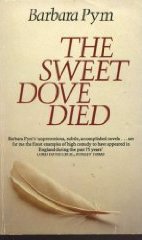
sweet doveI did read The Sweet Dove Died a week or so later, though. It’s a slight little book, yet it wasn’t an easy read for me: I kept picking it up and putting it down and letting myself be diverted to other books. It’s true I’d been on a steady diet of Dick Francis novels and so perhaps my reading senses (they’re like spidey senses only less tingly) were not attuned to Pym’s dry tone and small scale. I was eventually drawn into the pathos (or is it bathos?) of Leonora’s lost loves, and of course I abhorred the loathsome Ned … but I felt as if the larger significance of the subtle nuances were escaping me.

I was afraid that my relative inexperience and lack of success with Pym (I didn’t love Jane and Prudence either, when I read it last year) set me up badly for Felicity & Barbara Pym. It turns out, though, that the opposite was true, as Solow’s charming and slyly provocative book is (in part) a tutorial for someone not altogether unlike me. Not quite or even very much like me, I hope, as the recipient of the letters that compose the novel is a self-absorbed undergraduate who gets a little snippy at blows to her self-esteem. Actually, that last bit sounds kind of familiar … Anyway (as Felicity might say), she’s registered for a seminar on Barbara Pym and Mallory Cooper (whose side of the correspondence is all we see) is called in to provide some advance tutoring.

Felicity initially isn’t much better at appreciating Pym than I was, and Mallory is quick to call her (alright, us) on it:

Your notes aren’t bad. You have touched on a few themes that Pym’s biographers, editors, and critics analyse repeatedly: Silly men. Mousy women. Tea. Religion. Quotations. These are worthy of mention. The fact that you still think nothing happens is not. It merely shows that you do not respond to what does happen in the novel, for whatever reason — innocence, feminism, scepticism, youth, cynicism, thoughtlessness, expectation, or too rapid and therefore too shallow reading of the novel — too light, perhaps, a perception of the economy of expression Miss Pym employs.

OK, OK: I am appropriately shamed and humbled.

solow

Over the rest of the correspondence Mallory — cranky, erudite, witty, persistent — does her best to improve Felicity’s perception, working with her on nuances of dress and class, on historical contexts, on literary relationships (the riff on Religio Medici is particularly memorable), on silly men and, crucially, on the real significance of mousy women:

At best, the cultivation of mousiness is to participate in a distinctive moral past. At worst, it may indeed be a camouflage, brought about by war, under the protective covering of which the wish to inhabit one’s own cosmos peacably can be fulfilled.

“And now,” she continues, “– on to Tea” — and the excursus on tea is a wondrous thing indeed.

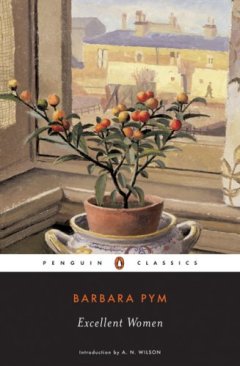
The Pym neophyte will benefit enormously from all of this: I have been moved not only to a greater appreciation of The Sweet Dove Died (“There is even an entire Pym novel devoted to the downfall of elegance, beauty, and taste, personified in the character of the colossally self-preoccupied Leonora”) but to a wish to reread Jane and Prudence and to acquire as soon as possible Excellent Women and Less Than Angels (at a minimum).

But the sneaky thing about Felicity & Barbara Pym is that Pym herself (as Solow acknowledges in her Preface) is not exactly the real subject of the book: instead, she’s a device for allowing Mallory — or  Solow — to critique academic approaches to literature she thinks are limited and limiting. Pym’s lack of academic currency (and really, how likely is it that anyone would offer or take an entire seminar on her novels?) makes her useful for this project: “she is such an antithesis to the prevailing attitude.”

It’s a project that could, like Pym, seem “outmoded.” Mallory speaks with nostalgia of a time when universities “were sacred to the pursuit of education, whereas now, for the most part, they are desultorily engaged in the dispensing of narrow expertise.” Her position is not exactly anti-theory: there’s even a theory primer of sorts near the end, which, though brisk and tendentious, is not inaccurate and includes the full URL of a real website at Brock University for “some rather more practical assistance,” perhaps even enlightenment. I might sum it up as a “pre-theory” position: Mallory feels that the literary conversation, particularly but not exclusively in the academy, needs to start with what Solow calls “the context of the civilisation of literature itself” — not just the big picture but the really big picture. “We do not read, after all, as a species,” Solow says in her Preface,

in order that we may deconstruct and dissect. People buy books and borrow books from libraries because they like them. They read, re-read, recommend, learn from, incorporate values from, live by, study, and take to bed at night, books they like; books they appreciate; books they find meaningful.  Appreciation is not perhaps what the university requests of its students today. But it is what writers … deserve.

As Felicity’s tutor, Mallory keeps broadening, rather than narrowing, the field of inquiry, the scope of questions. The ultimate goal, though, is not to ignore the range of theory, interpretation, and scholarship available but to arrive at it equipped with as rich an “appreciation” as possible, so that you can figure out its worth for your reading (and writing) with some independence. “I hope you will not ignore all of these critics,” exhorts Mallory, “for, among the labyrinths of nonsense, there is great, great worth. But that is for you to discover . . . ”

Excellent Women

To some extent I sympathize  with Mallory’s skepticism and impatience with the “labyrinths of nonsense,” and I certainly embrace the idea of appreciation, which is something I often pitch to my own classes as our goal (as opposed to, say, “liking”). The kind of appreciation Mallory endorses is also, crucially, not an anti-intellectual kind. There’s even a paragraph in the book that is eerily like a speech I have given more than once:

I want you to feel — and feel deeply about literature. But I also want you to know why and how these emotions are engendered by the writer, the text (apart from the writer), the words (apart from the text) as well as the relationship between the reader and all of the above. I also want you to be able to take that emotion out of any equation when it is necessary to do so. Otherwise, we could all take courses in “My Favourite Books” and spend endless and idle time in groups resembling your friend’s therapy session “sharing” our feelings about why we just love Gone with the Wind and how cool Harry Potter is. Not that there is anything wrong with that, intrinsically. But it’s not what we do in academic literary studies. If that’s what you want to do, join a book club.

Yet there are aspects of Mallory’s approach, and even more of her tone, that seemed a bit 1990s-culture-wars-ish to me, and I wondered how important it was that Felicity & Barbara Pym is epistolary fiction, rather than a straightforward first-person treatise or polemic: is Mallory herself being ironized even as she’s the vehicle for Felicity’s (re)education? Is her rather prim tone and affected manner a way of placing her at a safe distance? Are we meant to embrace her nostalgia, or to see her as embodying another among the list of theoretical approaches, one that purports to speak for the universal value of literature but that, in doing so, reveals its own limitations? (The book is actually, Solow says, “both fiction and non-fiction”; there are clear biographical parallels, but it’s also clear that we aren’t meant to assume a direct identification of author with speaker.)

Felicity & Barbara Pym, then, provokes as well as amuses. It had lots of connections, sometimes unexpected, to my own adventures in re-thinking literary criticism (speaking of “why we just love Gone with the Wind!). I would recommend Jane Smiley’s 13 Ways of Looking at the Novel over Francine Prose’s Reading Like A Writer, and I didn’t much care for Elif Batuman’s The Possessed, but these are hardly irreconcilable differences to have with a book  so lively and ingenious.

Full disclosure: Harrison Solow and I follow each other on Twitter and have had more than one friendly exchange. I first learned about Felicity & Barbara Pym as a result of this contact — and I’m glad I did.

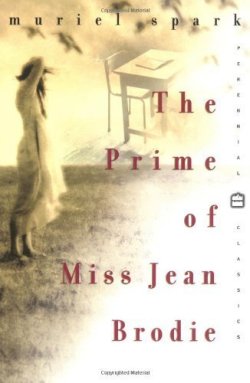
The Prime of Miss Jean Brodie: The Crème de la Crème?

I’ve finally read The Prime of Miss Jean Brodie: that’s one more potential “Humiliation” winner gone!

spark

I very much enjoyed reading this novel. And yet I felt as if I understood better what it was about than why it was written as it was. Miss Jean Brodie is a fabulous character, as charismatic as a creation as she is as a teacher. I can’t disagree with Hal Hager’s effusive remarks in my sleek Harper Perennial Modern Classics edition: “Irrepressible, imperious, and irresistible, she has joined the ranks of those fictional characters who, through the sheer power of their lives on the printed page, endure in memory and in the culture from which they spring.” Long before this meeting with Miss Brodie on the page, I felt I knew her, partly from having seen (though years ago) the film with Maggie Smith, and partly also from the general circulation of lines from the novel: “For those who like that sort of thing, this is the sort of thing they like”; “You are the crème de la crème”; “I am a woman in my prime.”

The novel’s a fascinating study in the problematic allure of charismatic leadership: Miss Brodie’s fascination with fascism (“She had returned from Germany and Austria which were now magnificently organized”; “the German brown-shirts, she said, were exactly the same as the Italian black, only more reliable”) has a comic aspect but is also frighteningly apt, and reflective of her own power over her “set” — though that power proves more wishful or elusive than the forms of authoritarianism she so admires. Miss Brodie is perhaps the agent of her own undoing as a leader, as she fiercely individualizes her girls and preaches the evils of “team spirit” (“phrases like ‘the team spirit’ are always employed to cut across individualism, love and personal loyalties”). It’s no wonder that this tension between leading and following eventually causes the set to implode.

The novel is equally preoccupied with the complications of sexual feelings: repression, desire, speculation, displacement. The girls’ prurient fascination with sex, and especially with Miss Brodie’s sex life (real and imagined), shows how entwined these feelings are with charismatic leadership, I thought: teaching, for instance, is always a kind of seduction, an attempt to win over hearts and minds, and Miss Brodie’s allure holds as long as she (knowingly or not) effectively channels her students’ erotic longings. Once they outgrow her — once they have sexual experience and power of their own, for instance — her grip on them begins to weaken.

There’s lot to think about in Spark’s strange, acerbic novel, lots to be amused and appalled at. But I was disoriented by some aspects of its style: I can’t see yet how they help me appreciate the tangle of emotions and politics and personalities the novel brings together. For instance, why does Spark insist so repetitively on characterization by tagline — there’s Rose (“famous for sex”), Mary (dies in the fire), Monica (mental math and fits of anger),  Eunice (does the splits), Sandy (“small, almost nonexistent eyes”). I appreciate that we need to get them all sorted, and that these are shorthand ways of indicating some fundamental things about them, but why reiterate their tags so incessantly? And why does Spark love prolepsis so? The chronology of the novel as a whole is quite an intricate braid of events from 1933 to 1939, but there’s a constant flitting still further ahead to the girls’ futures, as well as to Miss Brodie’s eventual end. Perhaps it is a way to signal that, intense as the school experience is, it is only a short interlude — or, the other way around, to bring out the lasting effects of early influences? I’d be interested in anyone’s ideas about  unities of form and content! My expectations were very high for this novel, and I’m a bit disappointed that at this point it seems more glittery than brilliant.

Rereading Dick Francis: the Top Ten!

0430 SOCIAL Racing[The essay for which this reading was preparation was Spinster, Victim, Soldier, Spy: Dick Francis and the Evolution of Female Characters in Crime Fiction, published in the Los Angeles Review of Books in 2013.]
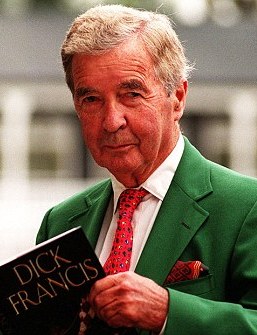
I have been binge-reading Dick Francis in service of an essay project that is steadily, if a bit stumblingly, heading towards completion. One question I’ve been asked pretty often when I mention that I’m doing this is “Which Dick Francis novels are your favorites?” A variation on this is “If I haven’t read any Dick Francis before, which one(s) should I start with?” You might think that, with so many books with so much in common, the worst time to answer these questions is right now, before the dust has really settled. On the other hand, the differences have never been — and probably never will be again — as clear in my mind as they are now. Interestingly, too, there are definitely standouts for me — and I think there are a couple of duds, too. And so, without further ado, here’s my Top Ten list.

10. Nerve (1964): Rob Finn, the lone jockey in a family of musicians, faces off against a malevolent villain driven by obsessive hatred of jockeys. The motive and thus the plot is a bit strained, but the book is brisk and suspenseful, and Rob Finn is a good early prototype of what becomes the classic Dick Francis hero.

8. and 9. Break In (1985) and Bolt (1986): Both feature jockey Kit Fielding, one of only two repeaters in Francis’s cast of characters. Kit is a good character, worth revisiting, and over the two books we get an interesting narrative arc involving his relationship with Danielle, niece of Kit’s patron, the excellent Princess Casilia. Racing is central to these books, as it is to Nerve, and Francis writes with great energy and great sympathy about horses and their riders.

7. Banker (1982): Here our hero is investment banker Tim Ekaterin, who gets a different return than he expects when he puts money into a race horse. Banker features one of Francis’s many strong women characters, here a pharmacist whose expertise proves essential to solving the case.

6. To the Hilt (1996): This time our hero is painter Alexander Kinloch, who prefers the solitude of the Highland mountains to life in society but is drawn into a thicket of family and corporate villainy. I’m particularly fond of this one, partly because the details about painting are fascinating, partly because of Alexander himself, and partly because of, again, the strong women characters. The most interesting one this time is Zoë Lang, a fierce 80-year-old expert on all things antique and Scottish. I can’t at all picture the portrait of her that Alexander eventually paints, and I don’t know if the technique described is even possible, but she believes he has made her “immortal.”

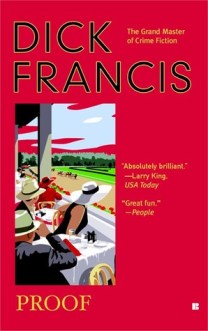
proof5. Proof (1984): In this one, Tony Beach, wine merchant, is on the site of a terrible accident and ends up drawn into its causes and facing off against some of Francis’s most cold-blooded villains (I’ll just say plaster of Paris and leave it at that). The investigation includes a lot of drinking — mostly scotch, and we get a lot of expert information about how it’s made and how to tell one kind from another. Tony is one of Francis’s best characters: a widower, he is broken with grief for his lost wife, while as the son of a military man, he is painfully conscious that he isn’t living up to his father’s standard of courage and masculinity.
4. Reflex (1980): Reflex features Philip Nore, jockey and amateur photographer, who gets caught up in a complicated tangle of blackmail and murder. A lot of the plot turns on his ability to solve photographic puzzles — so, again, the expert information is intrinsically interesting. But so, too, are the characters, including Philip himself, with his unusual family history, and his eventual love-interest, ambitious publisher Clare.

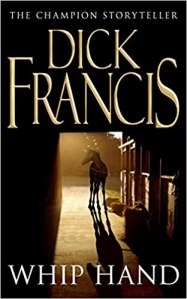
whiphand2. and 3. Whip Hand (1979) and Come to Grief (1995): There’s a good case to be made for ranking at least one of these as Number 1. The protagonist in both is former-jockey-turned-private-eye Sid Halley, who actually appears in four books altogether. The first, Odds Against, is also quite good, but the last one, Under Orders (2006) is one of only two Dick Francis novels that I consider real duds (the other is Blood Sport). Sid is Francis’s best-developed and most complex and interesting character, the array of secondary characters is robust and, again, interesting, and the plots are among Francis’s best. The title Whip Hand alludes to Sid’s greatest weakness: before Odds Against begins, his left hand was badly damaged in a racing accident, forcing his retirement; I won’t give away exactly what happens, but in the next two books he has a prosthetic left hand and greatly fears damaging or losing his right one. His blend of persistent, almost obstinate courage with soul-crushing weakness takes the typical qualities of the Dick Francis hero — always very human, never a superhero — to an extreme.
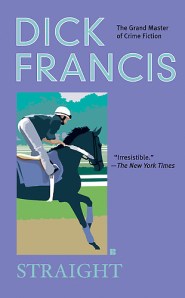
1. Straight (1989): It’s possible that Straight is not in fact the best Dick Francis novel, but it is certainly my favorite. The hero, steeplechase jockey Derek Franklin, inherits all of his brother Greville’s problems along with his business. Greville was a gemstone dealer, and so this time the expert information includes lots of tidbits about jewels and their composition and value. Derek is another good character, strong and likable and principled; his regrets over not having known his brother better add a bittersweet tenderness to the story as it unfolds. It’s still a thriller, but it’s also a good novel about people and their complicated mixed motives.

straightSo there they are: my top ten! No doubt this list reflects my taste as much as any objective standard of quality. Also, surprisingly many others stood up very well to rereading, including sentimental favorite The Edge (which takes place on a ‘mystery’ train across Canada), Decider (I especially enjoy the insights into architecture and building), Twice Shy (which has not one but two protagonists for our crime fighting pleasure), Shattered (with lots of fascinating insight into glass-blowing) and Hot Money (which is the closest of them all to a ratiocinative mystery).

If you’re also a fan, what do you think – is my top ten close to yours? Have I skipped over a favorite? And if you’re not (yet) a Dick Francis reader, are you tempted? Be sure to report back if you read one (or more) that I’ve recommended.

Middlemarch for Book Clubs: the beta launch

OxfordJust over a year ago, I got somewhat exercised over a news story claiming that Middlemarch is the kiss of death for book clubs. My annoyance was exacerbated by the number of links it got from other sources, which added up to quite the anti-Middlemarch buzz for a while.

My first response was a post on this blog that included a list of 10 tips to help book clubs that wanted to read Middlemarch but felt they could use a little support. In that post I also made a bold pronouncement: “I’ve decided, therefore, to put together an online site to encourage and support reading Middlemarch–whether in book clubs or on your own.” I was and am well aware that there’s no shortage of information about George Eliot and Middlemarch already available, but the work of finding and filtering with an eye to what might be useful and illuminating for book clubs (rather than, say, scholars) is not insignificant, and having relevant basics gathered in one place might — or so I thought and hope — simply be convenient.

middlemarchsite

At long last, I have a full (if not necessarily finished) version of that site now up for people to take a look at. As you’ll see if you visit it, it’s not a very fancy thing — it’s just a free WordPress site. I chose what I hope is a clean, easy-to-read theme and set up what seemed to me like simple but useful categories. At this point I feel very aware of what is not there (many more topics could be covered under ‘contexts,’ for instance) and also of how what is there reflects my own interests and idiosyncrasies as a reader and teacher of the novel. Depending on the response to this draft version, I could certainly end up adding more material. But I’m not sure I want to try to neutralize my own perspective: good discussions arise from encounters between different people’s minds, and I wanted the site to convey the sense that there’s a person behind it. That’s why I let myself be kind of chatty, including in the questions.

There are lots more excuses explanations I could offer for what I’ve done so far, but I think I’ll leave it at that for now. I welcome feedback, here or at the site, particularly from people who might some day — or have already — chosen Middlemarch for reading with their own book clubs!


“This blurred world”: Elizabeth Taylor, A Game of Hide and Seek

Elizabeth Taylor is the first repeat author we’ve chosen in my F2F book club: for our last meeting, we read Angel, which was such a surprise hit we agreed we’d like to try more of Taylor’s novels. By “surprise hit” I mean in part that because we had no expectations, we were surprised to find ourselves so engaged with the book (which is not to say everyone loved it, but we all liked discussing it). But I also mean that we were surprised by its particulars: by how many things about it are unlike other books any of us had read. It is strange and dark and sad and comic and grim and satirical, all at once. And talk about an unlikable heroine! And yet we all found her a perversely captivating one.

taylorhideandseekSo we’ve moved on to A Game of Hide and Seek, which is the other of Taylor’s novels recently reissued by New York Review Books. We haven’t met to discuss it yet, and I’m quite curious to find out how the others responded. For me it was surprising all over again, because at first it didn’t seem very much like Angel. And yet the more I think about it, the more I realize that despite the fairly different story and structure, it does resemble Angel, not in its characters or events but in its attitude. Both novels proceed with a relentless lack of sentimentality that is all the more unexpected in A Game of Hide and Seek because it tells what might be called a love story.

A Game of Hide and Seek tracks the awkward, uneven relationship between reticent Harriet and erratic Vesey. Harriet knows she loves Vesey from early on, but for some time she is tormented by uncertainty about how he feels about her — or, indeed, whether he feels anything at all. Believing there is nothing between them, she marries Charles — older, steadier, uneasy because he knows she nurses a secret passion for Vesey, who, after being both emotionally and then physically absent while Harriet yearned for him, turns up again now that Harriet is unavailable. Harriet and Vesey flirt (though that seems too perky a word) first with each other and then with outright adultery.

I found it impossible to root for a consummation of their love: Harriet is a drip, and Vesey is a bit of a jerk. It is love, though, I suppose, that is hiding and being sought, though the novel doesn’t give a very encouraging idea of what, exactly, love is. Harriet’s early infatuation is completely inexplicable: is that perhaps the point, that love is something that trumps or eludes reason? Or perhaps, as Harriet’s friend Kitty cautions her, the problem is loving an idea instead of a person: Harriet longs for love, and she believes Vesey to be her love, while he does just enough — he is just enough — to sustain the fantasy.

It’s the idea of Vesey and Charles’s knowledge of Harriet’s longing for him that undermine Charles and Harriet’s marriage. Taylor is very good at evoking the isolation that comes with unhappy intimacy:

Beyond their familiarity and nakedness, they could now sense their true isolation and were more perfectly strange to one another than people passing in a street.

After Vesey’s re-entrance into Harriet’s life, her daughter Betsy develops her own crush on him. In an odd twist, Betsy comes to believe Vesey is actually her father, which is at once traumatizing and gratifying:

That life was so unlike Greek literature had been the worse for life, to her mind. To-night it came — on the strength of a cryptic note, a faded photograph — magnificently near to it.

Her other crush, her Greek teacher Miss Bell, urges her not to “be such a slave to [her] feelings.” Miss Bell herself eventually has to leave for a new school, and one reason is that she has made too much of a favorite of Betsy: the lesson she carries away is “never [to] grown fond of any of them.”  Is it possibly better that love be neither sought nor found?

A further facet of the novel is its suffragette backstory: Harriet’s mother and Vesey’s aunt are close friends who were once “hustled, gripped above the elbows by policemen, up the steps of a police-station.” Their heroism embarrasses more than it inspires Harriet, who shows no particular interest in the bright future they fought to win for her. Her one independent move is going off to work in a dress shop, but this is a prelude only to her marriage, not to any assertion of herself or pursuit of a more rewarding career. It’s Betsy who finds her grandmother’s adventures exciting.  I don’t know how to put this piece together with Harriet and Vesey’s strange affair. Maybe I’m not supposed to: maybe it’s just there, rather than there as part of an aesthetic or thematic unity. Some people’s mothers really were suffragettes: does it have to mean anything? Why do I always seek unifying ideas?

Yet there are teasing intertextual moments that make me think it’s not wrong to try to solve the novel’s puzzles, as when Charles sits reading Persuasion while entirely conscious that something is afoot with Harriet and Vesey:

‘What a novel to choose!’ Charles thought. ‘Only the happy in love should ever read it. It is unbearable to have expression given to our painful solitariness, to rake up the dead leaves in our hearts, when we have nothing that can follow (no heaven dawning beautifully in Union Street), except in dreams, as perhaps Jane Austen herself never had but on the page she wrote.

Persuasion is another novel of love lost and regained; A Game of Hide and Seek could certainly be read as the anti-Persuasion, in that its lovers have aged but not grown, while their past love does not seem worth either remembering or reviving — even though they both remember and try to resuscitate it. Anne and Wentworth learn to fight for the love that will enable a new, better life; Harriet and Vesey, in contrast, can barely see what would be right, much less fight for it. Not knowing where they are, or where they’re going, is liberating at first, even though at the last minute they realize they have been stumbling towards a big mistake:

He walked beside her with the rose hanging from his hand. The taste of the fog was at the back of their throats. They could see only the shape of one another and, when they spoke, so private, so safe did they feel that they neither paused nor dissembled. In this blurred world, words were more beautiful and they used them more truthfully than at other times.

 Taylor’s writing is a bit like that. Sentences can be meandering and difficult to follow, leaving you disoriented:

This morning, however, she was ruffled herself, felt that a real sequence was so broken that the punctual arrival of the milk-man, the charwoman coming in at the back door at her usual time, were small mockeries, piteous pretences, like the first meal after a beloved one’s death, not even reaffirming that the world goes on as usual, that in the midst of death we are in life.

But then ideas emerge clearly out of the fog, giving you a distinct outline of feeling or intent:

‘Nowadays,’ she thought, ‘perhaps always, happiness has to be isolated. Only when we block out all that surrounds it, can we have it perfect, as we so often have perfect grief.’ She felt that she must not grope backwards over her conscience, or forwards over her desires, but keep her contentment in this different climate while she could.

A lot seems blurry in A Game of Hide and Seek: character, motive, plot, morality, meaning. Taylor creates a climate of yearning and dissatisfaction, though, in which words seem sometimes beautiful and sometimes true.

How human! Giuseppe di Lampedusa, The Leopard

Pictureleopard8Giuseppe di Lampedusa’s singular classic The Leopard is the latest book for the Slaves of Golconda reading group. Three other readers have already posted their thoughts, and having read their interesting remarks I find myself wondering what I have to add! They’ve all mentioned aspects of the book that I was also interested in. Alex, for instance, stresses the sensuality of the language: “It is by far the most insistently, sensuously, even seductively, oppressive book I’ve ever read. It made me want to applaud, underline and shudder in equal measure and often with just one very clever, deviously evocative phrase.” As both she and litlove point, out, the book’s beauties always coexist with horrors, so the garden scene Alex quotes, for instance, brings on gloomy thoughts for the eponymous protagonist, Don Fabrizio, because walking among his flowers he is reminded of the corpse they found among them not long ago:

They had found him lying face downwards in the thick clover, his face covered in blood and vomit, crawling with ants, his nails dug into the soil; a pile of purplish intestines had formed a puddle under his bandoleer.

And yet for all of its grim accents, The Leopard is also, as Stefanie and litlove observe, very funny — even, glancingly, in this lush but haunted garden, mostly because of my favorite character, the dog Bendicò:

every now and again the dog would turn innocent eyes towards him as if asking for praise at labour done: fourteen carnations broken off, half a hedge torn apart, an irrigation channel blocked. How human! “Good, Bendicò, come here.” And the animal hurried up and put its earthy nostrils into his hand, anxious to show it had forgiven this silly interruption of a fine job of work.

How human, indeed! I think for me that was one of the keynotes of this odd novel, which takes such a sideways approach to history. Don Fabrizio, born and bred to power, is moving sometimes deftly, sometimes awkwardly, but always inevitably through a period of transition to a future he neither understands nor endorses. “I belong to an unlucky generation,” he explains in one of the novel’s (bizarrely long) monologues, “swung between the old world and the new, and I find myself ill at ease in both.” The novel is about the human experience of that unease — the sense of change beyond one’s control. The Prince is mostly a man of good faith and good intentions, and so although he does not like the new world order emerging, he does not fight it either. Not only does he not resist Garibaldi’s move on Sicily, to incorporate it in the newly unified Italy — and what, after all, could one man, however formerly powerful, really do to resist this sweeping movement? — but in his own family he also makes concessions, approving the match between his beloved nephew Tancredi and the daughter of his upstart neighbor. An old name, a lot of new wealth: this is how families adapt and survive.

Earthly things ebb and flow; one of Don Fabrizio’s virtues is that he recognizes this and feels melancholic, rather than vengeful, as his own influence wanes. A dedicated amateur astronomer, he takes comfort from the serene continuity of the stars:

At the cross-roads he glimpsed the sky to the west, above the sea. There was Venus, wrapped in her turban of autumn mist. She was always faithful, always waiting for Don Fabrizio on his early morning outings, at Donnafugata before a shoot, now after a ball.

Don Fabrizio sighed. When would she decide to give him an appointment less ephemeral, far from stumps and blood, in her own region of perennial certitude?

 When that time does come, he reflects on his heirs and realizes that they will not, cannot, carry on the family in any more but name:

the last of the Salina was really himself, this gaunt giant now dying on a hotel balcony. For the significance of a noble family lies entirely in its traditions, that is in its vital memories; and he was the last to have any unusual memories, anything different from those of other families. . . .

 He had thought that perhaps, by changing, he could keep things the same, but of course that hope is as paradoxical as its logic.

Don Fabrizio is not literally the last of his family, and the book carries on after his death with his daughters in their old age. They are at once pathetic and comical in their attempts to maintain their family’s dignity. Now the family traditions are reduced to “mummified memories” — among them, with delightfully morbid literalness, is Bendicò,”dead for forty-five years, embalmed for forty-five years, nest now of spiders’ webs and moth, detested by the servants who had been imploring Concetta for dozens of years to have it thrown on the rubbish heap.” At the novel’s end Concetta has lost altogether her sense of place and certainty in the world: “she seemed to be living in a world known to her yet strange, which had already ceded all the impulses it could give her and now consisted only of pure forms.” I wondered at first why the novel hadn’t ended with the death of the Prince, but on reflection it seems appropriate to show us the incompleteness of any change, the endless pressure of time’s forward movement and the incremental but relentless concessions people have to make to history. Eventually Bendicò, symbol of the eager spirit of the Leopard’s vigorous past, makes his own symbolic exit:

As the carcass ws dragged off, the glass eyes stared at her with the humble reproach of things that are thrown away, got rid of. A few minutes later what remained of Bendicò was flung into a corner of the courtyard visited every day by the dustman. During the flight down from the window its form recomposed itself for an instant; in the air there seemed to be dancing a quadruped with long whiskers, its right foreleg raised in imprecation. Then all found peace in a heap of livid dust.

How human!

Blogging: Accept No Substitutes!

Lady (Waterhouse)Some time ago (two years, to be precise — where does the time go?!), I wrote a testy post about some things Leonard Cassuto said about blogging in an online discussion about academic publishing. One of my chief complaints was that he threw “a veil of pragmatism” over “an argument for accepting (even reinforcing) the status quo”:

Yes, it’s true: there is a “prestige deficit.” But I would have expected a discussion about ways the digital age is changing academic publishing to at least evaluate, if not actually challenge, that normative thinking. . . . We might also consider whether there are other goals in academic publishing (particularly related to work in progress or collaboration) or other values (such as open access) that are better served by non-traditional forms including blogging.

“Nobody that I know of,” I went on to say, “is trying to argue that blogging in general, or even particular highly scholarly blogs, should replace traditional publications.” As far as I’m concerned, the question should always be what forms of publication best serve the multiple goals and interests that motivate us to write and publish in the first place. These are diverse, and so too, I think should be our styles and outlets.

Plus ça change… The debate about what place, if any, blogging has in academic publishing not only continues but continues to stress the is over the ought.  A post this weekend at ‘dagblog’ explained the way things are:

You can’t blog your way to a tenure-track professorship. You simply can’t. Even a gig at IHE orThe Chronicle for Higher Education is not enough. That doesn’t mean blogging is not professionally useful to you. It means you need to be clear about what it’s useful for.

Blogging and other social media serve academics by bringing you to other people’s attention and building your professional network. It works largely as publicity for your other work, and it widens your potential audience while strengthening your connections. . . .

 What blogging never does is substitute for other academic writing. It doesn’t get counted as scholarship. It does not serve as an employment credential. (If you wish to argue that it should, I can’t help you. I’m interested in describing what is, not what ought to be…)

I don’t altogether disagree with this as a statement of how things are. In fact, I made similar points in my own post “Should Graduate Students Blog?“:

it would be naive to ignore that blogging (for some good and some bad reasons) is not yet widely recognized as a legitimate form of academic publishing and that the case for it as productive academic work at all remains a difficult one to make. Graduate students aspiring to tenure-track positions hardly need to be told that for most hiring committees, the crucial measure of their competitiveness as candidates will be the number of conventional peer-reviewed scholarly publications on their c.v.–and the more prestigious the venue, the better.

I also said, however, that

blogging is increasingly acknowledged as having a place in the overall ecology of academic scholarship. Graduate students who choose to blog should by now be able to make a thoughtful and well-supported case for the value of that effort as part of their overall scholarly portfolio.

Notice that I do not say that it “substitutes” for other academic writing but that it has a place alongside what we have for some time (but not for-absolutely-ever) seen as the only legitimate (that is, countable for hiring / tenure / promotion) forms of academic writing.

I strongly believe this, and I have some local evidence that such a view is taking hold: the recently developed Tenure & Promotion guidelines in my own Faculty of Arts and Social Sciences include, under the heading “Indicators of Academic Research and Scholarship” (and right after “peer-reviewed publications or performances)”,  “Other forms of publication or public performance, peer-reviewed or otherwise, in venues such as blogs, policy publications, public concerts, etc.” I don’t know if acknowledging that this is a pretty significant change sounds like the kind of “blog triumphalism” dismissed as passé in the dagblog comments thread — but it certainly seems significant to me.

But this is still focusing on the is, rather than the ought. Is acknowledging blogging as a valuable supplement to other kinds of academic writing and publishing as far as we ought to go? As Ted Underwood notes in his comment at dagblog, “blog is a baggy category.” So too, I’d add, is “academic writing,” which comes in many flavors even within any given discipline. Of most interest to me is, of course, my own discipline, in which the bulk of academic writing falls into the extremely baggy category “literary criticism.”

After reading the dagblog article on the weekend, I tweeted, “If your job is criticism and you write criticism on your blog, why doesn’t that “substitute” for academic writing?” In response, Miriam Burstein asked, “Is it really equivalent, though? I think of much blogged crit as being, at best, like a highly-polished 1st draft…Something that may take 3-5 days is a “long” composition time for a blog, as opposed to 2-3 mos. for an article.” I agree that these two kinds of publication are not the same thing. As far as that goes, if by “substitution” we mean “replacing with something that’s exactly the same,” then OK, we’re done.  But I would also say, as I replied to Miriam on Twitter, that a blog post is not the same as a blog, which over time is more than the sum of its individual parts. It’s blogging, not (usually) writing one blog post, that I would argue could be defended as an academic contribution. I would certainly support Miriam’s blog on these grounds! (Notice my careful qualifiers here: I’m sure we can all imagine and may even have seen a blog post that is every bit as substantial and lasting as a conventionally published article, as well as a blog that for whatever reasons is simply not a convincing part of an academic’s portfolio.)

I would say too that the differences between blog posts and academic articles are not all to the disadvantage of the former. And I would say that for literary critics, at least in some ways or some cases, the difference in kind is not as great as all that — not as great as it might be in other fields. It depends, for one thing, on what kind of literary criticism we’re talking about. In the dagblog post,  the author suggests that

the distinction [between blogging and scholarship] doesn’t pose a problem to science bloggers, or to most social scientists or historians, where the difference between a journal article and a blog essay is usually self-evident. But it can be tricky for people who work in literature or cultural studies, who can be tempted to blur the distinction between writing scholarship about new media and doing other writing on new media platforms.

That makes us literary types sound kind of clueless! (I admit, however, there’s some justice in that comment, as I have more than once explained to my own colleagues that no, writing literary criticism online does not mean I’m doing “digital humanities.”) I’d actually like to suggest, though, that, setting aside that kind of confusion between content and form, “the difference between a journal article and a blog essay”  is not entirely self-evident when we’re talking about literary criticism, and that’s precisely because literary criticism is not a science or a social science. Our preoccupation with publishing in peer-reviewed academic journals reflects some anxiety on our part about that: it’s a kind of scientism that has been beneficial in making some aspects of literary scholarship more rigorous and accountable, more historically attentive, and more theoretically sophisticated, but that has also shaped our profession and our professional lives in occasionally disheartening ways. To be taken seriously, we know we have to look serious, which means avoiding at all costs what was scathingly described (by a peer reviewer of my one and only — and of course unsuccessful — SSHRC application) as “the whiff of belles-lettres.” Bonnard The Letter

There are kinds of literary research and scholarship that have a lot in common with history and the social sciences, or that are so well insulated with theoretical implications that no such unsavory whiff could possibly be detected. But a lot of what literary academics do is not so much produce new knowledge as pursue new understandings of, or ways of understanding, literary texts. Careful close readings lie at the heart of many more elaborate scholarly projects. It is certainly possible to do this kind (or this part) of criticism in an open, accessible way, without the specialized language and complex apparatus of argumentation and citation that differentiate academic from non-academic versions of it. Academic training can be hugely beneficial for this enterprise, but such training need not be conspicuous to be effective. We are experts at reading literature in interesting ways and articulating those readings — that’s what we do. What difference does it really make where we do it? Why should we value it, or consider it “professional writing,” only if we do it in a style and form that severely limits the audience for it and the conversation we can have about it?

Where is the self-evident line, then, between the interpretations of novels we find in academic essays and the interpretations of novels we can find on blogs — besides (again) some specialized vocabulary and a lot more footnotes? In both cases we can and should look closely at the quality (the intelligence, the care, the subtlety, the persuasiveness) of the interpretation, but I would argue that there is a fundamental similarity in the activity represented that — while (to reiterate) it does not mean the final products are exactly the same — is at least as important as any differences. It really is the same kind of thing, just done under different circumstances, for different audiences. 

The author of the dagblog post adds in the comments a statement that seems to shift from description to prescription: “blogs are really not good vehicles for academic or professional writing.” Well, again there’s the bagginess problem that makes any such big generalizations about blogs imperfect. But besides that, what I object to is the implication that academic writing really can’t be done in other forms or venues, or that it’s the form or venue, not the content or purpose, that defines “academic or professional writing.” That may be true pragmatically, and in some disciplines it may be necessarily true (I’ll let scholars in those fields hash this out), but at least for literary folks, I think a case can be made that, as literary criticism is our profession, any time we engage in it we are doing professional writing. The desire to draw a firm line between what we do in academic journals and what we do elsewhere seems to me more reflective of our desire to defend ‘professing English’ as a profession than with any really principled or inevitable difference between the two. And, again, the results of that effort have not been altogether salutary, for criticism or for our profession.

jameswoodHere’s another way to think about the academic / non-academic divide. James Wood has done (as far as I’m aware) no conventional academic publishing (including How Fiction Works, which, however interesting and thought-provoking, is not really scholarly). However, he holds an academic appointment: he is the Professor of the Practice of Literary Criticism in Harvard’s English Department. Sure, it’s Harvard and he’s James Wood — but can’t we take away from this high-profile blurring of the boundaries between the academic and the non-academic critical worlds some support for other critics, at least as qualified as Wood, to practise criticism in other ways and other places than scholarly journals? And if we can make that concession, why not accept blogs as one perfectly good place for some of that work? Aren’t there even advantages to making the academy more porous, to engaging more personally and, yes, casually, with the rest of the world? It’s not as if academics are the only ones interested in literature, after all. In Canada we have been hearing a lot about ‘knowledge mobilization‘: if some of the value of conventional peer-reviewed publications is precisely their stability, the value of blogs could be said to be their mobility, their flexibility, and, in their own way, their accountability — because after all, there they are, open for anyone to read and argue with. Their basic model is coduction – again, not a scientific model, but one supremely well suited to the ongoing process that is criticism.

I understand the pragmatic issues, but if we think there is both intellectual and professional value in changing the norms of our profession, we have to keep making the argument, not shrugging our shoulders and reiterating the status quo. As I said in a further back-and-forth with Cassuto, this is a job for “senior, ‘established,’ faculty” above all:

we are the ones in a position to encourage alternative models of productivity and scholarship, and if blogging is valuable to me in the ways I described, there would be real hypocrisy in my case if I didn’t consider it valuable work for people at earlier stages of their careers and work to recognize it as such when they do it.

 I don’t know how much my own advocacy affected my faculty’s new T&P guidelines: I wasn’t on the committee and made no direct submission to it. But I have given three presentations at Dalhousie on blogging and academic publishing, including at a faculty research retreat, and I’ve been including my blog on my c.v. and a statement on blogging in my annual report for six years now. So I’m doing my best to walk the walk.

What matters to me most, though, is that I continue to practice literary criticism, including on my blog. That’s what I trained for, after all. I’ve made conventional academic contributions to my field, and that specialized work informs all the other writing I do. Blogging, though, is where I have the most fun with that expertise, and make it the most freely available. My scholarly articles and books are, I hope, good of their kind — but they are no substitute for Novel Readings!

Update: a shortened version of this post ran on the LSE Impact blog.

Open Letters Monthly: the June 2013 issue!

jeffsphoto

It’s a new month, and once again, a new issue of Open Letters Monthly is live and ready for your reading pleasure!

As usual, the pieces range widely and probe deeply. I have a proprietary interest in a handful of them. Alyssa Mackenzie, a former honors student at Dal (now doing graduate work on Virginia Woolf in NYC) contributed a great review of Sandra Djwa’s new biography of P. K. Page — by the time I’d finished working through it with Alyssa I was convinced I have not read nearly enough of Page’s poetry. Nicole Perrin, better known to some of you as bibliographing, takes a sharp look at Jane Gardam’s latest and (to her disappointment and mine) finds it not as good as her earlier books. My Dal colleague Jerry White has a stem-winder on Fintan O’Toole’s attempts to generate a new vision of republicanism in Ireland. It is genuinely exciting to work with people on books and ideas that they are excited about themselves, and gratifying to see our efforts (well, OK, the effort is mostly theirs, but I helped!) pay off with strong, interesting critical writing.

olivia-manning-a-woman-at-warMy own contribution is a review of Deirdre David’s Olivia Manning: A Woman at War, which I found fascinating for its account of Manning’s life and work and thought-provoking for the questions it raises about being (or refusing to be) a “woman writer.”

The issue also includes John Cotter’s take on Terry Eagleton’s How to Read LiteratureSteve Donoghue keeping up with the Tudors with a new alt-history account of Anne Boleyn, Spencer Lenfield with an impressively detailed and nuanced reading of Richard Ford, and much more. I hope you’ll come on over and read around in it — and if you read something you like, help us get the word out. Sometimes (perhaps unfoundedly) it feels like we are putting out the best online literary magazine nobody has ever heard of! And also, in case this doesn’t go without saying, if you ever have an idea for an essay or review that you’d like to contribute, let me know (rmaitzen at gmail).

Teaching Art: “Let me describe it to you”

I mentioned a couple of posts ago that we’ve been watching one of The Learning Company’s ‘Great Courses,’ The History of European Art. In the comments thread, I noted that the lecturer’s favorite move is to “describe” an artwork to us. At first glance (so to speak!) that seems an odd strategy: we’re looking right at the art, after all. There are many things we can’t do (interrupt him with questions chief among them) but we can see what’s right in front of our own eyes.

holmes

Or can we? That, of course, is the trick, the gimmick, the magic, even, of the process. We see it, but, as Sherlock Holmes so often says to poor Watson, “You see, but you do not observe.” The untrained eye does not really know what it’s looking at. Professor Kloss may begin by stating what seems self-evident (“there’s a woman in the center of the painting,” “the man on the left side is wearing a wonderful blue robe”) but this is only a preliminary stock-taking, prior to pointing out what requires more expertise to really see: who the woman is, perhaps, and how this version of her differs from other ones; how the blue robe makes other blue bits stand out and maybe form a design across the canvas; why that particular shade of blue is rare in frescoes; how the artist’s brush strokes create a light effect on the woman’s body; what the striking whiteness of her skin suggests about not just the design but the larger meaning of the painting. Even the stock-taking is sometimes a good prompt: perhaps I wasn’t looking at the man on the left at first, because my eye was more immediately drawn to something else.

It’s not a perfect process, especially pedagogically. Not only does Professor Kloss often not describe something we’re curious about, but he never invites us to look first and see what we notice. Realizing this is salutary, as I’ve been thinking that his method is close to one kind of thing I do all the time in my classes: focus on a scene or a passage and try to bring out what’s interesting about it. There too we typically start with a description: “what’s going on here?” Then we move to the more open-ended process of noticing: “what’s interesting about it?” Early in a course, I am likely to do sample analyses, to model what we’re trying to do. Throughout, I also provide relevant contexts, including historical, biographical, literary, or theoretical. But as we go along, the burden of noticing shifts more and more to my students: knowing what they’re looking at — being able to “describe” it with expertise — could be considered our ultimate “course objective.” When I lecture, but also when we discuss and analyze and debate in class, what we’re doing is accumulating the knowledge and skills to make their descriptions more than just statements of the obvious — in my classes, which are fiction-intensive, the crucial distinction is to make them more than just plot summary.

Watching Professor Kloss describe sculptures, lithographs, wood cuts, paintings, frescoes and everything else makes me very aware of how little I have in my own head that helps me with his task: he knows all kinds of things that I don’t, and as a result he sees all kinds of things that I wouldn’t. Sometimes I’d swear he sees things that aren’t there — and now I wonder how often my own students feel the same way. I’m also very aware of how passive it makes me knowing he’s going to do all of his own noticing, and how little room the video lecture format leaves for me to have any ideas of my own. Well, I could have speculative ideas: heck, I can pause the video and say anything I want! But what I really want is to test my tentative observations against his expertise. I feel confident in my own taste (many times I have thought, as he rhapsodized about whatever’s on his current slide, “I hate that!” or “That’s beautiful!”), but I know that visceral reaction is irrelevant to the important process of really seeing and understanding what I’m seeing. That lack of interaction with an informed point of view is the biggest obstacle to my becoming anything of an expert myself.

Édouard_Manet_-_Le_Déjeuner_sur_l'herbe

Of course, I’m never going to become an expert art historian, but my job is all about developing expertise in my students. Stocking their heads full of information is one thing, but it’s not the only thing, and it’s not the most important thing. In some ways, it’s also something they can do on their own, if they’re motivated, though as I’ve written about before, it’s easy to overestimate the ease and efficiency of finding good information, much less knowing how to make it useful. Watching Professor Kloss describe great works of art is very interesting, but it’s also very passive. It reinforces for me the pedagogical necessity of going back and forth. Sure, let me describe it to you — but now, tell me what you see. Then we’ll talk about it.

One question I would definitely ask Professor Kloss, if only I could: we’ve reached Monet and so far pretty much the only women in the series have been Madonnas, Magdalenes, saints, or nudes. In the history of European art to 1860, there’s not one woman artist worth including?

Middlemarch for Book Clubs: Preview #1 – Choosing an Edition

I’ve been working industriously on my Middlemarch for Book Clubs website. I hope to have a “beta” version of the whole site ready to make public by the end of June, but I thought it would be helpful for me to get some feedback on a couple of pages sooner rather than later. One reason is that I’m especially concerned about finding the right tone (not too didactic, but clear and practical; enthusiastic but not gushing), as well as the right balance between too much and not enough information. But also — and this is particularly important for a page like this one on choosing an edition — I can’t be sure if I’m providing the right information. I’d be glad to know if you think I’m on the right track, or, if not, what changes or corrections or additions you’d suggest.

Middlemarch for Book Clubs: Choosing an Edition

GENERAL CONSIDERATIONS

The first thing to consider is whether you want everyone in your group to use the same edition of Middlemarch. Even if you think that this would be a good thing, it may prove impractical, as people may already own copies, or may prefer one version over another for their own reasons. My classroom experience (as well as experience in my own book club) has taught me that it can be frustrating trying to talk about a long book when people quite literally can’t get on the same page. This is one reason to encourage people to use some system of navigational aids, like post-it notes! However, because Middlemarch is divided into Books and then into chapters, it’s not that hard to find common reference points.

The next question is whether you want to use a ‘popular’ or a scholarly edition. With a novel like Middlemarch, I think it’s a good idea to have a reliable, well-edited text with thorough annotations–not because you must consult them, but because you may want to. Scholarly editions not only include thoughtful introductions and explanatory footnotes (helpful for everything from literary allusions to historical contexts) but also point out changes made to the novel over its publishing history. One of the most interesting of these in Middlemarch is a tweak to its Finale that might spark some debate among the members of your book club, especially if you’ve talked along the way about how far Dorothea is responsible for her own bad choices.

RECOMMENDED EDITIONS OF MIDDLEMARCH

Oxford

Oxford World’s Classics: This is the edition I usually assign in my classes. It’s readily available, Felicia Bonaparte’s introduction is illuminating, the notes are good but not overwhelming, and the layout is readable and leaves enough room for annotations. In the current printing, there are two paragraphs out of order: bonus points for the person in your group who spots them! (I’ve notified the press and subsequent printings may be corrected.)


penguinPenguin Classics
: This is another fine, reliable edition, with a good introduction by Rosemary Ashton; it has the benefit of also being available as an e-book, which may be an advantage if some of your members use e-readers.


nortonNorton Critical Edition:
This edition is the most scholarly of the options, in that it conveniently packages a scrupulous edition of the novel with a selection of critical essays about it. If that’s the kind of thing your book club likes, this is the edition for you. If you doubt you’ll want to read the criticism, however, I recommend an edition with larger type!


broadviewBroadview Press Edition:
This handsome edition of Middlemarch is supplemented by contemporary reviews and documents (rather than the mostly 20th-century critical materials included in the Norton). It is annotated in great detail, with special attention paid to the role of the visual arts in the novel; it is the only one of these editions that includes illustrations. The footnotes do occasionally almost overwhelm the novel itself. This edition is also available as an e-book.

There are [will be] links to some free electronic full-text editions of Middlemarch on the ‘Links’ page. I don’t particularly recommend these for reading the whole novel, though of course you may find them fine for your purposes. The searchable e-texts are great, however, for finding lines you remember but forgot to mark with post-its!