Sometimes I think that was the happiest day of my life, those hours of heat and silence and colour, alone with David high up on the moor. But then I remember that I have said that of many other days, so I cannot be sure. This I know—that it was almost perfect. Not quite, for perfection is dull: it took the serpent to make Adam and Eve appreciate their garden.
I have had the nice British Library Women Writers edition of O, The Brave Music on my shelves for four or five years. I chose it as one of my samples when the series was launching because I remembered my mother saying it had been a childhood favorite of hers, but somehow I hadn’t gotten around to reading it yet; Shawn’s enthusiastic mention of it in a recent episode was just the nudge I needed. What a treat it was! I really enjoyed it.
O, The Brave Music follows young Ruan Ashley on her bumpy road towards adulthood. We first meet her when she is seven, living in the Manse with her stern preacher father, her beautiful mother, her older sister Sylvia, and her little brother Clem (“will he walk and talk soon,” she asks her father, “like other babies?”). Ruan’s story exemplifies the trend Anita Brookner so aptly describes in Hotel du Lac, by way of her romance novelist protagonist Edith:
In my books it is the mouse-like unassuming girl who gets the hero, while the scornful temptress with whom he has had a stormy affair retreats baffled from the fray, never to return. The tortoise wins every time. This is a lie, of course . . . In real life, of course, it is the hare who wins. Every time. Look around you. And in any case it is my contention that Aesop was writing for the tortoise market. Axiomatically . . . hares have no time to read. They are too busy winning the game. The propaganda goes all the other way, but only because it is the tortoise who is in need of consolation.
Ruan’s youth is full of hardship and loss, but Smith is definitely pitching her story to the “tortoise market” as it is clear from the beginning that (though Ruan herself is not always sure of this) it is better to be smart than beautiful, to love books more than boys, to be wild and free than to be (as Sylvia basically is) conventional and safe. Ruan is the direct descendent of Jane Eyre and Maggie Tulliver (though without their passion or rage) and an avatar of her most likely readers: other bookish girls who know they don’t quite fit the mould and long to be told that they will nonetheless win the game.
 The promise of ultimate victory for Ruan is embodied in David, her playmate, companion, and beloved. I give Smith credit for dangling the possibility that he will not, in the end, be true to Ruan: that her dream will turn out not to be his. Perhaps that would have been a more interesting novel, as it would have put their long alliance into a different light, undermining Ruan’s point of view (the novel is told in her voice)—but Smith spares her, and us, that disappointment. That said, the novel’s ending is surprisingly ambiguous or ‘open,’ and while Ruan is certain that happiness will come for her, “hand in hand with David,” I was reminded of the evasive ending of Villette.
Though the plot is well enough told and I was engaged throughout finding out what happened to Ruan and her odd collection of family and friends, what I liked best about the novel was how beautifully Smith (through Ruan) describes the moor, where Ruan is always happiest:
Now it would be lying asleep, dun and sere under sullen November skies, inimical to many, but never, never to me! Soon the snow would come; here, in these sheltered dales, a mere matter of an hour’s Christmas-card prettiness, followed by days of slush and mud; but oh, how different on the moor! My heart quickened at the memory of mile upon mile of untrodden purity, white as angels’ wings on the uplands, blue-shadowed in the hollows of air like bright sharp swords that you could almost see . . . of the solemn beauty that awed you when you peeped under your blind at night; so still, so vast and pure in the light of the moon, that a lump came in your throat because so much loveliness was not to be borne.
Even in deep grief, the moor brings Ruan life:
Up there, in the pure, clean moorland air, the pattern of life showed more clearly; on a larger scale. I lifted my eyes to the hills; and I perceived how minute, how unimportant, a portion of that pattern we made, all of us, and we no longer seemed to matter greatly.
Things do matter greatly to Ruan—the tension between that uplifting, unworldly liberty and the pull of both love and responsibility marks her maturation and gives the book, which is somewhat episodic overall, some unity and and also some depth. I think today we would categorize O, The Brave Music as “YA” fiction but like other examples of ‘books for younger people’ from an earlier era, it feels more sophisticated to me than much current YA fiction (as do the Pennington books, for example, which were favorites of my childhood and which I still reread with genuine interest).
A side note: the title of Smith’s novel comes from The Rubaiyat of Omar Khayyam (“O, the brave music of a distant drum!” is the line). Many years ago one of my teachers gave me an illustrated edition of the Rubaiyat, inscribed “To Rohan, a ‘rara avis.'” In retrospect, it was perhaps an odd choice, as I was in elementary school at the time. I just thought it was fanciful and beautiful; I was used to reading things I didn’t completely understand and picking out what I liked about them. What mattered most to me about it was that I felt seen, that I felt that being bookish could actually make me stand out in a good way rather than a bad way. I was (and am) very much a tortoise too!
 Probably most of the audience here knew the piece. But knowing it only made them eagerly anticipate the high point all the more. Masaru’s heart beat faster. And as always it struck him: What a truly emotionally rousing melody!
 There is also something just nice about the book, because the four characters it highlights care about music more than about competing. They are rivals in the competition but become caught up in each other’s playing. It’s not as simplistic as them rooting for each other instead of for themselves; it’s that as they listen to each other, they hear possibilities that excite them, idiosyncrasies that surprise them, and beauty that inspires them. It’s sweet. Their intersecting stories provide some structure for the novel as a whole, and by the end I was curious to find out who would win and why, but the outcome seemed almost beside the point by the novel’s conclusion—which I think is the point. After all, as one of the judges reflects, “could you really score art?”
 We watched this meeting with its strange weight of human dignity and goodness. I could not ever have believed that saying sorry might mean so much. None was their government. None bore responsibility. No one spoke for anyone other than themselves. Nothing said or done had any national consequence. Yet in that strange communion lay liberation. What other answer can any of us make to the terrible question of history?
 I expect Karen Powell’s Fifteen Wild Decembers is more interesting the less you already know about the Brontës when you read it, whereas I am pretty sure
 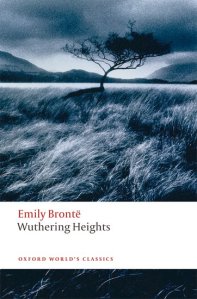 The novel is clearly building towards Wuthering Heights and includes some elements designed to get it, and Emily, and us, there, especially a boy (later a man) Emily sees on the moors who fascinates her with his elusive wildness. (There are hints of Cathy cutting her ghostly wrists on the windows too, among other allusions.) How the narrator of Fifteen Wild Decembers could plausibly generate the emotional frenzy of Wuthering Heights is not convincingly portrayed or explained, though. When Powell’s Emily eventually declares her aspirations for her fiction, they seemed to me unearned, not prepared for by what had come previously:
 And so on for another page and a half. For contrast, this is Gaskell’s account:
 I thought I had done very little reading in July, and I was prepared to defend myself: “
 The unexpected highlight was a very last minute choice: an interesting conversation with my lovely mom about A. S. Byatt convinced me I should reread the ‘Frederica quartet,’ but I felt too lackadaisical that night to jump right in so I plucked Byatt’s The Matisse Stories off the shelf on July 30 and finished it July 31. I’ve owned it for ages (I think it was a book sale find) but hadn’t gotten around to it. It turns out to be a really fascinating trio of stories all related (surprise! 🙂 ) in some way to paintings by Matisse, though in unpredictable ways. In the first one, a middle-aged woman reaches a breaking point at the salon and ends up absolutely trashing the place: I would never do such a thing to my nice stylist or the pleasant salon she co-owns, but there was something profoundly understandable about this woman’s rage. In the second, a self-absorbed, pretentious artist endlessly catered to (if silently criticized) by his deferential wife gets an unexpected come-uppance when it turns out their cleaning lady is the one whose wild artistic creations get noticed. The third turns on an accusation against a professor by a student who is clearly unwell; there’s a lot of thought-provoking discussion in it about art and standards, but what will stay with me is a stark moment of acknowledgment between two people who, it becomes clear, have both considered ending their lives:
 Nothing else I read made me think or feel as much as this little volume. I quite liked Ian Rankin’s Midnight and Blue; it has been especially fun watching Rankin push Rebus along through the years rather than preserving him in eternal crime-fighting youth. I also liked Kate Atkinson’s Death at the Sign of the Rook. I read Peter Hoeg’s Smilla’s Sense of Snow for my book club (I’m not considering this a re-read as it had been more than 30 years since my first go at it!). It starts out so strong! It goes so awry! It ends . . . with a parasitic worm? Really? Katerina Bivald’s The Murders in Great Diddling was mildly entertaining. Martha Wells’s All Systems Red—which I listened to as an audio book—was very entertaining and very short. Felix Francis’s The Syndicate was not very good: he took over his dad’s franchise and some of the results have been fine, but this one read like someone ticking off boxes.
 The 0.5 is Ali Smith’s Gliff. I lost traction on it about half way through. Smith is a hit-or-miss author for me: I think she’s brilliant and absolutely love listening to her talk about her fiction, but the Seasonal Quartet are the only novels of hers that I have gotten along with well at all.
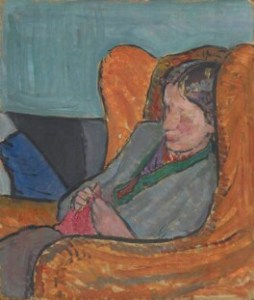
 In my previous post I wondered whether we knew what Woolf’s wishes were for her diary: whether she imagined it as something others would someday read, or thought of it as—and hoped it would remain—a private space. How might these different ideas about what she was writing, or who she was writing for, have affected what she wrote? With these questions still lingering as I read on yesterday, I reached an entry that explicitly addresses what keeping a diary meant to her and what her aspirations were for it, particularly for herself as a writer. It’s a longish passage but I’m going to copy the whole of it here, because I find every bit of it so interesting. It’s part of her entry for Sunday 20 April, 1919.
 I love that.
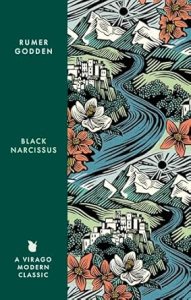 The flimsy walls did not shut out the world but made a sounding box for it; through every crack the smell of the world crept in, the smell of rain and sun and earth and the deodar trees and a wind strangely scented with tea. Here the bell did not command, it sounded doubtful against the gulf; the wind took the notes away and yet it brought the sound of the bells at Goontu very strongly; pagan temple bells. And everywhere in front of them was that far horizon and the eagles in the gulf below the snow.
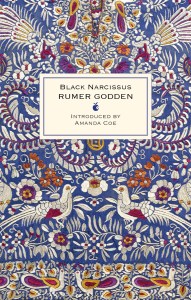 The nuns in this case have traveled to India to set up shop in what was previously St Saviour’s School, run by “the Brotherhood,” but which earlier had been known as “the House of Women,” meaning women with very different roles and habits (!) than those under the leadership of the staunch and upright Sister Clodagh. As they make their way to their new establishment, one of them, Sister Ruth, comments that she would like to know “why the Brothers went away so soon.” Sister Clodagh cannot give a direct answer, and she keeps her own doubts to herself: “she had lain awake thinking that they should not have come.”
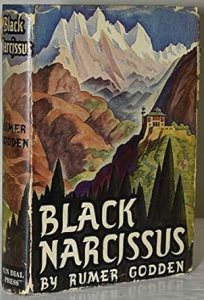 There are lots of interesting aspects to Black Narcissus. It trades in some familiar tropes around the “exotic east,” but I basically agree with Coe that Godden seems very in control of these, aware and critical of rather than acquiescent in them:
 I had barely recovered from my jet lag after my recent trip to Vancouver when I got caught up in another big distraction: I have adopted a cat! Her name is Fred, short for Winifred (she happily acknowledges either
 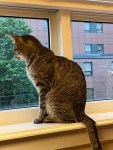 I had thought for a long time about getting a cat. I had one growing up, an elegant Siamese named Bothwell—I was in a big Mary, Queen of Scots phase when he joined the household. (Maybe Fred should consider herself lucky?) He was a great companion: loyal, eccentric, and independent, so basically a lot like me. During my marriage having a cat wasn’t an option, as my ex-husband is allergic; so too is my daughter, but only to some cats, and she encouraged me to take a chance. (So far, so good: she has visited Fred a few times and even held her, without any noticeable reaction.) I am extremely good at overthinking things, and I also don’t much like making decisions when I can’t clearly foresee the outcome, which is obviously the case when taking on a pet that is going to have her own personality and needs. I just could not get the pro / con list to be decisive either way! Then while I was away I missed out on an opportunity to adopt what sounded like the perfect cat for me, a ragdoll in sudden need of re-homing. My disappointment at not getting her clarified that I did want a cat in my life, and after an unsuccessful visit to a local shelter where the cat I went to meet first threw up at my feet then hid so I really could not get to know him, I got lucky with some help from Cat Rescue Maritimes . . . and here I am, and here we are.
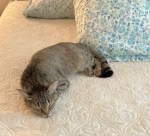 I admit I do feel somewhat overwhelmed at the moment, both at the change to my routines and by my new responsibilities. Also, pet stores have a bewildering array of options now, and the online cat-care debates are already making me crazy. The sleep deprivation definitely adds to this! (Don’t worry: I have set up an appointment with a vet and will try to follow only evidence-based advice rather than random Redditors’.) But Fred is a sweet and incredibly affectionate and trusting little cat. I was cautioned that she would probably just hide somewhere for the first few days, but she immediately explored all the available space, spent a lot of time watching out the windows, then settled on her favorite places to nap. She loves to be held and stroked and purrs like mad when you scritch her head and around her ears—just what Bothwell liked best too. I’m hopeful that we will get better at our nighttime routines. I mean, if she can sleep in this position, surely she can also figure out how to sleep more or less when I do, right? RIGHT?! 🙂
 We are frogs in a saucepan. All of us. We never noticed the water getting warmer and warmer. And now it’s almost too late to jump out. We tolerate the slow erosion of our climate the way a frog in a pan tolerates the rising heat. This year, we lose one percent of our coral reefs. Never mind. We can live with that. Next year, we lose another one percent. Hey. Never mind. And then another. And another. And in a hundred years they’re gone and we never noticed it happening.
 Novel Readings