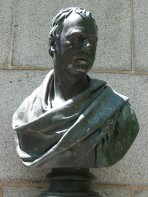
 This novel, like Wuthering Heights, is on my list of “alternates” to consider for my 19th-century fiction course–it would replace Waverley, which I have persisted in teaching for over a decade, despite its inevitable status as least-popular-book-on-the-reading-list. I thought I’d review Bride in particular because not only is it relatively short (OK, by 19thC standards) but its tragic plot and gloomy drama seem likely to have more crowd appeal. I did, mostly, enjoy reading through it this time: it’s relatively fast moving (again, by 19thC standards) and there’s plenty of thematically interesting material to work with, especially about fate vs. individual choice or agency, women and power, aesthetics, and also some of the same historical and historiographical problems explored by Waverley. But–though this may be because I have not worked with Bride carefully at this point–Waverley just seems much more useful for demonstrating what Scott means to the history of the novel…plus (though I usually have trouble convincing all but a few students of this) Waverley is a very funny novel, and except for the tedious Caleb, Bride is pretty slim on humour.
Thinking about Scott while also beginning Linda Holeman’s The Linnet Bird has helped me clarify a bit what I mean when I say I find a book “thin.” Holeman’s novel, while entertaining so far, does not give a rich sense of why, historically, its people are as they are: what are the social, economic, intellectual, and other structures that shape (if not necessarily determine) the options they have and the ways they understand them? Both Scott and George Eliot are particularly good at presenting their stories of past times so that you understand that a plot just like this particular one would not unfold in the same way, not just with different characters, but at a different historical moment. Other Victorian novelists have been described as writing ‘histories of the present,’ because they perceive their own time with a similar commitment to understanding its complexity and contingency. My dissatisfaction with Quindlen’s Black and Blue can be traced to a deficiency in its historical sense as well, I think: though unlike The Linnet Bird it is not deliberately a historical novel, it might have done much more to explore violence against women as a phenomenon manifested in a particular way at a particular time. What are the forces and systems that enable a husband’s violence, a wife’s shame and submission, in that place at that time, so that at some other point along the way things would have developed differently? What are the ideas of masculinity or femininity that are at stake? Many more specific questions would fill in this list (for instance, questions about the significance of Fran’s job). Quindlen focuses much more on the psychological, individual factors–on personalities–than on these broader issues, but her novel thus stands more as a case study than a social analysis, taken from a late 20th-century context it does not attempt to understand. In that sense it is written for its own time (contemporary readers will fill in that context based on their own sense of how things work today) rather than to offer insights (rather than snapshots) for later generations of readers. Is it fear of exposition (of the dreaded ‘telling,’ instead of ‘showing’) that limits how much explanation authors writing for a general readership are willing to include? In Waverley, Scott apologizes for his lengthy accounts of history and politics but protests in his defense that his story will not be intelligible without them. In the deeper sense–that is, beyond the simple action of the plot–every story relies on that kind of context, and I appreciate novelists able to integrate it in some engaging way, thus offering the reader a fuller picture of what the world looks like from their perspective. (I’d say this is one of McEwan’s accomplishments in Saturday.)
 I thought it was about time I re-read Wuthering Heights, not least because I am a little tired of teaching Jane Eyre in my 19th-century novels course and wanted to consider the obvious alternative. What a grim, unpleasant novel it is, though. The people in it are almost universally awful, and those that are not, like Edgar Linton, are weak and ineffectual, as if soft feelings just make you vulnerable. I remember at one time finding the passions of Heathcliff and Cathy romantic, but on this reading I found it impossible to associate either of them with any positive or sentimental feelings. The teacher (and critic) in me sees all kinds of stories to tell about the novel’s structure and themes, but I wonder how much enthusiasm I could muster for lecturing on it without something (or somebody) in it to root for. I have often made the argument to my students that the disappointments we are left with in George Eliot’s novels stimulate us to action: we wish for a realistic ending that is more satisfactory, for Maggie Tulliver, say, or Dorothea, and thus turn a critical eye on the real world that let them (and us) down. I can’t see taking this approach to Wuthering Heights, though, because the novel’s characters don’t really seem to deserve better than they get. Still, there’s no denying the raw power of the book, and its gloomy gravestones would certainly provide a contrast to the more conventional ‘marriage plot’ endings.
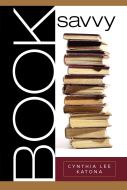 According to its jacket blurb, Book Savvy is “an effective guide for the burgeoning book-club community as well as a tool for literature teachers struggling to spark the interest of their students.” I certainly hope book clubs and teachers will choose better guides than this volume. For one thing, it is superficial, even shallow, in its approach to literature and to readers: do people literate enough to join book clubs really need icons indicating whether a book is one to be read “for information,” “for suspense,” or “to know oneself”? The author also rates each book for its “level of challenge”–at 5 we find “challenging masterworks of literature” (Madame Bovary or Hamlet, for instance, at 4 “works of literature with enduring qualities” (The Merchant of Venice, for example, or … The Robber Bride?), at 3 books that, while “thought provoking,” can be “read by almost anyone” (Sister Carrie or Bleak House…??), etc. Well, OK, the categories are idiosyncratic and the application of her standards sometimes suggests the author has not herself read the books in question very carefully, but I suppose for really insecure readers, it is helpful to be guided so as not to set your sights too high. And maybe, just maybe, it is odd but not unthinkable that The Picture of Dorian Grey should be brought up as an “example of a book to read primarily for thinking, writing, and conversational skills”; after all, as she goes on to say, Wilde “was a well-known wit and man-about-town” (p. 33), and wouldn’t we all like to be so quotable? Never mind what the novel is actually about! But when I came across this bit, I lost patience with amateur hour in the reading room: “One of the great innovations of twentieth-century literature was a movement away from telling the stories of kings and queens and other quite extraordinary people to the telling of stories of average people…” (p. 49). Innovations of twentieth-century literature? You see why I’m not sure she has read Bleak House, never mind, say, Moll Flanders? If Book Savvy
 does spark a student’s interest, then that’s all to the good, but it won’t take most savvy readers long to figure out that they need to look elsewhere for real insight and reliable information.
 .
. First of all, The Year of Magical Thinking is a strange kind of book. It is intensely personal, and thus poignant and compelling in the intimacy of its revelations about Didion’s grief, but thus also the reading experience seemed to me oddly voyeuristic–which made me puzzle over why someone would want to publish such an account. I didn’t notice that this issue is ever explicitly addressed, though I suppose we can fill in some good guesses, such as the therapeutic effects of writing it all out, the opportunity to pay a kind of literary tribute to her husband, or just the idea that writing is, after all, what a writer does.
