Happy International Women’s Day!

You forget too much
That every creature, female as the male,
Stands single in responsible act and thought
As also in birth and death.
(Elizabeth Barrett Browning, Aurora Leigh)
Happy International Women’s Day!
You forget too much
That every creature, female as the male,
Stands single in responsible act and thought
As also in birth and death.
(Elizabeth Barrett Browning, Aurora Leigh)
Monday morning: time for a little thinking out loud as I warm up for my week.
I’ve said quite a lot on this blog about my interest in Egyptian novelist Ahdaf Soueif. I first discovered her when I came across The Map of Love in Duthie’s on a trip to Vancouver (sadly, Duthie’s is another independent bookstore that has now closed up shop). I read it and wrote it up soon after. (I hadn’t looked at that post for a long time, and it is interesting to see how mixed my reaction was, as I’ve just reread the novel very slowly, in “work mode,” and appreciated it much more overall. Though the issues that struck me as unsuccessful in the working out of the Lady Anna plot [I see I actually used the word “boring”!] still strike me as problems, they seem also more deliberate, more politically challenging, than I understood them to be on that first reading.) I was interested enough to get ahold of In the Eye of the Sun and to read more about Soueif–which led me eventually to an idea for a critical essay which led me to a bunch of reading in post-colonial theory, then a conference presentation, then yet more post-colonial theory. My intention for some time has been to extend the discussion of In the Eye of the Sun into a comparative discussion of the two novels, with particular attention to their engagement with the novels and moral philosophy of George Eliot. When my sabbatical began, finishing this essay was first on my “to do” list, and indeed reviewing my notes and sources and rereading The Map of Love were among the first things I got working on in January.
Then the January 25th revolution began. It is no credit at all to me that I took a special interest in this world-historical event because for the past couple of years I had been reading and thinking a fair amount about contemporary Egypt–with a literary bias or angle, to be sure, and I wouldn’t begin to claim expertise in either Egyptian history or modern Egyptian politics. Still, I learned far more about both than I would ever have done otherwise as I puzzled over the relationship between the worlds Soueif’s characters inhabit and the literary traditions she draws on. Because of the imaginative investment I’d made in Soueif’s novels, the real world struggle that might otherwise have been just one more story in the headlines felt more personal to me. I suppose another way to put it would be that it was part of a story I was already in some sense following. I’ve written a couple of times here about fiction that aspires (among other things) to illuminate or humanize difference–this is one of the explicit goals, for instance, of Mahbod Seraji’s Rooftops of Tehran. Then there are the books that made me think about Anthony Appiah’s term ‘moral tourism’—A Thousand Splendid Suns is one example, The Wasted Vigil another (more sophisticated) one. Though I think it’s possible to criticize works that market themselves through an appeal to the very exoticism or Orientialism they also want to undermine, watching the stream of videos and tweets and reports coming from Tahrir Square made me think about how much more prepared I was to listen to and hope for the protesters than some other people (including, it often seemed, most of the staff and the stable of commentators at CNN) who seemed stuck in reductive stereotypes and worn-out narratives about the Middle East. (Rather than try to say a lot more about this myself, I’ll refer you to Aaron Bady at zunguzungu and his links and comments about the way the regime itself contributed by ‘staging Orientalist theater.’ All of his posts from January 25 to February 11 are worth reviewing–and of course his blog is worth following just in general.) In my post about The Wasted Vigil I worried about the value of the aestheticized experience we get of ‘otherness’ by reading such novels. While fretting that reading is not, really, acting, I still wondered whether, “if reading leads to understanding, especially appreciation for nuance and complexity, isn’t reading a kind of doing? Isn’t it a good thing to do? And wouldn’t the world be a better place if more people (former world leaders, even) perhaps read such novels?” As I watched Al Jazeera obsessively through those astonishing, frightening, exhilirating days, I couldn’t help but be aware that I would have been acting differently (though not, I hope and believe, indifferently) if I hadn’t read the novels I had, and particularly if I had never started reading and writing about Ahdaf Soueif.
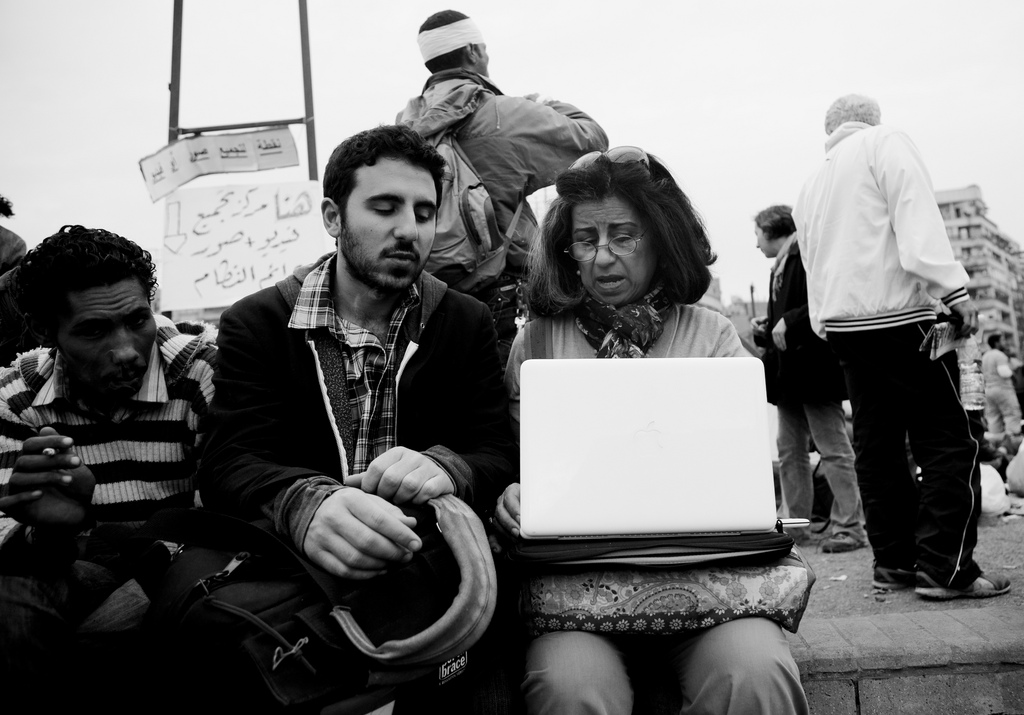
My spectator’s interest and my scholarly interest converged completely as Soueif herself became a conspicuous presence in the revolution. She wrote several pieces for the Guardian reporting from Cairo, including some written in the center of Tahrir Square. She was interviewed for various programs including on NPR, and she is featured in this excellent documentary on the ‘Women of Tahrir‘. Her home page now features the exuberant headline “Welcome to the New Egypt; Have a Lovely Stay.” Tomorrow night she is giving the Edward Said Memorial Lecture at Columbia (how I wish I could be there!), long scheduled but now announced with the title “Notes from Tahrir Square.”
All of these events, from the protests and their outcome (still, of course, very much a work in progress) to Soueif’s activism and role as an eloquent mediator between two worlds she knows equally well, have very little to do with me personally. I understand that! They are about so much more, something much, much bigger than my essay project. I issue that disclaimer because now I’m going to focus on what they have meant, or might mean, for me and that essay project, my own little work in progress.
One reasonable answer is: nothing at all. The essay is about the engagement between Soueif’s novels and a particular literary predecessor. The novels haven’t changed, and the essay was never going to be an intervention in current events.
But another answer is, surely something. Rather unexpectedly, something that began as a purely academic project has at least peripheral relevance to our contemporary moment. Writing about Soueif has gone from being a quirky sideways move for a Victorianist (finally, a new angle for writing about George Eliot!) to being something with some real possible significance, including to readers outside the academy–though not necessarily if the essay continues along quite the same lines as before.
And what about the essay’s lines of argument? Actually, they were never entirely literary. Or, more accurately, they always dealt with ways in which literary form reflects or enables ethical thinking, and the ethical issues, particularly in The Map of Love, have a lot to do with Egyptian history and encounters between ‘east’ and ‘west.’ The arguments I have been trying to work out are arguments about crossing cultural borders, inhabiting hybrid identities, the limits or potential of sympathy, the role of the imagination in mediating difference. Particularly in The Map of Love, these abstract issues are played out in the context of the occupation of Palestine; of the vexed role of the United States in the Middle East in general and Egypt in particular; of reductive Western stereotypes of both Arab men and Arab women; and of the dehumanizing realities of life in Mubarak’s police state. On January 25th, as it happens, I was taking notes on Chapter 16, which includes an impassioned political discussion among a diverse group of Egyptians, mostly women, and Isabel, an American visitor, who mostly listens (one not-so-subtle hint here is that America would do well to listen more to the voices of the people in the countries they meddle in, a lesson that of course the ongoing uprisings eloquently continue). Here’s an excerpt:
‘Ya Doctor, a national project comes about as an embodiment of the will of the people,’ Arwa says. ‘Nasser’s project finally did not work because for the people to have a will it has to have a certain amount of space and freedom, freedom to question everything: religion, politics, sex –‘
‘So the sans-culottes had freedom and space?’
‘No, and your revolution here will be an Islamist radical one. Because every other ideology is bankrupt. And capitalism isn’t an ideology, it isn’t something that people can live by . . . ‘
. . .
‘It seems to me,’ says Isabel, after a moment, ‘that people are completely caught up in trying to analyse the situation. But no one says, “This is what we should do.”‘
‘I don’t think anyone knows what we should do,’ I say.
‘I know some things we should do,’ Deena says. ‘We should speak out against the sanctions on Iraq. We should put a time limit on this so-called peace process. What’s the use of sitting around talking peace when the Israelis are constantly changing the landscape–putting things on the ground that will be impossible to dismantle?’
‘And when the time came, you’d go to war?’ Isabel asks.
‘If we had to. And I would stop this charade of ‘normalisation.’ What normalisation is possible with a neighbour who continues to build settlements and drive people off the land? . . . I’d mobilise the people to get our economy straight–‘
I can see why this section struck me on my first reading, as laborious, though clearly done with the understandable goal of trying “to educate her Western readers about international politics from a non-Western point of view, especially about the effects of colonialism in the early story, and the conflict over Palestine in the contemporary one.” In the novel, this kind of conversation (though educational) makes less difference to how people actually behave towards each other than the personal relationships that forge across boundaries of potential misunderstanding–Lady Anna’s romance with Sharif, in the earlier plot, but also, maybe more significantly, her friendship with his sister Layla, and then Isabel’s romance with Omar in the more contemporary plot, and again, more significantly, her friendship with his sister Amal. These affective developments (or so I was [am] going to argue) move people into what Soueif has called the ‘mezzaterra,’ a space Soueif says (in her introduction to her essay collection Mezzaterra) has been sadly beleaguered and dangerously shrunken in recent decades. My essay has been aiming at a discussion of how Soueif draws on both English and Arabic literary traditions as well as manipulates her own literary forms to explore and maybe expand that territory. I’m also very interested in the relationship between her emphasis on romance and friendship and the role of the novel in achieving cross-cultural understanding. And I’m interested in the pessimism in The Map of Love, in the way violence cuts off compromise and seems to show the inadequacy or futility of those same personal relationships for bringing about real political change.
Isn’t all this just as interesting and relevant as it was before January 25th? My problem right now is that while the context of the project seems to have a whole new hum of significance and that’s exhilarating, when I contemplate its specifics, I feel strangely deflated.
One somewhat trivial reason for this, I think, is just that literary criticism is not revolutionary action, it’s scholarly writing. Most of the time, I’m good with this. I’ve even felt discomfort (or worse) with criticism that aims or claims to be overt activism. As if! Our job is not really to march in the streets but to analyze the refractions of politics through literary history and literary form (among other approaches we can take and things we do, of course). And as I keep saying (because though I’m sure…pretty sure…it’s true, I need to reassure myself about it) Soueif’s novels are what they are, and nothing in the analysis I’ve been doing is inappropriate to them. I just have get on with it: to finish the piece and submit it for peer review as planned.
But less trivial is my uneasy sense that maybe the questions and arguments I’ve been pursuing are somehow mistaken from the start, or, if not necessarily mistaken, are not the most important questions to be asking right now. It matters how ‘east’ and ‘west’ understand each other, but throughout the days of protest one resonant message (from, just to name one eloquent voice, Mona Eltahawy) was that the events in Egypt were about Egypt–not about America, or Israel, or any other country obsessing about what the revolution might mean for it. A fascinating post today at Millicent and Carla Fran’s blog notes
After all we’ve written and thought about “selfish” and “unselfish” feminism, about the problems posed by Qaddafi’s female guards and the uneasy relationship between Middle East and West, it’s an honor to witness how Muslim women are talking not to the West (that’s a fraught interaction) but to each other about their vision for the future and—maybe as importantly—their vision of the past. (read the rest here–it lays out an important unfolding Twitter conversation about Muslim feminism)
In The Map of Love (also, but not quite so much, in In the Eye of the Sun) Soueif is explicitly working on ‘east’/’west’ relationships–this is hardly an issue that has been resolved by recent events, but recent events have also shown how partial this preoccupation is, maybe even that focusing on it tilts the conversation in a misleading way towards the east-west encounter as defining what matters. Or maybe what they have shown is that, unbenownst to her, Soueif was writing, not one historical story and one contemporary one, but two historical stories: by placing her novel so carefully in time and place, she made herself vulnerable to–not obsolescence, but at least becoming dated. Highly topical fiction transcends the passing of its moment either by exemplifying that moment so powerfully that it can go on to represent it, or by using its topical specificity to reach towards lasting problems or themes. I’ve only just begun to think about this, but I’m not sure if The Map of Love achieves the latter kind of resonance. If not, does that really matter at all to the novel as a novel? And does it matter at all to the essay that I’ve been trying to write? Is there some other essay I should be writing, either about The Map of Love or about Ahdaf Soueif?
In her interviews with NPR’s Renee Montagne, Soueif talks about her own work in progress:
The novel that I have been trying to work on for years now, was really supposed to be a prelude to something like this happening. And so now, you know, whats happened has caught up with it. And I at some point will have to sit and think whether it’s possible to sort of incorporate what has happened into what I’ve been doing, or whether everything that I’ve done is now obsolete.
I think it’s clear in context that she doesn’t mean the last remark generally, that “everything she’s done” over her whole writing career is obsolete but only that a novel imagined as a “prelude” to some kind of Egyptian transformation must be re-imagined now that radical change is underway. Her comment echoes in my head, though, as I work through my notes and contemplate the essay I’ve been trying to write. At least now I’ve started trying to articulate the questions it raises for me.
Where the dickens did February go? It only just started, and now it’s past. Sigh. I knew it was going to be a compromised month because in its infinite wisdom the Halifax Regional School Board decided to move the kids’ usual March break to February and extend it to two weeks, ostensibly to allow families to attend the Canada Winter Games, which Halifax hosted. I have yet to talk to one family that went to any of the sporting events: most seem to have left town, or just hunkered down–which is what we did. Between my sabbatical and my husband’s February break overlapping with the kids’ for one week, we managed to juggle things OK without packing them off to some kind of camp: this option is one great gift of the flexibility of academic schedules, but also as the kids get older (they are 9 and 13 now–which makes me … young! very young!) they are more self-sufficient about entertaining themselves. Still, I am cursed with a need for silence and extended contemplative periods without interruptions if I want to do serious reading or writing, so I knew that the second half of the month would not be my most productive time. What I hadn’t figured on was the four snow days in the first two weeks of the month, which meant that altogether they were in school (and thus I was “at work” in the usual way) only SIX DAYS in February.
Still, there was time to read and write, and even some time to think. When I fretted about how the break weeks were going to go, my daughter sagely recommended that I should “make plans for things that you can do, and then do them!” And that’s pretty much what I did: I adjusted my expectations and ambitions to focus on the projects that weren’t quite as intensive. Hence all the reading and blogging about crime fiction, which has actually brought me a lot closer to some decisions about how to mix up the second half of the reading list for my mystery fiction course. Right now, I’m thinking I’ll take out Rankin’s Knots and Crosses and probably a few short stories, and put in Ed McBain’s Cop Hater (to make the transition to contemporary police procedurals and a bridge to the Scandinavian writers explicitly influenced by him) and then either one of the Sjowall and Wahloo series or one of Henning Mankell’s. I still have more to read, but this direction makes sense to me, and I feel increasingly comfortable about being able to work with the material. I’m almost finished Mankell’s The Fifth Woman, and it really is quite a different kind of book than Faceless Killers. I don’t like the case much, and I still am finding the style dull, but it is just much richer and more interesting. That said, it’s also quite long, which may make it less than optimum for late in the term. I have a handful of other related titles to read but this seems like progress.
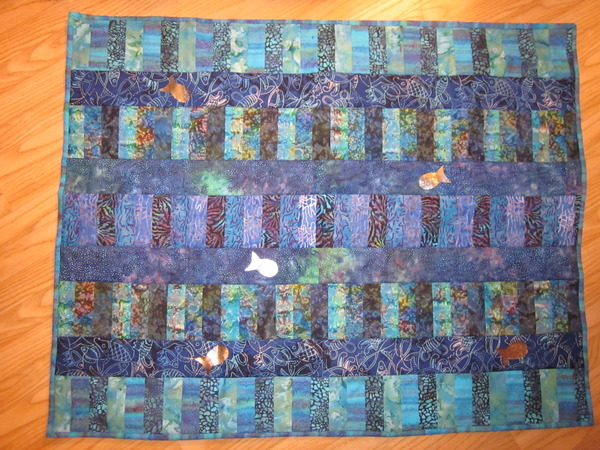
Let’s see: what else? I’ve done some other reading and blogging, and I’m working on a small piece for another site about one of my favorite books (the struggle I’m having being satisfied within the 400-word limit is a salutary one for me, as I often give my students very short limits on their papers and blithely tell them how much harder it is to make a few words densely meaningful than to ramble on for several pages). I have done more letters of reference (and another request for one came in this week). Yesterday I returned a 50-page thesis chapter on Frances Burney. I prepared some materials in support of my nomination for a teaching award. I explored funding options for a conference I hope to attend in early September–in the next week or so, I need to write up a proper proposal for my part in a panel as well as one for a workshop for graduate students, which will probably be something to do with academic blogging. I practised using my iPad. The keyboard still nearly defeats me. Maybe I could use little sticky things to give me some tactile indication of where the darned space bar is: about 75% of the time, if I try to actually ‘touch’-type, I put “n” in instead. It’s a long way from the IBM Selectric I learned on back in 1983 to a perfectly flat glass screen. I worked on soliciting and editing pieces for the March issue of Open Letters Monthly. That’s about it. Oh: I also finished my little ‘Blue Ocean’ quilt!
 If Rebecca Mead’s “George Eliot and Me” * didn’t take up eight pages (eight pages!) in the New Yorker‘s anniversary issue, I would just let it go by without comment. But the New Yorker is prime literary real estate, and eight pages is a lot. It seems a fair assumption that Mead’s essay should be significant in some way–that it should represent outstanding work of its kind. When, after reading it through three times, I still couldn’t find the payoff–well, that does seem to call for some discussion.
It’s not that “George Eliot and Me” is a terrible piece or anything–Mead is no Brenda Maddox (though she reports attending a talk by Maddox at which–surprise!–Maddox recounts the Curious Incident of the Honeymoon Defenestration). Then again, I notice Mead does think it’s important to tell us how plain Eliot was (however did I manage to write a whole essay on Eliot without feeling any need to bring this up?!) She also shares Maddox’s ageism, describing a female scholar she meets as “a tall woman, no longer young but still striking.” But? (This whole encounter is oddly described, actually: Mead introduces this scholar as a “notable exception” to a “maxim” she has just quoted, from Adam Bede: ‘The way in which I have come to the conclusion that human nature is loveable [sic]–the way I have learned something of its deep pathos, its sublime mysteries–has been by living a great deal among people more or less commonplace and vulgar.” I can’t tell if Mead means that this woman, though commonplace and vulgar, is an exception to the conclusion that human nature is lovable [if so, what a snidely gratuitous dig this is!] or, because she is not commonplace and vulgar, an exception to the idea that you can’t find lovable human nature in more glamorous guise.)
Anyway, as I was saying, it’s not a terrible piece. It’s nice to hear from someone who has loved Middlemarch a long time and feels she has learned from it. I felt a certain kinship with Mead on these grounds, especially at the beginning of the essay: “The first time I read George Eliot’s “Middlemarch” [I guess using quotation marks for novels rather than italics is New Yorker house style?] I was seventeen years old, and was preparing to take the entrance examination for Oxford University.” “Hey, me too!” I thought–except that I was eighteen and backpacking across Europe. So, not quite the same, but still, like Mead, I first read the novel early in my progress towards adulthood. Also, like Mead’s, my identifications and interpretations have changed over the years, not just because my own experience challenged my earlier assumptions and values, but because I learned to read the book better. Mead, too: on her early readings, she says, she “relished the satire” but “missed, more or less completely, the irony in the portrayal of Dorothea.” It’s an easy mistake; I made it too, once upon a time. And Mead and I share admiration for the novel’s moral wisdom, though I don’t think I’ve ever made Mead’s larger, and apparently continuing, mistake that “everything I might need to know about marriage, about love, about life itself, was encompassed in the novel’s eight hundred and fifty pages.” That’s a lot to ask of any novel–and it reduces the novel (as most of Mead’s comments d0) to a fairly literal set of lessons and examples that can be copied out epigrammatically.
Thinking it over, in fact, that attitude that the novel operates primarily at this level–as ‘philosophy teaching by examples,’ rather than as a richly organized aesthetic artefact–is what seems to me the essay’s greatest and most disappointing weakness. Nothing Mead says about Middlemarch is wrong, but none of it is going to surprise or even interest people who have thought much about Eliot or Middlemarch already, and none of it gives any sense of Eliot as an artist or a thinker: all we get, by and large, are one-sentence quotations used to illustrate points of character, theme or moral lesson. In the online “Ask the Author” chat that the New Yorker hosted, Mead mentions Zadie Smith’s essay, so she knows that there are richer ways to talk about Middlemarch.There are certainly richer ways to talk about The Mill on the Floss, which Mead mentions only to imply that it is “verbose,” which she then uses as an excuse to mention the (appalling) phenomenon of “a volume called ‘The Mill on the Floss: in Half the Time,’ an abridgement for those unable to countenance a six-hundred-page book.” I don’t think she means to endorse this absurdity, but juxtaposed against her “verbose” comment, it rather comes across that way. I see she didn’t get past her earlier lack of interest in Romola, either, here simply called Eliot’s “often tedious excursion into Renaissance Florence.” Sure, Romola is hard going and probably not a great novel. But you have eight pages in the New Yorker to talk about George Eliot! There’s so much more to be said about George Eliot’s novels, if you’re willing to work at it a little, to get outside your own head, and to explore not just her “maxims” (remember her cautions about people who live by them, after all–that’s one of the tedious philosophical bits that is probably left out of the truncated version of The Mill on the Floss) but her ideas and her craft. How did Mead figure out the irony at Dorothea’s expense, for instance, if not through the electric combination of Eliot’s intrusive narrator and her shifting point of view?
But perhaps in complaining about the superficiality of the literary discussion in the essay I’m making a category mistake . Maybe the main point of “George Eliot and Me” is not to talk about George Eliot, at least not in depth, but about the effect of her work on Mead’s own life and personal development. “I have gone back to ‘Middlemarch’ every five years or so,” she tells us, and her “emotional response” has evolved each time. She has learned to understand why Will’s “youthful energies and Byronic hairdressing” would have appealed “to his middle-aged creator,” for instance. (Oops, that’s actually another Maddox-like moment: Eliot the acknowledged cradle-snatcher, fantasizing about a sexy youngster!) Mead has also used Middlemarch to test prospective partners: when one tells her he “admired the climactic scene of Will and Dorothea…clutching each other’s hands, at last, as a thunderstorm rages,” she knows “things would never have worked between us.” Poor guy: done in by the pathetic fallacy! Eventually Mead married someone who “prized ‘Middlemarch’ as much as [she] did.” There’s some genuine human interest in these anecdotes, at least for a fellow Middlemarch lover who (true story) began a long tradition of reading aloud to her own husband by bringing Middlemarch along on their honeymoon. (We gave up on this tradition round about the time Frankenstein got thrown across the room for its terrible prose…but that’s another story. Maybe I should pitch it to the New Yorker.) But there’s still not a lot of substance here for someone hoping to find those precious eight pages used to advance public appreciation for one of the greatest novelists in the English tradition. I’d have to be really interested in Mead–rather than George Eliot–to be happy to read so much about her. Or, alternatively, she’d have to use her personal experience of reading Middlemarch to take us to some place more universally revelatory or insightful.
That’s not what happens in “George Eliot and Me,” though. It doesn’t articulate and illustrate the genius of George Eliot, and neither does it use its autobiographical form to build to some personal revelation or to a larger intellectual debate about, say, whether it is a good thing or not to derive one’s moral lessons from literature (now that’s a very Victorian conversation!)–or how one might do so in a rich and complex enough way that the literary texture of the source is not sandpapered out in favor of bland platitudes. (Where is the moral challenge of George Eliot’s “celebration of the unremarkable” in Mead’s commentary? The village dance which concludes the essay oddly summons up the most conservative aspects of Eliot’s rural nostalgia–as if the happy peasants of Raveloe had nothing to answer for in Silas Marner’s long isolation, or Arthur Donnithorne’s birthday dance weren’t undermined by Hetty’s seduction and abandonment.) Instead, we wander off with Mead as she tries to track down the source of a quotation often attributed to George Eliot: “It is never too late to be what you might have been.” It is, indeed, surprising that despite the tenacity of the attribution, this line cannot be traced to any of Eliot’s works. Mead asks a lot of experts about it, including Rosemary Ashton and Rosemarie Bodenheimer (both of whom have written wonderfully about Eliot’s life and writing). Not only do they say they can’t find a source for it, they also, quite rightly, note that it doesn’t seem to fit with Eliot’s explicit moral philosophy, which makes rather a big deal about the way our choices have an indelible effect on our characters and futures. Mead even interviews the author of a self-help book who used the quotation as her title: “I was depressed for a few days, and then I remembered the quote.” Eventually Mead resigns herself: she can’t find a source for the quotation or conclusively prove Eliot never said it. “Like Lydgate,” she says, “I had aspired to make a link in the chain of discovery, and had failed.” Along with some interspersed biographical material, this quest plot takes up nearly three of the eight pages. It might have been worth the space if the investigation was “linked” to something significant. (Lydgate, after all, is hoping to find “the primitive tissue” of life.) I wonder, for instance, why this is quite such a popular quotation, why it seems to satisfy so many people as something George Eliot said. Does it bring her within a safer community of women–reassuring, nurturing–and make her more conventionally feminine than is easily done if we quote from Mead’s least-favorite of her novels, Romola? “Children may be strangled, but deeds never” doesn’t go very well on a greeting card. Or how about this, from Felix Holt: “It is not true that love makes all things easy: it makes us choose what is difficult.” Try selling that on a wall plaque.
It feels churlish, in a way, to be so critical of an essay that speaks so sincerely of its author’s admiration for one of my own favorite books. It’s a good thing to tell more people how great Middlemarch is. Mead and I both think that Austen is more popular because she’s easier on (and for) her readers. As Mead says, Eliot “surpassed her precursor” (but why does she go on to say that the reader “marvels at Jane Austen’s cleverness, but is astonished by George Eliot’s intelligence”? Why “astonished”? I’m impressed–humbled–challenged–provoked by it, but not at all astonished). But the essay is a disappointment. It’s long (“verbose,” even), cluttered, and solipsistic, as if the greatest interest of George Eliot’s life and work really is that they have played a big part in Rebecca Mead’s life and work. At a time when it’s common to hear online writing decried for its lack of editorial oversight, rigor, and credibility, to see eight pages in one of the most prestigious magazines in the literary world used for something no better than this gives the lie to the claim that these supposed features of Old Media produce the best results. It’s not terrible–parts of it are even pretty good–but it’s certainly not great, and given its very prominent placement, it surely should be.
*The essay is called “George Eliot and Me” on the magazine cover, but “Middlemarch and Me” inside the magazine.
My education in Scandinavian crime fiction continues! After I expressed my doubts about Henning Mankell’s Faceless Killers, I received some very helpful advice in the comments thread. In particular, Litlove suggested the Wallander books participate in a peculiarly European mood of melancholia (about which, she rightly inferred, I am largely ignorant) and a literary tradition of what she, um, invitingly described as “ugly, grinding prose, empty, bleak, futile.” And Dorian, who added the nice term “effaced personality” to our conversation about how Wallander is characterized, noted that Mankell’s series has an important antecedent in the Martin Beck mysteries by Maj Sjöwall and Per Wahlöö. If I had been reading Mankell solely for pleasure, I might not have felt obligated to do the extra work of adjusting my reading framework to take these contexts into account, even though in principle I agree that good reading requires situating the book appropriately. I was reading Mankell in part as a professional, though, so I felt I did need to try a little harder to understand what he was up to–and boy, am I glad I did, not just as a teacher/scholar but as a reader. Three books into the Martin Beck series, I am thoroughly enjoying them, and I’m already feeling as if I will read Mankell much better (more aptly, more appreciatively) when I turn to The Fifth Woman, which is waiting here on my desk.
 Why am I liking the Sjöwall and Wahlöö books so much better than Faceless Killers? One likely answer is that I’ve already fine-tuned my expectations, so that the features they share with Mankell’s first Wallander novel are more familiar and comfortable. Among these I would include the bleak (grinding, empty, futile) atmosphere–including both the literal atmosphere of cold, wet, miserable winter (as Jonathan Franzen says in his introduction to The Laughing Policeman, the “weather inevitably sucks”) but also the moral and emotional atmosphere, which is grim in a resigned, routine way. There’s also the one-damn-thing-after-another plotting characteristic of a police procedural, where every lead has to be laboriously pursued, every interview methodically conducted. No snazzy locked-room mysteries, these, no death-by-icicle or orangutang, no brilliant ratiocination leading up to a triumphant revelation scene. In these books, crime is a sordid business, no matter which side of the law you are on. No wonder everyone drinks so much–or tries to (in the Beck books at least, the more you are looking forward to your aquavit, the more likely it is the phone will ring and tear you away from it).
To some extent, I would say too that the prose in the Sjöwall and Wahlöö books has the same somewhat clunky quality I objected to Faceless Killers. Those of us who know no Swedish (I’m guessing that covers all readers of this blog!) can’t know how far this is an effect of translation, of trying to capture the cadence of another language in English. There are some tics in the Beck books that do suggest that there’s something deliberate about it, something purposefully exotic, if you like. One small detail that stands out for me is the recurrent reference to ‘Martin Beck’ where I would expect the surname alone, e.g. “Martin Beck looked disbelievingly at Kollberg,” 200 pages in. That’s just the tiniest little bit jarring, as you read along; it lets you know you aren’t quite on your home turf. But more generally, I found Faceless Killers flat, whereas I am finding the Beck books dry–in a good way. They are almost as tersely declarative, but there’s a momentum to the language that I enjoy, and also there’s a wonderful streak of humor, sometimes sardonic, other times more flat-out comical (as with the two beat cops Kvant and Kristiansson–“Ask a policeman,” they helpfully tell a confused woman who asks them for directions).
I haven’t yet seen quite the scope of social criticism attributed to Sjöwall and Wahlöö in the prefaces provided to my editions–one by Mankell himself, another by Val McDermid, another, as I mentioned, by Franzen. Franzen calls the series “a ten-volume portrait of a corrupt modern society; Mankell says “the authors had a radical purpose in mind … to use crime and criminal investigations as a mirror of Swedish society.” I have seen enough, though, to believe that the critique already apparent accumulates over the remaining seven books–and especially in The Laughing Policeman (with its anti-Vietnam rallies and its complacently self-interested corporate villain) I can anticipate how it might proceed. Mankell writes that the authors never intended “to write crime stories as entertainment” and he points to Ed McBain as an inspiration for them, someone who showed how to use “crime novels to form the framework for stories containing social criticism.” McDermid highlights the difference between the Beck books and the “golden age” procedurals of the 1930s, set in a world in which “a bent cop is almost unthinkable; an incompetent one only a little less so.” I was actually surprised that none of these discussions mentioned the possible influence of hard-boiled detective novels: to be sure, one point of these is that their protagonist is not part of the official law enforcement system, but someone like Sam Spade moves precisely in a world of near-universal corruption (or, sometimes worse, incompetence) which very much includes the police. I mentioned the noir atmosphere of McBain’s Cop Hater, and I think there’s something of the same perspective–though illuminated by the flickering flourescent lights of bureaucracy, rather than the foggy fitfulness of street lights–in these bleak cop novels.
As for the cases, well, I didn’t like the graphic violence and sensational bursts of action in Faceless Killers. Two of the Beck novels I’ve read so far also turn on quite violent crimes, and particularly in Roseanna, the details are unrelentingly specific. Having read McBain’s comments about facing up to violence while still trying not to be “salacious” about it, I can see a similar principle at work in the Beck books, though I think the authors flirt with danger in the way they linger over the details of the sexual crimes and, especially, seem preoccupied with women’s sexual histories, or with women who are “too” sexually assertive or demanding. There are only rare cases of women who are something other than nagging/disappointed wives at home, or ‘whores’ shading into victims: here too, perhaps, some fruitful consideration might be given to the influence of hard-boiled novels, or perhaps this is just another reflection of the hyper-masculine world of the police. The standout exception is the woman police officer who helps entrap Roseanna’s murderer…but she too ultimately must play the vamp and then becomes a victim, only to be rescued. That the belatedness of the rescuers’ arrival is caused by the same kind of stupid screw-ups that typify the world of the novels more generally adds only a little painful irony to an exploitive situation.
These remain first impressions, but I feel like I’m making progress. I’ve talked fairly often about blogging as a way of thinking in public; it’s also, wonderfully, a way of learning in public. Thanks for your help so far–feel free to keep correcting and supplementing my attempts to come to terms with this material!
The fine site 3 Quarks Daily is once again running its Arts and Literature blogging contest, to be judged this year by blogger, essayist, novelist, and teacher Laila Lalami. I think these contests are a great way to draw attention to the engaged, passionate, articulate writing to be found in blogs: contrary to the whingeing of the nattering naysayers, I think there’s far more to celebrate than to lament in the wonderfully open, curious, diverse and generous conversation about books that the internet has enabled. I was truly honored to be among the finalists in last year’s competition, judged by Robert Pinsky, for my review of Daniel Mendelsohn’s remarkable book The Lost (yes, there’s some irony there, as he seems to be the Naysayer-in-Chief). I encourage everyone to think about posts they think represent the best of arts and literature blogging (whether their own or someone else’s), to post a nomination at 3QD, and then to spend some time browsing through the other nominations, which I’m sure will be full of treasures.
 The Education of Harriet Hatfield is an awkward novel, struggling–or so it seemed to me–to maintain a difficult equilibrium between the human stories it tells and the didactic message those stories are designed to convey. The awkwardness is palpable, I think, because Sarton doesn’t trust her readers enough to infer her message from the stories, but instead makes it an insistently explicit part of her characters’ conversations, or her narrator’s commentary. The characters, especially Harriet herself, have the same distinctive individuality that marked the people in Sarton’s The Small Room, and the story itself is engaging and rich with thematic and political potential. Harriet, who has lived for many years with the somewhat overpowering Vicky, decides after Vicky’s death to use her inheritance to open a woman’s bookstore in the Boston neighborhood of Somerville. She has no business experience and no specific agenda except that she hopes the store will become a gathering place for women of all kinds as well as a repository of books by, for, or about women. What she hasn’t anticipated is that opening the store will also open up her life, both by challenging her to rethink her own values and relationships, and by exposing her–and those values and relationships–to the sometimes hostile scrutiny of her new community. Harriet realizes belatedly that her economically privileged life with Vicky has sheltered her in many ways, but particularly from any pressure to define or defend their relationship. She thinks of it in the context of the “Boston marriage,” shying away from the label “lesbian” (“That word always makes me wince,” she remarks); she feels strongly about women’s need to express themselves and take strength from each other, but she does not consider herself a feminst. But her naivete about herself and her store is immediately challenged, by supporters who applaud her venture for being something she never quite imagined it as, and by opponents who target her with graffiti, hate mail, and, eventually, vandalism and violence. “Dear manager or whoever you are,” reads the letter that first forces her to see herself through the eyes of hate:
This was a clean blue collar neighborhood until you and your ilk arrived. Now it is full of filthy gay men and lesbians. This is a warning. We do not want your obscene bookstore and we will do everything we can to get you out.
Harriet is a reluctant and unlikely revolutionary. But she comes to see her very conventionality as her strength: she is seen by all around her as a “lady,” and she decides that by coming out she can counter stereotypes and provide what she thinks of as one version of an “exemplary life,” an example to prove the point that gays and lesbians are people too. If that conclusion sounds a bit shallow or trite, I fear that impression is fair to the novel, which is preoccupied with showing examples of gays and lesbians who are Perfectly Nice People living Unobjectionable Lives despite being misunderstood, insulted, or actively discriminated against. Some subtlety is in play because to some extent it is Harriet herself who is gradually enlightened, losing her anxiety about labels, realizing that the privacy she and Vicky valued can also be seen as avoidance, perhaps even a form of repression or denial–not sexually, but politically. It’s a shock to her when an interview with her about the threats against her and her shop appears under the large headline “Lesbian Bookseller in Somerville Threatened,” but by the novel’s end she has embraced the changes this involuntary exposure brings to her life. ‘It has been in some ways excruciating,’ she tells the private detective finally called in to find out who is behind the attacks;
‘but I have to admit that it is giving me an education I had missed. It has forced me to be honest about myself. That is a salutary thing. I can identify for the first time with any persecuted minority and’–here I can’t help laughing–‘I know it is absurd, but I am proud of being in the front line. Because, you see, I am safer than most gay people are. By that I mean I am more or less self-supporting and no one else, except Patapouf [her dog] has been intimately involved. So I can dare without fear of hurting.’
The story of Harriet’s education is a good one in many ways, and the earnest intentions behind the novel’s broader agenda are unobjectionable–but those who need the lesson it teaches are, surely, hardly likely to pick up the novel, which is perhaps why I started to find its preachier moments so tedious, even though the individual stories that are woven in with Harriet’s have plenty of intrinsic interest and are often deftly indicated, like the story of Martha, the unhappy wife who longs to be an artist and paints uncomfortable dark pictures of trees with encroaching roots. I liked the bookstore stuff the bes. Like many bookish people, I have totally inaccurate but cherished fantasies about what it must be like to run an independent bookstore (yes, this despite the tales I’ve heard from actual bookstore owners like Colleen of Bookphilia!). I would love to have a store like Harriet’s nearby, where tea is served in the late afternoon and all kinds of interesting women hang around and find support and friendship. Sarton is honest enough to make it clear that Harriet’s business may never make money, that it’s only her inheritance that enables her to embark on this adventure. Knowing that Sarton and Carolyn Heilbrun were friends, I was amused to see Harriet recommending the Amanda Cross mysteries to a customer. Also, recalling Heilbrun’s chapter on Sarton in The Last Gift of Time, I remembered her saying that Sarton hated criticism and resisted editorial advice. The Education of Harriet Hatfield is a book that might have benefited from some advice, particularly if it had led Sarton to let Harriet go through her internal and political transformations without talking about them so much and so laboriously.
From the Novel Readings Archives. Writing about Rosy Thornton’s The Tapestry of Love got me thinking about other examples of intelligent ‘women’s fiction’ (which I would say is the thinking person’s alternative to ‘chick lit’: readable but insightful stories about women living recognizable lives, sorting through family, career, or personal issues, learning more about themselves in the process–and prompting us to reflect a little on our own lives along the way). I mentioned Anne Tyler, for instance; her unassuming books often offer unexpectedly broad (or is it deep?) insights. Joanna Trollope is another writer I think writes low-key, easily readable, but worthwhile novels. Some of her more recent ones have not really worked for me (Friday Nights, for instance), but I’m fond of several of her earlier ones. I wrote about them long ago–when I almost never got readers or commenters! So I thought I’d repost what I said then. Has anyone else had a similar experience of being surprised into taking something more seriously than they expected? Also, what writers do you turn to when you want to relax a little into your reading? Who are your trusted go-to books or authors when you want something in between, say, Virginia Woolf at one extreme and Sophie Kinsella at the other? (Sally Vickers has been mentioned already; I’ve made a note!)
 When I decided to take a break from more “serious” reading with A Village Affair, I wasn’t really expecting the novel to reach towards the serious itself. I had read it before, but what I had retained was admiration for the clarity with which Trollope gives us the people she has devised: many (though not all) of her novels that I have read have struck me as achieving an enviable quality in their characters: they are enormously specific and individual and often intensely, even poignantly, believable. Here, Alice’s father-in-law, Richard, seems especially well conceived. Everything he says communicates to us who he is and how he has lived, particularly in his marriage to a woman he persists in loving but who cannot, in her turn, recognize in him someone as complex and fully human as she is. He lives this hampered life in full knowledge of its limits, neither tragic nor stoic. Alice’s discontent is the stuff of cliches; her affair seems contrived (by the author) to break up the seemingly calm surface, the routines and compromises of daily life. In fact, this is how Trollope’s plots generally work: the ordinary people, the change or revelation, the repercussions. For me, it’s the repercussions she does really well. Having set up her experiment in life, she works out plausibly how it will play out, and she does not sentimentalize–as, in this case, Alice’s “coming alive” through a new and different experience of love creates more problems than it solves.
In this case, as in another of her novels that I think is very smart, Marrying the Mistress, Trollope sets her characters up to confront what is a central dilemma in many 19th-century novels as well, namely how to resolve the conflict between, or how to decide between, duty to self and duty to others. That she is aware of her predecessors in this investigation is indicated by the quotation from Adam Bede recited (OK, improbably) by one of the characters in A Village Affair. As that quotation forcefully indicates, George Eliot placed a high value on renunciation and on accepting (as gracefully as possible) the burden of duty: resignation to less than you want, or less than you can imagine, is a constant refrain, and this with no promise of rapturous happiness. Hence the melancholic tinge at the end of Romola, for instance, or Daniel Deronda, or, for all its lightning flashes of romantic fulfilment, Middlemarch. (Of course, famously, it is her heroines who must resign or, like Maggie Tulliver, die.)
Although much has changed socially and politically since George Eliot found it unrealistic to give Romola, Maggie, or Dorothea uncompromised happy endings, the struggle between what we want for ourselves and what is expected or demanded of us by others continues to be a staple of fiction. Though Trollope’s scenario is much more contemporary, she too accepts that one’s individual desire cannot (or not easily, or not ethically) be one’s guiding principle, because of the “visible and invisible relations beyond any of which our present or prospective self is the centre” (Adam Bede). So Trollope, with admirable restraint, refuses a fairy tale ending for her protagonist, though, with a different kind of insistence that perhaps George Eliot would respect, she also pushes her out of the unsatisfactory life that was her reality before, and into what, given this context, seems like a narrative limbo, or a waiting room. This is not to say that Alice’s single life is an incomplete one, but she herself acknowledges that it is not, in fact, what she really wanted–only what she was capable of achieving.
I think this novel makes an interesting comparison to another quiet novel about a woman reconsidering her life, Anne Tyler’s Ladder of Years, which I have always admired. But Tyler, though far from offering simplistic fairy tales, offers her own version of the resignation narrative. In Ladder of Years, as in Back When We Were Grownups, it proves mistaken for the heroine to try to start a new life, however much she is, or believes she is, following the promptings of her innermost self. Again, the “visible and invisible relations” exert a powerful pressure, like the entangling webs of family and society in Middlemarch but perceived, overall, as more kindly, less petty and destructive. The plain litte room Delia takes and uses as a staging ground to reinvent her life is a room of her own, but her story is not rightly understood as being just about her own life (“was she alone,” Dorothea asks herself). In these novels Tyler’s women learn to appreciate the value of what they tried to leave, to see their own identities as having become inseparable from those of the others whose demands and complications hamper their desires. The vision seems starker in Trollope’s novel (“Aga saga” though it certainly is).
(originally posted June 15, 2007)
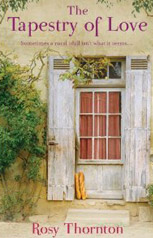 What’s not to like about The Tapestry of Love? It’s undemanding and charming, while also being thoughtful and literate. Along with Thornton’s Hearts and Minds, it now numbers among the little cluster of books I think of as my ‘comfort reading,’ books that I reread when I want to wander mentally away from home without feeling adrift, to be distracted without being distraught or dismayed–books, too, that always bring me home again, quietly, rather than leaving me staring wistfully over the horizon. I am sure I will reread The Tapestry of Love more than once in the years to come.
Like Anne Tyler (whose Ladder of Years is a longstanding comfort read), Thornton has an astute sense of character–of what makes people distinctly themselves–but also of relationships and how they challenge (or, more rarely, reinforce) that individualism. The story of Tapestry of Love is simple enough, perhaps even clichéd: a divorced Englishwoman pursues her dream by moving to a cottage in the Cévennes and setting up her own business, including making the tapestries that provide the novel’s underlying metaphor (and, obviously, its title). Though she doesn’t go in search of romance, inevitably (by fictional, not real standards) she finds it. But its development is hampered by her own reserve, by her more flamboyant sister, and by the complications of being both grown up and divorced already, and thus under no illusions about fairy-tale endings. Filling in this simple outline are details and anecdotes–sometimes humorous, sometimes poignant–about life in this rural community, told in prose that is precise, evocative, and unsentimental.
I first heard about Rosy Thornton from the review of The Tapestry of Love at Tales from the Reading Room. Litlove speaks so well about the book that I’m going to quote her at some length rather than try to find another way to say something that wouldn’t end up being very different (it’s not lazy, it’s appreciative!):
There are two preoccupations in this delicate novel that stand out in particular. The first is the exquisite nature writing that brings France alive on every page. I don’t recommend you pick up this book if you have a deep hankering to move to the south of France because you’ll find you’ve booked a ticket before the end is reached. Catherine is an observer, a practiced witness to lives that are more vivacious than her own, and her profound attention to the consoling beauty of the world around her is completely convincing. But at the same time, this attentiveness to the natural world has another purpose, in that it emphasizes the cycle of life in which all the characters are trapped. I found this to be the most poignant of Rosy’s books so far, the one most concerned with loss and how it might not perhaps be managed, but eventually accepted, or soothed with other distractions. The cycle of family life, with its need to find partners, to raise children, to let go of the adults they become as well as the parents who raised us in their time, is the underlying trajectory of the plot. Catherine is at the time of her life when there are too many goodbyes, and to add to that, she has chosen to leave her homeland and all its familiarity behind. But Catherine is a sensible, grounded woman, a woman whose work matters to her as much as her romantic life, a woman who knows what needs to be done and will do it, even if it requires unreasonable selflessness. And she is also a hopeful woman, one who believes without needing to say it, that tomorrow will bring fresh opportunities and new chances. Her resolute strength of character and her belief in the process of renewal carry her (and the reader) through adversity and to the optimistic ending you long for her to have.
There’s also a lot of wry humour in the book, about the French bureaucratic system (which deserves to have fun poked at it), and about sibling relationships. It’s a wonderful portrait of two sisters, and it was probably this relationship I appreciated most in the novel. There’s always a great core of strength at the heart of Rosy’s novels and this comes from her celebration of love over the false friends that are need, desire, lust and romance. Unlike other genre writers, who turn love into Sturm und Drang or emotional pyrotechnics, Rosy portrays love more realistically (and therefore surprisingly), as presence, awareness, mindfulness, and also as acceptance of people exactly as they are. This makes her books less outwardly dramatic than some, but reassuringly, resolutely real and immensely comforting. The Tapestry of Love is about the gentle warp and weft of relationships, the tracing of a thousand threads of attachment into patterns that please and console. In this way it’s a novel that leaves the romance genre some way behind, and deserves a categorization all of its own.
You can see from this why I was prompted to look up Rosy Thornton for myself (and why I like Tales from the Reading Room so much, too). I was delighted to learn from Thornton’s author page that her career as a novelist grew out of her enthusiasm for Gaskell’s North and South (and I would just like to say “I hear that!” to her comment about Richard Armitage in the role of John Thornton). I haven’t read her other two novels yet, including the first one in which, she says, the influence of North and South is particularly evident, but I enjoyed Hearts and Minds very much too–also gently humorous and unassumingly astute. This is the point at which easy access to the Book Depository and its free worldwide shipping becomes dangerous…
A trivial question that lingers: There are all kinds of novels about the English abroad, yearning for sunshine, or for a society fondly imagined to be somehow more open, emotional, or authentic–like A Room with a View, to give just one more famous example. Do folks in Italy or the south of France ever dream of (and write novels about) holidays in England? I suppose if they do, it would be out of yearning for something other than the weather.
 I took a break from the grim world of cop fiction after Faceless Killers and spent a little time with Rosy Thornton in the Cévennes (I’ll write a little about The Tapestry of Love later, I hope). What a nice interlude that was! But then I got right back on the horse with Ed McBain’s Cop Hater, which I had requested as an exam copy because it seemed a strong contender for the Mystery & Detective Fiction survey. Having read it, I think that was a pretty good call, though I can’t say I enjoyed the McBain any more than I enjoyed the Mankell. (I have also added Sjowall and Wahloo’s Roseanna to my Kobo collection and taken Mankell’s The Fifth Woman out of the library, so I’ll be improving my Mankell skills soon.) Cop Hater does seem to exemplify a certain definition and style of police procedural. McBain’s own introduction notes that his 87th Precinct novels were innovative in making the operations of a squad, rather than an individual detective, their focus; this comment made me think of the Dell Shannon series I remember my parents reading steadily many years ago (and I just this very minute, googling the name, learned that is one of the pseudonyms of novelist Elizabeth Linington). Her Luis Mendoza series premiered in 1960, so a few years after McBain published Cop Hater (1956).
I’d read only some 87th Precinct stories before; Cop Hater is my first full-length McBain. I imagine these books, too, get better as the writer becomes more sure of his territory and characters. I found this one a bit cheesy at times, with coy little writing tricks for effect, especially at the ends of chapters:
There was only one thing the investigators could bank on.
The heat.
Some of the writing is much better than this, though; McBain effectively conjures up the sights and, especially, the smells, of urban life in a heat wave:
The smell inside a tenement is the smell of life.
It is the smell of every function of life, the sweating, the cooking, the elimination, the breeding. It is all these smells, and they are wedded into one gigantic smell which hits the nostrils the moment you enter the downstairs doorway. For the smell has been inside the building for decades. It has seeped through the floorboards and permeated the walls. It clings to the banister and the linoleum-covered steps. It crouches in corners and it hovers about the naked light bulbs on each landing. The smell is always there, day and night. It is the stench of living, and it never sees the light of day, and it never sees the crisp brittleness of starlight.
McBain (not knowing, perhaps, quite how his own new subgenre should sound or would develop) sometimes seems to be aiming for a noir-ish atmosphere, and striving for the verbal panache of his hard-boiled predecessors. The results are occasionally awful: “He shook his head sadly, a man trapped in the labial folds of a society structure.” In fact, Cop Hater is most hard-boiled in its claustrophobic masculinity, in its unease with and about women (“trapped in the labial folds” indeed!), in the voyeuristic gaze it directs on all of its female characters, and especially in the femme fatale who turns out to behind the cop killings. I don’t really know what to do about Carella’s girlfriend being deaf and mute: on the one hand, there’s something fitting about that being the novel’s ideal woman, but then, she acts courageously and saves Carella’s life in the novel’s thrilling denouement, which is a refreshing change in a novel in which the women (including her) seem to spend all their time in stuffy apartments just waiting for their men to come home. As our villainess says, “What kind of life is that for a woman?” But I don’t see any room here for seeing, much less adopting, her point of view (despite her hopes, even the men on the jury don’t like her enough to save her), while in The Maltese Falcon Brigid is (arguably) not really worse than anyone else.
What seems really different about Cop Hater compared to earlier detective novels is its attention to the specific procedures of the police investigation, even including reproductions of gun licenses and rap sheets, but also detailed explanations of forensic measures (such as fingerprinting) and lab work. These features, along with the spread of the novel’s attention across several detectives (though Carella is clearly the main character) help us see the police as a system, as part of a bureaucratic organization operating within a network of other supporting (or, sometimes, hindering) systems. The case is not solved by the ingenuity of Poirot or the ratiocination of Dupin or Holmes but by the persistence of men who just keep looking and asking until they find something out.
The other thing that I found striking about Cop Hater is how completely unglamorous it is (setting aside the lacy lingerie bits). There are some quotations from McBain at the end including this one about violence in his books:
I am unflinching about the violence…If someone is getting killed, that person is getting killed and you know it, and it hurts, and it results in a torn body lying on the sidewalk. It’s not pretty…it’s horrible. But there’s a way of doing violence that’s salacious. And that’s wrong…I have never, ever, ever in my books tried to make violence appealing. I’ve made it frightening and I’ve made it ugly, but never appealing.
I respect that, and though the lead-up to violence in Cop Hater is almost always manipulatively suspenseful, the violence itself is as he describes it: blunt, horrible, not appealing. I’d like to discuss his dead bodies with my class in comparison to Roger Ackroyd’s bloodless corpse. And I think Cop Hater would make a good stop in between Hammett or Chandler and Paretsky, and not just because of the timing (right now my book list jumps pretty much right from 1930 to 1982). Perhaps it would also be a good step on the way to a later example of the police procedural–not an alternative to Rankin or Mankell, but a supplement. I think the students would probably like it: it’s short, it moves fast…but it’s also $21, which seems a lot for an edition that seems to be just a reproduction of an earlier version but on larger pages (there are oddly wide margins, especially at the top). I think there is also a page out of order: near the beginning of the book is a title page for Alice in Jeopardy, “now available in hardcover” etc., and it says “turn the page for a preview,” but next is the title page of Cop Hater. Then after Cop Hater ends (happily ever after!), we go right to a new Chapter 1, otherwise unidentified–which I assume is from Alice in Jeopardy. For $21, readers might like Simon and Schuster to make a nicer book.
And now, I need another break from the death and dirt and darkness, so I’ve started May Sarton’s The Education of Harriet Hatfield.
 Novel Readings