“Sheer misery”: Mankell and Scandinavian Noir

Henning Mankell’s most recent (and, as I understand, also his final) Wallander novel, The Troubled Man, is being released in its English translation this week. I’m still enjoying a break from my immersion in Scandinavian crime fiction, though I picked up another of the Martin Beck mysteries during my most recent excursion to Doull’s (The Abominable Man)–now that I’ve decided to assign one for my fall mystery course, I have to figure out which one, so I’ll be back reading them again in a bit. I won’t be rushing out to buy The Troubled Man right away, as I still need to catch up on the rest of the series (I’ve read only Faceless Killers and The Fifth Woman so far). Now that I’ve been thinking more about the characteristics of these books myself, though, the coverage of Mankell’s latest is interesting in itself. I must say that I particularly enjoyed the parodic opening of the review in the Guardian:

The flat, affectless sentences went on. Like rape out of season they stretched to the horizon in grey fields. Wallander found he was in another book. There was no reason for this. There could be no reason except money, but it would take 300 pages for him to work this out. It always did. Later, he would think about this often, but he could not reach any conclusions. Perhaps it was drink. Perhaps it was senility. Perhaps it was just the conventions of a Swedish crime novel. He wondered if any of this mattered.

Another page turned. His daughter rang. She disturbed him. This might be because she was the only human character in the entire book. She tells him he is a self-pitying bore but she loves him anyway. After she has gone he will spend some time looking out of the window and feeling regret while he remembers incidents from other books. Later, she has a baby, but to show she belongs in the book she will refuse to name it for three months. This is a joke that worked better in Doonesbury where the author was aware that people might find it funny.

An old girlfriend turns up. She is dying of cancer. Soon, she will kill herself, although it may have been an accident. Wallander is unhappy for some weeks, and then he decides he will always be unhappy. Life continues.

Spot on! And yet as you know, I have been brought round somewhat by the thoughtful arguments some of you made in response to my criticisms of Faceless Killers, to accept that the surface tedium of this style has its own literary antecedents and justification. (Thanks very much to @Liz_Mc2 for sending me this link via Twitter!)

There’s a longer piece in the Financial Times that is prompted by a recent BBC production, a “Danish-made Copenhagen set” drama called The Killers. The article opens with The Troubled Man (“the first page of the first chapter of Henning Mankell’s … The Troubled Man is sheer misery”) and then moves into a more general inquiry into the current popularity of Scandinavian crime fiction:

Crime fiction has long depended on a sense of dark forces lurking below calm surfaces and it is not unusual for it to have a reformist, critical edge. Critics have pointed to US noir novels and films as an allegory for fears of subversion and communism in the 1940s and 50s. English country-house crime of the Mousetrap genre depended on an assumption that, behind the tennis and the gin, bestial passions waited their time.

But in Scandinavian noir this is frequently married to a revolutionary intent. Most of these writers are militantly left-wing. It is a tradition started by Maj Sjöwall and Per Wahlöö, a couple of Swedish journalists who, between 1965 and 1975 (when Wahlöö died in his late 40s) wrote the 10-novel Martin Beck series. Beck, a Stockholm police inspector who resembles the later Wallander, stoically solves crimes that are often rooted in upper-class chicanery or lower-class desperation.

It’s not obvious why fiction of this kind (novels “from Marxists who write of people beset with misery who either commit or must deal with acts of extreme sadistic violence”) would have any market appeal today. Sex and violence always sell, as some of the interviewees note, and many of the most successful novels (the Stieg Larsson ones especially) are hyper-modern: “the trappings of contemporary technology are much in evidence.” But there’s also the variation these works provide on the consistent preoccupation of crime fiction: the ongoing contest between order and disorder. The Scandinavian countries have long exemplified a certain kind of contemporary social order: “their “model” – one of high taxation funding comprehensive welfare and education, coupled with world-beating corporations – has roused envy and emulation, as have the orderliness of their civic life and the fluency of much of their population in foreign languages.” Such control inevitably (or so the novels persistently suggest) comes at a cost, and has its own dark side:

Rigidity in maintaining surface order, the mark of the Scandinavian social democracies, needs to be breached violently by those who are, ultimately, on the side of order – otherwise it will be breached by the violence of those who would destroy it.

The piece ends with some comments from mystery novelist Joan Smith; I was interested that she describes the Wallander novels as “very old-fashioned,” and points to “Larsson, Arnaldur Indridason in Iceland, Jo Nesbø in Norway” as  doing something much more interesting.”

Book Club: Brian Moore, The Lonely Passion of Judith Hearne

The Lonely Passion of Judith Hearne is the third book chosen by the book club I recently joined: we began with Morley Callaghan’s Such is My Beloved, and in January we discussed Graham Greene’s The Power and the Glory. Our idea (a good one, I think) is to choose books with at least some connection to each other. So we began with an idealistic but ultimately disillusioned priest and moved on to another priest who is neither idealistic nor any kind of ideal–except, perhaps, in his inability to abandon his vocation in the face of every imaginable discouragement. We looked to Brian Moore next on the understanding that he was one of Greene’s favourite novelists, and when we saw that Judith Hearne is a drunk who endures a crisis of faith, well, it seemed the perfect choice, providing continuity but, with its female protagonist, a nice dose of difference as well.

Of these three books, I think The Lonely Passion of Judith Hearne is my favourite so far, just as a reading experience. I wonder if that’s because Judith herself is quite familiar: she’s a close cousin to Alice and Virginia Madden in Gissing’s The Odd Women, for instance, an unmarried woman in a world where women’s worth (and, sadder, their self-worth) is defined exclusively by their success in attracting a husband. Further, like the Madden sisters, she clings to a veneer of gentility despite her poverty: keeping up appearances is everything. Her situation is profoundly pathetic, her suppressed desperation poignant and sometimes even chilling. Moore writes wonderfully about her growing reliance on a little whiskey, “medicinally, of course, to help [her] feel better”:

For as the years wore on, there was not much to be cheerful about, old friends dying off, young men a thing of the past. . . . And all the things Miss Hearne used to dream about in those lonely years with her poor dear aunt: Mr Right, a Paris honeymoon, things better not thought of now, all these things were slipping farther away each year a girl was single. So she cheered herself up as best she could and if she overdid it, it was a private matter between herself and her confessor, old Father Farrelly, and he was understanding, he liked a drink himself, right up to the end . . .

The rooming house where Miss Hearne (temporarily sober) takes up residence at the novel’s beginning is vividly recreated, from its dreary clutter (“little lace doilies on the tables and lamps with pretty pastel shades . . . a big enamel china dog on the mantelpiece and a set of crossed flags on the wall”) to its odd and somewhat creepy inhabitants, including the landlady’s truly creepy son Bernard (“all bristly blond jowls, tiny puffy hands and long blond curly hair, like some monstrous baby swelled to man size”) and the landlady’s brother, James Madden, recently returned from America. Madden is a man on the make, eager to promote himself with inflated stories of New York and his own success “in the hotel business” there (in fact, he was a doorman who got a little money in a settlement after being by a bus).

Madden and Miss Hearne begin an awkward relationship–not exactly a courtship, but something like it, as she hopes against all hope that here, finally, is that Mr Right she’d given up on, and he believes that her appearance as a “lady” means she has enough money to make her worth pursuing despite her age and ugliness. All ends badly, largely thanks to Bernie’s machinations. We puzzled over Bernie’s role here. He fancies himself a great artist and is working on an epic poem; he meddles with Miss Hearne and Madden because he wants them out of the house, where his mother’s doting fondness frees him from responsibility, so that he can write as well as help himself furtively to the pretty young maid. One of the oddest scenes in the novel involves Mrs Rice washing Bernie’s hair in the middle of her living room:

Night gave a special flavour to Mrs Henry Rice’s nest. The coloured lampshades glowed orange, blue and green and flames yawned noisily up the chimney. already a state of nightly undress was evident. A pillow had been laid on a sofa and a blanket was folded beside it. In the centre of the room, kneeling on a rug, was Bernard, stripped to his bulging middle, his head immersed in a towel. A big enamel basin of soapy water stood beside him on the floor.

Poor Miss Hearne hardly knows where to look–and neither did we. His hulking, dripping, bulging presence seems ominously significant, but we couldn’t settle on the nature of that significance: why should he be the one who brings on the novel’s crisis? Given the novel’s emphasis on women’s economic and sexual powerlessness, it seemed plausible that he embodies men’s advantages, in which case it is interesting that his cruel and selfish behaviour is enabled by his mother.

As things fall apart for Miss Hearne, she starts drinking again, first turning her picture of the Sacred Heart to the wall. It’s a compelling scene of need, degradation, and escape:

Then she scrambled off the bed, shaking, took a glass from the trunk and scrabbled with her long fingers at the seal, breaking a fingernail, pulling nervously until the seal crumbled on the floor and the cork lay upended on top of the bedside table. She took off her clothes quickly, wise in the habits of it, because sometimes you forgot, later. She pulled on her nightdress and dressing-gown, sat quietly by the fire, shaking a little still, but with the rage, the desire of it. Then, while the bottle of cheap whiskey beat a clattering dribbling tattoo on the edge of the tumbler, she poured two long fingers and leaned back. The yellow liquid rolled in the glass, opulent, oily, the key to contentment. She swallowed it, feeling it warm the pit of her stomach, slowly spreading through her body, steadying her hands, filling her with its secret power. Warmed, relaxed, her own and only mistress, she reached for and poured a tumbler full of drink.

Moore handles her binge brilliantly: we don’t realize until she drags herself downstairs much later that she has been, as Mrs Rice slyly remarks, “singing and talking away to [herself[ as happy as a lark. . . . louder than the wireless.” It’s just a tiny bit funny to realize how she has given herself away, but it’s painful to watch her cling to her dignity when we know it is too late.

As things deteriorate, she seeks comfort in church, but Moore allows her no consolation there: the church in this novel is an institution stripped of its authenticity, a space for hollow rituals. Miss Hearne is terrified when she sees the sacristan closing up shop in a business-like manner:

It was as though the old sacristan, keeper of secrets, knew he had no need to genuflect again. The lights were out, the people had gone home, the church was closing. In the tabernacle there was no God. Only round wafers of unleavened bread. She had prayed to bread. The great ceremonial of the Mass, the singing, the incsense, the benedictions, what it if was show, all useless show? What if it meant nothing?

Miss Hearne is horrified at her doubt, but it worsens as the novel goes on, as she demands answers for her suffering and abandonment and meets only indifference from Father Quigley at her despairing confession:

She had seen his face. A weary face, his cheek resting in the palm of his hand, his eyes shut. He’s not listening, her mind cried. Not listening! . . . (O, he doesn’t understand, he doesn’t.)

Like the sacristan, Father Quigley leaves the church without reverence (he has a golf game to get to), adding to her fear that “they both knew there was no need to bow, as though the tabernacle was empty”: “Was it? Was there nothing to pray to?” And so Miss Hearne, in a moment of defiance, approaches the altar and issues a challenge: “Show me a sign.” The rest of the novel follows her as she tests God–withdrawing her savings, moving into a ritzy hotel, and drinking herself into some rare moments of honesty. Eventually, deposited back at the church, she not only approaches the altar but attacks it in a drunken rage, tearing at the door until her fingers bleed.

We debated whether there’s something heroic, or at least courageous, about Miss Hearne. It’s not an easy question. Her challenge is not a principled one: she rebels, not against the social rules and taboos that have reduced her to her pitiable state, but against her own unhappiness (she remains just as class-conscious as ever, for instance). And yet there’s something astonishing about the spectacle of her confrontation with a God she can neither believe in nor abandon; her tearing at the tabernacle door might be seen as her scrabbling also at all the shams and pretenses of her society and her life, trying to see what substance they really have.

In the end, though, she finds only the courage to persist in a life in which now, fairly explicitly, there is no substance, only surface. At the end of the novel she is, once again, setting up home, this time in a private hospital where charitable friends have arranged “convalescent care” for her after her breakdown. Once more she puts up her picture of the Sacred Heart, but this is more a gesture of resignation than a restoration of faith: she can’t give it up because without at least the overt sign of belief, she has nothing left to give any order or meaning to her life:

If you do not believe, you are alone. But I was of Ireland, among my people, a member of my faith. Now I have no — and if no faith, then no people. No, no, I have not given up. I cannot. For if I give up this, then I must give up all the rest.

That missing word (“Now I have no –“) is crucial, I think: even to herself, she cannot claim her own loss of faith. Instead, she choose, not belief itself, but the appearance of belief and the limited comfort of belonging, rather than the martyrdom of honesty, in which there might have been some moral heroism to offset the otherwise unrelenting bleakness of her story.

Next up for our group: Elizabeth Bowen’s The Heat of the Day. We decided to stay in that mid-century period, and Bowen is “Anglo-Irish,” so that’s another continuity. I think we all hope there’s no religious despair in this one.

Happy OLM-iversary to Me!

I was working so hard on the draft of an essay for next month’s Open Letters Monthly that I forgot to observe the 1-year anniversary of the migration of my blog to Open Letters Monthly: my first post at this address went up on March 21, 2010. Little did I know that this was only the first OLM tentacle that would wind around me–within another couple of months I was helping out a little with editing, and next thing I knew, I was editing all the time! And writing a lot, too! I was happy to be here then, and I’m still happy about it. Thanks to the readers who came along from the old site, and to the new readers who joined up with me here. I feel very fortunate in the community I’ve found online.

I never did start that “ask an academic” feature I had in mind. Do you suppose there’d be any takers? Maybe I should try it…

Carlyle on the Death of Louis XVI

I had a phrase from Carlyle’s French Revolution circling in my head today: I thought I wanted to use the phrase in the piece I’m writing for Open Letters Monthly (though now I think I won’t), but I couldn’t quite remember how it went (not even enough to try a search for it), so I was browsing through the book trying to bring it into focus, and oh! what an amazing, weird, spectacular, inimitable book it is. So, for no other reason than that we should all read a little Carlyle every so often (and yes, it will inspire us but also make us want to punch him in the head, as William Morris said), here’s some of my favourite chapter, “Place de la Révolution”:

A King dying by such violence appeals impressively to the imagination; as the like must do, and ought to do. And yet at bottom it is not the King dying, but the man! Kingship is a coat: the grand loss is of the skin. the man from whom you take his Life, to him can the whole combined world do more? Lally went on his hurdle; his mouth filled with a gag. Miserablest mortals, doomed for picking pockets, have a whole five-act Tragedy in them, in that dumb pain, as they go to the gallows unregarded; they consume the cup of trembling down to the lees. For Kings and for Beggars, for the justly doomed and the unjustly, it is a hard thing to die. Pity them all: they utmost pity, with all aids and appliances and throne-and-scaffold contrasts, how far short it is of the thing pitied. . . .

They arrive at the place of execution:

What temper is [Louis] in? Ten different witnesses will give ten different accounts of it. He is in the collision of all tempers; arrived now at the black Mahlstrom and descent of Death: in sorrow, in indignation, in resignation struggling to be resigned. . . .

The drums are beating: ‘Taisez-vous, Silence!’ he cries, ‘in a terrible voice, d’une voix terrible.’ He mounts the scaffold, not without delay; he is in puce coat, breeches of grey, white stockings. He strips off the coat; stands disclosed in a sleeve-waistcoat of white flannel. The Executioners approach to bind him: he spurns, resists; Abbé Edgeworth has to remind him how the Saviour, in whom men trust, submitted to be bound. His hands are tied, his head bare; the fatal moment is come. He advances to the edge of the Scaffold, ‘his face very red,’ and says: ‘Frenchmen, I die innocent: it is from the Scaffold and near appearing before God that I tell you so. I pardon my enemies. I desire that France —–‘ A General on horseback, Santerre or another, prances out, with uplifted hand: ‘Tambours!‘ The drums drown the voice. ‘Executioners, do your duty!’ The Executioners, desperate lest themselves be murdered (for Santerre and his Armed Ranks will strike, if they do not), seize the hapless Louis: six of them desperate, him singly desperate, struggling there; and bind him to their plank. Abbé Edgeworth, stooping, bespeaks him: ‘Son of Saint Louis, ascend to Heaven.’ The Axe clanks down; a King’s Life is shorn away. It is Monday the 21st of January 1793. He was aged Thirty-Eight years four months and twenty-eight days.

I would not be the first one to propose that The French Revolution is best understood as one of the (maybe, the) greatest novels of the 19th century. Certainly it defies conventional expectations for historical writing, then as much as now. It is itself, as Carlyle said, “itself a kind of French Revolution,” or in Mill’s words, “not so much a history as an epic poem.” The memories this all brings back! My undergraduate thesis was ‘Definition More or Less Arbitrary’: Ideas of History and Fiction in The French Revolution and Middlemarch, and my first publication was an essay on Carlyle’s “carnivalesque” historiography. After I read The French Revolution for the first time I couldn’t imagine not writing about it–I had simply never read anything like it before, certainly not in the assigned reading for my history courses! And I’ve never read anything like it again, though when I wrote about Hilary Mantel’s A Place of Greater Safety I did find some affinities there. Though A Tale of Two Cities has its own kind of genius (a more sentimental kind than Carlyle’s, that’s for sure), there’s nothing of the epic poem about La Vendée, I’m sorry to say.

Weekend Miscellany: Linking About

Weekends are a pretty miscellanous time for me. I don’t usually even try to do much concentrated reading, though occasionally I surprise myself and burn through a book when circumstances conspire, for once, in my favor (or the book does not require particularly hard concentration). But in between errands and cooking and laundry and family activities and a lot of what (thanks to Mr Casaubon) my husband and I call “desultory vivacity,” I browse around online and see what’s on offer. Here are a few things that caught my eye, or that I went back to read again, this weekend:

In the Guardian, Rachel Cusk writes about D. H. Lawrence. I read Lady Chatterley’s Lover once but that and a couple of short stories (‘The Odor of Chrysanthemums,” for instance) are the total of my Lawrence experience. The section on Lawrence in Booth’s The Company We Keep is about the only thing I’ve read that made me consider changing that. Cusk’s piece is interesting, but comments like this always puzzle and frustrate me, and undermine my trust in the critical faculties of the writer:

The Victorian novel routinely used individual characters as emblems of wider social and geographical realities, to the extent that its concept of character often strikes the modern reader as stylised and lacking in reality. Dickens, Eliot, Gaskell: despite their interest in social change, regionalism, community, the position of women, these great English novelists have nothing in common with Lawrence at all. In The Rainbow Lawrence does more than part company with Victorian modes of narration – he destroys them by completely inverting the literary and actual function of “man” as a representative of “mankind”.

Dickens, Eliot, and Gaskell actually have relatively little in common with each other at all, and generalizations about “Victorian modes of narration” should be much rarer than they are. It strikes me that writing about Lawrence tends to make people hyperbolic (“reading him remains a subversive, transformative, life-altering act”).

In the New York Times Book Review, Nancy Kline reviews Rosalind Brackenbury’s Becoming George Sand, which I recently downloaded from NetGalley. I read the first instalment of the contemporary story and wasn’t very engaged, so I haven’t pressed on into the George Sand bit. Kline doesn’t convince me that I should; indeed, leading off the discussion by saying that if the book “does nothing more than send us back to the source, it will have done its work” really damns and blasts the novel with faint praise, doesn’t it? Because surely sending us to a different novelist is not at all the “work” of the current novelist. On the other hand, Sand is another novelist I haven’t actually read, despite having read about her quite a bit. As Kline remarks, “Her admirers included Balzac, Turgenev, Dostoevsky, Margaret Fuller, Walt Whitman, Elizabeth Barrett Browning, George Eliot and Charlotte Brontë. The last three thought her the greatest French stylist of her time.” That’s a fan club worth having! But, on the other other hand, George Eliot also greatly admired Sir Charles Grandison and Henry Esmond (which I have read).

At The Millions, Lydia Kiesling takes her turn convincing us that Lolita,”with its veritable panoply of horrors,” is nonetheless “the most bracing and perfect work of art I know.” Lolita has always seemed to me the kind of “great” literary work that really forces us to confront the problem, not of the good or bad book, but of the good or bad reader. Our standard of tolerance surely must be set by the good reader, the one who gets it that we are not supposed to (that we must not) share Humbert Humbert’s values. But we seem to be living in a moment–or maybe it is always such a moment?–in which unreliability, irony, or narrative distance are easily misunderstood or just rejected: I’m thinking, for example, of the recent decision to ban the Dire Straits song “Money for Nothing” from Canadian radio, or of the “cleaned-up” edition of Huckleberry Finn. Good thing nobody reads Victorian poetry, or someone would probably come after Browning pretty soon.

At The Second Pass, John Williams followed his round-up of women critics on women writers with an interview about the VIDA statistics with Jennifer Szalai, former book review editor at Harper’s; if you didn’t see it already, I think it adds some useful perspective to the discussion (a wide-ranging round-up of which can be found here):

The statistics approach the issue from two angles: reviews written by gender, and the books being reviewed by gender. How separate or entangled are those issues to you? What do you consider unique elements of each?

I suspect the issues are connected in some way, though I’m not sure whether it’s as straightforward as claiming that the dearth of reviewed books by women derives directly from the dearth of reviews written by women. In fact, Ruth Franklin at The New Republic concluded that “the magazines are reviewing female authors in something close to the proportion of books by women published each year.” She then wonders whether the numbers have anything to do with how “we define ‘best’ and ‘most important’ in a field as subjective as literature, which, after all, is deeply of influenced by the cultural norms in any given age.” She raises the possibility that the dismal proportion of books published by women has to do with unconscious biases, but then she doesn’t go so far to provide a confirmation one way or the other — an approach that, to my mind, is less evasive than it is honest. With a work as complicated as a book, whose creation and reception is dependent on so many factors, I’d find it hard to believe anyone who claimed they could pinpoint exactly why so few women were published. We should also keep in mind that Ruth’s sample excluded those “books that were unlikely to be reviewed — self-help, cooking, art” — which also happen to be books that are often written by women.

This connects to the question of which books are considered “important” enough to review. I do think there are a whole host of cultural norms that come into play — among them the bizarre obsession with “the Great American Novel,” as well as a condescension toward certain subjects like motherhood and a young woman’s coming of age — but then it’s hard to see how this contributes to the gender imbalance among reviewers (though I can see how it might very well derive from it).

At American Fiction Notes, Mark Athitakis reviews The Late American Novel, a collection of essays about the future of books and reading:

The majority of the essays are structured by the writer’s taking notice of the alarms—e-books, tablets, an ever-destabilizing economy for writers, readers’ decreased attention spans, the novelist’s loss of centricity in the culture—and then choosing to ignore them. We’re wired for story; story will never die; writing is worthy labor; there will always be readers who appreciate it; and hey, didn’t Choose Your Own Adventure books prove the physical book can play with form well before the iPad? The arguments’ shape, along with their homily-like brevity, reminded me of a line from Roger Lambert, the bitter, pervy divinity-school teacher at the heart of John Updike‘s Roger’s Version: “Raise the doubts, then do the reassurances. People have no idea what they’re hearing, they just want a certain kind of verbal music. The major, the minor, and back to the major, then Bless you and keep you, and out the door to the luncheon party.”

This weekend I’ve also finished up The Lonely Passion of Judith Hearne, but I won’t be writing it up until after my book club meets this week. And I’ve just begun Shirley Hazzard’s The Transit of Venus, which is this month’s pick for the Slaves of Golconda group. Anyone who’s interested is welcome to read along and contribute to the discussion. So far I am liking the novel a lot. I find aspects of Hazzard’s prose perplexing (what’s with the words that are just not there, at the end of sentences, for instance?) but it’s difficult in a more inviting way than Christina Stead’s ranting cadences (The Man Who Loved Children has been retired, for now–just not a mental space I could be in).

Elizabeth Gilbert, Eat, Pray, Love

Eat, Pray, Love was not one of the books I specifically had in mind to read this month. In fact, until recently it wasn’t a book I ever intended to read–but the positive reviews of Committed at Tales from the Reading Room and Of Books and Bicycles made me curious, so I put holds on the digital copies of both of Gilbert’s books at the public library and lo and behold, this weekend, just as I was despairing at the difficulty of reading Christina Stead’s The Man Who Loved Children, I got to the head of the queue for Eat, Pray, Love. Rescued! Because after all, I own The Man Who Loved Children, so there’s no rush there, whereas Eat, Pray, Love will expire on my Sony Reader in just a few (well, about 12) more days! So I simply had to put everything else aside and read it. Right?

And you know, the thing that surprised me (because of various prejudices I had going into this) is that once I’d started reading it, I really did want to put other things aside and keep going. One reason is that Gilbert makes the reading so easy: her prose is lively, conversational, personal, colloquial. It’s also full of vivid details, entertaining anecdotes, and genuinely funny quips–for some reason I didn’t expect the book to be quite so funny, but for the first time in a while (since Miss Pettigrew Lives for a Day, I think) I was chortling merrily through a book, which actually was a nice change after all the gloomy Catholics and grim police inspectors I’ve been hanging out with this term. La Vendée is no laughing matter either, and as for Agnes Grey, which I whisked through last week–why, the kid who likes to torture baby birds is delightfully cheering, really!

To be sure, there is some serious stuff in Eat, Pray, Love. Gilbert’s struggles with divorce and depression are not, in themselves, funny at all, and though I had trouble taking Gilbert’s spiritual quests and episodes of transcendence quite as seriously as she does, they too are not intrinsically comical. But Gilbert has a gift for finding the irony or just the plain old silliness in any situation, and she relates even her most profound spiritual experiences with enough self-deprecation and unpretentiousness that it didn’t matter much to me that much of what she said about religion was pretty much all feel-good evasions and platitudes.

It’s not altogether complimentary, of course, for me to say that I basically gave the book a pass on this because it was fun to read. Usually I’m more stringent than that! So why aren’t I railing at Gilbert for peddling comfortable truisms? I did do a little rueful head-shaking, but mostly I just moved on to the next “good” part, mainly because Gilbert is really just talking about herself, and she seems perfectly sincere. She comes across as someone who is smart but kind of flaky, and the book–which is a memoir, after all, not a a treatise, not even really a self-help book (since she’s too smart to insist that what worked for her will work for anyone else)–speaks in her voice and tells her story. She is who she is, so the book is what it is.

But that doesn’t quite do justice to the book: it sounds more condescending than I think is altogether fair. Though the book is not a deep intellectual or philosophical exploration of the meaning of life in general, I did find it unexpectedly thought-provoking about life more particularly. In her review of Committed, litlove remarked that the book “makes you consider your own life, and those of the friends and family around you. Her vivid emotional honesty encourages you to look clear-sightedly at yourself, and the range of information she provides, as well as the stories she tells, provide a rich tapestry of experiences against which to measure your own.” I haven’t read Committed yet (I’m still in the queue!) but this description really fits Eat, Pray, Love as well. For instance, Gilbert talks about her (first) marriage and her reasons for finally leaving it in terms that probe the nature of the demands and expectations of marriage and family (an encouraging sign for Committed, which obviously continues these themes). I doubt that anyone who is or has been married can read someone else’s frank analysis of their own relationship without holding the mirror up to themselves. But some of the more abstract issues that arise as Gilbert makes her own voyage of self-discovery and self-affirmation were ultimately the most interesting to me.

One thing she talks about a lot, for example, in the context of her four months in Italy, is pleasure or beauty. She learns Italian in the first place because she thinks the language is so beautiful, and her Italian experience (the “eat” part of the book!) is full of sensuality (but not, as she repeatedly reminds us, sexuality, or at least not shared sexuality, as she has committed to celibacy–no easy commitment to keep, as she also often reminds us, when surrounded by beautiful Italian men). A lot of this sensuality is expressed through food. I particularly relished her description of the pizza she and her Swedish friend eat in Naples, which may well be “the best pizza in the world” –because the pizzeria is the best in Naples, which has the best pizza in Italy, which has the best pizza in the world:

I love my pizza so much…that I have come to believe in my delirium that my pizza might actually love me, in return. I am having a relationship with this pizza, almost an affair. Meanwhile, Sofie is practically in tears over hers, she’s having a metaphysical crisis about it, she’s begging me, “Why do they even bother trying to make pizza in Stockholm? Why do we even bother eating food at all in Stockholm?”

…I always thought we only had two choices in our lives when it came to pizza crust–thin and crispy, or thick and doughy. How was I to have known there could be a crust in this world that was thin and doughy? Holy of holies! Thin, doughy, strong, gummy, yumy, chewy, salty, pizza paradise. On top, there is a sweet tomato sauce that foams up all bubbly and creamy when it melts the fresh buffalo mozzarella, and the one sprig of basil in the middle of the whole deal somehow infuses the entire pizza with herbal radiance, much the same way one shimmering movie star in the middle of a party brings a high contact of glamour to everyone around her. . . . really, the pizza is so good we can barely cope.

But pizza, even the best pizza in the world, is still pizza. Her most amazing meal is in a little trattoria in Sicily:

It’s pasta, but a shape of pasta I’ve never before seen–big, fresh, sheets of pasta folded ravioli-like into the shape…of the pope’s hat, stuffed with a hot, aromatic puree of crustaceans and octopus and squid, served tossed like a hot salad with fresh cockles and strips of julienned vegetables, all swimming in an olivey, oceany broth.

And the next night, in another “little restaurant with no name,” “the waiter brings me airy clouds of ricotta sprinkled with pistachio, bread chunks floating in aromatic oils, tiny plates of sliced meats and olives, a salad of chilled oranges tossed in a dressing of raw onion and parsley. This is before I even hear about the calamari house specialty.” (Mmm, calamari!)

Gilbert is in love, enraptured, with the sights and smells and flavours of Italy; her pleasure is palpable. But what is it worth? She’s perfectly aware that what she’s doing might seem–might actually be–sheer self-indulgence. “A major obstacle in my pursuit of pleasure,” she herself remarks, “was my ingrained sense of Puritan guilt. Do I really deserve this pleasure?” And in Sicily especially, where “you can still find yourself picking your steps through World War II rubble, … is it maybe a little shallow to be thinking only about your next wonderful meal?” The meditation on the human value of pleasure and beauty thus provoked was, to me, one of the most thoughtful and convincing parts of the book.  Gilbert understands how privileged she is to be able to seek pleasure deliberately, exclusively, as she is doing, but it still seems fair to propose that “the appreciation of pleasure can be an anchor of one’s humanity,” a reflection of “individual human dignity.” The juxtaposition of beauty and degradation does create a tension, one she is honest enough to admit, but to turn away from beauty out of guilt would be what Will Ladislaw calls, in Dorothea, “the fanaticism of sympathy.”*

I was less convinced by her yogic experiences–or I guess I should say, since I can hardly dispute her experiences, by their underlying philosophy of acceptance. Gilbert talks a lot about her battle to overcome discontent and dissatisfaction, and she can be eloquent or, again, very funny about the damaging effects of these negative emotions on her life and her relationships. But there’s a fundamental passivity in all that embracing the wrongs and the injustices and the hurts and the insults and the failings–letting them into your heart and just living with them, or letting go of them. At a difficult time in my own life, someone recommended the book Full Catastrophe Living, which preaches a similar philosophy. But what if you don’t want to accept the things that are wrong, but rather to change them? to fight against them? I’ve long been a believer in the importance of dissatisfaction: it drives political change and social transformation, after all! Without people who refused to accept things the way they were–well, we can all put together a catalogue of the advances in social justice that would never have been made. Isn’t something similar true at a personal level? Acceptance may be the path to mental quiet, but it has always seemed to me the path, also, at least potentially, to self-suppression (which is, I suppose, actually the point), and also, again at least potentially, to unacceptable levels of self-sacrifice. It’s just not an ethos I can embrace. As a consequence, I have not found lasting mental quiet, and I continue to struggle against and complain about and be dissatisfied with some aspects of my life that I may ultimately never be able to change–or maybe I shouldn’t even aspire to change, who knows. Of course I’m always conscious that all things considered, I have it pretty good (I must say that seems especially true in a week full of overwhelmingly bad news from all corners of the globe). So I often feel guilty about my own mental chafing (meta-self-criticism!), and I wondered, as I read Gilbert’s rapturous accounts of learning meditation (and of the aftermath, in which she is both happier and, of course, much prettier) whether I should go down that road and seek contentment and inner peace through acceptance. I still have Full Catastrophe Living, after all. Gilbert isn’t really that specific, though, about the long-term benefits, or even about the real-world implications of her training. Maybe Committed will clarify for me what learning to just live with (or even embrace) life’s imperfections and disappointments means for her in practice. How do you find the balance between that acceptance and standing up for what you (or others) want, need, or deserve?

So that’s eating, and praying. The final part of the book is, of course, about loving–including her eventual abandoment of that vow of celibacy. Though I found her account of life in Bali as lively and entertaining as the rest of the book (at least, the rest of the travel and eating parts), the happy romantic conclusion seemed pretty pat to me. If it were a novel, I would have been disappointed at the descent into cliché, and at the way yet another story ostensibly about a woman’s self-discovery ends with her finding Mr Right. But I guess it really happened that way! And in the end, it doesn’t much change my overall response to the book. It made me laugh and it made me think. Both are good things in a book!

*For some interesting comments about Eat, Pray, Love as an example of “priv lit,” see these posts from zunguzungu and MillicentandCarlaFran about the film adaptation. I haven’t looked into the wider debate they reference–but I did follow up the link in the comments to Historiann’s post “Selfish! Selfish! Selfish!” which is well worth a read in this context.

The Cosmopolitan Republic of Letters and the Mezzaterra

I don’t have much to say here because I am trying to use my writing energy to move my Ahdaf Soueif essay along–trying to work through the doubts I expressed last week, just to put enough into words that I can at least feel better what the project is now. Here are some excerpts from my notes that I think are going to be helpful as I do this, comments that are playing off each other in my mind as I work.  First is a quotation from an essay in World Literature Today by Ales Debeljak, called “In Praise of the Republic of Letters”:

It is true that we readers are the citizens of various nation-states, each with our own home address and hometown. Yet the moment we open a book and yield, in our unique ways, to the adventurous challenge, we take part in the same ritual. We assert that our place of residence is in the same community, in the Republic of Letters. It cannot be found in any world atlas; its borders are unstable and are passionately negotiated time and again. With every story read, with every verse quietly recounted, we renew our citizenship in the Republic of Letters. Many opportunities arise and dissolve within it, faces distorted by horror offer a hand to fantastic patterns of paradise, and every page read turns a new chapter in a reader’s biography.

We can all become citizens in this republic, without restrictions. The only condition required to obtain citizenship is a human capacity for empathy – that is, the capacity to put oneself in someone else’s shoes.

I’m also thinking about–or perhaps, thinking along with–Anthony Appiah’s idea of cosmopolitanism, and particularly of cosmopolitan reading. Here’s an excerpt from his essay “Cosmopolitan Reading,” in the collection Cosmopolitan Geographies:

Cosmopolitan reading presupposes a world in which novels .. . travel between places where they are understood differently, because people are different and welcome to their difference. Cosmopolitan reading is worthwhile because there can be common conversations about those shared objects, the novel prominent among them. Cosmopolitan reading is possible because those conversations are possible. But what makes the conversations possible is not always shared culture . . . not even, as the older humanists imagined, universal principles or values . . . nor shared understanding . . . What is necessary to read novels across gaps of space, time, and experience is the capacity to follow a narrative and conjure a world: and that,  it turns out, there are people everywhere more than willing to do. . . . [W]e do learn something about humanity in responding to the worlds people conjure with words in the narrative framework of the novel: we learn about the extraordinary diversity of human responses to our world and the myriad points of intersection of those various responses.

These ideas resonate, for me, with Soueif’s notion of the “Mezzaterra”:

This was the world that my generation believed we had inherited: a fertile land; an area of overlap, where one culture shaded into the other, where echoes and reflections added depth and perspective, where differences were interesting rather than threatening, because they were foregrounded against a backdrop of affinities.

The rewards of inhabiting the Mezzaterra are enormous. At its best it endows each thing, at the same moment, with the shine of the new, the patina of the old; the language, the people, the landscape, the food of one culture constantly reflected off the other. This is not a process of comparison, not a ‘which is better than which’ project but rather at once a distillation and an enrichment of each thing, each idea. It means, for example, that you are both on the inside and the outside of language, that within each culture your stance cannot help but be both critical and empathetic.

Sadly, I think The Map of Love is ultimately pessimistic about about these Utopian theories of literary coexistence. In the Preface to her essay collection Mezzaterra, Soueif describes that space as diminished, hardened, under threat. In The Map of Love it is still conjured up as an ideal, as the characters cross and recross boundaries, at once critical and empathetic, having the kinds of conversations enabled by the narratives they read and create. But there seem to be forces that are stronger than that willingness, and these bring both of the intertwined stories to unhappy endings. Maybe the weakness of empathy as a moral and political force is suggested in this bit from Appiah’s Cosmopolitanism: “the great lesson of anthropology is that when the stranger is no longer imaginary, but real and present, sharing a human social life, you may like or dislike him, you may agree or disagree; but, if it is what you both want, you can make sense of each other in the end.” The little caveat “if that is what you both want” is hardly noticeable in the longer passage, but every day it seems we have reminders that progress towards understanding, towards reconciliation, relies on mutual effort and willingness–on genuine conversation.

Appearing Elsewhere: Our Books, Ourselves

In honor of the second anniversary of the launch of The Second Pass, founding editor John Williams (prompted partly by the VIDA statistics and the ensuing discussion about women and criticism) invited contributions for a feature by women about books by women that they felt deserved more attention. The collection is now posted and includes a fascinatingly diverse assortment: Ranylt Richildis writing on Mary Elizabeth Braddon’s Lady Audley’s Secret (which readers of this blog will know gets plenty of attention around here!) and Emma Donoghue’s Slammerkin (“inspired by the messy, irreducible worlds of folklore, desire, and crime”); Emma Garman on Elaine Scarry’s Dreaming by the Book (a “groundbreaking investigation into how words on a page — flat, inert, devoid of sensuous qualities — are miraculously transmuted into fully fledged, three-dimensional worlds in the mind’s eye”); Jessica Ferri on Chris Kraus’s I Love Dick (“a genre-busting book that bravely asserts there is a difference in the way men and women are treated not only as artists but as people”); Xarissa Holdoway on Jane Hirshfield’s Given Sugar, Given Salt (“her frequent invocations of heart, hope and grief would quickly irritate if they weren’t balanced so well with precision”); Jennifer Szalai on Mona Simpson’s My Hollywood (“a keen exploration of the American experience, with all of its attendant exhilarations and disappointments”); Emily Bobrow on Iris Murdoch’s A Word Child (“full of a dark curdling humor, the kind that captures the interior hum of a perceptive man who knows that he is a loser, and who knows it is partly his fault”); and me on Lynne Sharon Schwartz’s Disturbances in the Field. I’ve mentioned my longstanding admiration for Disturbances in the Field before here, particularly in my post about Schwartz’s Leaving Brooklyn (which is also fabulous). I wasn’t sure that it really counted as “underappreciated,” but then, when you really love a book, it’s hard to imagine that it is ever appreciated as much as it should be. It was challenging trying to explain just what about the novel moves and impresses me so much. I was tempted to, but ultimately didn’t, include the little personal detail that when I sat down to review the book for the piece, it fell open to a particular moment near the middle and I had read literally about four words before I was helplessly crying. That’s how powerful its hold is on my imagination and my emotions–indeed, that hold has only intensified over the years, particularly since I became a parent. Anyway, it is certainly one of the ‘books of my life,’ and if your TBR pile isn’t already teetering, you should consider adding it on.  Of the other books in this feature I think the one I’m most interested in trying is the Iris Murdoch: she’s a writer I have long meant to read, but I’ve never been able to focus on where to start.

Congratulations on two good years, John! Thanks for choosing this way to celebrate, and for inviting me to contribute.

In my 20s, I found it a compelling, if unconsoling, exploration of the kind of adult life I hoped to have: at once intellectually rigorous and emotionally intense

A little stumble out of the gate…

Remember my bold March reading plans, so recently announced? Well, it’s not that they are completely derailed or anything, but I admit that The Man Who Loved Children has presented me with an unexpected obstacle in the form of Sam Pollit, the single most annoying character I’ve ever met. What’s so annoying about him? Mostly, that he talks like this:

‘Boys,’ said he, ‘boys, you soon won’t have your little feyther with you. He is going away to Greenland’s icy mountings and India’s coral strand. You have to look after yourselves, your mother, and your sisters. I want all of you to stand together and look after the house for me, not only the female hanni-miles mentioned and aforesaid, but also the real honest-to-goodness hanni-miles, Procyon the raccoon, Gimlet the parrot, Didelpha the vixen opossum, Cocky-Andy the sulphur-crested cockatoo, Big-Me the pygmy oppossum, not to mention the birds and reptilians. That will be quite a job even for you smart boys. Now we’ll have to work up a schedule. And fustest, you must write to your poor Sam [that’s him] ebbly week and tell him how ’tis tuh hum; and second, you must keep a record of the birds and anni-miles wot visit Tohoga House. Tohoga Place that is. No! Momento! Loogoobrious can do that. It will be a good thing for her, keep her mind off of her herself, on which onpleasant objeck,’ he continued (believing that Louie was there), ‘it is glued at time of speaking. But that is, no doubt, on account of her fai-hairy figuar and her bewchus face.’

Seriously, WTF? I am pretty sure he is meant to be annoying–insufferable, even?–but if that quality is too perfectly realized, it’s about as risky as representing a tedious bore too exactly (the Baron of Bradwardine, anyone? who is rescued only–or maybe not quite–by Scott’s obvious affection for him and what he stands for?). We’ll see how this goes. At the moment, though, I dislike it so intensely whenever Sam starts talking that (a) I am all on his neurotic wife’s side in what he calls “this everlasting schism” (they aren’t speaking–but can you blame her?) and (b) I am hoping his trip to “Greenland’s icy mountings” lasts the rest of the novel.

March Reading Plans

International Women’s Day seems like a fitting occasion to declare that I have had enough of the intensely masculine atmosphere of police procedurals for a while. I have now read 5 of the Martin Beck books and while I think they are very good of their kind, it is still not the kind that best suits my own personal taste and I’m ready to read something different. I don’t even want to finish the attempt at a properly nuanced commentary on the role and depiction of women in them that I started to write just now and then deleted! There’s plenty to be said about it, I’m sure, and I’m not calling the books sexist. I just want to take my mental life somewhere else for a while–which means I’m also not keen on reading more Henning Mankell just yet either. Reading Danielle’s nice post at A Work in Progress about her own March reading plans made me think about what I have to look forward to or might choose to focus on for the rest of this month. One of the great luxuries of being on sabbatical, after all, is exactly that choice!

I think it’s going to be a pretty intense month for women writers–which is not unusual for me, of course. In fact, prompted by the flap about the VIDA statistics, I did a quick tally of the contemporary books I’ve written up on Novel Readings and came up with around 72% women authors. (This may in itself be one tiny piece of anecdotal evidence for the difference it might make having more women involved in editorial roles at the major periodicals: if their own reading skewed at all towards women writers, that would inevitably shift the sense of what books deserve attention.) Like Danielle, I’m reading Shirley Hazzard’s The Transit of Venus for the Slaves of Golconda reading group. I’m also determined to finish Margaret Kennedy’s Together and Apart. I’m going to reread Anne Brontë’s The Tenant of Wildfell Hall and also, maybe, Agnes Grey, as I’m hoping to write something about AB for Open Letters Monthly. First, though, I’ve just begun Christina Stead’s The Man Who Loved Children, because after all the detective novels with their mostly pedestrian prose I really wanted to dive into something where the writing really mattered–and the first two chapters have already convinced me that an extraordinary (if not altogether pleasant) reading experience lies ahead. Here’s her description, for instance, of Henny Pollit’s family home:

She had the calm of frequentation; she belonged to this house and it to her. Though she was a prisoner in it, she possessed it. She and it were her marriage. She was indwelling in every board and stone of it: every fold in the curtains had a meaning (perhaps they were so folded to hide a darn or stain); every room was a phial of revelation to be poured out some feverish night in the secret laboratories of her decisions, full of living cancers of insult, leprosies of disillusion, abscesses of grudge, gangrene of nevermore, quintan fevers of divorce, and all the proliferating miseries, the running sores and thick scabs, for which (and not for its heavenly joys) the flesh of marriage is so heavily veiled and conventually interned.

The passage starts out calmly enough, but that riff on marriage as a diseased body wrapped in the veils of domesticity lacerates the imagination. I’ve also already had to look two words up in the dictionary: “desquamating” and “crepitations.” (I’m sure you all already knew just what these mean.)

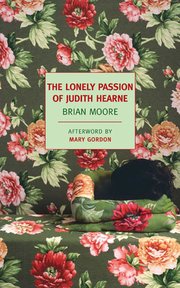
The other two books I’m planning to get through are Trollope’s La Vendée, which one of my PhD students is writing a chapter on (I’m about three chapters into that one, and as she and I were discussing today, it reads more like Scott–though not, perhaps, Scott at his best!–than like Trollope) and, for my other reading group, Brian Moore’s The Lonely Passion of Judith Hearne. I haven’t started that one yet, but I will say that the NYRB Classics edition has a gorgeous cover:

It sounds like a great month, actually. If I do get through all of these, I’ll be pretty proud of myself! But if I don’t, that’s OK too, because there’s always April…

So what about you? Anything on your TBR pile that you are especially looking forward to?