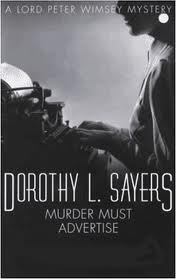
Not Quite Cricket: Dorothy Sayers, Murder Must Advertise

Murder Must Advertise is my fourth favourite Dorothy Sayers novel, after Gaudy Night (first, of course!), Busman’s Honeymoon, and Strong Poison and Have His Carcase (tied at third, because though neither of them is as good as I could wish, both do have Harriet Vane, and that’s such a lot for any novel to have). Harriet is around, in Murder Must Advertise, though never seen; she’s mentioned, very briefly, as Peter Wimsey heads off to “keep his date with the one young woman who showed no signs of yielding to him.” Though, as Sayers blithely remarks, “what he said or did on that occasion is in no way related to this story,” one reason Murder Must Advertise is as good as it is, is that Sayers wrote it after reinventing Peter as a character worthy of Harriet.*

Murder Must Advertise is a clever mystery, with plenty of clues and threads to amuse the devoted puzzle solvers among us. I’m not one of those, myself: I almost never try to figure out whodunit, which is probably why I am so comfortable with the police procedural as a form (no use trying to solve the crime before the police have collected all the evidence, after all), and the interest I do take in the crime and its solution is almost entirely the result of (or proportional to) the interest I take in the characters, setting, and situation of the novel — which is certainly why my preferred mystery writers are those who lavish care and detail on these elements: P. D. James, Elizabeth George, Ian Rankin. As I’ve often remarked here, I’m not really a fan of mystery novels as such. When I really like a mystery, I like it as a novel: I read it with the same attention and attitude as any other novel. The mystery just provides the skeleton, as a marriage plot provides the underlying structure of many other novels, or some version of the Bildungsroman the basic outline of yet more. In some cases, there’s too little flesh on the bone: when the generic framework is too exposed, covered in only the thinnest pretense of novelistic substance, I lose interest. At other times, I get frustrated when the mystery intrudes on the other aspects of the novel–or I wish the characters could escape for a while from their form and just get on with their lives! I love Gaudy Night because for me, it integrates its mystery perfectly – both structurally and thematically – with the other aspects of the novel. Sayers too thought it was something pretty special.

Murder Must Advertise is a very different book than Gaudy Night, much more satirical in tone and digressive (or, perhaps, experimental) in style. It seems to me to have its own thematic unities, though, arising from – or making apt – its setting in an advertising agency (a setting Sayers knew about first-hand). It’s a novel about money, I think, more than anything, and more specifically about the relationship between money and class, and between money and consumption, and how both of these are related, as means and motivators, to aspiration. It’s a satire on the folly of believing you can buy everything you want, from health to happiness, and it’s an exposé of the ruthlessness with which some people will feed and profit from that dream:

All over London the lights flickered in and out, calling on the public to save its body and purse: SOPO SAVES SCRUBBING – NUTRAX FOR NERVES – CRUNCHLETS ARE CRISPER – EAT PIPER PARRITCH – DRINK POMPAYNE – ONE WHOOSH AND IT’S CLEAN – OH, BOY! IT’S TOMBOY TOFFEE – NOURISH NERVES WITH NUTRAX – FARLEY’S FOOTWEAR TAKES YOU FURTHER – IT ISN’T DEAR, IT’S DARLING – DARLING’S FOR HOUSEHOLD APPLIANCES – MAKE ALL SAFE WITH SANFECT – WHIFFLETS FASCINATE. The presses thundering and growling, ground out the same appeals by the million: ASK YOUR GROCER – ASK YOUR DOCTOR – ASK THE MAN WHO’S TRIED IT – MOTHERS! GIVE IT TO YOUR CHILDREN – HOUSEWIVES! SAVE MONEY – HUSBANDS! INSURE YOUR LIVES – WOMEN! DO YOU REALISE? DON’T SAY SOAP, SAY SOPO! Whatever you’re doing, stop it and do something else! Whatever you’re buying, pause and buy something different. Be hectored into health and prosperity! Never let up! Never go to sleep! Never be satisfied. If once you are satisfied, all our wheels will run down. Keep going – and if you can’t  Try Nutrax for Nerves!

 The device of putting the über-aristocratic Peter Wimsey undercover at Pym’s Advertising Agency allows for some comic fish-out-of-water material in the early chapters, but the situation gets darker and more complicated as we see and feel – and Lord Peter sees and feels – the difference between his “ordinary” life and the realities of life for his colleagues at the office (and, just by the way, the novel is also an astute and sardonic portrait of office life and politics). It’s a harmless game to him at first, a pleasant charade laden with unthinking condescension:

‘So you have become one of the world’s workers, Peter,’ said Lady Mary.

‘Yes; I’m pulling down four solid quid a week. Amazin’ sensation. First time I’ve ever earned a cent. Every week when I get my pay-envelope, I glow with honest pride.’

Even Lord Peter seems surprised at how far he is transformed by his experience, which initially he is able to shrug off with ease:

In a taxi rolling south-west, Mr Bredon removed his spectacles, combed out his side-parting, stuck a monocle in his eye, and by the time he reached Piccadilly Circus was again Lord Peter Wimsey. With a vacant wonder he gazed upon the twinkling sky-signs, as though, ignorant astronomer, he knew nothing of the creative hands that had set these lesser lights to rule the night.

He is drawn into his new identity, however, by the simple necessity of having to do the job of writing advertising copy. It’s work for which, with his literary education and natural wit, he is actually well suited, despite being one of the people for whom (as he notes at one point to his brother-in-law Chief Inspector Parker) advertisement “does not exist,”people who are “not of the advertising sort”  – that is, he’s above either the lure of or the need for advertising by virtue of already having, or being able to afford, whatever he wants. He becomes fascinated by the cycle of yearning and imagining and manufacturing and advertising and selling and buying that sends money around and around in the modern world:

If this hell’s-dance of spending and saving were to stop for a moment, what would happen? If all the advertising in the world were to shut down tomorrow, would people still go on buying more soap, eating more apples, giving their children more vitamins, roughage, milk, olive oil, scooters and laxatives, learning more languages by gramophone, hearing more virtuosos by radio, re-decorating their houses, refreshing themselves with more non-alcoholic thirst-quenchers, cooking more new, appetising dishes, affording themselves that little extra touch which means so much? Or would the whole desperate whirligig slow down, and the exhausted public relapse upon plain grub and elbow grease? He did not know. Like all rich men, he had never before paid any attention to advertisements. He had never realised the enormous commercial importance of the comparatively poor. Not on the wealthy, who buy only what they want when they want it, was the vast superstructure of industry founded and built on, but on those who, aching for a luxury beyond their reach and for a leisure for ever denied them, could be bullied or wheedled into spending their few hardly won shillings on whatever might give them, if only for a moment, a leisured and luxurious illusion.

Far from bringing some kind of other-worldly values into play to challenge or even trip up this “vast superstructure,” he is drawn into it, ultimately initiating a great advertising “scheme” that anticipates today’s AirMiles-type points plans: “Whiffling Round Britain.” He has just hit upon the basic idea for this plan and “written the word ‘WHIFFLE’ in capital letters an inch high” on his scratch paper when a call comes from CI Parker asking him to call him at the Yard: “Lord Peter Wimsey was so intimately in the skin of Mr Death Bredon that he said ‘Damn!’ loudly and heartily.” He’s frustrated when a turn in the case makes it impossible for him to return to work: “But that won’t do. I’ve got to get that Whifflets campaign finished. Armstrong wants it particularly. And besides, I’ve got interested in the thing.”

But of course it’s a temp job for him, a fling; when it’s done, he understands something else about how the world turns, but it’s not until Gaudy Night that he is really forced to confront the limits of what his wealth can buy, and the challenge it poses to creating equal relationships. Harriet hates his wealth and the power it gives him. The mystery at Pym’s, in contrast, turns on the need for money, on the insidious way just the kinds of desires stoked by advertising can lead someone into debt, then erode their moral fiber as they struggle to conceal and protect their position. “You don’t know, Bredon – Wimsey – you don’t know what it is to be stuck for money,” the murderer says during his painful confession; “you marry and start paying for your house and furniture, and you must keep up the instalments…” His need for money made him vulnerable, and he became involved with a ruthless ring of drug smugglers, who connect the Pym’s storyline to another in a world at once remote and fundamentally similar, full of people whose yearning for amusement and distraction make them eager customers, with different but no less damaging results. Round and round it all goes, and there’s always someone there making a profit, turning someone else’s weakness or fantasy to their advantage. “We want to get women down to serious smoking,” kindly Mr Pym says as they prepare to launch the Whifflet campaign. “Too many of them play about with it. . . You can smoke a lot more [Whifflets] in the day without killing yourself. And they’re cheaper. If we increase women’s smokes by 500 per cent – there’s plenty of room for it – ”

Wimsey’s presence at Pym’s, then, lets Sayers go a little bit ‘Mork and Mindy’ on the advertising world, but also on the world it serves, both those who produce its goods and services and those who consume them. Wimsey’s class sets him outside this “desperate whirligig.” The novel does not seem to me to be interested in fiercely critiquing his position of privilege, but the juxtaposition of his pampered life with Bunter in the Piccadilly flat with the goings-on at Pym’s certainly exposes that privilege, and along with it, Wimsey’s casual superiority in pretty much every respect (looks, wit, education, clothing) as accidents of circumstance. “I could be a good woman if I had £5000 a year,” reflects Becky Sharp, and what special virtue can Wimsey claim for himself, never having faced the kind of petty catastrophes that come with being “stuck for money”? And yet if there is an underlying moral code at play in Murder Must Advertise, I think it is what might be called the “public school code,” something to do with fair play and honor, that’s central to Wimsey’s character and identity.  “I suppose that’s . . . the public school way out of it,” says the murderer, as he braces himself for what Wimsey presents as his best alternative, the only way he can extricate himself from the situation without leaving a legacy of scandal and shame for his wife and new baby. Their exchange refers us back to an earlier debate at the office about which schools really count as “public” schools, and whether it matters where someone was educated. There’s a painful self-consciousness on all sides about how schools act as class indicators, with those who went to Harrow and Eton (and perhaps Winchester, “a decentish sort of place . . . if you’re not too particular”) downplaying the significance of it all: “if only you people could get it out of your heads that these things matter a damn, you’d be a darn sight happier,” as “Mr Bredon” says. “I am quite aware,” Mr Smayle later says irately to Mr Tallboys,

that I never was at a public school, but that is no reason why I shouldn’t be treated with ordinary, common courtesy. And from those who have been to real public schools, I get it, what’s more. You may think a lot of Dumbleton, but it isn’t what I call a public school.

It’s all very well for Wimsey to take the signifiers of class so lightly, but only someone in his position can imagine that class doesn’t matter. Perhaps, also, only someone in his position can imagine that it shouldn’t matter. After all, he’s already in the class people like Smayle and Tallboys assume (correctly) has all the advantages. Lord Peter, though “not of the advertising sort” himself, is an advertising fantasy for everyone else: he embodies and lives their aspirations. He both is and has what they want.

This, I think, is where the cricket match becomes particularly interesting. I’ve been thinking about the relevance of the cricket match ever since a careless question about it at a recent Ph.D. exam I was involved in. Though I know next to nothing about cricket, I’ve always thoroughly enjoyed the cricket chapter in this novel. It’s brilliantly told, with lots of energetic detail; all the various Pym’s people play their part, and all the lurking tensions and resentments and all their hopes and fears give the actual cricket all kinds of human interest. The best part, though, is when Mr Death Bredon, who has planned to play an unobtrusive game that won’t give his own game away, that will give no sign of “the Peter Wimsey of twenty years back, making two centuries in successive innings for Oxford,” gets hit by a ball right on his funny-bone, at which point he “suddenly and regrettably forgot himself”: “He forgot his caution and his role, and Mr Miller’s braces, and saw only the green turf and the Oval on a sunny day and the squat majesty of the gasworks. The next ball was another of Simmonds’s murderous short-pitched bumpers, and Lord Peter Wimsey, opening up wrathful shoulders, strode out of his crease like the spirit of vengeance and whacked it to the wide.” What follows is pure sport, pure fun, and total exposure, as old Mr Brotherhood corners him: “Aren’t you Wimsey of Balliol? . . . You have a late cut which is exceedingly characteristic, and I could have taken my oath that the last time I saw you play it was at Lord’s in 1911, when you made 112.” An elaborate cover-up follows, but Wimsey’s double-life is over, the suspect is warned, and the sordid, unhappy conclusion follows soon after.

I suppose not everyone would necessarily enjoy the cricket match for its own sake the way I always have, but there’s no doubt that it plays a crucial role in the novel by bringing everything to this crisis point. But why do this through a cricket match? I actually think my colleague, in spite of himself, was asking a very important question about the central premises of Murder Must Advertise. One place to start with an answer is, again, with money and class, and also with national identity. Is there any game more English than cricket, for one thing? Or any sport more strongly associated, historically at least, with the British public schools like Eton and Harrow (which have held an annual match since 1805)? To play well (to show up in the right ‘flannels,’ even) is to stand up for something, or to stand out as something – something that seems, from the slipshod performance of most of the Pym’s players, to be out of date or out of reach. Cricket represents one form of aspiration for everyone involved, but it’s a backward-looking, nostalgic kind, a yearning for a certain vision of themselves, maybe even their country. Then there’s the more general idea of sports. “I can’t help feeling,” Mr Hankin remarks to Bredon, “that the cultivation of the team spirit would do this office good.” “Evidently, thought Bredon, Mr Hankin had realised that something was on the breaking point.” He too is struck by the uneasy contrast between the ideals Pym’s peddles (“EVERYONE EVERWHERE ALWAYS AGREES ON THE FLAVOUR AND VALUE OF TWENTYMAN’S TEAS”) and the realities:

In this place, where from morning till night a staff of over a hundred people hymned the praises of thrift, virtue, harmony, eupepsia and domestic contentment, the spiritual atmosphere was clamorous with financial storm, intrigue, dissension, indigestion, and marital infidelity. And with worse things – with murder wholesale and retail, of soul and body, murder by weapon and by poison. These things did not advertise, or if they did, they called themselves by other names.

At Pym’s, Wimsey goes around as something besides his best self. He plays at indifference, callousness, even crass commercialism – plays so well he finds himself becoming the man he pretends to be. Rapped on his funny-bone by a fast pitch, he breaks out of this adaptive inferiority, casting off “Mr Death Bredon” and appearing in his full glory as “Lord Peter Wimsey.” His class, in other words, re-asserts itself – and that, ultimately, is what begins the real process of restoring order and achieving justice. The revelation of Wimsey’s real identity brings the murderer to his flat; his moral authority sends the weaker, poorer man out to meet his dark but welcome fate: “We’ll show ’em that [we] can achieve the Eton touch. Why not?” It’s a grim and dubious responsibility Wimsey takes on here: who is he, after all, to play judge and, if indirectly, executioner? Or, to look at it from a different aspect, who is he to urge a murderer to circumvent the due process of law? It’s the time-honoured privilege of the amateur detective, though, to act on principle, and also to decide which principle to act on. (“When a man’s partner is killed, he’s supposed to do something about it,” Sam Spade intones in The Maltese Falcon.) “The first thing a principle does,” Lord Peter says in Gaudy Night, “is kill somebody,” and then later, “I admit the principle and the consequences must follow.” In that novel, the relevant – indeed, the central – principle is integrity of the mind. What principle holds the corresponding position in Murder Must Advertise? I’m tempted to say, cricket does. Cricket’s not a principle, you say? Well, it is when we use it metaphorically, as in “It’s not cricket,” which my trusty Brewer’s Dictionary of Phrase and Fable explains means “It’s not done in a fair and sportsmanlike way.” That, as I understand it, is what is meant by “the public school way” too, and that’s the principle that the various criminals and liars and cheaters in the novel have violated by playing on others’ weaknesses. How far is advertising implicated in the same creeping kind of villainy? Not completely, I think – as Miss Meteyard says, “if we didn’t do it, what would happen to the trade of this country?” But just because avarice and envy drive the economy forward doesn’t make them any less morally debilitating.

And yet there’s something uncomfortably high-handed about Wimsey’s role in this case, and something disingenuous at best about letting an aristocratic fantasy figure set the tone in a morality play about the dangers of social aspiration. “I’m damned sorry, old chap,” he says at the end, and to be sure, he is, but he’s not remorseful, and he’s not in any significant way reformed or transformed: his wealth makes him immune to the petty temptations that have done so much damage. I suppose it’s only fair to acknowledge that it opens up other temptations to him, including the sybaritic pleasures that prove pretty destructive to the characters in the other plotline, such as the languidly decadent Dian de Momerie. But here too he interferes playfully, and though his interference has fatal results, he remains essentially above it all. Unlike the people who really work at Pym’s, Wimsey can walk away from the whirligig, away from the lives lost or ruined or changed because of his field trip into the working world. Now that doesn’t seem quite cricket to me! On the bright side, though, Wimsey isn’t entirely happy with the way things worked out either. “Lovely,” he says, “with a spice of bitterness in his tone,” when Chief Inspector Parker calls to report that the case is nearly all cleared up. “I don’t feel quite like celebrating.” He’s pretty pleased with the results of his Whifflet idea, though: “with a few idle words on a sheet of paper he had touched the lives of millions.”

*When I next get to my office I will complete this post with a quotation from her essay on Gaudy Night, in which she writes eloquently about this point. Funny how odd, and rare, it is to be foiled in mid-post by wanting a text I have only in hard copy and only in one location!
This Week in My Class Prep: Details, Details!

Sometime Sunday afternoon it really hit me that in just a few weeks I will be right back in the midst of teaching. Not that there’s anything wrong with that! I’m looking forward to it, as I’ve said before. But I also need to be ready for it, and while I’ve been thinking about and in a general way preparing for next term since the beginning of my sabbatical in January, as classes approach the specifics get much more important. I have colleagues who refuse to do things like syllabi and Blackboard sites before the end of August–or, another way to put it, refuse to put aside their research, deferred (more or less) throughout the teaching year, until they must. I understand this attitude, and if I were in the midst of a deep, specialized research project I might feel the same. But I hate doing things at the last minute, and this year in particular I feel I need to be well organized in advance because I leave for England on August 29, not returning until September 5–with my first class of the term at 9:30 on September 9th. Imagine working on Blackboard sites while jet-lagged! No thanks. I want all the logistical stuff in order before I leave, so that when I get back I can get on with the readings and other actual content for the first class meetings. I’m sure I’ll miss (or need to change or fix) a few odds and ends, but here’s what’s on my to-do list:

  1. Blackboard sites. I’ve just completed one of three, for Mystery and Detective Fiction. This is the one that required the least revamping, since I taught the class not long ago and plan to use the same assignment sequence. Still, I’ve changed the reading list, so a lot of links had to be taken out or put in (I include a selection of links to related online content, such as author interviews or sites, topical blogs, etc.). Handouts needed to be updated – and in fact I still need to add new sets of discussion questions for the books now on the list for which I have no back-file of teaching materials. I haven’t put entries for each class meeting in the calendar tool yet (that’s an incredibly laborious task, but I think it’s probably worth it since it helps provide prompts to everyone, including me, about what we are supposed to do when). Basically, though, it’s up and running, and I’ve put in a request for the registered students to be given access to it, in the hopes that this will divert some of the inevitable emails about  the book list and so forth, and help students make up their mind about whether they want to stay in the course. (There’s a waiting list.) The two other sites are still pretty jumbled, but I can’t sort them out until I finish my work on …
  2. Course syllabi. Again, one of three is completed, but the other two are still in progress, because I’m still having debates with myself about which assignment sequences to use. Note that expression “assignment sequences”–this reflects my effort to think of course work as a set of interrelated tasks or projects, rather than as discrete exercises or displays, which is more or less how I approached things like term papers when I began teaching. I like to use small, low-stakes assignments (like in-class writing, journals, or question sets and responses) that let students learn and practise the kind of analysis that they will be expected to do in their larger, weightier assignments (papers, presentations, and/or exams). I wrote before about the letter exchanges I’ve used in my 19th-century novels courses. I am almost certain I will use it again this year, but based on the discussion on that post, I think I will give up on doing them electronically and revert to old-fashioned paper. I think. I’m reluctant, only because I had made a real commitment to going paperless and had appreciated many things about it. But I can see that in this particular case, having letters in hand might solve several of the logistical and technological problems that arose last time. Once I settle this for sure in my own mind, I can finish that syllabus up and get the Bb site sorted accordingly. I don’t think I have big decisions left to make for the upper-level seminar on the ‘woman question,’ but there I’m still sorting out the schedule so that there’s a reasonable rhythm between long and short texts, and a reasonable pattern for group presentations. Details, details.
  3. Course materials, research. Not everything has to be in hand by September, but the more notes and handouts I have filed away the less panic I will experience as the term rushes by! For books I have taught before, I have folders already stocked with old discussion questions, group exercises, lecture notes, and PPT slides. But this year I have added several all-new texts to the mystery class, so there in particular I feel I need to do some more advance work. I’ve got some articles downloaded on Walter Mosley, and I’ll read those as I reread Devil in a Blue Dress and work up some draft study questions. I also want to look around at the scholarship on Ed McBain, and on Sjowall and Wahloo, for The Terrorists. For all of these, I have some ideas already, of course, but I know I have more to learn. I may also need to read (or at least read about) Chandler’s Farewell, My Lovely, as Devil in a Blue Dress has been described as “a suggestive inversion (and perhaps an intentional critical parody” of that novel, at least in parts.
  4. Paperwork. Every year it seems I let myself be taken by surprise by administrative paperwork: attendance sheets and records, grade sheets, evaluation forms, sign-up sheets. Not this year! It’s true that the long add-drop period makes it desperately annoying handling attendance for the first two weeks of classes, but I can at least have the spreadsheets ready to paste the latest versions of the Registrar’s class lists into, and I can make some advance decisions about how to track and record those “little” assignments.

I have set up a ‘task list’ on my Google Calendar to get the anxiety under control: this kind of work is so cluttered, because it involves so many small and often moving parts!

Of course, before I leave for England I also need to have my conference talk prepared. I’ve been working on that, using Prezi, and I am really appreciating the way that Prezi lets me brainstorm and conceptualize the topics I want to cover and how they can be connected without committing me to the more elaborate and inflexible design process of PPT. And, last but not least, I didn’t get my Richard III-and-gender-and-genre piece in order for the August issue of Open Letters…so if I can, I’ll get that done before I leave as well. Oh, and the Ph.D. thesis chapters keep on coming in, and I’ve also agreed to be third reader on an M.A. thesis, expected to land in my box August 15. I feel the anxiety going up again…so it’s time to stop planning and start doing.

J. G. Farrell, Troubles

In 2010, J. G. Farrell’s Troubles won the “lost” Booker Prize. Farrell had already won the Booker once, for his later novel The Siege of Krishnapur–also part of the Empire Trilogy, which concludes with The Singapore Grip. Though it is certainly debatable how far literary prizes succeed in identifying the “best” novels of any given year, they undoubtedly succeed at drawing attention to those that are nominated. In this case, I suppose I might have come across Troubles anyway, but it probably would not have stood out to me without the buzz generated by its belated Booker win. The bland cover on my edition would not have helped, either! Nothing in that cool, flat scene suggests that inside the book will be moments like this one:

Then he noticed again, more strongly than before, the sweetish, nauseating  odour he had decided to forget about earlier. It was an awful smell. He could not stand it. . . . A small cupboard stood beside the bed. He wrenched open the door. On the top shelf there was nothing. On the bottom shelf was a chamber-pot and in the chamber-pot was a decaying object crawling with white maggots. From the middle of this object a large eye, bluish and corrupt, gazed up at the Major, who scarcely had time to reach the bathroom before he began to vomit brown soup and steamed bacon and cabbage. Little by little the smell of the object stole into the bathroom and enveloped him.

This is one of our (and our protagonist Major Brendan Archer’s) first encounters with the comic grotesquerie that characterizes the Majestic Hotel in Kilnalough. The Major, physically hale but carrying the emotional and psychological scars of his war service (he wonders, at one point, if he has lost his sense of humor, and it’s hard to imagine why he wouldn’t have) has traveled to Ireland to sort things out with Angela Spencer, daughter of the Majestic’s staunchly Unionist father. He got engaged to Angela during a short leave and since then their relationship has flourished primarily on the basis of her letters, which are full of such detail about Kilnalough and the hotel that the Major feels he practically knows the place already. Well, there’s nothing like a decaying sheep’s head in one’s chamber-pot to defamiliarize one’s surroundings! It doesn’t take long before we understand, as does the Major (though he never quite articulates it) that enveloping decay is not just the state of things at the Majestic but a metaphor for the state of Anglo-Irish society at this time of the ‘troubles.’ The sheep’s head epitomizes the many ways in which the crumbling, mouldering, collapsing, overgrown, over-run hotel symbolizes an era well past whatever glory it once had, gradually losing even the facade of respectability, never mind beauty. The tensions running between English and Irish, Protestant and Catholic, Auxiliaries and Sinn Feiners, manifest themselves at the Majestic through the roots working their way through walls and floors (“the wooden blocks of parquet flooring bulged ominously upward like a giant abscess”). Nothing is stable, nothing is to be depended on, and yet Edward Spencer and his motley assortment of guests, mostly old ladies in various stages of decay themselves, hang on, charming, bemused, perverse, fearful yet defiant.

Though every element of the novel is presented and supported realistically (there is, for instance, a reason there’s a decaying sheep’s head in the Major’s chamber-pot: it’s not there just to be symbolic), cumulatively the novel’s absurdities eventually take us beyond the realm of realism: living in its world, we must accept one implausibility after another, starting with the basic premise that anyone would – could – live at the Majestic in the conditions Farrell describes with such deadpan glee (indulge me as I quote at length, because its details are too delicious, and characteristic, to cut):

The thing that most worried the Major was that the Majestic was literally beginning to fall to pieces. . . . Meanwhile, no matter how much they might grumble, the residents adapted themselves remarkably well to the nomadic existence of moving from room to room whenever plumbing or furniture happened to fail them.

True, the amenities had gone from bad to worse (not that the Major really noticed any more). The foliage evacuated from the Palm Court now looked like taking command of the residents’ lounge; the mirrors everywhere had become more fogged and grimy than ever; the gas mantles which had until recently burned on the stairs and in the corridors had now stopped functioning, so that the ladies had to grope their way to bed with their hearts going pit-a-pat; the soup in the dining room became clearer and colder as the days went by, and as the cook was left more and more to her own devices bacon and cabbage followed by baked apples appeared more frequently on the menu; outside in the grounds a tall pine keeled over and flattened a conservatory with such a terrible crash that two ladies (Miss Devere and a Mrs Archibald Bradley) packed their bags then and there; on the few remaining tennis courts a peculiarly tough and prolific type of clover continued its advance, so that if anyone had been thinking of playing tennis (which nobody was) they would have found that even the most firmly hit service would never rise more than six inches. . . .

One unseasonably warm day the giant M of MAJESTIC detached itself from the facade of the building and fell four storeys to demolish a small table at which a very old and very deaf lady, an early arrival for Christmas, had decided to take tea in the mild sunshine that was almost like summer. She had looked away for a moment, she explained to Edward in a very loud voice (almost shouting, in fact) trying to remember where the floral clock had been in the old days. She had maybe closed her eyes for a moment or two. When she had turned back to her tea, it had gone! Smashed to pieces by this strange, seagull-shaped piece of cast iron (she luckily had not recognized it or divined where it came from).

 We also have to live, as the Major does, with brutality strangely laced through with comedy: Farrell excels at a ruthless sort of slapstick, provoking laughter even as he makes you flinch. In one scene, for instance, a cheerful whist game is interrupted when one of the hotel’s many resident cats is “tantalized beyond endurance” by a decorative pheasant on one of the old ladies’ hats. What follows is at once, uncomfortably, completely hilarious and entirely awful:

the cat sprang from Mrs Rappaport’s lap, hurtled through the air in a horrid orange flash, and pounced on Miss Staveley’s black velvet shoulders, sinking its hideous claws into the bird’s delicate plumage. Miss Stavely uttered a shriek and sank forward on to the card-table while the cat, precariously balanced on her shoulders, ripped and clawed savagely at her headgear in an explosion of feathers. There was pandemonium. The ladies cried out in alarm. The men voiced gruff barks of astonishment and leaped to their feet. But still the beast savaged its prey. At last Edward and the Major, knocking chairs aside, stumbled to the rescue. But before they could reach Miss Stavely the tutor sprang forward and dealt the beast a terrible blow on the back of the neck. It gave a piercing wail, thin as the shriek of a child, and dropped senseless to the carpet.

Silence fell. Everyone in the room froze. In the sudden stillness the crackling of a log in the fireplace seemed unnaturally loud. The tutor stooped and picked up the cat. For an instant, as he held it high over his head, there was a savage rictus on his white pocked face. Then he hurled it across the room with terrible force. It smacked against the wall with a sickening thud and dropped lifeless to the floor. There was a sharp intake of breath, and everyone peered at the shapeless marmalade bundle.

If you were laughing at first at the spectacle of “cat attacks hat,” I bet you aren’t laughing now. If Troubles were ever adapted for the screen, it would need a special warning that “no cats were harmed in the making of this film”–they feature largely in the novel, including in at least two other quite gruesome sequences (let’s just say, of the first one, that Edward and the Major resolve to reduce their numbers, which are multiplying uncomfortably amidst the neglect and decay of the hotel, with grim results, and of the second, that it has some relation to the “tiny white skeletons scattered around” the shell of the hotel described in the prologue). The tutor, Evans, who hates his employers and everything they stand for, later leans over a parapet to “vomit copiously, a thick yellow fluid” that splatters on the glass roof of the hotel ballroom as “the black and white gentleman on the other side of the glass continued to revolve mechanically with the softly flowing silk and taffeta of the ladies.” “You’re disgusting,” the Major says, dragging him back, but the scene is, again, both disturbing in its violence and unfortunately funny because it literalizes the visceral (sorry) and irreconcilable antagonism between the republican Irish and those they see as their occupiers.

The whole of the novel, in one way or another, embodies this conflict, with people’s personal troubles humming with or somehow reiterating the political troubles that are devastating the country. Thus, for instance,  the Major’s fitful, irrational, unsuccessful love affair with the beautiful sort-of crippled Sarah Devlin – “D’you know that I’m a Catholic? Of course you do. But do you even know what a Catholic is?” she demands, when he finally gets her, in fulfillment of his fantasies, alone into the linen cupboard where he has made himself a bizarre sweaty retreat from the hazards and tensions of the household. Farrell brings the literal, historical ‘Troubles’ into the novel through interspersed news clippings: I don’t know if they are authentic (they certainly feel so), but as the novel goes on their terse announcements of murders and reprisals are like the ominous bass notes to the chorus of mingled frivolity and despair that increasingly marks activities at the Majestic.

To some extent the novel has the form of the country house or ‘big house’ novel, but in the end, it’s important that the Majestic is not a house but a hotel. This setting means that we are continually reminded that the characters’ stay there is impermanent–at best they are guests, at worst interlopers, in a place where they were never really invited. How different is the situation of the Anglo-Irish (or just plain English) at the Majestic from the more general human condition? “All this fuss,” muses the doddering old Dr. Ryan of Kilnalough near the end: “it’s all fuss about nothing. We’re here for a while and then we’re gone. People are insubstantial.” We’re here for a while and then we’re gone: true enough. But Troubles clarifies that, transients as we may be, we are still bound to live together as best we can, and in the novel as in real life, one  of the most important courtesies we can display – one of the safeguards of civility- is knowing when it’s time to go. If there’s something lost, something to be mourned, however awkwardly, among the “charred rubble” which is all that remains of the Majestic at the end, the novel also leaves us in no doubt that time had come for the English in Ireland.

Summertime doldrums, or, I hate the idle pleasures of these days…

Bluhm PergolaWell, OK, that puts it a bit strongly — but I find I don’t flourish in the summer, despite being happy (who could not be?) to have some warmth and sunshine. I find the relative formlessness of the days difficult: I do better with more of a routine, including a routine that gets me out of the house and into my office on a regular schedule. I have an office space at home, but for years now my “real” workplace has been on campus, and though I use my home office for lots of things, from marking to blogging, still, there’s something psychologically useful to me about being “at work” rather than at home. That includes the absence of domestic distractions: being at work in a predictable way really helps me feel less torn when I am at home between wanting to appreciate being with my family and give my children the time and attention they deserve, and trying to get work-related chores and projects cleared away.
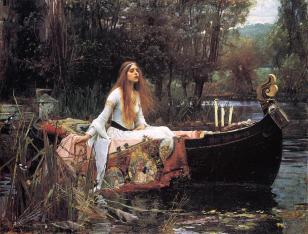
I realize that I am fortunate that the nature of academic work makes it possible to be home a lot during summer vacation, and my children are finally old enough to occupy themselves a fair amount, but I still don’t find it easy to concentrate, and the feeling of time drifting away amidst what we like to call (in honour of Mr Casaubon) “desultory vivacity” becomes nerve-wracking to me after a while. We also find that the city empties out during the summer as people head to their cottages. Neither of us was raised with the whole cottage phenomenon, and we aren’t interested in pursuing it now. We invested in a home in a very quiet and pretty part of town partly to obviate the need to rush away as soon as the weather turns nice, and we find one property quite enough to take care of (not to mention, to pay for). For various reasons, our family is also not particularly portable, so mooching off our friends at their cottages is not a live option. And so summers also feel quite isolated. Heck, even the internet is quieter in the summer!  I need to make a deliberate effort, in these circumstances not to prove a villain and get all restless and snarly. Waterhouse Shalott

To make sure I am in fact staying on top of my to-do list for work, I’m trying to focus on tasks that are more or less mechanical, like re-organizing my class syllabi and setting up Blackboard sites. I’m making progress here: two of my three fall syllabi are basically ready. All three fall Blackboard sites are in progress, though there’s a fair amount of housekeeping to do on them, because I’ve changed reading lists and am also revising assignment sequences since they were last used. I hate Blackboard. Everything about it is unbearably slow and clunky to manipulate. I also have the perhaps foolish idea that the course sites should be attractive, and should in some way reflect the themes and readings for each course, so that students feel that they are in a space that is an extension of our class time. I’m not computer-savvy enough to mean anything that elaborate by this, but I do choose colour schemes and custom icons and graphics to suit. For the Victorian ‘woman question’ seminar, for instance, I made a banner for the heading that is all different paintings of the Lady of Shalott, and at some point in the term we will reflect on the various representations in the context of our discussions of things like Victorian women as artists, problems of women entering the public sphere, idealizations of sick or dead women, and so on. I suppose I could just do the whole thing in a strictly utilitarian way and save myself time and grief (you don’t want to know how annoying it was getting that d–n banner made and then inserted–a process not helped at all by the painful sloth that comes over my otherwise zippy ASUS netbook when I’m inside the Blackboard interface).  I wonder if the students either notice or care how we set these things up. In any case, the tedious pointing and clicking of adding files, assignments, calendar entries (that’s the worst!) and links to things like the university’s academic integrity site as well as relevant web resources all has to get done by September, and it’s not the kind of work that gets thrown off too much by invitations to play MarioKart, demands for lunch, or doing taxi service to or from play dates or camps.

blogger-logoThe other work project I’m puttering away at is my presentation for the conference in Birmingham, which suddenly does not seem far off at all! I leave in just over a month. I’ve been learning Prezi, because what I’d seen of it (e.g. here) made it look just right for the kind of wide-ranging, open-ended talk that seems appropriate: the panel is on “knowledge dissemination in Canada,” and I was invited to talk about my experience as a blogger. I intend a short preamble to the more autobiographical / anecdotal part that will address some principled reasons for academics to think about and maybe even try blogging — the state of academic publishing, debates about open access vs. ‘gated’ scholarship, the potential value of academic expertise in the public domain — and also a bit about academic literary criticism and its relation to the wider book culture. But I’m not going to be trying to prove one particular point or argue for one particular value or approach, so the linearity of PowerPoint doesn’t suit. I did use PowerPoint the last time I spoke on these issues, to my departmental colloquium back in 2007, so I do have some graphics I may be able to recycle! But Prezi is an intriguingly different beast and if I can get the hang of it, I think it will work well for mapping relationships between all these different but interwoven threads. Also, it’s fun to play with–which I’m pretty sure nobody has ever said about PowerPoint. And it comes with a warning that it may cause motion sickness in your audience if not handled with care. Now tell me you aren’t longing to try it! Imagine the effect some uncontrolled zooming might have on a batch of unsuspecting first-year students…
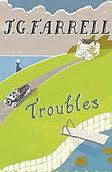
troublesI’m reading, too–right now, Troubles, by J. G. Farrell, which won the “lost” Booker a while back. I am loving it: it is brilliantly, mordantly, funny, with a current of uneasy violence running through its main storyline that is perfectly suited to the novel’s historical context, the Irish “troubles.” It’s yet another book (like Old Filth or Major Pettigrew’s Last Stand) featuring a retired servant of the empire — though in this case Major Archer is retired from active service but still a young man — yet it does not give me the same uneasy feeling that I’ve been through these moves before. We’ll see if I still feel that way at the end of the book. When day is done and I can’t even putter any more, I am watching Downton Abbey. This does seem familiar (wasn’t it called ‘Upstairs, Downstairs’ the last time?), but it is also very well done. I’ve just finished watching the Emma Thompson / Kenneth Branagh adaptation of Oliva Manning’s The Fortunes of War, which was excellent: I was most impressed that the series kept the oddly understated quality of the novels, which for some viewers might have made it unbearably slow in its pacing, which it is (slow,  not unbearable). While I watch these, I work on my bookshelf sampler, which I now believe I will actually finish by the end of the summer! I have just a bit more gilt for the book bindings and one final garland and then it’s time to mount and frame it.

My summer doesn’t sound so idle when I lay it all out like this! Add in that I’ve done some serious housecleaning (including, just this morning, taking everything out of the fridge, cleaning all the shelves and drawers, and putting everything back in all nice and orderly) and enjoyed such genuine summery activities as strolls in our beautiful Public Gardens, not to mention plenty of quality time with the kids doing other activities, and I feel quite pleased with the balance of work and play after all. Yet I will still welcome September, with its bouquet of freshly sharpened pencils* and the return to what feels–to someone who has, one way or another, been in school for nearly 40 years–like normal life.

*Sorry: I couldn’t find a clip with that actual line in it! But it’s near this point in the movie, I’m sure.

Rosamond Lehmann, The Weather in the Streets: Bridget Jones’s Purgatory

The front cover of my Virago edition of Rosamond Lehmann’s The Weather in the Streets prominently displays Carmen Callil’s comment that “The Weather in the Streets was our Bridget Jones’s Diary.” This is one of the most disingenuous marketing moves I have seen: anyone led by this to expect some frothy fun along the lines of Helen Fielding’s clever, witty, insubstantial comedy will be startled (as I was) by Lehmann’s dark, drifting narrative of erotic infatuation, disappointment, and psychic pain.

In the context of her introduction, Callil’s line makes a bit more sense: “Clubbing may have replaced the wild parties of 1930s bohemia that constitute Olivia’s world, but the pangs of the heart are the same.” Still, what is emphatically not the same is Lehmann’s refusal to let either us or her characters enjoy the fantasy of true, if forbidden, love. Bridget lusts after a cad but learns better and is rewarded by happiness with her Darcy. Olivia lusts after a cad (though Rollo isn’t quite the shallow playboy  Daniel Cleaver is) but all along has a hovering awareness that their relationship is self-limiting: he makes no promises, expresses no intention–not even any desire–to leave his wilting wife. Their relationship isolates Olivia literally as well as emotionally, due to the necessity of keeping it secret; much of the novel expresses the psychological strain this puts on Olivia, especially as she’s astute enough to have no dreams of a future with Rollo to sustain her. Their idyll has already begun to wear and fade when she realizes she is pregnant. Unable to reach Rollo, and unsure anyway about whether she wants him to know and be involved, Olivia broods and suffers and finally resolves to end the pregnancy. She becomes very ill from the abortifacients she tries but they don’t ultimately work, so she asks her flighty roommate if she knows a doctor who could help out ‘a friend.’ Their conversation has no place in Bridget Jones’s world:

Etty was silent.

‘He won’t take any one unless he knows who’s sent them,’ she said at last. ‘You see, it’s fearfully dangerous for him. If you’re caught it means prison . . . in spite of his being, of course, a public benefactor really. I suppose he’s saved regiments of unfortunate erring women from ruin . . . ‘

‘You mean,’ said Olivia, ‘ he might refuse to do it – if she just went out of the blue?’

Silence again.

‘You could give my name, I suppose . . . ‘ Etty stirred. Her slightly protruding eyes between curly doll’s lashes became fixed with a certain wild blankness on her cousin. ‘Only it was so long ago . . .’

‘Did you go to him, Ett?’

‘My dear, once. Wasn’t it shattering?’ The colour came up in her fragile egg-face, painfully, from neck to brow. She laughed, rather shakily. ‘The wages of sin, darling.’

‘Poor Ett.’

Amazing. A shock, definitely. That narrow miniature body, that, too, trapped, subjected to the common risks and consequences of female humanity. It only showed, for the hundredth time, how little one knew about anybody, particularly one’s nearest . . . Seeing only Etty’s marionette surface, allowing one’s intuition and mere circumstantial evidence to decide that never – however much she might dally with preliminaries – would she have brought herself to face ultimate physical issues.

‘Did you go alone?’ Olivia asks a bit later. ‘Well, no,’ Etty replies; ‘Mona was just a saint – she simply arranged everything. You see, she’d been to him just before, poor darling.’ ‘Mona too!’ reflects Olivia. ‘She began to feel fatally cosy and consoled, the seals of arduous secrecy, of solitary endurance melting, melting . . .’ and she is tempted to confession (‘Enter into the feminine conspiracy, be received with tact, sympathy, pills and hot-water bottles, we’re all in the same boat’) but she’s too anxious about revealing her affair and so this consolation, like Rollo, remains out of reach and Olivia endures her appointment alone. Lehmann’s account is quietly harrowing, not just because of Olivia’s physical trauma, but because, to her own surprise, though she recovers physically she is haunted by her decision: ‘I’ve never stopped minding – and longing for it. I suppose it’s Dame Nature’s revenge; one’s body cheated . . .’

In the end there’s no baby, there’s no Rollo, there’s no consolation prize in the form of another, more deserving, lover. In fact, throughout the novel Olivia cherishes an idealized love for another man, Simon, also already married, and far from emerging to provide her with a happily-ever-after (no matter the cost to others), he dies of typhoid just as she is finally breaking up with Rollo. Yes, Olivia goes to some wild bohemian parties, but under the circumstances they aren’t much fun, especially the last one where everyone we know who’s there is mostly worried about how Simon’s widow is doing. Bridget Jones’s Diary is the quintessential ‘chick lit’ novel, with its cheerfully facile problems and solutions and its mantra of loving Bridget “just the way she is” (now that’s a fantasy that puts Bridget’s erotic ones in the shade, isn’t it?).  The Weather in the Streets has a vaguely similar protagonist and plot structure, but its account of “the pangs of the heart” is entirely more cruel and disillusioning. There’s love, but it brings no guarantees: ‘It was only that the word love was capable of so many different interpretations.’

For me, that was the first surprise about The Weather in the Streets, then: that it so ruthlessly reduces its romantic story to such stark elements. The second surprise was Lehmann’s style. Most of the parts fluidly and a bit unnervingly combine third-person narration with Olivia’s own perspective, not through Austen-like free indirect discourse, but by drifting into first person and then out again with no signals:

She glanced at him. ‘I think that was the last time I saw you too . . . ‘

‘I remember.’

‘Do you? We didn’t speak.’

‘No, we didn’t.’

She looked away. A bubble of tension seemed to develop and explode between them. He watched me from the other side of the room. I thought once or twice we looked at each other, but he was too busy, caught up in his own world, to come near: sleek, handsome-looking in his wedding clothes, being an usher . . . I was still in the chrysalis; engaged unimpressively, without a Times announcement, to Ivor, and my clothes were wrong: a subsidiary guest, doing crowd work on the outskirts, feeling inferior, up from the country.

‘I followed her career in the Tatler,’ she said. She smiled . . .

One section is completely in first-person, which I think confirms the purposefulness of Lehmann’s approach here, though I admit I haven’t figured out quite what the purpose could be when first-person seems best suited to the book’s preoccupation with Olivia’s perspective and emotions. Is this as unusual a strategy as it seems to me? Of course I’m aware of novels that intersperse different forms of narration (like the alternation between Esther and the third-person prophetic narrator in Bleak House), but I can’t remember another one that drifts in this way between the two.

One thing that Lehmann can do in the third-person sections that wouldn’t really work in first-person is long passages of descriptive prose. Many of these are highly evocative, and also, bound up as they are in our vicarious experience of Olivia’s feelings, freighted with emotional resonance in a way that reminded me (in effect, not in particulars of style) of Bowen’s The Heat of the Day:

London in the scorched irritable airless end of day was an extension of the mind’s loathing and oppression. Petrol fumes were nausea; the traffic a fatuous, reluctant, laborious progress towards a pointless destination; the picture-houses, with mock-oriental fronts proclaiming within a blend of cool darkness and hot passions, were tawdriness, satiety, cynical sham and cheapness. The main thoroughfares looked empty and discouraged. Only in the by-streets, where mews and slum just touch, just unaggressively nudge the more classy residential quarters, groups of children, submerged in the fuller season, had come up and overflown upon the pavements: London’s strident August undergrowth, existing like cactuses in waterless stone; shouting, running, taking communal licks at ice-cream cornets; deprecated by the charitable passer-by, wish-transferred with spade and bucket to the seaside, where it would be better for it them to be . . .

In many ways, the places in the novel were more vivid to me than the characters, despite the pervasiveness of Olivia’s consciousness — Olivia herself, really, remained the most elusive, and this is where Lehmann lost me a bit. Olivia is completely preoccupied with herself and with Rollo, and in both cases in an entirely ruminating, sensual way. She has no other commitments: her job is of little interest, she is politically unengaged, she doesn’t read books except when she’s sickest, when she turns to “her old Oxford copies of Victorian novelists” (I can’t imagine finding Villette comforting when in her situation, but Vanity Fair seems apt enough, if, again, hardly comforting). I didn’t care much what happened to her and Rollo, because their whole affair is based on the shallowest kind of infatuation. “You’re so young,” he whispers to her as they kiss for the first time; “You’re like a young, young girl.” And she accepts the terms he sets: secrecy, furtive outings, expensive gifts, no promises. Olivia’s emotions are, indeed, described and even recreated with great immediacy and poignancy, but I’m impatient with making so much of feelings, as if erotic love and its presence or absence is what matters most. Probably this feeling that Olivia should get up and do something useful with herself is the result of reading so much Vera Brittain and Winifred Holtby–even though Sarah Burton is struck by Cupid’s arrow as well, her love is more complex and her life is dedicated to much more than moping about it.

Robert Graves, I, Claudius: Telling and Showing

I, Claudius is the complete antithesis of the shallowly sentimental historical fiction I’ve been reviewing and complaining about recently. There’s something almost ruthless about Graves’s approach as a historical novelist: he simply refuses to pander to his readers with rhetorical flourishes, dramatic scene setting, even dialogue. Paragraph after paragraph, page after page, rolls by with hardly any relief from long unbroken blocks of text. We are carried along not by emotion (except, occasionally, suspense) but by morbid fascination and curiosity about what happens next. And to make matters worse, or better (depending on what kind of reader you are) our curiosity is impeded by the sheer voluminousness of the information he gives us, starting with the endless citation of names, all very much like one another–there’s Agrippa and Agrippina and Agrippinilla, Livia and Livilla, Gaius, Gallus, Gemellus, at least two each of Nero and Drusus and Drusilla…and these are only a few among the most prominent or more lasting characters, as nearly every anecdote includes a roll call of more and more. Events pile on one another in the same relentless fashion:  ascensions to – then falls from – power, children, marriages, affairs, rapes, murders, wars, accidents, deaths, brutalities and obscenities, and the very occasional tenderness. The effect is of a crowded and rapidly moving procession to which we, through Claudius, are passive, sometimes bemused, often horrified, spectators.

This is a novel (more properly, a history) so full of incident, none independently more engrossing or significant than the others, that it is at once too easy and very difficult to find an exemplary passage. This one will do:

The close of the year was marked by the banishment of Julilla on the charge of promiscuous adultery – just like her mother Julia – to Tremerus, a small island off the coast of Apulia. The real reason for her banishment was that she was just about to bear another child, which if it were a boy would be a great-grandson of Augustus, and unrelated to Livia; Livia was taking no risks now. Julilla had one son already, but he was a delicate, timorous, slack-twisted fellow and could be disgreagrded. Æmilius himself provided Livia with grounds for the accusation. He had quarrelled with Julilla and now charged her in the presence of their daughter Æmilia with trying to father another man’s child on him. He named Decimus, a nobleman of the Silanus family, as the adulterer. Æmilia, who was clever enough to realize that her own life and safety depended on keeping in Livia’s good books, went straight to her and told what she had heard. Livia made her repeat the story in Augustus’s presence. Augustus then summoned Æmilius and asked whether it ws true that he was not the father of Julilla’s child. It did not occur to Æmilius that Æmilia could have betrayed her mother and himself, so he assumed that the intimacy which he suspected between Julilla and Decimus was a matter of common scandal. He therefore held by his accusation, though it was founded rather on jealousy than on knowledge. Augustus took the child as soon as it was born and had it exposed on the mountainside. Decimus went into voluntary exile and several other men accused of having been Julilla’s lovers at one time or another followed him: among them was the poet Ovid whom Augustus, curiously enough, made the principal scapegoat as having also written (many years before) The Art of Love. It was this poem, Augustus said, that had debauched his granddaughter’s mind. He ordered all copies of it found to be burned.

To paraphrase SNL, it goes on like this for 300 more pages. Probably 80% of the novel tells us what happens in just this kind of direct expository fashion. Graves’s prose is lucid and emphatic, energetic but without elaboration, very nearly without anything identifiable as a personal style, or even a personality, which is particularly strange and unexpected because the entire narrative is first-person narration, by Claudius himself.

Claudius is a bit player in most of the action he recounts, a witness more than a participant. He speaks as an outsider and aspires to a historian’s objectivity and detail: this accounts for the cool, persistent tone of the narrative. Yet we are learning more about him than we think, as we read along, and that’s the other 20% of the book: just by this aspiration to honesty, he distinguishes himself from the self-seeking liars and schemers who populate his world and the novel, and his self-deprecation – repeated and amplified by the scornful way he is dismissed as foolish and insignificant by almost everyone around him – does express his personality, as does his relegation of himself to the sidelines. Tacitly, implicitly, through the story he tells, Claudius shows us the man he is. For Claudius, of course, is no fool – as even Livia, his deliciously ruthless and conniving grandmother eventually sees. “Do you want to live a long busy life, with honour at the end of it?” inquires the historian Pollio, after a surprising encounter with young Claudius in the Apollo Library. “Then exaggerate your limp, stammer deliberately, sham sickness frequently, let your wits wander, jerk your head and twitch with your hands on all public or semi-public occasions. If you could see as much as I can see, you would know that this was your only hope of safety and eventual heroism.” This is precisely Claudius’s strategy, though to call it a ‘strategy’ is to impute to him more self-directed cunning and self-control than he allows himself in his own text. Still, we realize, as he does, that he survives because he represents no threat, issues no challenges, raises no defenses. All around him, men and women die horribly by sword or poison, starvation or torture, while Claudius lives on. He survives even the reign of his brilliantly psychotic nephew Caligula, who believes himself to have apotheosized into a God and amuses himself by, among other things, appearing as Venus “in a long gauzy silk robe with face painted, a red wig, padded bosom and high-heeled slippers,” or by organizing a brothel in the Palace at which his sisters Agrippinilla and Lesbia prostitute themselves. Caligula’s sister Drusilla, whom he loves as his wife, has died by this time – “I am certain in my own mind that Caligula killed her,” Claudius remarks, “but I have no proof” – but perhaps the most infamous scene in the remarkable BBC adaptation, in which Caligula (memorably played by John Hurt) aborts and devours her child by him, is not in Graves’s novel, unless I somehow missed it! The delightfully bizarre story of Caligula’s great battle with Neptune, however, and his victor’s bounty of sea shells, is here in full.

There’s nothing heroic about Claudius’s survival: he stands by helpless and dismayed as those he loved were banished, betrayed, and murdered; when he does interfere or help, he evades punishment only because he is considered too pathetic to be held responsible; he panders to those in power, particularly Caligula. Yet what is a man of some basic decency to do in a world so thoroughly corrupt? What Graves doesn’t do that I think another kind of historical novelist might have done is engage this moral problem directly, making it an explicit theme rather than a lurking practical question. Doing so would have required making Claudius a philosopher rather than a chronicler, though, and Claudius (and / or Graves) is a historian above all.

Against Generalizing: A Cautionary Tale

I’m often puzzled and annoyed by comments about “the Victorian novel” that purport to make a general – typically dismissive – claim applicable to all novels from the 19th century, often in order to praise “modern” fiction for being more experimental, various, risk-taking, or whatever. Sure, there’s plenty of pedestrian expository story-telling in 19th-century novels, just as there is in a certain class of fiction today, but put a paragraph of, say, Vanity Fair next to a paragraph of Wuthering Heights next to a paragraph of Mary Barton, all published in 847-48 (or pick your own examples if you prefer) and you will find your comfortable assumptions about Victorian “realism” – and just about anything else – grinding to a halt. Generalizations serve their purposes, but often these purposes are somewhat suspect, tendentious, or simply utilitarian.

I am thinking about this issue because I am currently reading two books from almost exactly the same historical moment: one was originally published in 1934, the other in 1936. In case I needed this lesson, they are teaching me to be every bit as wary about even the most tentative generalizations about “novels of the 1930s.” Here’s a characteristic excerpt from each:

I.

‘But it’s not like any kind of life!’ she cried out, in a kind of helplessness and distressed reluctance. ‘Not like any that comes your way, I’m sure.’

‘How d’you know what comes my way?’

Not that kind of waking anyway and getting on a bus, and mornings with Anna; not bed-sitting-rooms and studios of that sort; not that drifting about for inexpensive meals; not always the cheapest seats in movies; not that kind of conversation, those catch phrases; not those parties and that particular sort of dressing, drinking, dancing . . . . Not the book taken up, the book laid down, aghast, because of the traffic’s sadness, which was time, lamenting and pouring away down all the streets for ever; because of the lives passing up and down outside with steps and voices of futile purpose and forlorn commotion: draining out my life, out of the window, in their echoing wake, leaving me dry, stranded, sterile, bound solitary to the room’s minute respectability, the gas-fire, the cigarette, the awaited bell, the gramophone’s idiot companionship, the unyielding arm-chair, the narrow bed, the hot-water bottles  I must fill, the sleep I must sleep . . .

II.

Livia wrote the recommendation for banishment in very strong terms. It was composed in Augustus’s own literary style; which was easy to imitate because it always sacrificed elegance to clarity – for example, by a determined repetition of the same word, where it occurred often in a passage, instead of hunting about for a synonym or periphrasis (which is the common literary practice). And he had a tendency to over-prepositionalize his verbs. She did not show the letter to Augustus but sent it direct to the Senate, who immediately voted a decree of perpetual banishment. Livia had listed Julia’s crimes in such detail and had credited Augustus with such calm expressions of detestation for them that she made it impossible for him ever afterwards to change his mind and ask the Senate to cancel their decision. She did a good piece of business on the side, too, by singling out for special mention as Julia’s partners in adultery three or four men whom it was to her interest to ruin. Among them was an uncle of mine, a son of Antony . . . I believe that the charge of conspiracy was groundless, but as the only surviving son of Antony, by his wife, Fulvia – Augustus had put Antyllus, the eldest, to death immediately after his father’s suicide, and the other two, Ptolemy and Alexander, his sons by Cleopatra, had died young – and as an ex-Consul and the husband of Marcellus’s sister, whom Agrippa had divorced, he seemed dangerous.

I’m sure you recognize, or can guess at, the second: it’s from Robert Graves’s acclaimed historical novel I, Claudius. The first is from Rosamond Lehmann’s rather more obscure The Weather in the Streets. What a contrast between the pedantic literalness of Graves’s chronicle-like narrative (which has its own cumulative charm, but which feels not that much like a novel) and Lehmann’s idiosyncratically drifting voice. More reasons to proceed with caution: Virginia Woolf’s The Waves was published in 1931, Winifred Holtby’s South Riding in 1936.

Jane Gardam, Old Filth

I enjoyed Old Filth a lot. It has everything I like in a novel: thoughtful, often elegant prose, artful (but not gimmicky) construction that allows the gradual unfolding of plot and character, heartfelt emotion conveyed without sentiment, a story that ranges across time and place. It does all the right things, and does them well–and yet now, thinking back over the book, I’m uneasy by just how ‘right’ it felt. Is it possible that the novel made it too easy for me to like it? Deft, pointed, dry as it is, is it also, in a way, formulaic? Not as a mystery novel or a romance is formulaic, but in a specifically literary fiction way, and a very British literary fiction way too? The evocation of Britain’s fading imperial past, the old judge with his upright bearing like a last symbolic remnant of its problematic dignity, the indifference of his young associates to the complexities of his personal history, the staunch wife with her own, never fully specified side of the story (she gets her own novel, later), the eccentric family, London during the wars: how much of this is really very new or different? Perhaps I read Major Pettigrew’s Last Stand too recently (and Old Filth is the earlier novel), but even the shades of Kipling seem, in retrospect, a little too easy, a little too familiar. Of course I liked it: it was practically custom-made for readers like me. Not (as the saying goes) that there’s anything wrong with that…but somehow realizing how nicely the novel fits into a certain niche thins it out for me, in retrospect.

Yet I did like it; I admired it, even. The writing is persistently satisfying. Gardam finds and places details so that they surprise our attention; her people, especially Old Filth himself, are made admirably distinct through deft touches rather than extensive exposition. Old Filth–properly Sir Edward Feathers–is a wonderful mix of acerbic intelligence and suppressed humanity; the early episode with his old rival Veneering is deliciously comic. The cuts between time frames are occasionally disorienting, but the gradual accumulation of knowledge about his difficult past adds poignancy to the story of his old age, poignancy that is deliberately enhanced (a little too deliberately?) by the sniffing carelessness of the current Benchers. ‘Pretty easy life,’ they mutter, looking at him as he seems to doze after lunch in the Inner Temple; ‘Nothing ever seems to have happened to him.’ The novel is built on the dramatic irony thus introduced, as we come to know the inadequacy of this summation. ‘Nothing’ is not the sum of anyone’s experience, and yet how easy it is for them to underestimate him. The novel eloquently substitutes, for that casual ‘nothing,’ a complicated blend of suffering and happiness, work, sickness, friendship, passion, violence and humor. It ranges widely; it is engaging, often amusing, often moving. The only false note in it, I thought, was the melodramatic story of Filth’s abusive foster mother and its traumatic outcome: this is used to provide a unifying thread for other aspects of the plot as well as to develop the central problem of his emotional detachment (“You became no good at love,” his cousin tells him). Again, this is all artfully handled, but it didn’t seem necessary to me to give him such a past. It’s a concession to the idea–rejected so beautifully by the novel in its other aspects–that ordinary life is “nothing.”

Trollope Time!

Not here at Novel Readings, unfortunately–indeed, I’ve been a pretty poor source of Victorian material lately. But two of my favourite bloggers have recent Trollope posts well worth reading–and every much in their own distinctive styles, which makes it particularly fun to juxtapose them. At stevereads, it’s The Duke’s Children:

when the first chapters of The Duke’s Children began appearing in 1879, readers were thunderstruck:

No one, probably, ever felt himself to be more alone in the world than our old friend the Duke of Omnium, when the Duchess died … It was not only that his heart was torn to pieces, but that he did not know how to look out into the world. It was as though a man should be suddenly called upon to live without hands or even arms. He was helpless, and knew himself to be helpless.

The Duchess … dead? It seemed inconceivable, and Trollope is entirely right to shock us so (in the realm of television much later, after “All in the Family” had ended, an oddly similar shock was delivered to viewing audiences when the show’s sequel, “Archie Bunker’s Place,” featured the funeral of Archie’s ‘dingbat’ wife Edith – as one stunned critic aptly put it, “Oh Edith, how could you up and die on us?”). The main action of the first half of The Duke’s Children, at least for those in the Duke’s personal orbit, is one of shocked spasm at the sudden vacuum where once so much life had been. The Duke is all but destroyed by the loss, as Trollope writes with exceptional sensitivity:

In spite of all her faults her name was so holy to him that it had never once passed his lips since her death, except in low whispers to himself, – low whispers made in the perfect, double-guarded seclusion of his own chamber. ‘Cora, Cora’ he had murmured, so that the sense of the sound and not the sound itself had come to him from his own lips.

And his troubles are only beginning. His eldest son and heir, Lord Silverbridge (at one point Trollope drolly remarks that everybody had been calling the young oaf ‘Silverbridge’ so long they’d almost forgotten his actual name), in addition to racking up astronomical racing debts, has also fallen under the amorous sway of Isabel Boncasson, a high-spirted and wealthy young American heiress. His younger son Gerald is in trouble with his school. And his daughter Mary is in love with a nearly penniless young man named Frank Tregear – and had been encouraged in the match by her mother before her death, much to the Duke’s confused mortification (readers of the earlier Palliser novels noted that the family appeared to have mislaid a daughter, since a second girl is mentioned in The Prime Minister; I have my theories as to what became of her). The workings of the novel center on these inroads being blasted into the Duke’s privileged world – he fights both encroachments with a desperate, incremental determination.Trollope’s audience can’t for an instant entertain any serious doubt as to how either plot will eventually resolve – times are changing, after all, and it would be merely perverse for a novelist like Trollope to stand in their way.

And at Wuthering Expectations, it’s a series (here, here, and here) on The Loves and Adventures of Francis Newbold Gresham the younger, better known as Doctor Thorne:

There’s also a romantic plot – will Frank be able to wed Mary?  The latter is the novel’s heroine, “a point on which no choice whatsoever is left to anyone” (Ch. 2).  Frank would be the hero:

had not that place been pre-occupied by the village doctor.  As it is, those who please may so regard him.  It is he who is to be our favourite young man, to do the love scenes, to have his trials and his difficulties, and to win through them or not, as the case may be.  I am too old now to be a hard-hearted author, and so it is probable that he may not die of a broken heart.

Trollope was forty-three, so judge “too old” accordingly.  I remind the reader that we are still in Chapter 1, on page 7 of 569 in my orange Penguin, where we have been told how the “story” “ends.”  Tony, of Tony’s Reading List reminds me that “Trollope never lets suspense build up when he can tell us in advance what is likely to occur.”  Why does Trollope do that?

Perhaps Trollope is incompetent.  Such is his own claim at the beginning of Chapter 2:

It can hardly be expected that any one will consent to go through with a fiction that offers so little of allurement in its first pages; but twist it as I will I cannot do otherwise.  I find that I cannot make poor Mr Gresham hem and haw and turn himself uneasily in his arm-chair in a natural manner till I have said why he is uneasy…  This is unartistic on my part, and shows want of imagination as well as want of skill.  Whether or not I can atone for these faults by straightforward, simple, plain story-telling–that, indeed, is very doubtful.

He is as bad as Thackeray or Fielding, isn’t he, a terrible liar.  I, as a reader, should be insulted.  As a quite different reader – instead, I am openly laughing at Trollope’s mockery of simple story-telling.

I’ve had a few things to say about Trollope over the years myself, and of course these posts make me feel it has been too long since I read him (especially the Palliser series, which I last read fully a decade ago).

Update: There’s more at Wuthering Expectations, here and here…and the promise (or is it a threat)? of a “ten part series on Orley Farm” in which “at least three of the posts will be on the fictional treatment and metaphorical meaning of 19th century manuring techniques.” I think he’s kidding. Actually, I’m not sure–and I don’t think I want him to be!

Testament of a Generation: The Journalism of Vera Brittain and Winifred Holtby

The more time I spend in the company of these two extraordinary women, the more I appreciate their energy and commitment, as well as the clarity and force of their prose. All of these qualities are on full display in this collection of their journalism. The editors, Paul Berry and Alan Bishop, have organized the contents thematically, a decision which makes sense on many levels, though the chronological leaps backwards as a new section begins are occasionally disconcerting. There is also an element of arbitrariness in the divisions, particularly, I found, between what was filed under “A Writer’s Life” and what under “Politics”–for such intensely political writers, always aware that the personal is also political, there’s not really much difference. In fact, the most striking thing for me across the collection was the consistency of tone, regardless of subject: straightforward, direct, assertive, drily humorous. To some extent, in their fearless confrontations with prejudice, folly, and hidebound tradition, they remind me of Victorian writers like Frances Power Cobbe (some of whose outstanding essays can be found in the excellent Broadview anthology Criminals, Idiots, Women, and Minors). But both Brittain and Holtby seem to me less artful than Cobbe, which I don’t mean as a criticism but as recognition that Cobbe and her contemporaries had worked hard enough for women’s causes that by the time these two are writing, there is less need (not no need, mind you) to dance around the issues, to pander strategically to masculine egos or social norms, or to adopt disingenuous poses.

A straightforward recapitulation of just how much progress  had been made comes from Holtby in an essay she wrote for Time and Tide about King George V’s Jubilee. She refused the invitation to join a resolution protesting against the celebrations on the grounds that the previous twenty-five years “were, on the whole, the most propitious that women in this country had ever known”:

Twenty-five years ago forty thousand women marched through the streets of London in what was known as the Women’s Coronation Procession. It was a protest against desires unfulfilled. It represented arts, sciences, authorities, powers; lawyers and doctors walked there, the prototypes of peeresses and abbesses; and they were led by women carrying banners who had been imprisoned for insisting on women’s right to use their abilities in such service. ‘It will not come in my time, ‘ Mrs Pankhurst said. But do I not remember the extraordinary service at which Mr Baldwin unveiled Mrs Pankhurst’s statue under the shadow of Parliament, in which he, the constitutionalist, honoured her, the rebel, for having ‘set the heather on fire,’ at which Dame Ethel Smythe in the robes of a doctor of music led the police band playing The March of the Women, which she had once conducted with a tooth-brush through the bars of a window in Holloway Gaol to a chorus of exercising prisoners? I have seen a woman cabinet minister walking through the lobby of the House of Commons; I have seen a woman architect chosen to design the Shakespeare Memorial Theatre; I have seen my own mother applauded by a county council when she was elected as its first woman alderman; I have myself been heckled as an agitator at Marble Arch, demanding the vote in the equal franchise campaign of 1927 and 1928; and I have been enfranchised. I have voted. And I know that those people who say that the world is no better off since ‘women have been let loose in it’ simply do not know what they are talking about.

She goes on to detail the “revolution in social and moral values” which is “a direct result of that challenge to opinion which we call the Women’s Movement.” But for all her appreciation of these positive developments, she is clear about “the imperfections of the movement,” about which she is equally clear and specific. Though these great gains have been made, the challenge going forward (which may sound all too familiar, depressingly, to feminists in the present moment) is to maintain momentum, build on successes, and extend the principles underlying it beyond those who have so far benefited–including looking beyond gender to consider inequalities of race and class. “I am constantly reprimanded for ‘flogging the dead horse of Feminism,'” Holtby observes; “I do not think the horse is dead.”

The articles, then, carry on the work of social analysis and criticism, sometimes at the micro level (as in the nice little piece “Should a Woman Pay,” about the explicit assumptions and implications of men’s picking up the tab–“the ethics of social encounter reflect the economics of an earlier epoch,” Holtby observes), sometimes at the level of state or even international politics. Holtby writes stringently, for instance, about South African leader Jan Christiaan Smuts, “an indefatigable general in the nationalist Boer War; an architect of empire in the years succeeding it.” Smuts “has achieved superb feats of generalship, statesmanship, and intellectual synthesis,” Holtby acknowledges; he has unified “the Dutch and British sections of the white community” of South Africa; and he has recently given a “speech upon liberty” at St. Andrew’s University “which has won the acclamation of the English-speaking world.” Holtby’s critique is relentless. Having conceded his skill, renown, and accomplishments, she takes him apart for presuming to speak as a champion of freedom and equality:

‘Popular self-government and parliaments are disappearing,‘ he said. ‘The guarantees for private rights and civil liberties are going.‘ Quite. Smuts should know. In Cape Province, until 1931, there was no constitutional distinction between European and non-European citizens in the matter of franchise and property. True, the educational tests and property qualifications for voting were so arranged that only a minority of black men were enfranchised . . . Still, liberty broadens down from precedent to precedent, we are told. . . . All change, we thought, would be an extension of freedom, at least under men like general Smuts. In 1931 European women were admitted to parliamentary franchise; non-European women were excluded. Today before the country is a Bill, almost certain … to be passed, disenfranchising non-European males as well as females. The Native Conference, supposed to serve as a substitute for other constitutional powers, criticized this and other Government proposals in 1926 and 1927, so has not subsequently been summoned . . . .

‘Dissident views are not tolerated and are forcibly suppressed.’ Smuts should know. He himself encouraged the South African Government to pass the Riotous Assemblies Act – an Act which makes ‘incitement to ill-feeling between black and white’ an offense punishable by banishment. Now where conditions in a country as as they are in South Africa . . . merely to speak aloud of the laws and administrations precisely as they exist is adequate to ‘incite ill-feeling.’ The Act has been used to prevent the development of trade unionism, to prohibit political protest, to render inarticulate any form of native criticism; it has been used to enable politicians to say – ‘But the natives themselves do not protest.’

Smut should know: the refrain is initially, disarmingly, innocent-sounding, but ultimately damning. Holtby’s conclusion goes beyond South Africa to a wider indictment of the consequences of failing, as Smuts fails, to imagine other people, different people, as fully human:

These abrupt failures of the imagination are among the most fruitful sources of injustice in the world. They are more common than deliberate sadism, more insidious than fear. Indeed, they breed fear. . . . The Jews to Nazi Germany, the Catholics to the Ku Klux Klan, Negroes to a southern states lynching party, women to eighteenth-century liberals – they are not human; they need not be accorded human privileges. The mind closes against any conception of their own point of view.

This is only one of many references to Nazi Germany, which is not surprising if you consider the general historical context (the piece on General Smuts is from Time and Tide in 1934), but it did surprise me a little because the majority of them are specifically feminist critiques, which is not the most familiar argument against Nazism today. In the piece on the Jubilee, Holtby makes a passing reference to “what has happened in Germany, where the pendulum of reaction has swung back so violently that all that had been gained seems lost again.” In “Black Words for Women Only” (1934) she considers Sir Oswald Mosley’s assertions about the importance of women to the Fascist movement–which would, he declared, “treat the normal wife and mother as one of the main pillars of the state.” “It is not irrelevant,” Holtby proposes, “to compare what Sir Oswald promises with what Herr Hitler has performed”:

The German Constitution of 1918 granted equality before the law to all citizens. Women entered politics, the professions, the civil services. Between thirty and forty-two sat in each of the various Reichstags as deputies between 1919 and 1933 – a higher proportion than in any other country. They held high executive and municipal offices.

But the Nazi movement has reversed all that. Women may vote, but none stand on the lists as candidates. Their associations are all now directed by men; since July, 1933, all the girls’ high schools have been controlled by men. Professional women are finding themselves compelled for one reason or another to resign from work. Married women are persuaded to leave their employment, and unmarried workers are often asked to surrender their jobs to men, as in one Hamburg tobacco factory, where 600 girls were asked to hand over their work to fathers, brothers or husbands, or to retire, marry, and claim the State marriage loan.

There is little hope for ambitious young women in Nazi Germany, where the brightest contribution of constructive economic thought towards the solution of the unemployment problem appears to have been the expulsion of large sections of the community from paid work, as a penalty for being women, Socialists or Jews, and their replacement by unobjectionable loyal male Aryans. Individual women have protested against this mass campaign to restore their economic dependence and drive them back to the kitchen. But their protests are penalized; public influence is strong, and there are women who have been temporarily persuaded to believe that Hitler’s policy really serves their interests.

Quoting one such woman, who wrote to the Manchester Guardian declaring that “Woman has again been recognized as the centre of family life, and today it has again become a pleasure and an honour to be a mother,” Holtby acerbically observes, “No explanation is offered of why or when motherhood ceased to be a pleasure and an honour – perhaps when children were driven to concentration camps?” “Throughout history,” she concludes,

whenever society has tried to curtail the opportunities, interests and powers of women, it has done so in the sacred names of marriage and maternity. Exalting women’s sex until it dominated her whole life, the State then used it as an excuse for political or economic disability. . . . Today, whenever women hear political leaders call their sex important, they grow suspicious. In the importance of the sex too often has lain the unimportance of the citizen, the worker and the human being. The ‘normal’ woman knows that, given freedom and equality before the law, she can be trusted to safeguard her own interests as wife, mother, daughter, or what you will.

I was reminded in these articles of Gaudy Night, which also ties together Nazism and the gathering clouds of war in Europe with hostility to women’s rights at home: the strongest clues to the perpetrator’s identity turn out to be her strong view that women’s place is in the home, her most important identity that of wife and mother, not citizen, worker, or human being.

Brittain’s political writing focuses more on her pacificism, which leads her to support, provisionally, Chamberlain’s deal with Hitler at Munich in 1938–“a policy beset with problems and fraught with peril,” she acknowledges, but an alternative to “an ever-darkening night of hatred, suspicion, and fear.” Once that dark night has arrived, she continues to write about the horror of war and the need to act with what compassion and justice are possible under its terrible pressure. About “massacre bombing,” such as that of Dresden, she is eloquent: “It made no undeniable contribution to military victory,” she says (having cited a number of military experts on this controversial question), “and it relegated men, for whose salvation Christ died, to the level of hunted and outraged beasts”; “the ruthless mass bombing of congested cities is as great a threat to the integrity of the human spirit as anything which has yet occurred on this planet.”

The section on “A Writer’s Life” (though overlapping in some of its concerns with the sections on feminism and politics) takes us in some more personal directions, as with Holtby’s account of her development as a writer–complete with quotations from a book of her juvenile poetry published, at her mother’s instigation, when she was thirteen. “I was,” she says, and it is borne out by the verses she quotes, “a creature of completely uncritical piety and sentimental convention.” (I too endured the complex blend of satisfaction and utter humiliation of having my  private poetic scribblings taken up and prepared for public viewing, though in my case the little volume was not released to the genuine public, only to a select group of family and friends–this at my grandmother’s instigation. All I can say in defense of the poems in it is that they are not conspicuously worse than Holtby’s, except in formal specificity.) Holtby’s review of Woolf’s The Waves was of particular interest: it shows the same generous reaching towards understanding of an aesthetics wholly unlike her own that she shows when explaining her decision to write her volume on Woolf’s life. And Brittain’s essay on “The Somerville Novelists” would probably be the kicking off point for the  seminar I imagine offering on that subject.