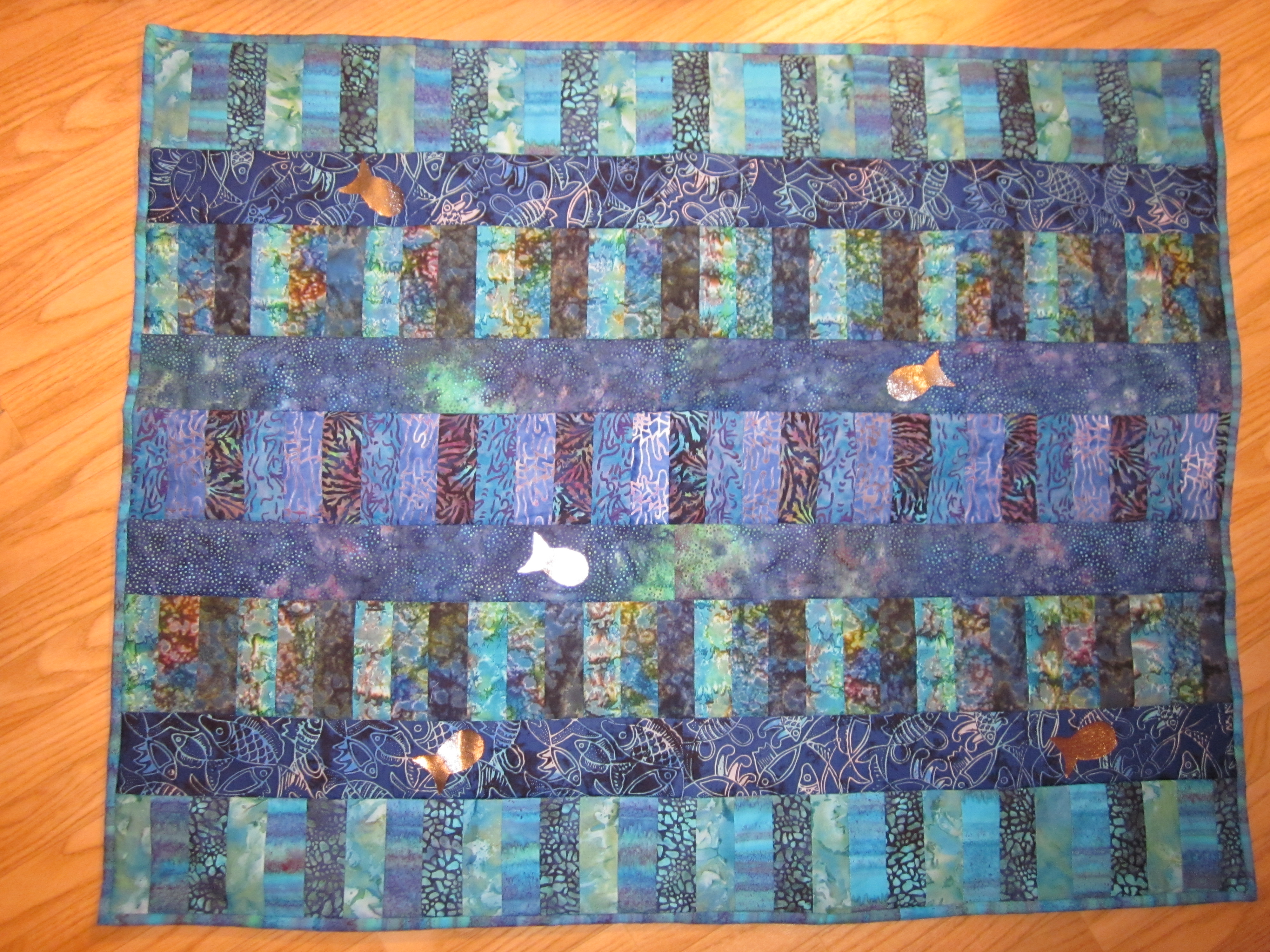
In the Penny Press: My Fantasy Life

I love Steve’s series on his readings in the “Penny Press.” He engages with such gusto with all kinds of periodicals, from highbrow literary journals to lad mags to Dogfancy and National Geographic–and he’s so delighted when he finds good stuff, and so disheartened when his favorites let him down.

Reading Steve’s posts always makes me think about the magazines I read. It’s a small number: I do most of my more miscellaneous reading online, and the only print periodical I actually have a current subscription to is the New York Review of Books (some years it’s the TLS instead, but next year I think it will be the NYRB again, and/or the London Review of Books). I do pick up individual issues of magazines sometimes–but they are almost never literary, culture, or news magazines. Usually, they are quilting magazines, with the occasional foray into Canadian Living (which I did subscribe to for many years–for the recipes!) and a dip into the Running Room’s freebie whenever I pass by the store. Once in a while I pick out something else for variety: I bought Granta‘s spring feminism issue, for instance, but I’m at least as likely to bring home something like the issue of Piecework shown in the photo.

I’ve been wondering why it is that these are the choices I make from the magazine rack and not, say, Harper’s or the New Yorker (or The Walrus, for that matter). What is the lure of these publications dedicated to food, fabrics, and healthy living? These are hardly the central concerns of my days, or at least, not so much that you’d think I would want pages and pages of articles about and glossy colour photographs of them. That said, I do dabble in all of these things: by and large I’m the family chef, and I appreciate getting new menu ideas; I do a little quilting and needlework; and I’ve been a slow, intermittent, but fairlypersistent runner since my “Learn to Run” clinic several years ago. Do you suppose that I buy these magazines because I wish these activities were a bigger part of my life? Do I buy them because doing so gives me the illusion that I do more of this stuff than I actually do–is browsing their pages a way of pretending I’m the sort of person who might run a marathon some day and distributes full-sized quilts to friends and family that have all the points of their triangle patches all neatly in position?

I do think that is part of why I buy them: to bolster my sense of commitment to things that are actually (partly by choice, partly by pragmatic necessity) peripheral to my main priorities. But why would I wish I were living the life that these magazines collectively illustrate, rather than the life I do in fact live? Why is my magazine pile not all book reviews–not to mention academic journals (which I read only under duress now)? Thinking about what the magazines I like have in common, I noticed that they all emphasize two things: the individual satisfaction of tangible achievements (something rare in academic work), and a strong sense of community created by a shared passion. The Running Room magazine and the quilting ones I like are especially conspicuous for their stories of people helping each other to realize their dreams: the Running Room has tributes to clinic leaders and coaches who inspired runners to do more than they thought possible, of people who began just as members of the same running groups and became fast friends. I love the “shop hop” issues of Quilt Sampler, which feature different shops around the country (sometimes in Canada, too) with stories of how they were founded, often by a couple or a pair or group of friends who just really wanted to shape their lives around something they loved and, happily, found a community of like-minded customers and became a supportive, creative community. I think I pore over these stories because academic work is only intermittently like that: the work itself, in fact, often seems to pull us (or at least me) away from the kind of creative fulfilment and warm-heartedness the quilt shop owners seem to enjoy in their work lives. Also, on a more personal level, I’m often a bit lonely in my day-to-day life: my extended family is all far away, my local friends are as busy and stressed out as I am, if not more; a lot of my work is done in solitude, and its group aspects are far from warm-hearted and creative (committee meetings, anyone?)–it’s easy to feel isolated, and the world these magazines conjure (and this is true of Canadian Living as well) is not like that. So, they represent a kind of fantasy life for me, in a few variations, one that if I had more time and energy and guts I might be able to pursue here (I could take a quilting class, maybe–but the nearest quilting store is quite far away, and winter is coming, with its icy roads… I could take another Running Room clinic–but they are often in the evenings, and I’m just so tired and swamped…and again, winter’s coming). Also, in my fantasy life I really love to cook, and nobody in the house has food allergies or any other dietary complications…

There’s one other thing I know I buy the quilting and needlework magazines for: often, their pages are just beautiful! And though I don’t have (or make, I guess) a lot of time for quilting, I do get some done now and then, and it’s inspiring to look at the colours and patterns and spend a little time indulging in the sensual pleasures they offer: they are treats for the eye, just as the fabrics are when you’re actually quilting (when they are a tactile pleasure as well–I bet all quilters sort their stash once in a while really for no purpose than to fondle the fabrics and look at them some more).

(A couple of my more recent quilting efforts: “Overall Bodie” and “Blue Ocean”)

This Week in My Classes: Pacing Problems

One of the most challenging aspects of course planning for me is pacing, particularly in my 19th-century fiction classes, where I teach a lot of pretty long books. My strategy has always been to assign specific parts to be read for each class meeting. That way I can keep expectations clear and the reading load manageable for all of us, and make sure we are on common ground for class discussions. Though this method does create some pedagogical and critical challenges (for instance, not talking about what happens later in the novel until we get there), I have found it also has surprising benefits: for instance, because we can’t rush ahead to what happens later, we really have to pay attention to what has happened so far!

Over the years I’ve stuck with this system. The only alternative I can really think of is expecting students to have read the whole book by the first class session on it–and that means they’d be reading the next book (presumably) while we’re still talking about the one before it, so how focused and ‘in the moment’ could they be? Plus realistically, they probably would not, in fact, have read the whole book by that first class, so it seems tidier to admit that and try to be literally all on the same page. Especially with novels that were published serially or in instalments, it’s not that hard to find good places to break and take stock. It can still be tricky, though, to assign enough that there’s something new to learn and discuss from each instalment, but not so much that we feel rushed, especially when there’s not that long a reading interval between one class and the next. My classes meet Mondays, Wednesdays, and Fridays. How much is too much–or too little–to expect them to read between 3:30 Monday, when we wrap up one session, and 2:30  Wednesday when we’re at it again? They do have four other classes (at least), after all.  I usually assign longer chunks between Friday and Monday–but is that fair, as it rather assumes weekends are for studying? Bigger instalments give us more to work with–if we haven’t read a lot since the last class, sometimes it feels to me as if our discussion is necessarily a bit thin or even repetitive–but if a lot of people are behind, it’s not necessarily the case that class discussions will be better if I assign more.

I used to notice this problem of balance less in these classes. My expectations overall were higher earlier in my teaching career (I’ve gone from a standard of six assigned novels in a one-term course to a norm of five–with six, there was never a feeling of having too much time to spend on any one of them!). Also, we used to meet twice a week instead of three times in upper-level ‘lecture’ classes, so with fewer classroom hours, again, there was never any feeling of lingering too long on one point or example. An order came down from above, though, that we had to have three “contact hours” a week in all our classes. In reading-intensive classes, it might actually make most sense to meet once a week for 2-3 hours. As far as I know, this is only an option for night classes, though, and that’s not an option that appeals to me at this stage of my family life. My impression is that five novels seems like plenty to my current students, especially when one of them is Vanity Fair  or Bleak House or Middlemarch, so bulking up the reading list and generally intensifying the workload doesn’t seem like a good idea. I do use some class hours for writing workshops, group discussions, and other learning activities, and that’s not only pedagogically time well spent but helps vary the pace. Sometimes I also use a lecture hours for student conferences, as it’s a time when I know that group is actually available (regular office hours are often sparsely attended, and conflicting schedules is a major reason). Even so, I sometimes look at the schedule and think “that many more classes on the same book? whatever will we talk about?”–or, “we haven’t read any further than that yet?” Those of you who also teach long novels–how do you manage them, logistically? Do you worry about finding that line between being burdensome and being boring?

I did pack the reading list for the mystery class with a couple more titles than usual this term and I like the greater variety–and I don’t think we’re rushing. The books are shorter there, and generally easier to read (except The Moonstone–but that’s just so fun!). We have three novels left to do in that class this term (after we finish The Terrorists for Wednesday, there’s An Unsuitable Job for a Woman, Indemnity Only, and Devil in a Blue Dress), whereas in the Victorian fiction class we have only 1.5 (the rest of Hard Times, and then North and South).


Mrs Tulliver’s Teraphim

One of the many things that make reading George Eliot at once so challenging and so satisfying is her resistance to simplicity–especially moral simplicity. It’s difficult to sit in judgment on her characters. For one thing, she’s usually not just one but two or three steps ahead: she’s seen and analyzed their flaws with emphatic clarity, but she’s also put them in context, explaining their histories and causes and effects and pointing out to us that we aren’t really that different ourselves. Often the characters themselves are in conflict over their failings (think Bulstrode), and when they’re not, at least they can be shaken out of them temporarily, swept into the stream of the novel’s moral current (think Rosamond, or in a different way, Hetty). But these are the more grandiose examples, the ones we know we have to struggle to understand and embrace with our moral theories. Her novels also feature pettier and often more comically imperfect characters who are more ineffectual than damaging, or whose flaws turn out, under the right circumstances, to be strengths. In The Mill on the Floss, Mrs Glegg is a good example of someone who comes through in the end, the staunch family pride that makes her annoyingly funny early on ultimately putting her on the right side in the conflict that tears the novel apart.

Then there’s her sister Bessy, Mrs Tulliver, who is easy to dismiss as foolish and weak, but to whom I have become increasingly sympathetic over the years. Mrs Tulliver is foolish and weak, but in her own way she cleaves to the same values as the novel overall: family and memory, the “twining” of our affections “round those old inferior things.” In class tomorrow we are moving through Books III and IV, in which the Tulliver family fortunes collapse, along with Mr Tulliver himself, and the relatives gather to see what’s to be done. The way the prosperous sisters patronize poor Bessy is as devastatingly revealing about them as it is crushing to her hopes that they’ll pitch in to keep some of her household goods from being put up to auction:

“O dear, O dear,” said Mrs Tulliver, “to think o’ my chany being sold in that way — and I bought it when I was married, just as you did yours, Jane and Sophy. . . . You wouldn’t like your chany to go for an old song and be broke to pieces, though yours has got no colour in it, Jane–it’s all white and fluted, and didn’t cost so much as mine. . . . “

“Well, I’ve no objection to buy some of the best things,” said Mrs Deane, rather loftily; “we can do with extra things in our house.”

“Best things!” exclaimed Mrs Glegg with severity, which had gathered intensity from her long silence. “It drives me past patience to hear you all talking o’ best things, and buying in this, that, and the other, such as silver and chany. You must bring your mind to your circumstances, Bessy, and not be thinking of silver and chany; but whether you shall get so much as a flock bed to lie on, and a blanket to cover you, and a stool to sit on. You must remember, if you get ’em, it’ll be because your friends have bought ’em for you, for you’re dependent upon them for everything; for your husband lies there helpless, and hasn’t got a penny i’ the world to call his own. And it’s for your own good I say this…”

Unable to believe she will be parted from her things, poor Mrs Tulliver brings before them “a small tray, on which she had placed her silver teapot, a specimen teacup and saucer, the castors, and sugar-tongs.” “‘I should be so loath for ’em to buy [the teapot] at the Golden Lion,'” she says, “her heart swelling and the tears coming, ‘my teapot as I bought when I was married…'”

Early in these scenes Maggie finds that her mother’s “reproaches against her father…neutralized all her pity for griefs about table-cloths and china”; the aunts and uncles are pitiless in their indifference to Bessy’s misplaced priorities. I used to find her pathetic clinging to these domestic trifles in the face of much graver difficulties just more evidence that she belonged to the “narrow, ugly, grovelling existence, which even calamity does not elevate”–the environment that surrounds Tom and Maggie, but especially Maggie, with “oppressive narrowness,” with eventually catastrophic results. She also seemed a specimen of the kind of shallow-minded, materialistic woman George Eliot’s heroines aspire not to be. But she’s not really materialistic and shallow. She doesn’t want the teapot because it’s silver: she wants it because it’s tangible evidence of her ties to her past, of the choices and commitments and loves and hopes that have made up her life and identity. She’s not really mourning the loss of her “chany” and table linens; she’s mourning her severance from her history.

I think I understand her better than I used to, and feel more tolerant of her bewildered grief, because I have “teraphim,” or “household gods,” of my own, things that I would grieve the loss of quite out of proportion to their actual value. They are things that tie me, too, to my history, as well as to memories of people in my life.  I have a teapot, for instance, that was my grandmother’s; every time I use it, or the small array of cups and saucers and plates that remain from the same set (my grandmother was hard on her dishes!) I think of her and feel more like my old self. I have a pair of Denby mugs that were gifts from my parents many years ago: one has Hampton Court on it, the other, the Tower–these, too, have become talismanic, having survived multiple moves. If I dropped one, I’d be devastated, and not just because as far as we’ve ever been able to find out, they would be impossible to replace. “Very commonplace, even ugly, that furniture of our early home might look if it were put up to auction,” remarks the narrator with typical prescience, shortly before financial calamity hits the Tullivers, but there’s no special merit in “striving after something better and better” at the expense of “the loves and sanctities of our life,” with their “deep immovable roots in memory.” Sometimes a teapot is not just a teapot.

From the Archives: Moral Tourism, Revisited

There’s a thought-provoking response at Arabic Literature (in English) to Steven Pinker’s The Better Angels of Our Nature (or, more precisely, to an excerpt from this book recently posted at the Guardian). On the general question of how fiction influences us, an interesting site to explore is OnFiction, where you will found a range of posts, articles, and academic papers on research into fiction’s psychological, social, and emotional effects. The post at ALiE raises questions specifically about whether “reading Arabic literature in translation” will make someone a better person. This made me think about my own motives for (and responses to) some of the reading I have done over the past few years, one aspect of which I explored in a 2009 post about Nadeem Aslam’s The Wasted Vigil. It would be nice if it were as simple as knowing that reading was morally improving, but as the post at ALiE makes clear, it’s important not to be complacent about this idea. On the other hand, in the same essay by Anthony Appiah from which I took the phrase “moral tourism” there are also some comments that ring true about the value of reading novels that stretch our attention and our empathy into less familiar territory:

What is necessary to read novels across gaps of space, time, and experience is the capacity to follow a narrative and conjure a world: and that, it turns out, there are people everywhere more than willing to do. . . . For we do learn something about humanity in responding to the worlds people conjure with words in the narrative framework of the novel: we learn about the extraordinary diversity of human responses to our world and the myriad points of intersection of those various responses.


I recently finished reading Nadeem Aslam’s The Wasted Vigil. It is a remarkable novel, equal parts beauty and brutality; as its parts accumulate it does an elegant job of evoking through its literary form some of its central motifs and symbols, such as the images gradually revealed, restored, or repaired from the walls of the house decorated originally to celebrate all the delights of the senses. The fallen Buddha that bleeds gold when assaulted by the Taliban’s bullets, the lingering fragrance from the perfume factory, the books nailed to the ceiling and gradually reclaimed but irreparably scarred, the canoe that becomes an unlikely symbol for a desirable but tragically impossible collaboration–the novel is full of rich but delicate details that can make you catch your breath with their unexpected eloquence about the damage, tangible and intangible, inflicted by the conflicts that generate its plot. It is a novel, too, that hums with nuance and yet somehow refuses to judge those on whom such ambiguities are lost: many of its characters themselves hold to intractable, unforgiving, unforgivable absolutes, but the novel often seems to be asking us how they could have done otherwise, with the result that the tragedy of the novel (and it is extraordinarily, lyrically tragic throughout) feels inevitable, which is the saddest thing of all. Like Bel Canto, though also very differently, The Wasted Vigil holds up against brutality an ideal of aesthetic, rather than political, commitment; in fact, at times it seems as if the greatest evil of the Taliban is less their physical violence (which many other factions in the novel are also shown to be capable of, after all) but their violence towards art and the beautiful. When we see a glimmer of hope, it comes from quiet moments of aesthetic appreciation; violence is, ultimately, vandalism.

I was moved and impressed by this novel. But I also became uneasy about it in ways that I did not feel uneasy about Bel Canto, I think because Aslam’s novel is much more directly intervening in our discourse about particular historical and political events. It is at times an exceptionally, horribly, violent novel, but my unease was not queasiness about the violence as such but rather about the kind of aesthetic experience the novel itself was offering me (including through that violence) and how my pleasure in the novel as a whole thus reflects on me as a reader. What does it mean to enjoy, or at any rate to appreciate aesthetically, a novel in which a captive soldier is literally pulled to pieces as sport, a wife is forced to amputate her husband’s hand, a young man’s eye is burned with a blow torch, a suicide bomb is detonated next to a school?

Puzzling over this question made me think more generally about the purpose of such a book and about my own purposes in seeking it out. The aesthetics-of-suffering issue is not uncommon (Holocaust literature seems the obvious example) and has certainly been analyzed and theorized–I’ve looked into this a little as part of preparation for teaching Elie Wiesel’s Night, for instance. There’s something a bit different about the recent wave of high-profile titles about the Middle East or the Arab or Islamic world, though, including Khaled Hosseini’s The Kite Runner and A Thousand Splendid Suns, Mahbod Seraji’s Rooftops of Tehran, Mohsin Hamid’s The Reluctant Fundamentalist, Yasmina Khadra’s The Swallows of Kabul and The Attack, to name a very few–and that’s not even touching on the many non-fiction titles, from memoirs to histories to political analyses.

It’s possible, of course, that what seems like a trend is actually just the result of my taking note of them as the circle of my own reading interests becomes less parochial, but my sense is that what has happened is that since 9/11, not only is the so-called “clash of civilizations” big news, but there is an interest, an appetite, among western literary audiences for stories that help them see different perspectives on current and historical events in a part of the world which, previously, they might have considered only glancingly, or with the reductive and limited insights available from following headlines and TV reports. The back cover of The Wasted Vigil quotes a reviewer suggesting as much–Peter Parker of The Sunday Times says that the novel “reminds us that fiction can do things that mere reportage can’t.”

One of the purposes of such novels, then, or at any rate one of their uses or effects, is revelation, maybe even instruction or pedagogy. That’s certainly one of the reasons I have been reading them: to the hoped-for satisfaction of a rewarding literary experience I can add the desire to learn more about these worlds that seem so other, to be in my reading life a better-informed citizen of the world and then perhaps, as a result, also to be a better-informed participant in real-world events–though I think there is also the temptation, the risk, to feel as if reading about, say, Afghanistan, is an actual substitute for trying to do anything about Afghanistan (would the money I spent on A Thousand Splendid Suns have been better spent as a donation to Canadian Women for Women in Afghanistan?). But if reading leads to understanding, especially appreciation for nuance and complexity, isn’t reading a kind of doing? Isn’t it a good thing to do? And wouldn’t the world be a better place if more people (former world leaders, even) perhaps read such novels?

And yet at the same time, fiction is not (quite) fact; anecdote, especially imagined anecdote, is not a reliable substitute for aggregate data and rigorous contextualization; impressions, however beautiful, are not analysis; and, finally, contemplation is not action, and actions must sometimes be reductive–nuance and complexity are, perhaps, luxuries permitted to those who need not make decisions. In Saturday, Ian McEwan actually makes a similar point about ambivalence, depicting it (or so I read the novel) as a luxury, even a self-indulgence, when decisive action is required; in the more theoretical realm, Geoffrey Harpham notes that “without action, ethics is condemned to dithering,” and perhaps novels feel ethically more satisfactory sometimes than real life precisely because they need not take a singular position. Ethical critics have often pointed to this “negative capability” as a strength of the novel form, but it is also a crucial aspect of its artifice.

While I was thinking these things I came across an phrase in an essay by K. Anthony Appiah that struck me as suggestive in this context. In the essay, “Cosmopolitan Reading,” Appiah is discussing Tsitsi Dangarembga’s novel Nervous Conditions; he is thinking about the question of the novel’s implied audience, “the ‘you’ addressed in the first paragraph of the novel”:

The usual answer, of course, is that the postcolonial African novel is addressed to a Western reader. Here, that is, according to the usual narrative, is a safari moment: an Africa constructed exactly for the moral tourist.

Appiah goes on to argue against reading Nervous Conditions in this way, but my interest is in the model he outlines of literature as a kind of “safari,” “constructed … for the moral tourist,” which seems at some level an apt characterization of the experience of reading something like A Thousand Splendid Suns or The Wasted Vigil (though the specific experience offered by each is, of course, quite different). I hear Appiah’s tone here as dismissive of that “moral tourist,” the reader seeking only an exotic experience, like a “safari,” rather than … I’m not sure what, actually. Is the alternative to being a “tourist” somehow “going native”? Is that any less problematic? Perhaps it is the author addressing the “Western reader” who is being faulted for offering up marketable, consumable, safe (fenced?) stories to suit the tourist’s taste. In her talk on representations of Arabs in western literature, Ahdaf Soueif points to some versions of this effect in recent novels; I’ve read some commentaries that object to the western fixation on veiling or stories of women’s oppression along similar lines. And yet … shouldn’t the story of women’s suffering be known, even if their victimization is not the whole story? Isn’t there something more substantial than “tourism,” than gawking, involved in seeking to know it? And, to come back to my opening comments on The Wasted Vigil, isn’t the aesthetic experience itself a kind of response, however inadequate, to the denial of their humanity?

[originally posted July 26, 2009]

This Week: More Classes, and a New Issue of OLM

Did I mention how busy things have been at work? It’s rare for me to go nearly a week without posting something here, but I just haven’t had the time or energy: what extra I had of either went into this month’s Open Letters, which includes my own review of Jeffrey Eugenides’s The Marriage Plot and a lot of other pieces across an impressive array of books and writers, from Rumi to Robert Musil, from Emma Goldman to Dick Cheney, from Ha Jin to Dickens to Umberto Eco. On the first of every month, all of us involved in editing, writing for, and producing Open Letters sit back and wonder for a little while that we did it again! And then we get right to work on the next issue. I found the Eugenides review quite challenging to write, partly because The Marriage Plot is one of the “it” books, the books of the moment, and comments and reviews are appearing from pretty much every source. I decided to keep my head down until I’d written mine–I didn’t even go over to the Wall Street Journal to see what our own Sam Sacks had said about it until yesterday. As I was putting the final touches on, it occurred to me that I have been pretty critical of every new book I’ve reviewed for Open Letters except Sara Paretsky’s Body Work. I guess I was pretty much OK with Claire Harman’s Jane’s Fame, too.  I do get enthusiastic about things I read! Maybe it’s just that the odds of any particular book being one I’ll be enthusiastic about are dramatically reduced when the field is limited to The Very Latest. What have I been most excited about here recently, for instance? Testament of Youth, for sure, and also The Last Samurai. One every 100 years isn’t bad! (But as those of you who follow me here know, I exaggerate my choosiness. It won’t be long now before my traditional look back at highs and lows of my reading year, and there will be many highs.)

At my day (and sometimes night and weekend) job, things continue to be busy, though I returned a set of papers last Friday and don’t get another in until this Friday, so I don’t feel quite as harried as I did–even though I am doing yet another “new” book in Mystery and Detective Fiction, The Terrorists. This is not new to me, of course, but new to my teaching, so I have no materials filed away for it. Rereading the opening chapters today, though, and drafting up some class notes, I felt really glad I had chosen it. We had good discussions of Ed McBain’s Cop Hater, and a lot of the students seemed to be enjoying it quite a bit, but there’s no getting around a couple of problems with it qua book. First, the writing really is cheesy (with some exceptional passages interspersed). I invited comment on the “literary merit” of the book, and one student said that every time she came to one of his emphatic one-sentence paragraphs she heard the Law & Order “da-DUH” scene-changer in her head–which I completely sympathize with. Those little tag lines seem so cheap and manipulative, as if we won’t feel the suspense with writing that’s any more complex. Then there’s the novel’s severe discomfort with women, who are consistently sexualized and severely limited in their roles, in ways that make Hammett’s portrayal of Brigid O’Shaughnessy seem subtle. Interesting and influential as McBain is in the history of the genre, I’ll be glad to move on to Sjöwahll and Wahlöö, who seem so much more sophisticated in just a few pages. We aren’t totally out of the woods yet with the representation of women, though: while the range of women is much greater and there are strong, independent women characters, there’s still a slightly voyeuristic quality to the way they are presented, including Beck’s love Rhea Nielsen, whose nipples are remarked frequently and whose naked body is described in much more detail than Beck’s ever is. Point of view accounts for some of this, but when Beck stares at his own body in the mirror, he doesn’t tell us anything about his pubic hair; we know the size of her breasts but not of his … anything. Not that I want to know, but it’s conspicuous which way the gaze is directed. (I wonder if I’m more aware of this now that I’ve been reading romance novels, which do direct our attention very specifically to men’s bodies.)

In 19th-Century Fiction, we have our last session on The Tenant of Wildfell Hall tomorrow and then on Friday we begin Hard Times. I have a love-hate relationship with this novel. I love that it’s shorter and thus in some ways an easier sell than most other Dickens novels; I love the clear fabular structure and the surreal tone and the elaborate artifice of the language. It’s more symbolically dense and thematically coherent than some of the bigger novels. But I hate that it is stripped so bare of the Dickensian details that make the big fat ones so delightful; I hate that it is so heavy-handedly moralistic and didactic (ironically so, given its emphasis on fancy); I hate that its fable-like style reduces the characters to quite slight and, again, artificial figures. But (yet again!) for all its oddities and its ironically mechanical feeling, it makes me cry every time I read it, and I think Louisa Gradgrind is one of Dickens’s really great creations. I absolutely thrill to the moment when she tells Tom that she would cut out the piece of her cheek where Bounderby kissed it. Cut it out with a knife! She understands the kind of man Bounderby is. Our final novel for the course is Gaskell’s North and South, and the two novels, published in close proximity, pair wonderfully for comparative discussions of industrialism, class relations, and unions–both contain chapters called “Masters and Men,” for instance, but they take really different approaches to resolving the “condition of England” problem.

In The Victorian ‘Woman Question’ we discussed “Goblin Market” last week and yesterday turned our attention to Gaskell’s short story “Lizzie Leigh.” That more or less concludes our ‘unit’ on fallen women, unless you consider Maggie Tulliver fallen, which of course will be part of our discussion of The Mill on the Floss, which we start talking about tomorrow. I’m really looking forward to that, for some of the same reasons I’m glad to get to Martin Beck in the mystery class: really good, interesting, satisfying novels are the most rewarding to pay sustained attention to, and they also usually generate the best discussions because their complexities need sorting out.

All of this week’s efforts will be fuelled by leftover Hallowe’en candy. Where have all the trick-or-treaters gone? We have maybe a dozen last night, even though the weather was as good as can be hoped for in Halifax at this time of year. (Better than it was on Sunday, when we greeted Ian Rankin with a massive wind and rain storm–he finished up his Canadian tour with a stop here, and yes, I lined up to get his autograph.)

This Week in My Classes: Mid-Term Madness!

The sheen is definitely off the new term now: we are in the thick of it, and the challenge of juggling its many demands has not been helped by (and probably contributed to) the cold-y flu-y virus I’ve been struggling with for about ten days. It was at its worst this past Friday,when in a rare moment of weakness I even let one of my morning classes go early! They looked so tired themselves, and they weren’t really rising to the bait of my discussion questions–but the bait itself was kind of limp with no fight left in it, not the fresh wiggly kind you need to … well, whatever. Probably best for us all that I stay away from fishing metaphors. Anyway, I was tired and slightly foggy at that point and suddenly just couldn’t keep the song and dance routine going. Some quiet working time in my office and some hot tea perked me up enough to get through the last class of that day, and by Monday I was more or less healthy, but it sure has felt like a slog. It’s good to feel better, but the work is still piled up, more than it would be if I hadn’t been sick last week, and that’s despite how much I did over the weekend and routinely do at night as well. This is the time of term when it’s particularly galling that all the mainstream media coverage of higher ed so often seems focused on what a bad job we are doing teaching undergraduates because we are either lazy tenured slackers or self-important research kingpins who can’t be bothered to spend time in the classroom.

So. Where are we now? Well, in Mystery and Detective Fiction we have just wrapped up our discussion of The Maltese Falcon, which I continue to find a particularly depressing novel, and tomorrow we turn to Ed McBain’s first 87th Precinct novel, Cop Hater. This is one of the books I read during my sabbatical quest to refresh the reading list for this course. When I wrote up my first impressions, I noted,

What seems really different about Cop Hater compared to earlier detective novels is its attention to the specific procedures of the police investigation, even including reproductions of gun licenses and rap sheets, but also detailed explanations of forensic measures (such as fingerprinting) and lab work. These features, along with the spread of the novel’s attention across several detectives (though Carella is clearly the main character) help us see the police as a system, as part of a bureaucratic organization operating within a network of other supporting (or, sometimes, hindering) systems. The case is not solved by the ingenuity of Poirot or the ratiocination of Dupin or Holmes but by the persistence of men who just keep looking and asking until they find something out.

This is one of the things I want to talk about tomorrow, though I think we’ll start with some attention to the setting, especially since we’ve talked quite a bit about the whole “mean streets” idea in Chandler and Hammett. Rereading the McBain, I was struck again by some of the stylistic tics I found annoying the first time, but I’m more interested in the dynamic of the squad room. I’m curious to see how the class reacts to this one. It is quite a good group: there’s a core of keen participants, and as far as I can tell most of the rest of them are reasonably engaged, with the exception of a couple of them who sit at the back and pretty obviously scrawl notes to each other and smirk. The room has tiered seating and isn’t that deep, so they are quite visible to me. Pretty soon I may actually say something to them, as it does occasionally throw me off my mental track wondering what they’re writing…

In 19th-Century Fiction (where, actually, there are also a few scribblers / whisperers and smirkers, and it’s a much smaller room, so again, it gets distracting!) we are working our way through The Tenant of Wildfell Hall. Happily for me, given how much else I’m trying to stay on top of, I just did this novel in The Victorian ‘Woman Question,’ so it’s pretty fresh in my mind, though I’m still rereading pretty much all of each instalment. It is interestingly different doing a book in a seminar and a lecture class. I don’t just lecture, of course, but even when we’re working through points together I’m steering things more than in the seminar. The participation level is definitely better with Tenant than with Vanity Fair. It helps that some of the students, too, just read the novel for my other class! But it helps even more, I think, that the novel is simply more straightforward, in some ways more familiar, and definitely shorter. I’m a big admirer of Tenant, which is a really artfully constructed novel as well as a compellingly told one. For some time I have been meaning to do another Victorian ‘Second Glance’ piece for Open Letters (which I haven’t done since I wrote on Vanity Fair in the summer of 2010) and Tenant is at the top of my list. Another one that would be fun is Ellen Wood’s East Lynne … but no time to think about that now!

And in The Victorian ‘Woman Question’ we wrapped up Aurora Leigh last week. I thought our discussions of it went well–better than I expected, frankly! They did not find its blank verse bulk nearly as off-putting as I had anticipated, and we had some good lively sessions on it. This week we’re doing more poetry: yesterday was D. G. Rossetti’s “Jenny” and Augusta Webster’s “A Castaway,” both complex and fascinating dramatic monologues focusing on ‘fallen women,’ and tomorrow and Friday it’s Goblin Market.

Behind the scenes, I marked the first set of Mystery midterms last week and this week I’m trying hard to get through the Vanity Fair papers for the novels class. On the weekend I wrote up my final evaluation of an honours thesis I’d agreed to examine for the University of Western Sydney and sent it off. The letters for the three tenure and promotion cases I was involved in have been submitted, and I don’t think there’s any major committee business looming again for a while–so that’s a relief, because there’s a Ph.D. thesis chapter languishing in my inbox that I’d like to get to before another week goes by, and it’s starting to seem possible that I will manage it!

Book Club: Susan Hill, The Woman in Black

I have been curious to read The Woman in Black for some time. I’m not sure exactly why, except that the title made me curious (did it have anything to do with The Woman in White?) and I had heard that it was a really good example of a ghost story. I finally picked it up when I was in London in the summer, and I proposed it for my local book group for our October selection, figuring if there is a time for ghost stories, round about Hallowe’en is it! We met to discuss it this week, on an appropriately dark and drizzly night.

Though overall the book was not a big hit, we had quite an interesting discussion about why we liked what we did like about it, and about the aspects of it we found disappointing. Most of us thought it was a pretty good read, though our appreciation did rather depend on our tolerance for its deliberately old-fashioned style: though it is neither actually Victorian nor neo-Victorian, it sounds Victorian, in that its tone is formal, its pacing deliberate, and its descriptions long and detailed. I particularly liked the evocative landscapes, which I thought Hill used effectively to create an atmosphere of mingled beauty and menace:

As we drove briskly across the absolutely flat countryside, I saw scarely a tree, but the hedgerows were dark and twiggy and low, and the earth that had been ploughed was at first a rich mole-brown, in straight furrows. But, gradually, soil gave way to rough grass and I began to see dykes and ditches filled with water, and then we were approaching the marshes themselves. They lay silent, still and shining under the November sky, and they seemed to stretch in every direction, as far as I can see, and to merge without a break into the waters of the estuary, and the line of the horizon.

My head reeled at the sheer and startling beauty, the wide, bare openness of it. The sense of space, the vastness of the sky above and on either side made my heart race. I would have travelled a thousand miles to see this. I had never imagined such a place.

Though I didn’t find the story nearly as eerie or scary as I expected, I thought it did have some really shivery moments–the best ones, for me, being the ones with the quietest effects, like this one:

I think I must have fallen asleep only a few moments after putting the lamp out and slept quite deeply too, for when I awoke – or was awakened – very suddenly, I felt somewhat stunned, uncertain, for a second or two, where I was and why. I saw that it was quite dark but once my eyes were fully focused I saw the moonlight coming in through the windows, for I had left the rather heavy, thick-looking curtains undrawn and the window slightly ajar. The moon fell upon the embroidered counterpane and on the dark wood of wardrobe and chest and mirror with a cold but rather beautiful light, and I thought that I would get out of bed and look at the marshes and the estuary from the window.

At first, all seemed very quiet, very still, and I wondered why I had awoken. Then, with a missed heart-beat, I realized that Spider was up and standing at the door. Every hair on her body was on end, her ears were pricked, her tail erect, the whole of her tense, as if ready to spring. And she was emitting a soft, low growl from deep in her throat. I sat up paralysed, frozen in bed, conscious only of the dog and of the prickling of my own skin and of what suddenly seemed a different kind of silence, ominous and dreadful. And then, from somewhere within the depths of the house – but somewhere not very far from the room in which I was – I heard a noise.

I liked the dog especially, and I was quite upset when … well, you’ll have to find out for yourself how the dog fares.

But if in these ways the book is well written, in others it really disappointed. One thing that bothered me was the heavy-handed foreshadowing, which seemed like an unnecessary and artificial way to create suspense. Another was the imbalance between the parts: the set-up is long and not really very interesting (and full of that heavy-handed foreshadowing), then the ghost story, which is told as a reminiscence, kind of staggers along, with fits and starts of ghostly business rather than the gradual development of irresistible eeriness. And then there’s a dénouement which is clearly meant to be the climax of the horror but which struck us all, I think, as too sudden and unmotivated: why would the ghost do that? What did Arthur Kipps ever do to her?

And that brings me to our main objection, which was that the ghost story itself was not very good. The haunting may be well described, but it isn’t well motivated: its specific cause is fairly predictable, if not from the outset, than from the earliest hints, and the ghost’s malevolence seemed disproportionate and random. Why should everyone suffer for such a particular tragedy, and a tragedy for which nobody is really strongly to blame? We brainstormed a bunch of alternative twists that we thought would have built the plot up into something more original and surprising, and one that would have made more of the characters more involved–Arthur Kipps especially. There should have been more information in the documents, more cruelty in the history, and some specific unfinished business that brought the ghost back to Eel Marsh House. The book seemed more special effects than anything else–there’s no compelling aboutness to it–which is probably why we agreed that while it’s not a great book, it will probably make a pretty decent film (and indeed, the trailer looks good, for people who like that sort of thing, though judging from what it shows, the screenwriters have added a lot of new elements).

If you are looking for a ghostly read yourself, I’d recommend Elizabeth Gaskell’s The Old Nurse’s Story instead. Or, of course, The Turn of the Screw. Or The Little Stranger. I actually left our group discussion feeling less satisfied with The Woman in Black than when I arrived, and I don’t really understand why it has the ‘contemporary classic’ standing it does.


Musical Interlude: Young Artists in Concert

I’ve posted a couple of times before about my son’s compositions. Last week he and two other talented young musicians performed in a concert that included a number of his original pieces (a Sonatina for piano and violin, two solo piano pieces, and a setting for voice and piano of Poe’s “Romance”) along with pieces by Ravel, Fauré, and Wieniawski–and, in an unusual twist, some piano-violin improvisations prompted by audience suggestions. It was a big event that took a lot of preparation, especially by Owen (who played in every piece on the program) and my husband, who handled most of the logistics. The evening was a treat: not only was the music delightful but it was wonderful to watch the three young performers working together for the love of it. The audience was very appreciative, and we have been been beaming with pride (and basking in reflected glory) ever since! Audio tracks of the entire concert are now available here, for anyone who would like a listen.

Helen DeWitt, The Last Samurai

samurai (1)The Last Samurai is the story of a single mother, Sybilla, and her son, whom she calls “Ludo”–though on his birth certificate it says either ‘David’ or ‘Stephen,’ ‘one or the other.’ It makes sense that Sybilla would consider it pointless to be certain, because one of the things this novel is about is precisely how we figure out and then live up to who we think we are. It’s also about the accidents that determine the lives we lead, regardless of who we might be, and about the choices and values and loves and hates and languages and books and ideas and music and art and movies and people that constitute those lives and make them worth living–or not. It’s a celebration of genius and an attack on mediocrity, a paean to the human capacity to create and learn and think and reason and a lament for the seductions of banality. It’s about quests and heroes and, of course samurai. Its parade of erudition is at once dazzling and surprisingly entertaining, and also inspiring, because it’s in the service of intellectual curiosity and love of knowledge, not accomplishment or grades or prizes.

It’s Ludo’s curiosity, in particular, that gives the novel its momentum: he is a child prodigy whose brilliance at once thrills and terrifies his mother. Ludo’s voice, and his quest for his father, eventually take over the novel from Sybilla, but she remains its presiding genius; without her, Ludo’s endless questions would go unanswered. Though their relationship is never sentimental (indeed, they rarely seem like parent and child, at least in the ways we would casually expect), their attempts to care for each other have an emotional intensity and an intellectual integrity that are ultimately very moving. A book so extravantly episodic and allusive risks losing its humanity. Somehow, miraculously, for all its jouissance, all its postmodern display, The Last Samurai never does.

dewittThis is a novel that feels exceptionally difficult (and more than usually pointless) to excerpt from–and yet, the temptation! And it incorporates so much that it’s difficult to know what to single out for commentary. One aspect of it that is obviously very important, both structurally and thematically, is its engagement with Kurosawa’s The Seven Samurai (which I have never seen–but the range of things alluded to in this novel that I don’t know first-hand is so long there’s no point remarking them all). The Seven Samurai is Sybilla’s favourite film. Not only does she watch it over and over, but she thinks of it as taking the place of a male role model in Ludo’s life. What she doesn’t expect, when she first shows it to him (when he’s five) is that it will prompt him to demand to learn Japanese.

L: When are you going to teach me Japanese?

I: I don’t know enough to teach you.

L: You could teach me what you know.

I: [NO NO NO NO NO] Well

L: Please

I: Well

L: Please

Voice of Sweet Reason: You’ve started so many other things I think you should work on them more before you start something new.

L: How much more?

I: Well

L: How much more?

The last thing I want is to be teaching a five-year-old a language I have not yet succeeded in teaching myself.

I: I’ll think about it. . . .

Her problem is that Ludo is urgent with his demands to learn, not just Japanese, but Latin and Greek and much much more, and that there isn’t, really, any reason not to teach him whatever he wants to know except the widespread (mis)understanding that he is too young for this kind of thing–a view they encounter over and over as they ride the Circle Line to keep warm:

. . . he has been reading the Odyssey enough for a straw poll of Circle Line opinion on the subject of small children & Greek.

Amazing: 7

Far too young: 10

Only pretending to read it: 6

Excellent idea as etymology so helpful for spelling: 19

Excellent idea as inflected languages so helpful for computer programming: 8

Excellent idea as classics indispensable for understanding of English literature: 7

Excellent idea as Greek so helpful for reading New Testament, came through eye of needle for example mistranslation of very simple word for rope: 3

Terrible idea as study of classical languages embedded in education system productive of divisive society: 5

Terrible idea as overemphasis on study of dead languages directly responsible for neglect of sciences and industrial decline and uncompetitiveness of Britain: 10

Stupid idea as he should be playing football: 1

Stupid idea as he should be studying Hebrew & learning about his Jewish heritage: 1

Marvellous idea as spelling and grammar not taught in schools: 24

(Respondents: 35; Abstentions: 1,000?)

Oh, & almost forgot:

Marvellous idea as Homer so marvellous in Greek: 0

Marvellous idea as Greek such a marvellous language: 0

 What place genius, what price genius, in a world like this? These are among the difficult questions Sybilla faces, as she reads about the education (and eventual breakdown) of John Stuart Mill, or about “the example of Mr. Ma (father of the famous cellist).”

dewitt2One of the most fascinating explorations of this in the novel is the story of the pianist Kenzo Yamamoto, who becomes obsessed, not with how to play a particular note or phrase or piece, but with how else you could play it, or how else it could sound:

Yamamoto: To put it another way, let’s just take a little phrase on the piano, it sounds one way if you’ve just heard a big drum and another way if you’ve heard a gourd and another way if you’ve heard the phrase on another instrument and another way again if you’ve just heard nothing at all–there are all kinds of ways you can hear the same sound. And then, if you’re practising, you hear a phrase differently depending on how you’ve just played it, you might play it twenty or thirty different ways and what it actually is at any time depends on those things it might be–

He gives a disastrous concert at Wigmore Hall in which he played “about 20 minutes of drum music after each of six [Chopin] Mazurkas . . . with the result that the concert ended at 2:30 in the morning & people missed their trains & were unhappy.” Sybilla takes Ludo to hear Yamamoto in concert at the Royal Festival Hall. The first half is uneventful, but after the interval, Yamamoto begins to play the Brahms Ballade Op. 10 No. 1, first just phrases and then eventually the whole piece:

For the next seven and a half hours Yamamoto played Op. 10 No. 1 in D minor, and sometimes he seemed to play it exactly the same five times running but next to the sound of a bell or an electric drill or once even a bagpipe and sometimes he played it one way next to one thing and another way next to another. . . .

Eventually he plays it through nine times along with a tape of traffic and footsteps, then when the tape stops and there is silence he plays it “so that you heard it after and over the silence.” Then, after all those hours playing Op. 10 No. 1, the audience is “shocked to hear in quick succession Op. 10 No. 2 in D major, Op. 10 No. 3 in B minor and Op. 10 No. 4 in B major, and you only heard them once each”:

It was as if after the illusion that you could have a thing 500 ways without giving up one he said No, there is only one chance at life once gone it is gone for good you must seize the moment before it goes, tears were streaming down my face as I heard these three pieces each with just one chance of being heard if there was a mistake then the piece was played just once with a mistake if there was some other way to play the piece you heard what you heard and it was time to go home.

samuraiHer bitterness at the inadequacies of the Circle Line riders is balanced by this moment of grace. Why do we put such limits, not just on our children, but on our art? Much, much later in the novel, Yamamoto says to Ludo, “When you play a piece of music there are so many different ways you could play it. You keep asking yourself what if. You try this and you say but what if and you try that. When you buy a CD you get one answer to the question. You never get the what if.” There’s no place for Yamamoto’s “what if” in the world of concert halls and recording studios and trains to catch.

The risk DeWitt takes is that this dedication to the highest possible forms becomes, or at least will come across as, sheer elitism, a blunt attack on popular taste. About a third of the way through the novel, pestered endlessly by Ludo for the name of his father, Sybilla presents him with a challenge: she gives him a tape of Liberace, a drawing by Lord Leighton, and a magazine article and tells him “You will not be ready to know your father until you can see what’s wrong with these things.” More than that,

Even when you see what’s wrong you won’t really be ready. You should not know your father when you have learnt to despise the people who have made these things. Perhaps it would be all right when you have learnt to pity them, or if there is some state of grace beyond pity when you have reached that state.

As Ludo takes over as the novel’s narrator and the plot (to the extent that it is linear) becomes the story of his attempt to find (or choose) his father, this quest to discern the failings of Liberace (which is, not incidentally, also  the code name Sybilla uses for Ludo’s father), of Lord Leighton, and of the boring magazine article runs in parallel. I wasn’t sure I wanted Ludo to grow up into another Sybilla, or even to pass her test–Sybilla herself does not live happily or  easily with her ideas, after all–and yet the whole book pits itself against relaxing into easy compromises, whether moral or ethical or aesthetic (and I’m not sure that the novel allows for a distinction between these). There’s nothing easy about Ludo’s progress towards the novel’s conclusion, but I think that through each of his encounters with potential fathers, he learns and grows in ways that eventually exceed what Sybilla wanted, or even thought was possible, for him.

There’s much more to The Last Samurai than this, but if I started listing off more of its ingredients it would make the novel sound like a kind of flamboyant bricolage rather than the gratifyingly readerly treat it is.

This Week in My Classes: WMT, AC, and EBB

It’s a short week, because of the Thanksgiving holiday on Monday. I think I saw the effects of the long weekend–not good ones–in my 19th-century novels class, where the limp response to questions about Vanity Fair (except from a couple of stalwart contributors) suggested people hadn’t exactly spent it keeping up with the reading. It has been three years since I taught Vanity Fair  (shocking!) and I’m not having as much fun with it as I’ve had before, and I also don’t get the impression that very many students are having fun with it. I feel as if I must be doing something wrong, though I’ve been too busy the past couple of weeks to get creative about possible fixes. The novel is massive as well as somewhat miscellaneous: I’ve been suggesting ways to manage the information overload by looking for parallels and patterns, themes and variations (on vanity, for instance) but maybe they are just feeling overwhelmed. Or maybe they are loving it and just not letting on. Will Vanity Fair join Waverley as a novel I just don’t want to teach because of the burden of resentment and disconnection it puts on the class? But what about the two or three students who do love it? And what about the fact that it is just one of the great Victorian novels? Why should I care if they don’t love it? I’m sure things will pick up when we get to Tenant of Wildfell Hall next week.

In Mystery and Detective Fiction, we have wrapped up our discussion of The Murder of Roger Ackroyd and are heading into our first mid-term on Friday. Funny how the looming presence of an exam improves attendance and concentrates attention. I think the discussion of Ackroyd went well. I always try to provoke as much discussion as possible about the morality of a novel in which violent death is treated so casually. It’s almost comical, in fact, the way the characters mill around Ackroyd’s dead body checking whether windows are closed and so on, and then when Poirot blithely sits down in the very chair in which Ackroyd was killed. We spent some time on the issue of why the chair wasn’t too bloody for that to be a good idea sartorially, never mind morally, and that let us move into the issue of the detective’s necessary (or is it?) detachment, a scientific or clinical attitude we also saw in, for instance, our sample Dr Thorndyke story–and which is of course exemplified in Sherlock Holmes, who is described by Watson as a “thinking and reasoning machine.” We have also read “The Problem of Cell 13,” featuring The Thinking Machine himself. The value of detachment gets challenged by some of our later readings, including especially P. D. James’s An Unsuitable Job for a Woman.

In the Victorian ‘Woman Question’ course, we are making our way through Aurora Leigh. It has been even longer than three years since I got to teach this strange, wonderful poem in its entirety. In our first session on it, I asked what background the students had in Victorian poetry, and the basic answer was none at all. That’s distressing! And it also means that some sections of the poem, like the central part in Book V about redefining the epic for modern times, lose a lot of their argumentative force. It would be nice to be able to refer to, say, Idylls of the King and know they have some idea what I’m talking about. Increasingly I regret that for various logistical reasons we simply can’t have specific prerequisites for what are supposed to be our most ‘advanced’ classes. It’s an issue that particularly irks me when I teach the seminar on sensation fiction: much of the interest of the genre and the course arises from the relationship of sensation novels to the Victorian ‘canon,’ but when Lady Audley’s Secret and East Lynne are the first Victorian novels someone is reading, it’s hard to have substantial discussion about why such novels were scandalous in their day and marginal in the field until very recently. On a still more basic level, my group was evasive about their background in scansion too, and we’re reading quite a bit of poetry this term–I can’t be expected to provide remedial instruction in poetic forms and versification for an honours seminar, surely! and yet how can we really talk about poetry without being able to talk about it as poetry? Aurora Leigh is particularly challenging in this regard because it is already a hybrid form, a verse-novel, so the temptation is strong to abstract the plot from the language and discuss characters, relationships, and social issues as if they don’t come to us in blank verse…but they do, and it matters that they do, not just because form always matters but because genre and poetic form are central issues of the poem itself and we can’t think well about how it reflects or advances its own aesthetic theories unless we care about it as poetry. Still, the discussion is going reasonably well, as far as it can go under the circumstances.