Another car would have come along, a family car for which she had said she was waiting, or even another man, a white man. Most travelers, like most men, were intrinsically decent. The end result for Iris would have been the same, cruelly the same. But he needn’t have been involved. He was the wrong man to have played Samaritan, and he’d known it, known it there on the road and in every irreversible moment since.
By the time I finished The Expendable Man, I was pretty sure I wanted to include it in the reading list for my survey course on mystery fiction next time around, probably in place of Walter Mosley’s Devil In A Blue Dress. It’s not that I think it’s better than Devil, but I’ve assigned Devil so often I would like to take a break from it, and Hughes’s novel deals with some very similar thematic issues. Both are astute and thought-provoking variations on noir conventions; both use specific individual crimes as devices for examining much bigger questions about social justice and especially about, as the NYRB cover text puts it, “the greatest of all American crimes.” The Expendable Man is also really gripping reading: its first chapter especially is an absolute masterclass in atmospheric unease. My profound relief when Hugh finally rid himself of Iris was compromised only by knowing that of course this was not really going to be the end of it for him—and by knowing already what the narrative itself so coyly withholds for as long as it can, which is that Hugh is a Black man in a racist world, and so he is never really going to be either free or safe.
 There are many interesting aspects of the investigation that unfolds as Hugh (with painful inevitability) ends up the prime suspect in Iris’s death. I haven’t spent enough time with the novel at this point to be sure what to make of all of them, but one thing I’ll want to think more about is Ellen’s role, which doesn’t fit any of the usual restrictive hard-boiled parts for women to play. It seems tied to the novel’s attention to class, which, as Mosley notes in his Afterword to the NYRB edition, does not protect Hugh the way he hopes it will: his education and career path, his family’s money and social standing—none of it insulates him from hatred or suspicion. But Ellen’s money and connections are sources of strength, as is her prompt and unequivocal commitment to being on Hugh’s side. If Iris can be seen as a version of the damsel-in-distress turned femme fatale (intentionally or not), Ellen is an ally and partner for Hugh, one who refuses to sit on the sidelines while an injustice is perpetrated. There are other details worth considering about who helps Hugh and who doesn’t, too, including the white lawyer whose motives are primarily political, rather than principled.
The aspect of the novel that I liked the least was its vilification of abortion providers. At least on this first read, I didn’t get any sense that Hugh considers reproductive rights worth defending. What sympathy he feels towards Iris is about her as a murder victim – which is related, of course, to her abortion, but I didn’t pick up any compassion for the secrecy and the risk specific to it, any sense that if only she could get a safe and legal abortion she would have been less vulnerable to other kinds of predation. And Doc Jopher comes across as wholly repugnant, including to Hugh, who reflects with disgust that whatever sentence he serves, he’ll be back before long “to carry on with his butcher’s business.” I don’t think this matters to my interest in assigning the novel: books don’t have to align with my politics to be worth discussing, that’s for sure – otherwise I couldn’t possibly assign The Big Sleep, which I find both misogynistic and homophobic. It’s also possible there are details that would complicate or even change my reading of Hughes’s novel as aggressively anti-abortion (not just grim about its realities at the time). I’d be interested to know what other readers of the novel think about this element of the novel. Does it just seem “of its time”? (And yet, of course, abortion rights were not universally condemned in 1963, so even if so, that’s a particular stance to take on an ongoing controversy.) If I keep Sara Paretsky’s Indemnity Only on the list, there would be an immediate contrast with V. I. Warshawski’s friend Lotty Herschel, whose commitment to providing safe abortions (even when they were illegal) is part of that novel’s feminist framing.
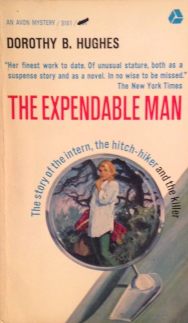 The thing that does make me hesitate is the oddity (arguably) of assigning a novel that is fundamentally about race, and that is told from the point of view of a Black man—but which is written by a white woman. “A white woman writing of a young black man’s problems with the law was a certain kind of gamble,” Mosley comments in his Afterword—but Mosley himself doesn’t seem to consider it problematic, moving immediately on to remark Hughes’s general interest in writing “from perspectives far from her own.” It is clear from the afterword that Mosley greatly admires Hughes in general and The Expendable Man in particular. What kind of representation is more important, in a class like mine that tries to show the range of uses to which the forms of detective fiction have been put since its emergence as a distinct form? It seems as if Mosley would consider it most important to address “the darker reality” (as he puts it) that lies behind more “glittering versions of American life.” Presumably he thinks the gamble paid off for Hughes because the result was a very good novel.

 Novel Readings