This Week in My Classes: Modelling the Process

We’re deep into the reading in all three of my courses now. On Monday we ‘wrapped’ The Moonstone in Mystery and Detective Fiction; we’re finishing up The Tenant of Wildfell Hall in The Victorian ‘Woman Question’ tomorrow; and in 19th-Century Fiction we’ve moved on from Persuasion to Vanity Fair. Those hours spent in the classroom actually talking with students about these fabulous novels are my favorite hours of the day–better even than the hours spent rereading the novels.

In recent years, and this term especially, I’ve been trying especially hard to make explicit what I think I (we) are doing in our classroom time. In particular, I’ve been commenting explicitly during class discussions on ways I see those discussions as models for the kind of work I want the students to do on their own. I have always thought of my class time as “exemplary” in this way — that is, as providing examples. When I lecture, sometimes I am delivering information and context, but more often I am offering an example of literary interpretation, building observations from the text into an organized “reading” of the text. In class discussion, we go through this process together: I pose questions and solicit the students’ observations and ideas, collecting them in a loose way on the whiteboard, often in the form of lists of words or phrases–and circles and arrows and many lamentable attempts at drawing. Then I encourage them to look over what we’ve come up with and think about what it means. My role at this point is to help the students appreciate the significance of what they’ve noticed, and to lead them to make explicit things they are already more or less aware of. I try to do this in an open-minded and open-ended enough way that it builds their confidence: they are noticing important things, they can discover patterns and connections, they can develop their own interpretations based on careful reading and thinking. At the same time, especially early in a course, I don’t proceed entirely randomly! I ask about aspects of our readings that I know will prove interesting and fruitful to analyze, and in that way I try also to model the kinds of questions and approaches that are appropriate to the class.

But until fairly recently I had basically assumed that it was obvious what we were doing and why. It isn’t, of course, at least not for students who aren’t already somewhat experienced in the process of moving from reading and taking notes about what’s on the page to finding an interpretive framework that makes sense of what they’ve noticed. Gradually (and perhaps I was just obtuse in not having realized this much earlier on) it occurred to me that the mismatch between my expectations and students’ work could be attributed to a mismatch between what they thought I / we were doing and what I understood us to be doing. The more I thought about this, the more I noticed that, for instance, lots of students busily write things down when I’m talking but not the rest of the time–waiting for me to deliver the information, rather than engaging in the process of analysis. In their written work, they often weren’t transferring ideas or practices from the examples “covered” in class to other characters or situations or features of the novel. Often, they were reiterating plot summary in answer to questions about why things are significant, rather than making that move from observing the plot to thinking about what their observations meant. In other words, many of them were approaching our class time as the time when I would tell them what things meant, rather than showing them how to figure out meaning. Of course, sometimes I do tell them what things mean, but the purpose is to show them how it’s done (when I lecture more formally) and to show them how to do it (when I summarize and synthesize their observations during more open discussion).

One factor in making me more aware that it would help to talk more explicitly about method and process was teaching a lot of non-majors in the Mystery and Detective Fiction class. I began to adapt for it some of the assignments but also some of the commentary I use in my first-year classes to orient students in the methods of literary criticism–not just addressing terminology but also things like how you identify what a theme is in a literary work, how you get from the literal words on the page to a reasonable idea about what else the book is about–and how you know when you’re going too far (not that there are strict rules for this, but I think all English professors are used to complaints that we are “reading too much into it,” so it’s helpful to be as clear as possible about how you legitimate an interpretation, about the kind of evidence as well as, frankly, the kind of experienced intuition that leads you to say that this, but not that, is a good “reading”).

I don’t know for sure whether my new meta-commentary is really that helpful, but I hope it is doing at least a little to clarify that literary criticism isn’t really that mysterious a process, and it’s certainly not something that I should do while they watch (and then write down the results). It’s what they are supposed to be learning and doing, as much as they are also learning what the contexts are for their readings and what the books are like as reading experiences.

This Week in My Classes: Back in the Saddle Again!

Finally! I planned to write this post last week, which was my first full week of classes since last December. But the Evil Virus of Doom spoiled that plan. Here I am, though, ready to start my fifth year in this regular series. I began it as a defensive reaction to some truly vituperative comments about English professors I encountered back in 2007. I guess I was sheltered, because I was quite shocked to discover that people hated us so! And also quite puzzled by the caricature of our work that they offered. Now that I read a lot more mainstream journalism and other public commentary about higher education, I have, sadly, come to expect just such ignorant vituperation. No amount of reason, argument, or enthusiasm seems likely ever to make a difference. But I thought, in my early 2.0 days, that greater transparency would help, and thus the very imaginatively-titled series ‘This Week in My Classes’ was born. As I’ve written about regularly since then, the value of the exercise proved to be as much intrinsic as anything else, and I look forward to continuing to reflect on my teaching as yet another semester gets underway.

So, what does this term have in store? I have another round of Mystery and Detective Fiction. I spent quite a bit of time on my sabbatical reconsidering the reading list for this class, which I have offered almost every year since I first introduced it to our curriculum in 2003. I continue to find it a lot of fun to teach, which I think is the result of tweaking the book list regularly, of the open-endedness of the course agenda, and of the lively mix of students I typically get–it’s a popular class with non-majors, and an absolutely elective class for English majors (at least, as far as I know it doesn’t fill any of their specific requirements). By and large, everyone is there out of interest and with the hope and expectation that it will be a fun class. Sure, some of them are also hoping that it will be an easy class–which is why we do The Moonstone early on, to show them that they are going to have to put in time and effort to keep up. (Well, that, and of course The Moonstone comes pretty early in our chronology!) I have a good feeling about this year’s group. Right from the first day, when we read aloud and then discussed James Thurber’s delightful story “The Macbeth Murder Mystery,” there were plenty of hands up and plenty of appreciative chuckles, and quite a few people seem engaged with The Moonstone as well.

I’m also teaching 19th-Century British Fiction from Austen to Dickens again. I last taught this in the spring session of 2010, which is quite a different kind of teaching–very compressed and high intensity–and for which I therefore compromise somewhat on the reading load by assigning more short texts (“The Two Drovers” for Scott, A Christmas Carol for Dickens, and Silas Marner for Eliot). For this go-round I am back with my more traditional list of five full-length novels (when I started teaching these courses, I always assigned six, but somehow now that seems like too much). Here too I routinely shuffle my choices, sometimes to reflect a particular theme, but more often just to keep favorite books and authors in circulation. We have begun with Persuasion, and by next week we will be on to Vanity Fair–which I certainly did not try to assign in the 3-week version of the course! Austen is usually a pretty easy start; this year, as usual, many students have read Austen before, some of them a lot. Those who haven’t read her are usually predisposed to like and admire her (though I long for a student who dares to be contrary and call her “boring”–if only to see what kind of discussion follows). Also, her novels are quite short. Vanity Fair, on the other hand, demands a lot of everyone. I’ll do my best to carry them along. There’s always someone who loves it, and really, one a year is enough.

And my other fall course is a 4th-year seminar on The Victorian ‘Woman Question.’ The last time I offered this course was 2008, when I did a variation focusing exclusively on novels and, more exclusively still, on novels that take us past or beyond the courtship plot and the marriage ceremony: The Tenant of Wildfell Hall, East Lynne, Middlemarch, He Knew He Was Right, and The Odd Women. It was an amazing course: I had a great group of students who really rose to the challenges of this rather daunting reading list, and we had some of the best class discussion I can remember. Before that, I always used to do more or less the readings we are doing this time: a mix of poetry, non-fiction prose, and fiction, including The Tenant of Wildfell Hall, Aurora Leigh (all of it!), The Mill on the Floss, The Odd Women, “Goblin Market,” an assortment of short poems, Mill’s The Subjection of Women and various essays from the excellent Broadview anthology Criminals, Idiots, Women, and Minors. I’m looking forward to going back through this set again. The discussion has been quite good already, and today we already had our first group presentation. I always discourage the students from holding forth for very long in their presentations, and I require them to include some kind of game or activity that gets us all involved. It’s always fun and surprising to see what they come up with. Today, for instance, after learning some general context and then focusing on some passages from our readings, we played “Snag, Marry, Kill,” in which those playing women had to give up their share of the candy they won to those playing men when they married. The bluntness of this unjust process made us laugh at first, but in the end it stimulated some very insightful discussion about entitlement, resentment, and the effect of individual character on systemically unjust rules (for instance, those who had to give their candy to classmates who were already their friends felt better about it, which brought us back to what Mill and Cobbe say about how “well” unjust laws work if everyone involved is kind and honorable enough not to take advantage of them).

Although this term has gotten off to a rocky start in other respects and, as usual, I resent the administrative and pedagogical confusion created by our long add-drop period, it does feel good to be back doing the part of this job I like the best. This week has its share of further complications–Maddie was home sick today with a bad cold and may need one more day before she can go back to school, my husband is headed to Amherst College to give a talk and is anxiously keeping an eye on the Air Canada news, and tomorrow night I am giving a talk myself at the Halifax Public Library, which I am quite excited about. It all feels rather hectic after the more ambling pace of a sabbatical and of the summer months! I’m just so happy to have my laptop completely restored, though (as of today, I think I have reinstalled and reoorganized everything that needed installing and organizing), that I feel ready for anything.

Monday Miscellany: Getting My House in Order, Course Prep, & LA Review of Books

In part, I mean “getting my house in order” quite literally, in the sense that much of my time in the past week has been spent sorting out a household problem of the most unexciting kind. It sounds simple enough: some time ago our dryer began catching items in its edges and scorching them – not a good thing! So I finally set up a “service call” and, after warning me that if he even stepped across the threshold he’d have to charge me at least the minimum for the visit and it might not be worth it for a dryer that is over a decade old, the nice man from Sears diagnosed the problem, “costed” the parts and repairs, and left us convinced that we didn’t want to fix the thing because to do so would cost very nearly as much as a new dryer. And a new dryer, of course, instead of developing yet more expensive problems, would actually be under warranty. And it might (technological advances being what they are) actually dry clothes more efficiently. Thus was launched the great Washer-and-Dryer quest of 2011 — washer too, because our old set was ‘stackers,’ a decision by our home’s previous owner that had seemed odd to us until we started looking for alternatives that would actually fit inside the closet where the laundry hook-ups are. Hours of internet research followed, and then multiple phone calls and then trips to stores (tape measure in hand, eventually, because it turns out you can’t trust the information you find on the internet!). It’s such a boring thing to spend so much time on, and yet it’s just the kind of thing you don’t want to screw up because you need the darned things to work, preferably for years. It’s a boring thing to write about, too! And this is just the kind of thing that gets the snide hashtag #firstworldproblems on Twitter…so I’ll stop, except to say that our new, pretty basic but, we hope, efficient and effective (and non-scorching) set arrives on Saturday. As most of the appliances in our house are at least that old or older, I fear we are living on borrowed time, especially with our cook-top and oven (original, I believe, with the house, which was built in the late 1980s). I promise not to keep you up to date.

I’ve also been getting things in order at work. A couple of weeks ago I laid out the tasks I need to get done to be ready for the start of classes in September: Blackboard sites, course syllabi, and other assorted paperwork and preparation. At this point I am happy to say the syllabi are ready for all three of my fall courses, including details about course requirements and policies, and, most important, full schedules of readings and assignments. I’ll give these one more thorough examination before I make them official, but I don’t expect to change anything major. I’ve also prepared the Blackboard sites for all three courses. I won’t be using these sites for much besides organization and storage of course materials except for in one class, where we will use the discussion boards for questions and responses. Even so, it takes a lot of tedious work to put the various pieces in place, including setting up and testing links to a range of online resources, uploading handouts, and so forth. There are some bits and pieces I still need to draw up, including study questions for novels I haven’t taught before, and I’ll keep puttering away at those, but those can be added easily enough now that the overall system of tools and folders is in place. I do hate Blackboard: every step is so laborious. But it is helpful having course information centralized in this way as well. I know we don’t have the latest version. I can’t say I’ve found the most recent upgrades improvements, but maybe the next level will give us a more intuitive interface and even (dare I dream?) drag-and-drop capabilities. Though I’m not completely finished with class preparation, there are some things it never makes sense to do very far ahead of time (like actual lecture notes, which I find need to be pretty fresh to be useful), and the panic I was feeling at the beginning of the month has more or less abated.

As for my other work, there too I am getting things in order. I’m actually caught up right now on thesis chapters to read. That won’t last – I expect not only another Ph.D. installment this week but an entire M.A. thesis, for which I am serving as 3rd reader. I must make the most of this little lull and … work some more on my conference presentation for Birmingham! I finished a first full draft version of the Prezi I was building for it (if it even makes sense to talk of a “draft” of something as malleable as a Prezi). Looking at it this weekend I felt that I had found pretty much all the pieces I wanted to include (the accompanying commentary, of course, is what will make it all intelligible, or so I hope) but it still seemed kind of linear and unimaginative given what you can actually do with Prezi’s layout options — it looks as if I took PowerPoint slides, shuffled them up a bit, and laid them out on the table in related clusters. I’m going to spend some time working on my speaking notes separately now, and then go back to the Prezi and tighten it up. I’ve been looking at some of the samples on the Prezi site (like this astronomy one: cool!) and getting a sense of how you can use the zooming functions and the multi-directional layout options more creatively to end up with a presentation that lets you step back and display the big picture as well as come in close and explore the details. In the end, of course, what matters most is that your audience understand your points and the relationship between them. What I have been appreciating about Prezi is that it lets me think about those relationships and play with them right there on the ‘canvas,’ muttering to myself as I go. I know that in PowerPoint you can shuffle slides around, but the slides themselves are both harder to set up and fussier to change than the Prezi, where you literally just slide things around. That said, I definitely want to do a trial run in one of our classrooms that has its own ‘desktop’ computer and a data projector, to check how what I see on my own computer translates to that technology. I think I’m also going to prepare a simple PowerPoint version: the conference organizers have told us to bring PPT presentations on memory sticks to use in the conference rooms, and even though I have double-checked that the available computers will have internet access (which should be all I need to run the Prezi right from the Prezi site), I don’t want to be caught short by some factor I haven’t anticipated. The conference program is up and it looks like it will be a very full three days of sessions. With my departure now only two weeks away, I am starting to feel my usual pre-travel jitters, which I will keep in check by focusing on planning. I’ve just started looking more attentively into trains from London to Birmingham, for instance. Both prices and times for the trip seem to vary enormously. Oh dear: something else to fret about!

In other news, I don’t think I ever mentioned here specifically that the piece I wrote on Sjöwall and Wahlöö’s Martin Beck series ran on the Los Angeles Review of Books site on August 5th (link). I’m really impressed at what the folks there have accomplished in what seems like a very short time (though I realize a lot of work went on in preparation for the launch even of this temporary site!), and also at their larger ambitions for the review, which reflect a deep commitment to but also a welcome optimism about books and book culture. If you haven’t been paying attention to them, one piece that is well worth reading because of the way it contextualizes their efforts is editor-in-chief Tom Lutz’s “Future Tense.”  Among the many interesting things he says is this, about their editors and contributors: “Many of us are also supported, as I am, by our universities (however much they, too, are shrinking and under siege), and so we can write and edit ‘for free’ as part of our commitment to the dissemination of knowledge that is integral to that job.” As I noted briefly on Twitter, the kind of writing the LA Review of Books represents is not the kind that is usually required or rewarded by universities (I bet most if not all of the academics who are heavily involved in this experiment in knowledge dissemination are tenured), so if they are indeed being encouraged by their institutions to proceed, that’s a promising sign that at least some administrators understand that there are more ways to use academics’ time and expertise than specialized, peer-reviewed publication.

I’ve been taking kind of a mini-sabbatical from Open Letters Monthly, partly to make sure I concentrated on my ‘must-do’ tasks, partly just to regroup and think about my priorities over there, including how best to balance them against the upcoming term, which promises to be one of my busiest in a while. I haven’t forgotten the essay on Richard III, gender, and genre, but my motivation for it rather sagged, especially given how esoteric it is, really — except for my own quirky interest in it, I couldn’t see the point of it, and it’s certainly not time-sensitive, unlike other work I’ve been doing. I’ll take a fresh look at it when my informal leave of absence is over and see if I feel excited about finishing it, and also if, on sober second thought, it seems like something anyone else would want to read! I also need to be ready to steer a couple of incoming pieces from other contributors through for the September issue, so I hope to be re-energized and back in the editing business soon. Watching the LARB take off has prompted some reflections on how we fit into the broader context Lutz describes: as Ed Champion remarks in his response to Lutz’s essay, there is a pretty extensive array of online review publications already, including OLM. (As a side note, following on the issue of how academics might fit into the ‘new’ order, one of the comments at EdRants says “Perhaps the kind of long-form book reviewing that was the rule in the old print world should be gathered into the fold of academia, and it seems like the LA Review of Books model might be the thin end of the wedge here.” The more I think about these issues, the more they seem to deserve a separate post, as they open up all kinds of questions, including about the role of academics in the wider world of books and reviewing – which were, of course, some of the questions that were most on my mind when I first began blogging.)

And now, I must go put some laundry in, as our old set leaves tomorrow and though the four-day interval before the new ones arrive may not seem like much, it’s not negligible with a teenaged boy in the house! Then I’ll settle in to address the next things on my to-do list.

This Week in My Class Prep: Details, Details!

Sometime Sunday afternoon it really hit me that in just a few weeks I will be right back in the midst of teaching. Not that there’s anything wrong with that! I’m looking forward to it, as I’ve said before. But I also need to be ready for it, and while I’ve been thinking about and in a general way preparing for next term since the beginning of my sabbatical in January, as classes approach the specifics get much more important. I have colleagues who refuse to do things like syllabi and Blackboard sites before the end of August–or, another way to put it, refuse to put aside their research, deferred (more or less) throughout the teaching year, until they must. I understand this attitude, and if I were in the midst of a deep, specialized research project I might feel the same. But I hate doing things at the last minute, and this year in particular I feel I need to be well organized in advance because I leave for England on August 29, not returning until September 5–with my first class of the term at 9:30 on September 9th. Imagine working on Blackboard sites while jet-lagged! No thanks. I want all the logistical stuff in order before I leave, so that when I get back I can get on with the readings and other actual content for the first class meetings. I’m sure I’ll miss (or need to change or fix) a few odds and ends, but here’s what’s on my to-do list:

  1. Blackboard sites. I’ve just completed one of three, for Mystery and Detective Fiction. This is the one that required the least revamping, since I taught the class not long ago and plan to use the same assignment sequence. Still, I’ve changed the reading list, so a lot of links had to be taken out or put in (I include a selection of links to related online content, such as author interviews or sites, topical blogs, etc.). Handouts needed to be updated – and in fact I still need to add new sets of discussion questions for the books now on the list for which I have no back-file of teaching materials. I haven’t put entries for each class meeting in the calendar tool yet (that’s an incredibly laborious task, but I think it’s probably worth it since it helps provide prompts to everyone, including me, about what we are supposed to do when). Basically, though, it’s up and running, and I’ve put in a request for the registered students to be given access to it, in the hopes that this will divert some of the inevitable emails about  the book list and so forth, and help students make up their mind about whether they want to stay in the course. (There’s a waiting list.) The two other sites are still pretty jumbled, but I can’t sort them out until I finish my work on …
  2. Course syllabi. Again, one of three is completed, but the other two are still in progress, because I’m still having debates with myself about which assignment sequences to use. Note that expression “assignment sequences”–this reflects my effort to think of course work as a set of interrelated tasks or projects, rather than as discrete exercises or displays, which is more or less how I approached things like term papers when I began teaching. I like to use small, low-stakes assignments (like in-class writing, journals, or question sets and responses) that let students learn and practise the kind of analysis that they will be expected to do in their larger, weightier assignments (papers, presentations, and/or exams). I wrote before about the letter exchanges I’ve used in my 19th-century novels courses. I am almost certain I will use it again this year, but based on the discussion on that post, I think I will give up on doing them electronically and revert to old-fashioned paper. I think. I’m reluctant, only because I had made a real commitment to going paperless and had appreciated many things about it. But I can see that in this particular case, having letters in hand might solve several of the logistical and technological problems that arose last time. Once I settle this for sure in my own mind, I can finish that syllabus up and get the Bb site sorted accordingly. I don’t think I have big decisions left to make for the upper-level seminar on the ‘woman question,’ but there I’m still sorting out the schedule so that there’s a reasonable rhythm between long and short texts, and a reasonable pattern for group presentations. Details, details.
  3. Course materials, research. Not everything has to be in hand by September, but the more notes and handouts I have filed away the less panic I will experience as the term rushes by! For books I have taught before, I have folders already stocked with old discussion questions, group exercises, lecture notes, and PPT slides. But this year I have added several all-new texts to the mystery class, so there in particular I feel I need to do some more advance work. I’ve got some articles downloaded on Walter Mosley, and I’ll read those as I reread Devil in a Blue Dress and work up some draft study questions. I also want to look around at the scholarship on Ed McBain, and on Sjowall and Wahloo, for The Terrorists. For all of these, I have some ideas already, of course, but I know I have more to learn. I may also need to read (or at least read about) Chandler’s Farewell, My Lovely, as Devil in a Blue Dress has been described as “a suggestive inversion (and perhaps an intentional critical parody” of that novel, at least in parts.
  4. Paperwork. Every year it seems I let myself be taken by surprise by administrative paperwork: attendance sheets and records, grade sheets, evaluation forms, sign-up sheets. Not this year! It’s true that the long add-drop period makes it desperately annoying handling attendance for the first two weeks of classes, but I can at least have the spreadsheets ready to paste the latest versions of the Registrar’s class lists into, and I can make some advance decisions about how to track and record those “little” assignments.

I have set up a ‘task list’ on my Google Calendar to get the anxiety under control: this kind of work is so cluttered, because it involves so many small and often moving parts!

Of course, before I leave for England I also need to have my conference talk prepared. I’ve been working on that, using Prezi, and I am really appreciating the way that Prezi lets me brainstorm and conceptualize the topics I want to cover and how they can be connected without committing me to the more elaborate and inflexible design process of PPT. And, last but not least, I didn’t get my Richard III-and-gender-and-genre piece in order for the August issue of Open Letters…so if I can, I’ll get that done before I leave as well. Oh, and the Ph.D. thesis chapters keep on coming in, and I’ve also agreed to be third reader on an M.A. thesis, expected to land in my box August 15. I feel the anxiety going up again…so it’s time to stop planning and start doing.

Summertime doldrums, or, I hate the idle pleasures of these days…

Bluhm PergolaWell, OK, that puts it a bit strongly — but I find I don’t flourish in the summer, despite being happy (who could not be?) to have some warmth and sunshine. I find the relative formlessness of the days difficult: I do better with more of a routine, including a routine that gets me out of the house and into my office on a regular schedule. I have an office space at home, but for years now my “real” workplace has been on campus, and though I use my home office for lots of things, from marking to blogging, still, there’s something psychologically useful to me about being “at work” rather than at home. That includes the absence of domestic distractions: being at work in a predictable way really helps me feel less torn when I am at home between wanting to appreciate being with my family and give my children the time and attention they deserve, and trying to get work-related chores and projects cleared away.

I realize that I am fortunate that the nature of academic work makes it possible to be home a lot during summer vacation, and my children are finally old enough to occupy themselves a fair amount, but I still don’t find it easy to concentrate, and the feeling of time drifting away amidst what we like to call (in honour of Mr Casaubon) “desultory vivacity” becomes nerve-wracking to me after a while. We also find that the city empties out during the summer as people head to their cottages. Neither of us was raised with the whole cottage phenomenon, and we aren’t interested in pursuing it now. We invested in a home in a very quiet and pretty part of town partly to obviate the need to rush away as soon as the weather turns nice, and we find one property quite enough to take care of (not to mention, to pay for). For various reasons, our family is also not particularly portable, so mooching off our friends at their cottages is not a live option. And so summers also feel quite isolated. Heck, even the internet is quieter in the summer!  I need to make a deliberate effort, in these circumstances not to prove a villain and get all restless and snarly. Waterhouse Shalott

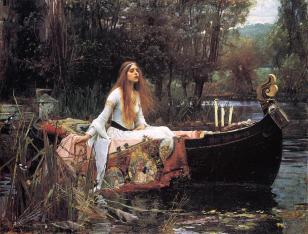
To make sure I am in fact staying on top of my to-do list for work, I’m trying to focus on tasks that are more or less mechanical, like re-organizing my class syllabi and setting up Blackboard sites. I’m making progress here: two of my three fall syllabi are basically ready. All three fall Blackboard sites are in progress, though there’s a fair amount of housekeeping to do on them, because I’ve changed reading lists and am also revising assignment sequences since they were last used. I hate Blackboard. Everything about it is unbearably slow and clunky to manipulate. I also have the perhaps foolish idea that the course sites should be attractive, and should in some way reflect the themes and readings for each course, so that students feel that they are in a space that is an extension of our class time. I’m not computer-savvy enough to mean anything that elaborate by this, but I do choose colour schemes and custom icons and graphics to suit. For the Victorian ‘woman question’ seminar, for instance, I made a banner for the heading that is all different paintings of the Lady of Shalott, and at some point in the term we will reflect on the various representations in the context of our discussions of things like Victorian women as artists, problems of women entering the public sphere, idealizations of sick or dead women, and so on. I suppose I could just do the whole thing in a strictly utilitarian way and save myself time and grief (you don’t want to know how annoying it was getting that d–n banner made and then inserted–a process not helped at all by the painful sloth that comes over my otherwise zippy ASUS netbook when I’m inside the Blackboard interface).  I wonder if the students either notice or care how we set these things up. In any case, the tedious pointing and clicking of adding files, assignments, calendar entries (that’s the worst!) and links to things like the university’s academic integrity site as well as relevant web resources all has to get done by September, and it’s not the kind of work that gets thrown off too much by invitations to play MarioKart, demands for lunch, or doing taxi service to or from play dates or camps.

blogger-logoThe other work project I’m puttering away at is my presentation for the conference in Birmingham, which suddenly does not seem far off at all! I leave in just over a month. I’ve been learning Prezi, because what I’d seen of it (e.g. here) made it look just right for the kind of wide-ranging, open-ended talk that seems appropriate: the panel is on “knowledge dissemination in Canada,” and I was invited to talk about my experience as a blogger. I intend a short preamble to the more autobiographical / anecdotal part that will address some principled reasons for academics to think about and maybe even try blogging — the state of academic publishing, debates about open access vs. ‘gated’ scholarship, the potential value of academic expertise in the public domain — and also a bit about academic literary criticism and its relation to the wider book culture. But I’m not going to be trying to prove one particular point or argue for one particular value or approach, so the linearity of PowerPoint doesn’t suit. I did use PowerPoint the last time I spoke on these issues, to my departmental colloquium back in 2007, so I do have some graphics I may be able to recycle! But Prezi is an intriguingly different beast and if I can get the hang of it, I think it will work well for mapping relationships between all these different but interwoven threads. Also, it’s fun to play with–which I’m pretty sure nobody has ever said about PowerPoint. And it comes with a warning that it may cause motion sickness in your audience if not handled with care. Now tell me you aren’t longing to try it! Imagine the effect some uncontrolled zooming might have on a batch of unsuspecting first-year students…

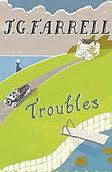
troublesI’m reading, too–right now, Troubles, by J. G. Farrell, which won the “lost” Booker a while back. I am loving it: it is brilliantly, mordantly, funny, with a current of uneasy violence running through its main storyline that is perfectly suited to the novel’s historical context, the Irish “troubles.” It’s yet another book (like Old Filth or Major Pettigrew’s Last Stand) featuring a retired servant of the empire — though in this case Major Archer is retired from active service but still a young man — yet it does not give me the same uneasy feeling that I’ve been through these moves before. We’ll see if I still feel that way at the end of the book. When day is done and I can’t even putter any more, I am watching Downton Abbey. This does seem familiar (wasn’t it called ‘Upstairs, Downstairs’ the last time?), but it is also very well done. I’ve just finished watching the Emma Thompson / Kenneth Branagh adaptation of Oliva Manning’s The Fortunes of War, which was excellent: I was most impressed that the series kept the oddly understated quality of the novels, which for some viewers might have made it unbearably slow in its pacing, which it is (slow,  not unbearable). While I watch these, I work on my bookshelf sampler, which I now believe I will actually finish by the end of the summer! I have just a bit more gilt for the book bindings and one final garland and then it’s time to mount and frame it.

My summer doesn’t sound so idle when I lay it all out like this! Add in that I’ve done some serious housecleaning (including, just this morning, taking everything out of the fridge, cleaning all the shelves and drawers, and putting everything back in all nice and orderly) and enjoyed such genuine summery activities as strolls in our beautiful Public Gardens, not to mention plenty of quality time with the kids doing other activities, and I feel quite pleased with the balance of work and play after all. Yet I will still welcome September, with its bouquet of freshly sharpened pencils* and the return to what feels–to someone who has, one way or another, been in school for nearly 40 years–like normal life.

*Sorry: I couldn’t find a clip with that actual line in it! But it’s near this point in the movie, I’m sure.

This Month in My Sabbatical: It’s Over!

Six months ago, I posted the first in a series of updates on my progress (if that’s what it was) through my winter-term sabbatical. As of July 1, I’m back on regular duties. Though in some ways, unless you’re doing summer teaching (which I am not, this year), July and August have a lot in common with sabbaticals, the several hours I have already spent preparing for, attending, and following up on committee meetings are clear signs that times have changed.

Looking back at my original goals and plans for this “teaching-free” interval is sort of disorienting. As the subsequent posts in the series show, my actual accomplishments differ  somewhat from those on the list I made in January! I would not say, exactly, or only, that I did not get them done, but that the plans mutated or evolved. For instance, my top priority then was to finish my essay on Ahdaf Soueif and submit it to an academic journal. I did finish an essay on Ahdaf Soueif, but it was this one at Open Letters; I have yet to decide if I want to do more with the academic one.

My next stated priority was a series of essays on Virago Modern Classics, specifically Margaret Kennedy’s novels. I did read both The Constant Nymph and The Ladies of Lyndon, but Kennedy disappointed (or puzzled and stymied) me. Spurred on in part by what I read on other blogs during Virago Reading Week, I did look into other writers of this period: a great highlight was reading Testament of Youth and Testament of Friendship. I still aim to read more of the Viragos I have gathered, starting soon (I hope) with Rosamond Lehmann’s The Weather in the Street. I also read a biography of Dorothy Sayers, and this plus what I’ve read by and about Winifred Holtby and Vera Brittain and my general interest in the period has made me quite thoughtful about proposing an honours seminar on the Somerville novelists for 2012-13. I don’t think I could work up to the level of expertise necessary for a graduate seminar, but I think I’d be spurred on to read with more focus with such a course in mind, and an honours seminar can be a great venue for exploring material you are somewhat but not completely knowledgeable about. Branching out like this, provided it is done with due humility, seems to me a good thing on all fronts: students get exposed to something we wouldn’t cover otherwise, and I get the fun of feeling a bit like a student again as I learn my way into the material. Imagine: the reading list could include Testament of Youth, Gaudy Night, and South Riding, plus something by Margaret Kennedy so I’d finally have to figure it out.  I’m nearly through Testament of a Generation now–a proper post on that should follow before too long.

I did do a lot of the things described in my paragraph about refreshing my teaching. I reviewed and, to an extent, revamped my reading list for Mystery and Detective Fiction. The amount of time this took, especially surveying options for the anthology, reminded me why so often–especially as ordering deadlines for fall books creep further and further back into the spring–I just stick with what I’ve done before. This is a good example of bureaucratic processes hampering pedagogical innovation–that, and the absence of any kind of book-buying budget for course development, since I find “trade” publishers more stingy with exam copies than, say, the very helpful Oxford University Press, and popular titles are hard to get at the public library. I also did some extensive re-organization of my electronic files: instead of being filed by course and then year, now my syllabi, handouts, lecture notes, worksheets, essay topics, and exams are now mostly sorted by teaching area, and then by author or function. In theory, it should be quick to find lecture notes on Wilkie Collins or all the versions I’ve done of final exams for English 3031, without having to remember which year I taught which book or which course, or which year I did or did not give a final exam. We’ll see how this works out!

With an eye to my Victorian classes as well as my own edification, I looked at a number of new books in my field, mostly without much excitement, and I read, or at least skimmed, dozens of articles and reviews. What I realized, going through this material, is that most of it makes no difference to me at all. I don’t mean that there aren’t interesting individual insights or original readings, but most of it operates on a very small scale or turns on a very particular interest or angle. None of it is paradigm-changing; nothing I saw made me feel I needed to re-think (rather than, say, re-tool a little) the approach I take when I teach Victorian fiction. Much of it is filed away for me to come back to when or if I need to take my critical attention to the next level–in a graduate seminar, for instance, or in more specialized work of my own. I’m glad to know it’s there. But I’m also, truth be told, glad to discover that I don’t need to feel so anxious about “keeping up.” What’s the benefit to it, in general, if I can read so much after such a long gap and still be satisfied that what I have to say about Jane Eyre or Middlemarch to my undergraduate fiction class remains what I want to say, has not been undermined or rendered inadequate or outdated? A year or so ago I read two good overview texts on Victorian fiction (George Levine’s How to Read the Victorian Novel and Harry E. Shaw and Alison Case’s Reading the Nineteenth-Century Novel) and they were similarly reassuring. Note that I don’t conclude from the minimal significance of this published scholarship to my immediate pedagogical goals that it is insignificant in a more general way: its purposes are different, for one thing. But also, as I have written about here before (but where? I can’t find it!), the cumulative effect of specialized critical inquiries can be dramatic–the undergraduate Victorian novels courses I teach have little in common with the one I took at UBC, and sensation fiction (on which I teach an entire seminar) had no place in either my undergraduate or my graduate coursework.

One thing that went just as expected was the steady stream of thesis material from the four Ph.D. students I’m working with. It is a very good thing that they are all writing steadily, and they are all working on interesting and substantial projects–but I admit, I wasn’t always glad to see another installment appear, especially when it often seemed I had barely turned around the last batch. Speaking of which, there’s one waiting for me now…

I had a general plan to read a lot, because, I proposed,

the more you read the richer your sense is of what literature can do, of how it can be beautiful or interesting or problematic or mediocre. I am convinced that I talk better about Victorian literature because of the contemporary literature I read, and that I teach with more commitment, and more hope of making connections with my students and their interests, because I read around and talk to them about books as things of pressing and immediate significance

I think my reading this term definitely added to my intellectual life and resources in the ways I’d hoped. Besides Testament of Youth, I’d point to the Martin Beck books as a great “discovery” for me (thanks very much to Dorian for the prompt). I’ll be teaching one in my mystery class, and I’ve written an essay on them which will be appearing elsewhere later this summer. Among the other books that really made an impression are  Graham Greene’s The Power and the Glory, Elizabeth Bowen’s The Heat of the Day, May Sarton’s The Education of Harriet Hatfield, Brian Moore’s The Lonely Passion of Judith Hearne,  Shirley Hazzard’s The Transit of Venus, and Carolyn Heilbrun’s The Last Gift of Time. Less successful reading experiences included Jennifer Egan’s A Visit from the Goon Squad and Terry Castle’s The Professor, along with Christina Stead’s The Man Who Loved Children, which is the first book in a very long time I have deliberately decided not to keep reading.  I have my two book clubs to thank for steering me towards titles I might otherwise not have chosen, or not have stuck with. The Transit of Venus is one I’m especially interested in teaching, but it seems a risky choice, so I’d have to pick the right course.

While there are things on that original list that I did not exactly get done, I also accomplished some things on sabbatical that I didn’t specifically anticipate. I wrote three more pieces for Open Letters, including the Ahdaf Soueif piece already mentioned but also two book reviews, one of Sara Paretsky’s Body Work, the other of Marjorie Garber’s The Use and Abuse of Literature. Though not, strictly speaking, academic publications, both of these (like the Soueif essay) are based on my professional expertise. I wrote a number of posts on academic issues, including one on “The Ph.D. Conundrum” and two on aspects of academic publishing (“Reality Check: ‘The Applicant’s Publication Record is Spotty’” and the recent one on Leonard Cassuto and blogs). I got feisty about Rebecca Mead’s high-profile, low-substance New Yorker essay on George Eliot, and went on and on about Sex and the City. I kept on soliciting and editing pieces from other writers for Open Letters, a process that is always satisfying. Finally, I accepted an invitation to participate in a conference panel, submitted a proposal and then the funding applications. Now I’m beginning to organize my miscellaneous notes and links into what will eventually be my lively, coherent (!) presentation. Along with my next essay project for Open Letters (on gender, genre, and novels about Richard III–no, really!), preparing this presentation will be my priority for the next few weeks–that, and getting things in order for my return to teaching, by which I mean preparing Blackboard sites, updating syllabi, keeping on top of waiting lists, and psyching myself up for the return to the classroom. I’m actually happy to be heading back: I have missed teaching a lot (remind me in October that I said this, will you?)

And so, onward! If I’m counting correctly, I am eligible for another half-year leave in 2014/15, provided the powers that be are convinced that I used the time wisely this year. Here’s hoping. I know that I feel pretty good about it. I have indulged my intellectual curiosity, expanded my horizons as a reader and a writer, and contributed in a variety of ways to discussions I think are very important to my profession and my discipline. I have advanced projects I’m excited about and discovered literary interests I didn’t know I had. I am eager to get back to teaching. To me, that adds up to a pretty productive sabbatical.


This Month in My Sabbatical: Reading and Writing

Though nothing especially momentous marks this month in my sabbatical, I am pleased that I have continued to move fairly steadily through the various projects I set for myself back in January. Though I appreciate having the time to read, reflect and reconsider, though, I have to say that this month I have felt particularly isolated, because it’s the two aspects of this job that you are relieved of on sabbatical (administration and teaching) that actually bring you into regular contact with other people. Without classes and meetings, much of what we do is strictly solitary, and during a regular term that quiet can be very welcome, precisely because teaching and committee work are hectic, demanding, and often as annoying as they are stimulating. At first, it was just a relief to be free of the incessant demands on my time and attention. But after a while, it’s lonely, even a bit depressing, puttering away by myself. That’s one reason this post on academic blogging (thanks to Jo VanEvery for the link) resonated with me, especially this bit:

a college of one’s own is essential to scholarship. Sometimes we get lucky and our collaborators are able to participate in that world, but more often they need us for narrower purposes: our technique, students, or grants. Who then to bump ideas off of? Who to share our latest little discovery or epiphany? How to communicate the interest of an article or book? Where to find a reader? Who will forgive us our latest and dumbest ideas? How to feel that slight flare of getting the last word in a debate among learned colleagues?

It’s true, as the author continues, that “a blog can provide those things, and more besides,” and I’ve been grateful for the interest and input I receive from so many of you on my posts here. (The post I link to also gives a thoughtful account of changes in the culture of academic life that have made that collegial interaction more difficult to achieve–if anything, I think he underestimates the role played by sheer day to day busy-ness.) I was thinking that it’s no accident I first began blogging on my previous sabbatical: without really knowing much about it, I was looking for more ways to communicate with other people, and it was exhilirating to discover the conversations going on online and then to become part of them myself. I wonder sometimes why I feel this lack, even when I’m not on sabbatical, and (as far as I can tell) most of my colleagues don’t. It’s true I’ve always been a chatty type (if my parents are reading this, they are muttering “no kidding” and recalling their coinage “talkit” … ) so there’s that; some of my colleagues are just more reclusive or scholarly by instinct, happy to burrow away in their research; some, I think, for whatever reason have a better network of peers and collaborators that provide input, support and energy; others might enjoy blogging but haven’t tried it, or think it would be a distraction from their “real” reading and writing. In any case, the solitude of sabbatical work has made me appreciate my online network more than ever. And it has also made me realize how much of the return I get for my investment in this career comes from my students, from the challenge and the fun of getting them involved in our readings, from their curiosity and energy and enthusiasm. I miss students! (Remind me I said this when I’m whining about grading their assignments in the fall, would you?) I miss my colleagues, too, a little bit … but it’s not like we do spend much time on the kinds of conversations evoked above. When we do talk about work-related topics, it’s more often griping conferring about workload, curriculum, or policy issues, about pedagogical problems–or about each other! Well, it’s a workplace, after all. (Those colleagues who are also personal friends are another matter, of course.)

So: what have I done? I’ve read and commented on more thesis material–and another 120+ pages sit in my inbox at this minute. I’ve read, or scrolled through, a large number of the nearly 100 reviews and articles I downloaded, getting “caught up” on–or at least refreshing my sense of–recent work in Victorian studies. That has not been as disheartening as I frankly expected it to be. The sheer quantity of scholarship in this field is potentially overwhelming if the idea really is to internalize all of it. It quickly becomes apparent, though, that most of it is of peripheral signifiance: the accumulation of it, trends and directions, are more revealing than any particular arguments, and even at that level I haven’t seen anything that suggests a paradigm shift on the scale of, say, feminist criticism or post-colonial criticsm: I haven’t seen anything that makes me think I need to fundamentally change what I think about or say about the material I teach. It’s possible to acquire lots of little insights, or to file things away in case they become relevant to some future class or project, but most of what I’ve read has left me unmoved. This result, in turn, has me reflecting on the pleasures of learning new topics. I have one colleague whose list of teaching interests struck me, back when I was first interviewing for my job here, as astonishingly diverse–but there’s an intellectual buzz that comes from discovery, and it’s hard to get that feeling at the level of highly specialized research. On the other hand, it is easy to get it when you don’t already know the central problems and paradigms of a field you are just starting to explore for yourself, so I can see the appeal of turning to new things, like a kind of learning junkie who can’t be satisfied anymore with yet another way to read the economics of Bleak House or the poetics of Goblin Market!

I’ve read more books that I thought might be appropriate for my classes, including Walter Mosley’s Devil in a Blue Dress and more of the Martin Beck mysteries–and in the last week or so I’ve drafted up a schedule for the course that actually includes Devil in a Blue Dress and The Terrorists. Other course-related reading included most of Rhoda Broughton’s Cometh Up as a Flower (which I ultimately decided not to assign),  a text book called Close Reading and the TOCs of numerous anthologies of crime fiction. I haven’t made the call yet about Close Reading but I did finally discover a Dover anthology of crime fiction that includes all the authors I wanted and is economical too–this is one more small testimony to the value of a sabbatical, because it took me ages to find and consider the alternatives here and if I had been in the midst of teaching, I would have given up and stuck with one of the books I’ve used before, even though for various reasons I wasn’t happy with them. (I have now ordered almost all the books for my fall classes and set up preliminary websites for them.)

I’ve also read a lot that wasn’t strictly for teaching or research, but then, as I say so often, in this job you never really know what reading will end up affecting your work, and I’ve been finding Vera Brittain and Winifred Holtby so interesting I am now wondering if at some point I could put together a course on the “Somerville Novelists”–not least because we have no in-house specialist in 20th-century British literature (crazy, I know) so I’d actually be helping round out our curriculum a bit if I did so. Just think: another excuse to assign Gaudy Night! (There’s that lure of the new, again: this would involve a whole process of learning and discovery.) Coming up for my two reading groups I have Somerset Maugham and Elizabeth Bowen–so more 20thC British fiction there too.

As for writing, well, there’s the blogging that goes along with all that reading, and I also decided to review Marjorie Garber’s The Use and Abuse of Literature after all. Following on my meditation about “giving myself permission,” I thought it might help overcome my writer’s block if I worked in a form I am very familiar with, so I did the review as a kind of feedback form. I thought it suited, because the book, though full of interesting and provocative threads, really read to me like something unfinished. I don’t understand why it got published without further revision, to be honest: what editor would be satisfied with something so amorphous? Despite my anxiety that it would seem unforgivably snarky to treat the book as I did, I did find it freeing to write it that way: for better or for worse, that is who I am, after all. And just as I do when responding to student work, I made sure to give credit for strengths as well as weaknesses, and to try to be constructive in my criticisms…

This Month in My Sabbatical: Marching On!

I feel as if March was a reasonably productive month, sabbatical-wise. Let’s see:

Graduate Supervision and Advising: This is one part of my ‘regular’ workload that doesn’t go on hold during a sabbatical (or during maternity leaves, just by the way). This month I received thesis installments from all three of my continuing PhD students. I also met with two of them, one in person, one by Skype, to discuss the progress of their thesis writing and do some long-term planning. I alsomet with a former PhD student who withdrew from the program about 18 months ago but has been wondering about returning. I find this part of my job a disconcerting mix of pleasure and pain. These are all wonderful young women–smart, accomplished, hard-w0rking, and just plain nice. So the pleasure comes from spending time with them, learning from them, and doing my best to support and improve their research projects. The pain, of course, comes from worrying about their professional situations. I have been, I think, very clear and direct with them, encouraging them to prepare to be competitive for academic jobs but also to consider other options–I’ve sent them links to a range of online discussions about graduate school in the humanities (including Thomas Benton’s infamous Chronicle columns as well as this one from Hook & Eye) and to some of the many sites addressing PhDs about non-academic options. In one case I think there is actually no intent to pursue a tenure-track academic position anyway; in another, options will be limited by geography, which makes the likelihood of a tenure-track option just that much smaller. But in that case, presumably if there was a local opening you’d still need to be competitive to have a shot, and in the case of the other continuing student, Lennard Davis’s advice is probably good to share–except what he doesn’t say but should is that it is perfectly possible to work insanely hard to do all the things he says, and you still might not win the job lottery. He also seems a bit sanguine about the pace of academic publishing: it’s all very well to submit things, but from submission to acceptance can take months or years. The hardest conversation, from my point of view, was the one with the student considering coming back. “You escaped!” was most of what I really wanted to say to her, along with what I more or less said, which is that a PhD in English is no kind of safety or default option. It seems attractive (if, and that’s a BIG if) you can get steady funding, because it’s a known world with clear expectations, work you’ve already trained for, and genuine intellectual rewards. But you could well end up, four or five years from now, right back in the difficult situation of trying to figure out what else to do–only by then you’ve invested heavily in your specialized training, including comprehensive exams and the huge chore of writing a thesis–not to mention trying to publish and otherwise pump up your c.v. (These are the features of the PhD program that make it difficult for me to accept the whole “it doesn’t have to be seen just as preparation for academic positions” argument. Sure, it doesn’t have to be, but if it’s not, what is the point of this intensive training in narrowly specialized fields and the hard, hard work of thesis-writing following stringently academic models? Unless we introduce streamed PhD programs, these will remain key components, and streaming is impossible as long as luck remains such a big factor in who actually gets a shot at the tenure-track when it’s all done.) In the end, as I told her, it’s her choice, and I understand it’s a difficult one. All of this (plus reading La Vendee, which is the subject of one of the thesis chapters now in progress) took up a fair amount of time but also, almost more significantly, a lot of mental energy this month. And the next pieces of chapters are already landing in my in-box, so on it goes! I’d be even more busy with graduate students if I hadn’t refused to take on any new MA supervisions: this is thesis proposal / first chapter season, and then the writing heats up heading into May and June. Usually I have at least one, and some years I have had as many as three. When my sabbatical ends, I’ll come in as second reader on a couple of theses, I expect, but it is a relief not to be juggling these meetings and drafts at this point.

Soueif Project: I did some relevant reading, reviewed my research notes, and drafted some new pages for the academic paper I’m trying to produce on Ahdaf Soueif. Then, prompted by reflections about how dissatisfying this work felt when Soueif’s current speaking and writing is all directed towards the Egyptian Revolution, I took the advice of some of my commenters and let myself address that new context in a separate piece, “A Novelist in Tahrir Square,” which appears in this month’s Open Letters. I wanted to use the time and thought I’ve given to her fiction, connecting its ideas to the sense of broader changes in perception and understanding that accompanied the Revolution. It was very challenging distilling the overflowing details of the novels and of my own notes and ideas, but I felt pretty good about it when I finally sent in the revised version (I appreciate very much the input I got from the other editors at Open Letters–though of course any lingering stupidities or infelicities are all my fault). I hope this will have settled me down so that I can appreciate the academic project for what it is: as some of you said, no one piece needs to do or be everything.

Filing and Stuff: I did quite a bit more of my electronic file sorting. I do think it will be helpful when I begin to put my course materials together for 2011-12 that I have eliminated a lot of redundancy and put lecture notes, handouts, quiz questions, exams, and assignments into a system that doesn’t require me to remember in which year, or in which course, I did that group exercise on Felix Holt or whatever. The problem turns out to be courses that aren’t themselves really focused on a particular genre, period, or author. My materials for Close Reading, for instance, will stay all together for now: the lectures and worksheets and assignments I devised on Middlemarch for that course are so different from the ones I use in my Victorian novel courses that I think it’s easiest just to leave that as its own category.

Reading: I have blogged about most of my reading for this month–except The Transit of Venus, which I will write up later today, as the discussion gets underway at Slaves of Golconda. The highlight has definitely been Vera Brittain’s Testament of Youth. Most of my reading was not strictly work-related (though, as I’ve often noted here, you never can tell–wouldn’t an honours seminar on the ‘Somerville Novelists’ be cool, for instance?). The coming month will be different, though, as I’m moving on to another of my sabbatical plans, which is catching up on criticism in my field. In January I took some recent monographs out of the library, but I think this is not actually the best way to proceed: many scholarly books now are just so specialized that the rest of us don’t really need to know that much about their subject. The case has been made a few times recently, I think, that many books in the humanities are artificially inflated essays–the introduction is crucial for making the argument, but then the chapters offer variations on the theme rather than essential development or elaboration. I really do think this is true, and I wouldn’t exempt my own book–though I suppose it hardly counts as recent (© 1998). There’s nothing wrong with the chapters, but there’s really no necessity to my choice of novels to discuss in the context I’d established–they were the ones I wanted to discuss, as much as anything. In any case, I’ve decided to try a different strategy and last night I downloaded a whole bunch of book reviews (and a few articles, but mostly reviews) from the past several years of Victorian Studies–71 PDFs, in total. Going through the reviews will alert me to books I may wish to read, or at least leaf through, in full, but it will also give me a sense of what people are up to, what is trending, and so forth. (I’m sure there are people who do this kind of upkeep on an ongoing basis. Obviously, I’m not one of them! But maybe I’ll find a good routine for it in future–this is something that my iPad will be very helpful for, for instance, as I can load the PDFs into GoodReader and page through them at my leisure.)

Paperwork: Finally, this month I confirmed my intent (or, I should probably say, my hope!) to participate in a panel at the British Association of Victorian Studies in Birmingham the very first weekend in September. I can’t be absolutely sure I can pull this off until I find out what level of funding I can get, especially at the rate air fares are going up. I do think it would be a really good professional opportunity for me, though, not just through my own participation but for what I expect will be the quality of the rest of the conference, so I’m going to give it a good try. I have had some pretty bad conference experiences in recent years, so I’d love to go to one that might help me feel excited about “my” field again.  In aid of that, I’ve begun assembling the necessary paperwork to apply for a travel grant.

And so, onward, with all of these tasks and also with some pedagogical planning, as book orders for the fall are due soon, which means I have to commit myself to my detective fiction list as well as my first round of 19th-century novels, for the Austen to Dickens course. . . .

This Month in My Sabbatical: Stupid Short Month!

Where the dickens did February go? It only just started, and now it’s past. Sigh. I knew it was going to be a compromised month because in its infinite wisdom the Halifax Regional School Board decided to move the kids’ usual March break to February and extend it to two weeks, ostensibly to allow families to attend the Canada Winter Games, which Halifax hosted. I have yet to talk to one family that went to any of the sporting events: most seem to have left town, or just hunkered down–which is what we did. Between my sabbatical and my husband’s February break overlapping with the kids’ for one week, we managed to juggle things OK without packing them off to some kind of camp: this option is one great gift of the flexibility of academic schedules, but also as the kids get older (they are 9 and 13 now–which makes me … young! very young!) they are more self-sufficient about entertaining themselves. Still, I am cursed with a need for silence and extended contemplative periods without interruptions if I want to do serious reading or writing, so I knew that the second half of the month would not be my most productive time. What I hadn’t figured on was the four snow days in the first two weeks of the month, which meant that altogether they were in school (and thus I was “at work” in the usual way) only SIX DAYS in February.

Still, there was time to read and write, and even some time to think. When I fretted about how the break weeks were going to go, my daughter sagely recommended that I should “make plans for things that you can do, and then do them!” And that’s pretty much what I did: I adjusted my expectations and ambitions to focus on the projects that weren’t quite as intensive. Hence all the reading and blogging about crime fiction, which has actually brought me a lot closer to some decisions about how to mix up the second half of the reading list for my mystery fiction course. Right now, I’m thinking I’ll take out Rankin’s Knots and Crosses and probably a few short stories, and put in Ed McBain’s Cop Hater (to make the transition to contemporary police procedurals and a bridge to the Scandinavian writers explicitly influenced by him) and then either one of the Sjowall and Wahloo series or one of Henning Mankell’s. I still have more to read, but this direction makes sense to me, and I feel increasingly comfortable about being able to work with the material. I’m almost finished Mankell’s The Fifth Woman, and it really is quite a different kind of book than Faceless Killers. I don’t like the case much, and I still am finding the style dull, but it is just much richer and more interesting. That said, it’s also quite long, which may make it less than optimum for late in the term. I have a handful of other related titles to read but this seems like progress.

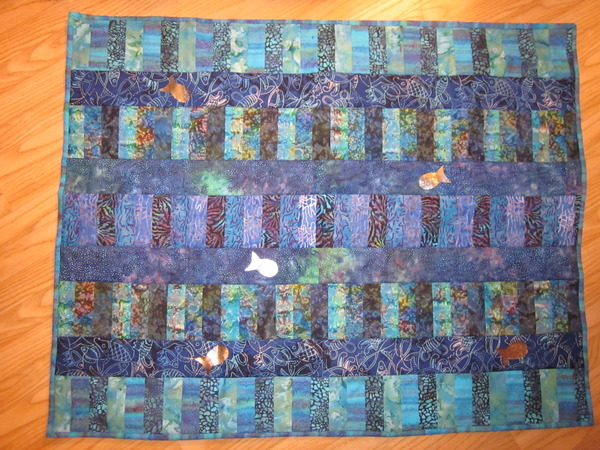
Let’s see: what else? I’ve done some other reading and blogging, and I’m working on a small piece for another site about one of my favorite books (the struggle I’m having being satisfied within the 400-word limit is a salutary one for me, as I often give my students very short limits on their papers and blithely tell them how much harder it is to make a few words densely meaningful than to ramble on for several pages). I have done more letters of reference (and another request for one came in this week). Yesterday I returned a 50-page thesis chapter on Frances Burney. I prepared some materials in support of my nomination for a teaching award. I explored funding options for a conference I hope to attend in early September–in the next week or so, I need to write up a proper proposal for my part in a panel as well as one for a workshop for graduate students, which will probably be something to do with academic blogging. I practised using my iPad. The keyboard still nearly defeats me. Maybe I could use little sticky things to give me some tactile indication of where the darned space bar is: about 75% of the time, if I try to actually ‘touch’-type, I put “n” in instead. It’s a long way from the IBM Selectric I learned on back in 1983 to a perfectly flat glass screen. I worked on soliciting and editing pieces for the March issue of Open Letters Monthly. That’s about it. Oh: I also finished my little ‘Blue Ocean’ quilt!

This Week in My Classes: Not with a bang but a whimper

My last class of the term was Monday afternoon–a review session for the final exam in my Brit Lit survey. I had hoped to go out on some kind of high note. Usually I plan a bit of a closing peroration about the value of literature and the intellectual rewards of our work over the term, and sometimes (ever the optimist) I bring a list of suggested further reading. Two things militated against rhetorical flourishes on Monday. First, I got sick–“just” a cold, but you try (I’m sure some of you have tried) being eloquent when you have a cold. (It turns out that even speaking as much as I did was a bad idea, since almost immediately after class the virus marched its happy way to my  larynx and took away my voice, which made my other major commitment for this week, participating in a PhD comprehensive exam, just that much more challenging!) The second factor was the format of the class: I like to do review in a Q&A format working off a handout of possible exam questions. I figure they should have their last chance to make me explain or clarify the things they feel uncertain about. But that means it wasn’t a very orderly session, and I didn’t have the physical or mental strength to reclaim the room at the end to make any kind of goodbye statement. Well, I’m sure they didn’t mind. I feel frustrated about this particular class because I really haven’t been able to judge their level of engagement as well as I usually can. One-on-one exchanges with students usually gave me a good feeling, but then the students who bother to talk to you one-on-one are a self-selecting group. I think I offered them quite a lot of good stuff this term (with the help, too, of some great guest lecturers) but I’m not sorry that someone else is taking this class next year: I’d like to rethink a few things about it before I do it again. I’m sorry to say that one of the things I’m reconsidering is the wiki project I designed. I was very enthusiastic about this assignment when I introduced it last year, and the results were pretty good despite some initial resistance and some lackluster participation from a few. I thought I could overcome the resistance better this time by talking about the value it had proved to have for last year’s group, and I made it worth more to motivate the slackers to do their share. Though some students really stepped up, overall the investment in the wikis seemed worse this year. Given how much effort it takes to set them up and administer them, I think I might not try again, or I might try such a thing only in a much smaller class where I can really play an active role in stimulating ideas and generating the kind of enthusiasm for results that is necessary to carry it along.

So now it’s all over but the marking: 23 essays for Mystery & Detective Fiction (they went through proposals with me already, so I’m expecting the final results to be quite good–plus in this group the level of engagement was conspicuously high), 60 or so for the survey (which thankfully I split with my TA), and then 60 or so exams, which don’t even get written until December 18. I can’t say I am looking forward to the next two weeks, but at the end of them lies my sabbatical, for which I have high hopes.