Ah, the holiday weekend, with its leisure reading! It’s just a fond memory right now … Well, I exaggerate slightly, as I’ve certainly had more hectic terms than this one (this time last year, just for instance, I was teaching three courses, including one entirely new one), but I have been pretty busy with class preparation, grading, and meetings in the last couple of days, and so far I haven’t really focused on another fun book to read in the interstices.
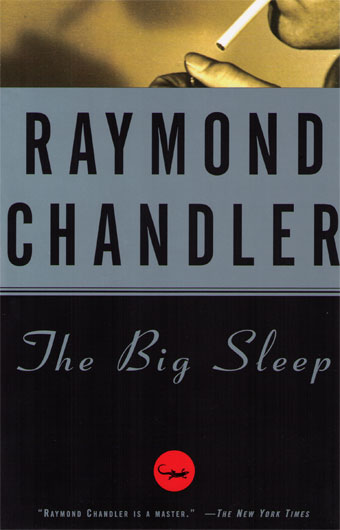 Today I finished marking the 75 midterms for my Mystery & Detective Fiction course (which means, in case any students are reading this, that the grades should be checked and posted to Blackboard tomorrow afternoon). In class, we’ve just started working through The Big Sleep. It’s my first time teaching it, after going endless rounds with The Maltese Falcon. I’ve been thinking about making this switch for years but it took me a while to get over my initial aversion to The Big Sleep (soon after that 2009 post, however, I did add The Hound of the Baskervilles to the syllabus, where I have enjoyed it ever since). There are a few things I already miss about Hammett, but I think Chandler is going to give us plenty to talk about, and now that I have the plot more or less sorted out and some interpretive threads to follow, I am relaxing enough into the book that I almost like it a little bit! (Hard-boiled fiction is never going to be my favourite thing, but note to David Gilmour: teaching outside of your comfort zone is good for the brain as well as the character…) Yesterday was mostly warm-up stuff, with background on hard-boiled detection, Black Mask, “The Simple Art of Murder,” and so on. Then we started in with some consideration of the title: how does the gently euphemistic The Big Sleep suit the novel in a way that, say, Stone Cold Dead would not? (“Why this, not that?” is one of my favourite conversation starters for class discussion.) We had time for a few preliminary comments on Marlowe and that’s where we’ll pick up tomorrow: what kind of knight-errant is he, what kind of candidates for his version of chivalry are the Sternwoods, what’s the world like that he moves in, what hope does a lone hero — however untarnished and unafraid — have against the kinds of crime and corruption he’s up against? I would like to be able to talk about Spenser, but there’s just no room for Robert B. Parker on this syllabus: if I were ever to propose a 4th-year seminar on this subgenre, it would be to have an excuse to assign him. Actually, a course like that would be a great complement to the one I already offer on Women & Detective Fiction (coming up next term). Hmmm…something to think about. It wouldn’t play to my own tastes the way the other seminar does (oh, how I’m looking forward to reading Gaudy Night again) — but given how hard it sometimes is to be scholarly and objective about books I really love, that might not be a bad thing.
In 19thC Fiction we’re done with Waverley (to everyone’s relief, I think) and on to Jane Eyre, which is always a much easier sell. I’m not as passionate about Jane Eyre as I once was. It’s partly that I’ve gone through it so often (though reiteration doesn’t seem to diminish my enthusiasm for Middlemarch), but this time I’m also finding its relentlessly high emotional pitch tiring and somewhat artless (can I say that? is it heresy, for a Victorianist?). And yet I suppose that’s kind of the point (one point, anyway) of the novel itself — that our passions need to be checked by reason, that rage (however justified) quickly becomes self-destructive. I find myself coaching my students in quite the opposite way than I was doing with Waverley: instead of saying ‘try to throw yourself into it more,’ I’m saying ‘be careful about identifying with Jane too quickly or easily.’ She gives us lots of clues that she herself has grown up since she was thrown into the Red Room for fighting back against John Reed’s oppression. My favourite parts of the novel are the sparring matches she has with Rochester: so much of their dialogue is just so unexpected. By tomorrow everyone should have read through to Jane’s discovery of her inheritance and her relationship to St. John and his sisters: I want to start with some discussion about why she doesn’t marry Rochester (not the plot reasons, of course, but the reasons that marrying him at that point would be risky even if he weren’t already married) — that means looking at the shopping spree, probably, and talking more about Bertha and whether she’s a cautionary tale for Jane, an ally of some kind, or an antagonist. Then we can consider what Jane gains at Marsh End, as well as what risks she faces there, too, to her personal development.
 I’m feeling a bit mad at myself for not learning the lessons of last term about the assignment sequence I’m using in 19th-Century Fiction. I’m doing reading journals again, and I’m also repeating the strategy of allowing students to choose which of our first novels to write their short essay on. Last time I worried that the journal entries were not well distributed across the term, and I’m seeing the exact same pattern this year — I didn’t change the instructions and rules because the degree of micromanagement required to key credit to specific stages of the reading seemed too much, but I’m not sure I can justify (to myself) doing the same thing again, given what actually happens (as opposed to what I’d like to happen). It’s a process-vs.-product problem again: mostly, they want credit for doing the journals, not the benefit the journals could be to their learning experience. (As always, there are exceptions who are absolutely making the most of the journals.) This term, I’m also seeing really uneven distribution in the essays: fully a third of the class wrote on Persuasion, nobody at all on Waverley, and it looks like the remaining two thirds are planning to write on Jane Eyre, which means nobody is writing on David Copperfield. (They all have to write ‘mini-midterms’ on each novel, though, and then a final exam with an essay question on our last book, North and South.) I want them to write on the books that interest and motivate them, but one effect of this uneven selection is to unbalance my workload. Before I design next year’s 19th-C novels class, I’ll revisit the great coercion conundrum. Maybe I’ll do a different assignment sequence altogether — though at this point I don’t think I can go back to the letter exchanges that I used to like so much. They had just become too much of a logistical nightmare!
But it’s too soon to fret about 2014-15 when 2013-14 isn’t even half over yet.
 First of all, I did decide to do something different, rather than just pressing on with my usual strategies. I had to admit to myself — and I admitted this morning to my class — that if year after year a critical mass of students just isn’t getting engaged by the novel, at least to some extent this is a failure on my part — a pedagogical failure. Dropping Waverley from my reading list was also a failure: some students in Waverley-free years have told me how happy they were to have missed it, but missing out on it was not a win for them any more than it was one for me. As I told my class this morning, it’s a novel that deserves its place on our syllabus, one that is well worth reading for our curriculum, whatever anyone’s personal response to it. But the failure isn’t all mine. To use the analogy I suggested to my class, if you’re stumped by a difficult calculus problem, you don’t blame the problem: you work it as hard as you can, get more help if you need it, and try to bring your skills up to the level you need to solve it.
 Again, this is all standard classroom procedure — lecture mixed with discussion prompted by questions designed to build interpretations out of observations. But it just doesn’t go well with Waverley, though there are always a few stalwart souls who put their hands up (thank you!). I’m always a bit puzzled by the conspicuous collapse: the novel doesn’t strike me as that opaque, especially once we’ve done our warm-up sessions. On the assumption that incomprehension is a problem, though, my first response is usually to step up what I think of as the ‘modeling’ component of class — that is, walking the students through those key episodes and showing them what’s in there to notice, enjoy, and work with. Then I try backing off again — but still with lackluster results. Is it me, I wonder? Perhaps I come on too strong: if they are feeling bemused or bored, then my enthusiasm, rather than ‘selling’ them on the novel, may just alienate them from both it and me. Also, sometimes I catch myself hectoring them: this week, for example, I gave them a heads-up that we’d be discussing three particular incidents, and when hardly anyone seemed prepared to do that, well, I did take them to task! But that backfires too, I bet: rather than feeling challenged to do better, they probably just feel defensive.
 The second full week of term has gone by already: it’s amazing how time seems to accelerate when things get busier. In both my classes we have moved from throat-clearing and context-setting to richer discussions about our readings: in The 19th-Century Novel from Austen to Dickens, we’ve wrapped up our work on Persuasion, and in Mystery and Detective Fiction we’ve got only one more class on The Moonstone. Starting the term with these two novels eases the transition from summer’s languors to fall’s stresses because both are so delightful. At least, I think so — and it seems as if a lot of students are enjoying them as well. Discussion in the Mystery class has been particularly good so far this term, especially considering it’s a big class (capped at 90), which can sometimes be inhibiting. I hope they keep putting their hands up!
 One thing I’ve been thinking about as our work gets underway, and as I contemplate my own non-teaching ambitions for this term, is trying to make the process as meaningful and rewarding as possible, shifting some emphasis away from the product — which for students is often the course credit or the grade, and for me is the finished piece of writing. I’ve been reading Donald Hall’s The Academic Self: An Owner’s Manual (thanks to



 Monday was my last day of class meetings, and now I’ve moved into the exams-and-essays phase of the term. I have mixed feelings about both final exams and final essays, but for different reasons. Final essays can be triumphant culminations of a term’s work, the products of significant reflection and practice. But they can also be perfunctory hoop-jumping or last-minute rush jobs, and because they are final, there’s no hope that you can turn them into learning opportunities. I still comment pretty thoroughly on them, but I bet we all have that disheartening file of uncollected papers stashed away in our offices: for some students, the recorded grade (which we often see as the least important part of our evaluations) is all that matters. (One of my favorite things about electronic submissions is that I can email them the marked papers, which at least puts the ball back in their courts — and doesn’t increase my clutter.) I often rethink how I approach or build up to a final essay assignment, but I never rethink including a final essay, or essay option, in my courses: organizing ideas about literature into well-supported analysis is just too fundamental to my goals for the courses, and indeed to my ideas about the discipline of literary studies.
 In my 19th-century novels class this term I tried what I hoped would be a more flexible and intrinsically valuable approach than the reading quiz: I required students to keep an online reading journal, using the journals tool in Blackboard. (I don’t like Blackboard in general, but this particular feature seemed unusually streamlined and user-friendly, so I took a chance on it.) The requirements were simple: three posts per novel minimum (no more than one per day for credit), at least 150 words and in full sentences. This way I figured they could keep track of their reading at their own pace, get regular small-scale practice writing (with the chance of regular quick feedback from me), and end up with a useful record of ideas and observations. After the first round, though, I realized that I had not been coercive enough: easily 75% of students did all three of their journals on the last three possible days, and often their posts suggested that they were way behind on the reading. What I hadn’t done, you see, is explicitly tie credit for the journals to the portions of the novels assigned for each class meeting, or insist that they stagger their work so that they were writing and thinking throughout our time on each novel. Silly me: I thought they would just be doing that anyway, and that self-interest and forethought would motivate them to do a journal here, a journal there — rather than piling them all on at the end. But apparently all that many of them wanted (and therefore got) out of the exercise was the credit for having done it. There were certainly some students who approached the whole exercise in exactly the spirit I hoped for, and kudos to them. My strong suspicion (and in some cases, my past experience) is that these are the students who don’t need coercion anyway: they’re just into it, and more power to them. But they are a minority.
 This week in my classes, which are traditional English classes rather than warm and fuzzy creative writing classes, I am burdening students with historical background, wrapping ideas in grad-school jargon, and generally obscuring the pleasures of reading and the power of literature. No, really!
 Novel Readings