 It always takes a couple of weeks for a term to rev up and really get going: we have to get through a certain amount of reading, for example, before much writing can be done and thus for much marking to be needed. We are passing that point now, though, and this week I have already returned some paper proposals, there’s a batch of tests waiting for my red pen, the pace of submissions has picked up on reading journals, and that won’t be the end of it — not just this week but really for the whole term, since I have built in so many ‘small’ assignments (as part of my attempt to emphasize the process over the product) that from now on there will almost always be something coming in and something going back.
That’s OK, though, because that also means we’re past the start-of-term annoyances (more or less) — things like having to constantly update the class list as students add and drop classes (for two whole weeks! I’m sure I’ve mentioned that this drawn-out period of indecision is one of my pet peeves. I have tried but so far failed to convince administrators that while it may be a convenience for ‘customers,’ it is a pedagogical nightmare for both students and teachers.). And it also means we are getting used to each other so class discussion keeps getting better, and that we all more or less know what’s going on in terms of course requirements and policies and all the rest of the logistical stuff.
 I should say that I think our final sessions on Pride & Prejudice went well in the 19th-Century Fiction class last week: whatever my misgivings about the novel’s intransigent popularity, that does mean a generally positive attitude in the classroom and a high percentage of people who are well (really well) caught up on the readings. We’ll see how their spirits hold up as we move into Vanity Fair, which we start on Friday. I am pretty excited about that, actually: I haven’t assigned Vanity Fair since 2010, so it will feel relatively fresh to me, and a quick poll showed that it’s completely new to all of the students. The actual OUP volume looks so vast and dour that I think they can’t help but be pleasantly surprised when they start reading. But before we get there I’m taking one class to do a workshop on how to write a good essay for the course — this has become a regular feature of my upper-level classes and reflects my ongoing efforts to make my expectations as clear and transparent as possible and to demystify, as far as possible, the concept of a “good essay.”
In Mystery & Detective Fiction, we are finishing up The Moonstone. I enjoy it so much that I’m almost sorry I’m taking a break from this class next year. It occurs to me that I could assign it in the 19th-Century Fiction class next year instead, since I’m doing the Dickens-to-Hardy version — but that’s my best chance to do The Woman in White, so I probably won’t.
As that comment shows, one of the things I’m busy with, if so far still haphazardly, is planning next year’s classes. We’ve got our course assignments and it won’t be long before we need to turn in preliminary course descriptions and reading lists, as registration begins in March and the whole course selection apparatus needs to be ready. The one I’m thinking about the most is Pulp Fiction, which I’ll be teaching for the first time next winter. I’ll save my many but currently quite inchoate ideas about that class for another post! But I will say that it’s a good example of why it’s hard to draw firm lines between work and not-work for people in my profession, or at least for me: many things I’ve read “for fun” in the past are now possible candidates for its reading list, and many things I’ll read in the next few months in case they’re perfect for it won’t be strictly work-related at first, and maybe never will be!
 I’ve also got a guest lecture on Ian McEwan’s Saturday coming up for a colleague’s class that seemed remote when I agreed to it but is now (eek) just over two weeks away. Wouldn’t you know it: I have a whole folder of materials on Saturday from when I taught it myself in 2006, but somehow I have no lecture notes specifically on the significance of “Dover Beach” in the novel, which is what I proposed talking to her class about (what with my being a Victorianist and all). Since I haven’t actually read Saturday since 2006, I should probably add rereading it to my to-do list…
Also looming uncomfortably close on the horizon is the Louisville Conference on Literature and Culture Since 1900, which I am attending (weather permitting!) as a participant on a panel about criticism in the internet age, along with Dan Green and David Winters. I have an abstract of my paper and a mess of notes: now it’s time to get serious about shaping something presentable out of them! Aside from the work that will require and the stress of having travel plans for mid-February, I’m looking forward to the conference: the program is full of interesting things, and it will be great to meet Dan and David in person. I’ve known Dan virtually since I started blogging in 2007! (Maybe one day I’ll also meet the elusive Amateur Reader face to face. I would promise never to reveal his super-top-secret-real-life-identity!)
I’ve been busy with some writing, also, and with the usual editorial things for Open Letters Monthly. And as if all this isn’t enough, it’s also winter and we have had three storms in the past week, which means we’ve also been busy shoveling. So far it has not been that bad — the roads and sidewalks are getting decently cleared in pretty good time — but I was recently reminded that at this time last winter, Halifax hadn’t turned into Hoth yet either, and we’ve got nearly three months to go before we’re really out of danger.
I am managing a bit of non-required reading in the interstices of my days. I finished Vivian Gornick’s The Odd Woman and the City but haven’t decided whether or how to blog about it. Now I’m about half way through my reread of Emma and it’s not going very well. I will persist, however — and then choose something a little less stuffy with a little more action in it. True Grit, maybe, which is on my list of Pulp Fiction possibilities and which by all appearances is pretty much the anti-Emma.
And that brings us pretty much up to date! I look forward to doing some more bookish blogging soon.
 Pride and Prejudice is the only work I ever teach (in any genre) that has routinely been read already, often multiple times, by many of the students in the class. You’d think that would be a great thing — and actually, in some ways it is. Students who know the novel really well bring their own expertise to our discussions; their enthusiasm, also, enlivens it. Both of these things are freeing for me: I can count on informed participation and turn much more than usual to other people in the room to help me out with details, and I can also play devil’s advocate more, with less risk of sowing confusion and more chance of just stimulating debate.
 The new term is underway, as you might guess from the sudden dearth of new blog posts. After all this time I am much better at the start-up logistics; what gets harder is adjusting to the sudden dramatic increase in demands on my energy. I was exhausted after every class meeting this week! But as we get deeper into our course material, more energy flows back towards me, and then the process feels less draining — on a good day, it’s even exhilarating!
 For Mystery & Detective Fiction, for instance, I start with some comments about the (vexed, contested, elusive, perhaps nonexistent) difference between “literary fiction” and “genre fiction,” and some thoughts about how our ideas and expectations about these kinds of fiction affect our reading strategies. I also give an overview of the development of mystery fiction as a genre, from Newgate and gothic fiction through sensation fiction and Sherlock Holmes and on to the present day, with attention to the emergence of a wide range of subgenres; and I talk a bit about the history of policing, from thief-takers to Scotland Yard. For courses on Victorian fiction, I often lead off with some discussion about the contemporary connotations of “Victorian,” then talk about the historical and literary-historical reasons for those stereotypes; then I go over some generalizations about the “rise of the novel,” with some attention to social contexts and some to formal or thematic trends.
 If our curriculum currently has an organizing principle or direction, it’s more skills-oriented rather than content-oriented: first-year classes emphasize reading strategies and writing skills, then for majors and Honors students we have kinds of required classes (literature surveys and theory / methods) that they choose among. There are some breadth requirements, for historical range, but because they can take classes in pretty much any order they want, none of this provides any predictability or consistency. And so I try to build it in myself.
 I’m always relieved at the end of the term, because the last phase is always quite stressful. But I’m also always aware that it’s really only the end of a term — another one immediately looms, and another, and another! Every limit is, indeed, a beginning as well as an ending, and so this in-between time inevitably prompts reflections. What went well — and what could I do better next time? What fell flat — and what might, nonetheless, be worth trying again? From class policies to book lists, from the layout of the syllabus to the assessment of final exams, teaching is always a work in progress, isn’t it?
 I enjoyed a lot about my graduate seminar on George Eliot, but it was a source of some pedagogical frustration for me. I felt all term that I was talking too much, for instance. But also I felt somewhat confused about the aims of the seminar now that we’ve all openly admitted that
 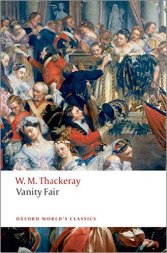 My other course is yet another incarnation of “The 19th-Century Novel from Austen to Dickens,” for which as usual I have mixed up the reading list: instead of Persuasion, I’ve switched in Pride and Prejudice (which I haven’t done in 5 years); instead of Waverley, I’m bringing back
 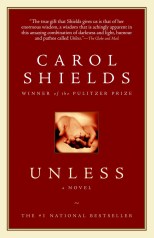 In a way, this post is also about “this week in my classes,” as it is prompted by the serendipitous convergence of my current reading around questions we’ve been discussing since we started working on Carol Shields’ Unless in my section of Intro to Lit. In our first session on the novel, I give some introductory remarks about Shields — a life and times overview, and then some suggestions about themes that interested her, especially in relation to Unless. One of the things I pointed out is that she also wrote a biography of Jane Austen; in an interview, Shields said “Jane Austen is important to me because she demonstrates how large narratives can occupy small spaces.” We come to Shields right after working through Woolf’s A Room of One’s Own, so I also bring up Woolf’s pointed remark: “This is an important book, the critic assumes, because it deals with war. This is an insignificant book because it deals with the feelings of women in a drawing room.” Both Shields and Woolf are thinking about the relationship between scale and significance, and both of them are drawing our attention to the ways assumptions about what matters — in literature, particularly, since that’s their primary context — have historically been gendered.
 Reta’s redrafting is disrupted by her editor, an officious American (of course! Unless is a Canadian novel, after all) named Arthur Springer who has even bigger plans for Thyme in Bloom, which (significantly) he proposes she retitle simply Bloom. His idea is that Alicia should fade into the background while Roman emerges as the “moral center” of the novel. This, he insists, is necessary for the novel to graduate from “popular fiction” to “quality fiction.” He also proposes that Reta retreat behind her initials: she will become R. R. Summers (“Winters” is her husband’s surname). This way her new (“quality”) book can’t possibly be associated with her, or with her earlier (“popular”) novel.
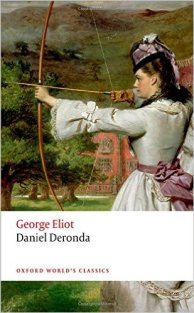 One of them is Daniel Deronda, which I’ve just finished reading with my graduate students. This novel is famously bifurcated between Gwendolen’s story (a highly personal, small-scale drama) — and Daniel’s (which starts out on a similarly domestic scale but opens out into a potentially epic, world-historical story). Is Gwendolen condemned to insignificance when she is left behind to suffer at home while Daniel goes off to (perhaps) found a nation? The literal scale of Eliot’s treatment of Gwendolen is not belittling: she gets at least half the huge novel to herself, after all. Perhaps this novel insists, formally, on an equivalence between two kinds of significance, one of which occupies a small space. Or perhaps what’s significant is Gwendolen’s discovery of her own insignificance. “Could there be a slenderer, more insignificant thread in human history,” asks the narrator,
 Neither of these novels, however, whatever their differences, feels in any way light, despite the intimacy of their core casts of characters. It’s the treatment, not the subject, that gives literary significance, isn’t it? Austen’s novels don’t feel trite even though viewed narrowly they are “just” about a handful of “ladies and gentlemen, in their elegant but confined houses” (in Charlotte Bronte’s words) — because her love stories are also stories about values and class structures and social changes with far-reaching effects. When Isabel Archer accepts Gilbert Osmond’s proposal, it feels large because James has imbued Isabel’s choices with philosophical consequence: her decision isn’t just to marry or not to marry, but about how to use her freedom, and about what to value and how to value herself. These are personal questions but also abstract ones, and so the small space of her individual life occupies a large narrative (by which I don’t mean, though I could, just a long book).
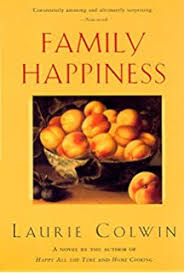 I have been thinking that this constellation of questions (not really any answers) is relevant to the discussions about why, say, Jonathan Franzen’s novels about family and private life get treated as more significant than some other books that are about similar topics. Gender may well be part of the explanation, but it would be disingenuous to pretend we don’t know that some books by both men and women simply do more with their material than others, and that that scale — the scale of meaning, of treatment — is ultimately where literary significance lies. But this post has gone on long enough without really arriving anywhere in particular, so that’s probably as good a place to stop as any.
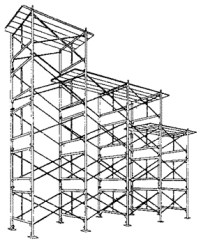 We are rapidly nearing the end of term, which means a lot of time and thought on all sides is going into final assignments. In my Intro to Lit class, I’m particularly conscious of this phase of the course as a time in which I pull back and see if the scaffolding I have tried to build for the students, starting on the first day of classes, supports them now that they have to do their biggest independent project. Last week I gave them a self-assessment exercise that, among other things, asked them to let me know what they thought the teaching staff could do to help them succeed — what else, I should say, since it’s not as if my TAs and I have been passive so far. It was useful to see what they identified as their own strengths and weaknesses. Their anxiety pretty clearly centers on building a viable and interesting argument out of the details they notice while reading. A number of students said that they wished we would “explain” the readings to them more clearly: as I discussed with the class, if this means “tell them the answer to the readings,” tell them what to argue about them, then they aren’t going to get their wish, since learning to develop and support their own interpretations is really the primary course objective. I’ve been stressing the process that leads to a good interpretation, which is what we model and practice in every class, but I’m not going to offer them a “nugget of pure truth to wrap up between the pages of [their] notebooks and keep on the mantel-piece forever,” even if (as Woolf ironically observes) this is “the first duty of a lecturer.”
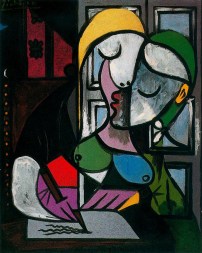
 My graduate students too are facing end-of-term hurdles. Here my scaffolding has been somewhat less meticulous or overt, but I hope our directed conversations all term have given them lots of ideas to work with as well as a good sense of how to talk about them. They also wrote proposals for their final essays last week, which I have returned to them with comments and suggestions. For the next two weeks, our class time will be dedicated to their presentations. In previous years I’ve integrated presentations into the term’s work, but this year I wanted to use them to extend our class discussions beyond the assigned readings, so I have two students presenting on works by George Eliot that weren’t otherwise on our syllabus, and three presenting on contemporary interpretations of Eliot’s work — Diana Souhami’s Gwendolen, Rebecca Mead’s My Life in
  My
My 
 My first-year students are beginners in some obvious ways. All term I have been trying to work with them in a way that recognizes that for most of them, not just the readings but the kind of writing they’re being asked for is more or less unfamiliar, and I’ve tried hard to provide steps and supports and suggestions that will help them get better at it all. This careful scaffolding comes with the territory for introductory classes. What I hadn’t quite anticipated, or thought as much about, is that in some ways my graduate students are also beginners. For instance, most of them have read very little, if any, George Eliot before. I’m finding this situation trickier to address pedagogically, because the strategies I would usually use to lead undergraduate students towards greater expertise seem out of place (not just more lecturing but also things like worksheets, exercises, or tests). Even for readers who are already quite sophisticated, four George Eliot novels in a relatively short time is a lot to wrap your head around, and the specialized academic articles we’re reading alongside the novels are not that helpful for just getting oriented. I feel rather as if I threw them right in the deep end, and though they are staying afloat, that is almost as much as I ought to expect from them. (I’m not sure how to finish that thought using the same metaphor – they won’t be doing any fancy diving? they’re not about to swim laps?) This is a criticism of me and my preparations for the class, not of my students. When (if) I teach another graduate seminar, I may structure it somewhat differently — though at this point I’m not really sure how. This time around, all I can do is be as explicit and helpful as possible. I will be their flotation device! (I can’t help it: “We all of us … get our thoughts entangled in metaphors, and act fatally on the strength of them.”)


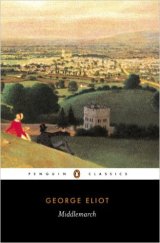
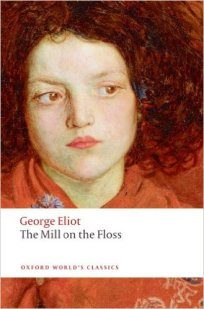 Because of the Thanksgiving holiday on Monday, my graduate seminar didn’t meet this week. If only Eliot had written her novels in a different order, we could have used that extra time for reading through Middlemarch — always the book for which I like to allow the most weeks because it demands and rewards such luxurious patience. But we are only on The Mill on the Floss, so instead we just delayed our discussion of the second half. Not that The Mill on the Floss doesn’t also demand and reward patient reading! In fact, rereading it has been one of the best parts of the past couple of weeks for me. It still absorbs me, especially as we rush towards the final catastrophe in Books VI and VII. I hope the students feel the same way.
 Today in our smaller tutorial my group will be reading a story that is equally artful but far more subtle: Kazuo Ishiguro’s “A Family Supper.” Here, I think, we will have to work much harder to move past our initial impressions of what the story is about, of what details in it are significant and how they add up. Ishiguro is a master of understatement but also of moods and shadows. Despite its innocuous-seeming title, “A Family Supper” has an atmosphere of menace from the opening account of the poisonous fugu fish, and the title itself starts to seem less and less innocent as we learn first of the death of the narrator’s mother (at another seemingly-innocuous supper) and then of a father who killed himself and his whole family to escape the dishonour of his failed business. There isn’t much overt action in the story, and the ending especially feels like an anti-climax. With Ishiguro, though, the conflicts tend to shimmer around the characters, to be represented as much by what they don’t say or do as by what they actually say or do.

 Novel Readings