 Technically, this post should really be called “This Week For My Classes,” since of course I’m not actually teaching any right now. In between other projects, though (mostly finishing a small essayish review of Mary Balogh’s Only Beloved for the next issue of Open Letters — yes, that’s right, I am trying my hand at writing a little bit about romance, thoughtfully, I hope, yet while avoiding the pitfalls of the dreaded “romance think piece”) I am chipping away at preparations for next year’s offerings, particularly the one completely new class, which is the “Pulp Fiction” one. I think I’ve reached some key decisions about it that will help me focus that preparation better as the summer goes on.
One thing I’ve decided is to stop worrying about the problem that it’s called “Pulp Fiction” but clearly described in the official Calendar as an introduction to genre fiction. I think it’s the title that’s kind of misleading, but it was chosen (presumably) to be catchy. I’m just going to approach the course as in introduction to popular genres, which will in some cases involve talking about actual “pulps” as part of the literary-historical context, but which frees me from worrying about whether the texts I assign are actually pulpy. It’s an introductory writing course primarily, after all: I don’t have to wrestle with definitions or theories the way I would if this were a graduate seminar, or even an upper-level lecture class.
 Following on that simple (if somewhat shoulder-shrugging) conclusion, I have decided not to spend a lot more time shopping for possible main texts to assign but just to call it for the ones that are my top candidates at this point, so that I can think about how to frame and teach them in particular (and what shorter texts to use to supplement them). So that means (I think – I haven’t actually placed the order with the bookstore yet) True Grit to represent Westerns, The Maltese Falcon for crime fiction, and Lord of Scoundrels for Romance. Valdez is Coming was another really appealing option for a Western (the only other one I seriously considered was Hondo, and I couldn’t finish it, which is a bad sign for teaching it with conviction) — but I enjoyed the subversiveness of True Grit so much that I’m just going to go for it. I’m 99% sure Elmore Leonard will be represented on the syllabus through one of his short stories, probably “3:10 to Yuma.” I went back and forth between The Maltese Falcon and The Big Sleep, and my decision is a bit arbitrary — I’ve been doing The Big Sleep in the mystery class the last few years, for one thing, but also I think Hammett’s blunter style and story will be better for a first-year class. Ever since I offered to do this class, Lord of Scoundrels has been my pick to represent romance.
 I’ve been looking at the syllabi for two of my colleagues who’ve taught this class recently and one thing that struck me is how many more readings they included. My big three won’t be my entire reading list, of course, but apparently I just take things more slowly than they do — they both typically take one week per novel, for instance (not super-long novels, but including, for example, King Solomon’s Mines, which is 300+ pages in the Penguin edition, or Frankenstein, which is around 200 pages). Looking at their schedules, I wondered if I should try to fit more in, so I did up a version of the timetable with Lady Audley’s Secret added — but unless I sped everything up more than I’m comfortable with, that meant leaving out most of the short fiction I’d included. In the end I think I’d rather allow lots of time to talk about particulars (and also take up class time with writing instruction, editing workshops, and that kind of thing — which I’m sure my colleagues do too, but I’m not sure how they manage to get it all done and still have robust discussions of so many complex readings). Pacing is one of the many mysteries of pedagogy, of course: there is no right rhythm, and what works depends on your own style as well as the purposes of the class. I usually spend three weeks on Middlemarch when I teach it in the 19th-century fiction class, but we take five weeks on it in Close Reading — and it would certainly be possible to take an entire semester for it, if only there were such a course (or, if only I dared to offer such a course and anyone actually took it!). Anyway, I reverted to a schedule with just three full-length novels, with short stories interspersed, and for now I like the looks of it. I can always order a fourth book later on if I change my mind. In the meantime, with the main titles chosen, I can set some parameters for my preparatory research.
 I have done a few more small things for teaching prep too: I began adjusting the plans for my two fall courses — both of which I’ve taught a few times before — to fit the university’s revised fall schedule (which includes a week-long fall reading break for the first time), and I’ve started poking around on our new Learning Management System, Brightspace. So far I don’t like Brightspace at all, mostly because we seem to have chosen the version that doesn’t let us customize any of it, even the colours. That takes a lot of the fun out of it! Obviously the real purpose of these things is utilitarian, but the more you restrict what I can do with it, the more inclined I am to use it as a document dump and nothing else. People who’ve been using Brightspace for a while tell me they like it better than Blackboard, though, so I’m trying to stay optimistic that in ways I haven’t yet discovered, it’s actually an improvement and not just a change.
 Where does the time go? It seems like I only just finished reading
  I have also been reading, in dribs and drabs, the critical books I’ve collected about romance fiction and Westerns, taking some first steps towards prepping for next winter’s ‘Pulp Fiction’ class. I have been enjoying the new ideas and frameworks raised by these materials, and they have started a lot of things turning around in my head. But since I haven’t been working on them in a very concentrated way this week I haven’t felt I had anything in particular to say. I’m sure I will! And I have also been kicking around, in a very preliminary way, how I might organize the course, and especially the readings. I am puzzling, for instance, about whether it would work to assign only full-length novels in a first-year course. I have taught many different incarnations of our introductory classes, but every one has included some blend of short and long readings. Short ones, of course, have many advantages when you’re working with beginning students: they can get the whole thing read reasonably quickly and you can begin to practice the analytical skills you want them to learn with material they can easily manage. Then you can build up to longer texts. In some of the genres we’ll cover (detective fiction, for instance) it is easy enough to find good short options, but this seems harder to do with romance. (I found one that I think might work quite well — Liz Fielding’s “Secret Wedding,” which is cleverly metafictional about romance conventions — but it seems to be available only in a Kindle edition, and I’m currently stumped about whether that rules it out as a required reading.) I’ve also been thinking about starting with some Victorian ‘pulp,’ specifically Lady Audley’s Secret — but I’m worried that they might bog down in it, especially if it’s the first thing we read. You can look forward to (or dread, I guess) many more updates as my thinking about this course develops. And, as always, I will welcome input!
 Classes ended last Wednesday, and I held my first final exam at 8:30 the following Saturday morning. That seemed hasty to me! Students have a lot going on at the end of term, and two days isn’t much time for them finish other assignments, regroup, and rest up a bit. On the bright side (for me, at least) I don’t have another exam until next Tuesday, so this has given me plenty of time to get that first batch graded. Since the only thing I have left to do for my other exam is copy it, I have a nice little window to sort out my own end-of-term mess and start organizing — literally and mentally — for my summer reading and writing projects. I spent some cheerful time this afternoon filing papers, reorganizing my bookshelves, and reflecting on the year that was.
 Often at the end of term I am full of resolutions about things I will do differently next time. One thing I am almost certain I’m going to change is my use of reading journals in the 19thC Fiction course.
  I have been very glad to see eloquent and well-informed responses to Ron Srigley’s screed “Pass, Fail” in The Walrus (which largely reiterates his screed in the Los Angeles Review of Books). I was disappointed in both venues, frankly: it seems to me to show poor editorial judgment to publish rants of this kind without checking their intemperate anecdata and wild generalizations against at least a broader sampling of facts and opinions about the very complex business that is higher education. I would have expected both journals to think better of themselves and their readers. Both
  But then I realized that I have said so, that I have made my argument — over and over, for almost 10 years. Here at Novel Readings I have posted regularly about my teaching, for instance, since 2007, when I began my series on
 Not for them — for me!
 Another reason teaching is a tonic for me, though, is precisely that I am not faking my interest in the course materials, and time spent really focusing on them brings me back in touch with the things that brought me into this profession in the first place. I loved being an English student myself (well, I loved being an undergraduate student – I mostly hated being a graduate student), and it’s in the classroom that the reasons for that are most present to me: the books themselves, of course, but also the open-minded engagement with them — teasing out what is most interesting, looking at the details and trying to put them into patterns that illuminate the whole, thinking and talking about the ideas that animate them, and all this, best of all, in conversation with other keen readers who bring their own questions and ideas to the process. This week’s readings are very purposeful, too, which gives our work on them extra urgency: in Mystery & Detective Fiction, we’ve just wrapped up
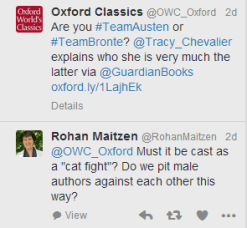 I got a bit snippy with the tweeters from Oxford World’s Classics a couple of days ago. Poor things: they were just doing their job, spreading some news about great books and trying to get people to click through and read it. How could they know that I was already feeling grumpy, for reasons quite beyond their control, and that this particular gimmick pushes my buttons on a good day?
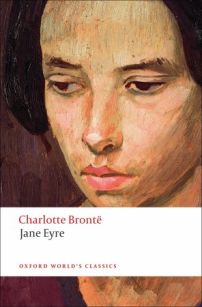 But (and you knew it was coming, right?) if for some absurd reason I absolutely had to choose, not which novelist is in any absolute sense “the greatest” but whose team to play on, it would be Brontë all the way — and I say that having only just enjoyed Pride and Prejudice entirely and absolutely for about the 50th time. We’ve just started working our way through Jane Eyre in the 19th-century fiction class and what a thrill it is. I know it’s a cliche to associate the Brontës with the moors, but it does feel as if a fresh, turbulent breeze is rushing through, stirring things up and bringing with it a longing for wide open spaces. The freedom and intensity of Jane’s voice, the urgency of her feelings, and of her demands — for love, for justice, for liberty — it’s exhilarating! I brought some excerpts from contemporary reviews to class today to demonstrate the shock and outrage with which some 19th-century critics received the novel: it’s striking how much the very qualities that enraged and terrified them are the same ones that make so many of us want to cheer Jane on. By the end we know that we should not have allied ourselves so readily with Jane’s violent rebellion, and we may even be equivocal about the conclusion to her story, but I think it’s impossible to read the novel and not be wholly caught up in her fight to define and then live on her own terms.
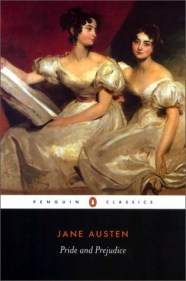 I started rereading Emma recently and had to put it aside. I appreciate that it is aesthetically and morally complex and infinitely nuanced, but I felt smothered by it: I found it claustrophobic. Brontë’s criticism of Austen is well known: she told G. H. Lewes that in Pride and Prejudice she found only “an accurate daguerrotyped portrait of a commonplace face; a carefully fenced, highly cultivated garden, with neat borders and delicate flowers; but no glance of a bright vivid physiognomy, no open country, no fresh air, no blue hill, no bonny beck. I should hardly like to live with her ladies and gentlemen,” she went on, “in their elegant but confined houses.” I think she underestimated the novel — a lot of people do, still, who see just the delightful characters moving on the surface and not the currents of social and historical change carrying them along. I’m also sure that my trouble with Emma is about me, not Austen. But I understand Brontë’s reaction, and it is just the one you would expect, too, from the author of such an entirely different book, one that opposes itself in every way to both literal and mental confinement. I think that’s why Jane Eyre refreshes my soul: it rushes with us out into the hills. Jane is so defiant, so passionate, so forthright: she speaks up so fearlessly, for herself and for the right! I wish I could always do the same: I admire her principles and envy her courage. So much as I would miss Elizabeth Bennet if for some reason I had to give her up, Jane’s the one I really couldn’t do without.
 Thanks to Dalhousie benefactor
  In 19th-Century Fiction, we focused today on Chapter 53, “
 I got to do an extra class this morning, making a guest appearance in a colleague’s first-year seminar. I say “got to” because although it was extra work, it was of a particularly pleasing kind, as she asked me in to speak on the role of “Dover Beach” in Ian McEwan’s Saturday. I taught the novel myself an astonishing (to me) nearly 10 years ago, so I had some notes to draw on but, oddly, none specifically on the scene with “Dover Beach,” so that left me some work to do! I am
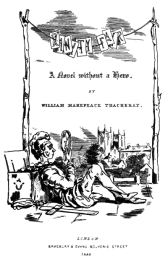 Teaching Vanity Fair is always a morally significant experience: it prompts so much reflection on what really matters, both in the world you actually live in, and in the world you wish you lived in.
  Novel Readings